He Called His Ex-Wife “Barren” and Laughed at the Gala… Then She Took His Entire $80 Billion Company
He was a titan of industry, a man who owned the New York skyline.
She was his new glittering prize of a wife.
And standing before them in the middle of the most exclusive gala of the year was the woman they had both discarded.
The ex-wife.
What started as a whisper ended as a gunshot.
The new wife mocked the ex-wife for the one thing she never had—a child.
But as the billionaire husband laughed along, a laugh that echoed off the marble walls, he made the biggest mistake of his life.
He didn’t just humiliate his ex-wife.
He unleashed her.
He forgot who she really was.
And in doing so, he just handed her the keys to his destruction.
The air at the Metropolitan Museum of Art wasn’t just air.
It was a pressurized substance thick with the scent of old money, new ambition, and a thousand blooming peonies.
The annual Pendleton Foundation gala was the undisputed crown jewel of the New York social scene.
To be invited meant you were someone.
To be ignored meant you were everyone else.
Eleanor Vance, for the first time in six years, was someone again.
She had arrived alone.
Her name was a quiet addition to the guest list, secured not by her past connection to the man whose name was carved into the museum’s new wing, but by her own quiet multimillion-dollar donation.
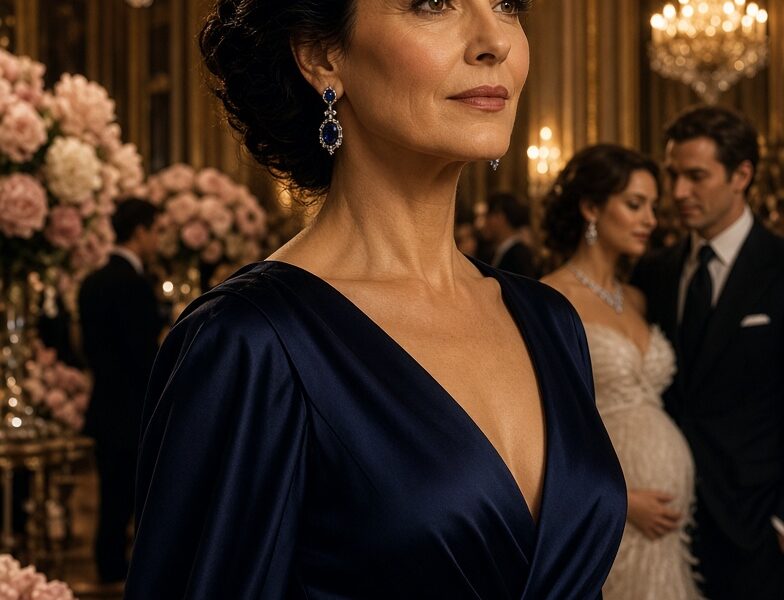
She wore a simple midnight-blue gown by a designer no one had heard of yet.
Her only jewelry was the vintage sapphire earrings her grandmother had left her.
She was elegant, understated, and completely invisible—until she wasn’t.
Arthur Pendleton, her ex-husband, held court by the Temple of Dendur, a bronze pharaoh in a custom Tom Ford suit.
On his arm was Seraphina Duval, his new wife of six months.
Seraphina was a whirlwind of blinding white feathers and Harry Winston diamonds, her every movement calculated for the Vogue photographers.
Eleanor had tried to avoid them.
She had made her donation, exchanged pleasantries with the museum curator, and was planning a quiet exit.
But Seraphina had spotted her, like a panther spotting a thorn.
Her eyes narrowed, and a cruel, beautiful smile spread across her face.
She glided over, dragging Arthur with her.
“Eleanor, I almost didn’t recognize you. You look so simple. It’s brave.”
Eleanor inclined her head. “Seraphina. Arthur.”
“Arthur, darling, isn’t she brave?” Seraphina cooed, her hand drifting down to rest protectively on her own slightly rounded stomach—a new development that had been splashed across Page Six that very morning.
Arthur, for his part, looked bored. “Eleanor. Good of you to contribute.”
The air crackled.
Seraphina leaned in, her voice dropping to a conspiratorial hiss, yet pitched just loud enough for the small circle of donors and reporters nearby to hear.
“I just feel so blessed,” Seraphina said, her hand caressing the bump. “To be able to give Arthur what he’s always deserved. A legacy. An heir. It’s the most important thing a woman can do, don’t you think?”
Eleanor’s face remained a mask of polite indifference. “I think there are many ways to build a legacy, Seraphina.”
Seraphina laughed, a tinkling, brittle sound. “Oh, of course. For those who can’t do it the natural way.”
She looked Eleanor up and down, a performative flicker of pity in her eyes.
“It must be so quiet in your life. All that time, all that money, and no little ones to show for it. Such a shame you could never give him this.”
She paused for effect. “Some women are just incomplete.”
The words hung in the air, a deliberate, venomous strike.
The small circle of onlookers held their breath.
They all knew the story—or the story Arthur had fed them.
The tragic, barren first wife.
Eleanor’s eyes didn’t go to Seraphina.
They locked onto Arthur.
She was waiting for him—the man she had known for two decades, the man she had built, the man she had protected—to shut this down, to show an ounce of decency.
Arthur Pendleton met her gaze.
A flicker of something in his eyes. Annoyance? No—it was recognition.
And then he did the one thing that sealed his fate.
He chuckled.
It was a small sound, a dismissive, patronizing huff of air.
He wrapped his arm around Seraphina’s waist, pulling her close.
“Be nice, darling,” he murmured loud enough for all to hear. “It’s not her fault. She’s barren.”
The word barren echoed.
It wasn’t a whisper. It was a judgment.
The small crowd visibly relaxed.
The king had spoken.
The joke was sanctioned.
The ex-wife was fair game.
But Eleanor Vance didn’t cry.
She didn’t flush with shame.
A strange, glacial calm settled over her.
The hurt that had lived in her chest for years didn’t just fade.
It crystallized.
It turned from a dull ache into a diamond-hard point.
She looked at Seraphina—the vapid, cruel girl who thought she’d won.
Then she looked at Arthur—the man who had just confirmed he was a coward.
She smiled, a tiny, cold smile that didn’t reach her eyes.
“You will regret that laugh, Arthur,” she said, her voice clear and low, cutting through the murmurs. “Both of you.”
She didn’t wait for a response.
Holding her head high, she turned and walked away, her simple dress flowing behind her like a queen’s robes.
She walked past the Vogue reporter, Eliza Dunn, who was scribbling furiously in her notebook, having forgotten the fashion entirely.
Arthur Pendleton watched her go, a flicker of unease beneath his bravado.
But Seraphina just laughed again, louder this time.
“What’s she going to do? Write a sad poem about it?”
In his arrogance, Arthur had forgotten the first rule of his own success.
Eleanor Vance never bluffed.
And she never, ever lost.
The drive back to her penthouse on Central Park West was silent.
Her driver, a man who had been with her for ten years, knew better than to ask if she’d had a nice evening.
Eleanor didn’t go to bed.
She walked into her home office, a room that overlooked the park, its walls lined not with art but with framed architectural blueprints and patents.
She poured a single glass of Macallan 25, sat in her leather chair, and let the mask fall.
The tears that came weren’t for the insult.
They were for the fool she had been.
Barren.
The word was a lie—a thick, suffocating blanket of a lie she had woven herself.
A lie she had agreed to wear like a shroud to protect him.
Her mind flashed back twelve years.
They weren’t Arthur Pendleton, the Titan, and Eleanor, the quiet wife.
Then they were just Arthur and Ellie, working out of a rented garage in Palo Alto.
He was the salesman, the visionary with the million-dollar smile.
She was the brains.
Eleanor Vance wasn’t just a socialite.
She held dual degrees from MIT in structural engineering and computer science.
The core technology that Pendleton Industries was built on—a revolutionary biosynthetic material that was now in everything from skyscrapers to military aircraft—wasn’t Arthur’s.
It was hers.
It came from her graduate thesis.
He had convinced her to put the company in his name.
“It looks better,” he’d said. “A strong frontman. We’re a team, Ellie. What’s mine is yours.”
She had believed him.
And as the company exploded, she had retreated, letting him take the credit.
She loved the work, not the spotlight.
Then came the desire for a family—or, more accurately, Arthur’s desire for an heir.
They tried for two years.
Nothing.
Then came the appointments, the sterile white rooms of fertility clinics, the invasive questions, the pitying looks from nurses.
Eleanor’s mind pinpointed the exact moment the lie began.
A sterile office on Park Avenue.
Dr. Evelyn Reed, the top reproductive endocrinologist in the country, held the folder with the test results.
Dr. Reed hadn’t looked at Eleanor.
She had looked at Arthur.
“The test results are conclusive,” Dr. Reed had said, her voice gentle. “Mrs. Pendleton, your fertility is perfectly normal. Excellent, in fact.”
Arthur had beamed a self-satisfied “I knew it” look—until the doctor continued.
“Mr. Pendleton, the issue is not with your wife. Your tests show extreme complications. Azoospermia. Zero viable count. It’s congenital.”
She had paused.
“To be clear, Mr. Pendleton, you are biologically sterile. You cannot have children. You never could.”
Eleanor remembered the silence—the sound of the clock on the wall ticking, ticking.
She had felt relief.
It wasn’t her.
After years of feeling like a failure, it wasn’t her.
But Arthur had shattered.
His arrogance, his swagger—it all crumbled.
He didn’t see a medical diagnosis.
He saw an invalidation.
“That’s impossible,” he’d hissed. “Your test is wrong. Run it again.”
“We ran it three times, Mr. Pendleton.”
“This cannot get out,” Arthur had stammered, his face pale. “My father, my board. They see me as weak. This would ruin me. A Pendleton who can’t produce an heir. It’s a joke.”
Eleanor had watched the man she loved dissolve into a paranoid, terrified boy.
He had looked at her, his eyes pleading.
“Ellie, please. No one can know. This will destroy the company. It will destroy us.”
And in that moment, she had made the choice that would define her life.
She had taken his hand.
“They won’t know,” she’d said. “It’s me. I’ll be the one. I’m the one who can’t.”
She had sacrificed her reputation, her truth, her very identity to protect his fragile ego.
For the team.
Their divorce years later was a quiet, amicable affair.
The narrative was already set.
Arthur desperately wanted a family, and poor barren Eleanor couldn’t give him one.
He had been generous in the settlement—but the settlement was the second lie.
Eleanor hadn’t wanted his money.
She had wanted her freedom.
But she wasn’t a fool.
She had leverage.
The original patents for her biosynthetic technology.
She had agreed to license the core patents to Pendleton Industries for a nominal fee.
The license was tied inextricably to a 20-page, ironclad non-disclosure and non-disparagement agreement.
He could never speak of her.
She could never speak of his condition.
He paid her to be quiet.
He paid her to take the blame.
And tonight, with one laugh, one word—barren—in front of a Vogue reporter, he had broken the one-sided contract.
Eleanor finished her scotch.
The ice clinked in the empty glass.
The hurt was gone, replaced by a cold, calculating fury.
He hadn’t just mocked her.
He hadn’t just called her barren.
He had set her free.
She picked up her phone and dialed a number.
It rang once.
“Marcus,” she said, her voice steady. “It’s Eleanor. Wake up. We have work to do.”
Seraphina Duval Pendleton admired her reflection in the black mirror surface of her penthouse elevator.
The diamonds, the dress, the pregnancy glow.
It was all perfect.
She had won.
She had taken down the ghost of Eleanor Vance.
She swept into their sprawling apartment, kicking off her Louboutins.
Arthur was already at the bar pouring a stiff brandy.
“Well, that was fun,” Seraphina trilled, kissing his cheek. “Did you see the look on her face? I thought she was going to turn to dust.”
“You laid it on a bit thick, don’t you think?” Arthur grumbled, not looking at her.
The unease he’d felt at the gala was growing.
Eleanor wasn’t reactive.
Her quiet “You will regret this” felt less like a threat and more like a weather forecast.
“Nonsense, darling,” Seraphina said, running her hands over his shoulders. “She needed to be put in her place. Everyone needed to see that I am the present, and she is the pathetic past. I am the one giving you a son. The Pendleton heir.”
Arthur softened, his hand going to her stomach. “The heir. Yes. That’s all that matters.”
Seraphina smiled, but it was a wolf’s smile.
She wasn’t just a trophy wife.
She was an opportunist who had been waiting her whole life for a score this big.
But her victory was built on a lie far more dangerous than Eleanor’s.
Seraphina was pregnant.
But the child wasn’t Arthur’s.
The real father was currently sitting on the board of Pendleton Industries, watching his cousin with a hungry patience: Julian Pendleton.
Arthur’s younger, sharper, and far more ruthless cousin.
Seraphina’s affair with Julian had started six months before she’d even met Arthur.
Julian was her long-term plan.
Arthur was just the shortcut.
The plan was simple and brutal.
Julian knew Arthur’s secret.
He’d been digging for years, looking for leverage, and he’d found a disgruntled former assistant who remembered the hushed-up medical crisis years ago.
He’d suspected sterility.
“You’re the Trojan horse,” Julian had told her in a stolen moment at their Hamptons estate. “Get him to marry you. Get pregnant with my child. He’ll be so desperate for an heir, he’ll never question the timeline. He’ll announce it to the world. And once he does, he’s trapped.”
The plan was for Seraphina to discover Arthur’s infertility after the baby was born, declare the child a miracle from a sperm donor she’d used in desperation, and paint Arthur as a monster for lying to her.
In the ensuing chaos, Julian would trigger a no-confidence vote at the board, using Arthur’s fraud as leverage, and take over the company.
The baby—his baby—would be the true Pendleton heir.
And he and Seraphina would control the entire fortune.
But tonight, Seraphina had gotten cocky.
The gala, the public humiliation of Eleanor—that had been her idea.
A spontaneous, petty power play.
“She’s irrelevant, Arthur,” Seraphina insisted, topping up his glass. “She’s a sad, childless woman who designs buildings or whatever. She’s nothing. We are everything.”
Arthur drank, the brandy burning his throat.
He wanted to believe her.
He needed to believe her.
He had built his entire identity on being the strong one, the fertile one, the king.
Eleanor’s quiet sacrifice had been the foundation of his empire.
He had just taken a sledgehammer to it.
Meanwhile, across town, Seraphina’s phone buzzed.
A text from a blocked number.
“You idiot. You didn’t just poke the bear. You poked the dragon. This wasn’t the plan. Fix it.”
It was from Julian.
Seraphina’s blood ran cold.
She looked at Arthur, who was now staring out the window, lost in his own insecure thoughts.
She’d thought she was playing him.
But as she stood there in her million-dollar dress, a chill settled over her.
What if Eleanor wasn’t the only ghost in this penthouse?
What if, in her haste to win a small, petty battle, she had just started a war she was not equipped to fight?
She had wanted to be the queen.
She was beginning to suspect she was just a pawn.
“He didn’t just breach the contract, Marcus. He voided it.”
Eleanor sat in the glass-walled conference room of Marcus Thorne’s law firm, Cravath, Swaine & Moore.
It was 3:00 a.m.
The table was littered with a copy of her original licensing agreement, her divorce settlement, and a single grainy cell phone video of the gala incident already circulating on gossip blogs.
Marcus Thorne, a man who charged $2,000 an hour and was worth every penny, pressed a button.
A large screen lit up, showing the video.
“Seraphina: ‘Some women are just incomplete.’ Arthur chuckles. ‘Not her fault. She’s barren.'”
Marcus, a man who had seen corporate titans eviscerated over a single misplaced comma, steepled his fingers.
“He said the word barren in public, in front of Eliza Dunn of Vogue, no less. It’s a clear-cut violation of Section 4, Subclause A—the non-disparagement covenant.”
“Exactly,” Eleanor said, her voice devoid of emotion. “And Section 12, Clause C. What does it say?”
Marcus read: “‘A breach of the non-disparagement covenant by either party renders all associated agreements, including the Pendleton-Vance Patent License Agreement of 2018, null and void at the discretion of the non-breaching party.'”
He looked up, the full weight of her words hitting him.
“Eleanor, the Pendleton-Vance patent license. That’s not just a patent. That’s the patent. The Vance Synth material. It’s the foundational technology for 92% of Pendleton Industries’ product line.”
Eleanor stated it as if commenting on the weather.
“It’s the material in their new Aegis line of military defense contracts. It’s the core of their entire $80 billion valuation.”
Marcus leaned back. “My God, Eleanor. You licensed it to him for what?”
“For $1 a year. And his silence. And he just—with a laugh—gave it all back to me.”
Marcus started to pace, his mind buzzing.
“He didn’t just call you a name, Eleanor. He just committed corporate suicide. What do you want to do?”
This was the moment she could sue him for damages, take a massive payout, ruin him in the press.
But Eleanor wasn’t interested in his money.
She was interested in her work.
“When we divorced,” Eleanor said, “I took a small settlement. But I also started a new, quiet company. Vance Technologies. It’s been operating in stealth mode for five years. I’ve been improving the patent. I’ve created Vance Synth 2.0. It’s 50% stronger, 30% lighter, and 100% owned by me.”
Marcus stopped pacing. “Eleanor, what are you saying?”
“Arthur’s company is built on an obsolete product. He just doesn’t know it yet. And as of 9:00 a.m. this morning, he no longer has the license to even use that.”
She slid a document across the table.
“I don’t want to sue him for money, Marcus. I want to acquire.”
Marcus read the document.
It was a proposal—a hostile takeover bid.
“You’re going to use the patent violation to force a default,” he whispered, the audacity of it dawning on him. “You’re not going to sue him for damages. You’re going to claim the assets built on your stolen IP. You’re going to—you’re going to take the whole company.”
“Not the whole company,” Eleanor said, standing up and walking to the window.
The sun was just beginning to tint the New York sky purple.
“The whole company is bloated, inefficient, and built on his ego. I just want the Aegis Defense Division, the R&D labs—the parts that were mine to begin with.”
“He’ll fight,” Marcus warned. “The board will fight.”
“Let them,” Eleanor said, her reflection staring back at her in the glass. “They’re about to find out their entire empire is built on a foundation that I am about to revoke. Send the first letter at 8:00 a.m. A cease and desist to all Pendleton Industries factories, effective immediately, for patent infringement. That will shut down their global operations.”
“The stock will—”
“Yes, it will,” Eleanor said.
“And a second letter,” she continued, “to the board of directors. An emergency meeting tomorrow. Tell them Ms. Vance has a proposal to save them from the ruin their CEO just caused.”
Marcus looked at the woman before him.
This wasn’t the quiet, barren ex-wife the world thought they knew.
This was an architect—and she had just drawn up the blueprints for the most brutal, elegant execution he had ever seen.
“He shouldn’t have laughed, Eleanor,” Marcus said.
“No,” Eleanor agreed, watching the city wake up. “He shouldn’t have.”
The first tremor hit at 9:01 a.m.
Arthur Pendleton was in his private gym when his phone began to vibrate so violently it nearly fell off the treadmill.
He ignored it.
It was his COO, Robert.
Robert could wait.
The second tremor hit at 9:15 a.m., when he walked onto the trading floor of his own company.
The atmosphere was a tomb.
The massive ticker on the wall, usually a sea of green, was a waterfall of blood red.
PDN -22.50.
PDN -31.75.
PDN -40.10.
“What the hell is going on?” Arthur roared, grabbing the nearest analyst.
“We don’t know, sir,” the young man stammered. “A cease and desist just hit the wire. All our manufacturing plants—China, Germany, Texas—they’re shutting down. It’s a patent dispute. The stock—it’s in free fall.”
“Patent dispute with who?”
“That’s the thing, sir,” the analyst said, his face white. “The filing—it’s from Vance Technologies. We don’t know who that is.”
But Arthur did.
He didn’t run to his office.
He teleported.
He slammed the door, his hands shaking.
Vance.
It couldn’t be.
She didn’t have—she wasn’t—
His private line rang.
It was Marcus Thorne.
“You can’t do this, Eleanor!” he bellowed into the phone, skipping the pleasantries. “This is insane. You’ll destroy us. You’ll destroy yourself. Your stock is tied to this.”
Marcus Thorne’s voice was impossibly calm.
“Good morning, Arthur. I’m afraid Ms. Vance is no longer a shareholder. She divested her remaining shares over six months ago at peak value. Smart. It’s as if she knew an unstable element might compromise the company’s integrity.”
“You—you—” Arthur couldn’t breathe. “She’s—she’s bluffing. It’s a shakedown. How much does she want? $10 million? $100 million?”
“Ms. Vance is not interested in your money, Arthur. She’s interested in her property. The cease and desist is real. You have 24 hours to halt all production using her intellectual property—which, as I recall, is all of it—or the federal marshals will do it for you.”
“She can’t! That license—it was ironclad!”
“It was,” Marcus agreed pleasantly, “until you stood up at a party full of reporters and breached the non-disparagement clause, calling your ex-wife barren. Tsk tsk. Not just cruel, Arthur. Catastrophically expensive. The board has been notified. They’ll be meeting tomorrow at 10:00 a.m. I’d advise you to attend.”
The line clicked dead.
Arthur slumped into his chair.
Barren.
One word.
One laugh.
The third tremor hit at noon.
Eliza Dunn’s piece for Vogue dropped online.
It wasn’t a gossip column.
It was a character assassination.
It was titled “The King’s Laugh: How Arthur Pendleton’s Hubris Just Cost Him an Empire.”
It didn’t just report the insult.
It analyzed it.
It painted Seraphina as a cheap, cruel usurper.
It painted Arthur not as a king but as a weak, pathetic man who hid behind his new wife’s skirts while he mocked the woman who had built his kingdom.
It recontextualized everything.
Suddenly, all the old barren-wife stories looked like what they were: a misogynistic smear campaign.
By 2:00 p.m., PDN stock was halted.
The company had lost 40% of its value.
Billions wiped out.
The fourth tremor was personal.
He stormed back to the penthouse.
Seraphina was in the lounge on the phone with her publicist, screaming.
“What do you mean Vogue won’t take my call? I’m—I’m—”
“Get out.”
Arthur whispered, his voice shaking with a rage so cold it terrified her.
“What?”
“Arthur, darling, it’s—it’s just a silly article—”
“You,” he said, advancing on her. “This was you. Your petty, stupid performance. You just had to poke her. You just had to win.”
“I was defending you!” Seraphina shrieked, backing away.
“You weren’t defending me. You were lighting a forest fire. Do you have any idea what she’s done?”
He grabbed a priceless Ming vase—one Eleanor had bought—and hurled it against the wall.
It shattered.
“She—she’s suing us,” Seraphina whimpered.
“Worse!” he roared. “She’s not suing us. She’s—she’s revoking.”
He didn’t even understand the full scope of it, but he knew it was bad.
“The patents, the company, it’s all—it’s all tied to her.”
Seraphina’s mind raced.
Julian. The plan.
This was too soon.
This was all wrong.
“The baby,” she tried, her hand going to her stomach. “Arthur, the stress, the heir—”
“I don’t give a damn about the heir!” he screamed. His face was purple. “What good is an heir if he’s inheriting nothing?”
He grabbed her arm. “You’re going to fix this. You’re going to call her. You’re going to apologize. You’re going to beg.”
Seraphina looked at him—at this pathetic, broken man.
Her one anchor, his power, was gone.
And in its place was a terrified bully.
She just stared at him, her own panic rising.
The plan was in ruins.
Julian hadn’t texted her back in hours.
The man who had laughed 24 hours ago was gone.
The man in front of her was crying.
The boardroom on the 80th floor of Pendleton Tower was a cathedral of glass and fear.
The longtime board members—ancient titans of industry, tech billionaires, retired generals—were assembled.
There was an empty seat at the head of the table.
Arthur sat to the right, looking like he had aged 20 years.
Seraphina was nowhere to be seen.
Julian Pendleton sat at the far end, his face a perfect, unreadable mask.
“This is an outrage,” Arthur blustered, though his voice was thin. “A marital dispute. She’s a bitter woman.”
“She’s a woman who just cost us $30 billion in eight hours,” Arthur growled.
General Hastings, a man who ran the Aegis Defense Division, spoke up. “I’ve got a call from the Pentagon screaming about national security. Our contracts are frozen. Explain that.”
“I—we are negotiating—”
The doors at the far end of the room swept open.
Eleanor Vance entered, flanked by Marcus Thorne and a team of forensic accountants.
She wore a white, razor-sharp pantsuit.
She looked like an avenging angel.
“Ms. Vance,” General Hastings said, standing up. “You are not on this board.”
“She’s not,” Marcus Thorne said, his voice filling the room. “But her new company, Vance Technologies, is. As of this morning, Vance Technologies has acquired a 30% stake in Pendleton Industries, purchased on the open market at a significant discount. She is now the largest single shareholder. She has a right to be here.”
The board stared.
Arthur looked like he was going to be sick.
“Good morning, gentlemen,” Eleanor said, her voice cool and clear.
She took the empty seat at the head of the table.
Arthur’s seat.
“Let’s dispense with the pleasantries,” she said. “Twenty years ago, I invented a material called Vance Synth. I allowed Mr. Pendleton to build a company around it, in his name, in exchange for his silence on a delicate personal matter.”
She paused, and her eyes found Arthur’s.
“He broke that agreement. He called me barren at a party,” Eleanor said, and for the first time, every person in that room heard the story from her side. “A term he knew to be false. A lie he created. A lie I carried for him for fifteen years to protect his ego. His condition.”
The board was silent.
“Condition?” whispered one member.
“Arthur Pendleton is, and always has been, sterile,” Eleanor stated flatly.
The gasp in the room was deafening.
Arthur was exposed.
The king was not just naked—he was a fraud.
“Which,” Eleanor continued, her gaze sweeping the table, “brings us to a fascinating secondary problem.”
Her eyes landed on Julian.
And then, for the first time, she acknowledged the elephant in the room.
“Seraphina,” she said, though the woman wasn’t there. “His new wife, who is, according to Page Six, pregnant.”
The room went from silent to a black hole.
Arthur’s head snapped up.
He looked at Julian.
Julian just smiled.
The board members—men who lived and died by calculation—all did the math at the same time.
Sterile man plus pregnant wife.
“It seems,” Eleanor said, “that Mr. Pendleton’s legacy is not his own.”
Arthur looked at Julian.
The betrayal—the full betrayal—finally landed.
The affair. The baby. The stock. It was a coup.
“Julian, you—” Arthur choked out.
Julian finally spoke. “It was a good plan, Arthur. But you got sloppy. You let your ego get in the way.”
“So,” Eleanor interrupted, reclaiming the room. “Here is the situation. Your CEO is a fraud. His heir is an impostor. And your entire company is guilty of mass patent infringement. As of now—”
She clicked a button.
The main screen lit up.
“This,” she said, “is Vance Synth 2.0. It’s the technology I’ve been perfecting. It’s what the market really wants. It makes the material you’re all using obsolete.”
She offered them a choice.
“Option A. You do nothing. My cease and desist holds. Pendleton Industries is bankrupt by Friday. You all lose everything. I build my company on your ashes.”
She paused.
“Option B. You vote right now. You remove Arthur Pendleton as CEO. You remove Julian Pendleton from the board—I don’t work with traitors. You give me a controlling interest. 51%. You make me chairwoman and CEO. In exchange, I will license Vance Synth 2.0 to this company. I will save the Aegis contracts. I will save your fortunes.”
General Hastings didn’t hesitate.
“All in favor of the removal of Arthur Pendleton?”
Every hand went up except Julian’s and Arthur’s.
“All in favor of the removal of Julian Pendleton?”
Every hand.
“All in favor,” the general said, “of instating Ms. Eleanor Vance as chairwoman and CEO?”
The vote was unanimous.
Arthur Pendleton just sat there, a hollow shell.
He had lost his company, his wife, his fake child, and his legacy.
All for a laugh.
Eleanor stood up. “Thank you, gentlemen. The new era of this company begins now. My team is securing the 80th floor. Arthur, Julian—security will escort you out.”
Eleanor walked over to Arthur, who was staring blankly at the table.
She leaned in, her voice a whisper only he could hear.
“Who’s incomplete now?”
The fallout was not a wave.
It was a tectonic shift.
The boardroom execution was so swift, so silent, and so brutal that by the time the markets reopened, the narrative was already set.
The Wall Street Journal ran a stark black-and-white headline: “Pendleton Out, Vance In: The Architect Reclaims Her Throne.”
The story, which had been fed by Marcus Thorne’s perfectly prepared press kit—complete with the original patent license and a copy of the gala’s non-disparagement clause—was not a story of gossip.
It was a story of corporate malfeasance, intellectual property theft, and the ultimate righteous correction.
The city and the world was stunned.
But for the players at the center of the storm, the end was only the beginning.
The first tremor of the new world order happened the second the vote was finalized.
Two uniformed security guards—men who had bowed to Arthur Pendleton for a decade—entered the boardroom.
They were not aggressive, but their new allegiance was terrifyingly clear.
“Mr. Pendleton. Mr. Pendleton,” the head of security, a man named Frank, said, his voice flat.
He looked not at Arthur, but at Eleanor.
She gave a single, almost imperceptible nod.
“This way, sir,” Frank said.
Arthur’s reality fractured. “This—this is my building. You—you work for me.”
“Our duty is to the board and the CEO, sir,” Frank replied, his hand gesturing firmly to the door. “And the board has made a change.”
Julian Pendleton was already on his feet.
He was a different breed of animal.
Arthur was a bully who had deflated.
Julian was a viper who had been cornered.
His face was a mask of cold, calculating fury.
He straightened his $10,000 suit, his eyes locking on Eleanor.
He said nothing, but the look was a promise of a war yet to come.
Eleanor met his gaze, unfazed.
“Your access codes were deactivated during this meeting, Julian. Your company-issued car is being returned. I’m sure you know your way to the main elevators. I’d advise against the side exit. Page Six is already there.”
She had thought of everything.
She hadn’t just beaten him.
She had humiliated him, trapping him in the same media circus he had tried to create.
Arthur was a different story.
He was a ghost stumbling from the room.
He didn’t speak.
He just walked.
The two men—the cousins, the conspirators—didn’t look at each other as they were escorted out.
The elevator ride down was silent.
Julian stared at the numbers.
Arthur stared at the floor.
When the doors opened to the grand lobby, it was a war zone.
The rumors had leaked.
A hundred camera flashes exploded.
A wall of white-hot light.
“Arthur, is it true?”
“Mr. Pendleton, have you been fired?”
“Who is Eleanor Vance?”
“Is Seraphina’s baby really Julian’s?”
The last question hit Arthur like a physical blow.
He staggered, shoving a reporter. “Get—get off me.”
Julian, meanwhile, simply melted into the chaos, a shadow disappearing into the crowd, his face a thundercloud.
But Arthur was trapped.
He was the spectacle.
He fled, shoving his way into a waiting car—one he didn’t realize was his last—and screamed at the driver to just go.
He stormed into the penthouse to find Seraphina, not in tears, but in a state of frantic, terrified packing.
Not suitcases.
She was stuffing Birkin bags with the diamonds, the watches, the bonds she kept in the safe.
“They—they kicked you out,” she stammered, her hands full of glittering necklaces. “Arthur, what—what do we do?”
Arthur looked at her, at the stolen goods, at her terrified, vapid face, and the last shred of his denial snapped.
“We?” he roared. A sound so primal it made her drop a diamond bracelet. “There is no we. You—you filth.”
“Arthur, you have to fix this. The baby—our baby—”
He advanced on her.
And for the first time, Seraphina saw not a fool, but a monster.
“I knew it. I knew it was his. You and Julian. You—you planned this. You laughed.”
She shrieked, backing away. “You were supposed to be the king. You were supposed to protect me. You were so weak. You let her—”
“That nothing?” Arthur screamed, his voice cracking. “She’s everything. She’s the company. She’s the money. She’s the heir. And you? You stupid girl. You just had to mock her.”
He grabbed her arm. “This is all your fault.”
“My fault? You’re the one who’s sterile. You pathetic old fraud.”
The word hit him harder than any camera flash.
He stopped.
The fight drained out of him, replaced by a cold, black emptiness.
He let go of her arm.
“Get out,” he whispered.
“What?”
“The lawyers? My lawyers?”
“Her lawyers now. They’re freezing everything. The accounts, the cars, this penthouse.”
He looked around as if seeing the gilded cage for the first time.
“It’s all tied to the company. It’s all hers. It always was.”
Seraphina’s blood ran colder than the diamonds in her hand.
“What? What do you mean? You’re—Arthur Pendleton. You have other money.”
Arthur just laughed.
A dry, broken, hollow sound.
The sound of a man who had just realized his entire life was a loan he could never repay.
“No, I don’t. It was all stock. It was all her.”
Seraphina’s phone buzzed.
A text from a blocked number.
“You’re on your own. Delete this number.”
Julian.
The betrayal was absolute.
She was a pawn, and the board had been cleared.
She looked at Arthur—the pathetic, ruined man.
She looked at the diamonds she could no longer sell.
She grabbed her purse, shoved her phone in her pocket, and ran.
She didn’t take the private elevator.
She took the service stairs, fleeing like the thief she was.
Her fall was swift.
The Vogue article had made her a pariah.
She was blacklisted from every event, every restaurant.
Her publicist dropped her.
Within a month, the diamonds were sold for pennies on the black market to pay for a lawyer.
The divorce was a one-sided slaughter.
Arthur, in his one final act of power, proved paternity.
The Pendleton heir was exposed as a lie.
Seraphina was last seen by a Page Six photographer, not at the Met, but at Port Authority, arguing with a bus station clerk, her face swollen from crying.
She was irrelevant.
A ghost in last year’s couture.
While the old world burned, Eleanor Vance was building.
She didn’t take a day.
She didn’t even take a breath.
Her first act as CEO was to walk into Arthur’s opulent, mahogany-paneled office.
It was a dark, suffocating room, smelling of brandy and ego.
“Remove all of it,” she told an assistant. “The desk, the paintings, the carpet. I want glass, steel, and light. I’ve had enough of shadows.”
By noon, General Hastings, the gruff ex-military man from the board, was in her new, sparse office.
“Ma’am,” he said—the word new and cautious on his tongue. “The Pentagon is on the line. They’re—let’s call it apoplectic. Our Aegis contract is in jeopardy. They’re talking about pulling it.”
“They’re afraid, General. As they should be,” Eleanor said, not looking up from a stack of files. “Put them on speakerphone.”
A moment later, a voice boomed from the speaker.
“Who in the hell is this? Who is Eleanor Vance? You’ve just compromised national security, ma’am—”
Eleanor leaned forward.
“This is Chairwoman Vance, Admiral. And what I’ve done is saved national security.”
“What the hell is that supposed to mean?”
“It means that for ten years, Arthur Pendleton has been selling you a Ford Model T and calling it a rocket ship. The Vance Synth material he was licensing from me was my prototype. It’s obsolete.”
Silence.
“As of this morning,” Eleanor continued, “Vance-Pendleton Industries is halting all production on the old Aegis line. We are retooling. In one week, my R&D team will present the Pentagon with Vance Synth 2.0. It’s 50% lighter, 300% stronger, and radar-invisible. It’s the material you thought you were buying. It’s the material I’ve been perfecting for the last five years, while Mr. Pendleton was at galas.”
More silence.
The admiral was stunned.
“You—you have this? It’s ready?” he stammered.
“I don’t make promises I can’t keep, Admiral. You’ll have the new specs by 5:00, and you’ll find our new bid is 10% cheaper, as we’re no longer padding the budget for executive luxuries. It’s a pleasure to do business with you.”
She cut the line.
General Hastings stared at her.
He had served with presidents, with kings.
He had never seen anything like this.
A slow smile spread across his face.
He was a soldier.
He recognized a true commander.
“Welcome aboard, ma’am,” he said.
And this time, he meant it.
Months passed.
The company, under her leadership, didn’t just stabilize.
It soared.
The engineers and designers who had been stifled under Arthur’s sales-first mentality were unleashed.
They worshiped her.
She spoke their language.
She was one of them.
Forbes put her on the cover: “The Trillion-Dollar Architect: The Woman Who Built, Was Betrayed, and Built It Better.”
But as her star rose, the others found their final fitting hells.
Julian Pendleton found his in exile.
He was rich, yes—the buyout, though forced, had left him with billions—but Eleanor’s lawyers had been meticulous.
The ten-year, ironclad non-compete he’d been forced to sign was a global masterpiece.
He couldn’t trade.
He couldn’t build.
He couldn’t sit on a board.
He was last spotted in Geneva, a man with all the money in the world and nowhere to spend it, reduced to reading about Eleanor’s triumphs in the Financial Times.
For a man who lived for the game, he was now a permanent spectator.
It was a prison of his own making.
Arthur Pendleton found his in a glass.
He had not, as Seraphina had, disappeared.
He had worse.
He lingered.
He was the butt of a citywide joke.
He was “Barren Arthur,” the man who had it all and lost it for a laugh.
He still haunted the old bars of the Upper East Side, a ghost in a fraying Tom Ford suit, trying to get bartenders to run a tab he could no longer pay.
He’d corner strangers, his breath sour with brandy and slur.
“You—you know who I am? I—I built that city. And my—my barren, bitter ex-wife, she stole—she stole—”
But no one ever listened.
He was a living relic, a monument to his own stupidity.
And Eleanor—she was, for the first time, free.
One afternoon, a year to the day after the boardroom execution, she received a call.
It was Dr. Evelyn Reed, the endocrinologist.
“Eleanor,” the doctor’s voice was soft. “I—I just read the Time magazine profile. Woman of the Year. I—I just—I wanted to apologize for all those years. I was bound by ethics, by his threats. But I—I am so sorry I was part of that lie.”
Eleanor paused, looking out her new glass-walled office at the city that was now truly hers.
“Evelyn,” she said, her voice warm. “You were not part of his lie. You were the only person in that room who told me the truth. You have nothing to apologize for.”
“Still—what he did, what he called you—”
“It’s just a word, Evelyn,” Eleanor said. “And it has no power anymore. In fact, I’d like to invite you to something. A groundbreaking.”
The groundbreaking was not at the Met.
It was not in Manhattan.
It was in the Bronx, on a piece of land that had been empty for a decade.
It was a cold, bright November day.
The crowd was not made of socialites in feathers.
It was made of community leaders, foster parents, and a hundred noisy, excited children wearing bright blue hard hats.
Dr. Reed was in the front row.
So was General Hastings.
So was Marcus Thorne.
Eleanor Vance took the podium.
She wore an elegant, practical wool coat, her hair pulled back.
She looked happy.
After her speech about the new building, a reporter called out.
It was Eliza Dunn, the Vogue reporter from the gala.
She wasn’t snide now.
She was humbled.
“Ms. Vance,” she called out. “Eliza Dunn, Vogue. A year ago, I—I watched you be humiliated. Now you stand here as the most powerful woman in New York. You’ve rebuilt an empire. You’ve launched a new age of technology. But I have to ask—after all this, do you ever regret it? Not having a family? Not having children of your own?”
The crowd hushed.
This was the question—the one that had defined her.
Eleanor smiled, a genuine, bright, unshakable smile.
She walked to the front of the podium, her eyes finding the children in the front row.
“Thank you for that question, Eliza,” she said, her voice clear and carrying in the cold air. “It’s a question that has followed me my entire life—in whispers, in pitying looks, and at parties, in very loud, cruel jokes.”
She looked at the crowd.
“For fifteen years, I lived in silence. I allowed a narrative to be written for me. A story of what I lacked. A story of being incomplete. A story of being barren. I did it to protect a man’s fragile ego. I did it because I thought that was loyalty. I was wrong.”
“My ex-husband—and men like him—they believe a legacy is a simple, primal thing. It’s blood. It’s a name. It’s a son. They believe a woman’s value is tied only to what she can produce. They are tragically mistaken.”
She spread her hands, gesturing to the blueprints for the building behind her.
“A legacy is not about producing. It is about building. A true legacy is not about what you leave behind in your blood. It is about what you leave behind in the world. It’s about the foundations you lay for others. Today, we are standing on what was once called barren ground. It was overlooked. It was underestimated. It was forgotten.”
She smiled. “It has a lot in common with me.”
“And today,” she continued, “we will plant a seed. Not a seed of ego. Not a seed of blood. A seed of opportunity. A seed of knowledge. A seed of hope.”
She gestured to the sign, which was being unveiled: The Eleanor Vance Center for Children—a STEM, arts, and leadership academy for the next generation.
“My predecessor,” she said, “thought an heir was something he could buy or create through a lie. But these are my heirs,” she pointed to the children. “This center, this promise—this is my family. This is my legacy.”
“So, to answer your question, Eliza—do I regret not having a child? No. Because I’ve come to realize I am not the mother of one. I am the architect for thousands. I was never barren. I was just busy—busy building a better future.”
She turned, picked up a golden shovel, and plunged it into the hard, cold earth.
The crowd exploded.
The camera flashes, this time, were not for a scandal.
They were for a beginning.
As she lifted the first shovel full of dirt, a little girl in a hard hat ran up and handed her a single, slightly wilted daisy.
Eleanor Vance took the flower, her eyes shining, and laughed.
A real, full, joyous laugh.
It was the only one that mattered.
And that’s where our story ends.
A laugh at a party—a moment of cruel, public mockery—became the trigger for the greatest comeback in New York history.
The new wife, who thought she had it all, learned that a baby isn’t a weapon.
It’s a person.
And the billionaire, who thought he was a king, learned that the woman he’d called barren was actually the only one who could grow anything real.
Eleanor Vance proved that a legacy isn’t about what you produce.
It’s about what you build.









