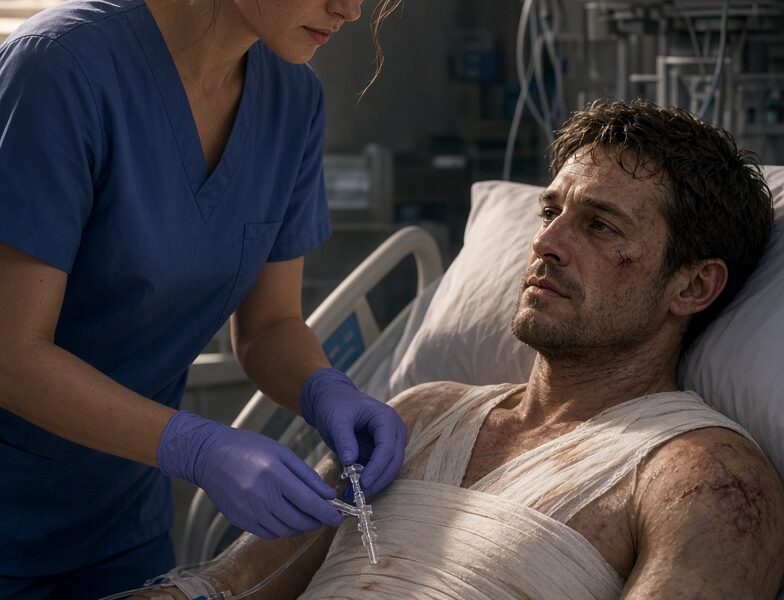
He Called Her a Glorified Waitress… Then She Saved the SEAL the Machines Missed
He survived three deployments in Fallujah and a helicopter crash in Kunar.
But a microscopic speck in a sterile hospital room was about to kill the most decorated SEAL commander in the Navy.
And the only person who saw it coming was the nurse he just called a glorified waitress.
The VIP surgical wing of Walter Reed National Military Medical Center hums with a different kind of energy than a civilian hospital.
There is no frantic screaming in the waiting rooms, no chaotic influx of Friday night bar fights. Instead, there is a heavy, disciplined silence broken only by the squeak of rubber soles, the rhythmic beeping of state-of-the-art telemetry monitors, and the occasional presence of men in dark suits who stand near the elevators with their hands clasped in front of them.
Clare Hennessy was in her third week on the floor.
At thirty-two, she was already a veteran of the trauma bays at Chicago’s Cook County Hospital, where she had spent eight years pulling bullets out of teenagers and packing chest wounds with nothing but gauze and adrenaline. She was recruited to Walter Reed specifically for her ability to remain ice cold under pressure.
But civilian trauma, she was quickly learning, did not fully prepare you for the ego of the United States military’s elite.
At 0400 hours on a Tuesday, the double doors of the trauma bay blew open.
A stretcher was flanked by three heavily armed men in tactical gear who hadn’t even bothered to change before boarding the medevac out of Ramstein Air Base.
On the stretcher lay Commander Russell Caldwell.
Even battered, covered in dried blood, and strapped to a backboard, Caldwell exuded an aggressive, undeniable gravity. He was the commanding officer of a Tier 1 unit.
His file, handed to Clare by a harried Navy corpsman, was heavily redacted with thick black ink, leaving only his medical history and the details of his immediate injuries.
Shrapnel to the right femur. Three broken ribs. A severe concussion. And second-degree burns across his right flank from an IED blast somewhere in the Horn of Africa.
“Move, move. I want a fast scan and a complete trauma panel,” barked Dr. Nathan Cross, the chief of trauma surgery.
Cross was brilliant, Ivy League educated, and entirely reliant on his billion-dollar imaging machines. He directed his team like an orchestra conductor, eyes glued to the monitors rather than the patient.
Clare stepped up to the left side of the stretcher, snapping on her purple nitrile gloves.
She picked up a pair of trauma shears and reached to cut away the remnants of Caldwell’s blood-soaked combat shirt to expose his chest for the EKG leads.
Before the blades could snip the fabric, a bruised, massive hand shot out and clamped around her wrist with the force of a steel vise.
Clare didn’t flinch.
She simply looked down at the hand, then up into the steel-gray, bloodshot eyes of Commander Caldwell.
“I bought this shirt in Tokyo,” Caldwell rasped, his voice like gravel grinding in a cement mixer. “I’d prefer if you didn’t butcher it, sweetheart.”
“You have a concussion and three cracked ribs, Commander,” Clare said, her voice completely flat, refusing to pull her arm away. “If you don’t let go of my wrist, I’m going to cut the shirt, and then I’m going to cut your ego down to size. Let go.”
Caldwell stared at her, assessing her. A smirk tugged at the corner of his cracked lips.
He released her wrist, letting his arm drop back onto the stretcher.
“Feisty,” he muttered, closing his eyes as a wave of pain washed over him. “Do they teach you how to handle actual combat injuries in nursing school, or just how to fluff pillows and talk back to your superiors?”
“They taught me how to keep arrogant men from bleeding to death in my bay,” Clare replied smoothly, slicing through the tactical fabric in three swift motions. “You’re not my superior, Commander. In this room, you’re just Patient 402, and you’re currently in my way.”
Dr. Cross ignored the exchange, looking up at the freshly populated imaging screens in the adjoining booth.
“All right, CT is coming back now. Scans confirm standard blast fragmentation in the right thigh. No arterial involvement. Femur is intact, just a hairline fracture. Lungs are clear. Brain CT is negative for bleeds.”
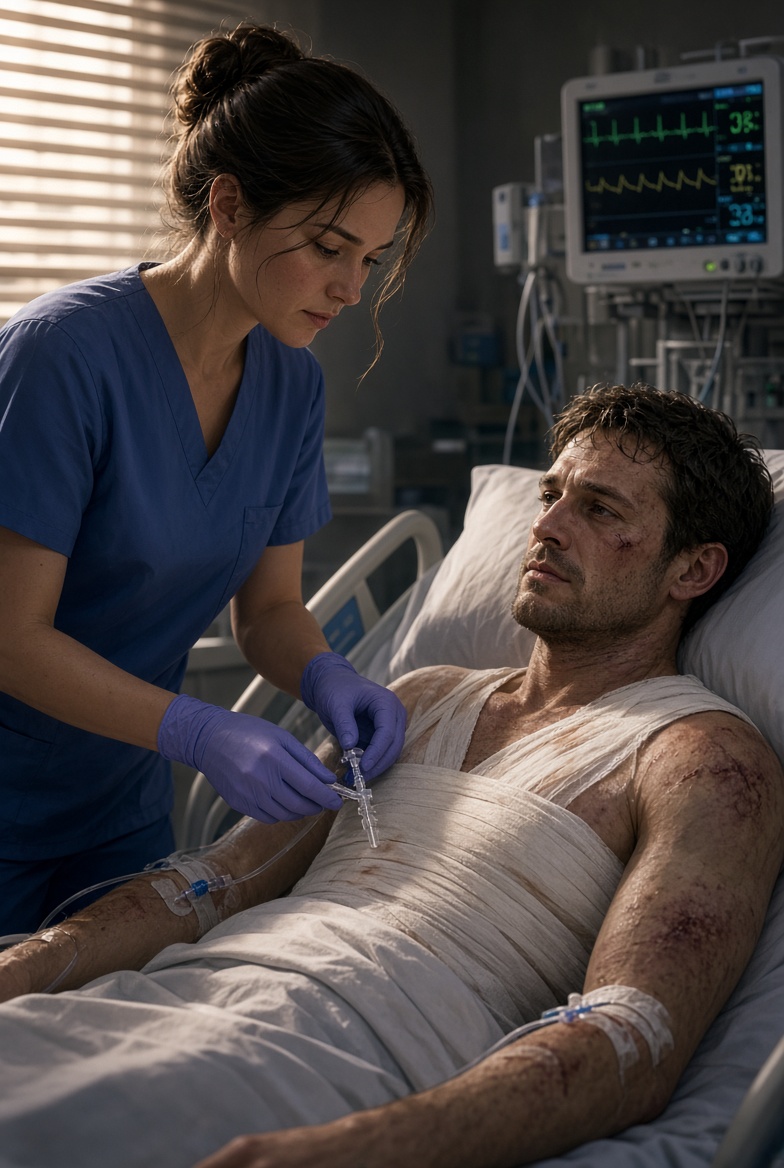
Cross smiled, clapping his hands together.
“You got lucky, Commander. We’ll take you up to the OR to debride the leg, pick out the metal, and you’ll be terrifying young sailors again in six weeks.”
“Told you,” Caldwell grunted, looking over at Clare with a victorious, mocking gleam in his eye. “Just a scratch. Next time, wait for the doctors to do the thinking, sweetheart. Just get me a glass of ice water and a real medic.”
Clare ignored the insult, her eyes sweeping over Caldwell’s body.
Something was off.
It wasn’t anything she could quantify. The monitors were flashing stable green numbers. His blood pressure was 110 over 70. Heart rate 88. Oxygen saturation 98 percent.
He was, by all technological accounts, perfectly stable.
But eight years in Cook County had taught Clare to treat the patient, not the machine.
She looked at Caldwell’s skin. Beneath the dirt and the iodine, there was a faint, unnatural pallor. An ashen-gray undertone that didn’t match the profile of a man who had only sustained localized shrapnel wounds and was fully hemodynamically stable.
“Dr. Cross,” Clare said quietly, stepping away from the bed and approaching the attending physician. “I don’t like his color, and his respiratory rate is climbing. He was at sixteen breaths a minute when he rolled in. He’s at twenty-two now.”
Cross sighed, clearly irritated by the interruption. He pointed a pen at the multi-million-dollar monitors.
“Nurse Hennessy, his sat is 98 percent. The CT scan, which gives us a cross-sectional view of his entire body down to the millimeter, is clear. He was in a bomb blast. He’s stressed. He’s in pain, and he’s full of adrenaline. That explains the tachypnea. Prepare him for OR 3.”
Clare looked back at Caldwell.
He was watching her, his arrogant smirk still firmly in place.
“Whatever you say, doctor,” Clare murmured, though a cold knot of dread was already forming in her stomach.
At 0200 hours, the VIP surgical floor was dead silent.
Caldwell had returned from his debridement surgery late in the evening. Dr. Cross had successfully removed five pieces of jagged steel casing from the commander’s thigh, flushed the wound, and stitched him up.
The operation was textbook. Cross had even gone home to sleep, leaving the night shift in the hands of the junior residents.
Clare was at the nurse’s station, catching up on charting, when she heard the faint, irregular rhythm of a cardiac monitor.
It wasn’t an alarm. It was just a slight variation in the tone. A shift from a steady, rhythmic beep to a slightly frantic, uneven cadence.
She stood up and walked down the dimly lit hallway to Room 4.
Through the glass, she could see Caldwell shifting restlessly in his sleep. His sheets were tangled, and the thin blanket had been kicked off his massive frame.
Clare pushed the door open, the scent hitting her immediately.
Hospitals smelled like bleach, chlorhexidine, and sterile plastic. But the air in Room 4 smelled like wet earth, rotting fruit, and raw iron.
It was a sweet, sickly odor that made the hairs on the back of Clare’s neck stand up. She had smelled that exactly twice in her life, both times on patients who were hours away from catastrophic septic shock.
She hurried to the bedside.
Caldwell’s face was slick with sweat. His arrogant demeanor was gone, replaced by the slack, pale features of a man drowning in his own body.
“Commander,” Clare said sharply, tapping his shoulder. “Caldwell, wake up.”
His eyes fluttered open. The steel-gray irises were dilated and unfocused. He looked at her, his lips parting, but instead of a sarcastic barb, only a dry, rattling wheeze came out.
Clare immediately checked his vitals. Heart rate 135. Blood pressure 85 over 50. Temperature 104.2 degrees Fahrenheit.
He was crashing, and he was crashing fast.
She hit the call button.
“I need a resident in Room 4 right now. Code sepsis protocol.”
A sleepy first-year resident named Dr. Hayes jogged into the room a moment later, rubbing his eyes.
“What’s going on?”
“He was fine two hours ago. He’s tachycardic, hypotensive, and febrile,” Clare snapped, already drawing blood from Caldwell’s central line for fresh cultures. “He’s in systemic shock.”
“Where is it coming from?” Hayes looked at the monitors, panic flaring in his eyes. “The leg wound? Did the surgical site get infected?”
Clare ripped the bandages off Caldwell’s right thigh. The surgical site was pristine. No redness, no heat, no pus.
It wasn’t the leg.
“His chest,” Hayes stammered. “Maybe the broken ribs caused a delayed pneumothorax.”
Clare grabbed her stethoscope and slapped it against Caldwell’s chest. Clear, equal breath sounds on both sides. No collapsed lung.
“You’re panicking, doctor,” Clare said, her voice dropping into a deadly calm.
She closed her eyes for a split second, shutting out the noise of the alarms and the terrified resident.
Treat the patient, not the machine. Look at the body.
She stripped Caldwell’s gown down to his waist. Under the harsh fluorescent lights, she examined every inch of his skin. The bruises, the burns on his flank, the abrasions. Nothing explained a massive, sudden-onset septic shock.
Then she saw it.
It was so small it could easily have been mistaken for a freckle or an insect bite. High up on Caldwell’s left shoulder, tucked almost out of sight beneath the collarbone, the exact opposite side of his body from the blast zone, was a tiny blackened puncture wound.
Clare leaned in close.
Originating from the tiny puncture was a faint, angry red line tracking directly down the skin, tracing the exact path of the subclavian artery toward his heart. The skin around it was slightly raised, and when Clare pressed her gloved finger against the flesh, it felt like popping bubble wrap. Crepitus. Gas trapped under the tissue.
Necrotizing fasciitis. Flesh-eating bacteria. But moving at a speed she had never seen before.
She turned to the resident.
“Page Dr. Cross. Wake him up. Tell him I need an OR right now. Tell him the patient has a secondary wound, likely contaminated with an aggressive biological agent, tracking toward his heart.”
Hayes hesitated.
“Nurse Hennessy, Dr. Cross’s notes specifically say the CT scans of the torso were 100 percent negative for foreign bodies. If there’s nothing in there, I can’t wake the chief of surgery at two in the morning for a bug bite.”
“Did you not hear me?” Clare roared, her professional mask slipping just enough to show the fierce, unyielding trauma nurse underneath. “Wood, bamboo, and certain organic marine materials do not show up on standard CT scans. They have the same radiodensity as human tissue. Whatever hit him out there didn’t show up on the billion-dollar machine, but it’s killing him right now. Page Cross. Now.”
Hayes scrambled out of the room.
Caldwell suddenly convulsed. The monitors shrieked a high, continuous wail. His blood pressure plummeted to 60 over 40.
Clare grabbed a bag of saline and squeezed it furiously, forcing fluids into his system to keep his veins from collapsing.
She looked down at the man who had mocked her just hours prior. He was seizing, his massive frame shaking the hospital bed violently.
“Hold on, you arrogant son of a—” Clare muttered through clenched teeth, her hands flying over his body as she prepared to push a massive dose of broad-spectrum antibiotics directly into his heart line. “You do not get to die on my shift just to prove a point.”
At that moment, the door flew open and a furious, half-dressed Dr. Cross stormed in. His lab coat was thrown over a wrinkled T-shirt.
“What the hell is going on here, Hennessy?” Cross bellowed over the screaming alarms. “I told you his scans were clear.”
Clare didn’t look up from Caldwell’s chest. She grabbed a surgical marker from her pocket, uncapped it with her teeth, and drew a thick black line across Caldwell’s shoulder, exactly where the red infection track ended.
“Watch the line, doctor,” Clare said, her voice shaking with adrenaline.
Cross stepped forward, furious. He looked at the black line on Caldwell’s pale skin.
Right before his eyes, the angry, furious red streak of the infection crept past the black marker, moving a quarter of an inch toward Caldwell’s heart in less than thirty seconds.
Cross’s face drained of all color. The arrogance vanished, replaced by sheer, unadulterated medical terror.
“Oh my God,” Cross whispered.
“Scans were clear,” Clare said coldly, tossing the marker onto the bed. “Are we going to stand here and argue about the machines, doctor, or are we going to cut this man’s chest open before he’s dead in ten minutes?”
The rush to Operating Room 1 was a blur of shouting voices, slamming doors, and the terrifying, erratic strobe of the cardiac monitor strapped to the foot of Caldwell’s bed.
“Push 1 mg of epinephrine. I need two units of O-negative blood on a rapid infuser right now,” Dr. Cross yelled, sprinting alongside the gurney as Clare and two orderlies shoved it through the double doors of the surgical suite.
The sterile, frigid air of the OR hit them like a physical wall. The room was already prepped, a miracle of military medical efficiency.
The anesthesiologist, Dr. Gregory, was already pulling the breathing tube from its sterile wrapper, waiting to paralyze Caldwell and take over his failing lungs.
“His pressure is tanking. 50 over 30. We are losing him,” Gregory shouted, securing the mask over Caldwell’s face and pushing the induction drugs.
“Scalpel. 10 blade,” Cross demanded, not even waiting for the surgical scrub nurse to finish draping the patient.
Clare stood directly across from Cross, suction tube in one hand, retractors in the other.
She had seen horrific things in Cook County. Gunshot wounds that tore through aortas. Industrial accidents that crushed limbs into pulp. But the sheer speed of this pathogen was entirely alien.
Cross brought the scalpel down on Caldwell’s left shoulder, slicing into the pale flesh directly over the blackened puncture wound.
The moment the skin parted, a foul, sulfurous odor flooded the pristine operating room. It was the undeniable stench of death.
Beneath the superficial layer of skin, the muscle tissue wasn’t the healthy, vibrant crimson of a living man. It was gray, liquefying, and laced with pockets of foul-smelling gas.
“Jesus Christ,” Cross whispered, his hands trembling slightly as he stared into the wound. “The fascia is completely necrotic. It’s eating him alive from the inside out.”
“Source control, doctor,” Clare snapped, her voice cutting through the panic like a whip. “You have to find the foreign body. If you don’t remove the source, the antibiotics won’t touch it. He dies.”
Cross hesitated.
He was a master of clean, precise incisions. He reconstructed shattered bones with millimeter accuracy. But this wasn’t clean. This was dirty, brutal trench-warfare medicine. He was afraid to cut too deep and sever the subclavian artery, which would bleed Caldwell out on the table in sixty seconds.
“Dr. Cross. His heart rate is 160. He’s going into ventricular tachycardia,” Gregory warned from the head of the bed.
“Give me the forceps,” Cross ordered the scrub nurse.
He plunged the metal instrument into the gray, rotting tissue, probing blindly for whatever had triggered this catastrophic immune response.
“Nothing. I feel nothing,” Cross said, his voice rising in pitch. “It’s just dead tissue. The CT was right. There’s nothing there.”
“The CT was blind,” Clare countered, leaning over the table.
She looked at the trajectory of the red line that had marched across Caldwell’s skin. She traced it backward in her mind, calculating the angle of entry.
“Angle your forceps thirty degrees to the left, toward the clavicle. It’s lodged under the bone.”
Cross adjusted his grip, pushing deeper into the shoulder cavity.
A sickening crunch echoed in the quiet room as the forceps scraped against Caldwell’s collarbone.
Suddenly, Cross froze.
“I have something,” he breathed. “It’s wedged tight into the periosteum of the bone.”
“Pull it,” Clare said.
With a hard, twisting yank, Cross extracted his hand from the wound cavity.
Clamped firmly in the jaws of the stainless steel forceps was a jagged, dark-green object roughly three inches long. It was covered in a thick, slimy resin.
It wasn’t shrapnel. It wasn’t a bullet fragment. It was a piece of organic, unrefined wood. A splinter from a jungle canopy, sharpened to a razor point, entirely invisible to a CT scanner, and dripping with a lethal cocktail of foreign bacteria.
“What the hell is that?” Cross muttered, dropping the bloody sliver into a stainless steel basin.
Before Clare could answer, the agonizing, high-pitched scream of the cardiac monitor filled the room.
Flatline.
“He’s in V-fib. He has no pulse,” Gregory screamed.
“Starting compressions,” Clare yelled.
She didn’t wait for permission. She dropped her surgical instruments, climbed onto the step stool beside the operating table, placed the heel of her hand dead center on Commander Caldwell’s massive sternum, and threw her entire body weight downward.
Crack. Crack. Crack.
The sound of his remaining intact ribs fracturing under her CPR was sickening, but Clare didn’t stop. Two inches deep, 100 beats a minute.
She locked her elbows, her face hovering mere inches from Caldwell’s pale, lifeless features.
“Charge the paddles to 200 joules,” Cross shouted, ripping the sterile drapes away from Caldwell’s chest.
“Charged.”
“Clear.”
Clare threw her hands up and stepped back.
Cross pressed the paddles to Caldwell’s chest.
“Clear.”
The electric shock lifted Caldwell’s 220-pound frame off the table. He slammed back down.
Everyone stared at the monitor. The green line remained a flat, jagged wave of death.
Nothing.
“Push another milligram of epi. Charge to 300,” Cross barked, sweat pouring down his forehead.
Clare jumped back onto the stool, resuming the brutal, bone-crunching rhythm of chest compressions.
Her arms burned. Her breath came in ragged gasps.
You arrogant son of a bitch, she thought frantically, staring at Caldwell’s face. You survived explosions, gunfights, and helicopters falling out of the sky. You are not dying from a damn splinter. Fight back.
“Charge to 300.”
“Clear.”
Cross yelled. Clare stepped back. The shock hit.
Caldwell’s body convulsed violently.
For three agonizing seconds, the room was entirely silent except for the hum of the machines.
Then a singular, beautiful sound echoed through the OR.
Beep.
Followed by another.
Beep. Beep. Beep.
Normal sinus rhythm.
“We have a pulse,” Gregory gasped, slumping back in his chair. “Pressure is stabilizing. 90 over 60 and climbing.”
Cross let out a breath that sounded like a sob.
He looked across the bloody operating table at Clare. The chief of surgery, a man who had treated her like a subordinate nuisance for three weeks, looked at her with an expression of pure, unadulterated awe.
“Get the infectious disease team down here to culture that wood,” Cross said quietly, his voice finally steady. “And someone get Nurse Hennessy a clean gown. We have a lot of dead tissue to cut out.”
Three days later, the afternoon sun filtered through the blinds of the intensive care unit, casting long shadows across the sterile white floor.
Commander Russell Caldwell was awake.
He looked drastically different from the terrifying, imposing figure that had rolled into the trauma bay. His skin was pale. His eyes were sunken. And his massive left shoulder was heavily bandaged, packed with surgical foam, and attached to a vacuum pump to drain the remaining fluid.
He had lost ten pounds of muscle in seventy-two hours, ravaged by the flesh-eating bacteria that had nearly stopped his heart.
Clare walked into the room holding a fresh IV bag of vancomycin.
She didn’t say a word. She quietly checked his lines, adjusted the flow rate on his IV, and checked the dressing on his right leg, which now seemed like a minor paper cut compared to what had happened to his shoulder.
As she reached up to hang the new bag of antibiotics, Caldwell spoke.
“The suit told me,” he said.
His voice was incredibly weak, a raspy shadow of its former gravelly strength.
Clare paused, looking down at him.
“What suit?”
“Agent Thomas. Naval intelligence.” Caldwell murmured, staring at the ceiling. “He came by an hour ago. Bagged the splinter. Classified it.”
Caldwell slowly turned his head to look at her.
“He told me you saved my life. He said the CT scans missed it. He said I was dead on the table for two minutes. And you were the one who broke my ribs getting me back.”
“I broke four of them,” Clare said flatly. “Sorry about that.”
A faint ghost of a smirk touched Caldwell’s lips.
“I’ve had worse.”
He fell silent for a moment, the rhythmic hissing of the oxygen cannula filling the quiet space.
“We weren’t in the Horn of Africa,” Caldwell said quietly.
It was a massive breach of protocol to admit that to a civilian nurse, but the man was hovering in the vulnerable space between life and death.
“We were in the Darién Gap. Deep jungle. Extracting a hostage from a cartel camp. A kid.”
Clare stopped charting and looked at him, realizing she was hearing a story that wasn’t on any official record.
“We got hit by an IED on the exfil,” Caldwell continued, his eyes darkening with the memory. “Shrapnel tore up my leg. But the blast threw me backward into a deadfall trap. Punji stakes. The locals coat them in decaying animal matter and river water to ensure they go septic. One of them clipped my shoulder. I pulled it out in the mud, but the tip broke off inside.”
“You knew it was in there?” Clare asked, her brow furrowing. “Why didn’t you tell the doctors?”
“I didn’t think it mattered,” Caldwell admitted, looking away. “My leg was bleeding out. We had a hostage bleeding out. I patched it with superglue and ignored it. By the time we got on the medevac, the fever was making me hallucinate. I convinced myself it was just blast trauma. I convinced myself I was invincible.”
He looked back at Clare, and for the first time, the steel-gray eyes held no arrogance. Only deep, profound humility.
“I called you a waitress,” Caldwell whispered. “I insulted you. And then you stood over my rotting body and refused to let me die when the smartest doctors in the Navy missed the bullet.”
“I’m from Cook County, Commander,” Clare said, stepping closer to the bed and resting her hands on the metal railing. “I don’t care how many medals you have, and I don’t care how many billion-dollar machines the military buys. A machine only sees what it’s programmed to see. I look at the patient. You looked like a man who was dying. So I treated a man who was dying.”
Caldwell stared at her, absorbing the absolute, unbreakable confidence in her voice.
He reached out with his right hand, the only one that wasn’t wired to a machine, and weakly gripped her wrist.
This time, it wasn’t a threat. It was an anchor.
“Clare, right?” he asked softly.
“Nurse Hennessy,” she corrected, though a faint smile finally broke through her stoic expression. “You haven’t earned my first name yet, Commander.”
Caldwell actually chuckled, though it ended in a painful cough.
“Fair enough, Nurse Hennessy.”
He released her wrist and sank back into the pillows, his eyes heavy with exhaustion.
“For the record, I owe you one shirt and my life. Whenever I get out of this bed, I intend to repay both.”
“Just focus on surviving the antibiotics first,” Clare said, turning toward the door. “And Commander—”
Caldwell opened one eye.
“Yeah?”
“Next time you come into my trauma bay,” Clare said, looking back over her shoulder, “don’t tell me how to do my job.”
As the heavy wooden door clicked shut behind her, Caldwell smiled in the quiet room.
He closed his eyes, the steady, strong rhythm of his heart monitor singing a sweet, consistent song of survival.
He had faced warlords, terrorists, and the most hostile environments on the planet.
But he knew, without a shadow of a doubt, that the most formidable force he had ever encountered was a thirty-two-year-old nurse with purple gloves and a stubborn refusal to lose.









