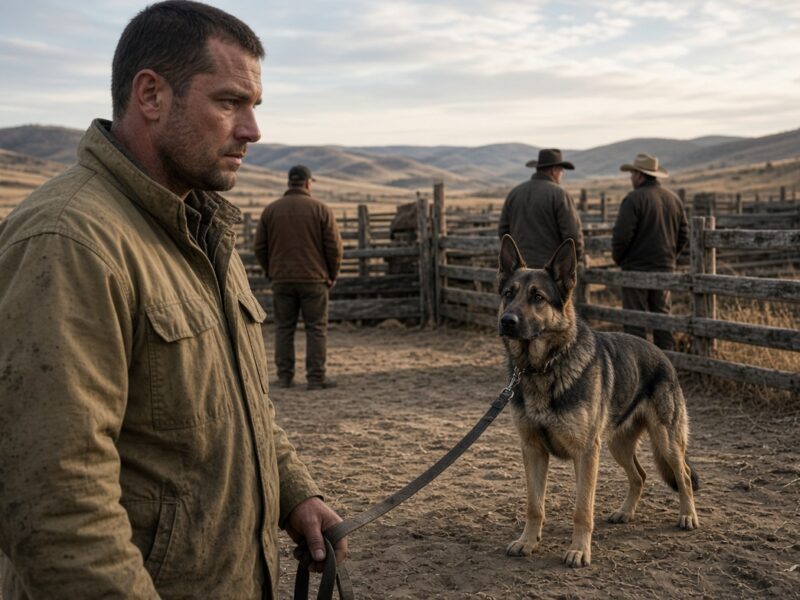
He Bought a German Shepherd Nobody Wanted for $75 — Then the Hidden Tag Changed Everything
The wind came off the Wyoming prairie like it had something to prove, bending the dry grass flat beneath a pale October sky and carrying the first real warning that winter was already packing its bags for the long stay.
Staff Sergeant Owen Carter drove west toward Casper in an aging dark blue Ford F-150 with fourteen years of Marine Corps life behind him and no clear picture of what was supposed to come next.
He was thirty-four years old, six feet tall, broad through the shoulders with close-cropped dark brown hair, a square jaw, and the lean, disciplined build of a man who had spent most of his adult life measuring days by schedules and responsibilities.
There were faint lines beginning around his gray-green eyes that made him look older when he was tired.
He was still wearing his Marine utility uniform beneath a weathered field jacket, more from the long drive than any desire to be noticed.
In several weeks, Owen would leave active service.
People kept asking what he planned to do afterward.
He had learned to answer with some variation of, “I’m figuring it out.”
The truth was less organized.
For nearly fourteen years, the Marine Corps had told Owen where to report, what needed doing, and what tomorrow required from him.
Soon, nobody would.
That freedom should have felt exciting.
Instead, it sometimes felt like standing in front of a road with every sign removed.
The only definite thing waiting for him was Cedar Hollow Ranch.
His maternal grandfather had died several months earlier and left Owen the small property outside Casper where Owen had spent portions of his childhood repairing fences, carrying feed buckets, and learning that a tool put back in the correct place was easier to find the next morning.
The ranch had once held horses and a modest cattle operation.
Now most of the pasture sat empty.
Several sections of fencing leaned toward the prairie.
The barn roof needed work, and the old horse stalls had gathered years of dust.
His older sister wanted it sold.
Clare Carter was thirty-eight, tall and slender like their mother had been, with shoulder-length auburn hair, clear blue eyes, and a practical manner that sometimes sounded colder than she intended.
Raising her son mostly on her own while working as an office manager had taught Clare to distrust problems that came without numbers attached.
She loved Cedar Hollow, but sentiment had never paid a property tax bill.
Owen’s phone rang through the truck speakers.
He already knew who it was.
“Tell me you haven’t forgotten Thursday,” Clare said.
“Good afternoon to you, too.”
“The appraiser is coming in two weeks. I remember.”
“You said that yesterday and somehow I still remembered today.”
Owen sighed.
He could picture her sitting at her kitchen table with a stack of documents arranged in perfectly straight piles.
“I’m serious, Owen. The place has been sitting empty too long. We need to know what it’s worth before winter creates three more things that need repairing.”
Owen looked through the windshield at the distant mountains.
“I’m going there now to inspect it, to start cleaning.”
There was a pause.
Clare knew her brother well enough to understand that cleaning could easily become repairing and repairing could become a reason not to sell.
“Just don’t make any major decisions before the appraisal.”
“Wasn’t planning to.”
After they disconnected, Owen drove another twelve miles before seeing the painted wooden sign beside the highway.
*Red Mesa Livestock and Horse Auction — Final Saturday Sale.*
A row of pickup trucks and livestock trailers filled the gravel lot beyond it.
Owen almost continued.
Then he remembered Cedar Hollow’s western fence.
Several posts needed replacing, and the old barn was missing enough usable hardware that purchasing everything new would become expensive quickly.
Auction yards were good places to find equipment nobody wanted to haul home.
He turned in.
Red Mesa was the kind of place that looked as though the Wyoming wind had been trying unsuccessfully to remove it for fifty years.
Long wooden pens surrounded a covered sales building.
Dust coated the lower rails, old advertisements hung crookedly along one wall, and men in work jackets stood in small groups drinking coffee from paper cups.
Owen remained near the back.
He had brought one hundred eighteen dollars in cash, mostly for used fencing tools, hinges, or perhaps a box of hardware.
He had no intention of buying anything that ate.
At the front stood Walter Crowley, the auctioneer.
Walter was sixty-three, thick through the chest with a lined face, a gray mustache, and white hair escaping from beneath a black cowboy hat.
He had spent more than thirty years around livestock sales and had developed the easy authority of a man who could manage impatient buyers without raising his voice.
His humor was dry, his patience practical, and by late afternoon he clearly wanted to finish the sale before the temperature dropped.
Owen bought nothing.
A bundle of old fence posts went above his limit.
A toolbox contained more rust than tools.
A stack of livestock panels sold as one lot and required a trailer he did not have.
He was already considering leaving when Walter looked toward one of the side gates.
“Got one more before we close this out.”
A handler opened the gate and walked in holding a worn nylon lead.
The dog beside him made Owen stop.
He was a male German Shepherd about four years old, large-framed beneath a body that was somewhat too lean.
His coat carried the familiar black and tan pattern, though the fur lacked the healthy shine it might have had under better circumstances.
His ears stood upright.
His dark eyes moved steadily across the people surrounding the ring.
A wide worn leather collar circled his neck.
The dog did not bark.
He did not pull against the lead.
He simply watched.
Walter checked a sheet.
“Name listed here is Rex. Four years old. No current working certification included, no guarantee on training.”
The handler shortened the leash slightly.
“Sit.”
Rex looked at him.
He remained standing.
The command came again, louder this time.
“Sit.”
Nothing.
Someone near Owen chuckled.
Another man remarked that a four-year-old shepherd that had forgotten how to sit had probably forgotten everything worth paying for.
Walter tried to open the bidding at three hundred dollars.
Silence.
One fifty.
Nothing.
One hundred.
A few men looked at Rex, then away.
Walter lowered it to fifty.
Still nobody moved.
Owen understood why.
A mature German Shepherd meant food, veterinary care, time, space, and responsibility.
Cedar Hollow already needed money.
Owen did not even know whether he would still own the ranch after the appraisal.
Common sense gave him an easy answer.
Then a metal gate behind the sales ring swung in the wind and struck its latch.
The sound caused several people to turn.
Rex reacted immediately.
His ears snapped toward the gate.
His head followed.
His body became still but not frightened.
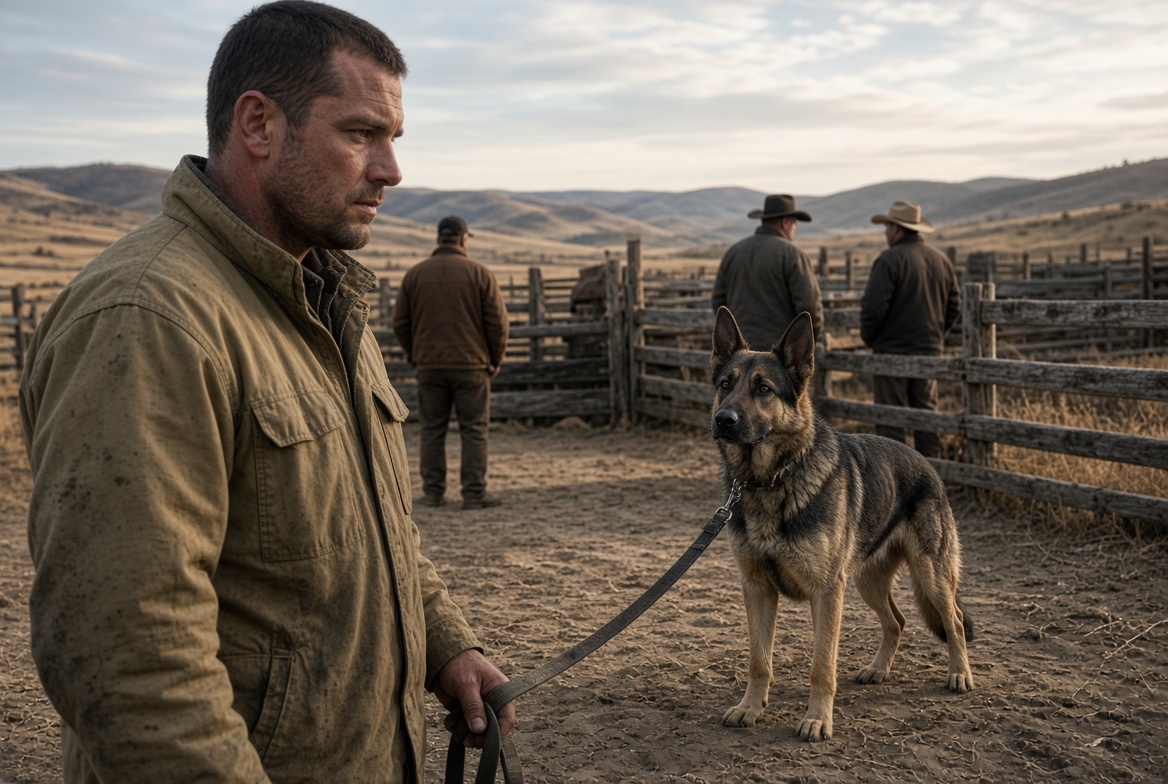
He located the movement, watched it briefly, then relaxed and returned his attention to the people around him.
Owen narrowed his eyes.
Years around Marines who worked alongside military working dog teams had taught him just enough to recognize what he had seen.
Rex had not ignored the world.
He had processed it.
There was a difference.
Walter looked around for the last time.
“Nobody at fifty.”
The handler began turning Rex toward the gate.
Owen reached into his pocket.
A fifty.
Three twenties.
A five.
Three ones.
One hundred eighteen dollars.
He thought of fence posts.
He thought of the barn roof.
He thought of Clare telling him not to make any major decisions.
Then he looked at Rex.
“Seventy-five.”
The room turned toward him.
Walter blinked.
“Seventy-five?”
Owen nodded.
A few men smiled at the sight of a Marine spending most of the cash in his hand on a dog everyone else had just declined at fifty.
Walter asked for eighty.
Nobody answered.
He asked again.
Then the gavel came down.
“Sold. Seventy-five.”
Owen stood still for a second.
He had arrived looking for fence hardware.
He was leaving with a German Shepherd.
After completing the simple paperwork, Owen took the lead but did not immediately pull Rex toward the parking lot.
The dog remained where he was, so Owen waited.
For nearly a minute, neither moved.
Then Rex looked toward the open doorway, back at Owen, and stepped forward voluntarily.
At the truck, Owen opened the rear passenger door.
“Your decision, partner.”
Rex studied the cab.
Owen waited again.
Eventually, the shepherd climbed inside on his own.
He ignored the center of the back seat and settled close to the door directly behind Owen’s position.
Owen shut the door gently.
Before climbing into the driver’s seat, he reached through the open window and adjusted the old collar.
His fingers caught against something beneath the worn leather.
A small piece of metal had been tucked almost completely under the collar lining.
Owen turned it slightly, but the surface was too dirty and worn to read in the fading light.
He let it go.
Whatever it meant could wait.
For now, Owen Carter had seventy-five dollars less than he had that morning, a ranch he still might have to sell, no plan for life after the Marines, and a German Shepherd named Rex sitting quietly behind him as though he had already decided where he belonged.
—
By the time Owen Carter reached Cedar Hollow Ranch, the last light had begun draining from the Wyoming sky.
The Ford F-150 rolled slowly beneath the weathered wooden entrance sign and followed the narrow gravel drive toward the farmhouse, its tires crunching over stones that had not been disturbed regularly in months.
Beyond the house, empty pasture stretched toward low brown hills.
The barn stood fifty yards away, with one section of roof faded almost silver, while several fence posts along the western boundary leaned at angles Owen knew would eventually become his problem.
Rex remained quiet behind him.
During the entire drive from Red Mesa, the German Shepherd had not barked, paced, or tried to climb into the front seat.
He had spent most of the trip lying near the rear door directly behind Owen, occasionally lifting his head when another vehicle passed or when the truck slowed through town.
Each time something changed, Rex noticed.
Each time the change proved unimportant, he settled again.
Owen parked beside the farmhouse and opened the rear door.
Rex did not jump out.
He looked past Owen toward the house, the barn, the darkening pasture, and the empty road behind them.
Owen waited.
After several seconds, Rex stepped down and stood beside the truck.
“Welcome to Cedar Hollow,” Owen said. “Neither one of us knows what we’re doing here, so that puts us on equal footing.”
The house still carried the quiet presence of Owen’s grandfather.
A denim jacket hung behind the kitchen door.
Three coffee mugs sat upside down beside the sink.
An old calendar remained open to May, even though October was nearly over.
Owen had been inside only twice since the funeral, and each visit had felt less like entering property he owned than walking through a room whose owner might return at any moment and ask why everything had been moved.
Rex entered cautiously.
He inspected the kitchen first, then the hallway, then the small living room.
He sniffed the legs of an old wooden table, examined the fireplace, and finally returned to the front door.
Then he lay down directly across the inside of it.
Owen looked at him.
“There are softer floors.”
Rex lowered his head onto his paws.
Apparently, the discussion was finished.
The following morning, Owen began repairing an old kennel attached to the rear section of the barn.
It had probably been used for farm dogs years earlier.
The wire panels were still solid, but one hinge had sagged, weeds had grown through the outdoor run, and the raised wooden platform inside needed replacing.
Owen spent most of the morning clearing it out.
Rex followed him from the house but never crowded the work.
When Owen carried a six-foot board through the narrow barn passage, Rex stepped aside before Owen needed to say anything.
When Owen placed a bucket near the doorway, the shepherd walked around it rather than knocking it over.
When Owen stopped to measure the kennel gate, Rex stopped several feet behind him and waited.
At first, Owen assumed he was seeing what he wanted to see.
People did that with animals.
They assigned meaning to ordinary behavior because meaning made the relationship feel deeper.
By afternoon, however, the pattern was becoming difficult to ignore.
Rex was always watching enough to stay out of the way.
That evening, Owen put an old horse blanket over the repaired platform and left the kennel door open.
“There,” he said. “Private room. Better ventilation than my barracks ever had.”
Rex walked inside, sniffed the platform, inspected the outdoor run, and remained there long enough that Owen believed the arrangement had been accepted.
At eleven that night, Owen went to lock the back door and found Rex lying inside the farmhouse again, positioned between Owen’s bedroom hallway and the front entrance.
Owen had no idea when he had returned.
He left him there.
Over the next several days, Rex established habits without being taught them.
He ate calmly and never pushed toward the bowl before Owen set it down.
He stayed close enough to keep Owen in sight but rarely demanded attention.
When Owen opened the truck door, Rex waited.
When Owen walked toward the barn, Rex followed.
When Owen stopped, the dog usually stopped a moment later.
The strangest behavior appeared whenever unfamiliar activity entered the property.
On the second afternoon, a delivery van turned into the Cedar Hollow drive with several boxes of hardware Owen had ordered before returning to Wyoming.
Rex had been lying near the barn while Owen replaced a broken fence rail.
Before Owen noticed the van, Rex was already standing.
He did not run toward it.
Instead, he crossed the yard and stopped near Owen’s left side.
His attention remained on the vehicle until the driver stepped out, placed the boxes near the porch, and left again.
Then Rex returned to the barn.
Owen watched him go.
“You’re either very polite,” he said, “or somebody taught you more than that auction handler knew.”
The question remained in his mind.
Rex had ignored the spoken commands at Red Mesa, but nothing about his behavior at Cedar Hollow suggested an animal unfamiliar with structure.
If anything, he seemed almost too practiced at understanding where people were moving and what they intended to do.
Perhaps the problem had never been that Rex did not know how to respond.
Perhaps the wrong person had simply been speaking the wrong language.
—
Three days after the auction, Clare arrived with her son.
Her Subaru stopped beside the farmhouse shortly before noon.
Clare climbed out carrying two cardboard boxes and immediately looked toward the repaired kennel, the stacked lumber, and the section of fence Owen had already straightened.
“You’ve been busy.”
“That sounds almost accusatory.”
“It is, when you’re supposed to be cleaning.”
“I am cleaning. Some things just look better after you repair them.”
Clare gave him the expression she had been using since they were teenagers whenever Owen offered an explanation technically true enough to be irritating.
Then the passenger door opened.
Noah Carter was ten years old, small for his age, with straight light brown hair that continually fell over his forehead, a narrow face, and thoughtful hazel eyes that seemed to study new places before deciding whether they liked them.
He had inherited Clare’s careful temperament but not her confidence.
Noah preferred model airplanes, books about aircraft, and quiet rooms where objects behaved predictably.
His father had moved out of state several years earlier, and although the adults rarely discussed it around him, the change had made Noah cautious about attachments and particularly uncomfortable around large, unfamiliar animals.
He climbed from the car holding a plastic storage case containing a model aircraft he had brought to work on if the adults became boring.
Then he saw Rex.
The shepherd was lying beneath the porch railing.
Noah immediately stopped.
Rex lifted his head.
Noah moved closer to Clare without saying anything.
Owen noticed.
So did Rex.
Clare said quietly, “That’s the auction dog.”
“Apparently, you bought a German Shepherd while I was explaining that this place already costs money.”
“I bought him before that particular explanation.”
“That makes me feel much better.”
Noah was still watching Rex.
“Is he friendly?”
Owen considered the question.
“He’s been good with me, but you don’t have to go near him.”
That answer seemed to surprise Noah.
Adults often told children not to be afraid when what they meant was that the child should pretend not to be afraid.
Owen did not do that.
He asked Rex to remain near the porch, although the dog showed no desire to move closer anyway.
For the next several hours, Clare and Owen sorted through boxes inside the farmhouse while Noah occupied one end of the dining table with his model airplane.
It was a detailed silver P-51 Mustang he had been assembling for weeks, complete with fragile landing gear and a propeller that turned if handled carefully.
Rex wandered in once.
Noah stiffened immediately.
The shepherd paused.
Between him and Owen stood the dining table, several boxes, and Noah’s model aircraft resting near the floor beside the boy’s chair.
Rex could easily have walked through the narrow space.
Instead, he changed direction and went around the far side of the table.
The model remained untouched.
No one noticed.
No one said anything.
The next day, Clare returned with him again because they had discovered another closet of family records that needed sorting.
This time, Noah did not stand behind his mother when Rex appeared.
He stayed near the truck, but he remained visible.
Rex settled beneath an elm tree perhaps fifteen feet away.
Neither approached the other.
By the third visit, Noah had begun watching Rex more openly.
At lunch, Owen filled the shepherd’s bowl and set it beside the porch.
When he returned to the kitchen, Noah remained outside.
Through the window, Owen saw his nephew remove a small piece of plain cooked chicken from his own plate.
Noah walked halfway toward Rex’s bowl.
He stopped several feet short, leaned forward, and dropped the piece into it.
Then he backed away.
Rex waited until Noah had returned to the steps before standing.
He walked to the bowl, ate the chicken, and looked briefly toward the boy.
Noah smiled.
It was small enough that Owen pretended not to notice.
Clare did notice.
Later, while they carried old files from the upstairs bedroom, she said, “You know, he asked this morning whether Rex would still be here today.”
Owen placed the box on the landing and said nothing.
Clare looked through the window toward her son.
“I’m just saying he doesn’t usually ask about things he’s nervous around.”
Then her attention shifted toward the barn.
“You’re repairing a lot for a man who says he hasn’t decided whether to keep this place.”
Owen followed her gaze as the new kennel hinge caught the afternoon light.
Two fence rails stood straight again.
He had cleared one corner of the barn and stacked every usable board according to length, something his grandfather would have approved of.
“I like having something to do.”
“You always have something to do. That’s different from knowing what I’m doing next.”
Clare softened slightly.
For once, she did not mention the appraisal.
That evening, after Clare and Noah left, Owen continued sorting through the small office off the kitchen.
Behind several old tax folders, he found a framed photograph he had forgotten existed.
His grandfather stood beside the Cedar Hollow barn, perhaps twenty-five years earlier, younger and broader than Owen remembered him.
Beside him were three men Owen did not recognize.
Two German Shepherds sat near a row of cattle runs.
Owen turned the photograph over.
Nothing had been written on the back.
He looked toward Rex, who was lying in the doorway.
“Apparently, you’re not the first shepherd to occupy this place.”
Rex remained unimpressed.
Before bed, Owen decided to clean the dog’s collar.
The leather was cracked around the edges and darkened from age.
Once he removed it, Rex sat quietly beside the kitchen table while Owen wiped away years of embedded dust.
That was when he found the metal piece he had noticed after the auction.
It was not a normal hanging tag.
A narrow copper plate had been fixed beneath the inner fold of the collar, almost completely hidden by the leather.
Owen rubbed it with a damp cloth.
Four characters appeared.
*SR12.*
He turned the collar beneath the kitchen light.
No phone number, no address, no explanation.
Just SR12.
Owen searched the paperwork from Red Mesa again.
Nothing mentioned the number.
He considered looking it up immediately, then glanced at the clock and decided the mystery could survive until morning.
The following day, Owen was replacing a loose board near the front pasture when Rex suddenly lifted his head toward the road.
A dusty gray pickup had stopped beneath the Cedar Hollow sign.
The driver remained there for several seconds before turning onto the property.
The man who climbed out appeared to be in his late sixties.
He was lean but solidly built, with close-cut silver hair, a weathered face, a neatly trimmed gray beard, and pale blue eyes that seemed to notice details before conversation required them.
He wore dark work pants, a brown canvas jacket, and old leather boots.
His movements were economical rather than slow, the habit of someone who had spent much of his life around animals that noticed unnecessary movement.
His name was Ray Monroe.
For more than three decades, Ray had worked around police canine programs in Wyoming and Montana before retiring.
Time had made him quieter, not less observant, and retirement had apparently failed to remove the instinct to study every dog he encountered.
Ray greeted Owen, explained that he had known Owen’s grandfather years earlier, and then looked past him.
Rex was standing near the barn.
Ray stopped speaking for perhaps twenty seconds.
He simply watched the German Shepherd.
Rex watched him back.
Then Ray turned toward Owen.
His expression had changed.
“Where’d you get that dog?”
Owen looked from the older man to Rex for the first time since reading SR12 the night before.
He had the distinct feeling that the four characters might mean something to someone after all.
—
Ray Monroe did not answer Owen’s question immediately.
He remained beside the gray pickup with one hand resting against the open driver’s door, studying Rex across the Cedar Hollow yard as though the dog had interrupted a conversation that had started years before either of them arrived.
At sixty-eight, Ray carried age in practical ways.
His silver hair was cut short because he had never developed patience for anything that required maintenance without purpose.
His shoulders remained square despite a slight stiffness through his lower back, and his pale blue eyes had the unsettling habit of moving from a person’s face to their hands, then toward the space around them.
Thirty-two years working with police and working dog programs in Wyoming and Montana had taught him that behavior was often more reliable than explanation.
Retirement had softened his schedule but not that instinct.
Owen stood near the pasture fence with Rex several yards behind him.
“You knew my grandfather?”
“For a long time?”
Ray looked toward the barn.
“Mostly through dogs.”
That caught Owen’s attention.
Ray explained that Cedar Hollow had never been a formal training operation, but Owen’s grandfather had occasionally let local handlers use portions of the property.
The barn, open pasture, narrow cattle lanes, uneven ground, and old outbuildings gave working dogs something polished training fields did not.
Unpredictable environments.
“He liked people who worked with dogs,” Ray said. “Didn’t always like the people themselves.”
That sounded enough like Owen’s grandfather that Owen smiled.
Ray finally nodded toward Rex.
“May I see him move?”
Owen hesitated only briefly before agreeing.
He unclipped the leash inside the fenced pasture and stepped away.
Rex remained near his left side.
Ray noticed immediately.
He did not call the dog.
Instead, he walked casually along the fence line, stopped, turned, then crossed toward the barn.
Rex watched him but stayed with Owen.
Ray changed direction again.
Nothing dramatic happened.
That appeared to interest him even more.
“What exactly are you testing?”
“Nothing yet.”
Ray stopped about fifteen feet away.
“I’m watching what he decides to do when nobody tells him anything.”
Rex’s eyes moved from Ray to the road, then back toward Owen.
Ray gave a small nod.
Then he lifted his right hand near his waist.
Two fingers moved downward.
The gesture was so slight Owen nearly missed it.
Rex did not.
The German Shepherd lowered smoothly into a down position.
Owen stared.
Ray waited several seconds, then turned his wrist and moved his hands subtly toward the left.
Rex rose, crossed behind Owen, and settled at Owen’s left side again.
For a moment, Owen said nothing.
He had spent several days wondering whether Rex understood something different from the spoken commands used at the auction.
Now he had his answer.
“You’ve seen that before,” Owen said.
Ray lowered his hand.
“I’ve taught versions of it.”
He explained that some working dogs were conditioned to respond to silent directional signals.
Hand signals were useful when distance, noise, terrain, or the type of task made constant verbal commands unnecessary or undesirable.
The purpose was not secrecy.
It was efficiency.
A dog trained that way might appear stubborn to someone who expected loud, repeated verbal obedience.
Owen looked down at Rex.
“So he knew exactly what they wanted at the auction.”
“Maybe.”
Ray corrected himself carefully.
“He may have understood the idea. That doesn’t mean he recognized their command system, trusted the handler, or had ever been taught to respond the way they expected.”
That distinction mattered to Ray.
He disliked turning incomplete evidence into a dramatic conclusion.
Owen appreciated that.
Ray walked another short pattern across the pasture.
Rex followed Owen naturally when Owen moved and returned to the left side without crowding his leg.
“Has he always worked there? Since I brought him home.”
“You didn’t teach it.”
“I’ve owned him less than a week.”
Ray’s eyebrows rose slightly.
“That’s useful.”
He explained that a dog repeatedly returning to the left side might simply be comfortable there, but combined with the silent signals, it suggested Rex had once worked consistently with a handler who expected that position.
Not proof.
Another piece.
Owen led Ray toward the farmhouse and showed him the collar.
Ray turned the worn leather over in his hands until he found the copper plate hidden beneath the inner fold.
*SR12.*
His expression became still.
“You recognize it.”
“I recognize the possibility.”
Ray sat at the kitchen table while Rex settled near Owen’s chair.
Years earlier, Ray explained, a small operation in southern Montana had been called Silver Ridge Working Dogs.
It had never produced large numbers of animals and did not advertise heavily to private buyers.
Most people outside working dog circles would never have heard the name.
Silver Ridge developed German Shepherds for practical work.
Some went into law enforcement.
Others were evaluated for search and rescue, wilderness tracking, ranch work, and roles where a dog needed to remain functional in difficult environments without constant direction.
“They weren’t trying to build dogs that looked impressive for five minutes,” Ray said. “They wanted dogs that still made sensible choices when the environment changed.”
Owen glanced toward Rex.
That sounded familiar.
Ray described the trait Silver Ridge valued most.
Stable judgment.
Their dogs were expected to notice unusual surfaces, strangers, machinery, livestock, noise, changing terrain, and unfamiliar situations without treating every new thing as a crisis.
The goal was not a dog that ignored the world.
The goal was a dog that noticed it without becoming controlled by it.
Owen remembered the metal gate at Red Mesa.
“That’s exactly what he did.”
Ray nodded.
“Which is why I’m interested.”
Silver Ridge had eventually closed before several younger dogs completed their evaluations.
Financial problems, changes in ownership, and personal circumstances had scattered some dogs through different kennels and working programs.
Records became incomplete.
Some animals continued training elsewhere.
Others simply disappeared into ordinary transfers.
Ray had once seen internal lists where young Silver Ridge prospects were identified with the letters SR followed by a number.
He remembered the sequence going at least into the teens, possibly to twenty.
SR12 could therefore be important, or it could be an unrelated kennel number.
Ray refused to pretend otherwise.
“We need evidence before we tell ourselves a story.”
Owen smiled slightly.
“You and my grandfather got along, didn’t you?”
“Usually.”
Ray handed the collar back.
“Which was about as friendly as either of us got.”
Later that afternoon, Ray conducted a few simple observations in the old barnyard.
Nothing aggressive, nothing stressful, and nothing designed to force Rex into a performance.
He placed a folded rubber mat over a slightly uneven wooden platform.
Rex approached it, tested the surface with one front paw, then crossed.
Ray introduced an unfamiliar plastic feed tub in the pasture.
Rex looked at it, circled once, and ignored it.
Ray hid a cloth carrying a familiar food scent behind two empty buckets.
Rex searched slowly.
He investigated the wrong bucket first, moved on, then returned when the wind shifted and stopped at the correct location.
He did not perform any formal indication.
Ray did not expect one.
“He’s not polished,” Ray said.
“Good or bad?”
“Neither. It means he’s not polished.”
Owen was beginning to understand that Ray rarely used more certainty than the evidence deserved.
The final observation happened without planning.
A neighbor’s utility vehicle passed along the road beyond the pasture, slowed near Cedar Hollow, then continued toward the next property.
Rex stopped searching.
His head turned.
He watched the vehicle until it disappeared behind a low ridge.
Then he returned to the scent area.
Ray looked at Owen.
“That matters more to me than the bucket.”
—
The next several days changed the rhythm at Cedar Hollow.
Ray returned twice, never for long, and Owen began practicing only the two silent signals Ray had already demonstrated.
He resisted the temptation to discover everything Rex might know at once.
There was no hurry.
Meanwhile, Noah had apparently decided Cedar Hollow was more interesting than home.
Clare brought him over after school on Thursday, and for the first time, Noah carried work gloves instead of only his model aircraft case.
“What are those for?” Owen asked.
“Mom said the old kennel boards have splinters.”
Clare gave Owen a look from behind the boy.
“He asked to come.”
That was new.
Noah helped Owen remove dust and loose straw from two unused kennel runs near the barn.
He was still careful around Rex, but fear had been replaced by curiosity.
Rex lay beneath the open barn door while they worked.
At one point, Noah placed his P-51 model on an overturned crate away from the work area.
Rex walked through the passage later, paused when the narrow route would have brought his shoulder close to the model, and deliberately stepped around the opposite side.
No one noticed.
“He remembers it,” Noah said.
“Maybe,” Owen said.
Noah looked toward Rex.
“I think he does.”
Clare was watching from the barn entrance.
“You’re turning both of them into projects.”
Owen shook his head.
“I’m fixing kennels.”
“And the dog?”
“He’s mostly watching me fix kennels.”
“And Noah?”
Noah was measuring a board with far more concentration than the task required.
Owen lowered his voice.
“He seems happy.”
Clare could not argue with that.
She had spent years watching her son approach unfamiliar things cautiously.
Since the changes in their family, Noah had become even more comfortable with routines he could control.
At Cedar Hollow, however, he had begun asking what they could repair next.
Clare looked around the barn.
The place was still old, still dusty, still expensive, but she no longer talked about selling it every time she visited.
While moving equipment from a storage room later that afternoon, Owen found another connection to his grandfather’s past.
Behind a cabinet sat a canvas bag containing three old tracking lines, several worn leather leads, two rubber training toys, and a set of small marker cones.
None looked recent.
Ray examined them when Owen showed him.
“Your grandfather used to store equipment for handlers who trained out here.”
“So he wasn’t training dogs himself.”
“Not professionally.”
Ray picked up one of the old lines.
“But he understood what they needed.”
The photograph Owen had found now made more sense.
Cedar Hollow had quietly been part of a working dog community long before Rex arrived.
The discovery did not explain SR12, but it made Owen wonder whether bringing Rex there had been as accidental as it first appeared.
Near sunset, Owen and Noah finished rehanging the first kennel gate.
Rex was lying outside the barn.
Noah stood nearby holding a short piece of rope.
For several seconds, he seemed to be arguing with himself.
Then he put the rope down.
He walked toward Rex slowly.
Owen started to speak but stopped.
Noah approached from the side rather than directly from the front, exactly as Owen had shown him.
Rex raised his eyes.
He did not stand.
Noah stopped beside him.
Then, for the first time, the boy reached down and placed one hand carefully against Rex’s shoulder.
Rex remained still.
No sudden movement, no attempt to demand more attention.
He simply accepted the touch.
Noah left his hand there for several seconds, then he smiled.
Owen looked away toward the pasture, giving the boy the privacy of pretending the moment was not important.
It was.
That evening, Ray returned with a photocopy of an old page one of his former contacts had kept from Silver Ridge.
It was incomplete, but the numbering was clear.
SR01, SR02, SR03.
The list continued.
Further down appeared numbers into the teens.
The copy did not contain SR12’s individual record, but it proved the identification system had existed.
Ray placed the page on Owen’s kitchen table.
“I’d keep that collar somewhere safe.”
Owen looked at him.
“You think somebody might care?”
“If he is what that number suggests? Yes.”
Ray explained that serious working dog trainers paid attention to old lines, especially dogs from programs that no longer existed.
A four-year-old shepherd with unfinished development and stable working traits could attract interest quickly.
“Don’t advertise the number,” Ray said. “Not yet.”
“Why?”
“Because right now Rex is your dog.”
Ray looked toward the doorway where the shepherd was resting.
“The moment people think SR12 means something valuable, some of them may stop seeing Rex and start seeing what they believe he could be worth.”
Owen rested one hand on the old collar.
Across the room, Rex lifted his head, checked him, then looked back toward the front door.
For the first time, Owen understood that finding out who Rex had been might create entirely new questions about who wanted him.
—
Now, three mornings after Ray warned Owen to keep the letters SR12 quiet, Cedar Hollow woke beneath a hard Wyoming frost.
The grass beyond the barn had turned silver overnight, and thin ice covered the water trough near the western fence.
Owen had been outside since sunrise, replacing two damaged boards, when Rex suddenly stopped beside him and lifted his head toward the road.
The German Shepherd had begun gaining weight steadily, and the improvement made his structure easier to see.
His chest looked fuller.
His black and tan coat had started recovering some depth, and the tired dullness around his eyes was disappearing.
What had not changed was the way he noticed things before Owen did.
An engine slowed near the Cedar Hollow sign.
Rex moved automatically toward Owen’s left side.
He did not bark.
A black SUV turned onto the gravel drive.
Owen put down the drill.
The vehicle was too polished for a ranch visit and too deliberate to be lost.
It stopped near the farmhouse, and a man stepped out wearing charcoal trousers, a dark wool coat, and expensive brown boots that appeared to have spent very little time around mud.
Victor Lang was fifty-five years old, tall and solidly built with neatly combed salt-and-pepper hair, a square face, and dark eyes that gave people the feeling they had already been evaluated before the introductions were complete.
He owned Frontier Canine Dynamics, a private working dog company operating across several western states.
Years of negotiating with police departments, security contractors, breeders, and wealthy private clients had made Victor controlled rather than openly aggressive.
He rarely raised his voice because he had learned that money usually worked better when presented calmly.
He looked past Owen almost immediately at Rex.
“Staff Sergeant Carter. For a few more weeks.”
Victor extended his hand.
“Victor Lang.”
Owen shook it.
“I know who you are.”
That was not entirely true.
He had searched the name only after Ray called the previous evening to say someone from Frontier K9 Dynamics had been asking questions about a German Shepherd in the Casper area.
Victor did not appear surprised.
“I understand you recently acquired a dog at Red Mesa.”
Owen looked toward Rex.
“I acquired Rex.”
Victor’s eyes moved briefly to the shepherd.
“Yes. Rex.”
The distinction was small, but Owen noticed it.
Ray arrived twenty minutes later.
He had been asked to come before Victor’s visit, and when his gray pickup entered the property, the older trainer climbed out wearing his usual canvas jacket and an expression that suggested he already disliked how quickly the situation was developing.
Victor greeted him professionally.
“Ray.”
“Victor.”
“You could have called.”
“You could have waited until we knew what we were looking at.”
Victor smiled faintly.
“That has never been one of my stronger qualities.”
Owen brought Rex into the fenced pasture.
He made it clear that Victor could observe, but he was not turning the morning into a sales demonstration.
Victor accepted the condition.
For several minutes, he said almost nothing.
Rex moved naturally with Owen across the yard.
When Owen changed direction, the shepherd adjusted.
When Ray deliberately opened a gate behind them, Rex noticed the movement without abandoning Owen.
A neighboring tractor passed beyond the far fence, and Rex turned his head to track it before returning his attention.
Victor asked Owen to stop.
Owen stopped.
Rex settled slightly behind his left leg.
Victor’s expression changed almost imperceptibly.
Then he asked whether Owen would use one of the silent signals Ray had shown him.
Owen made the downward movement.
Rex lowered himself.
Victor stepped several yards to the side and attempted a similar gesture.
Rex watched him.
He remained down.
Victor gave another directional signal.
Rex’s ears shifted, but instead of moving, he looked toward Owen.
Victor smiled.
“That’s interesting.”
“What is?” Owen asked.
“Handler discrimination.”
Ray folded his arms.
“Or he simply doesn’t like your coat.”
Victor ignored him.
A working dog, he explained, should not automatically transfer every learned response to anyone who happened to know the signals.
Depending on how Rex had been trained, checking back with his primary handler could be exactly what someone had wanted.
Victor then watched a simple scent exercise Ray had already used before.
A cloth carrying a familiar odor was placed among several ordinary ranch objects.
Rex worked slowly, checking one location, rejecting it, then adjusting with the wind.
He eventually found the correct area.
No spectacular performance, no dramatic indication, but he stayed with the problem.
Victor watched closely.
“Stable nerves,” he said.
He pointed toward Rex without moving closer.
“Environmental awareness. Scent persistence. He watches his handler without becoming dependent on him. And he solves problems instead of waiting for somebody to solve them first.”
Ray’s expression remained neutral.
“Those were Silver Ridge priorities.”
Victor nodded.
“Exactly.”
They moved inside because the wind had strengthened.
Clare was already at Cedar Hollow that morning with Noah, sorting paperwork related to the upcoming appraisal.
She stood at the kitchen counter when the men entered, immediately sensing that this was not a casual visit.
Noah was at the dining table painting one wing of his model aircraft.
Rex settled near the doorway.
Victor declined coffee.
He looked at Owen instead.
“I’ll give you twelve thousand dollars for him.”
The room became quiet.
Clare stopped sorting papers.
Owen thought he had misheard.
Victor repeated the number.
“Twelve thousand. I can arrange payment today.”
Owen looked down at Rex.
Five days earlier, men had declined the dog at fifty dollars.
Owen had paid seventy-five.
Now someone was offering twelve thousand.
“No.”
Victor waited.
“You should think about it.”
“I did.”
“You thought about it for three seconds.”
“That was enough.”
Victor leaned back slightly.
He was not offended.
Negotiation was familiar territory to him.
“I know the condition of this property.”
That changed Owen’s expression.
Victor continued carefully.
“I’m not insulting you. I’m saying twelve thousand dollars has practical value. Roofing. Fencing. Taxes. Transition expenses when you leave active service.”
Clare glanced toward Owen.
Victor had done his research.
Owen disliked that, but he also disliked the fact that the argument made sense.
Victor looked toward Rex.
“Twenty thousand.”
Noah’s paintbrush stopped.
Nobody had realized the boy was listening.
Twenty thousand dollars was different.
Owen had been avoiding the exact numbers associated with Cedar Hollow because numbers had a way of turning emotional decisions into uncomfortable arithmetic.
The ranch had overdue expenses.
The barn roof would not survive many more Wyoming winters without work.
Several fence lines required replacement rather than repair.
Owen would soon lose the predictable paycheck that had structured his adult life.
Twenty thousand dollars would not make him wealthy, but it would buy time.
It could also be the difference between keeping Cedar Hollow and selling it.
Clare broke the silence.
“Owen.”
He looked at her.
“I’m not telling you to do it,” she said. “But twenty thousand is not something you pretend you didn’t hear.”
Noah stood from the table.
“You’re selling Rex?”
His voice was quiet.
Owen turned toward him.
“No.”
“But he said twenty thousand.”
Victor looked briefly uncomfortable for the first time.
Owen motioned for Noah to come closer.
The boy stopped several feet from Rex.
“Listen to me,” Owen said. “Keeping a dog isn’t just saying you like him. It means food, care, time, training, and making decisions that are good for him, even when those decisions cost you something.”
Noah looked toward Rex.
“So he stays.”
Owen paused.
“I’m responsible for him. That’s what I’m telling you.”
Noah was not entirely satisfied, but Clare placed a hand on his shoulder and led him back toward the dining table.
Victor remained patient.
He had recognized hesitation.
People who negotiated for a living knew hesitation was often a door.
“You could use the money to keep this place,” he said.
Owen looked through the kitchen window.
From there, he could see the barn, the repaired kennel gate, the western fence, and the pasture Rex had been crossing every morning.
That was the cruelty of the offer.
Selling Rex might save the place Rex was beginning to call home.
For several seconds, Owen allowed himself to imagine it.
A repaired roof, property taxes paid, fuel without calculation.
Several months after leaving the Marines, in which he could decide what came next without accepting the first job available.
Twenty thousand dollars bought choices.
Rex lifted his head from the doorway and looked toward Owen.
The memory that returned was not from Cedar Hollow.
It was Red Mesa.
A German Shepherd standing beneath the auction lights.
The handler repeating commands, the crowd losing interest, nobody asking where Rex came from, nobody checking the collar, nobody wondering whether the dog had been trained differently.
At fifty dollars, no one wanted him.
Now four characters hidden beneath old leather had changed the conversation.
Owen looked at Victor.
“He didn’t become a better dog when you learned his history.”
Victor did not answer immediately.
Owen continued.
“He was the same dog at the auction. Same judgment, same temperament, same ability. Nobody cared because nobody knew what letters were under his collar.”
Victor’s voice remained controlled.
“I’m not pretending history doesn’t affect market value.”
“That’s exactly my point.”
Owen rested his hand lightly on Rex’s shoulder.
“No.”
This time there was no hesitation.
Victor accepted the refusal more gracefully than Owen expected.
He stood, buttoned his coat, and looked toward Clare.
“You’re his sister?”
“Yes.”
“You understand what he’s turning down?”
Clare looked at Rex, then at Noah, then back at Victor.
“I do now.”
It was the first time she had clearly taken Owen’s side regarding the dog.
Victor nodded once before leaving.
However, he stopped near the front door.
“There’s something you should check.”
Owen waited.
Victor explained that Silver Ridge had not always transferred dogs through ordinary sales.
Some promising young dogs had been placed under training agreements or leases while ownership remained with the original program.
Certain contracts also contained breeding control provisions.
“If Rex really is SR12,” Victor said, “the auction receipt proves you paid for him. It doesn’t necessarily prove the auction had the legal right to sell him.”
Ray’s face tightened.
“You know something specific?”
“No.”
Victor shook his head.
“I’m telling him what I would verify before assuming an old kennel number solves everything.”
He looked at Owen.
“If the chain of ownership is clean, then this conversation ends here.”
“And if it isn’t?”
Victor opened the door.
“Then you have a different problem than money.”
—
The SUV left Cedar Hollow ten minutes later.
Ray remained at the kitchen table with the photocopied Silver Ridge numbering sheet in front of him.
“I’ll start calling people.”
“Who?”
“Anyone still alive who worked there.”
Ray picked up his coat.
“Old handlers, kennel staff, maybe a veterinarian. Silver Ridge has been gone long enough that paperwork may be scattered.”
After he left, Clare set another folder in front of Owen.
“I called the bank this morning.”
He looked at her.
“They’ll give us thirty more days before they need a decision about how we’re handling the outstanding property obligations.”
“Thirty days?”
“Not much.”
“More than he had yesterday.”
Clare sat across from him.
“For what it’s worth, I still think we need to be realistic about Cedar Hollow.”
Owen nodded.
“But,” she looked toward the doorway where Rex had returned to his usual position, “I don’t think selling him should be the plan for saving it.”
Owen smiled faintly.
“That’s new.”
“So is the dog.”
Outside, Noah was sitting on the porch steps.
Rex lay several feet away.
The boy had not touched him.
He did not need to.
They simply watched the pasture together.
Owen stood at the kitchen window holding the Red Mesa bill of sale in one hand and the photograph of SR numbers in the other.
Twenty thousand dollars was no longer the question.
Now, there was only one question that mattered.
Had the man at Red Mesa actually sold Owen a dog he had the right to sell?
And somewhere in the broken history of Silver Ridge Working Dogs, the answer was waiting.
—
For the next six days, Cedar Hollow became less a ranch than a temporary archive.
Ray Monroe worked through old phone numbers, retired handlers, former kennel staff, and veterinary contacts whose names had not appeared in his notebooks for years.
Owen handled the other end of the search, calling Red Mesa, requesting copies of the liquidation records, and tracing the business that had surrendered Rex to the auction.
Most calls produced little more than another name or another disconnected number.
But Ray had spent too much of his life tracking working dogs through incomplete histories to expect a clean answer quickly.
The breakthrough came from Elaine Porter.
Elaine was sixty-four, a compact woman with short silver-blonde hair, wire-framed glasses, and the brisk, unsentimental manner of someone who had spent most of her career managing kennel records while trainers around her believed memory was an acceptable filing system.
She had worked at Silver Ridge for nearly eleven years before the program closed.
Retirement had not softened her opinion of poorly labeled boxes, which was fortunate because she had kept several of them after the operation shut down, simply because she did not trust anyone else to preserve the records properly.
Ray drove to her home outside Billings and returned to Cedar Hollow late the following evening with a yellow envelope held against his chest as carefully as if it contained something breakable.
Owen met him in the kitchen.
Rex was lying near the doorway.
Ray placed three photocopied pages on the table.
The first was an old Silver Ridge development sheet.
Near the center, in faded type, was the line Owen had been waiting to see.
*SR12 — Male German Shepherd, black and tan. High environmental stability. Strong scent persistence. Independent problem solving. Final evaluation: incomplete.*
Owen read it twice.
The words did not transform Rex.
That was what struck him first.
The dog in the doorway looked exactly as he had five minutes earlier.
Ray pointed to another section.
Silver Ridge had recorded Rex as approximately four years old now, matching the age listed at Red Mesa.
Notes from his younger development period described him as deliberate around unfamiliar surfaces, attentive to environmental change, and unusually steady after distraction.
Owen thought about the auction gate, then the vehicle entering Cedar Hollow, then the way Rex had checked strange objects before deciding they were irrelevant.
“What happened to the evaluation?” Owen asked.
“It stopped because Silver Ridge stopped.”
Ray explained that there was no failure notation, no rejection entry, and no record that SR12 had been removed for poor working ability.
The program had closed before the process was finished.
Rex had not failed.
His file had simply ended before his training story did.
The second document mattered even more.
Elaine had found a transfer inventory prepared when Silver Ridge dispersed its remaining dogs and equipment.
SR12 had been transferred outright to a regional training kennel in Wyoming.
The ownership release language was clear.
No training lease, no retained possession, no unfinished claim from Silver Ridge.
Ray then traced that kennel through two later business transfers.
The final operation in the chain was the same failing training company whose assets had been liquidated at Red Mesa.
Owen placed the Red Mesa bill of sale beside the copies.
“So they had the right to sell him.”
Ray nodded.
“And you had the right to buy him.”
Owen exhaled slowly.
For days, Victor Lang’s warning had made the simple leather leash hanging near the kitchen door feel temporary.
Now it did not.
Clare came over that night and read the documents at the kitchen table.
Noah stood beside her, pretending not to be impatient.
“So Rex is staying?” he asked.
Owen looked at him.
“Rex was staying before. Now the paperwork agrees.”
Noah grinned.
Ray did not allow the relief to become the end of the matter.
“Paper tells us where he came from,” he said. “It doesn’t tell us what dog we have today.”
He unfolded another form.
At the top were the words *Rocky Mountain Working Dog Evaluation.*
The event would take place the following Saturday outside Laramie.
Police canine teams, ranch dogs, search dogs, private working handlers, and independent entries could be evaluated across several practical categories.
Ray had already filled in most of the registration.
Owen stared at him.
“You registered us?”
“I prepared the paperwork.”
“That sounds suspiciously similar.”
“I left the signature blank. Very respectful of me.”
Owen looked toward Rex.
He understood Ray’s point.
Victor had placed a dollar value on history.
Silver Ridge had placed notes on potential.
Neither answered the more important question.
What could Rex actually do now?
Owen signed.
—
Saturday arrived under a bright, cold Wyoming sky.
The evaluation grounds occupied several acres beside a county training facility with fenced fields, gravel lanes, storage sheds, temporary obstacles, and a long row of vehicles carrying dogs from across the region.
Owen arrived wearing clean jeans, work boots, and the old field jacket he had worn repeatedly at Cedar Hollow.
Ray had suggested something newer.
Owen had declined.
“If the jacket bothers the judges, Rex and I have already identified the wrong competition.”
Clare and Noah arrived ten minutes later.
Noah was carrying a piece of poster board.
Across it, in large uneven blue letters, he had written: *GO REX.*
Owen looked at the sign.
“You made that?”
“No, a professional sign company made it.”
Clare smiled.
“He spent an hour on the R.”
The first phase was obedience.
Owen immediately understood that Rex was not going to be the most polished dog on the field.
Several professional handlers moved through the course with shepherds whose precision looked nearly mechanical.
Turns were sharper, stops were faster.
Their dogs maintained constant focus through every sequence.
Rex worked differently.
He stayed near Owen’s left side.
He responded to the silent signals they had practiced.
He completed the required positions, though once he looked away when a maintenance cart passed behind a fence.
Owen resisted correcting him immediately.
Rex watched the cart for two seconds, then returned his attention.
Their score was good, not exceptional.
At the exit gate, Owen looked at Ray.
“We’re not winning obedience.”
Ray shrugged.
“You brought Rex. Don’t spend the day wishing you brought somebody else’s dog.”
The temperament section changed the atmosphere.
A senior evaluator named Dr. Lauren Beckett supervised the phase.
Lauren was fifty-nine, medium height, athletic despite streaks of silver through her short dark hair, with a calm face and direct hazel eyes.
She had spent more than twenty years evaluating working dog temperament and had developed the habit of writing only after watching a dog recover from an event, not merely react to it.
She cared less about whether an animal noticed something unusual than about what it did next.
Rex encountered an unfamiliar volunteer first.
He remained neutral.
A moving tarp came next.
He paused, assessed it, then followed Owen past it.
A metal object dropped several yards away.
Rex turned immediately toward the sound.
His body tightened briefly, then relaxed.
He continued on a slightly shifting platform.
Rex placed one paw forward, felt the movement, withdrew it, considered the surface, then crossed without Owen pulling him.
Lauren wrote for a long time after that.
When the temperament scores appeared later, Noah found the board before Owen did.
“Uncle Owen.”
He pointed.
Rex had the highest score.
The scent exercise came in the afternoon.
Several target odors had been concealed among ordinary objects across a rough section of field.
Rex was not fast.
One specialized search dog finished its lane considerably earlier, but Rex did not guess.
He worked one scent path, abandoned it when it weakened, repositioned with the wind, and checked another area.
Twice Owen felt the urge to direct him.
Twice Ray’s earlier advice stopped him.
Let the dog solve the problem.
Rex located both assigned targets without a false indication.
His score placed him near the top.
Then came the final practical exercise.
The organizers had created a simulated ranch yard after a severe windstorm.
Temporary fence panels stood at odd angles.
Empty barrels and farm equipment created blocked passages.
Tarps had been secured safely around several structures to reproduce the visual confusion of storm debris without creating dangerous conditions.
Somewhere inside the course was an emergency kit.
The dog’s task was to locate it.
The handler could guide as much as necessary.
Owen entered with Rex.
Across the barrier, Noah raised his handmade sign.
Clare stood beside him.
Ray remained farther back, arms folded.
Victor Lang was there, too.
Owen had noticed him earlier near a Frontier K-9 vehicle with two professional handlers.
Victor had not approached them.
Not yet.
Owen unclipped Rex.
“Find.”
Rex moved forward.
He did not race.
He lifted his nose, checked the wind, then crossed toward the first debris lane.
He inspected an overturned container and left it.
A narrow route between two panels was partially blocked, so he paused and chose another way around instead of forcing himself through.
A tarp moved in the wind.
Rex looked toward it, then continued.
He disappeared behind a small storage structure.
Thirty seconds later, he came back.
Owen initially thought he had lost the scent.
Rex walked directly to him and touched his nose against Owen’s hand, then turned around.
Owen followed.
Rex led him behind the structure, around the safer side of a leaning panel, and stopped beside a stack of lightweight storm props.
The emergency bag was partly concealed beneath them.
Rex did not pull it out.
He simply stood beside it and looked at Owen.
The evaluator raised her hand.
“Exercise complete.”
Only then did Owen hear the applause from beyond the fence.
—
Late that afternoon, the results were announced.
Other dogs won advanced obedience and specialized scent categories.
Then Lauren Beckett stepped forward with the practical division.
“Highest temperament score: Rex, handled by Owen Carter.”
Noah shouted before Clare could stop him.
“And Best Practical Working Dog: Rex.”
Owen lowered his head for a second.
Rex sat beside his left leg.
The dog looked toward the applause, decided it required no response, and looked back at Owen.
Ray approached after the awards.
Owen held out the ribbon.
“You did this.”
Ray shook his head.
“I showed you a couple signals.”
He nodded toward Rex.
“You gave him time. That was the part he needed.”
A woman waiting nearby introduced herself as Karen Whitfield, forty-seven, a lean, sun-weathered search and rescue coordinator with dark hair tied behind her neck and the practical friendliness of someone accustomed to long days outdoors.
She represented a volunteer regional SAR group.
She told Owen that once Rex completed formal screening and additional training, she would be interested in seeing whether the pair could participate in volunteer search work.
“No promises,” Karen said.
Owen smiled.
“I’m getting used to those.”
“There shouldn’t be promises with dogs.”
“That’s exactly what Ray says.”
“Then Ray occasionally says something intelligent.”
Ray looked offended.
Victor approached only after the crowd began thinning.
He stopped a few feet from Rex.
For once, he did not look like a man calculating a price.
“I received copies of the transfer documents,” he said. “There’s no ownership issue. Frontier has no claim, and I have no reason to question your title.”
Owen nodded.
“Appreciate that.”
Victor looked toward the field.
“I was wrong about something else.”
Owen waited.
“I saw an underdeveloped Silver Ridge dog with market potential.”
His eyes moved toward Rex.
“You saw the dog first.”
Owen rested a hand against Rex’s neck.
“At the auction, nobody knew SR12 existed.”
Victor gave a small nod.
“Exactly.”
He looked at Rex one last time.
“I understand now why he didn’t respond to that handler.”
Owen glanced down.
Rex was sitting against his left leg, relaxed and attentive.
He had never been a dog incapable of working.
He had simply needed someone willing to watch long enough to understand how he worked.
Across the field, Noah was still holding the crooked *GO REX* sign.
For the first time since Red Mesa, everyone else had finally looked long enough, too.
—
Winning the Rocky Mountain Working Dog Evaluation did not repair the roof at Cedar Hollow.
It did not erase the overdue property expenses, replace the worn sections of fencing, or put twenty thousand dollars into Owen Carter’s bank account.
On Monday morning, the ranch looked almost exactly as it had before the competition.
The same boards still needed replacing.
The same barn doors still dragged when the temperature dropped.
The same thirty-day deadline from the bank still sat on Owen’s kitchen table.
What had changed was that people now knew where Cedar Hollow was.
The first call came from a small police department north of Casper.
They had heard about Rex through one of the handlers at the evaluation and wanted a place to run a weekend environmental training session.
Their usual field was flat, open, and predictable.
Cedar Hollow had uneven barn floors, narrow passages, old gates, livestock smells, gravel, timber, wind, and the kind of ordinary distractions that working dogs eventually had to learn to process.
Owen nearly laughed when he heard what they were willing to pay for two days of access.
It was not enough to save the ranch by itself, but it was enough to cover a utility bill and buy several bundles of roofing material.
The second call came from Karen Whitfield, the search and rescue coordinator Owen had met at the evaluation.
Her volunteer group wanted to use the back pasture and abandoned equipment shed for scent work practice twice a month.
Karen arrived the following Saturday with three handlers and two dogs.
She moved through Cedar Hollow with the same efficient, weathered confidence Owen remembered.
At forty-seven, she had spent enough years in volunteer search work to know that good training rarely required expensive facilities.
What mattered was varied terrain, safe obstacles, changing wind, and handlers willing to let dogs think.
She stood near the barn and looked across the property.
“You know what you have here?”
“A mortgage problem?”
Karen laughed.
“I mean, besides that.”
Owen looked toward the fields.
“A lot of repairs.”
“You have space that doesn’t feel manufactured.”
That sentence stayed with him.
For years, Cedar Hollow had been a working ranch.
Then it had become a quiet inheritance nobody quite knew what to do with.
Now, for the first time, the things that made it old and imperfect were becoming useful again.
Ray noticed before Owen did.
He had begun spending two or three mornings a week at Cedar Hollow, helping Owen refine Rex’s training and advising visiting handlers.
Retirement had once meant fewer obligations to Ray.
Lately, it had started looking suspiciously like a schedule again.
One cold afternoon, he found Owen repairing another kennel latch.
“You’ve got six usable runs now,” Ray said.
“Five and a half.”
“That one closes.”
“It leans.”
“Dogs are less judgmental about carpentry than you are.”
Owen tightened the hinge.
“What are you getting at?”
Ray looked through the kennel row.
“You ever think about using these for boarding?”
“No.”
Ray leaned against the fence.
“For dogs like Rex.”
Owen stopped working.
Ray explained that working dog trainers and shelters regularly encountered adult German Shepherds that were difficult to place.
Not because the dogs were dangerous or hopeless, but because the fit was wrong.
Some had too much drive for an ordinary household.
Some had basic training but no clear job.
Some were older and repeatedly overlooked for puppies.
Others simply performed badly in noisy kennels and were judged before anyone saw them in a calmer environment.
“Not every one of them is secretly SR12,” Ray said. “That’s not the point.”
Owen nodded slowly.
“The point is somebody looks properly.”
“Exactly.”
Ray suggested something small, one dog at a time.
Maybe two later.
Evaluate temperament, rebuild basic routines, observe what the dog actually enjoyed doing, then find a placement suited to the individual animal rather than trying to make every German Shepherd fit the same purpose.
Owen immediately had one condition.
“We’re not calling every dog a future police canine.”
Ray smiled.
“I was hoping you’d say that.”
A dog that failed police work might still make an excellent ranch companion.
A dog with no strong working drive might be perfect for a patient family.
An older shepherd might fit an older veteran who wanted steady company rather than a high-energy young dog.
And if a dog was not exceptional at anything, Owen asked that question directly.
Ray looked toward Rex, who was sleeping near the barn door.
“Then maybe we find a place where nobody requires him to be exceptional.”
That decided more than Owen admitted at the time.
Clare arrived that evening with a folder.
She had been reviewing the ranch accounts again, only now the pages contained more than expenses.
Police training rental, search and rescue field rental, a small contribution from one of the handlers who wanted continued access to the property.
Estimated kennel costs, insurance, feed, veterinary expenses.
Owen looked at the spreadsheet.
“You’re planning something.”
“I’m preventing you from planning something without numbers.”
Clare sat at the kitchen table.
Over the previous weeks, her attitude toward Cedar Hollow had changed quietly.
She was still practical.
She still believed affection could become financially irresponsible if nobody kept records.
But she had watched Noah transform from a boy reluctant to stand near Rex into someone who asked every Friday whether he could spend Saturday at the ranch.
She had also watched her brother change.
Owen no longer spoke about leaving the Marines as though he were approaching an empty space.
He woke early because kennels needed checking.
He repaired fences because someone planned to train there on Sunday.
He studied Rex because the dog depended on him.
Purpose had arrived before Owen had named it.
Clare opened another page.
“If you want to try Ray’s idea, I’ll handle the accounting and paperwork.”
Owen looked at her.
“You wanted to sell this place three weeks ago.”
“I wanted to stop losing money on a place nobody was using.”
She pointed toward the window.
Outside, Noah was carrying fresh water toward the kennel row while Rex followed several feet behind him.
“That is not the same situation anymore.”
Noah had assigned himself the title of Junior Helper.
Nobody remembered approving it.
At ten years old, he was still too small for many of the heavier jobs, but he carried water, organized leashes, swept the kennel walkway, and placed training cones with unreasonable seriousness.
He also stopped carrying his model aircraft everywhere, not because he had lost interest, but because now he had other reasons to come.
One Saturday morning, Owen found Noah standing beside an empty run with a clipboard.
“What are you doing?”
“Inspection.”
“Of what?”
“The water bowl is too close to the gate.”
Owen stared at him.
“You’ve been talking to Ray.”
“Ray says small problems become big problems if people are lazy.”
“That definitely sounds like Ray.”
From behind them, Ray called, “It also sounds correct.”
—
The ranch gradually became busy enough that Owen had to make the decision he had been avoiding.
The bank deadline was approaching.
Selling Cedar Hollow would still have been the safer financial choice.
Keeping it meant accepting uncertainty.
But Owen had spent nearly fourteen years in a life built around responsibility, and he was beginning to understand that what frightened him most about leaving the Marines had never been the loss of the uniform.
It was the loss of usefulness.
Cedar Hollow gave him something to build.
Rex had shown him that usefulness did not always disappear when one chapter ended.
Sometimes it simply needed another environment.
Owen called the bank.
He told them he intended to keep the ranch.
The next morning, Clare placed a blank page in front of him.
“If we’re doing this, it needs a name.”
Ray suggested three terrible ones.
Clare rejected all of them.
Noah offered *Rex Headquarters*, which lasted approximately twelve seconds.
Finally, Owen looked toward the kennel row.
“Cedar Hollow Second Chance Canine.”
The room became quiet.
Clare nodded.
Ray did too.
Noah wrote it at the top of the page in large block letters.
They began carefully.
Not every dog would become a working dog.
Owen insisted on that language from the beginning.
Cedar Hollow was not going to promise transformations that might never happen.
The goal was simpler and in some ways harder.
Look, evaluate, give the dog time, then decide what kind of life actually fit.
One German Shepherd might thrive on a ranch where there was room and routine.
Another might be well suited to an older veteran who wanted companionship and daily walks.
Another might need only a quiet household willing to accept that not every dog wanted constant visitors, constant activity, or constant expectations.
Rex became the first dog listed on Cedar Hollow’s new board.
Not because he needed placement, but because his story explained why the program existed.
Beside his name, Owen wrote only: *Look twice.*
—
By early winter, the barn roof had been partially repaired.
Four kennel runs were fully restored.
The police department scheduled another training weekend.
Karen’s search and rescue group became a regular visitor.
Clare maintained the books with such strictness that Ray once complained she had turned dog training into an accounting firm.
Clare told him the accounting firm was the reason he had heating in the training room.
He stopped complaining.
Noah began recognizing which leash belonged to which training activity.
Ray found himself arriving earlier than necessary, and Owen completed his final weeks of Marine service knowing that when the uniform came off, there would be somewhere he needed to be the next morning.
The second dog arrived on a clear Saturday afternoon.
Owen heard a familiar truck before he saw it.
An old livestock trailer rolled into the drive behind a dusty pickup.
Walter Crowley climbed out.
The auctioneer looked much the same as he had at Red Mesa.
Sixty-three.
Gray mustache, black cowboy hat, heavy jacket, and the patient expression of a man who had spent decades watching animals and people make unexpected decisions.
Owen walked toward him.
“Please tell me you didn’t bring fence posts.”
Walter looked toward the trailer.
“Something harder to stack.”
Inside was a female German Shepherd, approximately six years old.
She was medium-sized, sable-coated with gray beginning around her muzzle and alert brown eyes.
Her posture was cautious but composed.
According to Walter, a previous owner had returned her after deciding she was too difficult to manage in their household.
Walter had not brought her to Cedar Hollow because he believed she was secretly extraordinary.
That was exactly the point.
He had simply remembered the Marine who once raised his hand when everyone else stopped looking.
“Thought you might want to take a look before she goes to auction.”
Owen said nothing immediately.
Rex approached the fence.
The female shepherd noticed him.
She stepped closer to the trailer opening and watched.
No barking, no drama, just two dogs studying each other from a safe distance.
Behind Owen, a kennel gate opened.
Noah stood there with both hands on the latch.
“Run four is clean,” he announced.
Clare came out of the office carrying a clipboard.
Ray appeared behind the barn, took one look at Walter’s trailer, and smiled as though he had expected this eventually.
Owen looked around Cedar Hollow.
Months earlier, he had driven onto the property with no plan for what came after the Marines.
Rex had arrived with even less certainty.
Now the old barn had lights again.
The kennel doors worked.
People drove down the gravel road because something useful was happening here.
Owen turned back toward Walter.
“All right,” he smiled. “Let’s take a look.”
Noah opened the empty kennel gate wider.
Rex remained beside Owen, and Cedar Hollow welcomed its second dog.
—
At Red Mesa, everyone had seen a Marine wasting seventy-five dollars on a German Shepherd that would not obey.
Months later, the truth looked very different.
Owen had never purchased a worthless dog.
He had simply been the first person willing to look long enough.
And because he had, Cedar Hollow had become a place built for doing exactly the same thing again.
You know what stays with me most about Rex’s story?
It wasn’t the seventy-five dollars Owen spent at the auction, the SR12 tag, or even Rex’s victory at the working dog evaluation.
It was the moment Owen realized Rex had never become more valuable.
People had simply learned to see him differently.
At Red Mesa, everyone saw a German Shepherd that would not obey.
Owen saw patience, judgment, and calm in the way Rex studied the world before reacting.
Maybe he recognized those qualities because Owen was facing his own uncertain future after fourteen years in the Marines.
Then SR12 was discovered, and suddenly a dog nobody wanted was worth twenty thousand dollars.
But Rex had not changed.
His history, pedigree, and awards only revealed what had been there all along.
Maybe that was the real lesson.
Owen thought he was leaving the Marines without a mission, while Rex seemed like a dog whose purpose had already passed him by.
Instead, they found Cedar Hollow together and turned an old ranch into a place where other overlooked dogs could finally be given the time and chance to show who they truly were.
Tonight, I pray God blesses you and your family, protects your home, strengthens you through the seasons when your purpose feels unclear, and gives you the patience to look twice before deciding what someone is worth.
Maybe there is a person in your life who has been misunderstood.
Maybe there is an animal everyone else has overlooked.
Or maybe you are the one standing between chapters, wondering whether your best days are behind you.
Owen and Rex remind us that unfinished does not mean worthless.
And being overlooked does not mean being forgotten.
If Rex’s story touched your heart, write *amen* in the comments.
And if you believe in loyalty, faith, second chances, and the quiet kind of courage that does not need applause, subscribe and stay with us.
Because Rex was not the last German Shepherd whose real story was hidden behind what everyone thought they saw.
Wait until I tell you about the retired Navy SEAL who stopped at an abandoned mountain gas station during a Wyoming snowstorm and found an aging German Shepherd refusing to leave a weathered duffel bag beneath the awning.
The dog had no visible tag, no handler in sight, and every time the veteran tried to move the bag somewhere warm, the shepherd calmly pulled him back toward an old service road disappearing into the snow.
What they eventually found at the end of that road connected the dog to a rescue team that had vanished from the area years earlier and to one promise his former handler had never been able to finish.
Subscribe to the channel now, because when that veteran finally understood why the old German Shepherd had waited there through every storm, he realized the dog had not been waiting to be rescued.
He had been waiting for someone to help him finish one last mission.
—









