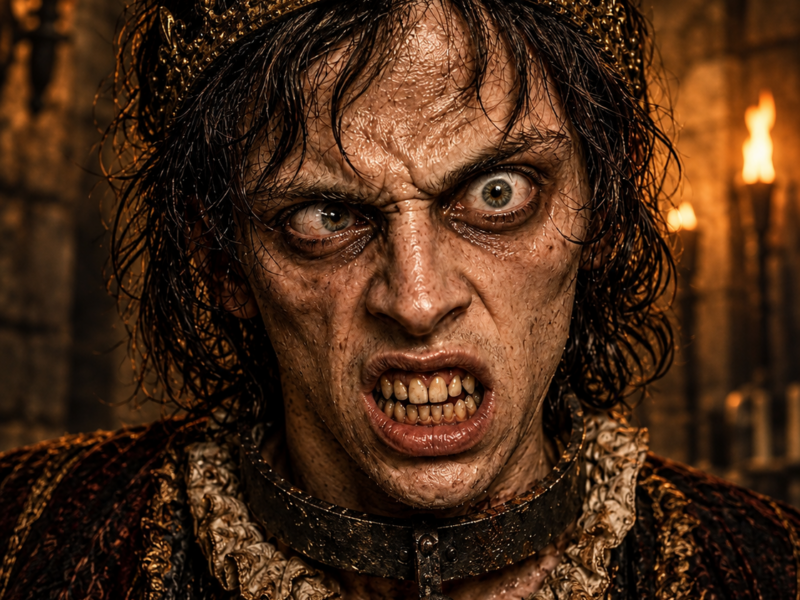
He Armored Up at Midnight to Arrest His Own Son: The Dark Truth About Philip II and Don Carlos
Just before midnight on January 18, 1568, the most powerful king in the world put on a suit of armor.
He did not do it for a battle. He did it for his own son.
Picture the scene. A palace in Madrid, long stone corridors, and almost no light.
Philip II of Spain walked through that darkness with a helmet on his head and a handful of trusted counselors behind him. One of them carried a single lamp ahead of the group.
At the end of the corridor was the bedroom of Don Carlos, the heir to the Spanish throne.
Within minutes, the prince’s sword was gone. So was his gun, and his windows were nailed shut.
Six months later, Carlos was dead at the age of twenty-three.
Within thirteen years, the king’s greatest enemy was telling all of Europe that Philip had murdered him.
So what did Philip II really know about his son? And how does the heir to an empire end up a prisoner in his own father’s palace?
The answer begins long before that night. It begins with a wedding between cousins.
In 1543, Philip, still only a prince himself, married Maria Manuela of Portugal.
These were not ordinary cousins. Philip’s father was the brother of her mother, and Philip’s mother was the sister of her father.
They were cousins twice over, on both sides of the family.
Now look at what that does to a family tree.
A normal child has eight great-grandparents. Carlos had only four, because every pair appeared twice.
One of the women who showed up twice was Joanna of Castile, the queen history remembers as Joanna the Mad.
Go back one more generation and it gets worse. Instead of sixteen great-great-grandparents, Carlos had six.
Even Ferdinand and Isabella, the monarchs who sent Columbus sailing west, sat in his family tree twice.
He was born in Valladolid on July 8, 1545.
Four days later, his mother was dead.
The records cannot even agree on how she died. Some say a fever after the birth, others say a hemorrhage.
Either way, the boy never knew her.
His father was rarely there. Philip spent years at a time away from home, in the Netherlands, in England, in Germany.
So Carlos was raised by his aunts, until their own marriages carried them away too.
He did get a tutor, a man named Onorato Juan, who built him a whole library of history, astronomy, and maps.
What he did not get was a family.
By his teenage years, the heir to Spain had no mother, a father he barely saw, and a body that was already letting him down.
And the foreign ambassadors at court were writing home about every bit of it.
Officially, everything was fine.
In 1560, at Toledo, the Cortes of Castile swore Carlos in as heir to the throne.
The court painter, Alonso Sánchez Coello, painted him standing straight in fine clothes, every inch a future king.
That was the version made for the public.
In private, the ambassadors told their governments something very different.
One of the prince’s shoulders sat higher than the other. One leg was shorter than its twin, and his spine curved inward.
From 1559, he was struck again and again by quartan fever, a kind of malaria that comes back every few days.
Paolo Tiepolo, the Venetian ambassador, reported that the prince had no interest in studying or exercise. His only real interest, Tiepolo wrote, was in hurting people.
An envoy from Vienna noticed something smaller but just as telling. When Carlos spoke, he mixed up his R’s and his L’s.
Put simply, the heir to the Spanish empire had a crooked frame, a speech problem, and a cruel streak.
And foreign courts were reading all about it.
There was one more thing taken from him in those years.
In 1558, Spain and France were negotiating peace, and part of the deal was a bride for Carlos. Her name was Elizabeth of Valois, the French king’s daughter, and she was about his own age.
Then, in November of that year, Philip’s English wife, Mary I of England, died.
When the treaty was signed in 1559, it was Philip himself who married Elizabeth.
At the time, the switch looked like routine diplomacy.
Three hundred years later, it would end up in an opera.
But first, something happened to Carlos that nearly killed him.
Alcalá de Henares, spring of 1562.
Carlos had been sent to this university town for his health and his studies. Two boys his own age went with him: Alexander Farnese, and Don John of Austria, Carlos’s young uncle and the illegitimate son of Emperor Charles V.
On April 19, Carlos went running down a staircase, reportedly chasing a servant girl.
He fell. The back of his head struck a closed door.
The wound was tiny, about the size of a thumbnail. He did not even lose consciousness.
Then, a few days later, the fever started.
The glands in his neck swelled. His right leg went numb. He became delirious.
We know all of this in unusual detail because two of the men treating him, his physician and his surgeon, each wrote a full report of the case.
And what those doctors did behind that bedroom door over the following weeks is where this story turns strange.
The famous anatomist Andreas Vesalius was called in.
He argued that the real damage lay inside the skull, and he pushed to open it.
The Spanish surgeons would not go that far.
Instead, on May 21, they scraped away at the bone until it showed white and sound underneath.
His eyelids swelled so badly that his eyes sealed shut.
Twice, the people around him believed he was dying.
So the friars of Alcalá did something remarkable. They brought in a body.
Fray Diego de Alcalá was a Franciscan who had died in 1463, nearly a hundred years earlier. The friars laid his remains right beside the prince.
Carlos recovered.
A loose piece of bone worked its way out in June. On July 13, after nearly three months, he was declared cured.
Philip gave the credit to the dead friar.
And in 1588, Pope Sixtus V made Diego a saint, largely because of this very case.
The English ambassador, Thomas Challoner, saw it differently.
He wrote home that nature had healed the prince in spite of what the surgeons did to him.
Whatever saved him, the Carlos who walked out of that sickroom was not an improvement.
His temper had been a problem before the fall. After it, by most accounts, it got worse.
And by 1567, he wanted something his father was never going to give him.
The Netherlands were in revolt, and Carlos believed that the job of governing them had been promised to him.
Philip handed it instead to his veteran general, the Duke of Alba.
Meanwhile, the marriage agreed for Carlos in 1564, to his cousin Anna of Austria, kept getting pushed back.
The French ambassador, Fourquevaux, reported the reason. Philip was afraid that a married son would begin demanding lands of his own to rule, whether Milan, Naples, or Flanders.
Carlos took it badly.
And the stories from these years turn ugly fast.
When he learned that Alba was getting the Netherlands, the prince reportedly drew a dagger on him and had to be held back.
A shoemaker once made him a pair of boots he did not like. Carlos reportedly had them cut to pieces, and made the man eat them.
Someone once splashed water on him from a window. Carlos reportedly ordered the whole house burned.
And all the while, he was running up debts everywhere.
As a preview of how he might rule an empire, it was not exactly reassuring.
Now pay close attention to December 1567.
What Carlos did that month explains everything his father did next.
In confession, he reportedly told a priest that he wanted to kill a man.
The man, everyone understood, was his father.
At the same time, he was quietly raising money and arranging post horses.
In January, he went to his uncle, Don John, who now commanded the Spanish galleys. He asked to be taken to Italy.
Where Carlos actually meant to go from there, nobody has ever been able to say.
Don John asked for a day to think it over.
Then he went straight to the king.
According to historian Geoffrey Parker, when Carlos worked out what had happened, several people saw him go after his uncle. The accounts do not agree on the weapon.
So that was what Philip knew.
His heir was planning to run. And his heir had told a priest he wanted to kill a man.
Just before midnight on January 18, the king came.
He wore armor and a helmet. A small group of counselors followed him, one of them carrying a light ahead through the dark.
They took the sword and the gun from beside the prince’s bed.
They took a box of his papers.
And they nailed the windows shut.
According to historian Henry Kamen, Carlos asked his father if he had come to kill him.
Philip answered that from now on, he would treat him as his king, not as his father.
At one point, Carlos tried to throw himself into the fire.
The men in the room pulled him back.
Philip never told the public what his son had done.
In a letter to Catherine de Medici, the queen mother of France, he described the arrest as a sacrifice to God of his own flesh and blood.
To Carlos’s grandmother in Portugal, he wrote something stranger.
The trouble with her grandson, he said, came from a root that neither time nor treatment could fix.
That was about as much as anyone outside the palace ever got.
Carlos never left those rooms again.
And when he died there six months later, Europe began asking the question people still ask today.
Did his father kill him?
Before we get to that, there is a moment the opera would later twist into a love affair. The real version is quieter.
When Elizabeth heard about the arrest, the queen cried.
Carlos had always been kind to her, this stepmother who was once meant to be his wife.
And Anna, his promised bride, was still waiting on a wedding that kept getting delayed.
But Philip’s words to Carlos’s grandmother left a harder question underneath all the gossip.
If neither time nor treatment could fix it, what was actually wrong with him?
A large part of the answer was written in his family tree.
In 2009, a team of geneticists published a study in the journal PLoS One.
They traced the Spanish Habsburgs back sixteen generations, more than three thousand people, and calculated an inbreeding coefficient for the kings and princes of the line.
That number measures how much of a person’s DNA is likely to be doubled up from the same ancestors.
Philip II, who founded the Spanish branch, scored 0.025.
A child of first cousins scores about 0.06.
Carlos scored 0.211.
That is close to 0.25, the number you would expect from the child of a brother and a sister.
Among the kings and princes in that study, only two scored higher. One of them, as you will see, was the half-brother Carlos never met.
Now think back to those ambassadors’ letters. The uneven shoulders. The short leg. The fevers that kept coming back.
The study’s own authors are careful about one thing, though.
Their evidence for what inbreeding did to these people is indirect. Nobody can prove it is what broke Carlos’s mind.
He also had a skull infection at sixteen, years of malaria, and a childhood without his parents.
What the family tree did was stack the odds against him before he was ever born.
And in those locked rooms in Madrid that summer, his body began to give out.
Carlos swung between starving himself and eating far too much.
He swallowed a diamond ring, apparently hoping it was poisonous.
In the heat of the Madrid summer, he drank enormous amounts of iced water and had ice brought into his room.
By July, he was terribly thin.
On July 24, 1568, Carlos died in his rooms at the Alcázar.
He was twenty-three years old.
The likeliest explanation is the plainest one. Starvation, fever, and a body that was weak to begin with.
The French ambassador put it more coldly.
He wrote that the prince’s death had solved a number of problems for the king.
Philip ordered that his son not be spoken of in public. His body was later moved to the royal crypts at El Escorial.
Up to then, Philip had kept the story almost as tightly locked away as his son.
That was about to flip.
In 1570, the English writer John Foxe put a version of it in his Book of Martyrs, claiming the Inquisition had demanded the prince’s death.
Then, in 1581, William of Orange, the leader of the Dutch revolt and Philip’s sworn enemy, published a defense of his rebellion.
In it, he accused Philip of having murdered his own child and heir.
After the politicians, the writers took over.
A French novella in 1672. A play by Friedrich Schiller in 1787. And in 1867, an opera by Giuseppe Verdi, Don Carlos.
In Verdi’s version, the prince is a tragic young lover, the queen is his lost love, and the king is a jealous tyrant.
The historian John Elliott called the murder story long discredited.
Yet Verdi’s opera is still on stage tonight, and it still tells the story the way Philip’s enemies told it.
And the opera leaves out what happened next.
Elizabeth died in October 1568, ten weeks after Carlos, following a premature birth.
Two years later, Philip married again.
His new wife was Anna, the cousin who had been meant for his son. She was also Philip’s own niece.
Their son became Philip III.
That same 2009 study gave him an inbreeding coefficient of 0.218, even higher than the half-brother he never met.
And Carlos was never a one-off.
The family went on marrying cousins and nieces for generations after him.
Now you know what Philip knew about his son, and why the murder story refused to die.
But the bride Carlos lost became the great-grandmother of the girl at the center of Velázquez’s Las Meninas.
And her family made the very same choice for her.
What it did to little Margarita Teresa is a story all its own.









