He Almost Drove Past… Until the Dog Refused to Leave the Abandoned Ambulance
A dog can wait beside an empty vehicle for food, shelter, or someone he remembers.
But a dog that refuses all three is usually waiting for something else.
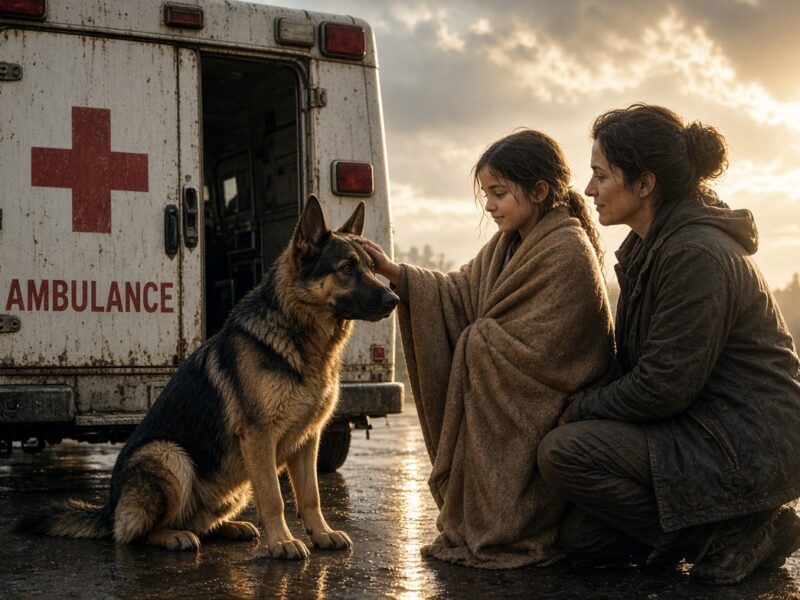
At 5:48 in the morning, Staff Sergeant Cole Harrison is less than twenty minutes from home when he sees the German Shepherd sitting behind an abandoned ambulance.
The old vehicle rests crooked beside a shuttered medical transport building outside Jacksonville, North Carolina.
Its white paint dulled by months of weather, its rear windows dark, its emergency markings half peeled away.
Rainwater runs along the curb in thin silver ribbons.
Pine needles cling to the pavement.
The storm that rolled through overnight has moved east, but the air still smells of wet asphalt, cold metal, and soaked earth.
Cole nearly drives past.
Nearly.
He has been awake since the previous evening, and every part of him wants coffee, a hot shower, and a few hours of sleep.
Then the dog turns its head.
Black and tan coat.
Mud along the legs.
Amber eyes fixed not on Cole’s pickup, but on the ambulance.
Cole eases onto the shoulder and stops.
A groundskeeper in a yellow rainshell is standing near the fence with half a breakfast sandwich in one hand.
“Been trying to get him to come over here,” the man says.
“Won’t touch food. Won’t leave that bumper either.”
Cole steps out into the damp morning.
The German Shepherd does not bark.
Does not growl.
Does not retreat.
He simply watches Cole for one second, then turns back toward the rear doors of the ambulance.
Cole notices the posture first.
Not panic, not confusion.
Focus.
The dog sits close enough that his shoulder nearly touches the metal bumper.
His ears angle forward toward the rear compartment.
Water drips steadily from his coat, but he barely seems to feel it.
“How long has he been here?” Cole asks.
The groundskeeper shrugs.
“He was here when I came in about twenty minutes ago. Could have been all night.”
Cole looks at the ambulance.
No plates.
Flat rear tire.
Rust beginning along the lower door seam.
One side mirror folded inward.
Nothing about it suggests anyone has used it recently.
The building behind it is dark.
A sign hangs crooked near the entrance.
“This thing operational?” Cole asks.
“Not for months. Company folded. Trucks are supposed to go to auction.”
The dog rises.
Just once.
He takes two steps toward Cole, then turns back and places his nose near the narrow seam between the rear doors.
Cole feels something tighten in his chest.
He has spent enough time around military working dogs to know that attention can look very different from fear.
This dog is not waiting to be rescued.
He is waiting for someone else to understand.
Cole moves closer, stopping several feet from the doors.
“Hey, buddy.”
The German Shepherd looks at him, then at the ambulance, then back at him.
Slow.
Deliberate.
Cole studies the dark rear glass.
For a moment, there is only his own reflection and the pale gray morning behind him.
Then he sees a faint patch of fog near the lower corner of the window.
It could be moisture.
It could be leftover condensation.
It could be nothing.
Cole takes one more careful step.
The dog’s ears lift.
The groundskeeper starts to say something, but Cole raises one hand.
“Hold on.”
Silence settles around them.
Water ticking from branches.
A distant truck on the highway.
The faint drip from the ambulance roof.
Cole leans slightly toward the rear doors.
At first, he hears nothing.
Then something small comes from inside.
A sound so soft he almost dismisses it as rain moving through metal.
He waits.
The German Shepherd does not move.
Cole holds his breath.
The sound comes again.
Not a scrape.
Not water.
A broken little sob from somewhere in the back of the ambulance.
Cole’s exhaustion disappears.
His eyes lock on the doors.
Beside him, the German Shepherd stands.
Cole does not reach for the rear door handle.
Every instinct tells him there is someone inside, but instinct is not the same as permission.
And an abandoned emergency vehicle can hide more hazards than answers.
He takes out his phone and calls county dispatch.
The groundskeeper stands a few feet away, breakfast sandwich forgotten in his hand, while the German Shepherd remains beside the bumper with his eyes fixed on the dark glass.
“I am at the old medical transport lot off Pine Hollow Road,” Cole says.
“There is a decommissioned ambulance here. I may have heard a child inside the rear compartment.”
The dispatcher asks him to repeat the location.
Cole does.
Then comes the question that makes the morning feel even stranger.
“Are you certain the vehicle is not in service?”
Cole looks at the flat rear tire, the missing license plates, the faded paint, and the weeds growing around the passenger side.
“It has not moved in months.”
The groundskeeper nods quickly.
“Eight months, maybe more. Company shut down last spring.”
Cole passes that along.
The dispatcher tells him not to force entry unless there is an immediate visible life threat and says fire rescue and law enforcement are being sent.
Cole agrees.
He slips the phone to speaker mode and lowers himself near the rear doors, keeping several feet of space between himself and the vehicle.
The German Shepherd shifts closer to him.
Not touching.
Just there.
Cole studies the rubber seals around the doors.
Water beads along the metal.
One of the rear windows is clouded near the bottom, but the rest is too dark to see through.
“Can you hear me?” he calls.
Nothing.
The groundskeeper looks toward him, uncertain.
Cole waits.
Rainwater drips from the edge of the roof onto the pavement with a slow metallic rhythm.
One.
Two.
Three.
Then silence.
Cole starts to think the sound he heard before may have been trapped water moving somewhere inside the vehicle.
The German Shepherd suddenly lifts his head.
His ears angle forward.
Cole turns back toward the doors.
“If someone is in there, knock on the door.”
For a second, nothing happens.
Then three faint taps come from inside.
Cole freezes.
The groundskeeper’s face changes.
“You heard that?”
“Yeah.”
Cole moves no closer.
“Do it again.”
Three taps.
Weak, uneven, but unmistakable.
The dispatcher hears them through the phone.
Her voice becomes sharper, more focused.
She tells Cole responders are less than ten minutes away and asks whether he can establish voice contact.
Cole looks at the narrow seam between the rear doors.
“I am outside the ambulance,” he says clearly.
“Help is coming. Can you tell me your name?”
No answer.
The German Shepherd takes one step toward the doors and presses his nose near the lower seam.
His tail does not move.
His whole body seems to listen.
Cole tries again, softer this time.
“You do not have to be afraid. I am staying right here.”
A small sound comes from behind the metal.
Not words yet.
Just breathing.
Then a child’s voice, thin with cold and exhaustion.
“Please do not leave.”
Cole’s expression tightens.
“I am not leaving.”
The German Shepherd turns his head and looks directly at him.
For the first time since Cole arrived, the dog steps away from the ambulance and comes close enough to stand beside his knee.
Cole keeps his eyes on the rear doors.
“Can you tell me your name?”
A pause.
“Emma.”
“All right, Emma. My name is Cole. I need you to keep talking to me.”
He hears her take a shaky breath.
“Is the dog still there?”
Cole glances down.
The German Shepherd has already returned to the bumper.
“Yes,” Cole says.
“He is still here.”
Inside the ambulance, Emma begins to cry again, but this time there is something different in it.
Relief.
Cole keeps his voice steady because Emma does not need to hear the concern growing behind it.
“You are doing good, Emma. Just keep talking to me.”
For several seconds, only her breathing comes through the metal doors.
It is faint, uneven with exhaustion, but present.
Cole looks toward the German Shepherd.
The dog has returned to the same place beside the rear bumper.
Ears forward.
Eyes fixed on the ambulance as if nothing else in the wet parking lot matters.
“Are you hurt?” Cole asks.
“I do not think so.”
Emma pauses.
“I am just really cold.”
“All right. Do not try to move around unless you need to. Fire rescue is coming to get you out.”
He deliberately avoids promising how soon.
Marines learn early that calm does not come from pretending everything is fine.
It comes from knowing what can be controlled and holding on to that.
The dispatcher remains on speaker, quietly collecting information.
“Ask her age,” she says.
Cole leans slightly toward the doors.
“Emma, how old are you?”
“Nine.”
The answer is clearer this time.
“Good. Nine years old. Can you tell me if you are sitting or lying down?”
“Sitting on the floor.”
“Can you see any light?”
“A little through the window.”
Cole glances at the fogged rear glass.
“That is good. Stay where you are.”
Behind him, the groundskeeper sets the sandwich on the hood of his maintenance cart and brings over a paper cup filled with water.
Cole pours some into a shallow plastic container he finds near the cart and places it several feet from the German Shepherd.
The dog looks at the water, then at the ambulance.
“Go ahead,” Cole says softly.
“She is still there.”
As if the words matter, the German Shepherd steps away long enough to drink three quick laps.
Then he returns immediately to the rear doors.
Cole watches him settle again.
Whatever brought this dog here, hunger is not what is keeping him.
The dispatcher’s voice changes.
“Staff Sergeant Harrison, we have a possible match.”
Cole straightens slightly.
“Go ahead.”
“There is an active missing child report from overnight. Emma Walsh, nine years old, last seen during the storm evacuation west of your location.”
Cole looks at the ambulance, then toward the empty road beyond the lot.
“How far west?”
“Approximately one and a half miles.”
The groundskeeper hears it and slowly shakes his head.
Cole says nothing for a moment.
A nine-year-old child.
A storm.
More than a mile of dark roads and flooded shoulders.
Somehow she ended up inside a vehicle nobody had used in months.
And somehow this German Shepherd ended up outside it.
“Emma,” Cole says, “is your last name Walsh?”
Silence.
Then, “Yes.”
The dispatcher immediately confirms the identification and tells Cole that Emma’s mother has already been notified that responders may have found her.
Fire rescue is less than five minutes away.
In the distance, Cole finally hears sirens.
Emma hears them, too.
“Is that for me?”
“Yes,” Cole says.
“Those people are coming for you.”
Her breathing catches.
“My mom does not know where I am.”
“She is being told right now.”
The words seem to settle into the darkness behind the doors.
Cole hears a small sniff.
Then Emma asks the question he has been expecting without knowing why.
“Is he still waiting?”
Cole looks down at the German Shepherd.
Rainwater still clings to the fur beneath his chest.
His paws are muddy.
His body must be tired.
Yet his eyes have never left the place where Emma’s voice comes through the metal.
“Yes,” Cole says.
“He has not gone anywhere.”
For the first time, Emma gives a tiny laugh through her tears.
“I knew he would stay.”
Cole turns toward the doors.
The approaching sirens grow louder behind him.
He looks at the dog again, and a new question begins to take shape.
Emma does not sound surprised that the German Shepherd found her.
She sounds as though she knows exactly who he is.
The first fire rescue vehicle turns into the lot just as Cole hears tires on the road behind it.
Red lights sweep across the wet pavement, reflecting in shallow puddles and the dull side panels of the abandoned ambulance.
The German Shepherd rises but does not move away from the rear doors.
Cole keeps his attention on Emma.
“Help is here,” he says.
“You are still doing fine.”
“Okay.”
Her voice is quiet but stronger than it was a few minutes ago.
Two firefighters begin assessing the vehicle while another speaks with the dispatcher.
Cole gives them the facts in short, clear sentences.
Nine-year-old girl.
Conscious.
Cold.
Rear compartment.
Door mechanism unknown.
No visible smoke.
No known collision.
No reason to believe the ambulance is powered.
They nod and take over the technical side without wasting time.
Cole steps back enough to give them room, but not so far that Emma loses his voice.
Then another car pulls into the lot too quickly and stops crooked near the entrance.
A woman gets out before the engine is fully quiet.
She is still wearing a dark sweatshirt under a raincoat, hair damp and loose around her face.
An officer moves toward her, but she is already searching the lot with wide, exhausted eyes.
“Emma,” she calls.
The voice from inside the ambulance changes immediately.
“Mom.”
The woman stops as though the sound has reached her physically.
Her hands cover her mouth.
“Emma.”
This time, the name is barely more than breath.
Cole watches some of the fear leave her face and turn into something more fragile.
Relief can look a lot like weakness when someone has been holding themselves together all night.
The officer guides her toward a safe point away from the working crew.
Cole walks over only when he is certain Emma can still hear him from where he stands.
“You are Sarah Walsh?”
“Yes.”
Her eyes stay on the ambulance.
“Is she all right?”
“She is awake. She is talking. She says she is cold, but she is answering clearly.”
Sarah closes her eyes for one second.
“Thank God.”
Then she opens them again.
“How did you find her?”
Cole looks toward the rear bumper.
The German Shepherd is standing there, body angled toward the ambulance, ears forward.
“He did.”
Sarah follows his gaze.
For a moment, she says nothing.
Cole expects recognition.
Instead, confusion settles across her face.
“Who is that dog?”
Cole studies her.
“You do not know him.”
“No.”
She shakes her head immediately.
“That is not our dog.”
The words land harder than Cole expects.
He glances back at the German Shepherd.
Emma had asked about him more than once.
She had said she knew he would stay.
Sarah takes one small step forward, still staring.
“Emma likes dogs, but we do not have one.”
Cole turns back toward the ambulance.
The mystery changes shape.
Until now, he had assumed the dog belonged to the family and had somehow tracked the girl after the storm.
That explanation was simple.
Familiar scent, familiar voice, familiar bond.
But Sarah’s answer removes the easiest part of it.
From inside, Emma calls again.
“Is he still there?”
Cole looks at Sarah, then at the dog.
“Yes,” he says.
“He is still here.”
Sarah’s brow tightens.
“Why does she keep asking about him?”
Cole does not answer because he does not have one.
Behind them, the German Shepherd shifts closer to the doors and lowers his head.
One of the firefighters kneels near the rear latch, studying the old mechanism before touching anything.
The dog watches every movement.
Not frantic, not aggressive.
Just unwilling to leave.
Cole turns toward the metal doors again.
“Emma,” he says, “I need to ask you something.”
A pause.
“Okay.”
“Do you know this German Shepherd?”
The silence lasts longer this time.
Long enough for Sarah to look at Cole with growing confusion.
Then the child answers from the darkness.
“Yes.”
Cole feels the cold morning settle deeper around him.
“What is his name?”
Inside the ambulance, Emma whispers one word.
“Atlas.”
For a few seconds, nobody says anything.
Sarah looks from Cole to the German Shepherd, then back toward the ambulance as if the name should explain everything.
It does not.
Atlas remains beside the rear doors, listening.
Cole lowers himself again so his voice carries through the scene without forcing Emma to speak louder than she needs to.
“Emma, I need you to help me understand what happened last night. You do not have to tell me everything at once. Just start with where you were before you got here.”
There is a pause.
Then her voice comes softly through the metal.
“We were at the community center.”
Sarah closes her eyes.
She knows that part.
The storm had knocked out power across several neighborhoods west of Jacksonville, and families had been moved temporarily while crews checked flooded roads and damaged lines.
“Mom was talking to somebody,” Emma continues.
“Everyone was moving around. It was loud.”
Cole can picture it without trying.
Wet coats, flashlights, children crying, volunteers calling names over the sound of rain.
“Then what?” he asks.
“I thought Mom was behind me.”
Sarah looks down.
Her face tightens, but Cole keeps his attention on Emma.
“I went outside because people were going to the parking lot. Then the lights went out again.”
Emma stops.
Cole waits.
He has learned that silence sometimes gives frightened people room to remember without feeling pushed.
“I could not see her,” Emma says.
“I called, but everybody was yelling.”
“Did you stay near the building?”
“I tried.”
Her breathing becomes quicker.
“Then I saw cars moving, and I thought maybe Mom went with them.”
Cole glances at Sarah.
She shakes her head slowly, tears gathering again.
“I walked down the road,” Emma says.
“I know I was not supposed to.”
“You were trying to find your mom,” Cole says.
“Keep going.”
“It started raining harder. I saw the ambulance behind the fence. The back door was open a little. I thought maybe somebody was inside who could help me.”
The groundskeeper looks toward the old vehicle, then at the bent section of chain near the side gate where the storm may have shifted the fence.
“I went in,” Emma says.
“There were no lights. It smelled weird, like old plastic.”
Cole looks at the faded ambulance and imagines the rear compartment after months of disuse.
Cold vinyl, dust, a trace of old disinfectant trapped in the walls.
“What happened to the door?”
“The wind.”
Emma’s voice trembles.
“It slammed shut.”
One of the firefighters glances toward the rear latch but does not interrupt.
“I tried the handle inside. It would not work. I yelled. I kicked the door a little. Nobody came.”
Cole keeps his voice low.
“How long were you alone?”
“I do not know.”
She sniffles.
“A long time.”
Rain had hammered the metal roof for hours.
Any small voice from inside could have disappeared beneath it.
“Then I heard scratching,” Emma says.
Cole looks at Atlas.
The German Shepherd lifts his head slightly.
“Scratching where?”
“On the back. Then on the side, like claws.”
Sarah turns toward the dog.
“You heard him?” Cole asks.
“I saw him through the little window when lightning flashed.”
Emma sounds different now.
Less afraid.
“I called his name.”
Atlas steps closer to the door seam.
“Did he leave?” Cole asks.
“No,” Emma answers immediately.
“He stayed.”
A soft metallic sound comes from inside as she shifts.
“Every time I got scared, I could hear his nails outside.”
Cole looks at the dog’s muddy paws.
All night, while the storm covered Emma’s voice, Atlas had given her one sound she could recognize.
Something alive on the other side.
Something that had not gone away.
Cole lets the last sentence settle between them.
Atlas stayed.
Not for a few minutes.
Not until the rain eased.
He stayed through the dark, the wind, the noise, and the long hours when nobody else knew where Emma was.
Sarah looks at the German Shepherd as though she is seeing him for the first time.
“You called him Atlas,” Cole says gently.
“How do you know his name?”
Emma is quiet for a moment.
“From the shelter.”
Sarah looks at Cole, confused, then understanding begins to move slowly across her face.
“The county shelter?” she asks toward the ambulance.
“Yes.”
Emma’s voice is softer now.
“The one near the library.”
Sarah presses one hand to her forehead.
“You mean the reading program?”
“Yes.”
Cole glances at Atlas.
The dog is still standing with his nose near the rear seam, listening to every sound from inside.
Sarah exhales.
“Emma goes there some Saturdays. They let kids read to the dogs.”
The explanation should make the mystery smaller.
Instead, it makes Atlas’s presence feel even more remarkable.
Cole lowers himself again near the door.
“So, Atlas lives there.”
“I think so.”
“And you know him from visiting?”
“He is my favorite.”
The answer comes faster this time.
“Most people pick the younger dogs because they are funny. Atlas just sits there.”
Cole looks at the German Shepherd’s gray-flecked muzzle.
Eight years old, maybe.
Mature, quiet, the kind of dog people sometimes walk past because he does not perform for attention.
“What do you do when you see him?” Cole asks.
“I read to him.”
Emma gives a tiny sniff.
“He likes when I sit by his kennel. I think he likes the mystery books best.”
Sarah lets out something between a laugh and a sob.
“She has been telling me about a dog named Atlas for months.”
Cole turns toward her.
“But you have never brought him home.”
“No.”
Sarah shakes her head.
“We rent. Our lease does not allow dogs.”
Atlas shifts his weight and briefly looks toward Sarah, then returns his attention to the ambulance.
Cole studies him.
“Emma, did you see Atlas before you came into the ambulance?”
“No.”
“Did he follow you from the community center?”
“I do not know.”
“Did you hear him before you got trapped?”
“No.”
Cole looks toward the road.
The county shelter is not next door.
It is farther west, closer to the area hit hardest by the storm.
“Then how did he get here?” Sarah whispers.
Nobody answers.
Cole hears the first fire rescue crew member call out that they are preparing to assess the rear mechanism more closely.
He gives a brief nod but stays focused on Emma.
“Do you remember when Atlas first showed up?”
“It was after the rain got really loud.”
Emma says.
“I had been crying for a while. Then I heard scratching.”
“And you called his name.”
“Yes.”
“What happened?”
“He stopped.”
Cole waits.
“Then I said it again.”
Emma’s voice grows steadier with the memory.
“Atlas. Outside.”
The German Shepherd’s ears lift at the sound of his name.
“He came back to the window,” Emma continues.
“I could see his face when the lightning flashed.”
Sarah covers her mouth again.
“I told him not to go.”
Cole looks at Atlas.
“Did he?”
“No.”
Emma answers immediately.
“He stayed right there.”
The morning feels quieter now, even with engines idling and responders moving around the lot.
Cole had thought Atlas was guarding the ambulance because he knew someone was trapped inside.
Now he understands there is another layer.
Atlas was not staying for a stranger.
Somewhere in the storm, he had found the one child who had spent months sitting beside his kennel when everyone else kept walking.
Captain Rachel Ford reaches the rear of the ambulance with two members of the fire rescue crew and takes in the scene before anyone touches the doors.
She is calm, direct, and careful in the way people become when they have learned that urgency and haste are not the same thing.
“Where is the child positioned?” she asks.
Cole turns toward the metal seam.
“Emma, can you tell us exactly where you are sitting?”
There is a brief pause from inside.
“On the floor, near the back.”
Rachel studies the door handles, then the narrow windows near the doors.
“Are you leaning against the doors?”
“I think so. My back is against something.”
Rachel raises one hand, stopping a firefighter who is preparing a pry tool.
“No force on the rear doors yet.”
The firefighter nods without argument.
Sarah watches from several yards away, arms wrapped around herself beneath her raincoat.
“Why not?” she asks.
Rachel turns just enough to answer.
“Because we do not know what is directly behind them. If Emma is leaning against the doors, I do not want to move anything suddenly until we have a better picture.”
Sarah nods, frightened but grateful for the explanation.
Cole returns his attention to Emma.
“You hear that? They are being careful because they know you are close to the back.”
“Okay.”
“You are doing exactly what you need to do.”
The German Shepherd remains beside the bumper, but his posture changes as the crew begins laying out equipment.
A metal case clicks open.
A flashlight rolls once against the wet pavement before a firefighter catches it.
Atlas lifts his head.
His ears move toward every new sound.
Cole notices the tension travel through the dog’s shoulders.
Not fear.
Attention.
Rachel crouches to inspect the hinges and latch assembly without pulling on anything.
“This is an older conversion,” she says.
“Could be corrosion. Could be an interior latch failure. We need another access point before we make the rear doors move.”
One firefighter walks toward the driver’s side to check the front cab.
Another shines a light through a narrow rear window, but the glass is too cloudy and the interior too dark to make out more than vague shapes.
“Emma,” Cole says, “do you see any lights moving?”
“A little.”
“Good. That is them.”
Sarah steps closer to the boundary the officer has set for her.
“Tell her I am here.”
Cole does.
“Your mom is right outside.”
A tiny sound comes from within.
“Mom.”
Sarah presses both hands over her mouth again.
“I am here, sweetheart.”
Her voice breaks on the last word, but she keeps going.
“I am not going anywhere.”
Atlas turns at Sarah’s voice, then looks back at the ambulance.
For the first time since Cole found him, the dog begins pacing in a tight line beside the rear bumper.
Three steps one way.
Turn.
Three steps back.
Rachel hears the claws against wet pavement and glances over.
“Is he getting agitated?”
“He has been focused on Emma all morning,” Cole says.
“This is different.”
A firefighter kneels near the rear door and positions a small inspection light along the seam.
The tool makes a sharp metallic tap.
Atlas freezes.
His head lifts.
Then he looks toward the passenger side of the ambulance.
Cole follows his gaze.
The dog takes two steps away from the rear doors.
Sarah notices immediately.
“Where is he going?”
No one answers.
Atlas moves faster now, circling along the side of the ambulance with his nose close to the body panel.
Cole stands but does not grab for him.
“Let him move.”
The dog passes one exterior compartment, then another.
At the third, he stops so abruptly that his paws slide half an inch on the wet pavement.
He lowers his head toward the lower edge of a rectangular side door and listens.
Rachel walks toward him slowly.
“What is that compartment?” Cole asks.
She looks at the old ambulance body, then at the latch.
“On some models, storage. On others, access near the patient compartment.”
Atlas presses his nose near the seam.
Then he looks up at Rachel.
For one second, nobody moves.
The dog does not bark.
He does not scratch.
He simply waits beside a different door.
Rachel does not assume Atlas understands the ambulance.
She assumes only that the dog has noticed something the people around him have not.
That is enough to make her look twice.
She crouches beside the rectangular compartment without touching the latch and studies the seams, hinges, and weathered identification plate.
“Older modular body,” she says to one of the firefighters.
“Let us find out what this opens into.”
Cole remains near the rear corner, close enough for Emma to hear him.
“Emma, I am still here.”
“Okay.”
“The rescue team is checking another part of the ambulance. You may hear some sounds outside.”
“Is Atlas there?”
Cole glances toward the passenger side.
The German Shepherd stands perfectly still beside Rachel, nose close to the lower seam.
“Yes. He moved a few feet, but he is still with you.”
Emma is quiet.
“He does that sometimes.”
Cole looks toward the doors.
“Does what?”
“Listens.”
Rachel hears the answer and gives Cole a brief glance.
No one tries to turn it into anything more than that.
A firefighter returns from the cab with information about the vehicle model, while another uses a flashlight to inspect the side compartment.
The outside latch is stiff but intact.
Rachel asks the groundskeeper whether the former company left any vehicle manuals or keys in the building.
He hurries toward the office with an officer.
Atlas does not follow.
His attention remains fixed on the panel.
Cole watches the dog’s nose move slightly along the seam.
Warm air can carry scent through surprisingly small openings.
Sound can travel through hollow vehicle compartments in strange ways.
Atlas does not need to understand any of that.
He only needs to know that Emma is somewhere close.
The groundskeeper returns with an old ring of labeled keys and a weathered binder found inside a filing cabinet.
Rachel checks the vehicle information, then points to a diagram.
“This compartment sits against the rear patient area. If we can open it, we may be able to see through the interior service panel before moving those back doors.”
Sarah grips the front of her raincoat.
“Will that get her out?”
“It may give us a safer view first,” Rachel says.
“That is what we need.”
One firefighter gently guides Atlas back several feet while Cole stays beside him.
The dog resists for only a second, then settles beside Cole, eyes never leaving the compartment.
Rachel tries the matching key.
The lock turns halfway and stops.
She changes the angle, applies steady pressure, and the mechanism finally releases with a dull click.
Atlas stands immediately.
Rachel opens the exterior compartment slowly.
Inside are old storage brackets, a shallow cavity, and a removable service panel along the inner wall.
No medical supplies.
No loose equipment.
Just dust, cold metal, and a narrow route toward the rear compartment.
The crew removes the interior panel carefully.
A thin line of darkness appears.
Then a firefighter raises a small inspection light.
“Emma,” Cole says, “you may see a light beside you.”
A pause.
“I see it.”
Sarah makes a sound behind him and covers her mouth.
Rachel angles the light through the opening.
For the first time, someone outside can see clearly into the rear compartment.
A small figure sits on the floor near the back, wrapped in an old emergency blanket she must have found inside.
She is awake.
She turns toward the light.
Rachel’s voice stays calm, but relief enters it.
“We have eyes on her.”
Cole closes his eyes for one second.
Beside him, Atlas gives a single quiet whine.
Emma turns toward the sound beyond the wall.
“Atlas.”
The German Shepherd steps toward the compartment until Cole gently stops him.
“He is right here,” Cole says.
Rachel studies Emma’s position and the rear doors from inside.
“Good,” she tells the crew.
“She is clear of the door path. Now we can open the back safely.”
Atlas looks from Rachel to the rear of the ambulance.
Then he turns and walks back to the place where Cole first found him beside the bumper.
As if the new information has changed only one thing.
Now the people finally know where to look.
The rear doors do not open all at once.
Rachel wants control, not force.
So the crew works the old latch slowly while one firefighter watches Emma through the service opening and Cole keeps talking from outside.
“You may hear some metal moving now,” he says.
“That is the team making room to get you out.”
“Okay.”
Emma sounds tired but no longer alone.
Atlas stands beside the bumper again, exactly where he was when Cole first saw him.
The dog watches the hands at the latch.
Every small movement pulls his ears forward.
Sarah remains several yards back with an officer, one hand pressed against her chest, the other gripping the edge of her raincoat.
The first door gives with a low groan.
Cool morning air slips into the rear compartment.
Emma flinches at the sudden light, then looks toward the opening.
“There you are,” Rachel says gently.
The second door opens enough for the crew to enter without crowding her.
No one rushes.
A firefighter kneels several feet away and speaks to Emma before moving closer.
“My name is Ben. I am with fire rescue. I am going to check how you are doing.”
“All right.”
Emma nods.
Cole cannot see much from where he stands, but he hears the calm exchange.
Name.
Age.
Breathing.
Hands and feet warm enough to move.
Dizziness.
Pain.
The questions are simple and steady.
After a few minutes, Rachel turns toward Sarah.
“She is cold and exhausted, but she is alert. We are bringing her out now.”
Sarah closes her eyes and exhales a sound that seems to have been trapped in her since the night before.
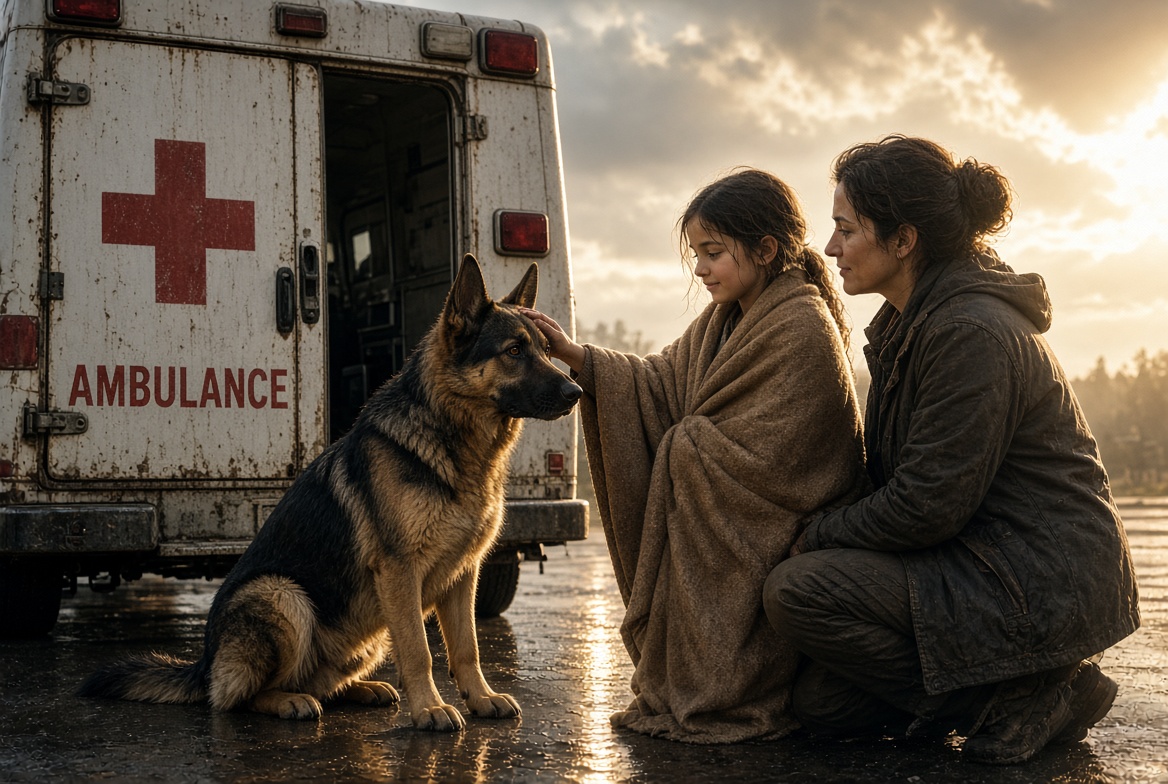
A warm blanket is wrapped around Emma before she is guided carefully toward the doors.
Cole steps farther aside.
This part belongs to the rescue crew and to the mother waiting beyond them.
Atlas does not move.
Emma appears at the rear of the ambulance, small beneath the blanket, hair messy from the long night, face pale with fatigue, but awake.
Sarah makes one step forward, stops when the firefighter asks her to wait another second, then finally reaches her when they are clear of the vehicle.
Emma disappears into her mother’s arms.
Nothing dramatic happens.
Sarah simply holds her as if letting go would be impossible.
Cole looks away for a moment, giving them privacy.
Then he notices Atlas.
The German Shepherd is still beside the bumper.
He has not rushed toward Emma.
He has not barked.
He waits.
Rachel kneels near the dog and removes one glove, letting Atlas smell her hand before she gestures toward the open space.
“All right,” she says softly.
“You can go.”
Atlas looks at her, then at Emma.
He walks forward slowly.
Sarah sees him coming and shifts just enough for Emma to look over her shoulder.
The moment she sees him, her face changes.
“Atlas.”
The dog stops two feet away.
Emma reaches one hand from beneath the blanket.
Atlas steps closer and touches his nose gently to her fingers.
That is all.
No jumping.
No frantic movement.
Just contact.
Emma closes her hand lightly against the fur along his muzzle.
“You stayed.”
Atlas exhales and lowers his head for the first time since Cole pulled into the lot.
The tension leaves the dog’s body.
His shoulders soften.
His ears settle.
Then he folds himself down on the wet pavement beside Emma’s feet.
Cole watches the simple motion and feels the whole morning shift.
Atlas had not been waiting for rescuers to praise him.
He had not been guarding a vehicle.
He had been waiting for one thing only.
To see Emma come out.
And now that she has, he finally allows himself to rest.
By the time the paramedics finish their first checks, the sky has begun to brighten over the wet lot.
Emma is sitting inside a warm rescue vehicle with Sarah beside her, wrapped in two blankets and drinking small sips of water.
Atlas remains on the pavement just outside, close enough to see her through the open side door.
Every few minutes, Emma looks down at him.
Every time she does, his ears lift.
Cole stands near the old ambulance with Rachel while responders secure the scene.
The abandoned vehicle looks different now, less like a mystery, more like a place that almost kept the child hidden because everyone had stopped expecting anything from it.
A county animal control truck pulls into the lot just after seven.
A woman in a navy shelter jacket steps out before the engine fully settles.
She is in her early forties, practical, tired, and moving fast without looking panicked.
“Megan Brooks,” she says to the officer nearest the entrance.
“County Animal Shelter. I was told you found a German Shepherd named Atlas.”
The dog hears his name and stands.
Megan stops.
For the first time that morning, Atlas’s tail gives a slow, unmistakable sweep.
“There you are,” she says.
Relief softens her face.
She approaches carefully, crouches, and lets him come the last few feet.
Atlas presses his forehead briefly against her shoulder.
“You scared ten years off my life.”
Cole looks toward Sarah.
She steps down from the rescue vehicle, keeping one hand on Emma’s blanket.
“You know him.”
Megan glances at Emma, then back at Sarah.
“Very well.”
Emma leans forward.
“He is from the reading room.”
Megan smiles.
“That is right.”
Cole stays quiet.
He already knows part of the story, but now the pieces begin to settle into place.
Megan explains that Atlas has been at the county shelter for almost seven months.
Eight years old, healthy, gentle, easy to handle, but older dogs are often passed over for younger ones, especially when families come looking for energy and novelty.
Atlas had learned not to make much of visitors.
He would sit near the back of his kennel and watch people walk past.
“Except on Saturdays,” Megan says.
Emma looks down at him.
“Because I came.”
Megan nods.
“The shelter partners with a local literacy program. Children come in, sit outside the kennels, and read aloud to dogs that benefit from calm company. Emma started attending months ago. She tried several dogs at first. Then she found Atlas. After that, she always chose him.”
“She would read for forty-five minutes,” Megan says, “sometimes longer if we let her.”
Sarah wipes at one eye.
“I thought she was just telling me stories about him.”
“She was,” Megan smiles faintly.
“Just not made up.”
Emma looks toward Atlas.
“He likes when I do the voices.”
Cole almost smiles.
“Mystery books.”
Emma nods.
“Those are his favorite.”
Megan laughs softly.
“According to Emma.”
For a moment, the whole scene feels lighter.
Then Cole asks the question that still matters.
“How did he get out?”
Megan’s expression changes.
“Storm damage. A section of the back fence came down sometime overnight. We found it at first light. Atlas was gone.”
Sarah looks from Megan to the dog.
“And he came here?”
“Apparently. From the shelter, about a mile and a half depending on the route.”
Cole looks at the flooded roadside beyond the lot.
Not impossible.
Not magic.
Just difficult.
Megan runs a hand along Atlas’s neck.
“He has never had formal search and rescue training,” she says.
“If that is what you are wondering.”
Cole shakes his head.
“I was wondering why he stayed.”
Megan looks toward Emma.
“That part does not surprise me.”
Emma reaches one hand down from the rescue vehicle.
Atlas walks to her immediately.
Megan watches him settle beside the step.
“Some dogs remember the people who make them feel safe,” she says.
“Maybe he found the one person here who had been doing that for him every Saturday.”
Later that morning, after Emma has been cleared to leave with Sarah and Atlas has been checked by the shelter staff, the rain finally stops for good.
Sunlight begins to break through the clouds in pale strips, catching on the wet pavement and the side of the old ambulance.
Cole stands near Megan while she finishes a phone call with the shelter.
Atlas lies beside Emma’s feet, head resting on his paws, eyes half closed for the first time since dawn.
“We found more damage,” Megan says when she hangs up.
“The back fence did not just come loose. A whole section shifted when a tree limb came down. That must be where he got out.”
Cole looks toward the road.
“What time?”
“Hard to know. Sometime after midnight.”
Sarah pulls Emma’s blanket closer around her shoulders.
“That is around when everything got worse at the community center.”
Megan nods slowly.
“Then the timing makes sense.”
Cole does not say anything.
He lets the pieces arrange themselves.
Atlas leaves the shelter during the storm.
Emma becomes separated from her mother.
She walks through the rain, frightened and disoriented.
She finds the abandoned ambulance and climbs inside.
The rear doors shut.
Somewhere in the dark, Atlas crosses into the same part of town.
Maybe he picks up a familiar scent on wet pavement.
Maybe he hears Emma calling when the rain drops for a moment.
Maybe he simply finds the ambulance because he passes close enough to recognize something he knows.
None of them can prove the exact path.
They do not need to.
“He found her,” Sarah says quietly.
Megan looks down at Atlas.
“Yes.”
“And stayed all night.”
“Looks that way.”
Emma reaches down and rubs the fur between his ears.
“He knew it was me.”
Megan smiles, but there is no mystery in her answer.
“I think he knew enough.”
Cole looks at her.
Megan continues.
“Dogs remember voices. Scent. Routine. People who spend time with them. Atlas heard Emma every week for months. She sat close to him. She touched the same blankets. Carried the same backpack. Read in the same voice. To him, she was not a stranger.”
Emma looks thoughtful.
“So he remembered my smell.”
“Probably your smell and your voice.”
“And the books.”
Megan laughs softly.
“Maybe not the books.”
Emma smiles for the first time without tears.
Cole watches Atlas lift his head when she speaks.
Not because of a command.
Not because of formal training.
Just recognition.
Familiarity.
Attachment built slowly through ordinary Saturdays that nobody expected to matter this much.
Sarah looks at the old ambulance.
“I keep thinking about what would have happened if he had left.”
Cole does too, but he does not answer.
Some questions do not need to be finished.
Megan reaches down and checks Atlas’s collar.
“People are going to want to turn this into something bigger than it was,” she says.
“They will call him a rescue dog.”
Cole glances toward the German Shepherd.
“He rescued her.”
Megan considers that.
“Maybe. But not because someone taught him how.”
Emma looks down at Atlas.
“Then why?”
Megan takes a moment before answering.
“Because you mattered to him.”
The words are simple enough that nobody tries to improve them.
Across the lot, firefighters finish packing their equipment.
The old ambulance stands open now, rear doors wide, morning light reaching into the compartment that had been dark all night.
Atlas looks toward it once, then he looks back at Emma and stays where he is.
By early afternoon, Cole has finally made it home, but sleep does not come easily.
His phone keeps vibrating on the kitchen counter.
A message from a co-worker.
Another from someone in his neighborhood.
Then a link to a local news story that already has his name in the headline.
Marine helps save missing girl.
Cole reads only the first few lines before setting the phone face down.
He knows what really happened, and the headline feels too clean for a morning that depended on so many small things going right.
A groundskeeper who noticed a dog.
A dispatcher who listened.
A fire rescue crew that did not rush the wrong door.
A shelter worker who knew the dog’s history.
An Atlas who had been there before any of them.
Cole makes coffee he does not need and stands by the window while the late sunlight brightens the wet street outside.
An hour later, Sarah calls.
Her voice is calmer now.
Emma is home, warm, fed, and resting.
Atlas has been returned temporarily to the county shelter while staff repair the damaged fence and finish checking him over.
“Emma keeps asking when she can see him,” Sarah says.
Cole smiles faintly.
“I figured she would.”
There is a pause.
“People keep telling me you saved her.”
Cole looks down at the coffee in his hand.
“The fire rescue team got her out.”
“You found her.”
“Atlas found her.”
Sarah is quiet.
“You stopped.”
That lands differently.
Cole leans against the counter.
He thinks about how easy it would have been to keep driving.
Another twenty minutes and he would have been home.
Another driver might have assumed the dog was waiting for food.
Another person might have called animal control and never looked at the rear doors.
“He was already asking for help,” Cole says.
“I just listened.”
Sarah does not answer right away.
When she does, her voice is soft.
“That still matters.”
Cole does not argue.
He knows better than to turn humility into another kind of performance.
“How is Emma?” he asks.
“Tired, but she keeps talking about Atlas.”
“That sounds like her.”
Sarah laughs quietly.
“She wants to read to him tomorrow.”
“Probably good for both of them.”
After the call ends, Cole finally checks the news story again.
There is a photograph of the abandoned ambulance behind emergency vehicles.
Atlas is visible near the bumper, small in the frame, almost easy to miss.
The article calls Cole brave.
It calls the rescue dramatic.
It calls Atlas extraordinary.
Cole looks at the picture for a long moment.
Extraordinary is not the word he would use.
Atlas had not done anything flashy.
He had simply stayed where someone needed him.
That evening at the shelter, Emma sits on a folding chair outside Atlas’s kennel with a blanket around her shoulders and a mystery book open in her lap.
Sarah sits nearby.
Megan watches from the hallway.
Atlas lies close to the gate, head raised, eyes on Emma.
“Ready?” she asks him.
His ears lift.
Emma begins reading.
Her voice is still a little tired but steady.
Atlas settles down.
No storm.
No metal doors.
No one calling from the dark.
Just the familiar sound of a child reading to a dog who remembers her.
And this time, neither one is alone.
Three weeks later, the county shelter smells like clean blankets, disinfectant, and the faint cedar scent of fresh lumber from the repaired back fence.
The storm damage is gone.
New posts stand where the old section collapsed, and sunlight falls across the kennel hallway in warm rectangles.
Emma walks beside Sarah carrying the same mystery book she has read to Atlas so many times.
She is back at school now.
The color has returned to her face.
The only thing that remains from that night is the way she sometimes reaches for her mother’s hand without thinking when heavy rain begins.
At the far end of the hallway, Atlas is lying on his blanket.
He hears Emma before he sees her.
His head rises.
His ears turn toward the familiar voice.
Then she steps into view.
Atlas stands.
His tail begins moving slowly.
Emma smiles.
“Hi, Atlas.”
Usually, she would pull the folding chair toward his kennel, open her book, and stay for forty-five minutes before promising to come back the following Saturday.
Today, there is no chair waiting.
Megan Brooks stands beside the kennel holding a folder.
Cole is there, too, leaning against the hallway wall with a paper cup of coffee.
Sarah had invited him, and although he nearly declined, Emma had insisted.
“You came,” she says.
“Would not miss it,” Cole answers.
Emma looks toward her mother.
Sarah nods.
The past few weeks have been filled with paperwork, conversations, and changes that had already started before the storm.
Sarah had signed a lease on a small duplex with a fenced backyard before Emma disappeared, and the new landlord allows dogs.
They moved in four days ago.
For months, Sarah had quietly considered adopting Atlas once they were settled.
The storm did not create that decision.
It only made her understand how much the dog was already part of Emma’s life.
Megan opens the kennel door.
Atlas looks at her, then at Emma, waiting for the familiar routine.
“Come on, old man,” Megan says softly.
“Different kind of Saturday.”
Emma clips the new blue leash to his collar.
Atlas steps into the hallway and immediately moves beside her.
Megan kneels and rubs the fur along his neck.
“You behave yourself.”
Atlas gives her one slow look.
“That means no escaping fences,” she adds.
Cole smiles into his coffee.
Outside, the morning is cool and bright.
Sarah opens the rear door of her sport utility vehicle.
A folded dog blanket covers the seat.
There is a water bowl on the floor and a new collar tag that catches the sunlight when Atlas moves.
Emma climbs in first.
Atlas pauses beside the open door.
For one small moment, everyone becomes quiet.
Seven months in the shelter have taught him what departures usually mean.
People arrive.
People look.
People leave.
Emma pats the seat beside her.
“Home, Atlas.”
His ears lift at the word.
Then the German Shepherd steps into the vehicle.
No hesitation.
After that, he turns once, settles beside Emma, and places his head across her leg.
Megan closes the door gently.
Through the window, Emma opens her mystery book.
Cole watches her begin reading before Sarah even starts the engine.
Atlas’s amber eyes slowly close.
There is no storm outside.
No abandoned ambulance.
No metal wall between them.
Just a child, a dog, and the familiar sound of pages turning.
Cole remembers Atlas sitting in the rain, refusing food because someone behind a locked door still needed him.
Now there is nothing left for him to guard.
Nothing left to wait beside.
Sarah pulls away from the shelter, and Atlas does not look back.
For the first time, staying and leaving mean the same thing.









