From Ballon d’Or Favorite to Benched at the Bernabéu: How Vinícius Júnior’s Two-Year Collapse Really Happened
Two years ago, Vinícius Júnior walked into the biggest night in football convinced he was about to be crowned the best player on the planet.
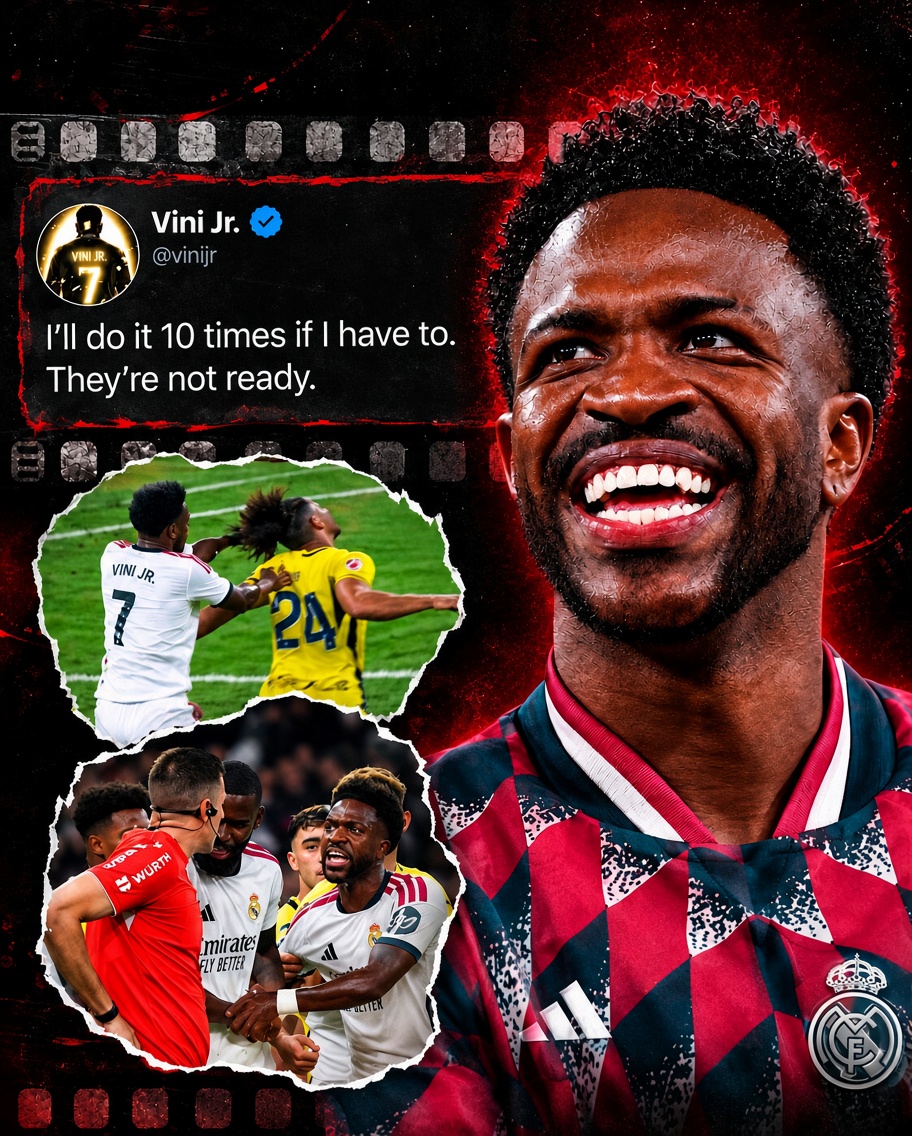
Last weekend, he walked out of the Santiago Bernabéu with a red card for pulling an opponent’s hair.
Between those two moments sits one of the strangest declines in recent football, and it was not caused by a single injury, a single mistake or a single villain.
It was a slow chain of decisions, rivalries, contract fights and bad nights, and a recent video has laid it out from start to finish.
What follows is that story in order, with the creator’s opinions marked as opinions, and with the caution that this is a narrative built on his reading of events.
Begin with last Saturday, because it is the picture that explains everything else.
Real Madrid hosted Villarreal on the eighth matchday, and José Mourinho made a decision he had avoided all season. He left Vinícius on the bench.
The Brazilian, long the team’s biggest star, had lost his place to Diomandé, a young Ivorian signed this summer for a reported 140 million euros.
Vinícius had been struggling for weeks. His numbers were down, the goals had dried up, and part of the Bernabéu was growing impatient.
When Mourinho sent him on in the 52nd minute, it looked like the perfect chance to remind everyone why he mattered.
Ten minutes later, Diomandé scored his first goal in a Madrid shirt. The player who had taken his place was now the hero of the night.
Then, in the 72nd minute, Jude Bellingham cut the ball back from the left, and Vinícius finished it. After weeks of criticism, he ran off to celebrate.
While he did, the referee received a VAR alert. Isidro Díaz de Mera went to the monitor to check an action from seconds earlier that almost nobody had seen live.
During a run down the flank, Vinícius had pulled an opponent’s hair. The goal was disallowed and he was shown a straight red card.
He protested furiously, confronted the referee, and teammates had to step in. In a matter of seconds, he had gone from regaining his status to leaving his team with ten men.
Afterward, Villarreal captain Juan Foyth said he did not believe Vinícius meant to hurt anyone, but he noted that the rules require a sending-off.
The player later posted an apology on Instagram to his teammates and the fans, though he did not name the opponent. Mourinho chose not to speak to the press.
The stakes are bigger than they look. A suspension could rule Vinícius out against Sevilla, and depending on the length, the Clásico against Barcelona on October 25.
It all comes at a delicate moment. His market value has reportedly fallen by almost half from the 200 million euros it once reached.
To understand how a star reaches that point, you have to go back to the summer of 2024.
Real Madrid had just won its 15th Champions League, and Florentino Pérez was about to present the player he had been chasing for years: Kylian Mbappé.
On July 16, 2024, Mbappé was unveiled before a packed Bernabéu. He arrived from Paris Saint-Germain on a free transfer, but the deal was far from free.
He received a substantial signing bonus and terms that put him among the best-paid players in the squad.
The creator makes a point that frames the whole story. Madrid had kept winning without Mbappé, taking two Champions League titles in the three seasons before he arrived.
Vinícius was central to both. He scored the winner against Liverpool in the 2022 final and found the net again against Borussia Dortmund in the 2024 final.
At 24, he had gone from a winger criticized for his finishing to one of the most decisive players in the world.
That raises the question the creator keeps returning to. Did Madrid actually need Mbappé?
On talent alone, adding a forward of that caliber looked like an opportunity nobody could refuse. But in sporting terms, the club was placing a new superstar in a team that already had one.
And both players wanted the same space. Each had built a career by attacking from the left, taking on defenders and being the star of the move.
Carlo Ancelotti tried to solve it by using Mbappé as a center forward and keeping Vinícius on the left. But the Frenchman kept drifting toward that wing, and the Brazilian had to learn to share.
That mattered because freedom was the heart of Vinícius’s game. Madrid’s attack had been designed to give him room to take risks and try again and again.
The creator’s view is that Florentino’s mistake was assuming two extraordinary players automatically make a better team. He is careful to add that nothing suggests Mbappé wanted to hurt his teammate.
The next test arrived quickly, on October 28, 2024, at the Ballon d’Or gala in Paris.
Vinícius arrived as one of the favorites. He had been decisive in the Champions League, scored in the final, and much of the press expected him to win.
But a few hours before the ceremony, Real Madrid received information that he would not be the winner. The club made a drastic decision and canceled its entire delegation’s trip.
Neither Vinícius, nor Florentino, nor Ancelotti attended, even though the club had been named best of the year and its coach was due to receive an award.
The award went to Rodri, the Manchester City midfielder, who had won the Premier League and the European Championship with Spain. Vinícius finished second.
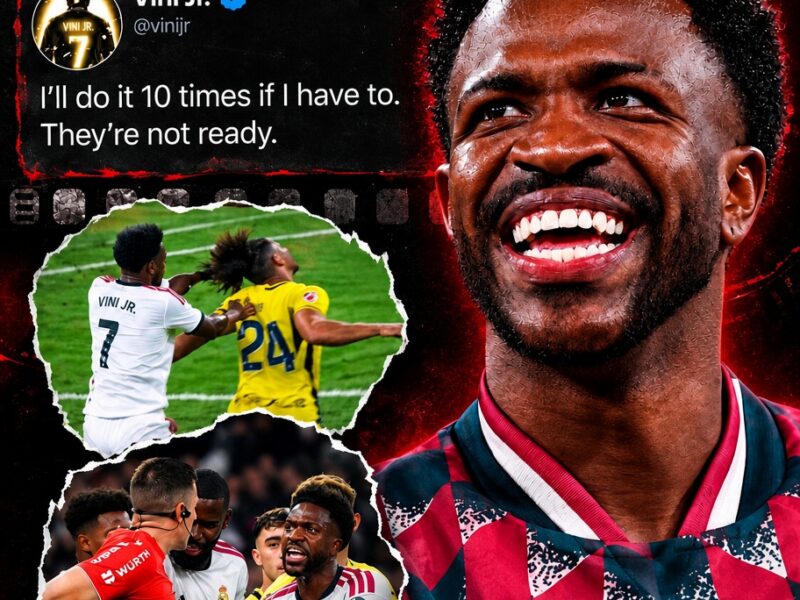
That night, the Brazilian posted a message saying he would do it ten times more if he had to, and that the others were not ready.
It was the response of a player who still believed the prize was coming. The following months made that harder to believe.
On January 3, 2025, Madrid visited Mestalla for a postponed match against Valencia. The team was losing 1-0 when Vinícius became involved in another controversy.
After a play in the box, he was on the ground when Valencia goalkeeper Dimitrievski came over to pat him on the back and ask him to get up.
Vinícius reacted by hitting the goalkeeper in the face, and the referee, after a VAR check, showed a straight red card.
Teammates had to hold him back as he protested angrily. The sending-off cost him a two-match ban, and that night he apologized to his teammates.
Remarkably, Madrid won anyway. Luka Modric equalized in the 85th minute and Bellingham scored in stoppage time, giving Madrid a 2-1 win with ten men.
The story is revealing. While Vinícius was adding another controversy to his record, Mbappé and the team around him were finding their form.
By the end of that season, the gap in the numbers was clear. Mbappé finished with 44 goals in 59 matches, including 31 in the league, winning the Pichichi and the Golden Shoe.
Vinícius ended with 22 goals in 58 matches. Those are solid numbers for any forward, but compared with his previous season, they showed a drop in efficiency.
More importantly, Mbappé had become the team’s main reference. And the club itself fell short of expectations, losing to Arsenal in the Champions League quarterfinals while Barcelona won the three major domestic trophies.
The creator’s reading is that Madrid had signed the best forward available, but may have hindered one of the best players it already had. He adds that Vinícius perhaps did not know how to adapt to no longer being the center of attention.
While the on-field picture shifted, another fight was building off the pitch, and this one was about money.
Madrid had been negotiating a renewal for months. The Brazilian’s contract was due to end in June 2027, and he was earning about 17 million euros net per season, including bonuses.
The club was willing to raise that to 20 million a year. According to ESPN, his representatives wanted something close to 30 million, through a higher fixed salary and extra bonuses.
One of their reference points, the video says, was Mbappé’s deal, whose signing bonus made his total income far higher than Vinícius’s.
That created an interesting contradiction. Vinícius had joined Madrid at 18, endured years of criticism, and earned his place. Now a new arrival had financial terms he wanted to match.
From his side, it could feel hard to accept that the club would make such an effort for Mbappé but not for a player who had contributed to its success for years.
The club saw it differently. Mbappé had cost no transfer fee, and the bonus was part of the price of signing him. Vinícius already had a valid contract, and the talks were about improving it.
A 30-million salary could also upset the balance of a squad full of important players. So the talks stalled at that stage.
Saudi Arabia kept showing interest in the meantime, with extraordinary sums mentioned. The available information did not confirm any formal offer accepted by Madrid.
Vinícius himself publicly said he wanted to stay and become a Madrid legend, but his representatives would not accept just any deal.
Then came a change of coach, and with it a new test.
Ancelotti left, and Florentino chose Xabi Alonso, a former player who had built his reputation at Bayer Leverkusen.
Under Alonso, Mbappé became the clear attacking reference and took over penalty duties. Vinícius quickly learned that his place was no longer guaranteed.
On the second matchday against Oviedo, Alonso left him on the bench and played Rodrygo instead. There was no midweek match or fatigue to justify it.
For a player who was the club’s third captain, who had spent seven years at the club and scored in two Champions League finals, it was a new and uncomfortable situation.
The tension boiled over on October 26, 2025, in the Clásico at the Bernabéu. Madrid was leading 2-1, and Vinícius was playing well.
Around the 70th minute, the fourth official raised the board with his number. He took a few seconds to understand, pointed at himself, and then lost his temper.
Cameras caught him protesting as he left the pitch. Reports afterward said he complained that it was always him and even threatened to leave the team.
Alonso barely reacted. He asked him to calm down and stayed focused on the match.
When the final whistle came, a scuffle broke out between players, and the Brazilian reappeared to confront several Barcelona players, including Lamine Yamal.
Madrid won the match, but the conversation afterward was about Vinícius. People close to the club said Alonso may have been hasty in substituting one of the best players on the pitch.
But they also said a captain cannot react that way in front of his coach and a full stadium.
Three days later, Vinícius apologized to the fans, his teammates and the president. He did not apologize to the coach.
From that point, the decline accelerated. He went 16 consecutive games without scoring and, for the first time, heard whistles from part of the Bernabéu.
His inner circle believed reports about his financial demands had damaged his image with some supporters.
The numbers were harder to argue with. In his first 24 matches under Alonso, he scored five goals and provided eight assists.
That meant roughly a goal every 356 minutes. At his peak two years earlier, it was one every 129.
Meanwhile, Mbappé scored 29 goals in the same 24 games, close to one every 73 minutes.
The creator reads the gap as a sign that the ecosystem had changed. Vinícius had gone from having the whole wing to himself, to sharing it, to competing for his place.
But he also insists on a second point. Losing prominence is part of football, and responding by marching to the tunnel when a coach substitutes you, or constantly confronting rivals and the stands, were choices Vinícius made himself.
That balance runs through the entire video. Madrid may have changed the context, and he may not have reacted well to it.
The pressure soon claimed Alonso as well. In January 2026, after only seven months, Madrid parted ways with him, following a defeat to Barcelona in the Spanish Super Cup final.
Álvaro Arbeloa, who had been working in the youth ranks and managing Castilla, took over. And under him, something unexpected happened: Vinícius looked like his old self.
Arbeloa took a different approach. Rather than questioning the Brazilian’s importance in public, he supported him and gave him confidence.
Vinícius regained a leading role in the attack. By mid-March, he had 15 goals and 11 assists on the season.
His best night came on March 17 at the Etihad, in the second leg of the Champions League round of 16. Madrid had won the first leg and needed to protect its lead.
Vinícius won a penalty that led to Bernardo Silva’s expulsion and converted it himself. City equalized, but in stoppage time he scored again to secure a 2-1 win.
It was a great Champions League night, and some outlets began talking again about a Ballon d’Or run.
The creator highlights a detail worth noting. When Arbeloa took charge, Mbappé was dealing with a knee injury that limited his participation.
That does not mean Vinícius’s improvement can be blamed on Mbappé’s absence, he says, but the coincidence is interesting. When the Frenchman stopped being available regularly, the Brazilian regained importance.
Not every episode that year was about football, though. In February, in a Champions League knockout tie against Benfica in Lisbon, Vinícius scored the winning goal.
Shortly afterward, there was a confrontation with Benfica’s Prestianni, a young Argentine player. Cameras showed the player covering his mouth with his shirt while speaking to Vinícius.
Vinícius told the referee that his rival had insulted him with a racist slur, which triggered the anti-racism protocol and stopped the match for several minutes.
Prestianni denied saying it. UEFA opened an investigation and, according to the video, ultimately handed him a six-match ban for discriminatory behavior.
The episode had consequences beyond that tie. In April 2026, the rule-making body IFAB approved a change allowing players to be sent off for deliberately covering their mouths during a confrontation, which became known as the Prestianni law.
Despite that stretch of revival, Madrid again failed in the big competitions and Arbeloa was dismissed.
Florentino turned to a very different figure: José Mourinho, who had coached the club from 2010 to 2013 and had a reputation for strong authority and clashes with players.
According to El Mundo, Vinícius welcomed the idea of working with him, convinced he could help him recover his best version.
But the contrast with Arbeloa was stark. One coach had tried to restore the player through confidence. The other was known for demanding discipline from everyone, regardless of status.
Before that relationship began, there was the 2026 World Cup, a chance to rebuild his standing without Mbappé.
He started well, with four goals by the time Brazil faced Norway on July 5 in the round of 16.
In that match, he tried everything. He took on defenders, beat Christopher Ajer with a stepover, and set up Endrick in a good position.
But the match stayed scoreless until Erling Haaland scored in the 79th minute and added a second as Brazil pushed forward. Neymar scored a late penalty, but it was too late.
Norway won 2-1. Brazil was out, and Vinícius had another blow to absorb after two years of declining status.
The new season began under Mourinho, and the early weeks only made things worse.
Vinícius stayed far from his best and was substituted more often. And on October 10, against Villarreal, he lost something that two years ago seemed impossible to lose.
His starting place went to Diomandé, a 19-year-old who had just arrived. That brings us back to the beginning, with Vinícius on the bench, scoring a goal he desperately needed, and watching it vanish on a VAR review.
The creator is careful on one point. The red card does not explain his decline, he says. It is simply the perfect image of it.
He argues that Vinícius did not forget how to play football overnight. He also rejects the idea that Mbappé arrived and destroyed everything.
In his opinion, Florentino Pérez is probably more to blame. The club had a European champion built around a 24-year-old at his peak, and it added another superstar who needed the same space.
But he adds a hard truth. It is one thing for someone to take your spotlight, and another to choose how you respond.
Vinícius’s personality, he says, has not really changed. He still protests to referees, confronts rivals, answers the fans and gets into controversies.
When you are one of the best players in the world, many people interpret that as character or ego and let it slide. When your form drops, the same behavior looks different.
He ends with a callback to the night in Paris. Vinícius said then that the others were not ready.
Two years later, the creator suggests, perhaps the one who was not prepared for what followed was Vinícius himself.
He also makes a prediction that Mourinho will fail at Madrid. That is his opinion, and plenty of supporters would disagree, especially given that Mourinho has barely started.
What is clear is that the next few weeks matter enormously. A suspension is coming, a Clásico is approaching, and the player at the center of this story needs a reaction.
Is this a star who can rebuild, or a player whose moment has passed? Tell us what you think in the comments.









