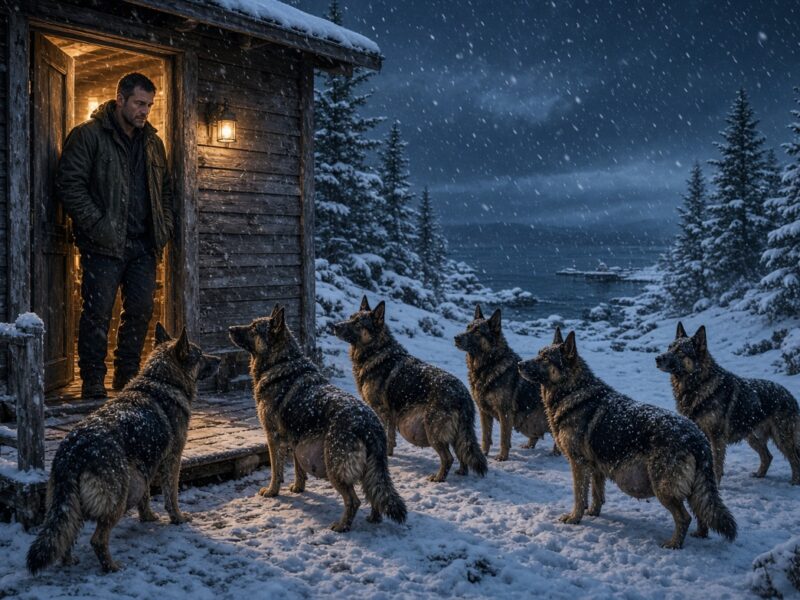
Former Navy SEAL Opens His Door on the Coldest Night — Six Pregnant German Shepherds Were Waiting in the Snow
On the coldest night of winter, a lonely former Navy SEAL named Ethan Cole opened his door to six pregnant German Shepherds standing silently in the snow.
They had crossed the frozen roads looking for warmth.
But the truth about why they were abandoned would soon shock the entire town.
As Ethan fought to protect the dogs and their unborn puppies, he was forced to face the grief he had carried since his parents disappeared at sea.
What began as a simple rescue would bring a forgotten community together, change the lives of six mothers, and transform the place Ethan once called home.
By late December, Cape Rowan, Maine, had turned almost entirely white.
Snow covered the narrow streets, the harbor ropes, and the roofs of the weathered fishing houses, while the cold wind carried the sharp scent of salt across the town.
The sky remained pale and still above the frozen shoreline, and most people stayed close to their fireplaces, waiting for another heavy snowfall to pass.
Ethan Cole returned to Cape Rowan on a gray afternoon with one duffel bag, a worn military coat, and no one waiting for him at the bus station.
At 34, Ethan was tall and broad-shouldered with dark hair cut short, tired gray eyes, and a quiet expression that made him seem older than he was.
Years of service as a Navy SEAL had taught him to move carefully, speak only when necessary, and keep his feelings hidden behind discipline.
After leaving the military because of an injury, he had come back to the only place that had ever felt like home.
Although he was no longer sure the word meant anything to him, the small wooden house at the edge of town still stood where it had always stood, leaning slightly toward the sea as if listening for something beyond the horizon.
The paint had faded, one shutter hung loose, and the chimney gave off more smoke than warmth, but the place belonged to him.
Inside, Ethan placed his duffel bag beside the narrow bed and opened the drawer beneath the kitchen table.
There were unpaid bills, a few folded letters from the military office, and a small metal box containing the last photographs of his parents.
He did not open the box.
He had not opened it in years.
His parents had disappeared when he was eight during a fishing trip that began on an ordinary morning and ended with an empty boat drifting back toward the harbor.
No one had ever found them.
No one had been able to tell Ethan exactly what happened, and that uncertainty had followed him into adulthood like a shadow that never moved far behind.
For a long time, he had blamed the sea.
Later, he blamed himself for surviving the years they had not.
The Navy had given him structure, purpose, and a way to keep moving forward without asking too many questions.
Now that he was home, there was nothing left to command him from one day to the next.
Ethan earned a little money repairing boat engines, replacing broken boards, and helping local fishermen pull heavy nets across the docks.
He was good with his hands, patient with difficult machinery, and willing to work in the cold when others refused.
Still, the jobs were irregular, and every month seemed to bring another bill he could not pay in full.
His old truck needed repairs.
The roof leaked near the back room, and the small amount of savings he had carried home from the military was disappearing faster than he wanted to admit.
He rarely spoke about any of it.
In Cape Rowan, people noticed everything, especially the things a person tried to hide.
The first person to visit him after his return was Mara Bennett, the town’s only veterinarian.
She was a woman in her early thirties with auburn hair usually tied behind her neck, steady green eyes, and a practical manner that made her seem calm even when everything around her was falling apart.
Mara and Ethan had grown up on the same street, shared the same schoolhouse, and once believed they would never leave Cape Rowan.
Life had taken them in different directions, but she had never completely stopped looking out for him.
Her clinic stood behind the old post office, a small white building with a blue door and a hand-painted sign.
Ethan had repaired the clinic’s back steps several years earlier, and Mara still sent him work whenever she could.
That afternoon, she arrived carrying two paper cups of coffee and found him splitting firewood behind the house.
“You came back,” she said.
Ethan rested the axe against the chopping block and accepted one of the cups.
“Looks that way.”
Mara glanced at the house, the damaged fence, and the empty wood rack.
She did not ask how long he planned to stay.
She already knew there was nowhere else for him to go.
Her own situation was not much easier.
The clinic was struggling under a growing debt, and the bank had warned her that she might lose the building if she could not make another payment.
Even so, Mara continued treating abandoned animals and injured strays without asking their owners for money they did not have.
She often worked late into the night, leaving the lights on long after the rest of Cape Rowan had gone dark.
“I could use your help with a broken examination table,” she told him.
“I’ll fix it tomorrow.”
“You always say tomorrow.”
“Tomorrow usually comes.”
A faint smile touched her face, but Ethan looked away toward the shoreline.
Mara understood that he was not being rude.
He simply did not know how to accept concern without feeling as though he owed someone an explanation.
Before she left, she placed a folded envelope on the porch.
“There’s food in there,” she said.
“You don’t have to pay me back.”
Ethan’s expression tightened.
“I can manage.”
“I know,” Mara replied gently.
“That doesn’t mean you have to manage everything alone.”
He did not answer, and she did not press him.
She only nodded once before walking back toward town.
A few minutes later, another figure appeared near the fence.
Theo Miller was sixteen, tall and thin with freckles across his nose, untidy brown hair, and the restless energy of a boy who had not yet decided what kind of man he wanted to become.
He lived with his grandmother in a small house near the harbor and often watched Ethan from a distance.
Theo knew Ethan had been a Navy SEAL and had built a private legend around him, imagining secret missions, impossible rescues, and courage that never failed.
The truth was quieter.
Ethan did not consider himself a hero.
He was simply a man who had learned how to endure difficult things without showing anyone how much they hurt.
Theo stopped near the fence, pretending to examine a loose section of wire.
“Your truck still won’t start?” he asked.
“It starts when it feels like it.”
“My grandmother says old machines are like old people. They need patience.”
Ethan glanced at him.
“Your grandmother is probably right.”
Theo smiled, encouraged by the answer.
He wanted to ask about the Navy, about the scars hidden beneath Ethan’s sleeves, and about why a man who had survived places no one in Cape Rowan could imagine would choose to live alone beside a freezing sea.
Instead, he only asked, “Are you staying?”
Ethan looked past him at the harbor.
The water was dark beneath a thin crust of ice, and the boats rested against the docks as if exhausted.
“For now,” he said.
Theo nodded, though the answer seemed to disappoint him.
After the boy left, Ethan went back inside and placed Mara’s envelope on the kitchen counter without opening it.
He stood for a long time beside the window, watching snow drift across the empty road.
Cape Rowan had given him a house, a few jobs, and the memories he had spent years trying to outrun.
It had not yet given him a reason to believe that returning was the same as coming home.
That evening, Ethan lit the stove and checked the lock on the front door and sat alone in the quiet house while the winter settled over the town.
He had survived the ocean, the military, and the years that followed.
But he still felt like a man standing at the edge of something vast, unsure whether he was meant to keep moving or finally stop.
The night at Cape Rowan grew colder after midnight.
Snow pressed against the windows in pale waves, and the wind moved through the pine trees with a low, restless voice.
Ethan had just banked the stove when he heard a faint scratching sound near the front door.
At first, he thought a loose branch had been pushed against the wall, but the sound came again, slower this time, followed by a soft movement outside.
Ethan stood still and listened.
The scratching continued, uneven and weak, as though whatever was outside had very little strength left.
He reached for the old lantern beside the stove, pulled on his coat, and crossed the room.
When he opened the door, the cold entered before the light could leave.
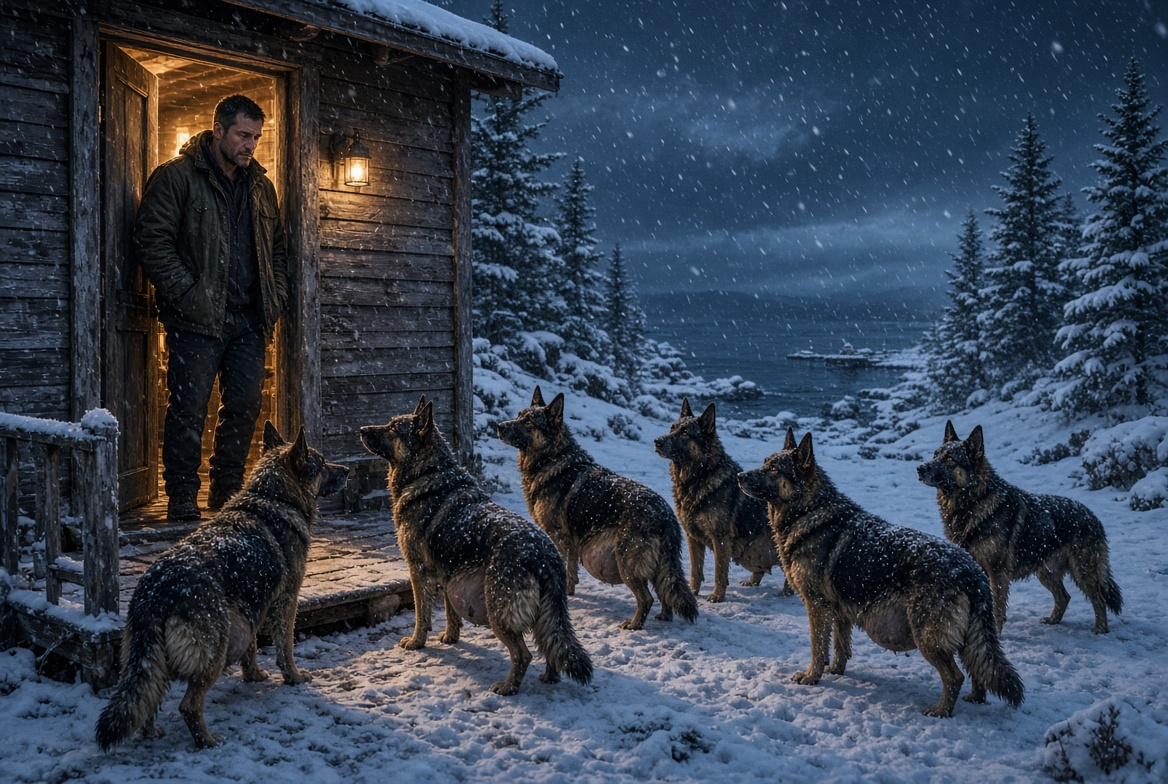
Six German Shepherd females stood just beyond the porch, their bodies arranged in a quiet half circle beneath the falling snow.
They were large dogs, but the winter had made them appear smaller.
Their coats were thick and beautiful beneath the snow, though several had become dull with cold and exhaustion.
Their sides were visibly heavy with pregnancy, and each animal stood with a careful stillness, conserving what little energy remained.
The dog at the front had a dark sable coat and watchful eyes.
She raised her head when Ethan appeared, but she did not bark or move toward him.
Behind her stood a black and tan female with a white mark near her chest, a golden-coated dog whose ears remained lowered, a narrow-faced shepherd with a cautious gaze, a strong dark female who kept close to the others, and a pale-coated dog at the back whose legs trembled more noticeably than the rest.
Ethan counted them twice because the snow made their shapes blend together.
Six, all female, all pregnant.
The pale-coated dog lowered her head, and the others shifted closer around her.
That small movement told Ethan more than any sound could have.
They were not wandering separately.
They had stayed together.
He had seen people abandon equipment, boats, and houses.
But he had never understood how anyone could leave living creatures to face a winter night alone.
“Come on,” he said quietly.
“You can come inside.”
None of them moved.
Ethan stepped away from the doorway and left it open.
He knew frightened animals needed room to decide, and he also knew that forcing them would only make the situation worse.
He placed the lantern on the floor, went to the kitchen, and returned with a shallow bowl of water.
The dark sable dog watched him closely.
After a long moment, she took one careful step forward.
The others followed one by one, while the pale dog remained behind until the strongest female turned and waited for her.
Ethan held the door wider.
“That’s it.”
Slowly, the dogs entered without panic.
They moved through the narrow kitchen and toward the old storage shed attached to the back of the house where Ethan kept tools, rope, and a broken fishing cart.
The shed was not built for animals, let alone six pregnant dogs.
But it had walls, a roof, and a small iron stove that still worked when fed enough wood.
Ethan cleared the floor as quickly as he could, carrying out a toolbox, two buckets, and several pieces of scrap timber.
He pushed the heavier items against the far wall, swept away the loose sawdust, and spread his old military blankets across the cold boards.
The dogs remained close together near the entrance, uncertain, but quiet.
Ethan placed water in two bowls and searched the kitchen for anything safe enough to offer them.
There was little to spare.
Some dried meat, a small amount of rice, and half a loaf of bread.
He hesitated, knowing none of it would be enough for six animals, especially six mothers carrying puppies.
Still, he divided what he could and set it down.
The dark sable dog approached first, but she did not eat immediately.
She looked back at the others, then lowered her head.
The remaining dogs followed, except the pale one, who stood with her nose near the floor.
Ethan crouched a few feet away.
“You don’t have to be afraid,” he said.
“Not tonight.”
He did not know whether she understood his words, but she lifted her eyes toward him, and something in that tired gaze made him think of every person who had waited for help.
Without knowing whether anyone would come, Ethan went back inside, added another log to the stove, and stared at the telephone on the wall.
Calling Mara meant admitting that he could not manage the situation alone.
He had spent years training himself to remain useful under pressure, and asking for help still felt like failure.
But six pregnant dogs were not a problem he could solve with discipline alone.
Before he reached for the phone, a small shadow moved across the window.
Ethan turned and saw Theo standing near the edge of the yard.
The boy had noticed the light in the shed and was trying to see through the snow.
A few minutes later, there was a soft knock at the back door.
Theo stood there with a knitted hat pulled low over his ears and a canvas bag held against his chest.
“My grandmother keeps food for strays,” he said.
“She said I could bring some.”
Ethan looked at the bag.
“You should not be out here.”
“You are out here.”
“I’m older. That does not make the weather warmer.”
Ethan almost smiled.
Theo opened the bag and showed him several cans of dog food, a folded towel, and a small thermos.
“The food is sealed,” he added quickly.
“My grandmother said it was better than giving them whatever we had in the kitchen.”
Ethan accepted the bag.
“Thank her.”
“She said you would say that and still try to pay her back.”
“Your grandmother knows me too well.”
Theo glanced toward the shed.
“Are they really all pregnant?”
“Yes.”
“Do you know who owns them?”
Ethan shook his head.
“Not yet.”
Theo was quiet for a moment.
“What will you do?”
Ethan looked through the open doorway.
The six dogs had settled closer to the blankets, though the pale one still stood apart.
“Keep them warm. Keep them calm. Call Mara.”
“That sounds like a plan.”
“It is the beginning of one.”
Theo nodded as if that answer mattered.
Ethan carried the food into the shed and divided it between the bowls.
This time, the dogs ate more steadily.
He watched them for several minutes, noticing the differences between them.
The dark sable dog kept her eyes on him, so he called her Luna.
The black and tan dog moved with a quiet, patient rhythm, and he named her Willow.
The golden-coated shepherd received the name Hazel, while the narrow-faced one became Ruby.
The strongest female, who never moved far from the others, was Faith.
The pale dog remained silent until Ethan placed a bowl near her paws.
“You can be June,” he whispered.
“You look like you have been waiting for summer.”
Theo repeated the names softly, memorizing them.
“They already seem different.”
“They were different before they came here.”
Ethan reached for the telephone at last.
Mara answered on the second ring.
He gave her only the necessary details.
Six dogs, all pregnant, all exhausted, one in worse condition than the others.
Mara did not ask why he had waited before calling.
She told him she would come as soon as she gathered her examination bag and winter coat.
While they waited, Ethan adjusted the stove, checked the door for gaps, and placed a wooden board across the lower opening to keep the wind from entering.
He moved slowly around the dogs, never reaching for them without allowing them to see his hands first.
Luna watched every movement, but she did not retreat.
When Mara arrived, she came through the snow carrying a lantern and a canvas medical bag.
She stepped into the shed, surveyed the animals, and her expression became serious.
“You were right to call me,” she said.
Ethan stood beside her.
“Can you help them?”
“I can examine them and tell you what they need tonight.”
Mara moved carefully from one dog to the next, speaking in a low voice and checking their general condition without alarming them.
She confirmed that all six were pregnant and that several were much closer to giving birth than Ethan had realized.
June needed the most immediate attention, but none of them could safely remain outside.
“They need warmth, clean water, rest, and proper food,” Mara said.
“They also need observation. We cannot assume they will all recover at the same pace.”
Ethan looked at the blankets, the small stove, and the few cans Theo had brought.
“I do not have enough.”
Mara met his eyes.
“Then we will start with what you have and decide what comes next in the morning.”
He expected her to mention the cost, but she did not.
She only placed a hand on the doorframe and looked at the six dogs gathered in the dim light.
“This is not going to be simple, Ethan.”
“I know.”
“And it will require more than one person.”
Ethan looked toward the animals.
Luna had lowered her head onto the blanket while June stood close enough to the others to feel their warmth.
“I know that, too,” he said, though accepting it was harder than saying it.
Mara helped him arrange the dogs so none of them were isolated, and Theo held the lantern while Ethan carried in another blanket from the house.
Before leaving, Mara gave him clear instructions to keep the shed warm, observe any changes, and call her immediately if any dog became distressed.
She did not promise that everything would be fine.
Ethan respected her for that.
After Mara and Theo left, the shed became quiet again.
Six dogs rested beneath the blankets, their breathing slow and uneven, but steady enough to give him courage.
Ethan sat near the door with his back against the wall, listening to the wind move over the roof.
He had returned to Cape Rowan believing his life had narrowed to a house, a few unpaid bills, and memories he could not change.
Now six frightened animals had crossed the snow to stand before his door, and he had opened it without knowing what would happen next.
For the first time since coming home, Ethan did not feel completely alone.
He watched Luna lift her head and look at him through the dim light.
“We will get through tonight,” he said.
He did not know whether he was speaking to her or to himself, but he remained beside the dogs until the coldest hours of the night had passed.
Morning arrived quietly over Cape Rowan, bringing a pale sky and a thin layer of frost across the windows of Ethan’s house.
The snow had stopped, but the cold remained sharp enough to settle into the wooden walls inside the storage shed.
The six German Shepherds rested close together beneath the blankets, while Ethan moved between them with a notebook in one hand and a cup of lukewarm coffee in the other.
He had slept for less than an hour, sitting against the wall with his coat still on, but he did not feel tired in the ordinary sense.
His mind had become too focused on the animals to notice anything else.
Mara returned shortly after sunrise and examined each dog again.
She confirmed that Willow, Hazel, Ruby, Faith, and June were all approaching the final stage of pregnancy.
Luna remained the greatest concern.
She had eaten only a little during the night and seemed unable to find a comfortable position.
Mara did not use alarming words, but Ethan could hear the seriousness beneath her calm voice.
“She needs warmth, water, quiet, and regular observation,” Mara said.
“All of them do, but Luna has less strength to spare.”
Ethan nodded and opened the notebook.
“Tell me what to record.”
Mara studied him for a moment before giving him a schedule.
He wrote down the time of every meal, the amount of water each dog drank, how often they stood or rested, and any change in their breathing or behavior.
He divided the shed into small spaces using old wooden boards, giving each dog enough room to lie down without separating them completely.
He cleaned the bowls, checked the stove, and placed the blankets so that Luna would not be pushed away from the warmth of the others.
The work reminded him of military routines, but there was no commanding officer, no clear mission, and no guarantee that following every instruction would lead to success.
There were only six living creatures depending on his attention.
Ethan searched the kitchen and found several bags of oats, a small amount of frozen meat, and a few cans of food left from the previous year.
He measured everything carefully and set aside portions for the next two days.
He knew it would not last long, but he refused to think beyond what needed to be done immediately.
Theo arrived before noon, carrying another container from his grandmother’s kitchen.
This time, he brought a clean towel, a pencil, and a sheet of paper folded into four sections.
“I made a chart,” he said.
Ethan looked down at the page.
Theo had written the dogs’ names across the top and left spaces beneath them for food, water, rest, and notes.
“You do not have to do this,” Ethan said.
“I know. School. We have a teacher’s workday.”
Theo placed the chart on a wooden crate.
“Besides, I can help more here.”
Ethan wanted to tell him that this was not a child’s responsibility, but Theo was already studying Luna from the doorway with a serious expression.
He seemed less like a boy seeking adventure and more like someone who had finally found a task that mattered.
“You can help by writing down the times,” Ethan said.
“Do not enter the shed unless one of us is with you.”
Theo nodded immediately.
Ethan showed him how to observe without disturbing the dogs.
They learned to notice whether a dog had changed position, whether she had taken water, and whether her body seemed restless or unusually still.
Theo asked questions, but he listened carefully to every answer.
By early afternoon, word had begun to travel through Cape Rowan.
Ethan did not know who had first mentioned the dogs, and he was not pleased that people were talking about his situation.
But the town had always carried news faster than the harbor carried boats.
The first visitor was Grace Holloway, a short woman in her sixties, who wore a blue wool coat and spoke with the directness of someone who had raised children, animals, and difficult neighbors.
She stopped at the shed door with two large bags of dog food.
“These were in my pantry,” she said.
“They have been there longer than I can remember.”
Ethan looked at the bags.
“I will pay you when I can.”
Grace gave him a firm look.
“You can thank me by using them.”
She placed the food beside the wall and left before he could argue.
Half an hour later, the Branson family arrived in an old pickup truck.
The family consisted of a father, two teenage sons, and a quiet mother who stayed in the passenger seat while the boys unloaded several bundles of clean straw.
The father introduced himself briefly and said they had more at home if Ethan needed it.
He did not step inside the shed or ask to see the dogs.
He simply helped place the straw beneath the blankets and drove away.
Ethan stood in the doorway after they left, watching the truck disappear behind the snow-covered houses.
He had spent most of his life believing that accepting help created a debt that could never be repaid.
Yet the people of Cape Rowan seemed to offer things without asking what they would receive in return.
Later that afternoon, an elderly carpenter named Walter Crane arrived with a small portable heater.
Walter had worked on boats for more than forty years and had the stiff hands and careful movements of a man who trusted tools more than conversation.
“It still works,” he said.
“Do not run it too close to the blankets.”
Ethan inspected the cord and checked the switch.
“I can fix it if something goes wrong.”
Walter gave a short nod.
“That is why I brought it to you.”
It was the closest thing to praise Ethan had heard from him, and it stayed with him long after Walter left.
Mara returned before evening and found Ethan kneeling beside Luna.
The dog had shifted twice in the last hour and had refused the food placed near her.
Ethan had moved the bowl closer and was offering water in small amounts, patiently waiting between each attempt.
Mara watched him for a moment before stepping inside.
“You have not eaten,” she said.
“I had coffee.”
“Coffee is not food.”
“It was warm.”
Mara sighed, but there was no anger in it.
She brought a wrapped sandwich from the clinic and placed it beside him.
“You cannot care for six animals if you collapse beside them.”
Ethan looked at Luna.
“She is worse than the others.”
“That does not mean you have to become worse with her.”
He did not reply.
Mara sat on the other side of the shed, leaving enough space for the dogs to remain calm.
For a while, neither of them spoke.
The heater hummed softly.
Theo wrote in the chart, and the dogs rested beneath the blankets.
“You are treating this like a mission,” Mara said at last.
Ethan kept his eyes on Luna.
“Missions have objectives.”
“And this one?”
“Keep them alive.”
Mara studied him.
“That is not the only reason you are doing this.”
Ethan’s shoulders became still.
He had not told her about the years after his parents disappeared, the nights when he imagined their boat returning, or the guilt he carried because he had been the one left behind.
He had never explained why the sea made him uncomfortable even after years of military training or why he sometimes woke before dawn convinced that he had heard an engine outside.
“I opened the door,” he said.
“They came in. That is what happened. It is enough.”
Mara did not challenge him.
She knew Ethan would speak only when he was ready, and perhaps he never would.
Instead, she helped him adjust the blankets around Luna and check the other dogs once more.
Theo looked up from the chart.
“Luna drank twice since noon,” he said.
Ethan glanced at him.
“Good. Write that down.”
Theo did so carefully and without missing a word.
For the first time in a long while, he felt that his attention mattered to someone besides himself.
He was not simply watching Ethan from a distance anymore.
He had a place beside the work, however small it was.
As evening settled over Cape Rowan, more lights appeared in the windows of nearby houses.
The town had not gathered in a crowd.
No one had made the situation dramatic.
People simply began leaving what they could at Ethan’s door.
A bag of food, a bundle of straw, a spare towel, a jar of broth, or a note with a telephone number.
Ethan placed everything in an orderly row inside the shed, still uncomfortable with the generosity, but no longer refusing it.
Mara stood near the doorway as he completed the evening checks.
“You should sleep for a few hours,” she said.
“I will return before sunrise.”
Ethan nodded.
“Thank you.”
She looked at him, surprised by the words because he rarely said them.
“You are welcome.”
After Mara left, Theo gathered the empty containers and prepared to go home.
Before he stepped outside, Ethan handed him the notebook.
“Keep this. Bring it back tomorrow.”
Theo held it carefully.
“You trust me?”
Ethan considered the question.
“I trust that you will do the work.”
Theo smiled.
For the first time since Ethan had known him, the boy looked completely certain of himself.
When the shed grew quiet again, Ethan sat beside the dogs and listened to the soft movement of their breathing.
Luna remained weak, but she had taken water.
Willow and Faith slept close to her, while Hazel, Ruby, and June rested in a loose circle around them.
Ethan looked at the chart, the donated supplies, and the worn blankets that had once belonged only to him.
He had wanted to keep his troubles hidden, believing poverty was easier to bear when no one could see it.
But the secret had not remained his, and perhaps that was not entirely a bad thing.
The people of Cape Rowan had begun to notice six dogs in need.
But Ethan suspected they had also noticed a man who had been trying to survive alone for too long.
He placed another piece of wood into the stove and lowered the lantern.
The night outside remained cold, yet the shed no longer felt empty.
For the first time since returning home, Ethan understood that keeping someone alive did not always begin with having enough.
Sometimes it began with using what little you had, then allowing another person to bring the next thing.
Over the next several days, the storage shed slowly changed from an emergency shelter into a place of careful routine.
The donated food was measured and stored.
The straw was replaced whenever it became damp, and Theo’s chart filled with small notes about appetite, rest, and movement.
Willow, Hazel, Ruby, Faith, and June were visibly closer to giving birth, while Luna remained weaker than the others but no longer refused every bowl placed near her.
Ethan still checked the dogs throughout the night.
Yet he had begun to understand the difference between watching over them and expecting disaster at every moment.
Mara visited twice a day, bringing supplies from the clinic and making quiet adjustments to the schedule.
She never promised that everything would be easy, but she told Ethan that the dogs were stronger than when they had arrived.
That small improvement gave him something solid to hold on to.
The town continued to help without making a ceremony of it.
Someone left fresh straw beside the shed.
Someone else brought a covered pot of food for Ethan, and the Branson boys repaired a section of the roof so that the cold air would not come through the boards.
Ethan thanked each person, though the words still felt unfamiliar in his mouth.
On the fifth morning, he was carrying a bucket of clean water toward the shed when he heard an engine approaching from the road.
The vehicle stopped near the fence, and a tall man stepped out wearing a dark wool coat, polished boots, and leather gloves that looked too expensive for the weather.
Gordon Pike was in his early fifties with silver beginning to show at his temples, a square jaw, and the controlled expression of a man accustomed to being obeyed.
He carried himself with calm confidence, not because he was calm, but because he had spent years learning how to make other people doubt themselves first.
A younger man followed him from the vehicle.
His name was Daniel Reed, a thin, neatly dressed lawyer with a narrow briefcase and a careful voice that sounded practiced in offices where every sentence had been chosen for effect.
Ethan set the bucket down and stood between them and the shed.
Pike looked at him briefly before turning his attention to the building behind him.
“You have my dogs,” he said.
Ethan did not move.
“They are being cared for.”
“That was not my question.”
“They are inside.”
Pike walked a few steps toward the shed, but Ethan blocked the path.
“You cannot enter without permission.”
Pike’s eyes settled on him then, and the confidence in them sharpened.
“I am not asking permission to see my property.”
Ethan felt the old pressure gather beneath his ribs, the familiar sensation of having to remain steady while someone else tried to control the room.
He had faced men who shouted, men who threatened, and men who believed their authority made them untouchable.
Pike was different.
He did not raise his voice.
He simply assumed the world would make space for him.
“They are not property in the way you are using that word,” Ethan said.
“They are living animals, and they were left outside in winter conditions.”
Pike’s mouth tightened.
“They were released temporarily.”
Ethan looked at him.
“You released six pregnant dogs and did not come back until they were safe.”
“You do not know what happened.”
“I know what condition they were in when they arrived.”
Pike glanced at the shed again.
“Are they all still pregnant?”
The question came so quickly and without concern that Ethan felt something inside him grow cold.
“That is what you want to know?”
“It is relevant.”
“Not to me.”
Pike ignored the answer.
“Which one is Luna?”
Ethan’s hand tightened around the edge of his coat.
“Why?”
“I have records on all six.”
“Then you know which one she is.”
For the first time, Pike looked irritated.
“Mr. Cole, I am here to take my dogs home. I am willing to overlook whatever expenses you claim to have incurred if you hand them over today.”
Ethan gave a quiet, humorless breath.
“Overlook?”
“You’ve provided temporary care. I am offering to settle the matter without unnecessary disagreement.”
“You did not come to ask how they were.”
Pike’s eyes moved toward the shed door.
“I came because I was informed that they were here.”
“And if they had not been safe?”
Pike did not answer.
The silence between them said enough.
Daniel Reed opened his briefcase and removed a folder.
“Mr. Cole, my client has documented ownership of the animals. The dogs are registered under his name, and there is no transfer of ownership.”
Ethan looked at the folder but did not take it.
“Were they registered as abandoned?”
Reed paused for less than a second, but Ethan noticed.
“They were never abandoned in the legal sense.”
“They were left without food, shelter, or supervision.”
“That is an interpretation.”
Mara arrived before Ethan could answer.
She parked beside the road, carried her medical bag across the snow, and stopped when she saw Pike and Reed near the shed.
“You should not move the dogs,” she said.
Pike turned toward her.
“And you are?”
“Mara Bennett. I have been treating them since they arrived.”
Reed looked at the bag in her hand.
“Are you the veterinarian?”
“Yes.”
“Then you can confirm that they are stable enough to travel.”
Mara’s expression remained calm.
“No. I can confirm that they need warmth, rest, regular food, and observation. I have not authorized their removal.”
Pike gave a short laugh.
“You have no authority over my animals.”
“Perhaps not,” Mara replied.
“But I have a professional responsibility not to recommend moving animals whose condition may worsen under stress.”
Ethan saw Pike’s attention shift between them.
He had come expecting one poor man standing alone.
He had not expected Mara, the repaired shed, the food stacked near the wall, or the sounds of six dogs moving behind the door.
“I will return with the proper paperwork,” Pike said.
“Do that,” Ethan answered.
“Until then, they stay here.”
Pike stepped closer.
“You’re making a mistake. Maybe you cannot afford a legal dispute.”
“That may be true.”
Ethan’s voice remained even.
“But I can afford to keep the door closed.”
Reed placed a hand lightly against Pike’s arm, not to restrain him, but to remind him that the conversation had reached its useful limit.
Pike looked at Ethan for another moment, then turned back toward the vehicle.
“You will hear from us,” he said.
“I expect I will.”
After they drove away, Ethan remained still until the sound of the engine disappeared beyond the hill.
Mara looked at him.
“You handled that well.”
“I wanted to say more.”
“You said enough.”
Theo arrived later that afternoon and found Mara sorting through a stack of documents at the kitchen table.
The papers had come from the clinic’s old files.
Pike’s animals had been treated there in previous years, and Mara had located vaccination records, missed appointments, and notes showing that several of the dogs had not received consistent care before being transferred between facilities.
None of the records told the whole story, but together they showed a pattern of neglecting routine care whenever it became inconvenient or expensive.
“This could matter,” Mara said.
Theo leaned closer, careful not to touch the papers.
“Is it enough?”
“Not by itself.”
“What else do we need?”
Mara looked toward Ethan, who was checking the stove in the shed.
“We need facts, dates, witnesses, and anything that shows what happened before they reached this house.”
Theo lowered his eyes to the chart in his hands.
“I might know someone.”
He explained that Colin Reeves, a former worker at Pike’s breeding facility, sometimes helped his grandmother with repairs.
Colin had left the facility months earlier and rarely spoke about it, but he had once mentioned that Pike kept old recordings on a phone used for training and inventory.
Theo did not have the recording, but he knew where Colin lived.
Mara told him not to investigate alone.
Yet before evening, Colin appeared at the clinic with an old phone and a tired expression.
Colin was a quiet man in his forties, with a work jacket faded at the shoulders and the guarded manner of someone who had learned to be careful around powerful employers.
He did not want his name mentioned publicly, but he allowed Mara to view a short recording he had saved before leaving.
The image was unclear and the sound was uneven, but Pike’s voice could be heard saying that the dogs were no longer worth the cost of keeping them through winter.
There was no dramatic scene, only a few cold sentences that revealed more than Pike had intended.
Mara copied the file and stored it securely.
Theo stood beside her, realizing that small pieces of information could become important when placed together.
That night, Ethan woke suddenly in the chair beside the shed door.
For a few seconds, he did not know where he was.
The room seemed too narrow, the air too cold, and the sound of the wind against the roof reminded him of waves striking the side of a boat.
He tried to steady his breathing, but his hands would not remain still.
Mara had been sitting at the kitchen table, reviewing the records.
She came to the shed without asking questions and sat several feet away from him.
She did not touch him or tell him to calm down.
She simply stayed.
After a while, Ethan looked toward her.
“It passes,” he said.
“I know.”
“You do not have to sit here.”
“I know that, too.”
Her answer was gentle, and that made it easier for him to remain where he was.
Behind them, Luna shifted beneath the blanket.
Ethan turned toward her and listened until her breathing became steady again.
The dogs did not know about ownership papers, lawyers, or threats.
They only knew the shed was warm, the bowls were full, and the people who entered did not leave them alone.
Ethan looked at Mara, then at the six animals resting in the dim light.
Gordon Pike had returned when everything appeared safe, believing he could reclaim what he had once discarded.
But the dogs were no longer standing outside a stranger’s door.
They were inside, surrounded by people who had begun to remember their names.
Ethan did not know what would happen next.
But he knew one thing with certainty.
He would not hand them over simply because someone had finally decided they were valuable again.
The days that followed passed according to the quiet rhythm of the storage shed.
Ethan, Mara, and Theo divided the hours between them, taking turns checking the dogs, refreshing the straw, warming water, and recording every change in behavior.
No one spoke about sleep unless it was absolutely necessary.
The dogs had grown calmer, but their movements had changed.
Willow paced slowly near the wall.
Hazel rested more often.
Ruby became restless whenever the shed grew quiet, and Faith refused to lie down for very long.
June stayed close to the others, watching each person who entered as if she were trying to understand whether the strange new place was safe.
Luna remained the most fragile.
She drank small amounts and accepted food when Ethan placed the bowl directly beside her, but she tired easily and spent most of her time resting beneath the blanket.
Mara watched her carefully without making promises.
“She’s holding on,” she told Ethan.
“That matters, but we still need to take each hour as it comes.”
Ethan wrote the words in his notebook even though he had already memorized them.
On the fourth morning after Gordon Pike’s visit, Willow began to behave differently.
She moved away from the others, circled the straw, and then returned to the same quiet corner.
Theo noticed first.
“She keeps changing places,” he said.
Mara looked up from the supplies she was arranging.
“That may be a sign that she is beginning labor.”
Ethan closed the notebook and moved toward Willow.
The dog watched him, alert but calm, while Mara prepared a clean section of the shed.
They worked without rushing.
Theo brought fresh towels, checked the water, and stayed near the doorway so that he would not disturb Willow.
The hours passed slowly, and the winter light faded before the first puppy arrived.
There was no dramatic sound, only a brief moment of uncertainty followed by a small, unmistakable cry.
Ethan leaned closer and stopped himself and let Willow remain undisturbed.
Mara checked the newborn from a respectful distance and nodded.
“The puppy is breathing well.”
Ethan lowered his head, releasing a breath he had not realized he was holding.
Willow turned toward the small bundle, and the shed seemed to grow quieter around them.
Theo smiled so widely that Mara had to remind him to keep his voice low.
“One,” he whispered.
“We have one.”
Ethan looked at him.
“We have one healthy puppy.”
Theo wrote the time in the chart with careful concentration, his hand shaking slightly from excitement.
The arrival of that first puppy changed the atmosphere completely.
Until then, the dogs had been waiting for something uncertain.
But now there was a new life resting beside Willow, warm and entirely dependent on her.
Ethan found himself returning to the corner again and again, not because there was anything he needed to do, but because he wanted to make sure the puppy was still there.
Mara caught him watching once and said nothing.
The following day, Hazel began labor just after sunrise.
She was calmer than Willow, but the process still required patience.
Ethan sat near her head, speaking in the same low voice he used whenever the dogs became uneasy.
Theo prepared the supplies before anyone asked, and Mara guided him through each step without allowing him to feel hurried.
When Hazel’s puppy finally arrived, it was a strong little female with a dark muzzle and determined movements.
Theo laughed softly when the puppy tried to lift her head.
“She is already trying to get somewhere.”
“That is what healthy puppies do,” Mara replied.
“They begin searching before they understand the world.”
Hazel rested after the delivery, and Ethan placed another clean blanket near her.
He was learning that caring for the mothers meant respecting their space as much as providing assistance.
The dogs no longer watched every movement with suspicion.
They had begun to recognize Ethan’s footsteps, Mara’s voice, and Theo’s careful way of entering the shed.
Ruby delivered next, followed by Faith.
Each birth brought its own quiet tension and its own moment of relief.
Ruby’s puppies were small and dark, and Faith’s were unusually restless once they began to move.
By then, the shed had become a place filled with soft sounds.
The mothers shifting in the straw, Theo turning pages, Mara opening her medical bag, and the faint cries of newborn puppies seeking warmth.
Ethan had stopped counting the hours by the clock.
Instead, he measured time by the number of mothers who had delivered safely and the number of small bodies breathing beside them.
June went into labor during the early evening.
Snow pressed against the windows, and the portable heater hummed near the wall Walter Crane had repaired.
June remained close to Ethan throughout the process, resting her head against his knee whenever she became uncertain.
He kept his hand near her shoulder but did not force contact.
“You know what to do,” he told her.
“We are right here.”
Mara worked calmly, and Theo moved between the kitchen and shed with water and clean towels.
When June’s puppies arrived, the last one took a little longer to respond.
Mara remained focused and patient, speaking softly while Ethan kept June calm.
At last, the puppy stirred and made a faint sound.
Theo covered his mouth with one hand, his eyes shining.
“That makes six mothers,” he said.
Ethan looked around the shed.
Willow, Hazel, Ruby, Faith, and June were now resting with their puppies, while Luna remained alone in the far corner.
The relief of the other safe deliveries could not completely reach him.
Luna had been quieter all day, and Mara had checked on her repeatedly.
She now stood beside the pale dog with one hand resting lightly near her neck.
“She may begin soon,” Mara said.
Ethan looked at Luna.
“Is she ready?”
“Ready is not the word I would use.”
Mara’s voice remained steady.
“She is tired, and the puppy may not be positioned correctly. We will need to stay calm and give her time.”
The night that followed was different from the others.
Luna shifted often, then became still and then shifted again.
She seemed to draw whatever strength she had left inward as though preparing for a task she could not explain.
Ethan stayed beside her while Theo took notes and Mara prepared the space.
Outside, the wind continued to move across the roof.
But inside the shed, everyone spoke in low voices.
Ethan kept one hand near Luna’s shoulder and watched her eyes.
“You came to my door,” he whispered.
“You crossed all that snow to get here. You do not have to do this by yourself.”
Luna looked at him, and for a moment, her breathing became calmer.
Mara gave Ethan simple instructions, and he followed each one without question.
There was no room for fear to take over.
He could feel it waiting at the edge of his thoughts.
But he had learned to focus on the next small thing.
Luna’s breathing, Mara’s voice, the clean blanket, the warmth of the stove.
Time moved slowly.
Theo remained awake even when his eyes began to close, holding the notebook in his lap.
At one point, he noticed that Luna had become unusually quiet and that the puppy showed no clear response.
“Mara,” he said softly.
“Look.”
Mara moved closer, assessed the situation, and directed Theo to bring the warm towel.
Ethan stayed beside Luna, speaking to her in a steady rhythm.
He told her that she had already traveled farther than anyone knew, that she had found a place to rest, and that she was not alone.
Now the words were meant for Luna, but they also carried everything Ethan had never said to his parents, to himself, and to the part of his life he believed had ended long ago.
Mara worked with patience and care, and Theo followed every instruction.
Finally, after a long silence, a small sound rose into the shed.
It was weaker than the cries of the other puppies, but it was real.
Ethan looked at Mara.
She nodded.
“The puppy is alive.”
Luna turned her head toward the sound.
Ethan lowered himself beside her, overwhelmed by relief.
Theo wiped his eyes with the back of his sleeve and wrote the time in the notebook, though the numbers blurred for a moment.
The puppy was smaller than the others and needed close observation, but it had made it into the world.
Ethan looked at the little body, then at Luna.
“Anchor,” he said quietly.
“That is his name.”
Mara glanced at him.
“Because he held everything here together.”
Ethan nodded.
“Because he gave us something to hold on to.”
For the first time, Mara reached out and rested her hand on Ethan’s shoulder.
It was a simple gesture, brief and careful, but Ethan did not pull away.
They remained that way for a moment while Theo sat near the doorway and listened to Anchor’s faint breathing.
Neither Ethan nor Mara spoke about what had changed between them.
They did not need to.
Their connection had grown through long nights, shared responsibility, and the quiet understanding that neither of them had to carry every burden alone.
By morning, Luna was resting with Anchor beside her, and the other five mothers were gathered around their puppies.
Ethan sat against the wall, exhausted but awake, while Mara checked the animals one more time.
“You should sleep,” she said.
“Soon.”
“You say that like it is easy.”
“It is not easy. It is necessary.”
Ethan looked at the dogs, then at Mara.
“You will be here?”
“Yes.”
That answer settled something inside him.
He closed his eyes for a few minutes, listening to the soft sounds filling the shed.
Six mothers had crossed the snow together.
And now six new families rested beneath the same roof.
For the first time since returning to Cape Rowan, Ethan felt that the future was not entirely a closed door.
It was small, fragile, and breathing quietly beside him.
But it was there.
The hearing was held in the old Cape Rowan Town Hall, a narrow brick building beside the library where the local council usually discussed fishing permits, property disputes, and winter road repairs.
That morning, the front steps were covered with a thin layer of frost, and the windows reflected a pale sky above the harbor.
Ethan arrived with Mara, Theo, and several neighbors who had chosen to stand beside him.
He wore the cleanest shirt he owned and a dark jacket borrowed from Walter Crane.
But the clothes did not make him feel prepared.
He had faced difficult situations during his years in the Navy.
Yet sitting inside a warm room while strangers decided the future of six mothers and their puppies felt more frightening than anything he wanted to remember.
At the front of the room sat Evelyn Hart, the chairwoman of the local council, a silver-haired woman with a composed face and a reputation for listening longer than she spoke.
Beside her were two council members, a clerk, and a representative from the county animal welfare office.
Gordon Pike sat on the opposite side with Daniel Reed, who arranged his papers in neat stacks and never looked toward Ethan for more than a second at a time.
The room filled slowly.
Grace Holloway arrived first, followed by the Bransons, Walter Crane, Colin Reeves, and several other residents who had helped Ethan during the weeks since the dogs appeared at his door.
No one made a speech or carried a sign.
They simply took their seats, one row after another, until Ethan understood that the town had come not to create a scene, but to make sure he would not stand alone.
Chairwoman Hart opened the hearing by explaining that Pike had filed a complaint, claiming Ethan had unlawfully kept his six German Shepherds and their puppies for personal benefit.
Pike’s petition described the dogs as temporarily displaced property and suggested that Ethan had used the situation to gain attention, donations, and future income.
Reed presented the argument smoothly.
He said Ethan had no legal authority to retain the animals, no professional training in veterinary care, and no documented agreement allowing him to make decisions on Pike’s behalf.
He described Ethan as a financially troubled man who had become emotionally attached to the dogs and might have mistaken sympathy for ownership.
Ethan listened with his hands folded in front of him.
Every sentence was carefully chosen to make his actions sound selfish without directly accusing him of cruelty.
When Reed finished, Chairwoman Hart turned to Mara.
Mara stood and carried a folder to the front table.
She explained that she had examined all six dogs after they arrived at Ethan’s property and had continued monitoring them during the weeks that followed.
Her report recorded their condition without exaggeration.
They had been underfed, exhausted, and in need of warmth and consistent care.
Several were close to giving birth, and Luna required particularly careful observation because she had arrived weaker than the others.
Mara explained that moving them immediately after rescue could have placed additional strain on the mothers and their unborn puppies.
Reed asked whether Mara could prove that Pike had intentionally abandoned them.
“I can speak to their condition,” she answered.
“I can speak to where they were found and what care they required. I cannot speak for every decision Mr. Pike made before that night.”
Her calm honesty made the room quieter.
She did not exaggerate the animals’ situation or turn it into a performance.
She simply described what she had seen and what she had done to help.
The council clerk added her medical records to the file.
Reed then questioned whether Ethan had received donations from the community.
“Some people brought food, straw, blankets, and equipment,” Mara said.
“Did Mr. Cole sell any of the puppies?”
“No.”
“Did he advertise them?”
“No.”
“Did he ask for money from the town?”
“Not at first.”
Reed paused.
“But he accepted help.”
“He accepted supplies that were used for the dogs,” Mara replied.
“That is not the same as profiting from them.”
After Mara returned to her seat, Grace Holloway was called to speak.
She described leaving food at Ethan’s house and said she had never heard him ask for payment or publicity.
The Branson family confirmed that the straw they delivered had been used inside the shed.
Walter Crane explained that the portable heater he loaned Ethan had remained in the shelter and had not been used for any other purpose.
Their statements were simple, but together they created a clear picture of a man trying to care for animals with whatever resources were available.
Pike shifted in his chair as each person spoke.
He had expected the town to remain neutral, perhaps even embarrassed by Ethan’s decision to keep the dogs.
Instead, the witnesses spoke with quiet certainty.
Then Colin Reeves was called.
He did not look at Pike when he approached the table.
He explained that he had once worked at Pike’s breeding facility and had left because he no longer agreed with the way business decisions were being made.
He did not describe anything in a graphic or sensational way.
He only said that Pike had discussed the cost of keeping the six dogs through winter and had referred to them as animals that no longer justified the expense.
Colin’s written statement was attached to the file, and then Mara asked permission to play the recording he had provided.
The audio was brief and imperfect.
Pike’s voice could be heard discussing the dogs as a financial burden and saying that he would not continue paying for them if they could not produce enough income.
There was no dramatic confession, only a few careless sentences spoken before anyone expected them to matter.
When the recording ended, no one moved for several seconds.
Reed objected to the recording, questioning when it had been made and whether the full conversation had been preserved.
Chairwoman Hart allowed the council to consider it as supporting evidence rather than treating it as the only proof.
Theo was called next.
He walked to the front with his notebook held tightly against his chest.
He had practiced what he wanted to say with Mara, but when he stood before the council, his prepared words seemed to disappear.
Ethan looked at him from across the room.
Theo took a breath and began again.
He explained how he had brought food on the first night, how Ethan had created a schedule for the dogs, and how every decision had been written down.
He showed the council his chart with the dates, feeding times, water intake, and notes about the dogs’ behavior.
Chairwoman Hart asked him why he had continued helping.
Theo looked toward Ethan before answering.
“Because they needed someone to pay attention,” he said, “and because Mr. Cole did.”
Reed questioned whether Theo understood the difference between caring for an animal and owning one.
Theo answered that he did.
“Mr. Cole never said the dogs were his,” he said.
“He said they were safe while they were with him.”
The answer made several people in the room lower their eyes.
Ethan had not expected Theo to speak so clearly, and he felt a quiet pride that had nothing to do with the hearing.
Finally, Ethan was asked to testify.
He stood slowly and faced the council.
He described hearing the dogs outside, opening the door, and bringing them into the shed.
He explained that he had not known who owned them, had not tried to find money from the situation, and had only wanted to keep them alive through the cold.
When asked why he had taken them instead of contacting the authorities first, Ethan thought about his parents, the empty boat that had returned without them, and the years he had spent wondering whether someone could have done more.
“Because they were at my door,” he said.
“They were frightened, exhausted, and carrying puppies. I could not close the door and pretend I had not seen them.”
Reed stood for the questioning.
He asked whether Ethan had medical training, whether he understood animal ownership law, and whether he might have allowed his personal history to influence his judgment.
Ethan answered each question without raising his voice.
“I am not a veterinarian,” he said.
“I am not a lawyer. I am a person who opened a door when six animals needed shelter.”
Reed asked whether Ethan expected to benefit from the puppies.
Ethan looked directly at him.
“If I wanted money, I would not have spent my remaining savings on food and heating.”
“You accepted donations for the dogs.”
“You became emotionally attached.”
Ethan’s expression softened slightly.
“Anyone who listened to them breathe every night would understand that.”
Reed had no immediate answer.
During the recess, Mara found Ethan standing alone near the hallway window.
“You did well,” she said.
“I only told the truth.”
“That is why it worked.”
When the council reconvened, Chairwoman Hart read the decision.
The evidence showed that Pike had failed to provide care, had not taken reasonable steps to recover the dogs during the period they were missing, and had returned only after they were safe and valuable again.
The council did not treat Ethan as a thief or a man seeking profit.
Instead, it recognized him as an emergency rescuer who had acted to protect animals in immediate need.
Pike would not be allowed to remove the dogs or puppies while their welfare remained at risk, and Ethan was granted legal authority to continue caring for them.
The room remained silent for a moment before Grace Holloway placed a hand over her mouth.
Theo exhaled sharply, and Mara closed her eyes with relief.
Pike sat rigidly while Reed gathered the papers.
He did not apologize, but he no longer looked certain that the room belonged to him.
After the hearing, a representative from the Harbor Paws Animal Foundation approached Mara and offered financial support for her clinic, explaining that the organization had followed the case and wanted to help her continue treating abandoned animals.
Another representative spoke privately with Theo about a training opportunity in animal care and service dog support.
Theo looked stunned when he heard the offer.
Ethan placed a hand on his shoulder.
“You earned it,” he said.
Outside the town hall, the air was cold and bright.
Ethan looked toward the harbor, then back toward the road leading to his house.
The six mothers and their puppies were still waiting in the shed, unaware of the papers signed inside the building.
Their future had not become perfect, but it had become safer.
Mara stood beside Ethan without speaking, and Theo walked ahead with the notebook tucked beneath his arm.
For the first time since the dogs arrived, Ethan allowed himself to believe that the door he had opened in the snow had led somewhere neither he nor anyone else in Cape Rowan had expected.
After the council’s decision, Cape Rowan expected Ethan to choose the practical path.
People assumed he would sell the puppies once they were old enough, repair his leaking house, pay his debts, and perhaps buy another boat so he could return to the work he understood.
Some even believed he would keep one of the dogs and find homes for the others.
No one expected him to sell the only boat he owned.
It was an old fishing boat that had belonged to his family for years, repaired more times than Ethan could count and tied to memories he usually avoided.
He had planned to restore it when he could afford the parts, but after the hearing, he stood beside it for a long time and understood that the boat represented the life he had once lost, not the life he wanted to build.
The sale did not make him rich, but it gave him enough to combine with the compensation connected to the dogs’ care, the donations raised by the community, and the support offered by Harbor Paws Animal Foundation.
With that money, Ethan purchased the abandoned coastal rescue station near the harbor.
The building had been unused for years, its windows dusty, its walls faded, and its old rooms filled with broken equipment.
Yet it had a solid foundation, a wide storage area, and a view of the sea that reached all the way to the horizon.
It was also the place where Ethan’s parents had prepared their fishing gear before the trip from which they never returned.
The first time he walked through the building, he felt the old ache rise inside him, but it no longer seemed to demand that he leave.
He thought that perhaps a place connected to loss could also become a place where other lives were protected.
“What are you going to do with it?” Mara asked when she found him standing in the empty main room.
Ethan looked at the sunlight falling through the dusty windows.
“Keep the door open.”
That was the beginning of the Six Anchors Haven.
Ethan chose the name because Luna’s smallest puppy, Anchor, had survived the most uncertain night.
But the name also carried another meaning.
An anchor did not erase the power of the sea.
It simply gave something a chance to remain steady when everything around it was moving.
The renovation took weeks.
Walter Crane repaired the doors and reinforced the old wooden steps.
The Branson family cleared the storage rooms.
Grace Holloway organized donated blankets and food, and other residents brought paint, tools, shelves, and supplies.
No one waited for Ethan to ask.
They arrived with practical things and worked until the building began to feel less like an abandoned station and more like a home.
Ethan divided the space carefully.
One room became a quiet recovery area for animals that needed rest.
Another became a clean nursery for puppies and small animals.
The largest section was reserved for retired service dogs where they could live in comfort after years of working beside soldiers, police officers, and rescue teams.
Ethan also created a separate room for veterans who needed a calm place to sit, talk, or simply spend time around animals without being questioned.
He did not describe it as therapy.
He called it a place to breathe.
Mara accepted Ethan’s invitation to become the center’s veterinary director, although she insisted that her clinic in town would remain open.
The support from Harbor Paws allowed her to pay part of the clinic’s debt, replace old equipment, and continue treating animals whose owners could not afford care.
She began dividing her time between the clinic and the new haven, bringing medical supplies, setting up health records, and teaching volunteers how to recognize when an animal needed professional attention.
Ethan trusted her judgment completely, and Mara trusted him to create a place where her work could continue beyond the walls of a small clinic.
Their relationship changed gradually rather than suddenly.
They did not make dramatic promises, and neither of them tried to turn their shared work into something it was not.
They simply began eating dinner together after long days, walking along the harbor when the weather was clear, and leaving the doors between their lives open.
Theo became responsible for the puppy room, a role he accepted with such seriousness that Ethan eventually gave him a key.
He kept detailed records, helped with feeding schedules, and learned how to handle the puppies with patience.
Under Mara’s guidance, he also learned the basics of animal care and began preparing for the training opportunity offered by the rescue foundation.
The puppies were not treated as products.
They were raised with careful routines, gentle socialization, and attention to their individual temperaments.
Some showed the calm focus needed for assistance work, while others were curious, energetic, or especially responsive to people.
Ethan and Mara agreed that their future roles would be decided slowly according to each animal’s abilities and comfort.
A few might become companions for people living with disabilities.
Some might enter carefully supervised search and rescue programs, and others might simply become loyal family dogs.
Their value would never again be measured only by money.
The six mothers remained together in a warm enclosure at the center.
Luna stayed close to Anchor, watching the puppy with quiet attention, while Willow, Hazel, Ruby, Faith, and June settled into their new surroundings as though they understood that they no longer had to keep moving.
Ethan visited them every morning before doing anything else.
He checked their food, opened the gates to the exercise yard, and sat with them when the work of the day became too heavy.
He had expected that building the haven would make him feel responsible for more lives, but it also gave him a reason to rise each morning.
Near the entrance, he placed a simple wooden plaque bearing the words: “The Cole Harbor Room, dedicated to his parents.”
There were no photographs, no dramatic explanations, and no attempt to tell visitors how much their disappearance had shaped him.
The room held a bench, a map of the coastline, and a small brass compass that had belonged to his family.
Ethan kept the door open to anyone who needed a quiet place to remember someone or to begin again.
When the center finally opened, the entire town gathered outside beneath a clear spring sky.
The snow had begun to recede from the roads, revealing dark earth and patches of grass beneath it.
The harbor remained cold, but the air no longer felt trapped in winter.
Grace brought a large pot of soup.
The Bransons carried fresh bread.
Walter stood near the entrance with his hands resting on a walking stick, and Theo moved from room to room checking that everything was ready.
Mara stood beside Ethan as the sign was uncovered above the doorway: Six Anchors Haven.
The six mothers were led into the enclosed yard, followed by their growing puppies.
They moved cautiously at first, then began exploring the clean ground while people watched from a respectful distance.
Anchor remained close to Luna, occasionally turning back as if to make sure she was still there.
Ethan looked at the animals, the repaired building, the people who had worked beside him, and the sea beyond the harbor.
For years, he had believed that survival meant carrying loss quietly until it became part of his body.
Now he understood that survival could also mean making room for something new.
He had not rescued six dogs because he knew exactly how to save them.
He had opened a door because they needed one.
The rest had happened through patience, trust, and the courage of many people who chose to help.
Mara reached for his hand, and this time Ethan held on without hesitation.
Theo called them toward the yard where the puppies were gathering around a wooden bowl.
Ethan smiled and walked with Mara into the sunlight.
The man who once believed he had nowhere to return to had built a place where abandoned animals, retired service dogs, and lonely veterans could find warmth without having to prove they deserved it.
The six mothers had arrived as forgotten burdens, but they had become the beginning of a home.
And on the day the Six Anchors Haven opened its doors, Ethan finally understood that the life he had lost at sea was not the only life meant for him.
There was another one waiting on shore, surrounded by people, animals, and a door he had chosen to keep open.
Sometimes the greatest changes in life begin with one small act of kindness.
Ethan opened one door, and in return he found a family, a community, and a new reason to hope.
This story reminds us that no good deed is ever truly wasted.
If you believe that every living soul deserves compassion and a safe place to belong, please comment, “I choose kindness” below.
Share this story with someone who may need a little hope today.
And subscribe to our channel for more stories about courage, loyalty, and second chances.
May God bless you, your family, and everyone watching this story.
Until we meet again, remember that even the smallest act of kindness can become a light in someone else’s darkest moment.









