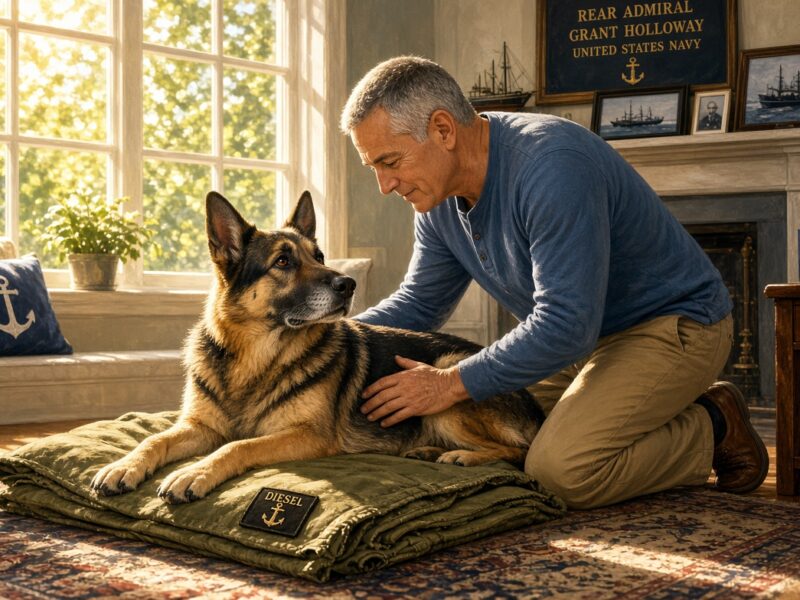
For Four Days He Stood Against the Wall and Refused to Eat… Until One Nurse Realized the Military Dog Was Grieving Too
At 5:26 on a cold Monday morning in Norfolk, Virginia, nurse Rebecca Sloan was halfway through her first cup of gas-station coffee when her phone rang.
The break room at Naval Medical Center Portsmouth still smelled like burnt popcorn from the night shift.
The number on her screen wasn’t saved.
She almost let it go to voicemail.
Then she noticed the prefix. It was a base line, the kind that only rang from inside the fence at Naval Station Norfolk.
She set the cup down.
“Hello?”
A man’s voice answered, low and careful.
“Is this Rebecca Sloan?”
“Yes.”
“This is Rear Admiral Grant Holloway.”
Rebecca straightened in her plastic chair without meaning to.
Twelve hours on her feet, and her spine still knew what to do with a title like that.
“Yes, Admiral?”
There was a pause on the line.
Not the pause of a man choosing his words for effect. The pause of a man who didn’t know where to start.
When he spoke again, his voice had gone quieter.
“I need help with my canine.”
Rebecca glanced at the clock above the vending machine.
5:27 a.m.
Nobody called about a dog at 5:27 a.m. unless they had run out of better ideas.
“What happened?”
“I don’t know.”
That answer worried her more than almost anything else he could have said.
In the ER, people always knew something. They knew he fell. They knew she ate something strange. They knew it started after the car accident.
“I don’t know” meant the problem had no edges yet.
“What is he doing?” she asked.
“He isn’t doing anything.”
She frowned and pulled a pen from the pocket of her scrubs.
“Can you explain that?”
“He stopped eating.”
“Since when?”
“Almost four days.”
Rebecca flipped open the small spiral notebook she kept for patient notes and wrote a single number at the top of a clean page.
96 hours.
Ninety-six hours without food.
She circled it twice.
“Is he drinking?”
“Barely.”
“Any vomiting?”
“No.”
“Diarrhea?”
“No.”
“Limping?”
“No.”
“Has he been injured?”
“Not that I know of.”
She wrote every answer down in neat block letters.
It was a habit from triage. Write it down, and the panic on the other end of the line has somewhere to go besides you.
“Is he barking?”
“No.”
“Responding to commands?”
“No.”
“Playing?”
“No.”
Rebecca lifted the pen.
Every answer so far was a door closing.
“Then what does he do?”
This time, Grant answered almost immediately, as if the sentence had been sitting in his throat for days.
“He stands against the wall.”
Rebecca paused.
She had heard a lot of things at 5 a.m. That was a new one.
“What do you mean?”
“He presses his side against it and just stays there.”
“For how long?”
“Sometimes twenty minutes. Sometimes an hour.”
A breath on the line.
“He moves only when I physically guide him.”
Rebecca leaned back in the chair.
Outside the break-room window, the parking garage lights buzzed against a sky still the color of wet slate.
“Has he shown any aggression?”
“No.”
“Fear?”
The admiral hesitated.
“I don’t know.”
Rebecca heard the hesitation and filed it away. A man like this didn’t hesitate on a simple question unless the question wasn’t simple.
“What do you mean, you don’t know?”
“I’ve had him for six years.”
She waited.
In her experience, the important part of a sentence usually came after the first silence.
“I know what he looks like when he’s tired,” Grant said. “I know what he looks like when he’s sick. I know what he looks like when he’s angry.”
His voice dropped until she had to press the phone closer to her ear.
“But this… I’ve never seen this before.”
Rebecca closed the notebook.
Something in her chest had gone very still.
A man who commanded thousands of sailors had just admitted he couldn’t read the one face he knew best.
“What’s his name?” she asked.
“Diesel.”
“Age?”
“Eight.”
“Background?”
“Former military working dog. German Shepherd. He did two deployments before he came home with me.”
Rebecca nodded slowly to no one.
“Admiral, I need you to do two things for me before I get there.”
“Go ahead.”
“Don’t try to force him to eat.”
Grant was silent.
She could almost hear him wanting to argue. Four days was a long time. Every instinct he had was probably telling him to do something, anything.
“And don’t drag him away from the wall,” she went on, “unless there’s an immediate safety concern.”
Another pause.
“Can you come?”
Rebecca looked at the dark window beside the vending machine, at her own tired reflection floating over the parking garage.
Her shift had ended twenty-six minutes ago. Her bed was eleven miles away. Her feet hurt in a way that felt personal.
“Yes,” she said.
She hung up and sat there a moment longer, the notebook heavy in her hand.
Then she poured the rest of the coffee down the sink and went to find her keys.
Rebecca left the hospital less than an hour later.
She stopped at home only long enough to change out of her scrubs into jeans and a Navy-blue fleece, then pointed her ten-year-old Honda north toward the base.
The Hampton Roads Bridge-Tunnel traffic hadn’t started yet. The water on either side of Interstate 64 looked flat and gray, like a sheet of brushed steel.
She drove with the radio off.
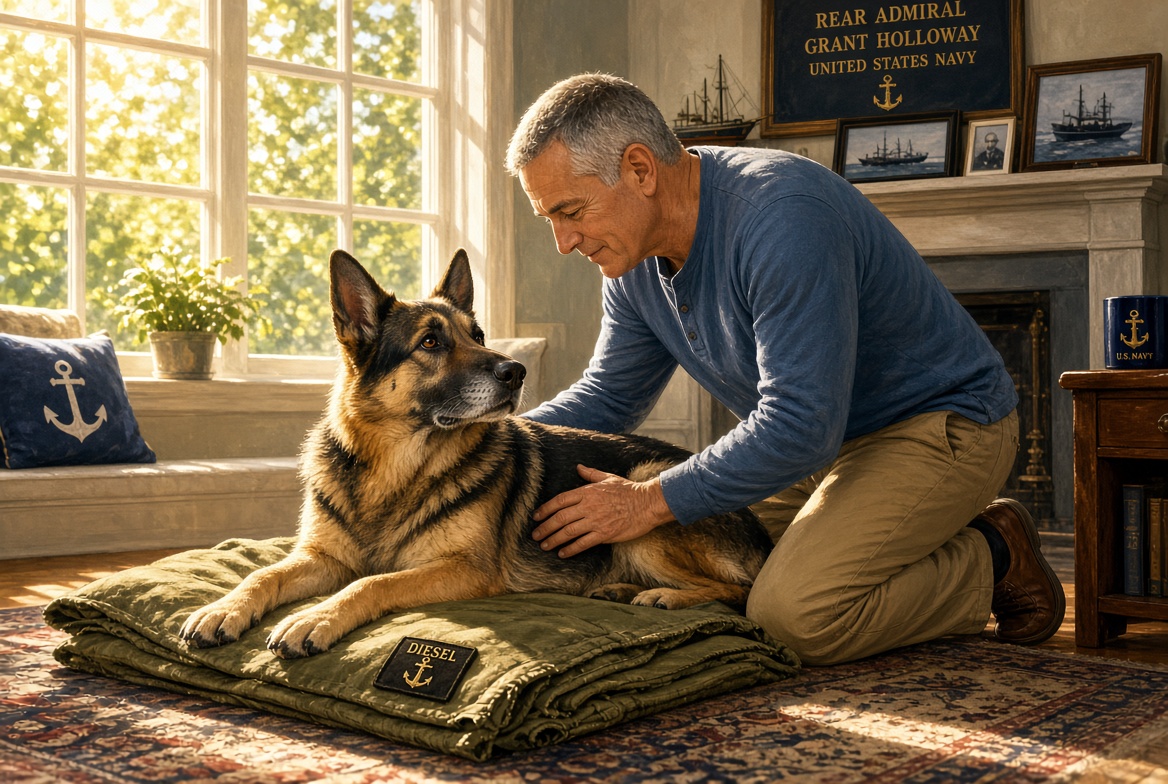
She had worked with service animals before. For three years, she had helped run a rehabilitation program on the hospital’s fourth floor, the one where wounded sailors and Marines learned to walk again with a dog at their side.
She had seen dogs comfort men who couldn’t sleep.
She had seen dogs refuse to leave a bedside.
She had seen a black Lab named Cooper wake a patient from a nightmare forty minutes before the nurses even noticed his heart rate climbing.
But this sounded different.
A dog refusing food for four days required a medical evaluation. That part was simple. Bloodwork, a physical exam, a vet who knew what to look for.
A dog refusing everything else, too, required something more.
She kept turning Grant’s words over in her mind like a smooth stone in a pocket.
He just wants the wall.
Why?
A dog like Diesel had spent years being trained to move toward things. Toward sound. Toward commands. Toward human direction. Toward the very things most animals run from.
Military working dogs were built for forward motion.
And now this one was choosing stillness.
Not just stillness. Contact. Pressure. A solid surface against his body.
Rebecca tapped the steering wheel with one finger.
In the rehab unit, they used weighted blankets for patients who couldn’t settle. Pressure told an overwhelmed nervous system that the edges of the world were still there.
She wondered whether Diesel’s wall was telling her something like that.
Or whether it was telling her something else entirely.
At the main gate, a young petty officer checked her ID, then checked it again against a clipboard.
“The admiral called ahead, ma’am,” he said. “You’re cleared.”
“Thank you.”
He hesitated, leaning a little closer to her open window.
“Is it Diesel?”
Rebecca looked at him.
“You know him?”
“Everybody knows Diesel, ma’am. He used to walk the fence line with the admiral every morning at 0600. Him and the old one, Bruno.”
The young man’s face changed slightly when he said the second name.
“Haven’t seen Diesel out here in a few days.”
Rebecca nodded slowly.
“I’m going to go see him now.”
“Yes, ma’am.”
He stepped back and waved her through.
As she pulled forward, Rebecca glanced in the rearview mirror. The petty officer was still watching her car, his hands loose at his sides.
She hadn’t asked who Bruno was.
She had a feeling she was about to find out.
The admiral’s home sat inside a quiet residential section of the base, a few blocks from the water.
Rebecca had expected something grand. Columns, maybe, or a flagpole the size of a radio tower.
Instead, she found a modest two-story brick house with white trim, clean landscaping, and a single porch light still burning against the dawn.
No dramatic gates. No display of rank.
Just a neat yard, a gravel path, and two stainless-steel water bowls on the front step.
One of them was full.
The other was bone dry, a thin ring of dust around its rim.
Rebecca looked at the two bowls for a long moment before she walked up the steps.
Some houses tell you what happened before anyone opens the door.
Grant Holloway opened the door before she could knock.
He was taller than she’d pictured, maybe six-two, with close-cropped gray hair and the kind of posture that never fully clocked out.
But his eyes gave him away.
They were red at the rims, and there were deep gray half-moons beneath them. He was wearing khakis and a faded Naval Academy sweatshirt that looked like it had been slept in.
He looked exhausted in a way rank couldn’t iron out.
“Thank you for coming,” he said.
Rebecca nodded.
“Show me.”
They walked inside.
The house was unusually quiet.
No television murmuring in a back room. No music. No household staff moving between rooms. No coffee maker gurgling in the kitchen.
Just the low hum of the refrigerator and the tick of a brass ship’s clock on the hallway wall.
Rebecca had been in a lot of homes during a lot of bad weeks. Grief had a sound. It was usually this one.
Grant pointed toward the living room without a word.
Diesel was there.
Rebecca stopped in the doorway.
The German Shepherd was standing with his right side pressed firmly against the far wall, between the fireplace and a tall bookshelf full of naval histories.
He was a big dog, black and tan, with a thick neck and a gray muzzle that told his age before anyone else could. Even standing still, he looked built for work.
His head was lowered.
His eyes were open but distant, fixed on a point somewhere near the baseboard.
He didn’t bark.
He didn’t turn when Grant entered the room.
He didn’t turn when Rebecca entered.
His tail hung straight down, motionless, like something he had forgotten he owned.
Rebecca looked at the dog for nearly twenty seconds without speaking.
She watched his ribs rise and fall. She watched his ears. She watched where his weight sat on his paws.
Then she asked, very softly, “How long has he been in this position?”
Grant checked his watch. It was a heavy steel dive watch, scratched across the face.
“About forty minutes.”
“Has he moved at all?”
“He went to the kitchen earlier. Stood by the bowls. Didn’t touch them.”
Grant’s jaw worked.
“Then he came straight back here.”
Rebecca nodded and approached, but only halfway across the room.
Diesel didn’t react.
That concerned her more than a growl would have.
Not because he looked dangerous. Because he looked absent.
A frightened dog watches you. An angry dog warns you. A dog in pain guards the place that hurts.
Diesel was doing none of those things.
He was somewhere else, and his body had simply been left behind to hold his place.
Rebecca crouched slightly, keeping her hands loose and low.
“Hi, Diesel.”
The dog’s ears moved a fraction of an inch.
Then they went still again.
Behind her, Grant whispered, almost to himself, “This isn’t him.”
Rebecca straightened and turned to face him.
“Admiral, what happened four days ago?”
“Nothing.”
She didn’t respond.
She just waited, the way she waited for patients who said they were fine while gripping the bed rail with white knuckles.
Grant frowned.
“I don’t know. Nothing happened.”
“Think carefully.”
He looked toward the dog.
For a long moment, the only sound in the room was the ship’s clock in the hallway.
“The only major change was…”
He stopped.
“What?” Rebecca asked.
Grant swallowed hard.
“My old canine partner died.”
Rebecca felt the words land in the room like a dropped plate.
“Four days ago?”
“Yes.”
“Was he living here?”
Grant nodded.
“His name was Bruno.”
“What happened to him?”
“He was retired. Sixteen years old. He’d been declining for months. Hips first. Then his kidneys.”
Grant’s voice stayed level, but it was the kind of level a man maintains by holding very still.
“He passed away at the veterinary hospital Thursday afternoon. I was with him.”
Rebecca turned slowly back toward the dog against the wall.
“Did Diesel know him?”
Something shifted in Grant’s expression, like a man seeing a map turned right side up for the first time.
“They were together for years.”
“How close?”
Grant let out a breath that was almost a laugh and almost something else.
“When Diesel came into the program, he was a two-year-old wrecking ball. Nobody could settle him. The kennel master paired him with Bruno, and Bruno just… lay down next to him. Every night.”
He rubbed the back of his neck.
“They slept in the same kennel when they were deployed. They trained together. Bruno taught him half of what he knows. When Bruno retired, I adopted him. When Diesel retired two years later, I adopted him, too, so they wouldn’t be split up.”
He gestured vaguely at the room, the house, the whole quiet world around them.
“They retired to this house together.”
Rebecca slowly stood to her full height.
“So Diesel lost his companion four days ago.”
Grant nodded.
“But I thought dogs don’t…”
He didn’t finish the sentence.
Rebecca looked at him gently.
“They notice changes, Admiral. Especially dogs with strong social bonds. Especially dogs who’ve worked in pairs.”
Grant stared at Diesel as if he were seeing him for the first time.
“I thought he was sick.”
“He might still be,” Rebecca said. “We’re not ruling anything out.”
She pointed carefully toward the dog.
“But the timing matters.”
For four days, Grant had been searching for a disease, and the answer had been sleeping in the next kennel the whole time.
Rebecca asked him to find Diesel’s veterinary records.
“Everything you have,” she said. “Vaccinations, bloodwork, weight history, any medications.”
Grant nodded and disappeared down the hall toward what she guessed was a home office.
She heard a filing cabinet drawer slide open.
While he searched, she didn’t approach the dog.
She watched.
It was the hardest skill she had ever learned as a nurse, and the one nobody taught in school. Not doing. Just watching.
Diesel’s nose moved occasionally, small twitches, as if he were reading something written in the air.
His breathing was slow. Maybe sixteen breaths a minute. Normal.
His body wasn’t trembling.
No obvious pain. No rapid panting. No licking his lips or yawning the way stressed dogs often did. No repeated attempts to hide behind furniture.
He was simply standing with his side against the wall.
Rebecca let her eyes drift around the room.
It was a comfortable space. Leather couch. A worn Persian rug. Framed photographs on the mantel: Grant in dress whites, Grant on the deck of a carrier, Grant kneeling in desert sand between two German Shepherds with their tongues out.
Then something caught her attention.
A large dog bed sat pushed into the corner near the fireplace, wedged at an awkward angle against the wall.
Near it were two bowls. Two blankets. Two sets of toys.
One set was untouched, neatly piled in a wicker basket.
The other had been shoved toward the wall, as if someone had cleared them out of a walkway in a hurry.
On top of the bed lay a folded olive-drab wool blanket, the old Army-surplus kind, frayed at one corner. Someone had stenciled a name on it in black block letters, now faded to gray.
BRUNO.
When Grant returned with a thick manila folder, Rebecca was still looking at it.
“Where did Bruno sleep?” she asked.
Grant followed her gaze.
“Right there. By the fireplace. Diesel slept beside him. Usually.”
“Was the bed always in that corner?”
Grant hesitated.
“No.”
Rebecca looked toward the empty space in front of the fireplace, where the rug was slightly less faded in a large rectangle.
Then she looked back at Diesel.
And she understood something that made the back of her neck go cold.
The dog hadn’t chosen a random wall.
He had positioned himself exactly where the edge of Bruno’s old bed used to be, before someone shoved it into the corner.
He was standing on the line where the faded rug met the unfaded rectangle.
Rebecca walked closer to the bedding, slowly, giving Diesel plenty of space.
She noticed something else.
A faint indentation remained in the old green blanket, a shallow oval pressed into the wool, the shape of a body that had curled there for years.
She didn’t touch it.
Instead, she asked, “Have you washed this?”
Grant shook his head.
“No. Why?”
He paused, and his voice went rough.
“I couldn’t.”
Rebecca understood.
The blanket still smelled like Bruno.
To a human nose, it was probably just old wool and dog. To Diesel, it would be a voice. A whole history written in scent. Sixteen years of a life, still hanging in the fibers.
And Diesel had been pressing himself against the wall beside it for four days.
Not because he wanted the wall.
Because the wall was the last solid boundary beside the place where his companion used to sleep.
Rebecca turned to Grant.
“I don’t think he’s trying to disappear.”
“Then what is he doing?”
“I think he’s staying as close to Bruno’s old place as he can.”
Grant’s face tightened, the muscles along his jaw jumping.
“He hasn’t eaten.”
“I know. That’s serious.”
“He won’t move.”
“Then we don’t make him move just because we’re uncomfortable watching it.”
Grant stared at her.
She wondered how long it had been since anyone in this man’s life had told him not to do something.
“What should we do?” he asked finally.
Rebecca looked toward Diesel.
“First, we rule out a medical problem. I want his vet out here today.”
“I’ll call Dr. Feldman. And then?”
She paused.
“Then we help him understand that this house is still safe.”
Grant looked at the dog again.
“And how do we do that?”
Rebecca didn’t answer.
Instead, she lowered herself to the floor several feet from Diesel, crossed her legs on the Persian rug, and rested her hands in her lap.
She sat.
She did nothing else.
Diesel’s ears moved.
Grant watched from the doorway, the manila folder hanging forgotten in one hand.
“You’re just sitting there?”
“Yes.”
“Why?”
“Because right now, I don’t think he needs another person asking him to respond.”
She kept her eyes soft, aimed somewhere near the dog’s shoulder, not his face.
“He needs someone willing to stay nearby without demanding anything.”
The room went quiet again.
The ship’s clock ticked.
A car passed on the street outside, tires hissing on damp pavement.
One minute.
Two.
Then Diesel slowly turned his head.
For the first time since Rebecca had entered the house, he looked directly at her.
Not at Grant. At her.
His eyes were dark brown, ringed with amber, and for a moment they weren’t distant at all.
They were asking something.
Rebecca didn’t move.
She didn’t smile, didn’t speak, didn’t reach out. She let him look.
Diesel kept staring.
Then, very slowly, he lifted one front paw away from the wall.
Behind her, Grant held his breath.
The dog didn’t walk.
He didn’t come closer.
He simply stood there, one paw raised a half inch off the rug, looking at a stranger sitting quietly on his floor.
And Rebecca realized the wall wasn’t the whole story.
Diesel wasn’t refusing the world.
He might still be looking for a reason to trust it again.
For the next several minutes, Rebecca Sloan remained exactly where she was.
She didn’t call Diesel.
She didn’t reach for him.
She didn’t offer food, or a toy, or the high, bright voice people use on dogs at the park.
She simply sat on the floor several feet away and let the quiet do its work.
The retired military K9 kept watching her.
His body was still partly against the wall, but the pressure had changed. She could see it in the way his fur no longer flattened against the paint. He wasn’t leaning as heavily.
His head was raised.
His eyes were focused.
That was the first real change Rebecca had seen.
Behind her, Grant shifted his weight in the doorway.
“Is that good?” he whispered.
Rebecca nodded without turning around.
“It means he’s still engaging with his environment.”
“Even though he hasn’t moved?”
“Movement isn’t the only thing that matters.”
She kept her voice low and even, the same voice she used in the trauma bay when a family member was about to come apart.
“Look at his eyes.”
Grant looked.
“He’s watching you.”
“Yes.”
“And that’s unusual?”
“For a dog who hasn’t looked at anyone in four days? Very.”
Rebecca allowed herself a faint smile.
“So don’t interrupt.”
Grant hesitated. Then, slowly, he crossed to the far side of the room and lowered himself onto the leather couch.
Rebecca noticed he sat on the very edge of the cushion, elbows on his knees, as if ready to stand at attention the moment someone needed him.
For several minutes, neither adult spoke.
Diesel remained near the wall.
Then his nose moved.
He sniffed the air, a long, deliberate pull, then two shorter ones.
Rebecca noticed.
“What are you seeing?” Grant whispered.
“Nothing yet. He’s checking scent.”
“Of what?”
“Everything.”
She pointed with two fingers, low, toward the hallway.
“Your house smells different to him.”
Grant looked confused.
“It’s the same house.”
“Not to him.”
Rebecca stood slowly, brushing off her jeans, careful not to make any sudden motion in Diesel’s direction.
“Bruno’s scent is still strongest over there.”
She nodded toward the green blanket on the bed in the corner.
“But the rest of the house has changed.”
Grant frowned.
“I’ve cleaned.”
“Exactly.”
He stared at her.
Something flickered across his face. Guilt, maybe. Or the beginning of it.
“I vacuumed Friday,” he said slowly. “Twice. I mopped the kitchen. I put his leash and his collar in a box in the garage. I threw out his kidney medication. I thought…”
He trailed off.
“What should I have done?”
“I don’t know yet,” Rebecca said honestly.
She looked toward Diesel.
“We need to understand what he’s trying to hold on to.”
Grant had scrubbed his house clean of grief, and in doing so, he had erased the only map his dog knew how to read.
The veterinarian arrived forty minutes later.
Dr. Aaron Feldman was a compact man in his late fifties with a gray beard, wire-rimmed glasses, and a canvas field bag slung over one shoulder. He had treated military working dogs at the base clinic for nearly twenty years and had been seeing Diesel since the day he came home.
He shook Grant’s hand, nodded at Rebecca, and then stopped short when he saw the dog.
“Well,” he said quietly. “Hey, old man.”
Diesel’s ears twitched.
Dr. Feldman examined him carefully, right there against the wall, without trying to move him.
He worked slowly, talking in a low murmur the whole time. Rebecca recognized the technique. It was the same way she talked to patients who were scared of needles.
Heart rate normal.
Temperature normal.
No obvious orthopedic pain when he ran his hands along Diesel’s spine and hips.
No abdominal sensitivity.
No fever.
No signs of an acute injury.
He pinched a fold of skin at the back of Diesel’s neck and watched how slowly it settled.
“A little dry,” he murmured.
Then he slipped a portable scale under the dog’s front and back paws, one at a time, and frowned at the readout.
“What did he weigh at his last checkup, Grant?”
“Eighty-two pounds. Maybe eighty-three.”
Dr. Feldman tapped the screen.
“He’s seventy-seven.”
The number hung in the room.
Five pounds in four days.
Rebecca watched Grant absorb it. A muscle in his jaw jumped, and his hand went to the back of the couch as if he needed something solid, too.
“We should run bloodwork,” Dr. Feldman said. “Full panel. I want to see his kidneys, his liver, his thyroid. At his age, I’m not assuming anything.”
Grant nodded.
“Do it.”
Dr. Feldman drew the samples with a gentleness that made Rebecca like him immediately. Diesel didn’t flinch. He didn’t seem to notice at all.
While the vet called the clinic to rush the tests, Rebecca remained nearby.
Diesel stayed close to the wall.
But now, every minute or so, his eyes drifted toward her.
Dr. Feldman noticed.
He lowered his phone and studied her with open curiosity.
“You’ve only been here, what, an hour?”
Rebecca shrugged.
“A little more.”
“He’s tracking you.”
“I haven’t done much.”
“That’s probably why it’s working.”
He looked at the dog, then back at her.
“Dogs in distress are usually surrounded by people trying to fix something. Lots of hands. Lots of voices. Lots of urgency.”
Rebecca nodded.
“Exactly.”
Grant looked between them, a man standing on the outside of a conversation he desperately wanted to be inside.
“So what do we do?”
Dr. Feldman answered first.
“Keep checking the medical side. I’ll have results within two hours.”
Rebecca added, “And reduce pressure.”
Grant rubbed his face with both hands.
When he lowered them, he looked older than he had at the door.
“I already booked a behavioral specialist out of Richmond,” he said. “Twelve hundred dollars for the first consult. She can come Thursday.”
Dr. Feldman raised an eyebrow but said nothing.
Rebecca kept her voice gentle.
“That might help later. Right now, I don’t think he needs another stranger asking him for something.”
Grant didn’t answer.
But he didn’t argue, either.
It was a little before noon when the front door opened without a knock.
A broad-shouldered man in a Navy working uniform stepped inside, wiping his boots on the mat. He had a shaved head, a weathered face, and the rolling walk of someone who had spent his whole career around dogs that outweighed most people’s kids.
“Admiral,” he said. “Sorry, sir. Door was unlocked.”
“Chief,” Grant said, standing. “Rebecca, this is Chief Petty Officer Dale Mercer. He runs the kennels on base. He trained Diesel.”
Mercer gave Rebecca a polite nod, then looked past her at the dog against the wall.
His expression hardened.
“Still at it, huh?”
“Yes,” Grant said.
Mercer exhaled through his nose and set his hands on his hips.
“Sir, with respect, I’ve seen this before. Dog gets in his head after something changes. You let it ride, it becomes a habit. You’ve got to break the loop.”
Rebecca kept her voice neutral.
“How would you break it?”
“Structure,” Mercer said. “Leash him up. Run him through his commands. Make him work. Food comes after the work, same as always. Remind him who he is.”
He glanced at Grant.
“And frankly, sir, we’re running out of clock. The memorial is Saturday.”
Rebecca looked between them.
“What memorial?”
Grant was quiet for a moment.
“There’s a K9 memorial wall by the training field,” he said finally. “Every dog who served out of this base gets a plaque when he passes. Bruno’s goes up Saturday at ten.”
“There’ll be about three hundred people there,” Mercer added. “Handlers, families, a couple of the old teams flying in. Base paper’s covering it. Everybody’s expecting Diesel to walk up beside the admiral and stand for his partner.”
He said it simply, but Rebecca heard what was underneath it.
It wasn’t just a ceremony. It was a story everyone already knew the ending to.
The loyal partner, standing at attention. The admiral beside him. The photograph on the front page.
And right now, the loyal partner couldn’t walk across his own living room.
Rebecca turned to Mercer.
“Chief, can I ask you something?”
“Ma’am.”
“When Bruno and Diesel were deployed, and something went wrong out there, what did Bruno do?”
Mercer frowned, clearly not expecting the question.
“What do you mean?”
“When the young dog got rattled. When something blew up a mile away, or a convoy came under fire. What did the old dog do?”
Mercer was quiet for a long moment.
His hands came off his hips.
“He’d lie down next to him,” he said slowly. “Bruno would just lie down, right up against him. Side to side. Till Diesel stopped shaking.”
Rebecca let that sit.
Then she turned and looked at Diesel, standing with his whole side pressed against the wall.
Mercer followed her gaze.
And Rebecca watched the exact moment he understood.
“Oh,” the chief said quietly. “Oh, hell.”
Diesel wasn’t stuck in a loop; he was doing the only thing his partner ever taught him to do when the world stopped making sense.
Mercer didn’t leash the dog.
He didn’t say another word about structure.
He crouched down in the doorway, a big man folding himself small, and said, “Hey, Diesel. Hey, buddy. I’m sorry.”
Then he looked up at Rebecca.
“What do you need from me, ma’am?”
“Tell the people on base to stop calling and stopping by for a few days,” she said. “Fewer voices. Fewer new smells.”
Mercer nodded once, the way men in uniform nod when they’ve been given a mission they understand.
“Done.”
The bloodwork came back just after one o’clock.
Dr. Feldman read the results off his phone, scrolling slowly.
“Kidneys are fine. Liver’s fine. Thyroid’s fine. White count is normal. He’s mildly dehydrated, which we expected.”
He lowered the phone.
“Nothing else that explains the dramatic behavioral change.”
Dr. Feldman looked relieved.
Grant didn’t.
“Then what’s wrong with him?”
Rebecca looked toward the living room.
“Grief may be part of it.”
“Part?”
She nodded.
“There’s another possibility.”
“What?”
She pointed toward the fireplace.
“When did you move Bruno’s things?”
Grant looked at her, and something in his face went very still.
“I put his bed against the wall.”
“When?”
“The day after he died.”
“Why?”
He was quiet for a long time.
“I couldn’t look at it,” he said finally. “Every time I walked past, I’d see it empty. So I shoved it in the corner.”
Rebecca nodded.
“That’s completely understandable.”
She paused.
“But Diesel may have experienced that change very differently.”
Grant frowned.
“How?”
Rebecca counted on her fingers, slowly, so he could follow.
“He lost Bruno. Then the scent changed, because you cleaned. Then the bed moved. Then the routine changed, because you stopped walking the fence line. Then the house got quieter, because you got quieter.”
Grant slowly sat down on the arm of the couch.
“So he lost his partner,” he said, “and then woke up in a different version of the same home.”
“Yes.”
Rebecca looked at Diesel.
“That can be overwhelming for anyone.”
Then she asked Grant to do something difficult.
“Put Bruno’s bed back.”
Grant stared at her.
“You’re sure?”
“Not permanently. Just for tonight.”
“Why?”
“Because Diesel keeps returning to that spot. He’s telling us where the center of his world used to be.”
Grant looked toward the faded rectangle on the rug in front of the fireplace.
His throat moved.
“I don’t know if I can.”
Rebecca’s voice softened.
“You don’t have to do it because you’re ready, Admiral.”
She looked at the dog.
“You can do it because Diesel isn’t.”
Grant looked at her for a long moment.
Then he nodded.
He walked to the corner, bent, and dragged the heavy bed back across the floorboards. The sound of it scraping was loud in the quiet house.
He set it down exactly on the faded rectangle, square with the hearth, the way it had been for years.
Then he picked up the old green blanket with Bruno’s name on it, held it for a moment against his chest, and laid it carefully beside the bed.
Diesel immediately lifted his head.
His nostrils flared.
He stood a little straighter, then slowly peeled his side away from the wall.
One step.
Another.
He walked toward the bed, sniffed its edge, then put his nose deep into the folds of the green wool and stayed there, breathing.
Grant’s eyes filled.
“He hasn’t gone near it since Friday,” he whispered. “Not since I moved it.”
Rebecca stayed quiet.
Diesel lowered his head further, pressing his muzzle into the blanket.
Then he lifted it and looked across the room toward Grant.
It was the first time all day the dog had voluntarily looked at the man who loved him.
Grant crouched down slowly, one hand on the floor.
“Hey, buddy.”
Diesel walked over.
Not quickly. Every step looked heavy. But he walked the whole way across the room, and when he reached Grant, he pressed his broad head against the admiral’s shoulder and leaned.
Grant closed his eyes.
His hand came up and rested on the back of Diesel’s neck, fingers buried in the thick fur.
Rebecca looked away.
Some moments didn’t need commentary. Some moments didn’t even need a witness.
That evening, a little after six, Diesel finally drank water.
He walked to the kitchen on his own, lapped for almost a full minute, then went back to lie beside Bruno’s bed.
An hour later, he ate.
Not much. Seven or eight bites of kibble softened with warm water, eaten slowly, with long pauses between each one.
But something.
Grant stood over the bowl, staring at what was left.
“He ate.”
Rebecca smiled from where she leaned against the kitchen counter.
“Good.”
“That’s it? Just good?”
“That’s it for tonight.”
Grant looked almost frustrated. He ran a hand through his short gray hair.
“I want him back.”
Rebecca nodded.
“I know. But he isn’t going to become normal overnight.”
Then she paused, as if she’d heard herself.
“Actually, let’s not use that word.”
“Which one?”
“Normal.”
She gestured toward the living room, where Diesel lay with his chin resting on the edge of the green blanket.
“He’s responding to a major loss. He isn’t broken.”
She cleared her throat softly.
“He’s adjusting.”
Grant was quiet.
Then he nodded.
“Okay.”
Rebecca picked up her keys.
At the door, she turned back.
“Leave the blanket where it is tonight, Admiral. Don’t fold it. Don’t wash it. Don’t move it.”
“I won’t.”
She drove home across the dark water with the windows cracked, the cold air keeping her awake.
She thought about the dog’s nose buried in that old green wool.
A blanket that Grant couldn’t bear to look at had just become the only thing in the house his dog could bear to touch.
The next morning, Rebecca returned at 7:15, a box of Dunkin’ coffee under one arm.
Grant opened the door before she reached the top step, and for the first time, he didn’t look like a man bracing for bad news.
He looked like a man who wanted to show her something.
“Come see,” he said.
Diesel wasn’t against the wall.
He was lying beside Bruno’s old bed, his long body stretched along its edge, his chin resting on the green blanket.
Grant kept his voice low, but it was bright with something close to wonder.
“He moved overnight. I came down at three to check on him, and he was already there.”
Rebecca smiled.
“That’s important.”
“Why?”
“Because he chose a different location. Nobody guided him. Nobody made him.”
Diesel lifted his head at the sound of her voice.
Rebecca set the coffee on the side table and sat down on the rug, closer than yesterday, but not close enough to crowd him.
This time, he stood.
He walked toward her, three slow steps, stopped, and then sat down, facing her.
Grant watched from the couch, barely breathing.
“What do you want me to do?” he whispered.
“Nothing.”
Diesel looked at Rebecca.
She extended one hand, palm down, low and slow, and let it rest in the air between them.
He leaned forward and sniffed it. Her knuckles. Her wrist. The sleeve of her fleece.
Then he lowered his head and slid it beneath her palm.
Rebecca gently touched the fur around his neck, her fingers moving in slow circles just behind his ears.
He didn’t pull away.
Grant’s expression softened in a way Rebecca hadn’t seen before.
“He hasn’t let anyone touch him there.”
“Not since Bruno died?”
“Not since Bruno died.”
Rebecca nodded.
“Then that’s significant.”
She felt the dog’s weight settle slightly into her hand, the smallest surrender.
She thought of all the patients she’d sat with over the years, the ones who flinched from every touch until one day, without warning, they didn’t.
Healing never announced itself. It just quietly stopped pulling away.
Over the next several days, the routine changed gradually.
Rebecca came every morning after her shift and every evening before it. Sometimes she stayed twenty minutes. Sometimes two hours.
Bruno’s bed remained in front of the fireplace.
Diesel’s feeding schedule became consistent: 7 a.m. and 6 p.m., the same bowl, the same corner of the kitchen, the same quiet.
Walks were shorter, just to the end of the block and back.
Visitors were limited. Chief Mercer had made good on his word. The phone in Grant’s office stopped ringing every hour. The casseroles from officers’ wives were left on the porch with notes instead of handed over at the door.
And Grant stopped calling Diesel’s name over and over whenever the dog withdrew.
That was the hardest part for him.
Rebecca watched him struggle with it on Tuesday afternoon, when Diesel drifted back toward the wall and stood there for nearly fifteen minutes.
Grant’s hands kept opening and closing on his knees. His mouth kept starting to form the dog’s name.
“Admiral,” Rebecca said quietly.
“I know.”
“He’ll come back on his own.”
“I know.”
He didn’t call.
Instead, he sat nearby. He waited. He let Diesel choose.
And at minute sixteen, Diesel peeled away from the wall, walked across the room, and lay down at Grant’s feet.
Grant looked at Rebecca with an expression she would remember for a long time.
It was the look of a man who had spent thirty-one years believing that strength meant action, discovering for the first time that sometimes it meant the opposite.
The hardest order Grant Holloway ever followed was the one that told him to do nothing at all.
On Wednesday morning, Grant made two phone calls while Rebecca sat with Diesel in the living room.
The first was to the behavioral specialist in Richmond.
Rebecca heard him through the half-open office door.
“No, ma’am, it’s not that he’s better. It’s that I think I finally understand what he needs. Please keep the deposit. No, I insist.”
The second call took longer.
When Grant came out of the office, his face was set in the expression of a man who had just made a decision some people weren’t going to like.
“That was Chief Mercer,” he said. “I asked him to move the memorial.”
Rebecca looked up.
“Move it?”
“Two weeks. Saturday the twenty-fourth instead of this Saturday.”
He rubbed the back of his neck.
“The base commander’s not thrilled. Two of the old handlers already bought plane tickets from San Diego. The paper had the story laid out. Someone in public affairs used the word ‘optics’ twice.”
“What did you tell them?”
Grant looked toward the fireplace, where Diesel lay with his nose tucked into the green blanket.
“I told them Bruno waited sixteen years to retire. He can wait two more weeks for a plaque.”
He paused.
“And I told them Diesel isn’t a prop.”
Rebecca didn’t say anything.
She didn’t need to.
Something unexpected happened over those next days.
The dog started choosing.
On Wednesday night, he slept away from the wall entirely, curled on Bruno’s bed instead of beside it.
On Thursday, he followed Grant into the kitchen while Grant made coffee, and stood there watching him, tail moving in slow, uncertain arcs.
On Friday, he brought his blue training toy.
It was a battered rubber Kong on a frayed rope, chewed nearly to pieces over six years. Rebecca had seen it lying under the coffee table since Monday, untouched.
Diesel picked it up and dropped it at Grant’s feet.
Grant stared at it as if it were a live grenade.
“Do I…?”
“Toss it,” Rebecca said. “Gently.”
Grant rolled it three feet across the rug.
Diesel watched it go. He didn’t chase it.
But an hour later, he brought it back again.
On Saturday morning, the day the memorial was supposed to have happened, Rebecca arrived to find Diesel standing at the front door.
Not against the wall. Not by the bed.
At the door, nose an inch from the crack, tail lifting and lowering.
Grant stood in the hallway in his old sweatshirt, staring at his dog.
“You want to go outside?”
Diesel’s tail moved, a little faster now.
Rebecca smiled.
“Ask him.”
Grant took the leash off the hook by the door. His hands weren’t quite steady.
He clipped it on and opened the door.
Diesel stepped out onto the porch.
For the first time in days, he looked curious.
He sniffed the boards. Sniffed the two steel bowls on the step. Lingered over the dry one for a long moment.
Then he went down into the grass, lifted his head toward the cold morning air coming off the water, and walked forward.
Grant followed, the leash slack between them.
Rebecca stayed on the porch and watched them go down the block, past the neighbor’s flag, past the stop sign, toward the fence line where a man and two dogs used to walk every morning at 0600.
When they came back twenty minutes later, Grant’s eyes were wet.
“He’s coming back,” he said hoarsely.
Rebecca shook her head gently.
“He’s moving forward.”
Grant looked at her.
“What’s the difference?”
“He doesn’t have to become the dog he was before.”
She watched Diesel climb the porch steps and nose at the door.
“He just has to become comfortable being the dog he is now.”
But there was still one thing bothering Rebecca.
Every evening, just after sunset, Diesel returned to the wall.
Not for an hour anymore. Not all night.
Just a few minutes.
He would walk to the exact spot beside the fireplace, press his right shoulder against the paint, and close his eyes.
Then, after three or four minutes, he would walk away.
Grant noticed it the second night and came to find Rebecca in the kitchen.
“He’s doing it again,” he said, his voice tight. “Should I stop him?”
“No.”
“Why not? I thought we were past this.”
Rebecca dried her hands on a dish towel and walked with him to the living room doorway.
They watched Diesel standing there, eyes closed, side against the wall.
“Because maybe he doesn’t need us to take that memory away,” she said.
She smiled a little.
“Maybe he needs to know he can visit it and still leave.”
Grant looked at the dog for a long time.
She could see the idea working its way into him, changing the shape of what he was seeing.
The wall wasn’t the enemy.
It was part of the dog’s mourning.
And mourning didn’t always need to be corrected.
Sometimes it needed to be given a safe place.
Grant had spent a week trying to pull his dog away from the wall, never realizing the wall was where Diesel went to say goodnight.
One evening near the end of that first week, Rebecca was gathering her keys and her jacket when Diesel came and stood in the hallway near the front door.
He looked at her.
Then at the empty hallway behind him.
Then back at her.
Rebecca paused, one arm in her jacket sleeve.
“What?”
Grant laughed softly from the kitchen doorway.
“He doesn’t want you to go.”
Rebecca smiled.
“You think?”
Diesel took one step toward her.
Then stopped.
Grant looked amused, and something else, too. Grateful, maybe.
“He’s never done that with visitors. Not once in six years. Bruno was the social one.”
Rebecca crouched down in the hallway.
“Good night, Diesel.”
The dog stretched forward and touched his cold nose to the back of her hand.
Then he turned and walked back to Grant, and leaned his weight against the admiral’s legs.
Rebecca stood.
Before leaving, she looked at Grant.
“Tomorrow, move the bed.”
Grant frowned.
“Where?”
“Not back to the corner. Not away from the wall. Toward the center of the room.”
“Why?”
Rebecca smiled.
“Because I think he’s ready to make a choice.”
Grant looked toward the living room.
The old bed. The wall. The open space in the middle of the rug.
For the first time in days, there were three possible places for Diesel to rest.
And Rebecca had a feeling he was finally ready to decide where he wanted to be.
The following morning, Rebecca returned to Rear Admiral Grant Holloway’s home at the usual time.
When she walked into the living room, she immediately noticed the difference.
Diesel wasn’t anywhere near the wall.
He was lying beside his old bed, his head resting on his paws. His eyes were open, watching, but not hiding.
Grant stood near the kitchen doorway, a mug of coffee in his hand, practically vibrating.
“He moved again.”
Rebecca smiled.
“I can see that.”
“Last night, he walked around the whole house. Every room. Upstairs, too. I heard him on the stairs at midnight.”
“Did he eat?”
“Almost the entire bowl.”
Rebecca nodded.
“Good.”
“He even brought me his training toy. Twice. And this time, he chased it.”
“That’s excellent.”
Grant looked toward Diesel, and for a moment the pride on his face slipped into something rawer.
“I thought I’d lost him, Rebecca. Monday morning, I really thought…”
She shook her head.
“You were watching him like something was wrong with him.”
“There was.”
“No.”
She looked at Diesel.
“Something was wrong around him.”
Grant went quiet.
That distinction mattered, and she could see him turning it over, feeling the weight of it.
Rebecca sat on the floor.
Diesel lifted his head, then stood.
He walked toward her. Not quickly. Not cautiously. Just normally, the easy, loose-shouldered walk of a dog crossing a room he knew.
He stopped beside her.
Rebecca offered her hand. He sniffed it, then lowered his head beneath her palm without hesitation.
Grant smiled.
“I’ve never seen him do that with anybody but me.”
Rebecca gently stroked his fur.
“He’s learning that the world is still predictable.”
“What changed?”
“We did.”
Grant looked at her.
“We stopped asking him to be the dog he was before Bruno died,” she said.
In just under a week, Grant had tried almost everything a man with resources and rank could try.
He had called a trainer. Booked a specialist. Priced a twelve-hundred-dollar consult. Considered medication. Considered behavioral therapy. Changed the food twice. Tried more exercise. Tried less exercise.
But Rebecca had done something different.
She had observed.
She had asked one question.
What changed?
And the answer hadn’t been complicated.
Diesel had lost his closest companion.
Then his home changed. His routine changed. His scent environment changed. His person became anxious and quiet and full of urgency.
Everyone around him wanted him to return to normal.
So Diesel had retreated to the one place that remained predictable.
The wall.
It wasn’t a strange obsession.
It was the only constant he could find.
Grant set down his coffee.
He walked over to Bruno’s old bed, bent, and took hold of its edge.
Then he began to move it toward the center of the room.
Diesel watched.
Rebecca watched, too.
The bed moved slowly. Half a meter. Then another. Then another, until it sat almost in the middle of the rug, under the light from the front window.
The green blanket rode along on top of it.
Diesel stood.
He walked around the bed once, slowly, in a full circle.
He sniffed the blanket.
He looked at the wall.
Then he looked toward Grant.
Grant stopped moving.
“What now?” he whispered.
Rebecca smiled.
“Let him decide.”
Diesel stood there for several seconds, his head turning between the three places.
The wall, where he had stood for four days.
The old bed, with its blanket that still carried his partner’s scent.
And the open floor in the middle of the room, in the sunlight, where nothing had ever been before.
Then he walked toward the middle of the room.
He turned once. Looked around at the room, the window, the two people watching him.
And lay down.
Not against the wall.
Not beside Bruno’s bed.
In the center, in a square of morning sun, with his front paws stretched out in front of him and his eyes half-closed.
Grant stared.
Rebecca smiled.
“He chose.”
Grant swallowed hard.
“That’s the first time he’s ever done that.”
“Exactly.”
Healing doesn’t mean forgetting what happened; it means learning that you can remember it and still walk to the middle of the room.
Over the next two weeks, the changes kept coming.
Diesel began eating normally. By the end of the first week, Dr. Feldman’s scale read eighty pounds. By the end of the second, eighty-two.
He started greeting Grant at the door again when the admiral came home from the office.
He responded to familiar commands: sit, down, heel, the clipped one-syllable language of his working years.
He brought his blue training toy so often that Grant started keeping it in his jacket pocket.
He accepted short walks, then longer ones, then the whole fence line at 0600, the young petty officer at the gate grinning and lifting a hand as they passed.
And one afternoon, something happened that Grant hadn’t seen since Bruno died.
Diesel ran.
Not far. Just across the backyard, after a squirrel that had the nerve to sit on the fence.
But he ran, ears back, tail out, the old power suddenly there in his shoulders.
Grant laughed out loud, a sound Rebecca hadn’t heard from him once in fourteen days.
“That’s him!”
Rebecca watched from the back porch, a mug of coffee warming her hands.
“That’s a part of him.”
Grant turned.
“What do you mean?”
“He isn’t going back, Admiral. He’s going forward.”
Grant smiled crookedly.
“That sounds like something you’ve said before.”
“Because you keep trying to get him back.”
He looked out at Diesel, who had given up on the squirrel and was now sniffing the base of the fence with great seriousness.
The smile slowly faded.
“I miss Bruno, too,” he said.
It came out quietly, almost like an apology.
Rebecca nodded.
“I know.”
The admiral’s face softened, and for a moment he looked less like an officer and more like a tired man standing in his own backyard.
“Maybe I’ve been making it harder for him.”
“Possibly.”
He sighed and sat down on the porch step beside her.
“I thought if I kept everything normal, he wouldn’t notice Bruno was gone. I thought if I moved the bed and cleaned the floors and kept to the schedule, it would just… pass.”
Rebecca looked at him.
“Dogs notice.”
Grant laughed sadly.
“Apparently.”
“And people do, too.”
He didn’t answer. He just nodded, slowly, looking down at his hands.
The conversation went quiet, because Rebecca wasn’t only talking about Diesel, and they both knew it.
Grant had lost Bruno, too.
He had been grieving for two weeks while trying to remain the officer in charge of everything. He had answered emails and signed papers and attended briefings with a face carved out of granite.
He had spent all that time managing his dog’s pain, because it was easier than acknowledging his own.
Rebecca had seen it on the very first morning, in the red rims of his eyes and the sweatshirt he’d slept in.
Diesel had probably seen it, too.
The admiral had called a nurse for his dog, without ever admitting that the dog wasn’t the only one standing against a wall.
One evening, a few days before the memorial, Rebecca came by later than usual.
The porch light was on. The door was unlocked.
She let herself in quietly and found Grant sitting on the living room floor, his back against the couch, beside the bed in the center of the room.
He was holding an old photograph.
It was a creased four-by-six print, the colors faded toward orange. A younger Grant in desert fatigues, kneeling in the sand, one arm around a big black-and-tan Shepherd with a gray-free muzzle and an expression of total confidence.
Bruno, in his prime.
Grant didn’t look up when she came in. He knew she was there.
Diesel walked over from the kitchen.
He sniffed the photograph carefully, the way he had sniffed the green blanket on that first afternoon.
Then he sat down beside Grant, close enough that their shoulders touched.
Grant smiled, and his eyes were wet.
“You miss him, too, huh?”
Diesel rested his heavy head against Grant’s shoulder.
“He found a pressure plate on a road outside Kandahar in 2011,” Grant said quietly. He wasn’t talking to Rebecca, exactly. He was talking to the room. “Just sat down in the dirt and wouldn’t move. I almost pulled him off it. Twenty minutes later, the engineers told me why he sat.”
He ran his thumb along the edge of the photo.
“Eleven people went home because that dog sat down. I was one of them.”
Rebecca stayed where she was in the doorway.
Neither of them needed her to say anything.
For the first time, Grant allowed himself to grieve without treating grief as a problem to be solved.
Diesel didn’t need Grant to hide the loss.
He needed Grant to acknowledge it.
And that night, sitting on the floor of his own living room with his dog’s head on his shoulder, Grant finally did.
The K9 memorial sat at the edge of the training field, under three old live oaks.
It was a long, low wall of gray granite, maybe forty feet across, its face lined with small bronze plaques. Each one had a name, two dates, and a pair of paw prints etched into the metal.
There were one hundred and twelve of them.
On Saturday, the twenty-fourth, at ten o’clock in the morning, there would be one hundred and thirteen.
Rebecca stood near the back of the crowd in a navy peacoat.
Mercer had been right about the turnout. There were nearly three hundred people spread across the grass: handlers in dress uniform, kids on their parents’ shoulders, two silver-haired men who had flown in from San Diego, a photographer from the base paper with a long lens.
And near the front, standing apart, Rear Admiral Grant Holloway in his dress blues.
Diesel stood at his side, on a loose leash.
Rebecca watched the dog carefully.
He was alert. Ears up. Nose working, reading the hundreds of strangers, the cut grass, the oak leaves.
But he wasn’t rigid. He wasn’t shaking. He wasn’t leaning against Grant’s leg for support.
He was just standing there, the way a dog stands when he knows where his person is.
The chaplain spoke. A bugler played. Chief Mercer read Bruno’s service record aloud in a voice that cracked exactly once, on the word “Kandahar.”
Then it was Grant’s turn.
He stepped to the small podium and looked out over the crowd for a long moment.
Rebecca saw him glance down at a folded index card in his hand.
Then she saw him put it back in his pocket.
“Three weeks ago,” Grant said, “I thought this ceremony was going to be about loyalty.”
The crowd was very quiet.
“I thought Diesel was going to walk up to this wall and stand at attention beside his partner’s name, and somebody was going to take a nice picture, and we’d all go home.”
He looked down at the dog beside him.
“But Diesel stopped eating the day Bruno died. For four days, he stood against a wall in my living room and wouldn’t look at me. And I didn’t understand why.”
A few people shifted on the grass.
“I called a specialist. I called a trainer. I almost called a lot of people. In the end, the person who helped was a nurse who sat on my floor and didn’t ask him for anything.”
Rebecca felt a few heads turn toward her. She kept her eyes on the dog.
“She taught me something I should’ve known after thirty-one years in uniform,” Grant went on. “Grief isn’t a disobedience problem. You don’t correct it. You make room for it.”
He unclipped Diesel’s leash.
A small ripple went through the crowd. Mercer took half a step forward, then stopped.
“So I’m not going to tell him what to do today,” Grant said. “Whatever he does, that’s his.”
Diesel stood still for a moment, free.
Then he walked forward.
Past the podium. Across the strip of grass. Straight to the gray granite wall.
He walked along it slowly, nose low, past plaque after plaque, past names that had been there for years.
Then he stopped in front of the newest one, its bronze still bright.
BRUNO.
Diesel turned, and pressed his right shoulder against the cold stone beneath his partner’s name.
He closed his eyes.
Three hundred people held their breath.
No one called him. No one moved.
Rebecca counted silently, the way she counted compressions, the way she counted breaths.
One. Two. Three. Four. Five.
At eleven, Diesel opened his eyes.
He stepped away from the wall.
Then he turned around, walked back across the grass at an easy trot, and sat down at Grant’s feet, looking up at him.
Grant dropped to one knee in his dress blues, right there in front of everyone, and put both arms around his dog.
Somewhere in the crowd, someone started to cry. Then someone else.
The photographer from the base paper lowered his camera for a moment before he remembered to raise it again.
He hadn’t come to stand at attention; he had come to say goodbye, and then he had come home.
The base paper ran the photograph on its front page the following week.
It wasn’t the picture anyone had planned. There was no dog standing at attention, no admiral saluting.
It was Diesel walking away from the memorial wall, back toward Grant, with three hundred blurred faces behind him.
The headline read: “He Remembered. Then He Came Home.”
By the end of the month, the story had been shared across a dozen military family groups online. Rebecca got emails from handlers in Texas, Georgia, and Okinawa, each with a version of the same question about their own dogs.
And Chief Mercer quietly rewrote the kennel’s retirement guidelines.
When a working dog passed away, his bedding would now stay with his surviving partner for at least thirty days. Unwashed. Unmoved. Mercer called it “the Bruno rule,” and nobody argued.
That evening, after the ceremony, Grant did one more thing.
He took the old green blanket from Bruno’s bed, the one with the faded stenciled name, and folded it carefully into a square.
Then he laid it on the bed in the center of the living room. Not as a shrine. Not as something to be visited.
Just as a blanket.
Diesel walked over, turned twice, and lay down on it, his chin resting right over the faded letters.
He was asleep within a minute.
A few weeks later, the admiral called Rebecca again.
It was a Sunday afternoon this time, not 5:26 in the morning, and his number was saved in her phone now under a single word.
Diesel.
“How’s he doing?” she asked.
“Good,” Grant said. Then, after a beat, “Actually good.”
Rebecca smiled.
“Yes?”
Grant laughed.
“He sleeps in the middle of the room now. Every night. On the blanket.”
“Good.”
“He still visits the wall.”
Rebecca nodded, even though he couldn’t see her.
“How long?”
“A few minutes. Right after sunset. Then he walks away.”
“Exactly. That sounds healthy.”
Grant was quiet on the line.
“You know what I realized?”
“What?”
“I don’t need him to stop remembering Bruno.”
Rebecca smiled.
“No.”
“I just need him to know he’s safe enough to keep living.”
Rebecca closed her eyes for a moment.
“That’s the whole thing, Admiral.”
Months passed.
Diesel settled into a routine. Not the exact routine he’d had before. A new one.
He became more social. He accepted familiar visitors, even the occasional officer’s kid who wanted to throw the blue toy. He slept in different rooms on different nights. He played more often. He followed Grant around the house like a shadow with a tail.
But once every few days, he would still walk toward the wall, stand there, close his eyes, and then leave.
Grant never stopped him.
Rebecca never asked him to.
The wall had become a memory, not a prison.
One afternoon in early spring, Rebecca stopped by on her way home from the hospital.
Grant wasn’t home. He was in Washington for meetings, and Diesel was being looked after by a family assistant, a cheerful retired corpsman named Luis who waved her in from the kitchen.
When Rebecca entered the living room, Diesel got up from the center of the floor and walked toward her.
He stopped in front of her and looked up into her face.
Then he turned, walked to the wall, and pressed his side against it.
He stayed there for several seconds.
Rebecca didn’t interrupt.
After a while, he moved away, walked back to her, and lay down beside her feet.
She sat down on the rug next to him, the way she had on that very first morning.
“I know,” she said softly.
Diesel’s tail moved against the floor.
“You miss him.”
The dog closed his eyes.
Rebecca rested her hand on his side and felt the slow rise and fall of his breathing.
“No one is asking you to forget.”
Diesel leaned closer, his warm weight against her leg.
She gently stroked his fur.
And for a few minutes, the house was completely quiet. Not the heavy quiet she had walked into months ago. A different kind. The quiet of a place where nothing needed to be fixed.
When Grant returned two days later, Luis told him about it.
The following weekend, Grant found Rebecca and Diesel sitting together on the living room floor and stopped in the doorway, still in his travel clothes.
“You two have your own arrangement now.”
Rebecca laughed.
“Apparently.”
Grant looked at Diesel.
The dog was relaxed, loose-limbed, completely different from the hollow-eyed animal Grant had seen against that wall all those months ago.
Grant walked over and sat beside them on the rug, his knees cracking.
For a moment, the three of them simply stayed there.
Then Grant said, “I want to thank you.”
Rebecca smiled.
“For what?”
“You didn’t fix him.”
“No.”
“You taught me how to stop trying to.”
Rebecca nodded slowly.
“That mattered more.”
Grant looked down at Diesel.
“He saved me, too, you know.”
Rebecca looked at him.
“What do you mean?”
“He made me understand I wasn’t the only one grieving. And that I was allowed to.”
She smiled.
“Sometimes dogs make us admit things we wouldn’t say ourselves.”
Grant laughed under his breath.
“That’s exactly what happened.”
Before Rebecca left, Grant walked her to the door.
“One more thing.”
She turned on the porch step, beside the two steel bowls. Both were full now. Grant filled them every morning out of habit, and Diesel drank from both.
“What’s that?”
“I used to think being a good handler meant knowing how to control a dog.”
Rebecca smiled.
“And now?”
“Knowing when not to.”
She nodded.
“That’s a good lesson, Admiral.”
He looked back over his shoulder toward the living room.
The German Shepherd was lying in the middle of the floor, on a folded green blanket, in a square of late-afternoon sun.
Not against the wall.
Not hiding.
Just resting.
Grant smiled.
“Thank you.”
“You’re welcome.”
She walked down the steps to her car, and she didn’t look back, because she didn’t need to.
Some patients you discharge, and some patients quietly discharge you.
Months later, Diesel still visited the wall from time to time.
Nobody worried.
Because they understood now.
Recovery didn’t mean erasing Bruno. It didn’t mean pretending the loss had never happened.
It meant Diesel could remember his companion and still eat.
Remember him and still play.
Remember him and still sleep.
Remember him and still choose the center of the room.
That was the real change.
Rebecca hadn’t made the military K9 normal again.
She had helped the admiral understand what his dog was saying.
And Grant had learned to listen.
Sometimes a dog doesn’t need another command.
Sometimes he doesn’t need another treatment.
Sometimes he needs someone to notice what changed around him.
To stop asking, “How do I make him go back to normal?”
And to start asking, “What does he need to feel safe again?”
Diesel had stood against that wall because it held the last familiar piece of a life that had disappeared overnight.
Now he could leave it.
Not because he had forgotten Bruno.
Because he finally believed there was still something worth moving toward.
And every evening, when Grant came home, Diesel would meet him at the door.
The admiral would kneel.
The dog would lean against him, the same way Bruno used to lean against a frightened young dog in the dark, side to side, until the shaking stopped.
And for a few seconds, neither of them would move.
Because sometimes healing doesn’t look like a dramatic transformation.
Sometimes it looks like a dog who once spent an hour facing a wall finally turning around.
And choosing to come home.









