Five Centuries, No Answer: What Is Giorgione’s The Tempest Really About?
For more than 500 years, art historians have been trying to unravel the meaning of this painting. Some believe the artist showed Adam and Eve after their expulsion from the Garden of Eden. Others are convinced it is the Holy Family, with the Virgin Mary, the infant Christ and Joseph portrayed in a way unusual for the time. Still others see figures from classical mythology, or an allegory of human life.
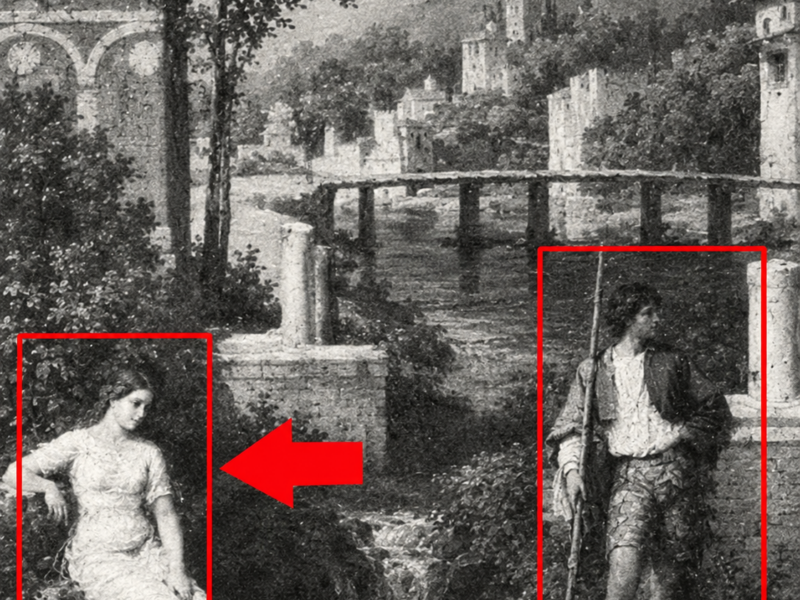
Then, in 1939, an x-ray examination revealed a sensation. The man on the left had not been there originally. In his place, the artist had first painted another nude woman stepping into the water.
The discovery overturned most existing theories while bringing scholars closer to the painting’s true mystery. What was the original subject, and why did it disappear? What made the artist abandon it? And what if the figures were never meant to tell a specific story at all?
That is the puzzle at the heart of Giorgione’s The Tempest, one of the most mysterious paintings of the Renaissance.
At first glance, it looks remarkably simple. On the left stands a young man holding a long staff. On the right, a half-naked woman breastfeeds a child. A narrow stream runs between them, and in the background are a bridge, houses, trees and city walls. Above it all, heavy storm clouds gather while a flash of lightning appears in the distance.
Most Renaissance paintings told viewers a clear and recognizable story. They depicted scenes from the Bible, classical mythology or history, and every figure had a defined role. The Tempest is completely different. The woman barely acknowledges the man. There is no conversation between them, not even the slightest hint of interaction.
So for centuries, historians have tried to answer what seems like a simple question. Who are these people?
Take a closer look at the man. A soldier, a shepherd, a nobleman? His clothing matches early 16th-century fashion, yet there are no convincing signs of his profession or status. He carries no armor, no sword, no shield. Even his long staff is ambiguous and could just as easily be a spear. It is as if Giorgione deliberately removed every clue to his identity.
The woman raises just as many questions. She calmly nurses the child as though nothing around her matters, despite being almost completely nude. She looks directly at the viewer, pays no attention to the approaching storm and makes no attempt to find shelter.
One of the most popular readings holds that the painting shows Adam and Eve after their expulsion from Eden. In this version, the woman is nursing Cain, the first child of humanity. The lightning stands for God’s wrath, and the broken columns for the lost paradise and the destruction of a perfect world.
Supporters also point to an easily overlooked detail, a white stork perched on a roof in the background. In the Renaissance, the stork symbolized new life, motherhood and family loyalty, which makes its place beside the woman and child look far from accidental.
It sounds convincing, but the weaknesses show quickly. Why is Adam dressed like a fashionable Venetian of the early 1500s? And why does he lack any of the traditional attributes of the biblical first man?
Another popular theory names the figures as the Holy Family. The woman is the Virgin Mary, the child is Christ, and the man is Joseph, protecting them on the flight into Egypt. Some scholars have even suggested the storm symbolizes the dangers awaiting them on the road.
This reading runs into serious problems too. Mary is shown almost completely nude, an extremely unusual choice for religious painting of the period. The halos that almost always accompany Christ and the Virgin are missing. And the composition resembles no known representation of the Holy Family. Instead of a clear religious narrative, we see two people who seem to have no meaningful connection at all.
Over time, scholars turned to classical mythology. Some identified the pair as Paris and the nymph Oenone, while others read them as an allegory of virtue and fortitude. Yet each new theory explained only part of the picture and left other details hanging. Competing interpretations multiplied, and none could convincingly explain the true meaning.
Then came the x-rays of 1939. They showed that the man had not been part of the original composition. Where he now stands, there was once another nude woman, and Giorgione painted her out completely and replaced her with the young man.
It was a tremendous shock. The man’s presence was exactly why scholars had read the painting as Adam and Eve after the fall, as Paris and Oenone, or as an allegory of strength and mercy.
But if one of the main figures could be swapped so freely during the painting process, perhaps the figures were never meant to represent a specific story at all. They may simply have been elements of the overall composition, there to create a mood rather than to tell a narrative. Perhaps that is why the search for a single storyline was doomed from the start.
An increasing number of scholars now believe Giorgione deliberately abandoned traditional storytelling and made an atmosphere, not an illustration, the true subject. Skeptics counter that a lost first design does not prove there was no story, and that the answer may simply be waiting in some undiscovered document.
If the atmosphere reading is right, it was revolutionary for the early 16th century. Before Giorgione, nature almost always served as a backdrop for events unfolding in the foreground. In The Tempest, everything is reversed, and the landscape makes a far stronger impression than the figures.
Try imagining the painting without the man and the woman. It would lose surprisingly little of its power. Remove the storm clouds or the flash of lightning, though, and the whole work loses its tension. The real drama seems to unfold not between people but within nature itself.
The dark sky, the silence before the storm, the motionless air, the eerie light and the lone bolt of lightning create an overwhelming sense that something inevitable is about to happen. The human figures dissolve into that atmosphere of expectation and become part of the landscape. They do not shape the mood. Nature dominates them.
It is no coincidence that The Tempest is often called the first visual poem in the history of European art. Like poetry, it does not demand a single correct interpretation. Rather than offering answers, it evokes anxiety, anticipation and mystery, and invites every viewer to search for their own meaning among the silent figures and the approaching storm.
Many great works eventually give up their secrets. Restorers uncover hidden images, archives reveal the identities of forgotten figures, and new technologies expose details unnoticed for centuries. The Tempest does the opposite, and every new discovery raises more questions.
The x-ray revealed a radically altered composition, yet it could not explain why Giorgione made the change. Perhaps that is the painting’s greatest secret. He created a work that does not ask to be solved, offers no single correct answer and makes no attempt to tell a complete story. It compels viewers to keep searching, and to find something new each time.
That may be why, more than 500 years later, it remains one of the most celebrated paintings of the Renaissance and one of the very few masterpieces about which scholars can still honestly say, “We simply do not know.”
So did Giorgione deliberately hide a specific story in The Tempest? Or did he intentionally create a painting that was never meant to have a single definitive interpretation?









