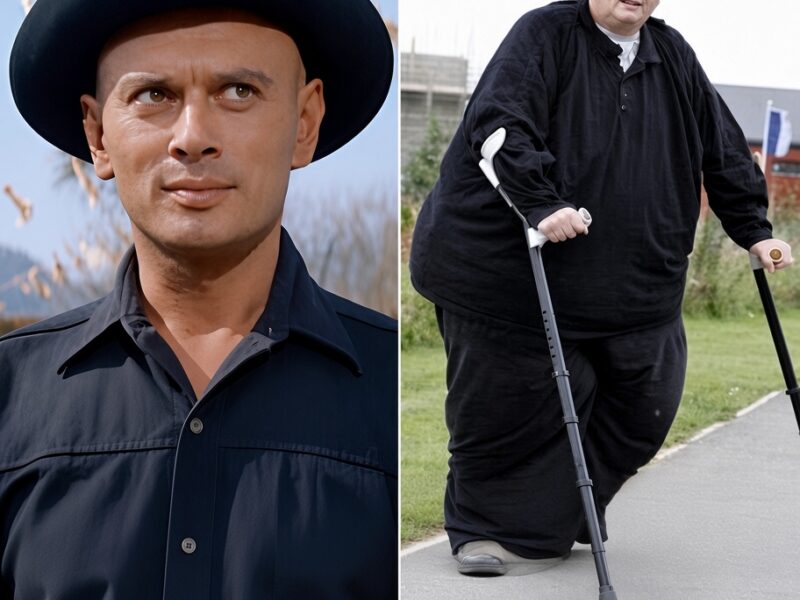
Every Star Has Ridden Into the Sunset, and Their Final Chapters Will Stay With You
Seven gunmen rode into a forgotten village and became immortal.
But the men and women behind them could not outrun time.
Every major cast member of this story is gone now.
Some became Hollywood legends whose names still light up movie marquees. Some carried private battles far from the cameras. Some left much sooner than anyone expected.
So what happened after the dust settled and the guns finally went quiet?
This is the cast of The Magnificent Seven, then and now, in 2026.
Let’s begin with the man who smiled while he threatened.
Eli Wallach as Calvera: The Villain Who Never Had to Shout
Calvera is the smiling threat at the center of the film.
He is a bandit leader who can joke with the very villagers he is robbing and still make every word feel dangerous.
Eli Wallach was 45 when the movie reached theaters in 1960. He gave Calvera a charisma that keeps the character from sliding into a simple Western villain.
Calvera is ruthless, but never dull.
He talks as though exploitation is simply part of the natural order. Fear and violence are practical tools to him, not moral choices.
That confidence is what makes him frightening.
He never seems to wonder whether he has the right to take what he wants.
Wallach gave him quick eyes, sudden flashes of cruelty, and a strange sense of humor that made every encounter unpredictable.
His presence also raised the stakes for the seven gunmen.
They were not fighting a faceless enemy. They were facing a man smart enough to understand weakness and arrogant enough to believe he could always control it.
That is why Calvera lingers in the memory. The danger comes wrapped in charm.
Eli Wallach passed away on June 24, 2014, at the age of 98, from natural causes.
After the film, he built one of the great character actor careers in cinema. He became unforgettable as Tuco in The Good, the Bad and the Ugly, and he appeared in films including The Misfits and Lord Jim.
Calvera endures because Wallach understood something the best villains always know.
They do not need to shout. Sometimes they smile, explain why they are right, and make the threat feel even colder.
Robert Vaughn as Lee: The Gunfighter Whose Courage Was Cracking
Some men look composed from the outside while fear tears through them underneath.
Lee was that man.
Robert Vaughn was only 28 when he played the role in 1960, yet he gave Lee the weary presence of someone who had spent years surviving on reputation alone.
Among the seven hired defenders, Lee stands apart for a painful reason. He knows something inside him has changed.
The confidence that once made him deadly is beginning to fail, and he is fully aware of it.
Vaughn never lets Lee confess this in a dramatic speech.
Instead, the fear leaks out through small details. Restless eyes. Hesitation. The sense that every gunfight now carries a question he never used to ask.
That vulnerability gives Lee one of the most human arcs in the entire film.
He is not trying to become fearless. He is trying to act despite his fear.
So when he finally chooses to stand with the others, the moment lands hard, because the audience understands exactly what it costs him.
Lee becomes proof that bravery can exist even after confidence disappears.
Robert Vaughn passed away on November 11, 2016, at the age of 83, after a battle with leukemia.
After The Magnificent Seven, he became internationally famous as Napoleon Solo in The Man from U.N.C.L.E. He kept working across film, television, and theater, and he even earned a doctorate in communications.
Lee remains one of his most memorable Western roles because Vaughn gave the character something deeper than coolness.
He showed a man discovering that fear does not erase courage.
Sometimes fear is what finally gives courage its meaning.
James Coburn as Britt: The Quiet Blade
Every group needs someone who does not talk much.
In this group, that man was Britt.
His confidence comes not from boasting, but from knowing exactly what he can do.
James Coburn was 32 when he took the role. His long frame, weathered face, and effortless physical control made Britt feel like a man who had been riding through Westerns for years.
He speaks little because he has nothing to prove with words.
Then comes one of the film’s most memorable moments.
Britt calmly accepts a challenge from another gunfighter and shows that his knife can be deadlier than a pistol.
Coburn plays the scene without unnecessary drama. Stillness and a faint half-smile make the danger feel even greater.
That restraint defines Britt.
He is not reckless, loud, or hungry for attention. He observes, waits, and acts only when the moment demands it.
Among a crew of very different gunmen, his silence gives him a special kind of authority.
James Coburn passed away on November 18, 2002, at the age of 74, from a heart attack.
After the film, he became one of Hollywood’s most recognizable tough guys, appearing in The Great Escape and Our Man Flint. Years later, he won an Academy Award for his work in Affliction.
Off screen, he was known for his love of jazz, martial arts, and fast cars.
Britt endures because Coburn made silence magnetic.
He showed that a Western hero did not need a speech to command the screen. A steady gaze, a knife, and absolute self-belief were enough.
Rosenda Monteros as Petra: The Heart of the Village
Not every battle in this story is fought with guns.
Petra brings the human heart of the village into the film. She reminds audiences that this fight is not really about gunfighters proving themselves.
It is about ordinary people hoping for a future.
Rosenda Monteros was 25 when she played the role, and she gave Petra a quiet strength that balances the violence around her.
Petra is gentle, but never passive.
She cares for the children. She survives the fear created by Calvera’s raids. And slowly, she allows herself to believe that life might become something more than waiting for the next attack.
Her relationship with Chico gives that hope a personal shape.
He begins the story obsessed with becoming a legendary gunman. Petra represents another possibility entirely, a life of belonging, love, and community rather than endless violence.
Monteros played their growing connection with warmth and restraint, letting the romance unfold naturally inside a film dominated by men with weapons.
Petra’s courage is different from theirs, but no less important.
Rosenda Monteros passed away on December 29, 2018, at the age of 83, from natural causes.
After the film, she continued working in Mexican cinema, international productions, and theater, and she became known for her poise and emotional honesty.
Petra stays with us because Monteros gave the film something the gunfighters could never provide on their own.
A reason to imagine what comes after the shooting stops.
Charles Bronson as Bernardo O’Reilly: Granite on the Outside, Tender Within
Bernardo looks like one of the hardest men among the seven.
Yet his most memorable moments come when the armor begins to soften.
Charles Bronson was 39 when he played the role, and his rugged physical presence made Bernardo instantly believable as a hired gun.
He signs on partly because he needs the money. He jokes bitterly about how little society values men who live by the gun.
But something changes once he reaches the village.
The local children begin to idolize him. They follow him around, treating him not as a killer, but as a hero.
Bronson handles those scenes with remarkable restraint.
Bernardo does not suddenly turn sentimental. He stays gruff. But small smiles, awkward affection, and flashes of protectiveness reveal a man who may have spent years pretending he no longer needed family.
His bond with the children gives the film some of its most touching moments, because it proves that even a hardened gunfighter can still be surprised by belonging.
Charles Bronson passed away on August 30, 2003, at the age of 81, from pneumonia.
After the film, he became an international star through The Dirty Dozen, Once Upon a Time in the West, and the Death Wish series.
Bernardo matters because Bronson revealed tenderness without weakening the character.
His toughness never disappears. It simply gains another meaning.
Beneath that granite face is a lonely man discovering that being admired by children can matter more than being feared by enemies.
Horst Buchholz as Chico: The Youngest Fire
Chico is the youngest spark among the seven.
He is a farmer’s son desperate to prove that he belongs beside men whose reputations already sound like legends.
Horst Buchholz was 27 when he played the role, and he gave Chico a restless energy that instantly separates him from the older gunfighters.
At first, Chico wants the image of the life more than he understands its cost.
He boasts. He pushes himself forward. He tries again and again to impress Chris and the others.
Underneath it all is a fear that going back to ordinary work would mean admitting he is ordinary, too.
Buchholz makes that insecurity visible beneath the swagger.
Chico is exciting because he is still becoming someone.
As the fight with Calvera grows more dangerous, his ideas about heroism begin to shift. He witnesses death, responsibility, and sacrifice, while his growing affection for Petra opens up another possibility.
Perhaps courage does not mean becoming a famous gunfighter.
Perhaps it means choosing a life worth staying for.
Horst Buchholz passed away on March 3, 2003, at the age of 69, from pneumonia.
After the film, he kept up a busy international career, appearing in One, Two, Three and later in Life Is Beautiful.
Chico endures because Buchholz captured the exact moment when youthful fantasy collides with adult consequence.
He begins wanting glory and ends understanding responsibility.
Of all the seven, he is the one given a chance to leave violence behind, and that choice gives his story a hope the others can no longer claim.
Jorge Martínez de Hoyos as Hilario: The Farmer Who Said Enough
Not every hero carries a gun.
Hilario is one of the villagers who begins the story feeling powerless, then slowly discovers that fear does not have to be permanent.
Jorge Martínez de Hoyos was 40 when he played the role, and his grounded performance gives the village a human reality beneath the larger-than-life gunfighters.
Hilario lives under the constant threat of Calvera’s raids.
Every harvest can be taken. Every act of resistance may bring terrible consequences.
Yet he is also among the men willing to travel to the border and seek help, a decision that sets the entire story in motion.
Martínez de Hoyos gives him quiet dignity rather than theatrical bravery.
Hilario listens, worries, hesitates, and gradually moves from depending on the seven toward defending his own home.
That transformation matters, because the film’s deepest victory is not simply defeating bandits.
It is helping ordinary people believe they can stand up for themselves.
Jorge Martínez de Hoyos passed away on May 6, 1997, at the age of 76, from natural causes.
Beyond the film, he built a long career in Mexican cinema and international productions, including The Professionals, and became one of Mexico’s respected character actors.
Hilario remains important because he represents the people who truly have everything to lose.
The seven may ride away or die in battle, but the villagers must remain.
Through Hilario, the story reminds us that courage is not reserved for men with famous guns. Sometimes it belongs to the farmer who finally decides that fear has taken enough.
Natividad Vacío: The Face in the Crowd
Some actors never get the dramatic arc.
Natividad Vacío, playing one of the villagers, was one of them.
Yet his presence helps make the Mexican village feel like a real community rather than a backdrop for someone else’s heroism.
Vacío was 48 when he appeared in the film, bringing years of supporting experience to a role built more on presence than dialogue.
He is one of the worried fathers, husbands, and workers whose lives are shaped by Calvera’s raids.
These villagers have crops to protect and families to feed, with very little power against armed men who return whenever they please.
Vacío’s familiarity with the Western genre let him inhabit that world naturally.
A worried glance toward approaching riders, or a tense moment among neighbors, can do important storytelling work even without a name attached.
Characters like his give weight to every decision the seven make, because they remind us exactly who will suffer if the defense fails.
Natividad Vacío passed away on May 30, 1996, at the age of 83, from natural causes.
Outside this film, he built a steady career in mid-century American television, appearing in shows like The Twilight Zone and The Rifleman. He took many Latino supporting roles during an era when opportunities were painfully limited.
His villager is modest in screen time, but not in function.
Without performers like him, there would be gunfights and scenery, but far less sense that a real community was fighting to survive.
Steve McQueen as Vin Tanner: The Coolest Man in the Room
Even in an ensemble crowded with strong personalities, one man kept pulling the eye.
Steve McQueen was 30 when he played Vin Tanner, the watchful gunfighter beside Chris.
Vin can appear completely relaxed while noticing every detail around him.
He does not need long speeches. McQueen gave him small movements instead: checking the coffin, handling shotgun shells, scanning a room.
Those details made Vin seem constantly alert without ever looking nervous.
That physical economy became one of McQueen’s signatures.
Vin is cool, but never empty. His dry humor and quiet loyalty helped define the bond among the seven, especially his connection with Chris.
He understands the danger perfectly, and he chooses to stay anyway.
That makes his calm different from recklessness.
Vin knows what violence can cost. He simply refuses to let fear control the decision.
Steve McQueen passed away on November 7, 1980, at the age of 50, from mesothelioma, a cancer often associated with asbestos exposure.
After the film, he became one of the defining movie stars of his generation through The Great Escape, Bullitt, and The Thomas Crown Affair.
Off screen, he was known for his passion for motorcycles, racing cars, and risk.
Vin Tanner endures because the role captures McQueen’s star power at its purest.
He could do almost nothing and still command attention.
Decades later, Vin remains the image of Western cool: watchful, understated, and completely comfortable letting everyone else talk first.
Rico Alaniz as Sotero: The Man Who Stayed
Sotero stands among the villagers who must decide whether survival means enduring Calvera or risking everything to resist him.
Rico Alaniz was 41 when he appeared in the film, and his experience in Westerns gave Sotero an authenticity that quietly strengthens the story.
He is not one of the famous gunfighters riding into town.
That is exactly why he matters.
Sotero represents the people who will still be there after the battle ends. He works the land, lives with the fear of another raid, and watches as outsiders arrive promising to help.
Alaniz relied on expression rather than spectacle.
He showed the anxiety of a man who knows resistance could mean death, but also understands that surrender has already taken too much.
As the villagers become more involved in their own defense, Sotero becomes part of that gradual shift from helplessness to determination.
Rico Alaniz passed away on March 9, 2015, at the age of 95, from natural causes.
Beyond the film, he piled up credits in classic Western television, including Gunsmoke and Bonanza, often playing cowboys, soldiers, and townsmen.
Sotero is a subtle contribution, but an important one.
Alaniz helped make the village feel inhabited rather than staged.
His character reminds us that the seven are temporary, and that the people who truly own the victory are the ones who must keep planting, rebuilding, and living after the gunfighters are gone.
Brad Dexter as Harry Luck: The Cynic Who Found a Cause
Harry Luck joined the seven convinced there had to be more to the job than anyone was admitting.
Brad Dexter was 43 when he played the role, and he gave Harry a worldly, suspicious edge that made him one of the group’s most openly self-interested members.
He simply cannot believe Chris would risk his life for poor villagers without some hidden reward waiting at the end.
In Harry’s mind, there must be gold somewhere.
That assumption reveals the life he has lived. He expects people to act for profit, because experience has taught him that idealism rarely pays.
Dexter never makes him purely greedy, though.
Harry feels like a survivor who has learned to distrust noble motives because the world has punished them too often.
That is why his transformation hits so hard.
As he watches the villagers suffer and sees the courage of the other gunmen, something shifts.
By the final battle, the man who came searching for secret treasure has found a cause worth sacrificing himself for.
Brad Dexter passed away on December 11, 2002, at the age of 85, from emphysema.
His career included Run Silent, Run Deep and The Asphalt Jungle, and he later worked as a producer and, briefly, as Frank Sinatra’s bodyguard.
Harry Luck endures because Dexter gave cynicism somewhere to go.
He begins believing everything has a price, and ends by proving that even a hardened opportunist can still choose loyalty when it matters most.
Yul Brynner as Chris Adams: The Still Center
And then there is the man in black.
Chris Adams is the still center of The Magnificent Seven, a gunfighter whose authority comes from the feeling that he has already decided what kind of man he wants to be.
Yul Brynner was 40 when he took the role. He was already an international star, and he brought Chris a commanding presence without leaning on obvious theatrics.
From the moment Chris volunteers to drive a hearse through a hostile crowd, the audience understands his code.
He does not need applause. He is not chasing money.
Something inside him simply refuses to walk away when people need help.
Brynner played him with clipped speech, steady eyes, dry humor, and an almost total absence of wasted movement.
That control gives the character enormous power.
As leader of the seven, Chris must hold together men with different motives, fears, and personalities, while also accepting responsibility for villagers who have placed their trust in him.
Beneath the confidence is melancholy.
He understands that the world is changing, and that men like him may soon have nowhere left to belong.
Yul Brynner passed away on October 10, 1985, at the age of 65, after developing lung cancer.
Beyond this film, his career included The King and I, Westworld, and years of stage performances that confirmed his status as one of Hollywood’s most distinctive stars.
Chris Adams endures because Brynner made leadership look quiet.
He created a Western hero defined less by how many men he could defeat than by the responsibility he accepted when walking away would have been easier.
The Final Ride
The village is quiet now.
Every one of these performers has taken their final ride.
But Chris, Vin, Britt, Bernardo, Chico, Calvera, and the people they fought to protect still live wherever this film is watched again.
Thank you for remembering them with us.
Stay with Rewind 1960s for more classic stars, hidden struggles, unforgettable losses, and movie legends whose stories continue long after the final shot fades.









