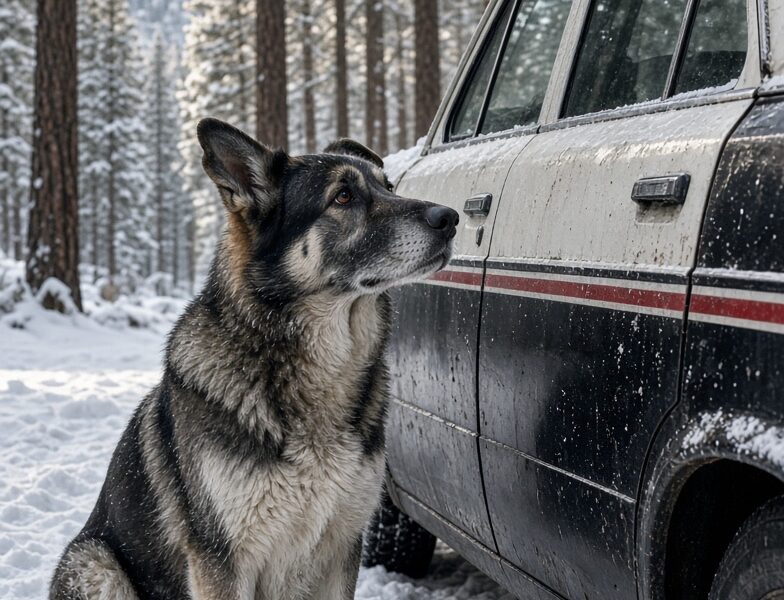
Every Evening at 6:15 He Sat by the Police Cruiser Door — Waiting for a Handler Who Never Came
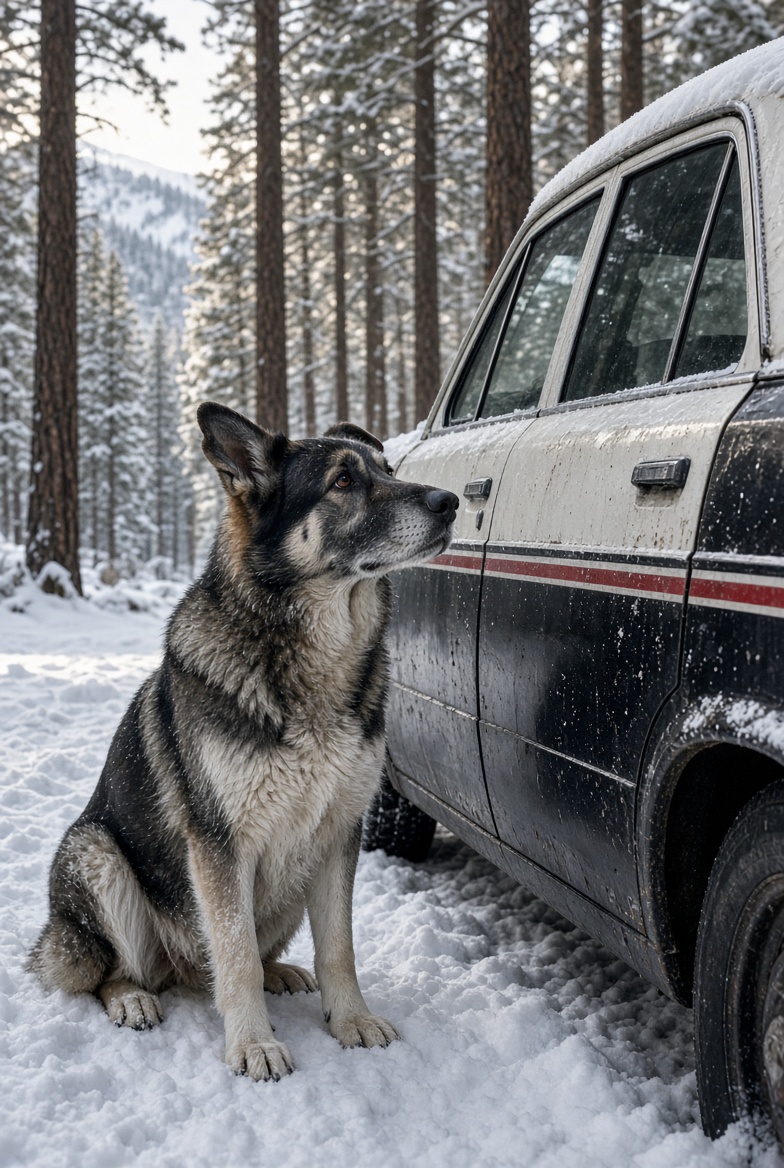
The snowstorm had barely cleared over Flagstaff, Arizona, when Officer Ethan Walker noticed the old German Shepherd sitting beside a retired police cruiser, staring at its rear passenger door as if someone had promised to return and simply taken too long.
The dog was twelve years old, his muzzle silver, his hind legs stiff from age, and his name was Major.
For nearly five months, families had come to High Desert Animal Rescue, met the former police canine, and left without adopting him.
They called him distant. Difficult to connect with. Too old to start over.
But Ethan’s ten-year-old son, Logan, noticed something the adults had missed.
Major wasn’t trying to get inside the cruiser.
He was waiting for someone to step out.
Every evening, at exactly 6:15, the old dog returned to that same door and settled onto the snow-covered ground.
And when Ethan eventually discovered the name of the man Major was waiting for, he uncovered a mistake that had kept two loyal partners separated for months.
What happened when they finally met again would change the way everyone at that shelter understood loyalty, retirement, and the meaning of coming home.
Snow still covered the sidewalks of Flagstaff that Saturday morning, softening the rooftops and collecting around the trunks of ponderosa pines.
The clouds had begun breaking apart above the San Francisco Peaks, but the roads remained slick, and the cold had settled deep enough to make every breath visible.
Officer Ethan Walker had expected an ordinary Saturday.
Instead, he was driving toward High Desert Animal Rescue with a toolbox sliding around in the back of his SUV and his ten-year-old son sitting quietly beside him.
Ethan was forty-four, a little over six feet tall, with broad shoulders, short dark brown hair graying above his ears, and a square face that rarely revealed his thoughts before he was ready to speak.
Seventeen years in police work had taught him to study a situation before entering it.
He knew how to calm an angry driver, question an unreliable witness, and approach a frightened animal without making things worse.
He was patient with other people.
With himself, he was another matter.
That morning, he wore his dark patrol uniform beneath a heavy winter jacket.
Although officially off duty, he had volunteered to help repair storm damage at the rescue after hearing that part of the rear fencing had been damaged and several roof panels had come loose.
His son had asked to come along.
Logan Walker was small for his age, with straight light brown hair, hazel eyes, and a serious expression that sometimes made adults forget he was only ten.
His teachers described him as bright but unusually quiet.
He preferred observing a group before joining it, and he often waited several seconds before answering questions that other children answered immediately.
Ethan had spent the past year encouraging him to speak louder, participate sooner, and stop thinking so long before responding.
He meant well.
Still, Logan sometimes wondered why silence made adults so uncomfortable.
“Dad, do you think they’ll let me help with the dogs?” he asked as they turned off the main road.
“If you finish the jobs Emily gives you first.”
“What if the jobs take all day?”
“Then you’ll have to negotiate.”
Logan considered that.
“Can I negotiate for a dog?”
Ethan glanced at him.
“Absolutely not.”
“That was a quick answer.”
“Some questions don’t need much thought.”
Logan turned toward the window, hiding a small smile.
Ethan missed it.
High Desert Animal Rescue stood near the edge of Flagstaff, where residential streets gradually gave way to open ground and thick pine forest.
The shelter consisted of several low tan buildings, a modest reception area, a storage shed, and a fenced exercise yard.
It was privately supported and almost permanently short of money, but it had developed a reputation for taking in older animals that larger adoption networks struggled to place.
Emily Carter, the rescue’s director, met them outside the main entrance.
At fifty-one, Emily was medium height and strongly built, with dark blonde hair tied into a low ponytail, blue-gray eyes, and mud-streaked work boots.
She wore a faded green rescue jacket and carried a clipboard that appeared to have survived several winters, two rainstorms, and at least one encounter with a determined puppy.
Fifteen years earlier, she had begun volunteering after adopting an elderly Labrador that had spent almost a year waiting for a home.
The experience had changed her.
She had little patience for people who treated senior animals as problems to be solved quickly, but seemingly endless patience for the animals themselves.
“You brought tools,” she said, looking toward Ethan’s SUV.
“And cheap labor,” Ethan replied.
Emily looked at Logan.
“I pay in hot chocolate.”
“That sounds better,” Logan said.
“Then we have a deal.”
For the next hour, Ethan helped secure a loose section of fencing while Emily organized volunteers around the damaged storage building.
Logan carried folded blankets, moved empty food bowls, and stacked lightweight supplies wherever Emily directed him.
He worked without complaining, which earned him two marshmallows in his hot chocolate instead of the usual one.
Eventually, the rear kennel door opened.
Six dogs were released into the exercise yard, one at a time.
A young mixed-breed dog raced toward a mound of snow and plunged his nose into it.
Another trotted along the fence, investigating every patch of ground that might conceal an interesting smell.
A stocky brown dog followed Emily toward a bucket of toys.
Then the final dog appeared.
Logan stopped carrying blankets.
The German Shepherd moved slowly through the doorway.
He was large despite his age, black and tan, with a broad chest and a thick coat that still hinted at the powerful working dog he had once been.
Silver covered most of his muzzle and spread beneath his dark brown eyes.
His left ear tilted slightly outward while the right remained upright.
His hind legs moved carefully, not exactly weakly, but with the deliberate rhythm of an older animal that had learned not to waste motion.
He did not follow the other dogs.
He crossed the yard alone.
Near the rear fence stood an old black-and-white Ford Police Interceptor.
The Flagstaff Police Department had donated the retired cruiser months earlier for community events and educational programs.
Its emergency equipment had been removed, and it had not been used for patrol in years.
Snow covered part of the hood and roof.
The German Shepherd walked directly toward it.
Logan watched as the dog passed the front bumper, continued along the passenger side, and stopped beside the right rear door.
Then he sat.
No barking.
No scratching.
No attempt to climb inside.
He simply faced the closed door.
Logan lowered the blankets onto the ground.
Emily noticed him watching.
“That’s Major.”
Logan glanced at her.
“How old is he?”
“Twelve.”
“Was he a police dog?”
Emily nodded.
“Retired police canine. He worked for years before coming here.”
Logan looked back at the cruiser.
“Why does he sit there?”
Emily followed his gaze.
“That’s what we’ve been trying to figure out.”
Ethan had been tightening a temporary brace against the damaged fence.
At the words police canine, he stopped working and looked across the yard.
“Major was a working dog?”
“Almost nine years with a department in Arizona,” Emily explained. “He retired, went through a few transitions, and eventually arrived here.”
“How long has he been with you?”
“Almost five months.”
Ethan frowned.
Five months was a long time for a senior dog to remain in a shelter, but a retired police canine usually attracted at least some interest from people who understood working breeds.
“Nobody wants him?”
“Two families came specifically to meet him,” Emily said. “Both were good people. Both changed their minds.”
“Why?”
Emily removed one glove and rubbed her hands together against the cold.
“He doesn’t seem interested in them. He’ll walk politely, let them examine him, and accept a little attention if they approach slowly. But he never really connects. It’s like part of him is somewhere else.”
Logan looked at Major.
“Does he always sit by that door?”
“Almost every day.”
“Every day?”
“Every day the yard is open.”
The answer changed something.
Ethan had worked around police canine teams enough to understand that repetition mattered.
Working dogs developed patterns because consistency helped them interpret complicated environments.
A dog that repeatedly returned to the same place was not necessarily being stubborn.
Sometimes, he was following a rule nobody else knew existed.
Ethan crossed the yard.
Major heard him approaching but did not turn immediately.
Then he noticed the uniform beneath Ethan’s winter jacket.
The change was instant.
The old shepherd stood, lifted his head, and brought both ears forward.
Ethan stopped several feet away.
Major looked at the badge visible beneath the open jacket.
Then he moved.
Not toward Ethan.
Around the cruiser.
He passed behind the vehicle, crossed to the passenger side, and returned to the same rear door.
Then he stopped and looked at Ethan again.
The expression was not excitement.
It was expectation.
Ethan had seen that look before.
He had seen working dogs wait beside vehicles for their handlers, hold position outside familiar doors, and remain alert because a routine had not yet reached its final step.
He took one step toward the cruiser.
Major straightened.
Ethan moved toward the front of the vehicle.
Major stayed where he was.
Then Ethan returned toward the passenger side.
Major lifted his head again.
“Dad.”
Ethan raised a hand without looking back.
“Stay there, Logan.”
“I am.”
“Good.”
Logan studied the dog for several seconds.
Then he pointed.
“I don’t think he wants the car.”
Ethan turned.
“What makes you say that?”
“Because he doesn’t look inside.”
Emily stepped closer.
Logan continued, choosing his words carefully.
“He keeps looking at the door. Not at the seat. And when you walk away, he watches you, but he doesn’t follow you. He only moves when you come back.”
Ethan glanced toward Major.
The old shepherd had returned to his seated position.
Logan’s voice grew quieter.
“I think he believes somebody is going to get out.”
For several seconds, nobody spoke.
The wind moved lightly through the pine branches beyond the fence.
Major remained beside the rear passenger door, waiting.
And Ethan realized that everyone at High Desert had been asking the wrong question.
They had wondered why Major would not accept another family.
Perhaps Major believed his family had never finished leaving.
That afternoon, Ethan returned to the damaged fence, but his attention repeatedly drifted toward the cruiser.
Major eventually went inside with the other dogs.
Before disappearing through the kennel door, he looked over his shoulder at the vehicle.
Ethan watched him go.
For the first time in months, someone had noticed something about Major that did not fit the usual explanation.
The following week, Ethan intended to find out what it meant.
He did not know that the answer would begin with a faded photograph, an incomplete record, and one particular time written in his notebook.
Six fifteen.
Three days after his first visit, Ethan returned to High Desert Animal Rescue without a toolbox.
This time, he carried a notebook beneath one arm.
Logan came with him again, bringing a paperback adventure novel inside his coat pocket.
During breakfast, he had asked whether Major would remember them.
Ethan had explained that three days was not very long for a dog.
Logan had considered the answer.
“Five months isn’t very long, either, apparently.”
Ethan had looked up from his coffee.
“What do you mean?”
“Major still remembers somebody who hasn’t come back.”
Ethan had no immediate answer.
Now, as they entered the shelter office, Emily seemed to understand why they had returned.
“No tools today?”
“Different repair,” Ethan said.
Emily glanced toward Logan.
“Major?”
“Major.”
She led them into the cramped office behind reception, where a gray filing cabinet stood beside an aging computer and shelves crowded with veterinary folders.
Most of the rescue’s records had been digitized, but Emily still kept paper files for animals whose histories involved multiple organizations.
“Sometimes the old paperwork tells you more than the new system,” she explained.
She opened the bottom drawer and removed a thick manila folder with MAJOR written across the tab.
The first pages contained routine information.
Vaccinations.
Senior wellness evaluations.
Medication notes.
Feeding instructions.
Then Ethan reached the older records.
Major had served almost nine years with a small Arizona police department.
His evaluations repeatedly described him as stable, disciplined, highly responsive to routine, and comfortable around officers, vehicles, and public environments.
Nothing suggested that his behavior at the rescue came from aggression or fear.
Major had simply spent most of his life understanding exactly what was expected of him.
Then Ethan found the name Sergeant Raymond Collins.
Raymond Collins had been listed as Major’s final handler and primary caretaker after retirement.
Several documents referred to him as Ray.
The oldest photograph in the folder showed a younger Major standing beside a patrol cruiser, his muzzle almost entirely black.
Beside him stood a tall officer with a narrow face, broad shoulders, and short dark hair already turning silver.
Ray appeared to be in his late fifties when the photograph was taken.
His posture was straight, his expression serious, and one hand rested lightly against Major’s shoulder.
Logan leaned closer.
“That’s his person.”
Emily looked at him.
“Maybe.”
“No,” Logan said. “Look at Major.”
The boy pointed toward the photograph.
The dog was not looking at the camera.
He was looking up at Ray.
Ethan studied the image again.
There was something unmistakable in the way Major stood beside the man.
Not merely obedience.
Familiarity.
The kind that came from years of sharing ordinary mornings, long shifts, quiet drives, and routines repeated so often that neither partner needed to think about them anymore.
“What happened to Ray?” Logan asked.
“That’s what we’re trying to find out,” Ethan replied.
The answer became less clear with every page.
After retirement, Major had apparently gone home with Ray.
Several months later, he entered temporary boarding.
Another document placed him in a senior working-dog foster program.
After that came a transfer form bearing the name of a different organization, followed eventually by the intake paperwork from High Desert Animal Rescue.
The dates made sense.
The explanation did not.
There was no clear surrender statement from Ray.
No complete note describing why Major had left his home.
No reliable current phone number.
One photocopied address had been crossed out twice.
A handwritten margin note simply read: PLACEMENT APPROVED.
There was no explanation of who had approved it or whether the placement was intended to be temporary or permanent.
Emily leaned against the filing cabinet.
“That’s basically what we received. We tried the numbers and addresses we had. One number belonged to someone else. Another was disconnected. A letter came back.”
Ethan turned another page.
“So everyone assumed he wasn’t coming back.”
Emily’s expression tightened.
“Eventually, yes.”
Ethan did not blame her.
Shelters could only work with the information they received.
Major had arrived needing care, and High Desert had provided it.
But an assumption repeated often enough could begin to look exactly like a fact.
Logan had wandered toward the office window.
From there, he could see the rear exercise yard.
Major was outside.
He stood beside the cruiser.
“Dad?”
Ethan looked up.
“Yes?”
“What if Ray doesn’t know where he is?”
The question settled over the room.
Emily looked at the incomplete records.
Ethan looked at the photograph.
Nobody had proof that Ray knew Major was still waiting in a shelter.
Nobody had proof that Ray had deliberately stopped looking for him, either.
They had five months of uncertainty disguised as a completed placement.
Ethan closed the folder.
“Let’s find out.”
Outside, he approached Major again.
The old shepherd noticed his uniform and immediately became alert.
“Major. Sit.”
Major lowered himself carefully, front legs first, then his hips.
“Stand.”
He rose without hesitation.
Ethan tried two more basic commands.
Each response came promptly.
There was no excitement afterward and no demand for food.
Major simply returned his attention to Ethan and waited.
Emily folded her arms.
“He doesn’t respond like that to me.”
“He’s probably associating the uniform with his old work,” Ethan said.
He walked toward the right rear door of the cruiser.
Major stood.
Ethan reached for the handle.
Major moved into position beside him.
Then Ethan opened the door.
Nothing happened.
Major did not jump inside.
He did not even lean toward the seat.
Instead, he stepped slightly backward and stared at Ethan.
Ethan waited.
Major waited longer.
“That’s strange,” Emily murmured.
Ethan looked inside.
The rear seat was empty except for a folded blanket used during community events.
He tapped the edge of the doorway lightly.
“Major.”
The dog remained outside.
Logan moved closer but stopped several feet away.
“He never wanted to get in.”
Ethan glanced at him.
Logan pointed toward Major’s paws.
“He always stops outside the door. He leaves room for somebody.”
Ethan looked again.
The boy was right.
Major’s position was not that of a dog waiting to enter a vehicle.
He had deliberately left enough space for the door to open.
Ethan stepped behind the door.
Major’s eyes followed him.
Then Ethan moved back into view.
Major straightened.
Logan’s expression changed.
“He’s waiting for somebody to get out.”
Emily looked from Logan to Major.
Ethan slowly closed the door.
Major sat beside it again.
For the second time in less than a week, Logan had recognized the pattern before the adults understood it.
That afternoon, Logan returned to the yard with his book.
He chose a low wooden bench roughly fifteen feet from the cruiser and began reading.
Major looked at him once, then returned his attention to the vehicle.
Logan did not call him.
He brought no treats.
He made no attempt to shorten the distance.
Ethan almost suggested that he move closer.
Then he stopped himself.
At school, Logan’s teachers often encouraged him to join conversations sooner.
Ethan did the same thing at home.
Speak up.
Go introduce yourself.
Don’t wait so long.
Watching him now, Ethan wondered whether Logan’s waiting was always hesitation.
Perhaps sometimes it was patience.
Two days later, Logan moved his reading spot a few feet closer.
Major remained beside the cruiser.
The following afternoon, Major left the vehicle after several minutes and settled halfway between the cruiser and Logan.
The boy never acknowledged the change.
He simply turned another page.
Ethan watched from the shelter doorway.
“He’s not trying to make the dog come to him,” Emily whispered.
“No.”
“He’s letting Major decide.”
Ethan looked at his son.
“I’m starting to realize that.”
The next clue came from the security cameras.
Emily had originally installed them to monitor the rear yard and kennel entrances, not individual animal behavior.
But after Logan’s observation, she pulled several days of recordings.
They watched the footage inside the office.
Monday.
Major entered the yard during the afternoon and wandered normally.
Then, at approximately 6:15, he walked to the cruiser.
Tuesday, 6:14.
Wednesday, 6:16.
Thursday, 6:15.
Different weather, different volunteers, different activity in the yard.
Almost the exact same time.
Each evening, Major approached the passenger side, positioned himself beside the right rear door, and waited.
Sometimes he remained there for ten minutes.
Sometimes longer.
Eventually, he returned inside.
Emily stared at the monitor.
“I knew he went out there often. I never realized the time was this consistent.”
Ethan wrote 6:15 in his notebook.
Training could explain repetition.
Routine could explain the vehicle.
But something had happened often enough at 6:15 that Major’s aging body still remembered it months after everything else around him had changed.
They returned to the records.
Ethan searched more carefully, separating photocopies by date and department.
Near the bottom of the folder was a faded handling sheet that appeared older than the rest.
Several sections were unreadable, but it contained brief notes about feeding, transport, equipment, and vehicle procedures.
Ethan flattened the page beneath his palm.
One line remained clear.
END-OF-SHIFT VEHICLE CHECK PERFORMED WITH HANDLER.
Below it, part of the page had been damaged during copying.
The remainder of the procedure was gone.
No explanation.
No final instruction.
No description of what Major and Ray had done after the vehicle check.
Ethan stared at the sentence.
End of shift.
Vehicle check.
Handler.
Six fifteen.
Pieces were beginning to gather, but they still did not form an answer.
Logan leaned over the desk.
“So he did this when he worked.”
“Looks that way.”
“With Ray, probably.”
“Probably.”
Logan glanced toward the window, where Major was visible in the fading afternoon light.
“Then maybe he isn’t waiting because he misses the car.”
Ethan looked at him.
“Why else would he be waiting?”
“Maybe the car is just where he remembers waiting for Ray.”
That distinction stayed with Ethan.
The cruiser might not be the object Major cared about at all.
It might only be a place in a routine, a marker between working and whatever came afterward.
Near six that evening, Ethan and Logan prepared to leave.
But neither went directly to the SUV.
They waited near the shelter doorway instead.
At 6:11, Major wandered near the fence.
At 6:13, he stopped and looked toward the cruiser.
At 6:15, without anyone calling him, the old German Shepherd crossed the yard.
He walked around the rear bumper, moved along the passenger side, stopped beside the right rear door, and sat exactly as the recordings had shown.
Logan stood beside Ethan with his book held against his chest.
Major did not look inside the cruiser.
He looked toward the door, then toward the space beside it, as though someone belonged there.
Ethan thought about Sergeant Raymond Collins, a name buried beneath years of incomplete paperwork.
He thought about the missing portion of the handling sheet.
For the first time, he became certain of one thing.
Major had not spent five months waiting for an old police car.
He had been returning to the last place where his memory told him a person was supposed to appear.
The only problem was that nobody at High Desert Animal Rescue knew what happened next.
And the one line that might have explained it had disappeared from the record.
The number stayed in Ethan’s notebook for the rest of the weekend.
6:15.
It was written beneath Raymond Collins’s name and beside the faded line Ethan had found in Major’s handling record.
By Monday morning, Ethan no longer believed the time was a coincidence.
Major had repeated the same behavior through different weather, different volunteers, and different activity around the shelter.
Something about 6:15 belonged to a life the old German Shepherd still understood, even if everyone around him had forgotten what it meant.
During a quiet hour at the Flagstaff Police Station, Ethan began searching archived K-9 records.
Major had not served with his department, which made the work slower.
Some documents had been digitized years earlier.
Others survived only as scanned newsletters, training summaries, equipment forms, and brief references inside reports written for entirely different purposes.
Gradually, however, the shape of Major’s former life emerged.
For nearly nine years, he and Sergeant Raymond Collins had spent most ordinary patrol days together.
Their scheduled shifts generally ended around six in the evening.
Several vehicle logs showed Ray returning his cruiser between 6:05 and 6:20.
The times changed slightly, but the pattern did not.
One training photograph interested Ethan more than the official records.
Major stood beside a cruiser much like the retired Ford at High Desert Animal Rescue.
His coat was darker then, his muzzle almost completely black.
Ray stood near the open rear passenger door while Major waited outside.
Ethan enlarged the image.
Major was positioned almost exactly where he now sat every evening at the shelter.
Another document offered more.
It was an old vehicle-care checklist used by the department’s canine unit.
At the end of ordinary shifts, handlers checked the cruiser, removed equipment, inspected the rear compartment, and made sure nothing required attention before leaving.
Most handlers probably completed the routine without thinking about it.
For Major, repetition had apparently turned those final minutes into something much more important.
Ethan needed someone who remembered them.
The name came from an old communications roster: Susan Miller.
Susan had retired from dispatch four years earlier and still lived outside Flagstaff.
When Ethan called, she listened to his explanation without interrupting.
The moment he mentioned Raymond Collins and Major, her voice changed.
“I remember both of them.”
They arranged to meet that afternoon at a small coffee shop near downtown.
Susan was sixty-three, barely five feet three inches tall, with short silver hair, narrow shoulders, bright green eyes, and a quick, organized manner that made retirement seem like something she had agreed to only reluctantly.
Twenty-seven years in emergency communications had trained her to notice details other people dismissed as background noise.
Early in her career, a seemingly unimportant time notation had helped supervisors reconstruct a confused sequence of calls after a major storm.
From then on, Susan had developed a habit of saving notes, dates, and routine details long after everyone else stopped considering them useful.
“Ray was predictable,” she said after Ethan showed her Major’s photograph.
“Predictable in a good way?”
Susan smiled.
“There’s a difference between predictable and boring. Ray was predictable.”
She remembered him returning near the end of his shift, parking in roughly the same section of the lot, and finishing his paperwork before leaving.
Major usually remained with him until the cruiser had been checked.
Ethan opened his notebook.
“What happened after the check?”
Susan thought for several seconds.
“Ray unloaded whatever he needed. Major went around the vehicle with him. Then the dog waited by the rear passenger door.”
“Inside?”
“Outside. Always outside, as far as I remember.”
That matched Logan’s observation.
Susan continued.
“Ray would finish with the equipment, close everything up, and touch Major on the shoulder before they walked toward his personal truck.”
“A command?”
“Maybe. I couldn’t hear them from dispatch most days, but the touch was consistent. Very consistent.”
Susan leaned back and looked at Major’s photograph again.
“That dog loved routines. Ray did, too, if we’re being fair.”
Ethan asked about 6:15.
Susan’s expression became more serious.
“That would make sense.”
“Why?”
“Most normal days, that was about when they were leaving.”
There it was.
The cruiser was not Major’s destination.
It was the final station in a sequence.
Patrol ended.
The vehicle was checked.
Equipment was removed.
Major waited beside the rear passenger door.
Ray touched his shoulder.
Then they went home.
For almost nine years, Major had repeated some version of that routine hundreds, perhaps thousands, of times.
Now Ethan understood why simply opening the cruiser door had meant nothing.
Major had not been waiting to enter.
He had been waiting for the sequence to continue.
But one question remained unanswered.
What happened on their last day?
Susan’s certainty disappeared.
“That part I don’t remember.”
She promised to check several boxes of old materials she had kept after retirement, including copies of shift notices and personnel updates that had never made it into formal archives.
Ethan thanked her.
Before leaving, Susan tapped Major’s photograph with one finger.
“People remember unusual days, Officer Walker. Dogs sometimes remember ordinary ones.”
The sentence followed Ethan back to High Desert Animal Rescue.
Logan was already there after school, sitting near the retired cruiser with his paperback open across his knees.
Over the previous several days, his quiet routine had become almost as predictable as Major’s.
He never called the German Shepherd, never offered food to persuade him closer, and never moved toward him when Major created distance.
That afternoon, something changed.
Major approached Logan.
The old shepherd stopped beside the bench, turned once, and carefully lowered himself onto the ground.
His shoulder rested only inches from Logan’s boot.
Logan looked down, then deliberately returned to his book.
Ethan watched from the shelter doorway with Emily.
“You’re not going to tell him to move closer?” Emily whispered.
“No.”
“He knows what he’s doing.”
Ethan looked at his son.
“I’m beginning to think so.”
For nearly twenty minutes, Major stayed there.
His head eventually lowered across his front paws.
Logan turned pages.
The afternoon sun stretched long shadows across the snow.
It was the most relaxed Ethan had seen Major outside.
Then Major’s head rose.
No one had called him.
No door had opened.
Ethan checked his watch.
6:15.
Major stood.
He left Logan without hesitation, crossed the yard, walked around the cruiser, and returned to the right rear passenger door.
Then he sat.
Logan closed his book.
For a moment, disappointment crossed his face.
Ethan walked over.
“He came to you, but he left.”
Logan considered that.
“That doesn’t erase the first part.”
Ethan nodded.
“No, it doesn’t.”
Major remained beside the cruiser.
“He thinks he has to be there,” Logan said.
Ethan looked at the old dog.
“I think so.”
That evening, another reminder was waiting on Ethan’s phone.
The department’s personnel office had sent an email regarding the community safety coordinator position.
DECISION REQUESTED WITHIN SEVEN DAYS.
The job would move him away from regular street patrol.
He would coordinate school safety programs, neighborhood emergency planning, outreach events, and communication between officers and community organizations.
The schedule would be steadier.
He would spend more evenings with Logan.
Nothing about the position was unimportant.
Still, Ethan had not answered.
He had spent seventeen years measuring his work through patrol shifts, calls, radio traffic, and the familiar weight of equipment around his waist.
He knew intellectually that police service could take different forms.
Emotionally, another part of him kept translating the offer into a simpler sentence.
Your patrol years are ending.
Across the yard, Major sat beside a cruiser that had not performed police work in years.
The comparison was uncomfortable.
Ethan slipped his phone back into his pocket.
Logan was watching him.
“The job again?”
Ethan nodded.
“You still haven’t answered.”
“No.”
“Why?”
Ethan searched for an explanation a ten-year-old would understand.
“I’ve done patrol a long time.”
“That doesn’t answer why.”
Ethan almost smiled.
“No, I suppose it doesn’t.”
Logan reopened his book.
Major continued waiting.
Two days passed before Susan called.
She had found something.
Ethan met her at her house that evening.
Susan lived in a modest single-story home with neatly trimmed shrubs and a garage containing more labeled storage boxes than Ethan had seen outside an evidence room.
She had already arranged several folders across her dining table.
“I told you I kept things.”
“You weren’t exaggerating.”
“I was a dispatcher. Exaggeration wastes radio time.”
She handed him an old shift summary.
It confirmed that Major’s retirement had occurred shortly before Ray himself left active duty.
Nothing unusual appeared in the final canine entry.
No dramatic last assignment.
No extraordinary incident.
Major simply stopped appearing on active schedules.
Then Susan pulled out another page.
This one was different.
It was a brief administrative note dated several weeks after Major’s retirement.
Ray had experienced a serious health problem that required extended treatment and rehabilitation.
The document contained no unnecessary medical detail, only information relevant to staffing.
His planned transition out of the department had been accelerated, and assistance had been requested to move essential belongings from his home.
Ethan read the page again.
“That explains the sudden change.”
“Some of it,” Susan replied.
She produced another note.
Major had been placed in temporary boarding during Ray’s recovery.
EXPECTED DURATION: TWO TO FOUR WEEKS.
Ethan stared at the line.
Two to four weeks.
Five months later, Major was sitting beside an old cruiser at High Desert Animal Rescue.
“What happened after four weeks?”
Susan shook her head.
“That’s where my records stop. Ray never came back for him.”
“Apparently not.”
Ethan disliked how easily the sentence could become an accusation.
Nothing they had found explained why Ray had failed to return.
A health crisis, a sudden move, incomplete records, and temporary boarding were facts.
Everything beyond them was assumption.
Susan seemed to understand what he was thinking.
“Ray cared about that dog,” she said.
“You’re sure?”
“I watched them leave together for years.”
She paused.
“I don’t know what happened afterward, but whatever answer you find, start there.”
Susan turned to another sheet.
“I did find one more thing.”
It was not a police record.
It was an address search she had conducted using an old retirement association directory and several forwarded contact listings.
One name appeared at the bottom.
Raymond Collins.
Ethan leaned closer.
Below it was a current mailing address in Prescott, Arizona.
For the first time since Logan had noticed Major beside the cruiser, they had something more useful than an old photograph, a damaged document, or a forgotten routine.
They had a place.
Susan looked across the table.
“Are you going to contact him?”
Ethan folded the paper carefully.
“Yes.”
Outside Susan’s window, evening had settled over Flagstaff.
Somewhere across town, it was already past 6:15, and Ethan knew exactly where Major had probably been sitting.
The Prescott address remained on Ethan Walker’s kitchen table until nearly ten the following morning.
He copied it twice, compared it with Susan Miller’s records, and checked everything he reasonably could before deciding to make contact.
The address belonged to Juniper Ridge Retirement Community, a quiet residential complex designed for older adults who could live independently but benefited from accessible housing and nearby support.
Raymond Collins was still there.
For the first time, Ethan had reached the other end of a trail that had begun with an old German Shepherd sitting beside a retired police cruiser.
The first telephone call went through the community office rather than directly to Ray.
Ethan explained who he was, provided his department information, and asked only that Raymond Collins be told he was calling about Major, his former canine partner.
The staff member would not share personal details, which Ethan respected.
She promised to pass along the message.
Then there was nothing to do but wait.
Twenty minutes became an hour.
Ethan completed paperwork, answered two routine calls, and returned to his desk shortly after noon.
A missed call from a Prescott number appeared on his phone.
He called back immediately.
A man answered after the third ring.
“This is Ray Collins.”
Ethan sat straighter.
“Mr. Collins, this is Officer Ethan Walker in Flagstaff. I understand you used to work with a German Shepherd named Major.”
“I know why you’re calling.”
A pause followed.
“You said this was about Major.”
“Yes.”
Another silence.
Ethan chose the simplest place to begin.
“Major is alive. He’s safe.”
Nothing came from the other end.
Ethan waited.
When Ray finally spoke, the control in his voice had weakened.
“Where?”
“High Desert Animal Rescue in Flagstaff.”
“At a rescue?”
“Yes.”
“How long?”
“Almost five months.”
The silence that followed felt different.
Ethan could hear Ray breathing slowly, as though the number required time to understand.
Raymond Collins was sixty-nine now.
Later, Ethan would receive a recent photograph and see how retirement had changed the man from the old canine pictures.
Ray remained tall, though his shoulders had narrowed with age.
His once dark hair was entirely silver.
His face was long and deeply lined, and he used a wooden cane because walking longer distances had become difficult.
People who knew him described him as disciplined, private, and dependable.
Decades in law enforcement had made him careful with words, while the sudden loss of mobility near retirement had made him even more reluctant to ask others for help.
“I thought he had a home,” Ray said.
Ethan looked at the copies of Major’s transfer records spread across his desk.
“That’s what I need you to help me understand.”
The story emerged slowly.
After Major retired, he had gone home with Ray exactly as the early records indicated.
For several months, their life changed very little except that the cruiser no longer waited outside each morning.
Major slept near Ray’s chair, walked the neighborhood with him, and followed him from room to room with the patient attention of a dog still expecting schedules.
Then Ray’s health changed.
A long-standing physical problem became serious enough that doctors recommended treatment followed by rehabilitation.
Ray’s two-story house suddenly became impractical.
For a period, even ordinary daily tasks required planning.
He arranged temporary boarding for Major through an organization familiar with retired working dogs.
“Two weeks,” Ray said. “Maybe four. That was the plan.”
That matched Susan’s note, but Ray’s recovery took longer.
His first temporary living arrangement changed.
He eventually moved into an accessible apartment while deciding whether returning to his old house was realistic.
During the same period, the organization caring for Major underwent an ownership and management change.
Phone numbers changed.
Staff changed.
Major was moved.
At first, Ray received updates.
Then they became less frequent.
The boarding organization transferred several senior dogs into a foster network better equipped for longer placements.
Major was among them.
Ray had objected to the idea of permanent surrender.
He had agreed only that if his recovery made caring for Major impossible, they could discuss a suitable long-term arrangement.
Several weeks later, an email arrived.
Ray still had it.
He read the important line to Ethan.
“Major has been successfully placed through our senior working-dog network.”
Ray had understood successfully placed to mean Major had gone to an experienced permanent home.
He had been disappointed that the process moved faster than expected, but by then his doctors had told him returning to his former house was unlikely.
He convinced himself Major had what mattered most.
Stability.
“I pictured him with somebody who knew shepherds,” Ray said. “A yard, maybe another retired dog. Somewhere quiet.”
Ethan looked down at High Desert’s intake form.
The rescue’s paperwork told another story.
One transfer sheet contained a box indicating PERMANENT PLACEMENT AUTHORIZED.
Ray’s name appeared in the previous-handler section.
There was no signature directly beside the permanent authorization.
Somewhere during multiple transfers, permission to seek a future placement had apparently become documentation suggesting the placement had already been permanently surrendered.
Neither version contained the whole truth.
“You didn’t know he was still moving between organizations?” Ethan asked.
“No.”
“And the rescue believed you’d approved permanent placement.”
Ray released a long breath.
“So, while I thought he was already home, he was still waiting.”
Ethan did not answer.
There was nothing useful to add.
No villain existed in the story they had reconstructed.
Emily had not deliberately ignored Ray.
The foster network had not necessarily hidden Major.
Ray had not knowingly abandoned his partner.
A chain of changing staff, incomplete language, forwarded records, and assumptions had created two different endings to the same story.
Major had simply ended up between them.
Ethan eventually told Ray about the retired cruiser.
At first, Ray said nothing.
Then Ethan mentioned the time.
“Every evening around 6:15, he walks around the vehicle, then sits beside the right rear passenger door.”
Ray interrupted him.
“6:15?”
“Yes.”
Another long pause followed.
“What does he do?”
“Nothing. He waits.”
Ray’s breathing changed.
Ethan continued.
“He doesn’t try to get inside.”
“I know.”
Ethan stopped.
Ray’s voice had become quieter.
“That’s where he waited for me.”
The final pieces began settling into place.
Most ordinary patrol days ended around six.
Ray completed paperwork, returned equipment that did not stay with him, and checked the cruiser before leaving.
Major followed him around the vehicle.
He always checked with me, Ray explained, not because I needed him to.
“It became our routine.”
After the last walk around the cruiser, Major waited beside the rear passenger door.
Ray removed whatever equipment remained.
Then he placed one hand against Major’s shoulder.
“And then we went home.”
Ethan looked at the damaged handling sheet.
“That touch meant the shift was over.”
“Part of it.”
The word mattered, but Ethan did not push further.
He still did not know everything that had happened during Major’s final working day, and Ray was clearly not ready to unpack every detail over a first telephone call.
Instead, Ethan told him about Logan.
He explained how his ten-year-old son had been the first to notice that Major was not trying to enter the cruiser.
For the first time during the conversation, Ray gave a faint laugh.
“Smart kid.”
“He’s quiet.”
“Those aren’t opposites.”
The answer caught Ethan off guard.
“No,” he said. “I’m beginning to figure that out.”
Before ending the call, Ethan asked the question that had been waiting since the first minute.
“Do you want to see him?”
Ray did not hesitate.
“Yes.”
Then came a second answer.
“But I can’t bring him home.”
Juniper Ridge allowed small companion animals in certain units, but Ray’s apartment was not approved for a dog Major’s size.
More importantly, Ray admitted that his mobility remained limited.
He could manage his own routine, but providing daily care for a twelve-year-old German Shepherd was no longer something he could promise safely and consistently.
“I can see him,” Ray said. “I can tell him I didn’t forget him, but I can’t pretend we can go back.”
Ethan looked through the station window.
Sometimes returning was impossible, even when love had never disappeared.
Ray said he would arrange transportation to Flagstaff.
They ended the call with no exact date yet, only a promise that Ray would come as soon as the retirement community could help organize the trip.
That afternoon, Ethan went directly to High Desert Animal Rescue.
Emily listened without interrupting as he explained everything.
When he finished, she lowered herself into the chair behind her desk.
“So he never abandoned Major.”
“No.”
“And Ray thought Major had already been adopted.”
“Yes.”
Emily looked toward the kennel corridor.
For months, she had privately judged a man she had never met.
Now the certainty disappeared from her face.
“I should have kept looking.”
“You worked with the records you had.”
“That doesn’t make five months disappear.”
“No,” Ethan agreed. “It doesn’t.”
Neither tried to make the situation simpler than it was.
Emily’s next concern was Major himself.
“What happens when Ray comes here? Major recognizes him, and then Ray leaves again.”
Ethan had already wondered the same thing.
“I don’t know.”
Logan arrived after school and received the shortened version.
Ray was alive.
Ray had not forgotten Major.
He had believed Major already had a home, and he was coming to Flagstaff.
Logan initially smiled.
Then Ethan explained that Ray could not take Major back with him.
The smile disappeared.
Logan looked through the office window toward the yard.
Major was resting near the cruiser.
“What if finding him means Major loses him twice?”
Ethan had no immediate answer.
Emily did not either.
That evening, Ray sent Ethan a photograph.
It was older than the others.
A younger Major sat beside a patrol cruiser, his black muzzle lifted toward Ray.
Ray stood beside him with one hand resting lightly on the shepherd’s shoulder.
Ethan turned the photograph over.
On the back, written in faded blue ink, were five words.
LAST CHECK, THEN HOME.
He showed it to Logan.
The boy read the words twice.
Outside, the evening light faded over Flagstaff.
Major rose from his resting place.
At 6:15, he walked toward the old cruiser once again.
But now they finally knew why.
The car had never been what Major was waiting for.
It was simply the last place where he remembered Ray standing before they went home.
And somewhere south of Flagstaff, an old handler was preparing to return to the partner who still believed the workday had never quite ended.
Ray Collins arrived at High Desert Animal Rescue shortly after four on a cold Thursday afternoon, when the winter sun was already beginning its slow descent behind the ponderosa pines.
Ethan recognized him before the driver who had brought him from Prescott finished opening the passenger door.
Ray was taller than Ethan had expected, though age and years of physical difficulty had pulled a slight curve into his posture.
His silver hair was neatly cut, his face narrow and deeply lined, and his faded brown winter coat hung loosely from shoulders that had once filled a police uniform.
A smooth wooden cane supported his right side.
Yet the most noticeable thing about him was not his age.
It was the way he stopped before entering the yard, as though crossing that gate required more courage than he had expected.
Emily had kept the afternoon deliberately quiet.
There were no volunteers gathering near the fence, no visitors waiting with phones, and no attempt to turn the reunion into an event.
Major had spent most of the afternoon beside Logan, who sat on his usual bench reading.
Over the previous week, the old German Shepherd had begun choosing that spot more frequently.
His silver muzzle rested near Logan’s boot, his dark eyes half closed, and his left ear leaned slightly outward while the other moved whenever someone crossed the yard.
Logan had learned not to mistake stillness for sleep.
Major noticed almost everything.
The gate opened.
Ray stepped inside.
The wooden cane touched the pavement.
Major’s eyes opened.
His head lifted before Ray had moved more than a few steps.
For several seconds, the old dog did nothing else.
Then he stood.
Logan lowered his book.
Ethan remained near the shelter doorway with Emily.
Nobody called Major.
Nobody encouraged him forward.
Ray stopped approximately twenty feet away.
The years between them seemed to fill the space.
Major stared at him.
Ray’s hand tightened around the top of his cane.
“Hey, partner.”
Major took one step, then another.
He did not race across the yard.
There was no uncontrolled burst of excitement, no dramatic collision.
Major approached with the same deliberate care that seemed to define everything about him.
Halfway across the yard, he stopped again.
Ray waited.
Major continued.
When he reached him, the German Shepherd sat directly in front of his former handler.
The position was formal, almost perfect.
Ray looked down at the dog he had believed was living safely with another family.
Major looked up at the man he had apparently never stopped expecting to return.
Then Ray slowly lowered himself, balancing carefully against his cane, and placed both hands around Major’s silver face.
The old shepherd leaned forward, only slightly, but enough.
Ray closed his eyes.
For a long time, nobody spoke.
Logan watched from the bench.
Emily turned away for a moment, pretending to check the latch on the gate.
Ethan remained where he was.
Some reunions did not need celebration.
They needed room.
Eventually, Ray stood again, and Major followed him across the yard as though the missing months had somehow collapsed into a single afternoon.
When Ray sat on the bench, Major settled beside his left leg.
When Ray moved toward the fence, Major rose.
When Ray stopped, Major stopped.
But Ethan noticed something important.
Major never completely relaxed.
The reunion had answered one question.
It had not finished the routine.
Ray noticed it, too.
“He’s still working,” he said quietly.
Later, inside Emily’s office, Ray removed a small photograph from his wallet.
It showed Major during his younger years beside a police SUV.
Ray had carried the photograph through rehabilitation, two moves, and the months after he believed Major had been permanently placed.
Then he admitted there were other things he had kept.
His old badge remained inside a box beside his bed.
So did an empty radio holder and Major’s old leather leash.
“I told myself I kept them because they were memories,” Ray said.
Ethan waited.
Ray looked through the office window toward Major.
“Maybe that wasn’t all of it.”
Retirement had arrived differently than Ray expected.
For decades, mornings had begun with purpose already waiting for him.
There was a uniform to put on, equipment to check, a radio to answer, and Major watching for the first sign that the day was beginning.
Then almost everything stopped at once.
His health changed.
His house changed.
Major disappeared from his daily life.
Ray had learned how to live with quieter mornings, but he had never fully accepted what those mornings meant.
“I kept thinking I was supposed to feel relieved,” Ray said. “No midnight calls, no schedules, no responsibility for a whole shift.”
“Did you?”
“Sometimes.”
Ray gave a faint smile.
“Mostly, I kept checking the time.”
Ethan understood more than he wanted to.
His unanswered community safety coordinator email was still sitting on his phone.
Major was not the only one in this story who had confused a routine with an identity.
By late afternoon, Ray and Major had spent nearly two hours together.
They walked slowly around the yard.
Ray showed Logan several simple photographs from Major’s working years.
He explained that Major had never been the kind of dog who demanded attention.
Even when young, he preferred sitting close to someone rather than climbing over them.
“He wasn’t distant,” Ray told Logan. “He just never wasted movement.”
Logan smiled.
“I like that.”
“I thought you might.”
At 6:08, Ethan noticed Major becoming more alert.
At 6:11, the shepherd stood.
Ray stopped speaking.
At 6:14, Major looked toward the cruiser.
Then the minute changed.
6:15.
Major walked away from Ray.
He crossed the yard.
Logan started to rise, but Ethan gently touched his shoulder.
“Wait.”
Major reached the retired cruiser and began his familiar route.
Front passenger side.
Around the rear.
Along the vehicle.
A careful inspection performed by an animal whose body had aged while the pattern inside his memory remained precise.
Ray watched him.
His face changed.
“I know what he’s doing.”
Major completed the circle and sat beside the right rear passenger door, waiting.
Ray looked at Ethan.
“The last check.”
Ethan remembered the photograph.
LAST CHECK, THEN HOME.
Ray pushed himself upright.
He walked toward Major using the cane.
This time, instead of standing back and observing, he joined him.
Ray began at the front of the cruiser.
Major rose beside him.
They moved slowly around the vehicle.
There was no urgency, no performance, just an old handler and an old canine completing a routine that had once been ordinary.
At the rear of the cruiser, Ray paused.
Major paused.
They continued to the passenger side.
Major returned to the familiar door, then sat.
Ray stood beside him.
For several seconds, the old officer could not continue.
Ethan could see why.
This was not merely Major’s unfinished routine.
It was Ray’s.
The final working chapter of their lives together had been interrupted by illness, temporary boarding, transfers, and paperwork before either of them had understood that it was ending.
Ray placed his cane firmly beside his foot, then rested one hand on Major’s shoulder.
The gesture was small.
Major immediately looked up.
Ray swallowed.
“Last check complete.”
Major’s ears moved forward.
Ray kept his hand there.
“Let’s go home.”
Major remained still.
One second.
Two.
Then something changed.
His shoulders softened.
He looked toward the cruiser once more.
After that, Major turned his head toward Logan.
The boy stood near the bench with his book against his chest.
Major rose and walked away from the police car.
He did not look back.
Ray remained beside the cruiser for several moments.
Then he reached inside his coat and removed an old folded leather leash.
It was Major’s.
Ray had brought it from Prescott.
He held it for a moment before walking toward Logan.
“This used to mean he was with me,” Ray said.
Logan looked at the leash but did not reach for it immediately.
Ray extended it.
“I don’t want you to use this to make him another working dog.”
Logan finally accepted it.
“Then why give it to me?”
“Because I spent a lot of years thinking Major needed a handler.”
Ray looked toward the shepherd.
“I think what he needs now is a family.”
That evening, Ethan completed the paperwork allowing Major to leave High Desert under a foster-to-adopt arrangement.
Emily packed his food, medical records, blanket, and medications into a canvas bag.
Ray did not take the leash back.
Before leaving, he knelt once more beside Major.
There was no promise that they could restore the life they once had.
That life was over.
But Ray could still visit.
Major could still know where he had gone.
And this time, nobody would disappear because of missing paperwork.
Ethan opened the rear door of his SUV.
Major looked at it, then looked at Ethan.
For one brief moment, Ethan wondered whether another vehicle would trigger another old routine.
Instead, Major stepped inside.
Logan climbed in beside him.
Ray stood with Emily near the shelter entrance as Ethan drove away.
That night, Major explored the Walker house slowly.
He inspected the living room, kitchen, hallway, and Logan’s bedroom doorway.
Ethan placed a dog bed near the sofa, but Major chose the floor between the living room and the front hall.
Logan sat nearby reading.
Major eventually lowered his head.
For the first time, there was no retired police cruiser outside waiting for him.
Ethan thought perhaps that mattered.
The following evening seemed ordinary.
Dinner ended.
Logan finished his homework.
Major rested beside the sofa.
Then the clock reached 6:15.
Major’s eyes opened.
He stood, walked directly to the front door, and waited.
Ethan stopped in the hallway.
Logan looked up from his book.
The last vehicle check had been completed.
Ray had released him from the old routine.
Major had left the cruiser behind.
But apparently ending an old shift was not the same thing as knowing how to live when there was no shift at all.
At 6:15 the following evening, Major stood at the Walker family’s front door and waited.
There was no cruiser outside, no police station beyond the glass, no equipment for Ray Collins to remove, and no final vehicle check left unfinished.
Ray had completed that ritual with him at High Desert Animal Rescue.
He had placed his hand on Major’s shoulder and told him they were going home.
Yet the twelve-year-old German Shepherd still seemed to believe that when evening arrived, something was supposed to happen before he could truly rest.
Ethan did not give him a command.
Logan did not call him away.
They simply watched.
After nearly fifteen minutes, Major eventually returned to the living room, but he chose the floor near the hallway instead of the soft bed Ethan had placed beside the sofa.
His body settled while his head remained upright.
Even at home, some part of him still appeared to be waiting for instructions.
Two mornings later, Ethan took Major to see Dr. Laura Bennett.
Laura was forty-six, medium height, athletic, with auburn hair cut just above her shoulders, rectangular glasses, and the calm manner of someone who had learned that frightened animals responded better to patience than enthusiasm.
Earlier in her veterinary career, she had worked with several retired police and military dogs whose transition into ordinary homes proved more complicated than their medical retirement.
That experience had made her particularly interested in senior working dogs.
She rarely rushed an examination and never assumed quiet behavior meant comfort.
Major entered the examination room with Ethan and Logan.
Laura did not immediately approach him.
She allowed Major to inspect the room first.
Only after he settled beside Ethan did she begin.
The examination was reassuring.
Major showed the expected stiffness of an aging German Shepherd and would need sensible exercise, routine veterinary monitoring, comfortable resting areas, and adjustments as he grew older.
But Laura found nothing that prevented him from enjoying family life.
“He’s twelve,” she explained. “So the goal isn’t proving what he can still do. It’s keeping him comfortable enough to enjoy what he wants to do.”
Ethan glanced at Major.
“That might be the problem.”
He told Laura about 6:15, the cruiser, Ray, the last check, and the front door.
Laura listened carefully.
When Ethan finished, she crouched several feet from Major.
“You finished the old routine,” she said. “That doesn’t mean he knows the new one yet.”
Logan frowned slightly.
“Ray told him the work was over.”
“Yes.”
“Then why does he keep waiting?”
Laura smiled gently.
“Because knowing what ended isn’t the same as knowing what comes next.”
The words stayed with Ethan.
His first instinct had been to give Major another routine, something structured, a sequence of commands before dinner, perhaps a daily object search around the house, anything that could replace the old duty with a new one.
Laura discouraged that approach.
Major had spent nearly his entire adult life being useful on command.
Perhaps the kindest thing they could teach him now was that he did not have to earn rest.
He did not need another job.
He needed permission to have none.
So the Walkers changed 6:15.
The first evening, Logan put on his winter coat and picked up Major’s ordinary walking leash instead of Ray’s old working leash.
No command was given.
They stepped outside.
Major immediately moved beside Logan’s left leg in a precise position.
Logan stopped.
Major stopped.
Then Logan started walking again without correcting him.
At the first intersection, Logan let Major choose.
The shepherd hesitated for several seconds.
He looked up as though waiting to be told which direction was correct.
Logan waited.
Major eventually turned right.
That became their new evening routine.
Except it was deliberately not much of a routine.
Some evenings they walked three blocks, sometimes only one.
There was no heel command, no search, and no destination.
If Major stopped beneath a ponderosa pine, Logan waited.
If he wanted to investigate footprints in the snow, nobody hurried him.
If a bird caught his attention, Logan allowed him to watch until he decided to continue.
At first, Major seemed confused by freedom.
Then he became curious about it.
A week later, Ethan noticed Major standing beneath a tree for nearly a minute because several small birds were moving through the branches.
Major watched them, nothing more.
There was no task hidden in the moment, and that was precisely why it mattered.
Changes came slowly.
Major stopped sleeping near the front door.
Then he stopped choosing the hallway.
One evening, Ethan entered the living room and found him stretched across the middle of the rug, forcing everyone to walk around him.
Ethan smiled.
For a dog who had spent years staying out of the way until needed, occupying the center of a room felt strangely significant.
Another night, Major fell asleep completely on his side.
His legs extended across the rug.
His head rested flat.
He did not wake when Ethan crossed the kitchen.
Logan noticed, too.
“He looks different.”
“He looks tired,” Ethan said.
“No.”
Logan studied him.
“He looks like he knows he can stay asleep.”
Ethan looked at his son.
Once again, Logan had found the better explanation.
Then there was the tennis ball.
It was an old, faded yellow ball Logan discovered inside a box in the garage.
He rolled it toward Major one afternoon.
Major watched it pass.
Nothing happened.
Logan left it alone.
The following morning, the ball was beside Major’s bed.
Nobody mentioned it.
The next day, it appeared beneath the kitchen table.
Three mornings later, Ethan found it near the sofa.
He looked at Logan.
Logan looked at Major.
Major looked at neither of them.
They agreed not to investigate the matter further.
The change in Major began changing the house around him.
Ethan stopped telling Logan to speak up every time he took longer than expected to answer something.
He stopped interpreting silence as uncertainty.
At a school meeting, Logan’s teacher again mentioned that he participated less than other students.
Ethan asked a different question than he would have months earlier.
“Does he understand the work?”
“Yes.”
“Does he contribute when he has something to say?”
“Usually.”
“Then maybe we should give him room to do that his way.”
Driving home afterward, Logan stared through the passenger window for several minutes.
Then he said, “Thanks.”
Ethan understood exactly what he meant.
The community safety coordinator deadline arrived two days later.
This time, Ethan did not leave the email unanswered.
He accepted the position.
The decision surprised him with how ordinary it felt once made.
He was still an officer.
He still wore the badge.
He would simply spend more time coordinating emergency preparedness, working with schools, helping neighborhoods understand safety resources, and connecting residents with the officers who served them.
For years, Ethan had confused the patrol car with the purpose.
Major had taught him the difference.
At High Desert Animal Rescue, Emily Carter was learning something similar.
Major’s story had exposed a weakness she could no longer ignore.
Senior working dogs often arrived with histories that looked complete on paper but were emotionally unfinished.
A retired canine could be medically healthy and technically adoptable while still carrying years of habits that ordinary families misunderstood.
Emily created a small program called Off Duty, Still Family.
The goal was simple.
Families interested in retired working dogs would receive additional guidance about routines, adjustment, aging, and the difference between obedience and emotional readiness.
Ray volunteered to help.
At first, he advised Emily by phone.
Later, whenever transportation from Prescott could be arranged, he visited Flagstaff.
His visits with Major changed, too.
During the first one, Major had watched Ray constantly.
During the next, he stayed close but occasionally wandered toward Logan.
By the fourth visit, Ray sat on the Walker porch while Major slept several feet away in the winter sunlight.
No commands.
No equipment.
No last check.
Ray reached down once and scratched behind Major’s ear.
Major opened one eye, then closed it again.
Ray laughed softly.
“He never would have done that on duty.”
Ethan sat beside him.
“Does that bother you?”
Ray considered the question.
“No.”
He looked at Major.
“I think I finally like seeing him ignore me.”
Ray began helping families understand retired canines not as machines that needed replacement assignments, but as aging animals learning an entirely different way of living.
In helping them, he seemed to become more comfortable with his own retirement.
The old badge remained in its box.
The radio holder stayed there, too, but they became memories instead of unfinished business.
Spring approached slowly in Flagstaff.
Snow withdrew from sunny patches first.
Water ran along the curbs in the afternoon and froze again overnight.
Major’s walks grew slightly longer whenever he chose them to be.
The foster period ended.
Ethan, Logan, and Emily sat together at High Desert Animal Rescue with Major lying beneath the table.
The final adoption form required only a few signatures.
Emily turned the paperwork toward Ethan.
“Ready?”
Ethan looked at Logan.
Logan looked under the table.
“Major?”
The shepherd did not move.
Logan smiled.
“I think that means yes.”
Ethan signed.
There was no ceremony, no banner, and no crowd gathered to celebrate.
Major simply went home with them exactly as he had been doing for weeks.
Only now was there no temporary label attached to it.
Major Walker belonged to the family.
One quiet evening, not long afterward, Logan sat on the sofa reading.
Major lay across his feet.
Ethan was preparing dinner in the kitchen when the clock changed.
6:15.
Major opened his eyes.
His ears moved.
He lifted his silver muzzle.
Then he looked toward the front door.
Ethan stopped what he was doing.
Logan lowered his book for a few seconds.
Nobody moved.
Major stared at the door.
Once, that hour had meant a cruiser, a handler, equipment, a final inspection, a hand on his shoulder, and a signal that he was finally allowed to go home.
Now there was no cruiser, no uniform waiting outside, and no unfinished shift.
Major looked from the door to Logan.
Then he lowered his head.
His muzzle settled across the boy’s foot.
A long breath left him.
His eyes closed.
Logan waited several seconds before returning to his book.
Ethan returned to dinner.
Nothing happened at 6:15 that evening.
And that was the happy ending.
Major had spent most of his life learning when to work, where to stand, what to watch, and when to wait.
Now, at twelve years old, he had finally learned something no training program had ever needed to teach him.
He could simply stay.
He could grow old.
He could sleep through the end of a shift.
And he could be loved without doing anything to earn it.
Major’s watch was over.
His place in the family was not.
Weeks later, on a bright afternoon when the snow had finally begun retreating from the shaded corners of Flagstaff, Logan sat beside Major beneath a ponderosa pine.
The old dog rested his head on the boy’s knee.
Logan had brought his book, but he had not opened it.
Instead, he watched the light move between the branches.
“Dad says you used to have a job,” he told Major.
The shepherd’s ears shifted slightly.
“I think you were good at it.”
A car passed on the road beyond the fence.
Major lifted his head, watched it for a moment, and settled again.
Logan smiled.
“But you don’t have to do that anymore.”
He rubbed the soft fur behind Major’s ear.
“You can just be Major.”
The old shepherd closed his eyes.
And for once, Logan did not wonder whether he should say anything else.
Some silences did not need filling.
Some endings did not need fixing.
And some of the strongest bonds in the world were built by two souls willing to sit beside each other without demanding anything more.
Ray visited the following Saturday.
He brought no photographs, no old equipment, and no reminders of their former working life.
He carried only a small paper bag containing two plain dog biscuits and a sandwich for himself.
Major greeted him at the gate.
Then, after a few minutes, the shepherd wandered away to investigate the yard.
Ray watched him go.
Ethan stood beside him.
“He seems happier.”
Ray nodded.
“He does.”
For several moments, they watched Major sniff a patch of grass while Logan explained something about a book he had finished at school.
Ray smiled.
“I used to think the important thing was making sure he knew what to do.”
“What do you think now?”
Ray leaned on his cane.
“That maybe I should have spent more time making sure he knew when he didn’t have to.”
Ethan considered the answer.
Then he glanced toward the old retired cruiser, which Emily had arranged to keep in a quiet corner of the shelter yard.
The vehicle was still there.
The right rear passenger door remained closed.
But Major no longer visited it every evening.
Sometimes he walked past without looking.
Sometimes he paused for a moment, as though remembering something familiar, then continued toward Logan.
And sometimes he lay in the sunshine beside the bench, completely uninterested in the world around him.
Ray did not call him back.
He did not give a command.
He simply watched his old partner enjoy the freedom both of them had spent so long learning how to accept.
One afternoon, Emily asked Ray whether he regretted the years he and Major had spent working together.
Ray looked genuinely surprised.
“Not one of them.”
“Even knowing what happened afterward?”
“Especially then.”
He turned toward the yard.
“Those years mattered. They gave us a life together. But they weren’t supposed to be the only good years he ever had.”
Emily nodded.
That sentence became part of the guidance she gave families considering retired working dogs.
A working life was meaningful.
But it was not the only life a dog deserved.
And retirement was not proof that the best years were behind them.
It was an opportunity to discover what came after.
Months later, High Desert Animal Rescue received a handwritten letter from a family that had adopted another retired police canine through Emily’s program.
The dog had initially spent every evening sitting beside the garage door, watching for a former handler who would never arrive.
The family had worried that he would never adjust.
Then they learned about Major.
They learned that the dog might not need another assignment, another sequence of commands, or another person trying to make him forget the past.
He needed time.
He needed consistency.
And he needed a family willing to let him move forward at his own pace.
The letter ended with a simple sentence.
“We stopped trying to teach him how to be a different dog, and he finally started showing us who he was.”
Emily placed the letter in a folder beside Major’s old records.
For years, that folder had represented an incomplete history.
Now it represented something else.
A reminder that understanding an animal often began with understanding what humans had failed to notice.
Ethan kept his own copy of the photograph Ray had sent him.
The younger Major stood beside the patrol cruiser, his black muzzle lifted toward his handler.
On the back were those five faded words.
LAST CHECK, THEN HOME.
Ethan sometimes looked at the photograph before leaving for work.
He no longer saw a reminder of an ending.
He saw a promise that had finally been fulfilled.
The last check had been completed.
The old shift was over.
And Major had found his way home.
You know what stays with me most about Major’s story?
It wasn’t just the old police cruiser, the silver around his muzzle, or the sight of a retired canine returning to the same rear door every evening at exactly 6:15.
It was the moment Ethan finally understood that Major had never been waiting for a car.
He was waiting for the person who had always stood beside it.
For nearly nine years, that simple place had meant one thing.
The workday was finished.
Ray was there.
Together, they were going home.
People at the shelter thought Major was distant.
Two families believed he simply did not want them.
But Major was not refusing a new life.
He was still standing inside an old one, patiently waiting for a routine that nobody else knew how to finish.
And sometimes that is what loyalty looks like.
It does not make noise.
It does not demand attention.
It simply remembers.
Maybe that was what God wanted Ethan to understand, too.
Major was not the only one afraid of what came after the uniform, the routine, and the job that had given his life structure.
Ethan was holding on to patrol.
Ray was holding on to his old badge and leash.
Even Logan was being told that his quiet nature needed to change.
But Major helped all of them see something important.
Your purpose can change without your value disappearing.
Because Ethan stopped and paid attention, Ray learned that Major had never been abandoned.
Logan discovered that being quiet could be a strength.
Emily created a place where other retired working dogs could be understood before they were judged.
Ray found a new purpose helping families care for aging canines.
And Major finally learned that he did not need another mission to deserve another home.
Perhaps someone reading this needs that same reminder.
Maybe you spent years doing a job that gave you direction, only to find yourself wondering who you are without it.
Maybe you are waiting for someone who has not returned, or carrying an old disappointment because nobody ever explained how things ended.
Maybe you have been told that your quietness is a weakness, that your age makes you less valuable, or that the most important chapter of your life is already behind you.
Major’s story reminds us that none of those things has to be true.
You can begin again without erasing your past.
You can honor what you have lost without refusing what is still possible.
You can be useful without being constantly productive.
And you can be loved simply because you are here.
Tonight, I pray God blesses your home, protects the people and animals you love, gives peace to the parts of your life still waiting for closure, and reminds you that you are worth more than the job you perform or the role you once held.
May you find the patience to wait when waiting is necessary, the courage to move forward when the time comes, and the wisdom to recognize the people who are willing to sit beside you without asking you to become someone else.
Sometimes the end of one mission is simply the beginning of a quieter, more meaningful one.
If Major’s story touched your heart, write AMEN in the comments.
And if you believe in loyalty, faith, family, and second chances, stay with us for more stories about the bonds that change lives.
Because Major would not be the last retired canine whose past refused to stay buried.
Somewhere in the Montana mountains, a former Marine would soon discover an aging German Shepherd sitting alone outside an abandoned ranger station.
Every evening before sunset, the dog returned to the same snow-covered trail and waited beside an old wooden sign.
Around his neck hung a faded search-and-rescue tag belonging to a handler who had disappeared years earlier.
At first, the Marine believed the old shepherd was simply waiting for someone who would never return.
Then he discovered an outdated trail map, an old rescue whistle, and records from a mountain search that had never been fully explained.
What the dog remembered would lead them back toward a place everyone else had stopped searching.
And like Major, that old shepherd had one final lesson to teach.
Sometimes the past is not asking us to live there forever.
Sometimes it is simply waiting for someone to understand it before we can finally go home.









