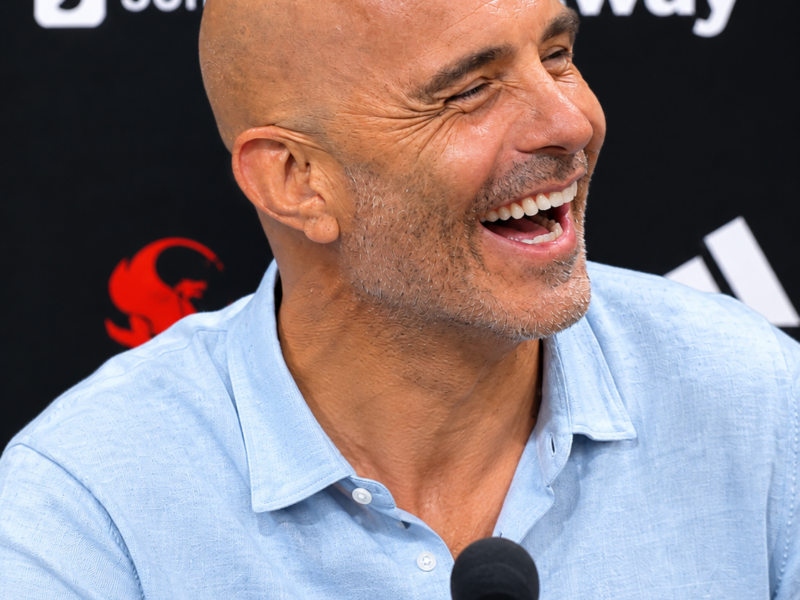
Down to Ten, Never Down and Out: Inside Pep Guardiola’s Wild Derby Night, the Red Card Chaos, and the Signing Who Made the Difference
There are wins, and then there are wins that tell you something about a team’s soul.
For roughly seventy minutes, Manchester City were forced to play with ten men in the middle of a Manchester derby, staring down a fired-up home crowd and a Manchester United side built to punish exactly that kind of numerical advantage.
By the time the final whistle blew, City had somehow turned a nightmare scenario into one of the most defining results of their young season, and the man at the center of it all, Pep Guardiola, walked into the post-match press conference with a story that was equal parts controversy, courage, and quiet vindication.
What followed was one of the more revealing press conferences of the campaign so far. Guardiola didn’t dodge the contentious moments. He didn’t pretend the red card was a non-issue. Instead, he laid out, incident by incident, exactly how he saw the pivotal passage of play that could have derailed City’s afternoon, and then explained, in surprisingly candid terms, how his players refused to let a numerical disadvantage turn into a psychological one.
The Flashpoint That Changed the Game
Every derby has a moment where the entire complexion of the match shifts, and this one arrived early, tangled up in a single, chaotic passage of play involving Phil Foden and Bruno Fernandes.
Asked directly for his read on the sending-off, Guardiola didn’t hesitate.
He said flatly that Foden’s red card was, in his eyes, a red card. No hedging, no attempt to spin the officiating decision in his own favor. That kind of blunt honesty from a manager, especially one whose team had just been reduced to ten men, is rarer than fans might think.
But Guardiola wasn’t finished. In the same breath, he pointed out something that had clearly been eating at him since the incident unfolded, that in his view, Bruno Fernandes’ role in the same passage of play was just as deserving of a card. He explained that once he’d had the chance to review the action from the bench immediately after the decision, it became clear to him that Foden’s reaction was one half of the story. The other half, he argued, was an intentional action from the United captain that never drew the referee’s attention.
It’s the kind of claim that will spark debate on phone-in shows and social media for days, a manager conceding his own player was rightly dismissed while simultaneously arguing the officials missed an equally punishable act at the other end of the same phase of play. Guardiola wasn’t trying to have it both ways for the sake of spin. He was simply describing what he saw, twice, in real time and then again on replay from the touchline.
Clearing Up the Offside Confusion
Alongside the red card, there was a second flashpoint that needed addressing, this one tied to City’s goal and whether Erling Haaland had strayed offside in the buildup.
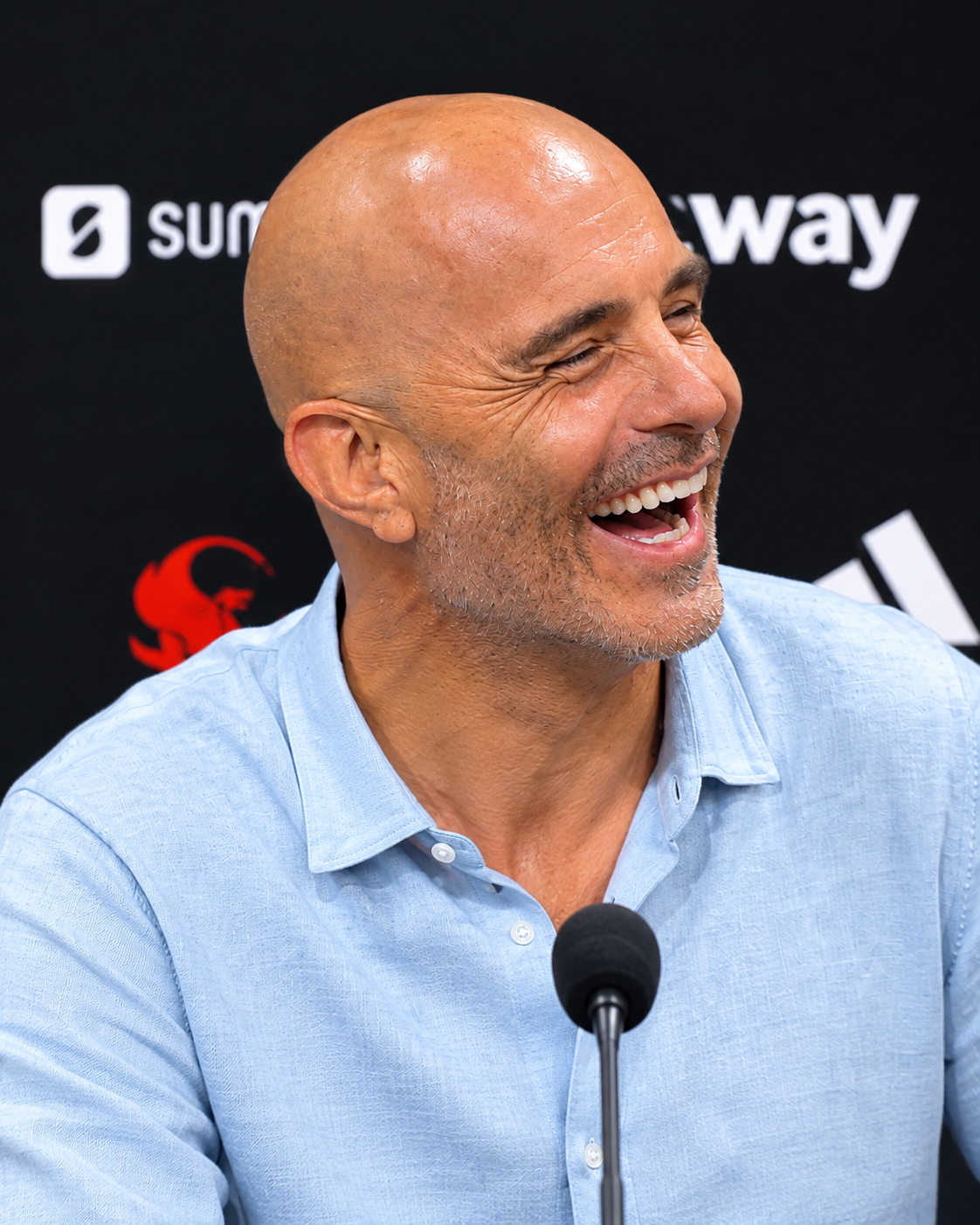
Here, Guardiola’s answer was refreshingly simple. He revealed that the fourth official had come over to him almost immediately after the goal to confirm that Haaland was level, or onside, and that the officials upstairs were reviewing a separate question entirely, the nature of the interaction in the build-up rather than Haaland’s positioning.
He was also asked whether Enzo Fernandez’s involvement in the passage of play had somehow interfered with a United defender’s ability to deal with the situation, a claim that had reportedly come from the opposition bench. Guardiola pushed back on that framing directly, saying that from where he sat, Erling was onside and Enzo did not interfere with the action in any meaningful way.
It’s a small but important distinction. In the chaos of a derby, with a red card, a goal, and a VAR check all bundled into the same five-minute spell, narratives can calcify quickly. Guardiola’s job in the mixed zone was essentially damage control and clarity, separating what actually happened from what frustrated opponents were already beginning to suggest had happened.
Ten Men, One Plan: Rewriting the Game Model on the Fly
Losing a player to a red card in any match is disruptive. Losing one in a derby, against a United side that thrives on transition and space in behind, is the kind of moment that can define a manager’s season.
Guardiola didn’t shy away from admitting just how much the sending-off changed his approach. He explained that City had gone into the match with a clear plan for how to play with eleven versus eleven, and that plan had to be scrapped almost entirely the moment Foden walked off.
What struck him most, he said, was that the numerical disadvantage cut both ways. Yes, City were down a man, and yes, that made life harder. But United’s greatest attacking strength, their ability to hurt teams in transition and exploit space in behind a high line, became far less effective once City dropped into a deeper, more compact block. With ten men sitting in, there was no space in behind to exploit and no transitions to punish. In Guardiola’s telling, the sending-off didn’t just make life harder for his own side, it also blunted the very weapon United typically relies on to win these games.
It’s a subtle but important tactical point, and one that explains why City were able to survive the numerical disadvantage for the better part of an hour without conceding. Rather than opening the game up in desperation, City effectively took the game’s rhythm away from United by refusing to engage in the transition battle altogether.
A Manager Who’s Been Here Before
For Guardiola personally, this wasn’t uncharted territory. He referenced a previous experience from the year before, when his team had gone down to ten men inside the opening minutes of a match, a nightmare scenario that forced an entire game plan to be rebuilt from scratch almost before it had started.
There was a wry humor to how he framed it, essentially saying that after enduring an early red card once already, he was hoping the next fixture might actually be played with the full complement of players on both sides. It was a rare flash of gallows humor from a manager who has built a reputation as one of the most meticulous tacticians in the world game, someone for whom improvisation under duress is clearly becoming an unwanted specialty.
The Substitution That Changed Everything
If the tactical discipline of the ten men kept City in the game, it was a halftime substitution that ultimately won it.
Guardiola was asked directly about the decision to bring on fresh legs and specifically about the impact of the player who came to be seen as the difference-maker in the second half. His answer offered a rare look into the thinking behind an in-game change that, on paper, looked like a gamble.
He explained that while the player coming off was undoubtedly a top performer, the moment called for something different, a player capable of winning fouls, relieving pressure, and attacking with intent in transitional moments of their own. The idea, he said, was to use the width and pace on both flanks in tandem with Haaland’s movement centrally, so that whenever City did win the ball back, they had an immediate answer going forward rather than simply killing time.
It’s a mentality that runs contrary to how many ten-man teams approach the second half of a match they’re clinging onto. The conventional wisdom says shut up shop, sit deep, protect what you have. Guardiola’s message to his players, by his own account, was the opposite. He told them plainly that if they simply waited for United to come at them without ever threatening in the other direction, the game would become progressively more difficult to manage. Attacking when the opportunity presented itself wasn’t optional. It was the entire strategy.
He also pointed to something less visible on the scoresheet but just as important to how the second half unfolded, City’s ability to retain possession even while playing a man short. Holding onto the ball, he suggested, did double duty. It denied United time on it to build attacks, and it allowed his own players a way to manage their energy levels across a grueling final half hour.
The New Faces Delivering Under Pressure
Every transfer window brings scrutiny, and big-money arrivals in particular are judged against impossibly high standards from the moment they step off the plane. On derby day, with the pressure cranked up to its absolute maximum and the team down to ten men for most of the match, two of City’s newer faces stepped up in exactly the moment that mattered most.
Guardiola was asked about the players brought in over the summer to replace a core of experienced figures who had departed, veterans whose leadership and know-how had been such a fixture of previous seasons. His response made clear that replacing that kind of experience wasn’t just about raw talent, it was about identity and mentality, and that the club had made a deliberate effort in the market to find players who embodied both.
He didn’t shy away from acknowledging the price tags attached to the new arrivals, players who had walked into the club carrying the kind of transfer fee that invites instant comparison and instant judgment. But he was equally clear that he doesn’t believe a player’s value should be measured by what the club paid to sign them, especially in a modern transfer market he described, without much diplomatic softening, as having become somewhat unpredictable in terms of the numbers being thrown around.
What mattered more to him, he explained, was history and evidence. He’d worked alongside one of the new midfielders previously during his time at Chelsea and knew firsthand the level the player was capable of producing. The other newcomer, arriving from Newcastle, had already proven himself on the big stage domestically and on the international scene, and crucially, both players are young enough that Guardiola sees them not just as squad reinforcements for this season, but as foundational pieces for the future of the club.
On a day when City needed composure, energy, and fearlessness from players still settling into a new environment, both delivered. It was, by Guardiola’s own admission, about as strong a first statement as either could have hoped to make in a fixture of this magnitude.
The Goalkeeper’s Moment
Amid the chaos of red cards, tactical adjustments, and a raft of individual performances worth dissecting, it was easy to overlook just how important a single save was in preserving City’s slim advantage during the second-half siege.
Guardiola didn’t overlook it. Asked about his goalkeeper’s role in seeing the result over the line, he was unambiguous in his praise. There was really only one moment of genuine danger that required a top-level intervention, but it came at a critical juncture, and Guardiola’s explanation of why it mattered so much doubled as a broader philosophy on what he expects from players in the biggest positions on the pitch.
His view is straightforward. The attacking players exist to find the right moment to score. The goalkeeper exists to find the right moment to save. On this particular afternoon, with City down to ten men and clinging to a lead against a United side pressing for an equalizer, his goalkeeper found exactly that moment, and in doing so, effectively won the points.
What This Result Means Going Forward
Beyond the individual battles and tactical chess match, Guardiola was pushed to reflect on the bigger picture, what a result of this nature, delivered in these circumstances, means for a squad still finding its identity after a summer of turnover.
His answer leaned heavily on the word togetherness. Winning with ten men, he said, is satisfying in any context. Winning with ten men in a derby, against a fierce rival, with new faces still adapting to the demands of the club, adds an entirely different emotional layer.
He was candid about the fact that this version of his squad looks and feels different from the one that walked out for previous campaigns. The departures of several experienced, high-profile figures left more than just gaps in the lineup, they left a leadership vacuum that somebody needed to fill. Guardiola pointed to Haaland specifically as a player who has visibly grown into that void, someone who is not just delivering goals but increasingly setting the tone in the dressing room and on the training pitch.
Asked to expand on what that leadership looks like day to day, Guardiola offered a lighthearted but telling anecdote, joking that his striker’s mood off the pitch has a way of setting the tone for the group as a whole, borrowing an old saying about domestic harmony to describe just how much of an emotional barometer his talisman has become for the rest of the squad.
There was also a note of caution mixed in with the celebration. Guardiola flagged that with a long season ahead and a demanding fixture list following an international tournament, careful management of his star forward’s workload will be necessary at some point. For now, though, the priority is simple: ride the momentum, keep building chemistry among the new arrivals, and continue finding ways to win difficult matches even when circumstances turn against them.
A Statement Win With Layers
Strip away the individual talking points and what’s left is a match that will likely be remembered as one of the season’s genuine character tests, the kind of afternoon that either exposes cracks in a rebuilding squad or reveals a spine strong enough to survive adversity.
City chose the latter path. A red card that could have unraveled the entire game plan instead became the catalyst for a tactical reset that neutralized their opponent’s biggest attacking threat. A questionable refereeing decision that could have consumed the post-match narrative was addressed head-on by a manager unwilling to let frustration curdle into excuse-making. And two expensive summer signings, under the kind of derby-day scrutiny that has broken lesser careers, delivered exactly when their new manager needed them most.
For Guardiola, walking away from Old Trafford with all three points and a man disadvantage that lasted the better part of an hour is more than just a result. It’s evidence, both to his locker room and to a wider football world still assessing this rebuilt City squad, that the fundamentals underpinning years of success have not gone anywhere. The faces have changed. The demands of the schedule remain relentless. But the mentality, by his account at least, is very much intact.
Whether this becomes a defining early-season marker or simply one very good afternoon in a long campaign will depend on what comes next. For now, though, City have a result that speaks to resilience, tactical flexibility, and a squad capable of grinding out points even when the odds, and for a long stretch, the numbers on the pitch, were stacked against them.









