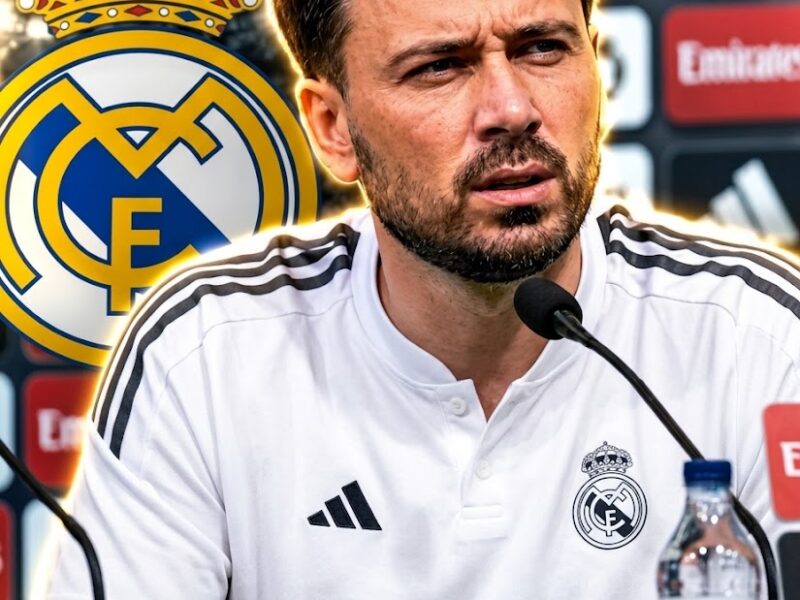
Davide Ancelotti Just Exposed Real Madrid’s Biggest Problem, and It Has Nothing to Do With Speed
Sometimes the most damaging criticism comes from the politest voice in the room.
That is exactly what happened when Davide Ancelotti sat down for an interview and talked about Real Madrid.
He chose his words carefully, and he never pointed a finger at anyone.
But if you listened closely, the message was impossible to miss.
Real Madrid has a footballing problem.
It is not the only problem the club has, and Spanish football has plenty of other storms to deal with right now.
Still, this one sits right on the pitch, and it is hard to argue with.
Madrid went into the international break with that problem still hanging over the team.
And the break has felt endless, as if their last match was played a year ago.
In the meantime, the football conversation has been swallowed by other stories, from City to the Barcelona controversy that every pundit and content creator is chasing.
But Madrid returns to action in a week, and the questions have not gone away.
So let’s talk about what Davide Ancelotti really said.
It starts with Barcelona, which makes it sting even more.
Barcelona is playing very good football right now, and getting very good results.
By all accounts, they have been winning match after match, and scoring plenty of goals along the way.
What makes it interesting is how they are doing it.
This is not the misunderstood version of tiki-taka, with pass after pass after pass that leads nowhere.
Even when Barcelona played their best football under Guardiola, they were never really that team.
Those sides scored a lot of goals, too.
The current Barcelona is becoming a very vertical team, and at the same time a team that controls its matches.
Those two things can live together.
That is the part many people miss.
Davide Ancelotti says he likes vertical football, and he admits that Barça is playing it right now.
He enjoys watching them play, even though he says it has been painful to watch as a Madrid man.
He singled out Raphinha playing as a nine.
He likes the runs Raphinha makes, and how the forward attacks space.
But then he added the key point.
A forward can run into space all day long, but someone has to put the ball in front of him.
That means midfielders who can deliver the perfect pass, over and over again.
This is where he brought up the days of Luka Modrić and Toni Kroos.
He was careful, almost apologetic, because anything he says about Madrid can be labeled as criticism.
But he made the comparison anyway.
When Luka and Toni were on the field, every run into space had an answer.
The ball simply arrived at your feet.
Then came the sentence that said everything without saying anything harsh.
He did not say the current players are bad.
He did not have to.
The meaning was obvious.
Today’s Madrid midfielders, with the exception of Aurélien Tchouaméni and perhaps Jude Bellingham, do not often put the ball in the right place at the right speed and the right rhythm.
And this is not only a question of technique.
Any professional can strike a good pass.
The real skill is seeing the movement at the exact moment it happens.
A technically perfect pass delivered one second too late is useless.
Modrić and Kroos had that sense of timing built into their game.
Madrid, right now, does not.
Davide never named a single player, because he is polite and cautious by nature.
But the message is clear.
The current squad is missing that kind of midfielder.
So what does vertical football actually mean?
It does not mean putting eleven sprinters on the pitch and hoping for the best.
Verticality also needs people who know how to handle the ball.
It needs players who can choose when to go forward and when to slow things down.
That is why the argument that Madrid should simply play vertically misses the point.
Yes, the team has Vinícius, Mbappé, Rodrygo, and even Bellingham.
Yes, those players love open space, and it is tempting to say the team should attack nonstop.
But verticality without control is not verticality at all.
It is nothing.
If a team always plays the pass into space, opponents will adapt.
They will close the gaps and wait for the same move again and again.
Verticality should be a weapon, not the entire game plan.
The best teams know how to manage tempo, change the rhythm, and strike only when the moment is right.
That is what Barcelona seems to be doing now.
And that is what Madrid used to do without even thinking about it.
For years, the club had two absolute geniuses in midfield.
Modrić and Kroos were not just historic for Real Madrid.
They were historic for world football.
When they left, the drop in quality, hierarchy, game intelligence, personality, and competitiveness in the middle of the pitch was tremendous.
Nobody should expect Madrid to replace that level overnight.
Players like that come along once in a generation, if you are lucky.
But the club does need to return to the path of midfielders who command and dominate.
It needs players who control the game rather than just take part in it.
And right now, the reality suggests Madrid has not found them yet.
Tchouaméni, for all his strengths, is not a dominant midfielder.
Federico Valverde has the engine and the energy, but his inconsistency has been a problem, even if he is playing well with France at the moment.
Then there is Bernardo Silva, the main bet for that role.
So far, he has not been an undisputed starter by any means.
There are some encouraging signs.
Eduardo Camavinga is doing really well with France.
And a young player named Tiago Palacios had a great game with Castilla, Madrid’s reserve side.
Those are pieces Madrid can hope to build around someday.
But hope is not a plan, and the gap remains wide.
It is worth pausing on one more thing.
Davide Ancelotti is now working at Lille, and by most accounts he is doing very well there.
He knows Real Madrid from the inside, having grown up around the club and its dressing room.
So when he speaks about Madrid’s midfield, he is not a distant critic.
He is someone who understands exactly what a Madrid team is supposed to look like.
That is why people should keep an eye on him.
Who knows what the future holds for a coach with that background and that kind of football brain?
Now, back to the real question.
What should Madrid do?
The answer is not to abandon its fast, explosive attackers.
Vinícius, Mbappé, and the others offer a vertical threat that few teams in the world can match.
If you put the ball in space for them, they usually end up right in front of goal.
That is a gift, and it would be foolish to waste it.
But the gift only works with the right supply line.
Madrid needs midfielders who can read the game, adjust the rhythm to whatever the team needs, and deliver the ball with precision.
Those players are the key that unlocks the attackers.
Without them, the speed up front is only half a weapon.
Barcelona has shown the blueprint, whether Madrid likes it or not.
A team can be vertical and in control at the same time.
The two ideas are not enemies.
Madrid just has to find the people who can make them work together.
The break is almost over, and the questions are still waiting.
Davide Ancelotti has already given the polite version of the answer.
Now it is up to Madrid to prove they were listening.









