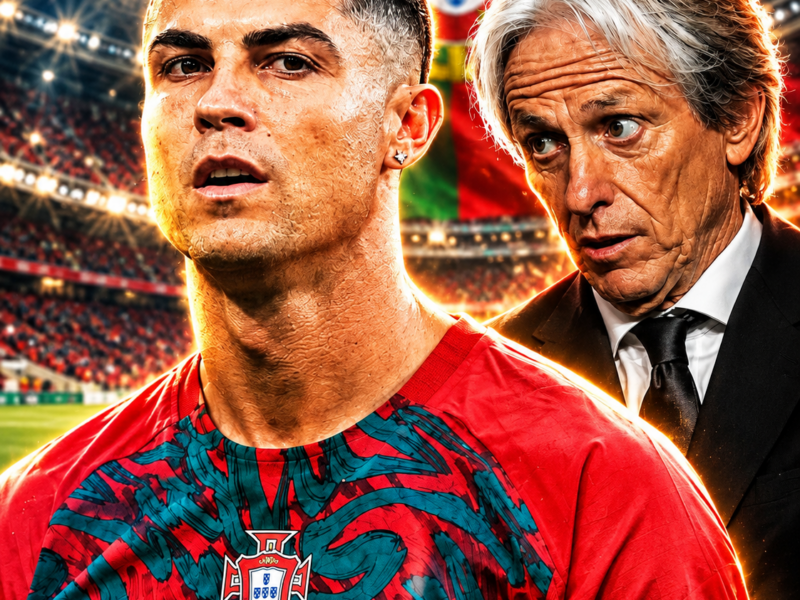
Cristiano Ronaldo Walks Out on Portugal: Did Jorge Jesus and the Federation Betray a Legend, or Did the Legend Refuse to Let Go?
A truck. A private jet. A training camp in Denmark.
And one of the greatest footballers who ever lived, heading for the exit.
That is the image that has Portugal in turmoil, and it is hard to look at without wincing.
In the final hours, Jorge Jesus and Federation president Pedro Proença reportedly raced to try to stop Cristiano Ronaldo from leaving.
Reports in Portugal say his departure from the national team is final.
And the commentators discussing it all agree on one point: no icon of this size should leave this way.
So how did it come to this?
And who, exactly, is to blame?
An Exit That Fits No One’s Legacy
The first reaction from the analysts is blunt.
Leaving a national team camp like this, fleeing by truck and then by private plane, is not worthy of Cristiano’s stature.
It looks cheap, they say, and it is an almost absurd way for a story this big to end.
The Federation, in their view, should have shown more calm, more maturity, and more experience.
And Ronaldo, with all due respect, should not be walking away because of one coach’s decision.
But the more they talk, the clearer it becomes that this is not a one-sided story.
Both sides handled it badly.
The Personality That Built a Legend
Start with Cristiano himself.
He was the best in his school, the best in his neighborhood, the best in his city, the best in his country.
That personality is what made him who he is.
It is also the very thing that often stands in the way of admitting you may no longer be at the level that makes you decisive.
It would have been wise, the analysts argue, for him to retire after the World Cup and leave it there.
He did not.
And they are not surprised.
This is a man who left Madrid in a way that left a mark, and whose second spell at United ended badly.
What made him great is the same thing that keeps getting him into these situations.
So yes, he carries responsibility too.
Because there are other ways to deal with disappointment and anger than walking out of a camp.
Few players ever recognize when the time has come.
Toni Kroos is mentioned as a rare example of someone who got out on his own terms.
Most never do.
The 30-Minute Warm-Up
Now to the match at the center of the storm.
According to the version reported by Edu Aguirre on El Chiringuito, there was a meeting between the Federation president, the coach, and Ronaldo.
The report says Jorge Jesus apologized to Cristiano for leaving him warming up for 30 minutes without bringing him on.
One analyst understands Ronaldo’s anger.
Another points out the other side of the coin: if you want to be treated like an ordinary player, you have to accept the risks that come with it.
And if you believe a player should never be left warming up for half an hour, that means you see yourself above everyone else.
Ronaldo is a legend, no question.
But in the end, the coach decides.
Then comes the twist.
The analysts argue that if Cristiano is a regular squad player, as planning and minutes suggest he should be, then the coach should never have promised him 30 minutes.
He does not make that promise to anyone else.
So the mistake begins right there.
Ask yourself what would have happened if Jesus had promised nothing and broken nothing.
According to this reading, the coach made a promise, did not keep it, and created an unfair inequality that fueled Cristiano’s anger.
The Press Conference That Allegedly Lit the Fuse
And this is the part that, according to the report, really set things off.
Aguirre claims Jesus did not stop at a private apology.
He allegedly told Ronaldo he would apologize publicly, and say openly that he had been wrong.
Then he stepped in front of the cameras.
And, according to the version being told, he said something very different: that the club president decides some things, but here he is the one who makes the decisions.
Picture Cristiano watching that press conference.
What is this man saying?
The analysts are careful here.
They stress this is Ronaldo’s version, and everyone knows it is his version.
But if it is true, Jorge Jesus handled the situation very badly.
Because the story, as relayed, is one of betrayal.
Your coach speaks to you in private and says he made a mistake.
He promises to clear things up in public.
Then he goes out at noon and makes your position worse, asserting his authority and treating you like just another player.
The analysts have no problem with a coach asserting authority.
One of them says he defended exactly that in Madrid and would defend it in Portugal too.
But there are smarter ways to manage a legend.
And if a different promise was made behind closed doors, they say, it is easy to understand why Cristiano might feel betrayed.
Ronaldo’s Message: “I Will Tell the Truth”
The latest word from Cristiano himself came in a post across his social media accounts.
After the coach’s press conference and a conversation with the Federation president, he decided to leave the camp.
In his message, he says that in due time he will tell the Portuguese people the truth about why he is leaving the national team he has always dedicated himself to.
The analysts note the text is translated from Portuguese, but the wording is clear.
And it is ambiguous in an interesting way.
The first part talks about leaving the camp.
The second part talks about leaving the national team.
That is why many in Portugal read it as a permanent retirement from international football.
Reports in various outlets say the decision is final.
The Quiet Plan Nobody Admitted
There is another layer to the story.
According to a report in the newspaper AS, even inside the Portuguese Federation, some had hoped Ronaldo himself would step away after the World Cup.
The report claims some of the candidates in line to replace Roberto Martínez had indicated they might set a condition: no Cristiano.
So the Federation was giving the impression it was handing the national team’s future to someone who might not count on him at all.
And yet Ronaldo’s answer was simple.
No, I am not going anywhere, if you want to rely on me.
That is the deadlock they now live in.
The analysts do not hide their view.
If the Federation wanted Cristiano to resign, knowing how difficult he is to manage, then it should have taken the initiative.
They are talking about a national legend with a huge following and enormous devotion.
Taking responsibility for hard decisions is part of what Portuguese fans pay the Federation to do.
Raúl, Ramos, and the Art of Saying Goodbye
Spain has faced similar cases, on a smaller scale.
The example given is Raúl and Luis Aragonés.
At first the coach gave ground, but then came a moment when he realized he did not want to count on Raúl.
He had to live through a major crisis, because it was controversial at the time.
But in the end, everything passes.
The same thing happened with Sergio Ramos, and in other cases.
The lesson is that it can be managed with intelligence.
But leaving the decision to the player does not mean he will take the decision you want.
Footballers rarely look in the mirror.
They keep seeing themselves as they were.
And for Ronaldo, it is not easy.
He sees himself as Cristiano Ronaldo, the greatest legend in Portuguese football history, with Ballon d’Ors and a European title to his name.
Jorge Jesus, meanwhile, is a coach who has to get Portugal through the Nations League and toward the next European Championship.
Each man is defending his own interests, and the analysts say they understand both.
A better path, they suggest, would have been honesty.
Tell him plainly after the World Cup that his role would be very secondary.
Or tell him directly that a new era is starting and he is not in the plans.
He may not take it well.
But if he does not, the blame for the mess falls on him.
Because in their view, the Federation shares responsibility for mishandling the situation.
Not the First Time Ronaldo Thought of Ronaldo
One analyst is not surprised, and he explains why.
In his view, he has never seen Cristiano think about anything but himself first.
He points back to the night Madrid won the Champions League in 2018.
That was the night Cristiano hinted he might leave.
The analyst was in Kyiv as a fan.
He remembers walking out of the stadium and seeing the statements from Bale and Cristiano explode on Twitter.
He remembers feeling deeply frustrated.
A Champions League is a Champions League, whatever anyone says.
It was the third in a row, and he imagined he should have been used to it.
But he could not believe what he was reading.
And he believes Cristiano was wrong that day too, because it was not the moment for messages or goodbyes.
This time, it is true, there is no decisive moment for Portugal, since it is just the Nations League.
But that is Cristiano.
And if everyone knows that is Cristiano, then the Federation and the coach should have known it better than anyone.
That is why the analysts insist Portugal handled this with little intelligence.
A Detour Into Negreira and the Manchester City Case
The conversation then shifts to another storm: the Negreira case in Spain.
One of the hosts recalls an interview on his channel with a former referee, who said Negreira carried real weight in the daily work of the referees’ technical committee.
According to that referee, it is not true that he only appeared on special occasions.
He was present, followed the level of each referee, and kept an eye on the physical tests.
The ex-referee even believes a decision that was judged a mistake in Madrid’s favor ended his career.
He describes a controversial penalty call, which, in the view of the technical committee, was an error.
He says he heard a conversation in which Negreira complained about the problem of computer-assigned refereeing.
That year was the last in which a computer picked the referees.
The committee then took back the power to appoint them.
And from that point on, his career was over.
He also stresses that other referees made equally serious mistakes without losing their careers.
As an example, he mentions Rodríguez Santiago, who allowed a goal by Messi that was scored with the hand, on the famous “Tamudazo” day, and refereed the Copa del Rey final the following week.
The host calls it valuable testimony, because the official line has been that Negreira played no role.
The Comparison With Manchester City
Then comes the comparison that fires up the discussion.
The host says he would like to sit down one day and talk calmly about the possible consequences for Madrid, but today he wants to talk about the Manchester City case.
In Italy, “Calciopoli” cost several teams dearly, Juventus above all.
Portugal has had sanctions for corruption.
In Turkey, authorities have now arrested the head of the referees’ committee.
In England, clubs have been punished over Financial Fair Play.
He believes the City case could be historic, with the caveat that it depends on what is ultimately proven.
His argument is that, unless City can prove otherwise, they would have been breaking the rules for years, and that helped them build a great team.
He sees an atmosphere of accountability in England, with everyone united behind the idea that if you cheat, you should pay, and pay heavily.
In Spain, he sees something very different involving Barcelona, on two fronts.
The first, and in his view the less severe, is Financial Fair Play.
He points to operations like “Barça Studios,” which Barcelona itself has acknowledged, and to the fictitious capital gains for which Juventus was sanctioned.
The second front is far more serious: the Negreira case.
On this he is careful.
He does not accuse anyone of sporting corruption, which is a crime for a judge to decide.
They are innocent until proven guilty, he says, and that is the presumption they have.
But there is a sporting dimension, he argues, separate from the criminal one.
If you pay a referee committee’s vice president, sports rules should punish you whatever the purpose.
So far, he says, neither UEFA nor Spanish football has taken any action.
And he contrasts that with England.
When Premier League clubs move with full force against City, he says, you think: that makes sense, that is the natural reaction.
In Spain, he does not see that outrage.
Except among many Madrid fans, who feel, he says, that they look like fools.
Where This Leaves Us
Two stories, one uncomfortable theme.
In Portugal, a legend is leaving through the back door while the people in charge argue over who handled whom badly.
In Spain, a long-running scandal drags on while the question of accountability hangs in the air.
In both cases, the commentators land in the same place: it could have been managed better.
Ronaldo promised the truth in due time.
The Federation, the coach, and the fans are all waiting to hear it.
What do you think?
Did Jorge Jesus and the Federation push Cristiano out, or did a legend refuse to see that his time was up?
Tell us in the comments.









