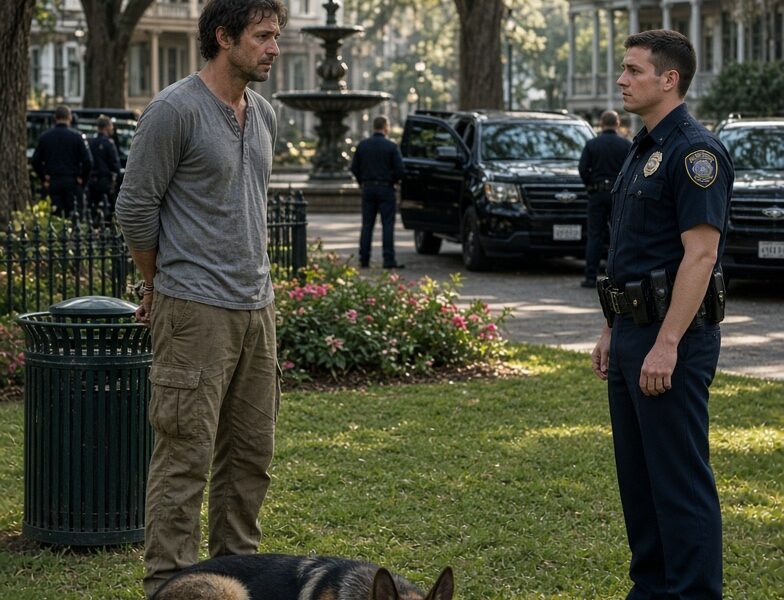
Cop Tosses Navy SEAL ID in the Trash and Cuffs Him in the Park — Then Three Black SUVs Pull Up
Officer Greer never saw it coming.
He was too busy laughing.
He stood in the center of Harborview Commons, the most manicured park in the most expensive zip code in Savannah, Georgia, holding a Department of Defense identification card between his thumb and index finger like it was a piece of expired grocery store coupon.
He read the name printed on the card.
He looked up at the tall, quiet man standing in front of him.
He looked back down at the card.
Then he let out a sharp, ugly laugh that carried across the open green grass and landed against the wrought iron fencing like a slap.
“A Navy SEAL,” Officer Greer said.
He said it the way people say the punchline of a joke they’ve been waiting all day to tell.
“Sure you are, buddy.”
The man he was talking to did not blink.
He did not shift his weight.
He stood with his arms loose at his sides and his feet planted shoulder-width apart on the grass, and his expression said absolutely nothing at all.
That specific brand of stillness was something you could not fake.
It came from years of training your nervous system to stay quiet when every instinct in your body was screaming.
His name was Adrien.
He was 38 years old and he was an active duty Navy SEAL, currently on a 10-day leave he had not taken in 14 months.
He stood six-foot-one with a frame built by years of physical demand, not vanity.
His dark hair was cut tight on the sides.
His jaw carried a faint scar along the left edge, white and thin, the kind that doesn’t come from glass or a kitchen accident.
He wore a pair of worn olive cargo pants and a gray Henley that had been washed so many times the fabric had softened into something close to paper.
His boots were black, laced tight, worn at the toe.
He did not look like the neighborhood’s idea of someone who belonged there.
Beside him sat Kodiak.
Kodiak was a German Shepherd with a coat the color of a storm cloud fading into black, with tan points above each eye and along his chest.
He weighed 91 pounds.
He had served two overseas deployments with Adrien before a shrapnel injury to his left shoulder ended his active service.
The injury healed.
The bond did not break.
Adrien had gone through the paperwork to bring Kodiak home, and wherever Adrien went now, Kodiak went too.
The dog sat perfectly square on the grass with his tail flat and his ears forward, and he watched Officer Greer with the focused, unreadable patience of an animal that had learned to wait.
Adrien had driven seven hours from Virginia Beach to Savannah to visit his younger brother, Philip.
Philip had married three years ago.
He and his wife had bought a house in Harborview Reserve, one of those new developments where the HOA newsletter used phrases like “community standards” and “property harmony” and where a pickup truck with a cracked side mirror constituted a visual disturbance.
Adrien parked his truck on the street outside the community gate.
He signed in at the guard booth.
The guard checked his name against a visitor list, found it, and waved him through without ceremony.
Philip had texted that morning.
Running late, took a deposition that went long. Keys under the mat, let yourself in, or walk Kodiak around the commons. It’s nice this time of day.
Adrien chose the walk.
He had been sitting in a truck for seven hours.
Kodiak had been in the back seat.
They both needed the air.
The Commons was a long green rectangle in the center of the neighborhood, ringed by iron fencing and oak trees and bordered on three sides by houses that started at $2.5 million and climbed from there.
There was a stone fountain in the center.
There were benches.
There were flower beds with the kind of blooms that suggested a professional on a monthly contract rather than a homeowner with a trowel.
It was a nice park.
It was quiet.
It smelled like cut grass and fresh mulch and someone nearby grilling something on a Wednesday afternoon.
Adrien had been there for 12 minutes when the complaint started.
He didn’t hear the calls.
He just noticed the shift.
A woman walking a Cavalier King Charles Spaniel on the far path stopped and stared at him.
She pulled out her phone.
A man sitting on a bench with a newspaper folded it closed and watched Adrien.
The way you watch something you’ve already decided is wrong.
A second woman appeared on a porch across the street and spoke into her phone while pointing toward the park with one rigid finger.
Adrien recognized the pattern.
He had seen it in different countries, in different contexts, with far higher stakes.
He understood what was happening.
He simply didn’t have any particular emotional response to it.
He kept walking.
He told Kodiak to heel.
Kodiak heeled.
Three minutes later, the cruiser came around the corner.
It pulled up along the curb with the lights on, but no siren.
Officer Greer climbed out.
He was in his early thirties, clean uniform, boots so polished they reflected the afternoon sun.
He moved with the specific energy of a man who had decided the outcome before he arrived.
He looked at Adrien.
He looked at Kodiak.
He looked back at the truck parked on the street outside the gate and apparently found that information meaningful.
“Afternoon,” Greer said.
He did not say it warmly.
“Afternoon,” Adrien replied.
“You live here?”
“No, I’m visiting my brother. Philip Seaton, 14 Harborview Lane. I signed in at the gate.”
Greer glanced toward the gate.
He looked back.
“You got ID?”
“I do.”
Adrien moved his hand to his back pocket, slowly, clearly, keeping his palm visible at all times.
A habit from years of not wanting anyone with a firearm to misread what his hands were doing.
He pulled out his wallet.
He opened it.
He removed his military ID and extended it toward the officer.
Greer took it.
He looked at it for a long moment.
Then came the laugh.
“A Navy SEAL,” Greer said.
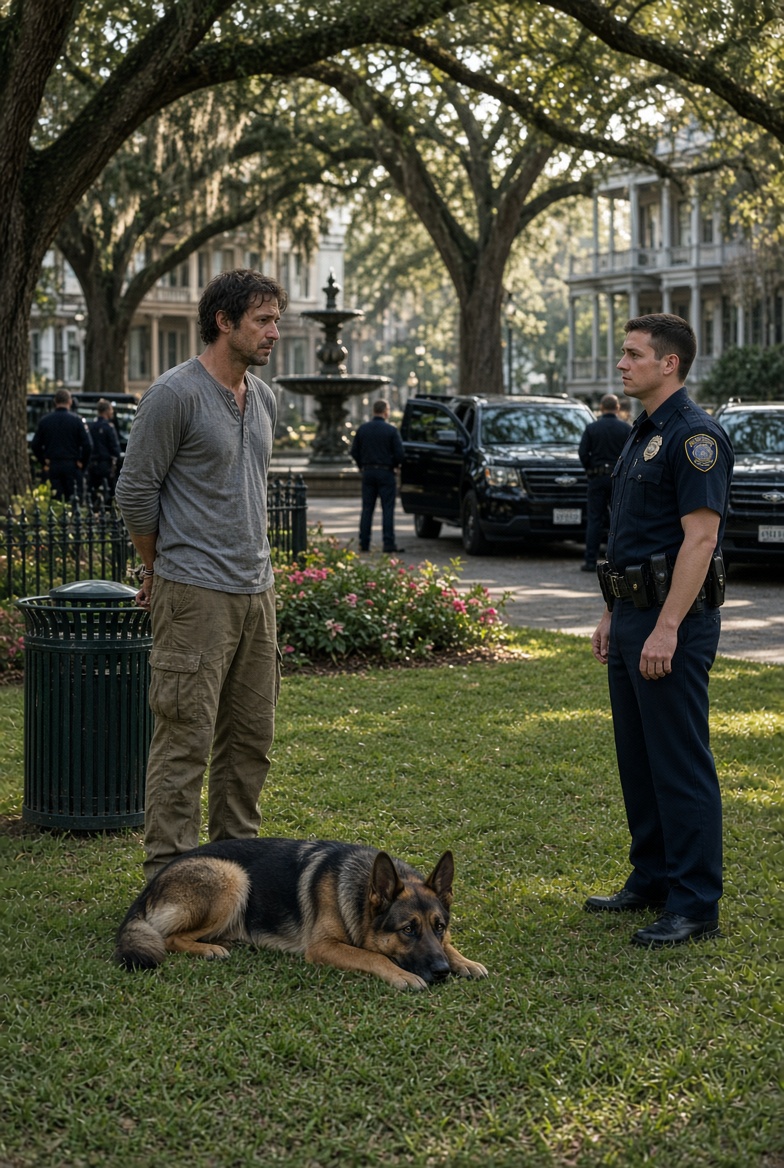
“Sure you are, buddy.”
Adrien said nothing.
Greer held the card at arm’s length like he was examining it under a jeweler’s loop.
He shook his head.
He flipped the card over.
He looked at the front again.
“You know what I see when I look at this?”
Adrien waited.
“I see a pretty good print job on a fake ID.”
Greer said it casually.
The way you comment on traffic.
“We get guys like you running this every so often. Walk into a nice neighborhood, flash some kind of military card. People feel bad about calling it in. Figure they made a mistake. It’s a solid play. Doesn’t work on me.”
“Call it in,” Adrien said.
“The number is on the back. DoD can verify in two minutes.”
“I’m not running down your fake card on dispatch.”
Greer said that wastes everybody’s time.
He turned.
He walked three steps to the nearest trash can, a heavy green metal container near the path’s edge.
He held the ID over the opening.
He opened his fingers.
The card dropped.
It made a hollow sound hitting the metal bottom.
Adrien stood very still.
Some moments exist in two dimensions at the same time.
In one dimension, it was a laminated plastic card inside a park trash can.
In the other dimension, it was 12 years of service, two combat zones, missions he could not discuss with anyone outside a cleared facility, and six months of paperwork just to bring his dog home from overseas.
Both dimensions were equally real.
Kodiak made a sound, not a bark.
A low thing that started in the chest and didn’t quite make it out.
He felt the shift in Adrien before any human in the park did.
“Steady,” Adrien said.
Flat, quiet.
Kodiak went still.
Greer turned back around.
“You’re going to need to come with me.”
“On what basis?”
“Trespassing. This park is for Harborview residents and their guests.”
“I’m a guest. I signed in at the gate.”
“The gate doesn’t grant access to community spaces. That’s HOA policy.”
Greer reached for his duty belt.
“I’m going to ask you to turn around and put your hands behind your back.”
“You’re making a mistake.”
Adrien said it, not loudly, not with any heat in it.
The same way you’d tell someone they left their lights on.
“Turn around,” Greer said.
Adrien turned around.
He put his hands behind his back.
He kept his breathing slow.
He felt the cuffs close on his right wrist first, then the left.
Greer pulled them snug.
The metal was cold.
Kodiak stood up from his sitting position.
He did not advance.
His shoulder blades rose.
His head dropped two inches.
His lips pulled back at the corners.
The sound he made was not loud.
It was the kind of sound that goes straight through you and lands somewhere in the base of the brain that predates language.
“Call off that dog right now,” Greer said, and his voice jumped an octave.
“Kodiak, down. Stay.”
Adrien’s voice did not jump.
Kodiak lay down, chin on paws, eyes fixed on Greer.
He did not look away for a single second.
Greer exhaled something that tried to sound like composure.
He stepped back.
He reached for his radio.
He began to call for a transport unit.
The woman in the white linen blouse watched from her front porch.
She had been the one to call in the complaint.
Her name was Patrice Holloway, and she had lived in Harborview Reserve for four years and served on the aesthetic committee for two.
She watched the tall man standing handcuffed near the trash can and felt a particular satisfaction that she would have described as justice.
She was not asked.
The radio crackled.
Greer began to speak.
He did not finish the sentence.
The sound came from the far end of Harborview Drive.
Three black Chevy Suburbans, federal plates, moving in tight formation at a speed that was not polite for a residential street.
They made no effort to slow for the decorative median strips.
The engines were loud enough to vibrate the water in the stone fountain.
The vehicles split slightly as they entered the common circle, then realigned, stopping in a precise line at the curb 20 feet from where Greer stood.
The doors opened.
The man who stepped out of the middle vehicle was Deputy Director Charles Wynn.
He was 54 years old and he ran the Southeast Regional Counterterrorism Task Force out of Jacksonville.
And he had the particular posture of someone who had spent 30 years in rooms where decisions were made and had never once needed to raise his voice to make those decisions land.
He wore a dark jacket over a white shirt.
He moved without hurry.
Three more men in tactical dress stepped out of the flanking vehicles.
They stopped.
They took in the scene.
Wynn looked at Adrien.
He looked at the handcuffs.
He looked at the green trash can.
His expression did not change exactly, but something behind his eyes went very flat and very cold in a way that was more alarming than anger.
He walked toward the group.
He did not acknowledge Greer.
“Adrien,” Wynn said.
“Sir,” Adrien said.
“Are you hurt?”
“No, sir.”
Wynn looked at Kodiak, lying flat on the grass with his chin on his paws and his gaze locked on the uniformed officer.
Wynn looked back at the trash can.
He looked at Greer.
“I’m going to need you to get those cuffs off him,” Wynn said.
Greer had not moved.
He stood holding his radio at his side.
And the confident architecture of his afternoon was coming apart in real time.
He looked at the federal plates.
He looked at the vehicles.
He looked at the four men in tactical dress standing at quiet attention.
He looked at the ID card he had thrown in the trash.
“I was responding to a call,” Greer started.
“Key,” Wynn said.
Greer reached to his belt.
He unclipped the handcuff key.
He walked around behind Adrien.
The cuffs came off.
Adrien brought his arms forward and rolled each wrist once.
“Thank you,” Adrien said to Greer, not sarcastically.
Wynn did not say thank you.
He looked at the trash can.
He looked at Greer.
“That’s a federal military identification document.”
Greer swallowed.
“I thought it was fraudulent.”
“You thought,” Wynn said.
The two words sat there.
“You had a number on the back of that card,” Wynn continued.
“You had two minutes and a radio. You chose not to use them.”
He paused.
“Instead, you arrested an active duty SEAL on leave and threw his federal credentials into a public garbage can in front of a residential neighborhood.”
Another pause.
“That’s what happened today.”
Greer had no answer for that.
Wynn turned to one of the men from the vehicles.
“Get the card.”
The man walked to the trash can.
He reached inside without comment.
He found the ID near the bottom, wiped it clean on his jacket sleeve, and brought it back.
He held it out to Adrien.
Adrien took it.
He looked at it once, then slid it back into his wallet.
Patrice Holloway had stepped off her porch during all of this.
She stood at the edge of the grass now, still clutching her phone.
The satisfaction she had felt six minutes ago replaced by something considerably less comfortable.
Wynn noticed her.
He did not address her yet.
He turned back to Greer.
“Your department has a direct liaison with the task force. There’s a protocol in place for exactly this kind of identification situation. You were not trained to recognize federal credentials. That’s a gap we can address. But you were trained to verify before you act. You chose not to.”
He let that sentence stand on its own.
“Your department will hear from us this afternoon.”
Greer’s posture had been eroding for the past three minutes.
Now it was gone entirely.
He stood with his hands at his sides and his eyes somewhere near the ground.
“Officer,” Adrien said.
Greer looked up.
Adrien was looking directly at him, not with anger, with the same flat, uncrowded attention he had maintained since the beginning.
“I understand why you made the call you made,” Adrien said.
“I looked wrong to you. I didn’t fit what you expected to find here. That’s a human thing. I’ve made those calls, too.”
He stopped.
“But there’s a reason we train past the first instinct. The first instinct is a guess. The second step is verification. One is bias. The other is procedure. You stopped at the guess.”
Greer said nothing.
“You pulled a weapon on a trained military dog who was sitting still,” Adrien said.
“Not because he was advancing, because you were afraid and you needed to feel like you were in control. I understand that, too. Fear does that.”
He glanced at Kodiak, who had not moved.
“He was never going to move unless I told him to. But you didn’t know that because you hadn’t asked. You hadn’t done anything except react.”
The woman on the grass cleared her throat.
“I was the one who called,” Patrice said.
Her voice was careful, measured, positioned to seem reasonable.
“I had concerns about an unfamiliar individual in a community space. That’s not unreasonable.”
Wynn looked at her.
“No,” he said, “concern isn’t unreasonable. But you watched an officer throw a federal ID in the trash and handcuff a man in your park. And you stood on your porch and felt good about it.”
He tilted his head slightly.
“You might want to spend some time thinking about what specifically felt good and why.”
Patrice opened her mouth.
She closed it.
Wynn turned back to Adrien.
“Cars ready when you are. We can drop you at your brother’s before the briefing.”
Adrien bent down.
He put one hand on Kodiak’s neck.
The dog stood up immediately, shook himself once, and moved to Adrien’s left side.
His shoulder came to exactly Adrien’s knee.
They fell into step together without any visible cue.
The way two things move when they’ve been moving together long enough that the coordination stops being conscious.
Adrien walked toward the vehicles.
He passed Greer without stopping.
He did not say anything else to the officer.
He did not need to.
The education was already complete.
Whether Greer chose to learn from it was a separate question, and it was no longer Adrien’s question to answer.
Wynn followed.
The tactical officers returned to their vehicles.
The doors closed.
The three Suburbans pulled out of the common circle in the same tight formation they had arrived in.
They turned at the far end of the street and disappeared from sight, and the sound of the engines faded down through the oak trees and out into the city.
The park went quiet.
Greer stood alone on the grass, his radio in one hand, his boots still shined, his shirt still pressed, everything looking exactly the same from the outside.
He looked at the green trash can.
He thought about a card he had held in his hand for 30 seconds before deciding what it was worth.
He thought about the number on the back he had chosen not to dial.
He thought about a dog lying flat on the ground, chin on paws, patient, disciplined, waiting for a command from the man he trusted.
He thought about how the dog had never moved.
There is a kind of pride that does its work in the dark, quietly, without asking to be seen.
It doesn’t arrive with black vehicles or federal plates.
It doesn’t announce itself.
It wears worn cargo pants and gray Henley shirts.
And it signs in at the guest booth.
And it tells a dog to stay.
And the dog stays even when the gun comes out, even when the cuffs go on.
Because something deeper than instinct has been built over years of doing the right thing in places where the wrong thing would have been so much easier.
That kind of pride doesn’t need a loud room.
It just needs to be recognized when it’s standing in front of you.
The hardest lesson any of us ever learn is the one that requires us to admit we looked at a person and saw a verdict before we saw a human being.
Officer Greer drove back to his station that afternoon with that lesson sitting in the passenger seat.
What he did with it, only he could decide.
But Adrien drove to his brother’s house.
He sat on the couch.
He drank a cold beer.
Kodiak lay down across his feet, heavy and warm and completely at ease.
And for a few hours, neither of them had to be anything other than what they were.
Sometimes that’s the whole point of coming home.









