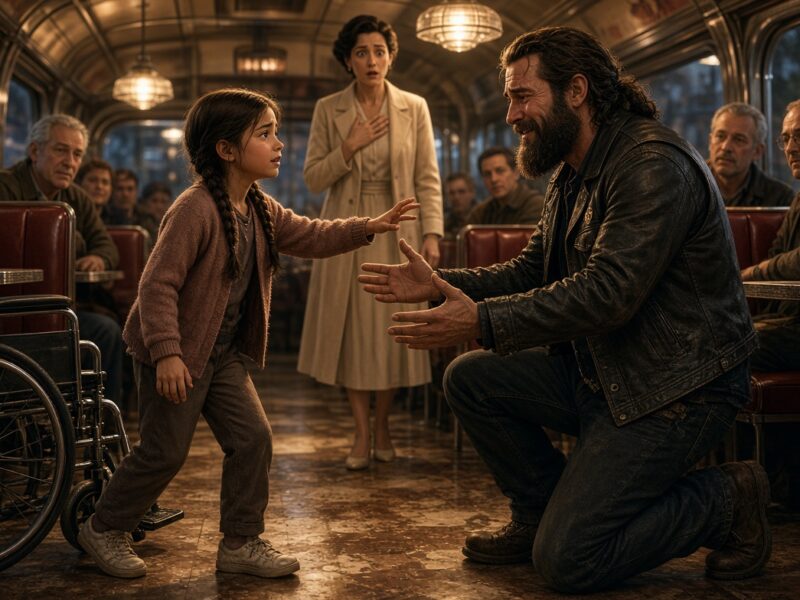
Billionaire Mom Screams at a Biker in a Diner — Then Her Paralyzed Daughter Stood Up and Walked Straight to Him
A woman’s hand shot out and shoved a man in the chest.
He didn’t move.
She shoved him again, harder, both palms flat against the leather on his back as he turned away.
The plastic cup in her other hand cracked.
Ice spilled across the diner floor.
Customers froze mid-bite.
A fork hung in the air.
She jabbed a finger an inch from his nose and called him filthy, a disease on two wheels.
The big man in the leather vest lifted his coffee and drank.
He said nothing.
He didn’t look at her.
That silence filled the room.
Her name was Vivian Crane, and she was worth $4 billion.
But money meant nothing in the next ten seconds, because her daughter, the girl who had not stood on her own in two years, unbuckled her belt.
What happened next stopped every heart in that diner.
Let me take you back about twenty minutes to before any of that happened.
Because to understand why this hit so hard, you have to understand who walked through that door.
The diner sat just off the highway outside Flagstaff, Arizona.
Nothing fancy.
Red stools, a long counter, a pie case that spun under a warm light.
The kind of place truckers stop at.
The kind of place that smells like coffee and bacon all day long.
It had been there forty years, and the same woman had run the register for thirty of them.
On a Tuesday around noon, it was full.
Ranch hands, a couple of families, two state troopers in a corner booth, an ordinary lunch crowd minding their own business.
Then a black car pulled up out front.
Long, polished, the kind of car that costs more than most of those people made in three years.
A driver in a gray suit got out first and opened the rear door, and out stepped a woman in a cream coat, sunglasses pushed up into her hair, heels clicking on the pavement like she owned every inch of it.
That was Vivian Crane.
And in a way, she did own a lot of things.
Steel mills in three states, shipping contracts, a name that showed up in business magazines next to words like ruthless and untouchable.
She had built an empire out of iron and cold decisions.
And she had buried two kinds of people to do it: the ones who crossed her and the ones who simply got in her way.
She had a saying she used in meetings.
“Sentiment is a line item, and I cut line items.”
The men around her table would laugh when she said it because they were afraid not to.
But that’s not the whole story of Vivian Crane.
Because the driver didn’t just open her door.
He went around to the other side and lifted out a folded wheelchair and snapped it open on the gravel.
Then, very gently, he lifted a small girl out of the back seat and set her down in it.
That was Lily, eight years old.
Dark hair in a braid that had come half undone from sleeping in the car.
A blanket over her legs even though it was warm.
And legs that did not move.
Two years before, there had been a crash on a mountain road in a storm.
Vivian hadn’t been in the car.
Her husband, Daniel, had been driving, taking Lily home from a school recital.
Another vehicle crossed the line.
Daniel never made it out.
Lily had been pulled from the wreck, barely breathing, with her spine damaged so badly that every doctor since had said the same careful, awful thing.
She may never walk again.
So Vivian had spent two years and a fortune fighting that sentence.
The best clinics, the best surgeons, flights across the country, specialists flown in from Europe, second opinions and third opinions and experimental programs that cost more than houses.
And nothing.
Lily sat in that chair, and Vivian’s money, for the first time in her life, could not buy the one thing she wanted.
It had made her hard.
Harder than before.
Like she was angry at the whole world for something the whole world couldn’t fix.
Now, here’s the thing about people like that.
When they can’t control the big thing, they try to control every little thing instead.
The temperature of a room, the wording of an email, the exact spot a car is parked.
It’s never really about the small thing.
It’s about needing to win somewhere, anywhere, because they lost the one fight that mattered.
The driver wheeled Lily up the ramp.
Vivian held the door.
They took a booth near the window, and Vivian ordered without looking at the menu, and she told the waitress the coffee was weak and the table was sticky and the window was dirty.
The waitress, a tired woman named Dot, just nodded and said she’d fix it.
People like Dot learned not to argue.
She’d been doing this thirty years.
She could spot the unhappy ones before they sat down, and she’d learned that the unhappy ones were almost never unhappy about the coffee.
And for a few minutes, that was all.
Just a rich, unhappy woman and her quiet little girl and a diner going about its day.
Lily had her face turned to the window, watching the highway the way she always did.
Watching, though her mother never thought to ask what for.
Then came the sound of an engine.
Not a car.
Deeper than that.
A low rolling thunder that you feel in your chest before you hear it in your ears.
A single motorcycle swung off the highway and rolled into the lot, slow, and parked in the empty space beside the long black car.
The man who climbed off it was big.
Military big.
A thick neck, a gray beard, forearms like a man who’d worked with his hands his whole life.
He wore a worn leather vest over a black shirt, and across the back of that vest were the colors of a motorcycle club, the kind of patch that makes some people nervous just to see it.
He took off his gloves one finger at a time, tucked them in his belt, and walked toward the door without hurrying.
He didn’t look at anybody.
He looked like a man who’d stopped for coffee a thousand times and planned to do it a thousand more.
His name was Dutch Kowalski.
And I’m going to tell you exactly who he was, but not yet, because Vivian didn’t know yet either.
All she saw was a biker.
All she saw was that he’d parked his dirty machine right next to her beautiful car.
And something in her just snapped.
She was up out of that booth before her coffee had even cooled.
She met him halfway across the floor right as he reached the counter, and she didn’t lower her voice one bit.
“Do you have any idea,” she said, “how much that car is worth?”
Dutch stopped.
He looked at her.
He didn’t say anything.
“You park that thing next to it. That filthy, leaking thing. If there is one scratch, one drop of oil on my paint, I will own everything you have. Though I doubt that’s much.”
The whole diner went quiet.
Forks down.
The troopers in the corner lifted their heads.
Dot froze with the coffee pot in her hand.
And Dutch, this huge man she was screaming at, just stepped around her, pulled out a stool, and sat down at the counter.
He set his gloves beside him.
And he nodded at Dot and said in a low, easy voice, “Coffee, please. Black.”
That was it.
That was all he gave her.
And it made her ten times angrier.
See, Vivian Crane had spent her whole life making men like that flinch.
Boardrooms full of them.
Men twice his size on paper.
Men with lawyers and titles and bank accounts.
And every one of them had learned to drop their eyes when she walked in.
And this one wouldn’t even turn around.
He wasn’t scared of her.
Worse than that, he didn’t seem to think she was worth being scared of.
So she followed him to the counter, and she leaned in close.
And that’s when she started in with the words.
“Filthy garbage. A disease on two wheels.”
That’s when the shoving started.
That’s where we came in.
And through all of it, Dutch Kowalski lifted his coffee and drank.
Now, I want you to hold a picture in your head.
A woman in a cream coat, red in the face, screaming at a silent man in leather.
A full diner holding its breath.
Two troopers deciding whether to get up.
And over by the window, forgotten in all of it, a little girl in a wheelchair watching.
Watching the man at the counter.
Not her mother. The man.
Because Lily had gone very still.
Her eyes were locked on that gray beard, that leather vest, those big scarred hands wrapped around a coffee cup.
And slowly, while her mother shouted, something was happening in that little girl’s face.
Recognition.
The kind that comes up from somewhere deep, from a place before words.
Her lips were moving, just barely, like she was counting something only she could see.
Vivian didn’t notice.
She was too busy.
She grabbed the sleeve of his vest and yanked hard enough to pull him half off the stool.
And she said, “Look at me when I’m talking to you. Get your trash off my property and get out.”
Dutch set down his cup.
He turned on the stool, and for the first time, he looked at her.
Really looked.
With eyes that were tired and calm and not afraid of anything.
He opened his mouth to speak.
He never got the chance, because across the diner there was a small metallic click.
It was the sound of a seat belt buckle coming undone.
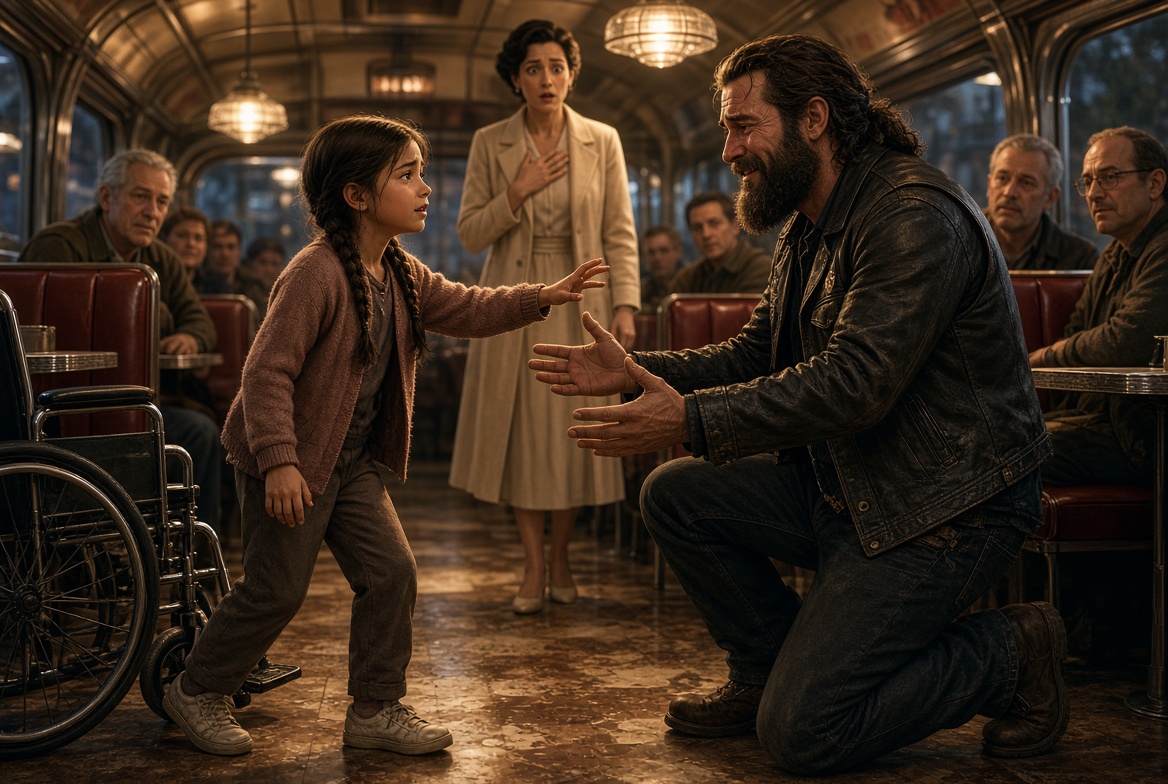
The strap that held Lily into her chair.
And in a room that quiet, everybody heard it.
Vivian heard it as she turned.
“Lily, honey, stay. Stay in your chair, baby. I’ll just be a—”
But Lily’s hands were already on the armrests.
Her knuckles white, her little arms shaking with the effort as she pushed.
The blanket slid off her legs onto the floor.
And then, slowly, in front of the whole stunned room, that girl who had not stood on her own in two years rose up out of that wheelchair.
She swayed.
She caught herself.
Her legs trembled like a newborn colt.
Dot gasped out loud and dropped a plate, and it shattered, and nobody even looked at it.
Vivian couldn’t move.
She couldn’t speak.
She just stared at her daughter, standing there.
Standing.
And her own voice came out as a whisper.
“Lily. Lily. No, you’ll fall. Sit down. Sit.”
Lily took a step.
One tiny, wobbling, impossible step away from the chair.
Then another.
The second one almost put her on the floor, and the whole diner surged half out of their seats to catch her, but she caught the edge of a table instead and steadied herself.
A man half rose with his arms out, then stopped himself, because he could see she wanted to do it alone.
And then a third step.
Away from the table, away from her mother, straight across that diner floor toward the man in the leather vest.
Dutch Kowalski came off that stool like the floor had dropped out from under him.
He went down on one knee, and his big arms opened, and his face, that hard, calm face, just broke apart.
And Lily fell the last little way into him, and those scarred hands closed around her, so careful, so gentle, like she was made of glass.
And the little girl pressed her face into his beard and said, in a voice everybody heard,
“I knew you’d come. I always wait for you on Thursdays.”
The glass slipped out of Vivian’s hand and smashed on the floor.
Nobody moved.
Nobody breathed.
And for one long, strange, beautiful moment, the storm just stopped.
The anger drained out of the room.
Dot put a hand over her mouth and started to cry.
One of the troopers slowly sat back down.
A trucker near the door whispered, “Would you look at that?”
And Vivian Crane sank down onto the edge of the booth, shaking, her hand pressed flat against her chest, and she let out a breath like she’d been holding it for two years.
Her baby was standing.
Her baby had walked.
The fight didn’t matter.
Nothing mattered but that.
She reached down with a trembling hand and picked up the fallen blanket and folded it against her lap, over and over, the way you do when your hands need something to hold.
Someone slid a fresh glass of water in front of her.
The quiet felt soft now.
It felt like the worst was over.
It wasn’t.
Because Lily, still wrapped in Dutch’s arms, turned her head, and she looked right at her mother.
And in that soft, happy little-girl voice, she said the word that changed everything.
“Mommy.”
She was smiling.
“This is the man who carried me out of the car. This is the man who held Daddy’s hand.”
The water glass stopped halfway to Vivian’s lips.
And outside, down the highway, came a sound.
Low at first, then louder.
A rolling thunder, the same as before, but many times over.
The ground beginning to hum with it.
Engines.
A lot of engines, getting closer.
The whole mood of that diner flipped in a single second.
The trucker who’d been smiling went pale and pushed back from the window.
A mother pulled her kids in close.
The two troopers stood up slow, hands drifting toward their belts, and one of them muttered, “Here we go.”
Because into that gravel lot, one after another, rolled a line of motorcycles.
Ten of them.
Twelve.
More behind.
Big men in the same leather colors as Dutch, kicking down their stands, climbing off, a wall of them between the diner and the highway.
The light through the window dimmed with the size of them.
And Vivian Crane, who ten seconds ago had been crying with joy, felt a different thing crawl up her spine.
Fear.
Real fear.
The kind of fear she had never once felt in a boardroom.
She looked at the man on his knee with her daughter in his arms, the man she had shoved and spit words at in front of everyone.
And then she looked at the dozen more just like him, filling the doorway, and her whole body understood what her pride had done.
She had just publicly humiliated the leader of all of them.
This wasn’t about a parking spot anymore.
It wasn’t about her paint or her pride.
She was a woman alone, far from her lawyers and her security and her money, in a roadside diner.
And she had screamed filth at the one man whose name those twelve riders would follow off a cliff.
Every threat she had ever made in her life had been backed by something.
A contract, a lawyer, a bank.
Here she had nothing behind her but a cream coat and a bad temper.
Her hand found Lily’s empty wheelchair and gripped the handle until it hurt.
The door opened.
A bell jingled over it, which seemed like the smallest sound in the world.
And the riders came in.
But they didn’t come in like a gang.
That’s the thing.
They came in slow, hats coming off, boots wiping on the mat, the way men come into a church.
The first one through was older than Dutch.
Long white hair, a patch on his chest that read President.
He looked around the silent room.
He took in the troopers, the frightened faces, the shattered glass.
And then he saw Dutch down on one knee, and he saw the little girl standing on her own two feet, holding on to that big man’s shoulders.
And this hard old biker’s eyes went wet.
“Is that—” he said, and his voice cracked.
“Is that our Lily? Is she—Dutch, is she standing?”
“She walked, Tom,” Dutch said, and his voice wasn’t steady either.
“She walked to me. Three steps on her own.”
What happened next, I promise you, no one in that diner expected.
One of those big leather-clad men made a sound like a sob and turned away to hide his face.
Another pulled off his bandanna and pressed it to his eyes.
The white-haired president crossed the floor and knelt down beside Dutch, careful and slow.
And he looked at Lily like she was the only thing in the world, and he said,
“Hey there, little sister. You remember me? You remember old Tom?”
And Lily laughed.
She reached out one small hand and touched his white beard and said,
“You bring me the chocolate ones. The round ones.”
The man broke completely.
Just sat down right there on the diner floor and wept into his hands.
This huge, frightening man, crying like a child in front of everyone.
Another of them crouched beside him and gripped his shoulder, and his own jaw was working, and he gave up trying to hold it, too.
Vivian stood frozen by the booth, understanding less and less and more and more all at once.
Because these men knew her daughter by name.
They knew what candy she liked.
They were crying over her like she was their own blood.
And her mind was racing back over two years of Thursdays.
Two years of Thursday afternoons when Lily had come home from the rehab clinic a little brighter than the other days.
Two years of her daughter saying her friend came to see her, and Vivian busy, distracted, grieving in her own hard way, never asking who.
She remembered now.
She remembered Lily at the dinner table saying the men had a new patch and asking what a patch was, and Vivian answering a phone call instead.
She remembered a toy motorcycle on the nightstand and never wondering how it got there.
Two years of a visitor’s name on a clinic sign-in sheet that she had never once bothered to read.
She looked at Dutch, and in a voice that had none of its sharpness left, a small voice, she asked the question that mattered.
“Who are you?”
Dutch rose, lifting Lily easily into one arm, and he stood to his full height in front of the woman who had called him trash.
He wasn’t angry.
That was the strangest part.
There was no triumph in his face, no payback, none of the things she probably deserved to see.
There was just that same tired calm, and underneath it, something that looked a lot like grief.
“Two years ago,” he said quietly, “I was riding home through a storm on the mountain road. I passed the ridge, and I came around a curve, and there was a car that had gone through the guardrail and down into the rocks. I was the first one there. First by a long way, out of anybody.”
He paused.
“I climbed down to it. There was a man in the front seat, badly hurt, and a little girl in the back.”
The whole diner was still.
Vivian had gone white.
“The man knew he wasn’t going to make it. He knew it before I did. And he didn’t ask me to save him.”
Dutch’s voice dropped.
“He grabbed my hand, and he looked at me, and he said, ‘The girl. Get my girl out. Her name is Lily. Tell her Daddy loves her.’ And then he held my hand until he couldn’t anymore.”
A woman at a nearby table had both hands over her mouth.
The trooper by the wall was looking at the floor.
“I got her out before the car went,” Dutch said.
“I carried her up that slope, and I held her on the roadside in the rain until the ambulance came. Forty minutes. And I told her the whole time that she was safe, that a friend had her, that she wasn’t alone.”
He looked down at Lily, who had her head on his shoulder now, calm as anything, like this was the safest place she knew.
“Forty minutes is a long time to hold a child who’s scared. You run out of things to say, so I just kept telling her the same three words. ‘You’re not alone.’ Over and over. And somewhere in there, she stopped crying, and she started saying it back to me.”
He took a breath.
“And I made that man a promise while he was dying. I promised him I would not disappear. So every Thursday for two years, I rode to that clinic, and I sat with his girl while she did her exercises. I brought the boys sometimes.”
He nodded at the weeping men.
“We’re not much to look at, but she never had to wait for us. Not once.”
Vivian Crane’s legs gave out.
She caught herself on the edge of the table and lowered herself into the booth, and the tears came.
And she didn’t fight them.
Didn’t wipe them.
Didn’t care who saw.
Two years.
Every single week.
The man she had shoved.
The man she had screamed trash at in front of a room full of people.
He had held her husband’s hand while he died.
He had carried her daughter out of the fire.
And he had never said a word.
Never called her.
Never asked for a thing.
Never once told the woman whose family he had saved that it had been him.
Because he hadn’t done it to be thanked.
“Why?” she managed.
“Why didn’t you ever tell me? Two years. I never knew your name. I would have—I would have given you anything.”
“That,” Dutch said gently, “is exactly why I didn’t tell you.”
And that answer took the last of the fight out of her, right down to the floor.
Because she heard it.
She heard what he meant.
She was a woman who paid for things, who settled debts, who turned every kindness into a transaction so she’d never owe anyone.
And he had known that about her without ever meeting her.
And he had decided her daughter deserved something that didn’t come with a receipt.
She slid out of that booth, and she got down on her knees on the dirty diner tile, this billionaire in a cream coat, and she looked up at the man she had spit on.
And she said the only thing left to say.
“I’m sorry. I am so sorry for what I said, for what I did, for not knowing. For two years of not knowing.”
Her voice fell apart.
“You gave me back everything I lost. And I called you garbage to your face.”
The diner was dead silent.
Every eye on the two of them.
And Dutch Kowalski reached down with the same scarred hand that had held a dying man’s hand on a mountain.
And he took Vivian Crane by the elbow, and he lifted her back up to her feet.
Didn’t let her stay down there.
Wouldn’t allow it.
“We don’t do this on our knees,” he said.
“Not you, not me, not anybody. Stand up.”
And Lily, still in his arm, reached out and put her small hand against her mother’s wet cheek, and she said,
“Don’t cry, Mommy. I wanted it to be a surprise.”
Dutch said, “One day, my legs would get strong enough.”
He said, “When they did, I should walk to whoever I love the most and show them first.”
She smiled that gap-toothed smile.
“I was going to walk to you, but then you were yelling, and I got scared, and Dutch was right there, and my legs just went.”
And somehow that broke Vivian and healed her in the same breath.
Because her little girl had been planning this in secret.
A gift.
Learning to stand again just to surprise the mother who’d been too lost in her own grief to notice the miracle growing right in front of her.
Every exercise, every hard afternoon, every time she came home brighter than the day before, she’d been building toward this one moment.
And she’d wanted to give it to the one person who couldn’t see it coming.
She pulled Lily into her arms, chair and all forgotten.
And she held her daughter, and she looked over that little shoulder at a dozen weeping bikers and a diner full of crying strangers, and she laughed through the tears.
This broken, grateful, human laugh.
The first real one in two years.
It was Dot who started the clapping.
Just one pair of hands at first, the tired waitress with a broken plate at her feet.
Then the troopers joined in.
Then the truckers, the families, all of them.
A whole diner on its feet, applauding a little girl who’d taken three steps across a linoleum floor and, without meaning to, put a room full of hard hearts back together.
That was almost the end of it.
Almost.
Let me tell you how the rest of that day went, because the way a story like this settles afterward is the part that stays with you.
They pushed two tables together, and they all sat down to lunch.
The billionaire and the bikers, side by side in a roadside diner.
Vivian insisted on paying for every plate in the house, and nobody argued with her about that one.
The white-haired president, Tom, pulled out his phone and showed her two years of photographs she’d never seen.
Lily at the clinic, grinning up from a therapy mat with a ring of big leather-clad men around her.
Lily wearing somebody’s enormous sunglasses.
Lily holding a tiny toy motorcycle that Dutch had bought her the first week, the one she slept with every night.
The one Vivian had always assumed came from the hospital gift shop.
She cried again over that toy motorcycle.
She’d tucked it under her daughter’s chin a hundred nights and never once asked where it came from.
And she learned the rest of it, slowly, over coffee.
How the men had quietly paid for things the insurance didn’t cover, back at the start, before they knew who Lily’s mother was.
Back when they thought the family had nothing.
A specialist’s bill here, a set of leg braces there, passing a helmet around the clubhouse and filling it with crumpled twenties.
How Dutch had been there in the clinic hallway through every surgery, sitting on the floor because the chairs were too small for him.
And how the nurses had stopped questioning the giant biker in the pediatric wing because the kids lit up whenever the boys rolled in.
How Lily had taught twelve rough men to play a card game with rules she mostly made up, and how they let her win every time and swore up and down they weren’t.
Vivian Crane had built an empire believing that strength was the thing you could see.
Big contracts, big cars, the power to make men flinch.
And she had just watched real strength walk across a diner floor on two trembling little legs.
Sit on the floor of a hospital because it wouldn’t fit in a chair.
And lift a cruel woman back up to her feet instead of letting her grovel.
She didn’t go back to being who she was.
People ask me when I first told this story whether she really changed or whether it was just a good afternoon.
And here’s what I know.
The Crane Foundation opened a spinal rehabilitation wing for children that fall.
Free to any family who couldn’t pay.
Built fast, because Vivian Crane, when she decides on something, is a force of nature.
She put Dutch Kowalski’s name on the door.
He asked her not to.
She did it anyway and told him that’s exactly why she did it.
There’s a photo in the lobby of a little girl mid-step, caught by somebody’s phone in a diner outside Flagstaff, arms reaching for a man in a leather vest.
People stop and look at it every day, and most of them never know the whole story.
Lily walks now, with a limp, with a cane on bad days, but she walks.
And every Thursday, rain or shine, there is still the sound of an engine in the driveway.
Dutch is older now, slower, the beard all white.
He still comes.
He never missed a promise he made to a dying man on a mountain in the rain.
And Vivian, she waits by the window on Thursdays with the coffee already poured.
Black, the way he likes it.
She hands it to him herself every week, with both hands, careful.
The way you hand something to a person you respect more than anyone alive.
I think about how that day started.
A woman’s hand shoving a man who wouldn’t move.
A room full of people frozen in an ugly silence.
And I think about how it ended.
The same hand holding out a cup of coffee to the same man.
And a silence in that house that isn’t ugly at all anymore.
A quiet that means thank you.
A quiet that means I see you now.
Funny thing about the people we’re quickest to look down on.
Sometimes they’re the ones already carrying us, and have been for a long, long time, and never said a word.
The loudest person in the room almost never is.
And the one sipping his coffee in the corner, the one you wrote off at a glance, might just be the one who held your whole family together with his bare hands while you weren’t looking.
So the next time you’re ready to decide who somebody is by what they’re wearing, remember the diner outside Flagstaff.
Remember the three steps.
And maybe pour the coffee first and ask the name later.
That’s the story.
Thanks for staying with me to the end.
If it moved you even a little, leave a comment and tell me about the person in your own life who turned out to be nothing like you first thought.
I read them, and I’ll see you on the next one.









