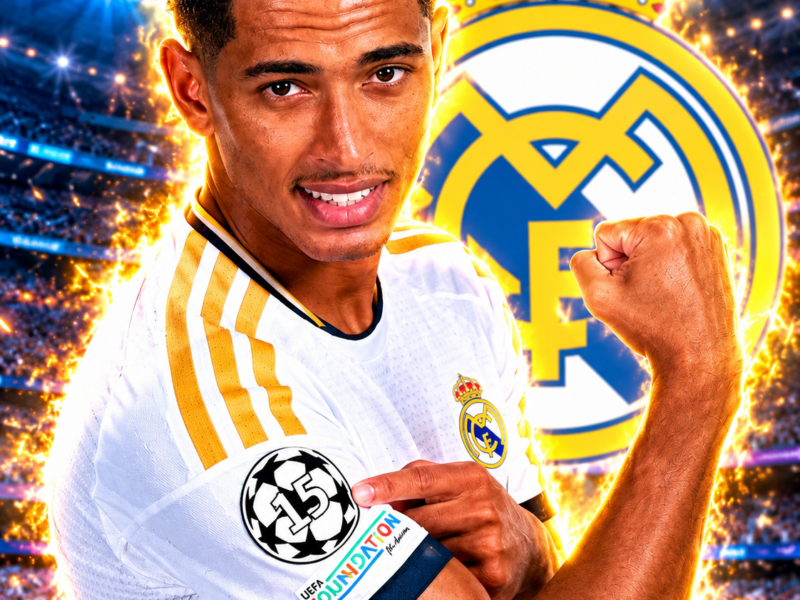
Bellingham Wants Vinícius Money, Real Madrid Is Offering a 50% Raise, and the Real Fight Is Over Image Rights
Everyone is staring at the salary number.
They are looking in the wrong place.
Behind the Jude Bellingham contract talks at Real Madrid sits a quieter battle, one that could shape how every superstar at the club gets paid for years.
It has nothing to do with the paycheck and everything to do with a face.
Whose face sells the watch, the suit, the burger, the video game, and who gets to keep the money when it does?
That is the question hanging over the negotiating table, according to the voices in this discussion.
And the answer might surprise you.
The Talks Have Started, But No Number Is on the Table
Let’s begin with what is actually happening.
Bellingham’s extension is one of the files Madrid has to handle this season, especially as it nears its end.
Have talks begun?
Yes, but only in the loosest sense.
Madrid asked whether he wants to continue, and the answer was yes.
Bellingham’s side asked whether the club wants him to continue, and the answer was yes.
Wonderful, everyone smiled.
But no figure has been put on the table yet.
What Madrid does know is that Bellingham’s camp has already signaled where the real conversation will happen.
When we sit down, they said, we have to talk about salary figures and we have to talk about image rights.
That second item is where things get complicated.
The Image Rights Wall Bellingham Built Before He Arrived
To understand the fight, you have to go back to the day Bellingham signed.
According to what the speakers were told, he arrived in Madrid with a kind of financial firewall.
Everything he owned before signing with the club, particularly his deal with Adidas, stayed his.
That makes sense when you think about it.
The Adidas relationship came from a contract that predated Madrid, so why would the club get a cut?
Everything that arrived afterward is a different story.
Louis Vuitton, McDonald’s, the video game deals, the whole portfolio that blossomed once he put on the white shirt.
On those, one of the speakers said, Bellingham does not keep an even half.
He was not given the exact split, and he was careful to say so.
What he understood is that Bellingham signed away an important share of his image rights to Madrid but held onto the larger portion for himself.
It is not as extreme as what Mbappé reportedly secured, which was described as getting close to 80 percent.
And it is not what Vinícius has now.
That is the gap Bellingham wants to close.
The Salary Math That Makes Everyone Wince
Now to the money itself.
Madrid’s expectation, as the speakers described it, is a raise of roughly 50 percent.
Bellingham currently earns around 10 million net.
Moving him to 15 is where the club’s thinking lands.
Bellingham’s camp, however, is asking for double.
The reasoning is easy to follow.
Why should he earn 15 when Vinícius is on 25?
One of the speakers made a sharp point here.
The problem is not that Madrid will refuse to pay Bellingham 25 net, and Bellingham knows that perfectly well.
He simply has to ask for it.
That is how negotiation works when you want to land somewhere in the middle.
For the club, the cost is steeper than the headline suggests.
If he earns 10 net, that is roughly 20 gross for Madrid.
A 50 percent raise pushes the real expense toward 30.
And that is before anyone discusses what the player wants on image rights.
What Madrid Would Happily Sign
Here is the scenario the club would celebrate.
A 50 percent salary increase, plus three or four additional percentage points of image rights handed to Bellingham.
That would be a deal Madrid could present as a win.
But one of the speakers added a note of caution about how this plays out.
If Bellingham has a strong season, the club ends up in a similar position to the one it faces with other stars.
Everything depends on his individual performance and whether the team wins titles.
Success gives the player leverage.
A weaker campaign gives it back to the club.
The Two Battles Inside One Negotiation
The speakers framed this as two separate fights.
The first is straightforward: the salary.
Madrid is willing to pay roughly 50 percent more, according to their information.
The second is how the image rights are divided.
And that is where the real tension lives.
One host asked what Bellingham is actually requesting.
The answer led into a fascinating tour of how Madrid handles image rights across the roster.
Courtois, Kroos and Modric: The 100 Percent Club
Madrid, the speakers explained, generally takes a share of image rights from its players.
The exception is players in the final stretch of their careers.
Take Thibaut Courtois, who is 34.
Because he renews year by year, the club currently gives him all of his image rights.
Madrid asks nothing of him.
One of the hosts admitted he had not known this, saying it had probably been mentioned before without him noticing.
Kroos and Modric, they said, also received 100 percent in their last renewals.
The logic is almost sentimental.
Think of it as the club saying, you have already earned it.
You have been here for years.
One of the speakers offered a colorful example.
If a car rental company called tomorrow and wanted Modric in an ad, the fee would belong to him.
Madrid has long since earned back what it invested.
Two Legends, Two Very Different Paths
The comparison between the two midfielders turned out to be revealing.
Modric’s contracts, the speakers said, shrank with each renewal.
The club kept trimming his pay, partly because he had already won the Ballon d’Or.
One of the hosts used a pointed word to describe how some people view that award.
Kroos, by contrast, always earned the same salary.
The club never reduced it.
The explanation they offered was simple.
Kroos retired as an undisputed starter.
Modric spent roughly four years without being one.
When Kroos played his final game, they said, fans were crying and begging him not to leave.
The lesson is hard to miss.
At Madrid, the contract you get at the end often depends on how the end looks.
Why Bellingham’s Argument Makes Sense
So what about Bellingham?
The speakers agreed that his position is logical.
He signed with Adidas in 2016, and he is entitled to ask why he should give half of that to anyone.
He arrived with commercial relationships that had nothing to do with the influence of Real Madrid.
One speaker said he does not know whether other players will make the same claim, but the reasoning holds up.
At the same time, Madrid has a counterargument.
Some of the deals Bellingham now enjoys exist because he plays in Madrid.
Louis Vuitton, for instance, is the brand the club uses for its travel suits.
Now Bellingham is the face of the brand.
Wearing a Louis Vuitton suit and carrying one of its bags, the speakers said, is a powerful image.
It is far different from how it would look on someone like Gonzalo García, who they noted has his own following.
The same logic applies to Cucurella.
As a Madrid player, he is expected to receive sponsorship deals that never came to him at Chelsea.
That is how media growth works at the biggest club in the world.
Is Madrid Looking at This the Wrong Way?
One of the hosts offered a thought experiment that reframes the entire conversation.
Put yourself in Florentino Pérez’s seat.
Instead of seeing this as a painful negotiation, look at it from another angle.
Madrid has been getting a bargain.
For years, the club has had a player who arguably deserved more from the start, and he has been earning just 10 million net.
That is the argument for treating this renewal as a correction rather than a concession.
Then there is the transfer fee.

Madrid paid 120 million for Bellingham.
As with Diomandé, the club starts from minus 10 once you factor in the cost of the operation.
The speakers made it clear that Madrid is pleased with what he brings in revenue.
But recouping a transfer cost of that size takes time.
The Bellingham We Saw, and the One We Keep Waiting For
Then came the uncomfortable part, the question of performance.
Bellingham delivered six months at a Ballon d’Or level, the speakers said.
Since then, he has not consistently returned to those heights.
There have been flashes of something extraordinary.
Particularly with England, and in certain Madrid matches, you see how he fills the pitch.
How he attacks the box.
How he scores, recovers the ball, shows fire, and lifts the crowd.
When he is at his best, they said, he has everything.
But the player in the highlight reels is not always the player who shows up.
One host pointed to the Getafe game, and to the day in Pamplona when he snapped at the referee and was sent off.
If the best Bellingham were the only Bellingham, the host argued, he would already have at least one Ballon d’Or.
He went further.
Had Bellingham sustained the form Rodri showed in his award-winning season, the one many believe was taken from Vinícius, he would have been a stronger candidate than Vinícius.
From September to November, he said, Bellingham was playing like Di Stéfano.
Which makes the gap since then all the more frustrating.
The Precedent Problem: Mbappé and Vinícius Changed the Rules
This is where the story becomes bigger than one player.
The speakers explained that the image rights issue has become a sticking point in renewals for the club’s biggest stars.
The reason is precedent.
Madrid opened a new door with Mbappé and then solidified it with Vinícius.
Before that, Vinícius’s previous contract followed a 50-50 split.
The deal he signed a month, a month and a half, or roughly 70 days ago does not.
What changed?
The speakers credited his representatives at Roc Nation.
They raised their hands and pointed out that Mbappé was not getting a 50-50 arrangement.
As a representation agency, Roc Nation earns money from Vinícius’s sponsorship agreements, so it had every incentive to push.
One speaker believes that without Roc Nation, Vinícius would never have landed a campaign like the Hugo one he appeared in.
The work done by Madrid and the work done by his agency both played a role in turning him into a global sponsorship icon.
The agency’s reach in the American market, they said, boosted him significantly.
That sets two precedents.
And every superstar who follows will point to them.
Will Haaland Make the Same Demand?
It is a natural question.
One speaker said he does not know whether Erling Haaland will press the issue when his contract comes up.
But he expects the biggest names to do it.
The money is there, and everyone knows it.
Image rights are also a way of paying players.
Clubs treat them as a revenue stream, but they can also be used to structure contracts so that part of the compensation flows through that channel.
There may come a time, the speakers suggested, when the club’s share, once 100 percent in some cases and now 50 percent at Madrid, keeps shrinking.
It is a slow shift in power from club to player.
The Barcelona Angle
The discussion did not stay in Madrid.
One of the speakers wondered how Barcelona handles all this now.
In the past, he said, the club kept 100 percent, but the player gets it today.
Whatever the details, he said he does not find the current path fair at either club.
Everything they described for Bellingham, he noted, also applies in Barcelona.
Raphinha is there, and so is Lamine Yamal.
But he made a distinction.
Yamal at Barcelona is not worth the same as a Yamal who does not play there.
If he were at Paris Saint-Germain or Bayern Munich, perhaps it would be different.
Then came the provocative idea.
If Barcelona could secure 40 percent of Yamal’s image rights, he said, that would be a real lever.
A powerful one.
Of course, he added, an agent like Jorge Mendes would tell you to hop on Mbappé’s bicycle, grab the seat, and start pedaling.
Then he would give you 40 percent of what you made from that seat.
It was a joke, but it carried a real point about how hard it is to win these battles.
Even a 30 percent share of Yamal’s image rights, he said, would be enormous and likely grow far beyond that.
The Yamal Phenomenon
The conversation drifted to one simple observation.
Lamine Yamal may be the biggest star in world football right now.
Not necessarily the best player, the speakers clarified, since that is a separate debate about who ranks first, second, third or fourth.
They were talking about global iconography.
Cristiano Ronaldo and Lionel Messi remain icons, and Yamal has not yet overtaken them.
But the pull is undeniable.
One speaker described what he sees on the Costa del Sol, where he lives.
Yamal shirts, either Spain or Barcelona, appear more often than Real Madrid shirts.
Children wear them everywhere.
Even those who do not follow Barcelona choose the Spain shirt.
The area is full of Scandinavian and German families, he said.
You see blond kids, and you can tell they are Danish, maybe supporters of Dortmund or Copenhagen.
They wear a Málaga shirt or a Spain shirt, and they are not wearing Madrid colors.
That, he said, shows the power of a phenomenon that is just beginning to spread.
From Contract Talks to Controversy: The Mbappé Question
As the conversation moved toward a different subject, the tone shifted.
One of the hosts was about to start a live session with several guests and wanted to test his opinion first.
What do you think about the Mbappé situation?
The bicycle.
The Mourinho video.
The nights out and whatever else was circulating.
The answer was candid.
There are things Real Madrid should not tolerate, he said.
He was careful to point out that Mbappé is not being denied treatment.
As described, the knee issue is not a serious injury, just inflammation from a sprain.
What he needs, whether anti-inflammatories, stretching, or physiotherapy, can be done in Paris, Segovia or Madrid.
But the optics, he argued, are poor.
Your biggest star leaves his national team in the middle of an international break because of an injury.
Then he goes home.
Had he been from a small town in Castile, the host joked, no one would care.
But he is from Paris.
So he went home, not to recover, but to be there with his girlfriend, as the speaker put it.
In his view, Madrid should not have allowed it.
A Question of Authority
The host went further.
A few days off would be fine, he said.
But he was not even sure Mbappé had come to Madrid at all.
People saw him, and then he left immediately.
To him, that proves a lack of authority at the club.
And now, on top of everything, there he was on a bicycle.
He was quick to add that he does not think Mbappé went out to get drunk at a nightclub.
More likely he went out to listen to music and enjoy himself, which he has every right to do.
Still, in the current context, he said, those actions look bad.
He added with a laugh that he would have been tempted to take the player’s passport.
Then he corrected himself, since France is a European country and it would hardly matter.
But the message would have been clear.
You stay in Madrid.
Look at what is happening, he said.
Look at the shirt situation, he said, and remember the team had just lost the derby.
You cannot leave, simply because you cannot.
The Mourinho Defense and Why It Falls Flat
Another voice offered a counterpoint that did not satisfy anyone.
A journalist named Félix had said that morning that the trip was authorized by Mourinho.
In effect, that pulls the club out of the equation, since Mourinho is the one in charge of the matter.
But the speakers were not convinced.
A week earlier, they pointed out, the line was that cycling was off limits.
And Mbappé did more than ride a bicycle.
Perhaps ten other players had done the same.
The difference is that he posted it on Instagram, as if to say, look at me riding this bike.
In the same video, he later appears on a motorcycle that evokes Márquez.
That, too, they said, is not something a player in recovery should be doing.
And then the skiing.
The Ski Track Remark That Raised Eyebrows
One of the hosts said Mbappé once mentioned in an interview that he is looking forward to retiring from football because he wants to build his own ski track.
He loves skiing, the host said, and he insisted he was not making it up.
People could look it up.
Another speaker found the quote on the page in front of him.
According to the text, when he retires, Mbappé said he would rent a large ski run so he could enjoy it.
The explanation they offered was practical.
Skiing is hard on the knees, so it makes sense that a footballer cannot do it during his career.
Mbappé wants to make up for lost time once he retires.
One of the hosts clarified that this was not some lifelong dream.
It was more of a statement about what he cannot do now.
He would rent it only for himself, one of them added.
Not build anything, not open it to the public.
Simply say that this place is his and he will spend as much time on it as he likes.
They noted that, as far as they know, he likes skiing on snow, and they did not know whether he enjoys the other kind.
Two Stories, One Theme: Who Holds the Power at Madrid?
On the surface, a contract negotiation and a bicycle clip have little in common.
Look closer, and they tell the same story.
Both are about leverage.
In the Bellingham talks, the leverage comes from precedents set by Mbappé and Vinícius.
Every superstar who follows will point to those deals when it is time to negotiate.
In the Mbappé episode, the question is whether the club still holds authority over its biggest names.
The speakers worry that it does not.
Together, the two stories paint a picture of a club that pays enormous sums to its stars while struggling to define what it expects in return.
What Happens Next
For Bellingham, the next phase will test both sides.
Madrid wants to keep a player who has been central to its project.
He wants to be paid like the best player at the club, or at least close to it.
The salary gap, 15 million against 25, will be negotiated.
The image rights split will be harder.
Because once a deal is signed, it becomes the next precedent.
For Mbappé, the issue is quieter but just as real.
Fans will forgive almost anything when the team is winning.
When it is not, a video of a bicycle becomes a symbol.
As the speakers put it, there are things a club like Madrid should not allow.
And in the weeks ahead, the club will have to decide how much it is willing to defend.
Because at Real Madrid, contracts, images and authority are all tied together.
Pull one thread, and the rest begin to move.









