Barcelona Look Unbeatable, But Real Madrid Insiders Say the Numbers Hide a Much Bigger Story Ahead of the Atlético Showdown
Somewhere in Barcelona this week, a fan is quietly wondering whether the league season can just be called off.
Five goals here. Seven goals there. Two goals in the first twenty minutes, again and again, like a machine running on a timer.
Then you talk to the people on the other side of the rivalry, and the story turns upside down.
They say the scoreboard is lying. They say the real headline is buried in the starting lineups, the schedule, and a pile of numbers almost nobody is talking about.
And they say the fall will be brutal.
The Question That Split the Room
A roundtable of Real Madrid supporters and commentators sat down this week to ask a question that has swallowed Spanish football whole.
Is this Barcelona team simply unbeatable?
The hosts even joked about talking over each other before they got started, then agreed on a rule to avoid the chaos. One would open, the other would answer.
The opening voice admitted to mixed feelings, and that honesty set the tone for everything that followed.
On one hand, there is no denying what Barcelona have been doing. On the other, there is a growing sense that the league is handing them a gift.
Both things can be true at once. That tension is what made this conversation worth listening to.
A Madrid Reborn Under Mourinho
Before turning to the champions, the panel started with their own house.
They argued that Real Madrid under José Mourinho look dramatically better than the team of the last two seasons. Not just because of the coach, who they believe manages the whole operation far more effectively, but because of the roster itself.
Think back to those away trips, one speaker said. Defensive lines built around names like Raúl Asencio, David Alaba, Dani Carvajal and Fran García were, in his words, far below what Real Madrid should ever field on the road.
This year, he says, the difference is visible on the pitch.
The center-back pairing is working very well. Güler has been described as majestic, and Diomandé looks like a player from a different level.
Marc Cucurella is still not at full physical sharpness, but the panel says it is starting to show.
They also urged the football world to be careful about snap judgments on new signings. Give them time, they said, before anyone writes a verdict.
There is one signing they are particularly excited about who has barely played.
Bernardo Silva arrived to lift the ceiling of the midfield, and the panel believes he has been held back only for physical reasons. His impact, they say, will be huge once he finally steps on the field.
The Dressing Room Has Changed
Ask one of the panelists what separates this Madrid from the last one, and he does not hesitate.
There are two things, he says, and he is not sure which matters more.
The first is a change in mentality. He claims that anyone walking into Valdebebas right now would feel the tension in the air, with players fighting for every place in the lineup.
That kind of real competition, he says, had been missing for three years.
Then came a surprising concession. He gave Barcelona credit for landing on something similar under Hansi Flick.
Flick, he believes, built a dynamic that served them well, and did it by talking with his players instead of barking orders at them. Yet nobody steps out of line.
It is a formula that worked, he says, and Madrid have now rediscovered their own version of it.
Mourinho’s message, as he puts it, is simple. Nobody gets comfortable here.
The second factor is the bench.
Six Monsters on the Bench
Look at Madrid’s substitutes in any given match, the panel says, and you see six players who are hungry to prove they deserve to start.
That is not a small thing. It creates pressure across the entire squad.
One speaker went as far as to say the Madrid roster is better than Barcelona’s by miles, especially when comparing the benches side by side.
He pointed to what happens when Mourinho makes his changes. They often come late, he admitted, but the team tends to wake up the moment fresh legs arrive.
And the most striking example came in the last match.
Vinícius Júnior was taken off around the sixtieth minute. By the panel’s account, he left without showing any visible frustration.
On came a player who had been sitting, one of the heaviest names in the dressing room, Jude Bellingham.
Bellingham may have been the one who tipped the balance. He was the best player on the field over the final fifteen minutes, and the panel is convinced that without him, the win would not have happened.
Brahim Díaz, playing in Vinícius’s spot, gave a better performance than any stretch Vinícius has produced this season, according to the same speaker.
Which is exactly the point, he said. Vinícius cannot relax, because someone else is ready to take his place at that level.
The same goes for Bellingham, and for Mbappé, and for Güler.
If any of them slips into comfort, another name will move in.
Mourinho’s Toughest Balancing Act
The panel did not pretend this was easy.
Mourinho is not only building a team right now. He is managing large egos while doing it.
That, in their view, is where the real work lies.
Some of those egos, they say, need a dose of medicine that coaches have been reluctant to administer in recent years. Starting on the bench, coming on with thirty minutes left, and accepting it without a fight.
They are starting to see that medicine being applied to several players at once. And they hope those players respond the right way.
There was one more sign of the coach’s methods, the speakers noted with a smile.
Earlier in the week, Mourinho reportedly put a giant screen on the pitch to walk the players through tactical details. The message was clear. This is a team still learning, and the learning is happening in public.
Nobody on the panel thinks Madrid is a finished product.
In fact, one of them put it bluntly. Madrid are missing most of the pieces of a complete team, and that is exactly what you would expect at this stage.
The Barcelona Machine
Now to the team everyone is asking about.
One speaker did not soften his praise. He said he could not remember seeing a team dominate La Liga this way since Luis Enrique’s treble-winning side.
Home or away, the pattern looks the same. The game is decided in the first twenty minutes or so, with hardly any resistance.
Two early goals, in what feels like every single match, and then the foot goes down on the accelerator.
The recent results tell the story. Seven goals against Racing Santander, a rout at Levante in a stadium where Barcelona normally suffer, and more of the same across the early rounds.
But the speaker was careful to add context, which he promised to return to later.
This is not the Barcelona of 2015, he said, the one that had Luis Suárez, Neymar and Messi up front with a superb defensive midfield behind them. This team is not at that level.
What has happened instead, in his view, is that Barcelona have taken a real step forward in recent years.
He even admitted something that might sting his own supporters. He believes in this team more than he did before.
The League Nobody Believes In
Then came the sharpest turn of the conversation.
One of the panelists said he had recently written on social media that La Liga has turned, almost overnight, into a weak league. A modest league. He compared it to the French league of the past.
In his telling, the competition has lost its credibility and its level.
And when you add what he describes as favorable officiating, you get the picture we are seeing at the start of this season, with Barcelona flattening opponents.
He said he came to the show with a mission. To lift the spirits of Madrid fans, and to deflate the pride of those he accused of buying referees.
He laughed that he did not know which he enjoyed more.
But he said he was genuinely happy with how the season was going.
Because he believes the fall will be bigger.
The higher they climb, the harder they drop, he said. He is convinced of it.
The Bench-Warmer Problem
Here is where the discussion moved from feelings to numbers.
One panelist argued that opposing teams have been making life easy for Barcelona by resting their best players.
He pointed to a graphic he had sent to the show. It counted how many backups Barcelona’s recent opponents had started.
Rayo Vallecano started none. Valencia started four. Levante started five. And Racing Santander, the day before, started eight.
Eight.
By the panel’s math, that averages out to roughly four backups per match, and to them it looked like nearly half the lineup.
They called it embarrassing. Some said it should be investigated, and that the league or the federation should step in and hand out sanctions.
One speaker quoted the frustrated reactions of Racing’s own supporters, who reportedly said they had spent their whole lives trying to reach the top flight. And now that they finally got there, they were heading to a stadium like Camp Nou and sending out the reserves.
That, the speaker said, is essentially walking onto the field planning to lose.
Barcelona fans have a different explanation, the panel acknowledged. Some argue that opposing coaches rest their starters to spare them the shock of a heavy defeat.
The panelists did not buy it.
The Timing Makes It Worse
There was one more detail that made the Racing situation look even stranger to the panel.
Rotation in the middle of a season, when squads are physically drained, might be understandable. Coaches could justify it.
But this was September 17.
Racing’s next match, they noted, is the last before a four-week break, the longest one any of them could remember. And most of Racing’s players are Spanish, so they will not even be joining national team duty.
So the idea that these were tired players who needed a rest?
The speaker called that a joke.
Who Has Barcelona Actually Played?
The panel then turned to the schedule.
According to the league table they were looking at, Barcelona have not faced a single team in the current top nine.
Not one.
They were fair enough to admit that this may change. Athletic Club, currently ninth, is expected to climb the standings, and the picture will shift as the season moves along.
They also brought up Elche, which one panelist called a joke, though he said we should wait and see how things play out.
The larger point stands. The scoreboard looks dominant, but the list of opponents has been forgiving.
The Referee Argument
Then the conversation got heated.
Several speakers said they were convinced officiating was tilted in Barcelona’s favor, and they went into detail about why.
A few of the claims, which are strictly the panel’s opinions and were not backed by evidence in the conversation, deserve to be repeated here as such.
They said they were seeing Madrid players hit, kicked and stomped with no cards until the eightieth minute and beyond. Yet Madrid players, they said, get shown a card simply for looking at the referee.
They compared the treatment of stars, too. Lamine Yamal, one speaker said, had suffered only four fouls in a match, while Vinícius takes fifteen fouls in a single game and the opposition sees only four whistles and two yellow cards.
How, they asked, can anyone compete like that?
They added that penalties and red cards are part of the same imbalance.
One panelist went further. He said this season felt worse than last year in the early rounds, and that the violence he sees against Madrid, combined with the shortage of cards, reminded him of the dark days of the Negreira scandal, or even worse.
He pointed to an elbow from one player and a rash challenge in the box from another, saying the video review had somehow looked away.
He said Elche played Madrid with far more aggression than they showed against Barcelona. If they had treated Barcelona the way they treated Madrid, he claimed, the players involved would have had to leave the country.
It is a sharp accusation, and it is fair to remember it came from fans of one club.
Barcelona supporters would almost certainly say the opposite.
But Barcelona Are Not Lucky
Even in the middle of all this, one of the speakers refused to go along with the idea that Barcelona are bad.
It is a message he wants Madrid fans to hear.
He said he does not share the popular line among some Madrid supporters that all of Barcelona’s players are poor. For two years, he pointed out, they have outplayed Madrid with real talent.
Fermín López has delivered wonderful seasons. Dani Olmo, in his view, was the best player at the European Championship and put together an outstanding World Cup.
Lamine Yamal, whether you like him or not, and whether or not you think he gets help from referees, keeps getting better.
Raphinha has been playing at an elite level for three seasons, first on the left wing and now as a number nine. And Pau Cubarsí delivered a great World Cup.
So the message, he said, is simple. Let’s not fool ourselves.
These players do not win games by accident. They have grown in front of our eyes into a very good football team.
The Summer Nobody Can Explain
Another voice on the panel was less generous, and this is where the tone got sharper.
He said he looked at what Barcelona did in the summer and could not make it add up.
They signed Anthony Gordon, an ordinary player in his eyes. They signed Karim Adeyemi, whose form had been declining in the Bundesliga. They signed Gabriel Jesus, who at Arsenal was considered the fourth option.
And then they took Rodri from us, he said. But Rodri is thirty or thirty-one and coming off a mediocre season.
Meanwhile, he said, Madrid have spent years fighting half of Europe for a player like Diomandé and chasing players like Bellingham.
Suddenly they are the smartest club on the continent and everyone else is a fool?
He rejected the story completely. He said Barcelona want him to believe they can win the league and the Champions League with Gabriel Jesus as the striker, and that either he understands nothing about football or someone is trying to sell him illusions.
He also refused to compare this group to the great Milan side of Gullit and Van Basten. Olmo, Fermín, Adeyemi and Gordon, he said, are not that.
He did concede that it is Flick’s third year, and that the team has a lot of acquired automatisms. He agreed with all of that.
But he said he will not accept things that make no sense.
He pointed to one more example that bothered him. A player who averaged around four league goals a season in Germany over the last three years arrives and scores more in ten rounds than in any of those seasons.
Another player who usually scores five or six goals a year, he said, seems to be getting them in just a couple of matches.
Put Raphinha in and he becomes a Buster, he joked, and put Lamine in and he is suddenly on fire.
He said he was convinced that any player you put in Barcelona would look like a star, whatever their level.
He decided not to push the line further, because he knew a video was coming on the other channel. But the point was made.
The More Balanced Take
Another panelist landed somewhere in the middle, and his view carried some weight because it acknowledged both sides.
He said he agrees more with the skeptic than with the believer, but he does not think Barcelona are unbeatable.
He does think a set of circumstances is distorting the big picture, starting with the opposition. Missing four regular starters, he could understand. Five, he said, looks serious.
Then he made what may be the most useful point of the whole discussion.
Barcelona have added pieces that are not super-elite, and he does not consider Adeyemi or Gordon super-elite. But they give Barcelona something extra, like the ability to rotate, especially in a style where the forwards do a huge amount of pressing.
And above all, he said, they added a piece he considers absolutely essential. Rodri.
He believes Rodri will raise Barcelona’s competitive ceiling on the big European nights.
When the Rodri move to Madrid stalled, the panel had talked about it, he recalled. They said that with him, Barcelona might be able to control the rhythm of matches, not only in the league but in Europe too.
Does that make them unbeatable? No.
He thinks Mourinho’s Madrid could beat them, with hard work and big individual performances from a few players. It is possible, he said. Definitely possible.
Where Madrid Have Been Vulnerable
The same panelist then turned the criticism back on Madrid.
He pointed out that Madrid have made a strong start, but the away record needs a closer look. There was a 2-1 win at Espanyol, decided by a Carlos Espí goal in the ninetieth minute.
There was the painful loss at Betis, a game the panel believes Madrid would win nine times out of ten.
And there was the trip to Elche, where Espí scored again in the ninetieth minute. Without it, Madrid would have dropped points there too.
Another speaker noted that the bad moments have tended to arrive in the second half. Second half against Espanyol. Second half against Elche. A stretch against Inter where things did not go well.
Each time, fans blamed the midfield.
Everyone points to the midfield when Madrid struggle, the panelist said, because there is a feeling that every problem starts there.
What Madrid Are Getting Right
He wanted to highlight something else, a quality Mourinho has brought that he thinks is being overlooked.
Chance creation.
Over the last two seasons, he said, Madrid were boring. You would watch a match, and it felt like there was no direct attack at all, no real danger. A couple of isolated chances. If you scored them, you won. If not, you drew.
This year it is different, whether Madrid win or not.
Madrid have won every game except the one at Betis, and there are chances everywhere. He said the team is walking out of matches with something like three expected goals, though he admitted he might be exaggerating slightly.
He is not even sure Barcelona have created more scoring chances than Madrid. He does not believe they have.
His example was the round everyone remembers. Levante 0, Barcelona 5. Betis 1, Madrid 0.
In that round, Madrid beat Barcelona easily on expected goals.
Barcelona scored five, and Madrid scored none, even though Madrid had far more chances.
The problem, the panel says, is that Madrid did not finish. But they are getting there.
And when the team does not switch off, he said, it is solid defensively.
The Real Test Has Not Arrived
So what do the panelists think happens next?
One of them said the true picture will only emerge in the Champions League, against strong opponents, which Barcelona are about to face.
That is when we see the real Barcelona, he said, and see what happens.
He questioned whether this is simply the league effect. He said the level of the league is falling sharply, and that each year it gets worse.
And he wondered aloud how Madrid failed to beat seven of these teams last year.
It is a sad state of affairs, he said, and a strange one.
He also made no secret of his suspicion. People say I’m always skeptical, he said. With this club, you have no choice.
Other panelists were more measured, and they laid out what each team must prove.
Two Checklists for a 70-Game Season
One speaker said both clubs need to tick certain boxes before anyone can trust them across a full season of around seventy matches.
For Madrid, it is the road.
Madrid have left good impressions early in the season, he said, but the away record has been uneven. That is why he sees Sunday’s trip to Atlético Madrid as a good test.
He wants Madrid to show they can pick up points away from home week after week, with relative ease.
For Barcelona, the box to tick is defense.
They rely on Cubarsí staying healthy for seventy games, he said. If Cubarsí or Eric García breaks down physically or gets injured, Barcelona will be in real trouble.
That is the vulnerability he believes could bring them back to the pack at some point.
The Numbers That Closed the Argument
One panelist saved his data for the end.
Many people, he said, would already have heard the counterargument in other channels. Sure, but did anyone compare this with Madrid?
Here is what he shared.
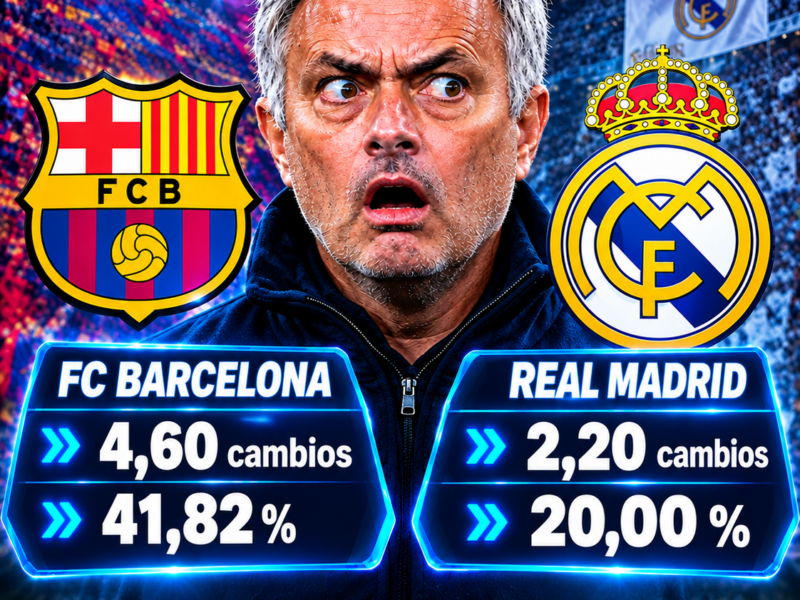
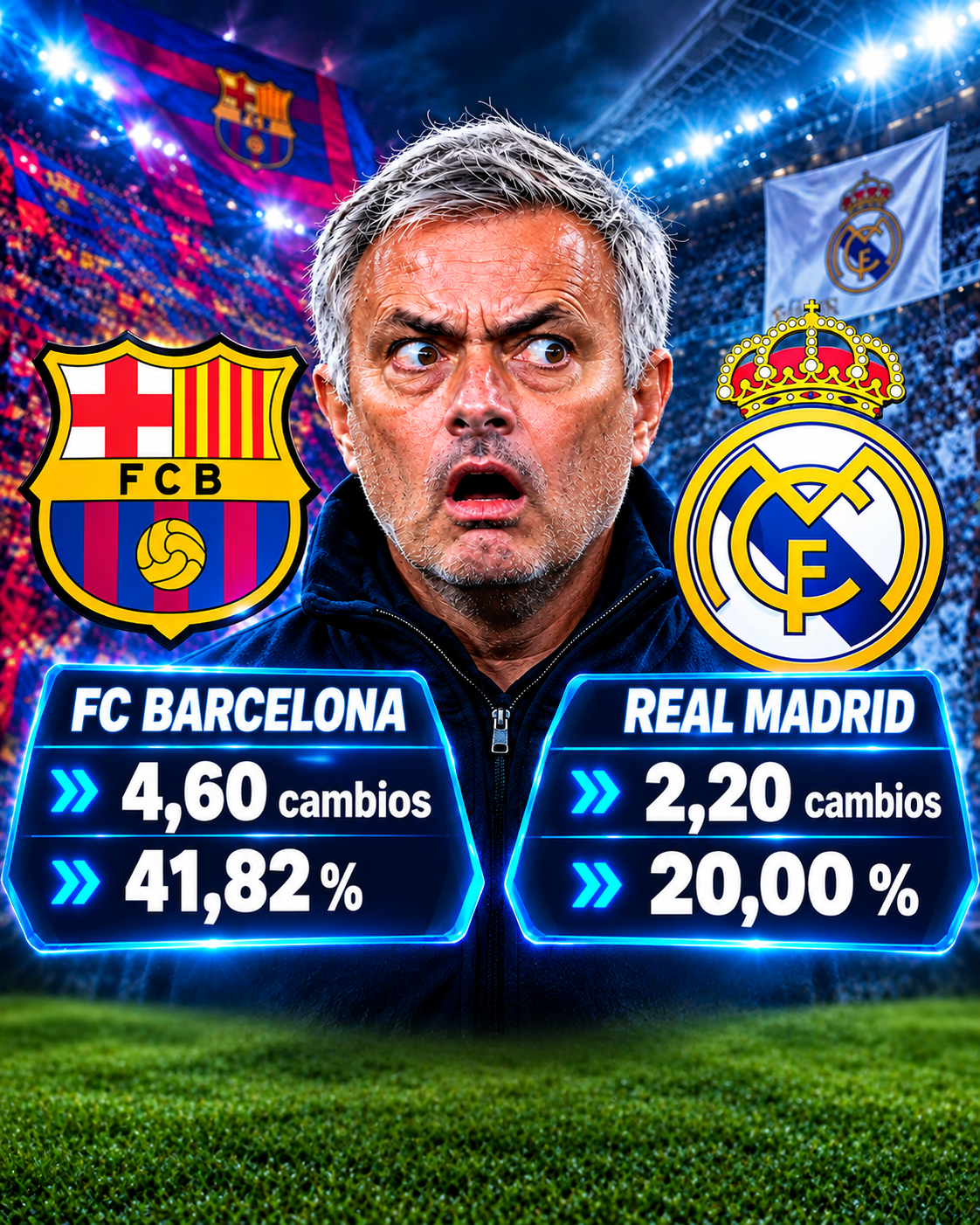
By his numbers, Madrid’s opponents make 2.20 changes per match, and you have to add two absences because of red cards.
Barcelona’s opponents, meanwhile, make 4.60 changes per match. That means almost five regular starters are not playing in every game.
Put another way, 41.82 percent of the players Barcelona face are backups.
He called it a joke.
And then he added the part that bothers him most. The press, in his view, keeps describing all of this as though everything is peaceful and normal.
The referees, the cards, the opponents. It is all connected, he said, and it will be picked up on the other channel later.
A Club That Stays Quiet
The final word went to a panelist who had been waiting to stir things up.
He asked what Madrid themselves are doing about all this.
Real Madrid TV, he said, is a channel nobody watches. He called it an excuse for the club to avoid complaining, an echo chamber that keeps the truth from getting out.
So what is the club doing to protest these issues, along with the ones the panel never got to in other areas?
Where is the protest? Where is the fist on the table? Where is the stand?
There is nothing, he said.
Nobody on the panel had an answer.
The hosts wrapped up the show, thanked each other, and sent viewers off to the partner channel.
So, Are Barcelona Really Unbeatable?
Strip away the noise and this is what the roundtable actually said.
Barcelona are very good, and even the most skeptical voice admitted they have grown into a strong team. But the panel does not believe they are unbeatable.
They point to a soft schedule, opponents who keep sending out reserves, and a defense that leans heavily on two players.
They also say the real proof will come in Europe, where nobody rests their starters against Barcelona.
And they believe Mourinho’s Madrid, imperfect and still learning, has the depth, the competition and the chance creation to hunt them down.
Whether that turns out to be wisdom or wishful thinking depends on what happens next.
Sunday’s trip to Atlético is the first real answer.
Then come the big European nights.
If Madrid can win on the road and Barcelona’s defense holds firm through the fall, this season may turn out to be far closer than the scoreboard suggests.
And if it does not?
Well, the fans on both sides will have plenty to argue about.









