Atletico Madrid Stun Real Madrid 2-1 In Chaotic Derby: Inside The Tactical Collapse, The Red Card That Changed Everything, And The Tchouameni Gamble That Blew Up In Mourinho’s Face
Atletico Madrid Stun Real Madrid 2-1 In Chaotic Derby: Inside The Tactical Collapse, The Red Card That Changed Everything, And The Tchouameni Gamble That Blew Up In Mourinho’s Face
It started to go wrong before most fans had even settled into their seats.
By the time the final whistle blew on this Madrid derby, one team had been reduced to ten men, a manager’s biggest in-game decision had unraveled in real time, and a dressing room that was supposed to have been “fixed” over the summer looked every bit as fragile as the one that fell apart a year earlier.
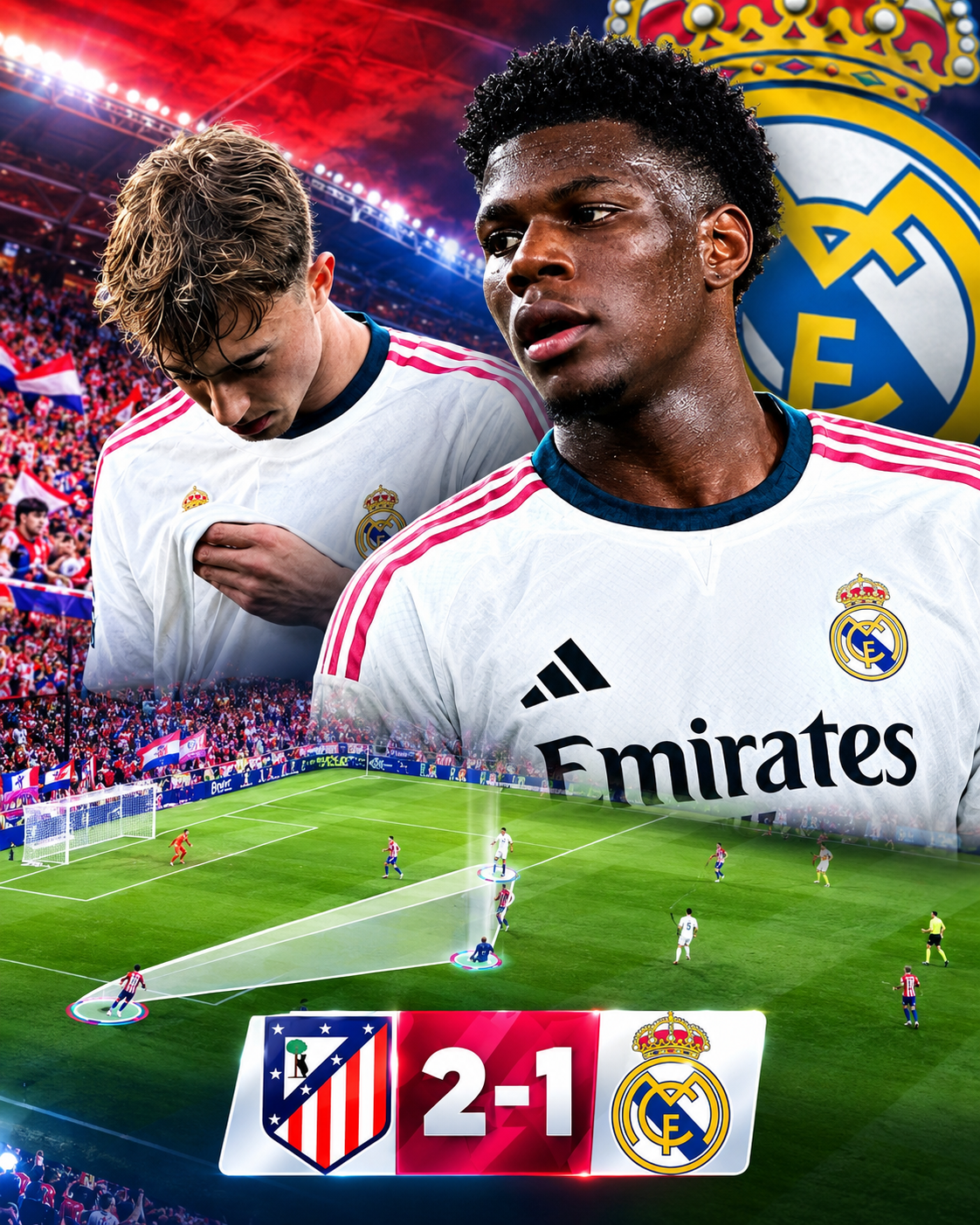
This is the story of how Atletico Madrid beat Real Madrid 2-1, and why the damage from this defeat may run a lot deeper than the scoreline suggests.
Real Madrid arrived at this derby already carrying pressure. Every Madrid derby carries weight on its own, but this one had an extra layer to it: a new manager trying to prove he had actually changed something inside that dressing room, a midfield selection that raised eyebrows the moment the team sheet dropped, and an opponent that, as usual, seemed to know exactly what it wanted to do before the game had even kicked off.
By full time, Real Madrid had been picked apart in buildup play, exposed repeatedly through the middle of the pitch, and then undone by one individual mistake that turned a tight, competitive match into a lost cause. Atletico, disciplined and structured as ever under their setup, did what Atletico teams have always done best in this fixture: they waited, they absorbed, and they punished every single opening they were given.
Let’s break down exactly how it happened.
The Lineups: A Surprise In Midfield That Immediately Raised Questions
Real Madrid lined up in a 4-2-3-1. Courtois started in goal behind a back four of Dunfri, Konate, Huijsen, and, in a genuine surprise, Cucurella at left back instead of the expected starter.
The bigger shock, though, came in central midfield. Instead of Camavinga or Bernardo Silva, who many expected to partner Valverde in the double pivot, Tchouameni was handed the start. It was only his second appearance as a starter all season, and it would go on to define the story of this match in ways nobody could have predicted before kickoff.
Ahead of that midfield two, Real Madrid set up with Vinicius on the left, Bellingham in the number ten role, Arda Guler on the right, and Mbappe as the central striker.
Atletico Madrid, in contrast, set up in a back three that stretched into a back five depending on the phase of play, essentially a 5-3-2 in defensive shape. Simeone and Grimaldo operated as wing-backs, pushing high when Atletico had the ball and dropping into a flat back five whenever Real Madrid had possession. In the middle of the park, Cardoso, Llorente, and Baena rotated through central midfield duties, while Kin Lee and Jonathan David led the line together up front.
On paper, it looked like a classic Atletico approach against a possession-heavy opponent: sit deep, stay compact, and strike on the counter. What actually happened on the pitch, though, was far more damaging to Real Madrid than a simple game of patience and opportunism. Atletico did not just sit back and wait. They actively dismantled Real Madrid’s ability to build from the back, and that is where this match was truly decided.
Real Madrid’s Buildup Play Fell Apart From The First Whistle
To understand why this derby went so badly for Real Madrid, you have to start with how the team tries to play out from the back under normal circumstances.
In a typical buildup structure, Real Madrid create a triangle in front of their center backs by dropping one of their pivots, usually Valverde, Camavinga, or Bernardo Silva, into the space between the two center backs. That extra body gives Courtois an additional passing option and helps Real Madrid overload the first line of an opponent’s press.
Tchouameni does not play that role the same way. When he starts, he tends to position himself as an option in front of the center backs rather than dropping between them. It is a subtle difference, but against a team as well-organized as Atletico, subtle differences become enormous problems very quickly.
Atletico’s front two, Jonathan David and Kin Lee, took turns marking Real Madrid’s two center backs directly. At the same time, Atletico’s rotating central midfield trio of Llorente, Baena, and Cardoso picked up Tchouameni and Valverde individually, following them man for man rather than allowing Real Madrid to build calmly through midfield.
The result was immediate and obvious. Courtois had no clean passing lane into his center backs because they were closely marked, and the center backs, in turn, had no safe outlet because Tchouameni was being shadowed everywhere he moved.
This is where Tchouameni’s positional style became a real liability. He is, by nature, a very structured, disciplined midfielder who holds his position rather than constantly searching for pockets of space. He does not drift wide, he does not drop between the center backs to create numerical superiority, and he does not make the kind of unpredictable off-ball runs that can break a man-marking scheme. Against a side that had clearly prepared to mark him tightly, that stillness turned him into an easy target rather than a reliable outlet.
As the half progressed, Valverde began dropping deeper to try to help Tchouameni escape the pressure in that double pivot. It did not solve anything. The moment Valverde dropped closer, Baena or Cardoso simply followed him too, maintaining the same suffocating coverage. Because Atletico’s midfield three rotated fluidly between Llorente, Baena, and Cardoso, there was always a body available to track whichever Real Madrid midfielder tried to find space.
Making matters worse, Atletico’s wing-backs, Simeone and Grimaldo, were positioned high up the pitch rather than tucking in to help build an extra passing option. That meant Real Madrid had essentially no short passing route out of their own defensive third. From the opening exchanges, Real Madrid were being forced into long, hopeful clearances rather than the composed, patient buildup that has defined their identity for years.
This is the part that should worry Real Madrid fans the most. It was not bad luck. It was not a one-off mistake. It was a structural failure in how the team was set up to play out from the back, and it happened over and over again in the opening stages of the match.
Where Real Madrid Actually Looked Comfortable
To be fair to Real Madrid, the picture was not entirely bleak in every zone of the pitch. Once the ball reached the middle third, something shifted.
In that second phase of buildup, Cucurella would push up alongside the center backs rather than staying in a traditional left-back position, effectively turning Real Madrid’s structure into a back three in possession. Neither Tchouameni nor Valverde needed to drop into that line, because Cucurella’s positioning already created a numerical advantage of three defenders against Atletico’s two central strikers.
This adjustment had a ripple effect across the rest of the pitch. With Dunfri pushing forward on the right as an auxiliary winger, Grimaldo was forced to retreat and hold his position in that back five rather than pressing forward. Similarly, Vinicius’s width on the left dragged Simeone back into a more defensive posture. Both of Atletico’s wing-backs, in other words, were being pinned back rather than allowed to push high and support the press.
In this middle zone, Arda Guler stood out as one of the more effective performers on the pitch for Real Madrid. Rather than staying glued to the number ten position beside Bellingham, he consistently dropped deeper to link with the center backs and the two central midfielders, offering an additional passing option and helping the team retain possession in that second phase. His movement was intelligent and unselfish, and it gave Real Madrid at least one route to progress the ball once they escaped that suffocating first press.
So the picture that emerges is a team capable of holding its own in the middle third of the pitch, but completely unable to reliably get out of its own defensive third to reach that middle zone in the first place. That gap between phase one and phase two of buildup was the single biggest tactical problem Real Madrid faced in the opening period, and it would have consequences that went far beyond simple possession statistics.
Mbappe’s Isolation Problem
If Real Madrid’s issues in buildup were about structure, their issues in the final third were about spacing, and specifically about how isolated Kylian Mbappe became as a central striker.
Atletico’s back three, anchored by two central defenders flanking a third, essentially trapped Mbappe in a three-versus-one situation every time the ball reached the final third. Bellingham tried to offer support from the number ten role, but even with his help, Real Madrid were still working from a numerical disadvantage in that central area.
The problem compounded because Vinicius, operating on the left, positioned himself very wide, which is not inherently a bad decision for a winger looking to isolate his marker in one-on-one situations. But it meant that through the middle of the pitch, where Mbappe most needed support, there was often nobody available to combine with him.
As a result, Mbappe was regularly forced to abandon his central position and drift toward the left flank simply to touch the ball and stay involved in the game. It is not where a world-class striker wants to be spending his afternoon, chasing the ball out wide because the central passing lanes have been completely cut off. This pattern repeated itself throughout the first half and was a major reason why Real Madrid struggled to generate any meaningful shots on goal during that period.
Put the two problems together, a broken buildup phase and an isolated striker in the final third, and you get a clear picture of why Real Madrid managed so little in the way of genuine attacking threat before things fell apart completely.
Atletico’s Buildup Masterclass
While Real Madrid struggled to escape their own half, Atletico Madrid were doing the exact opposite with remarkable efficiency.
Atletico’s buildup shape saw their three central defenders spread across the back line while both wing-backs pushed high and wide. Crucially, Llorente and Cardoso would drop closer to the base of the team, creating extra passing options around the ball.
This created two separate problems for Real Madrid simultaneously. First, Mbappe was still stuck in that three-versus-one disadvantage against Atletico’s back three whenever Real Madrid tried to press from the front. Second, and more significantly, when Llorente and Cardoso dropped in to support, Atletico could generate a five-versus-two or even five-versus-three numerical advantage through the middle of the pitch.
Real Madrid simply did not have the bodies to match that central overload. Vinicius was positioned wide on the left rather than tucking inside to help mark centrally, and while Arda Guler did drop in to help at times, he also had defensive responsibilities tracking Grimaldo out wide. The end result was that Atletico were able to play through Real Madrid’s press with real composure, not because Real Madrid weren’t willing to press high, but because the numbers simply weren’t there to make that press effective.
Once Atletico escaped that first phase, their route to goal became fairly straightforward: attack down the flanks. When Atletico transitioned into their attacking phase, Kin Lee and Baena would drift wide toward the touchlines, leaving Jonathan David as the lone central striker. Combined with Simeone and Grimaldo pushing forward from wing-back, Atletico regularly attacked with two players stacked on each flank.
This forced Real Madrid to retreat into a compact 4-4-2 defensive shape just to cope with the numbers out wide, with Vinicius dropping back to help Cucurella and Arda Guler tracking back to support Dunfri. It is a demanding defensive workload for two attacking players who are usually asked to provide the primary attacking threat, and as the match wore on, it visibly began to wear Real Madrid down, pushing the entire team deeper and deeper into their own half.
Even with all of this, the match was still competitive. Real Madrid were not playing a perfect game by any means, but they were still in it. Then came the moment that changed everything.
The Moment Everything Fell Apart: The Penalty And The Red Card
Football has a cruel way of punishing even small lapses in concentration, and this derby produced one of the clearest examples of that all season.
The buildup to the incident traces directly back to the exact problem described earlier: Real Madrid were allowing Atletico’s central defenders and first line of buildup to play far too freely, without any real pressure being applied. Atletico were able to progress the ball up the pitch with almost no resistance, right in front of the entire Real Madrid team.
That freedom eventually led to the ball reaching Simeone in a dangerous area. What happened next was painfully familiar to anyone who has watched Real Madrid closely over the past year. Huijsen grabbed Simeone by the shoulder inside the penalty area, conceding a clear penalty in the process.
It was not an isolated incident from Huijsen either. It echoed two almost identical situations from the previous season, one against Borussia Dortmund and another against Real Sociedad, where the same kind of careless shoulder challenge inside the box led directly to a penalty being awarded. For a young defender still establishing himself at the highest level, repeating that exact mistake for a third time in such a short span is a genuinely alarming pattern.
This time, the consequences were even harsher. Not only did Huijsen concede the penalty, he was also shown a straight red card for the challenge, reducing Real Madrid to ten men. Grimaldo converted the resulting penalty calmly, and just like that, Real Madrid found themselves down 1-0, a man short, with more than half the match still to play.
Mourinho’s Response: Reshaping A Broken Team
Facing a one-goal deficit and a numerical disadvantage simultaneously is about as difficult a situation as a manager can be handed mid-match, and the head coach needed to react immediately.
The response came in the form of a defensive reshuffle. Both Rudiger and Diomande were introduced, with Arda Guler and Vinicius sacrificed to accommodate the personnel change. Real Madrid effectively restructured into a 4-1-4-1, or something close to it, with Tchouameni now sitting as the lone holding midfielder, Valverde pushed into a more all-purpose, box-to-box role, and Bellingham shifted out to the left flank.
On paper, the logic made sense. Down to ten men, you need extra defensive solidity, and pulling an attacker for a defender is a fairly standard adjustment in that scenario. The problem was that the underlying issue from earlier in the match had not gone away. It had gotten worse.
With Tchouameni now isolated as a lone pivot rather than sharing midfield responsibilities with a partner, the burden on him increased dramatically at the exact moment his effectiveness on the ball was already in serious question. He simply was not connecting with the game. The numbers bear this out in a genuinely striking way.
The Statistic That Tells The Real Story
Sometimes a single number captures a performance more accurately than any amount of description can. In this case, that number is thirty.
Tchouameni touched the ball just thirty times across the entire ninety minutes. For a central midfielder, and particularly one being asked to dictate tempo from a deep-lying position, that is an extraordinarily low figure.
To put that in context, consider what happened the last time Bernardo Silva started in that same deep midfield role. In that match, he touched the ball fifty-nine times, nearly double Tchouameni’s total in this derby. And Camavinga’s most recent start in a similar role produced an even more dramatic contrast: more than seventy touches in a match against Malaga, well over double what Tchouameni managed here.
Neither Bernardo Silva nor Camavinga is necessarily the finished article in that deep midfield role either. Both have had their own struggles adapting to it at various points. But the gap in ball involvement between them and Tchouameni in this derby is simply too large to ignore. A double pivot player who defends well but rarely receives the ball creates a structural weakness that opponents can and will exploit, and Atletico exploited it mercilessly.
This is really the crux of the tactical story from this match. It was not just that Real Madrid made individual errors, though they certainly did. It was that, for long stretches of this derby, Real Madrid simply did not have functioning central midfielders capable of dictating the tempo of the game, controlling possession, or dictating attacking tempo, and that absence was felt in every single phase of play.
The Second Goal: A Formality At That Point
With Real Madrid down a man and their midfield struggling to touch the ball at all, it was really only a matter of time before Atletico extended their lead.
The second goal arrived from a cross delivered by Simeone. Jonathan David, left with essentially nothing more than a tap-in, made it 2-0. By that stage of the match, the game had effectively become a formality, with Atletico controlling both the ball and the man advantage, and Real Madrid struggling just to stay competitive on the scoreboard.
Mourinho’s Second Wave Of Changes
It was not until around the eightieth minute that Mourinho made his next set of substitutions, bringing on Camavinga and Bernardo Silva in place of Tchouameni and Bellingham.
There is a reasonable argument that at least one of these two players should have started the match in the first place, given the touch statistics discussed above and the way Real Madrid’s buildup issues were entirely predictable once Tchouameni was named in the lineup. Hindsight is always clearer than foresight, but the numbers from Tchouameni’s ninety minutes make it hard to argue that this substitution came too late rather than too early.
With Camavinga and Bernardo Silva on the pitch, Real Madrid shifted back into a double pivot structure. It was, realistically, too little too late to change the overall complexion of the match given the scoreline and the man disadvantage. But it did produce one moment of genuine quality.
A Late Consolation, But Little More
Real Madrid’s goal came from a set piece rather than open play, which tells you almost everything you need to know about how the run of play had gone by that point in the match.
Bernardo Silva delivered the ball into the box, and Rudiger rose above his marker to head home, cutting the deficit to 2-1 and giving Real Madrid something resembling hope heading into the closing stages.
Calling it a genuine route back into the match, though, would be overstating things considerably. In truth, Atletico came closer to scoring a third goal to make it 3-1 than Real Madrid did to finding an equalizer at 2-2. The consolation goal mattered on the scoreboard and gave Real Madrid supporters something to hold onto, but it did not reflect a shift in momentum or control. Atletico remained the more dangerous and more threatening side for the remainder of the match.
Why This Result Matters More Than A Single Defeat
Every derby loss stings, but some carry more weight than others, and this one falls firmly into the second category.
The most immediate concern is the Tchouameni selection itself. He had made just one previous start all season before being handed the responsibility of anchoring midfield in the biggest fixture of the calendar. He did not deliver, and by most reasonable measures, from touches on the ball to his role in the buildup collapse that led directly to the penalty, he was one of the central figures behind this defeat. That raises uncomfortable questions about the decision-making that put him in that position in the first place.
But there is a bigger issue lurking underneath the tactical breakdown, and it concerns exactly what this new managerial appointment was actually supposed to fix.
The stated purpose behind bringing in this particular head coach was never purely about tactics. It was about discipline. It was about waking up a dressing room that had grown complacent, about being willing to bench players and hold difficult conversations when performances demanded it, and about restoring a sense of accountability that many felt had been missing.
And here is where the real alarm bells start ringing. During the previous season, there was a well-documented moment when Vinicius was substituted and reacted visibly, and that single incident was widely seen as a symbol of a dressing room beginning to fracture from within. In this derby, almost the exact same sequence played out. Vinicius was substituted following Huijsen’s red card, and he left the pitch quickly, mirroring the exact dynamic from a year earlier that supposedly needed fixing.
This is precisely the kind of moment that will define whether this managerial reset actually works. If the club allows this incident to pass without consequence, if there is no firm public response, no accountability, and the same old dressing room dynamics simply continue as if nothing happened, then very little will have actually changed behind the scenes despite the change on the touchline.
On the other hand, this is also exactly the kind of moment where a manager known for ruling with an iron fist has the opportunity to draw a clear line in the sand. A strong, pointed press conference addressing standards and expectations directly, rather than the usual diplomatic post-match platitudes, would go a long way toward proving that this appointment is about more than just a new face patrolling the touchline.
What Real Madrid Need To Fix Before The Next Derby
Strip away the drama of the red card and the late goal, and the tactical lessons from this match are actually fairly clear.
First, the buildup structure needs serious reconsideration whenever Tchouameni starts alongside Valverde. Asking him to operate as a fixed reference point in front of the center backs, rather than dropping between them or making more dynamic movements, is simply not working against organized, aggressive pressing teams. Whether that means changing his role specifically, changing his midfield partner, or adjusting the overall structure of the buildup phase, something has to give.
Second, Mbappe needs central support. Isolating your most dangerous striker in a three-versus-one situation for large stretches of a match, forcing him to abandon his position and drift to the flanks just to receive the ball, is not a sustainable approach against a well-drilled defensive block. Real Madrid need a plan for connecting play through the middle third that does not rely purely on individual brilliance to manufacture chances out of nothing.
Third, and perhaps most urgently, the disciplinary lapses need to stop. This is not a one-off problem confined to a single player or a single match. Huijsen’s challenge on Simeone was the third time in roughly a year that a nearly identical mistake has led directly to a penalty. Patterns like that do not fix themselves. They require coaching, video review, and repetition in training until the underlying habit is broken.
None of these fixes are simple, and none of them happen overnight. But if Real Madrid want to avoid another afternoon like this one, all three issues need genuine, sustained attention rather than a one-match reaction that fades by the next international break.
The Bigger Picture
Games like this tend to be remembered less for the final scoreline and more for what they reveal. Atletico Madrid did what they have so often done in this fixture: they identified a structural weakness, set their team up to exploit it relentlessly, and made Real Madrid pay for every single mistake along the way. That is not luck. That is preparation and discipline executed at a very high level.
For Real Madrid, the questions raised by this derby extend well beyond a single lineup decision or a single reckless challenge. They cut to the heart of whether the reset this club promised over the summer is actually taking hold, or whether the same old problems are simply wearing a new manager’s name on the team sheet.
The next few weeks, and particularly how this dressing room situation is handled behind closed doors, will go a long way toward answering that question. For now, Atletico Madrid have bragging rights in the capital, and Real Madrid have a long list of uncomfortable conversations ahead of them.









