“Atlético Madrid Slams Mourinho and Real Madrid Over Referee Complaints Days After El Derbi — But Their Own Track Record Says Otherwise”
A quiet Tuesday morning in Spanish football turned into anything but quiet once the numbers came out, the reactions started flying, and one club decided it was finally time to speak up.
It started with a simple question that nobody expected to have such an explosive answer.
Which team runs the least in La Liga this season.
Guess who topped that list, and no, it is not a coincidence.
Real Madrid.
The club that spent the last several days accusing referees of bias against them is now dealing with a very different kind of scrutiny, and this time the numbers do not lie.
According to the latest tracking data released this week, Real Madrid covers roughly 21 fewer kilometers per match than Barcelona, and about 10 fewer kilometers than the league average.
Not fourth. Not fifth. Dead last.
For a club that has spent the past 48 hours insisting the officiating world is conspiring against them, discovering they are also the team that runs the least in Spain’s top flight is, to put it mildly, an awkward look.
And it did not take long for people to start connecting the dots, half joking that the next press conference excuse might somehow blame the referees for that too.
But before we get to the running numbers, there is a much bigger storm brewing, and it involves the club that has arguably made the most noise of all in the last day: Atlético Madrid.
Atlético Madrid Fires Back, But History Is Not on Their Side
Diego Simeone did not waste any time responding to the criticism directed at referees following the derbi.
Speaking in his press conference, Simeone made it clear that in his view, nobody, not Mourinho, not Hansi Flick, not anyone, should be speaking the way they have been about officiating, and that everyone in Spanish football owes referees a basic level of respect.
It’s a stance that sounds reasonable on the surface, until you remember exactly who is saying it.
This is the same manager who, before a season even kicked off, publicly claimed that the league was “dangerously prepared” to hand the title to Real Madrid. Ironically, that same season ended with Barcelona lifting the trophy, not Madrid. Yet somehow, Simeone gets to lecture other clubs about restraint.
And that’s just one item on a much longer list.
What made this moment particularly rich, though, was Atlético’s official social media account posting a video mocking the current wave of complaints about officiating, featuring an image of a printer spitting out photos, one supposedly representing the referees, and another showing Mourinho holding up a printed photo of his own.
The message was clear: stop obsessing over refereeing conspiracies.
Except this is coming from a club with an extensive history of doing exactly that.
Fans and journalists were quick to dig up Atlético’s own social media archive, and the results did not do them any favors.
There was the infamous tweet, “peligro, maquinaria en funcionamiento” (danger, machinery in operation), posted after a controversial call that, ironically, ended up being upheld days later upon review.
There was also the time Atlético formally requested clarification from Spain’s refereeing technical committee over what they viewed as inconsistent use of VAR within a single matchday.
And then there was the outrage after a controversial night at the Bernabéu the previous season, another example of Atlético crying foul when decisions did not go their way.
None of that, apparently, counted as “acoso arbitral,” or referee harassment, in their own eyes.
But when Real Madrid does the same thing this week, suddenly it is a national emergency that requires official statements and mocking printer memes.
The hypocrisy here is not subtle, and it is worth stating plainly. It is entirely fair to criticize Real Madrid for making noise about referees when the evidence does not support their complaints in this specific case. But it is equally fair, arguably more so, to point out that Atlético Madrid is in no position to play the role of moral referee police. They have done the exact same thing, not once, not twice, but repeatedly, and only now that it is inconvenient for them do they suddenly discover the virtue of accepting officiating decisions gracefully.
This is not a defense of Real Madrid’s complaints. It is simply pointing out that the loudest voice condemning that behavior right now happens to have one of the messiest histories on the subject.
El Clásico Gets Its Date, and Nobody Is Thrilled About the Timing
As if the fallout from the derbi were not enough for one week, La Liga chose this exact moment to announce the official date and kickoff time for El Clásico.
Barcelona will host Real Madrid on October 25th, at 9:00 p.m. local time, in what is shaping up to be one of the most highly anticipated fixtures of the season.
For Barcelona supporters, the timing of this announcement, arriving right in the middle of Real Madrid’s post-derbi turbulence, feels almost too perfectly cruel. For Real Madrid fans, it is salt in an already open wound.
There is a certain dark humor in watching a club deal with bad news about running stats, refereeing controversy, and now a Clásico date all landing within the same 24-hour window. It has the feel of misfortune arriving in waves rather than one at a time.
Still, with a little over a month to go before the match, there is time, at least in theory, for things to change. The complication is the international break sitting squarely in the middle of that window, cutting the actual preparation time down significantly.
Real Madrid have four matches before the Clásico: Villarreal, Roma, Sevilla, and Levante. Barcelona’s run-in looks even tougher on paper, with Getafe, Galatasaray, Betis, and PSG all standing between now and the biggest match of the season, but they arrive to that stretch in noticeably better form.
There is a scenario worth watching closely here, one that some supporters are already bracing for. Last season, under Hansi Flick’s first campaign in charge, Barcelona went through a stretch where they beat Bayern Munich away and then turned around and beat Real Madrid as well, all within a short window. If a similar sequence plays out again this year, it could be a nightmare scenario for Los Blancos heading into the Clásico with confidence already shaken.
The Running Numbers That Nobody Saw Coming
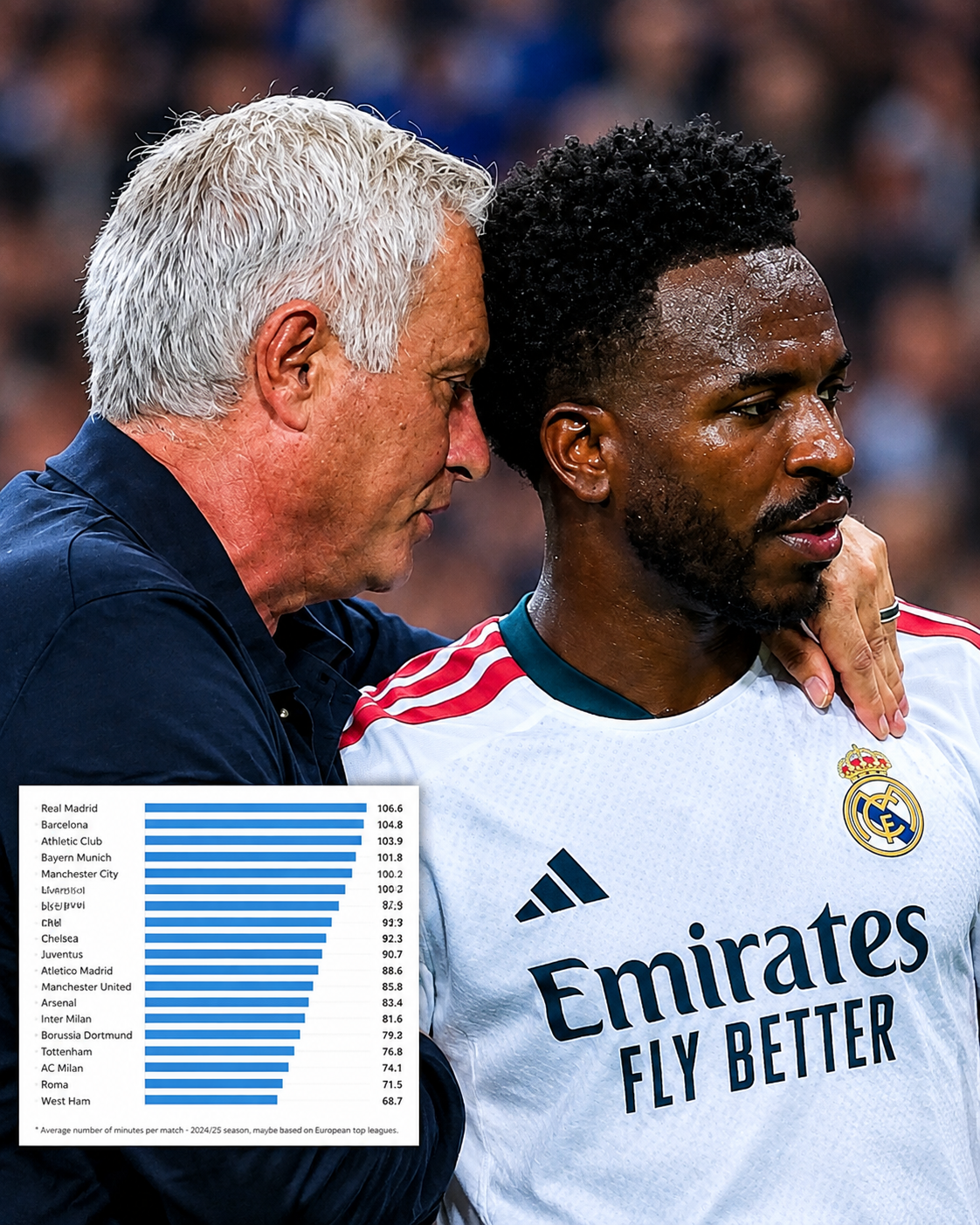
Back to that data point that started this whole conversation. Real Madrid ranking last in distance covered per match is the kind of statistic that invites obvious jokes, but it also raises real questions about intensity, fitness, and tactical approach under the new coaching setup.
A change in manager was supposed to bring a shift in mentality, discipline, and commitment. Instead, the underlying physical output numbers suggest business as usual.
It is worth noting the nuance in these figures, since raw distance covered does not always tell the whole story. Barcelona, for instance, is not the team that runs the most either, largely because they dominate possession, and teams with more of the ball naturally cover less distance in certain phases of play. But there is an important distinction between holding the ball and refusing to run. Creating space and shaking off markers requires movement, off-ball runs, players constantly repositioning to stretch the opposition. Simply standing still with possession is not the same thing as controlling a match through intelligent running.
One surprising name near the top of the list is Elche, a club currently struggling near the relegation zone. On paper, it might seem odd that a struggling side is out-running the traditional powerhouses, but it is a reminder that these numbers do not differentiate between running with the ball and running without it, and context always matters when reading raw data like this.
Mourinho’s Patience Reportedly Running Out
The most eye-catching headline of the day, though, came from journalist Alberto Pereiro, who reported that Mourinho has effectively given the current situation a deadline: he will tolerate things as they are until the upcoming international break, and after that, he intends to start making decisions of his own.
According to the report, the manager is not the one under real scrutiny internally. Instead, the primary player under the microscope is Vinicius Júnior.
There is reason for healthy skepticism here, and it has nothing to do with doubting Mourinho’s frustration; it has everything to do with the source. This is the same reporter who, over the summer, confidently claimed that Rodri would be joining Real Madrid and would even wear the number 16 shirt. That transfer never happened. He is also the same journalist who claimed, back in May, that Real Madrid’s first major summer signings would be Florian Wirtz and Rodri, a claim that did not hold up either.
None of this means the current report is automatically false. It simply means it deserves to be treated with caution rather than accepted as gospel, especially compared to information coming from more established, consistently reliable transfer journalists.
That said, there is a logical case to be made for why this specific claim could turn out to be accurate, even without insider information. If Mourinho was effectively instructed to integrate Vinicius gradually, benching him at times and managing his role delicately as a kind of directive from ownership, and that approach has not produced results, it stands to reason that at some point Mourinho reasserts control. Managers in his position, with his history, tend to reach a breaking point where they insist on doing things their own way rather than functioning as someone else’s instrument.
Whether that breaking point arrives right after this international break, or waits until after the Clásico, is almost beside the point. The larger trend, a manager growing tired of external interference, tends to follow a predictable arc regardless of the exact date attached to it.
A Deeper Problem Than Any Single Result
Strip away the noise around referees, transfer rumors, and running statistics, and there is a more fundamental issue at the heart of Real Madrid’s early season: consistency, or rather, the lack of it.
This is not a team complaining about one unlucky loss to a fierce rival, or one match where they created thirty chances and simply did not convert. The frustration stems from a broader pattern of underwhelming performances, masked at times by individual moments of brilliance rather than collective control of matches.
Two results this season have felt genuinely convincing: a strong win against Levante and another impressive performance against Real Sociedad. Both times, there was a sense that this Real Madrid side finally looked like it was clicking into gear. And both times, the warning was the same: enjoy it, but do not get carried away, because the real test is whether that level can be sustained.
It could not be. This is essentially the same critique Xabi Alonso voiced last season about this squad’s lack of consistency, and Mourinho’s arrival has not solved that underlying issue. A team without consistency does not win a league title, no matter how talented the individual pieces are.
Look closely at recent results and a clear pattern emerges. Without a string of individual moments of quality, Real Madrid’s record over the past few weeks would look considerably worse than it does. A win over Elche, for example, came down to a well-executed sequence, a clever pass into space finished off calmly, hardly a dominant defensive or tactical statement. A win over a domestic opponent came via a deflected goal, not exactly the mark of a team playing with total control.
Relying on a deflection to secure a result is not sustainable. A squad with this much individual talent should not need to lean on good fortune to get results against mid-table opposition.
What Actually Needs to Change
The solution being floated is not particularly complicated, at least in theory. The intensity, pressing, and urgency this team has occasionally shown against Barcelona or Athletic Club needs to become the baseline standard against every opponent, not an exception reserved for the biggest occasions.
Consistency is built through habits, not moments. It comes from applying the same pressure against Levante, Betis, and Elche that gets applied against direct rivals. So far, that level of application simply has not been there on a game-to-game basis, and that inconsistency is the real root of the current turbulence, far more than any single refereeing decision or running statistic.
Where This Leaves Things
For now, all of this circles back to one central, unresolved question: will Mourinho actually take the decisive action being reported, particularly regarding Vinicius, once the international break concludes.
Given the source’s uneven track record on previous reports, there is legitimate reason for skepticism about the specific details and timing. But there is also a broader, more grounded logic suggesting that some kind of reckoning is coming, whether it lands immediately after this break or gets pushed back until after the Clásico itself.
Between the running statistics controversy, Atlético’s selectively convenient stance on referee criticism, and the swirling uncertainty over Mourinho’s next move, Real Madrid finds itself at the center of an unusually chaotic stretch, and none of it involves what is actually happening on the pitch during ninety minutes of football.
The next several weeks, culminating in that October 25th trip to Camp Nou, will go a long way toward determining whether this version of Real Madrid can finally find the consistency that has eluded them, or whether the noise around the club continues to overshadow the performances themselves.









