Are You Thinking What I’m Thinking?
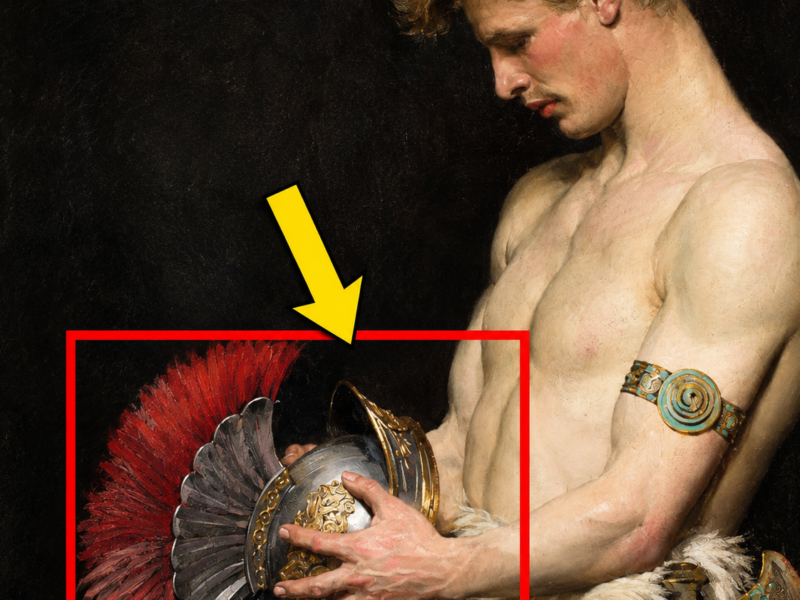
A young man stands in the dark, shirtless, with a white fur slung around his hips and an axe hanging from his belt. In his hands, he holds a Roman soldier’s helmet, polished silver with gold all over it and a big red plume sticking out the back. He stares down into it as if it’s the most important thing he has ever held.
Now look at where he’s holding it. Look at the height.
Yes, you’re thinking what I’m thinking. Everyone thinks it. It’s pretty much the only thing anyone ever says about this painting, and that’s exactly where almost everyone gets it wrong. There’s another detail the crowd casually ignores, one people mention only to complain, and once you see what it actually means, the painting stops being funny.
It’s called Germanic Warrior with Roman Helmet, painted around 1902 by a German artist named Osmar Schindler. That’s Osmar, not Oskar, and no relation. He was a respected professor at the Dresden art academy who painted landscapes and historical myths, which makes a funny contrast with the vibe of this particular canvas.
So let’s deal with the obvious part first. Look at him: rosy cheeks, bright red lips that are nearly lipstick red, and veins standing out on the back of that hand. And then there’s the helmet, right where it is.
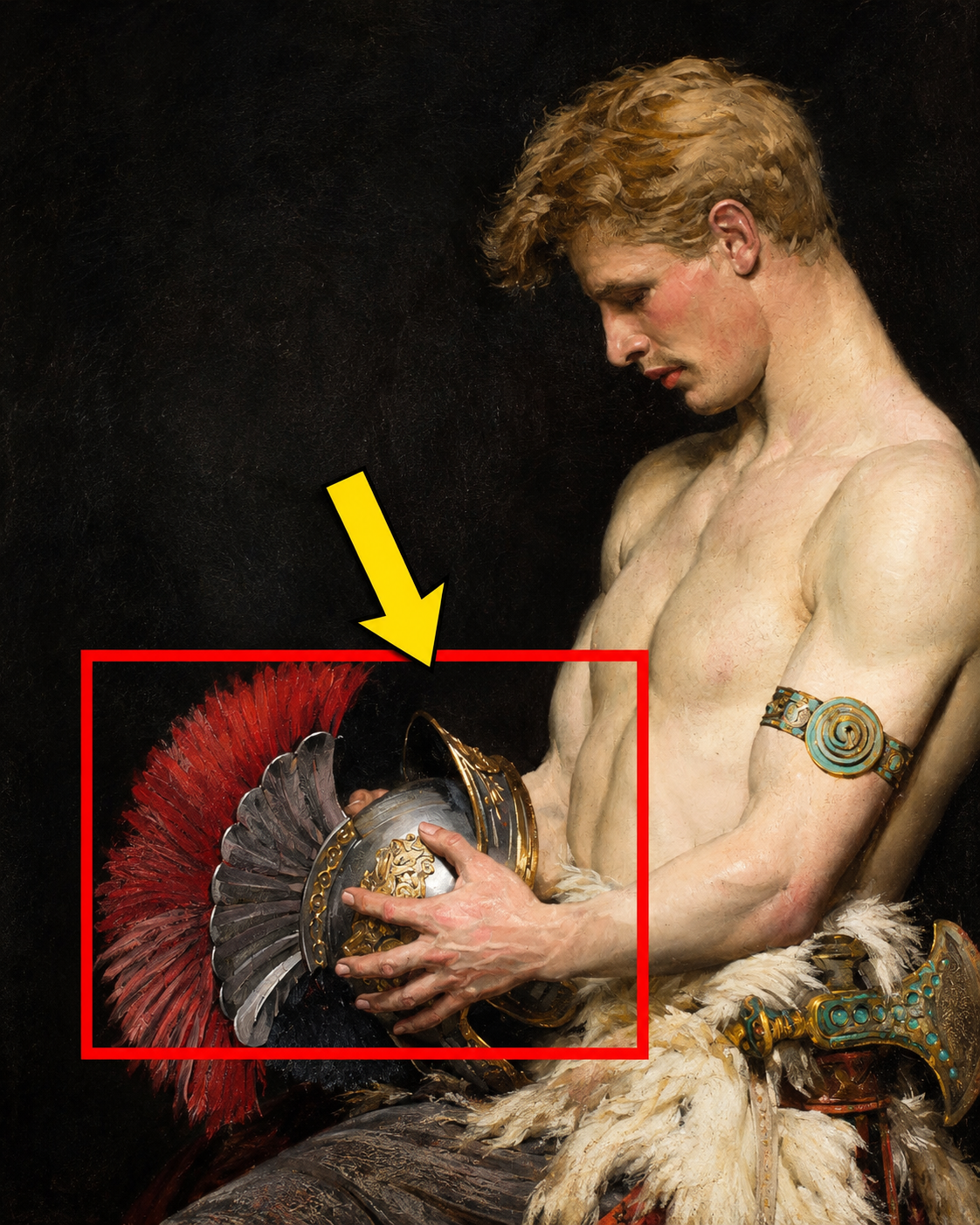
Plenty of viewers decide on the spot that the painter wasn’t exactly straight, and that he slipped this one past the censors. For what it’s worth, Schindler was married with two sons, though that doesn’t prove much either way. Did he know how the helmet looked? Many would say absolutely, since you don’t teach painting for a living and place something at that height by accident. Others insist it’s a coincidence of pose and a modern mind in the gutter. Either way, the gag may be a distraction.
Because who is this guy, exactly? He’s supposed to be a warrior from the forests of ancient Germany, two thousand years ago, and he’s spotless. There’s not a scratch on him and not a speck of mud. The axe rests right under his elbow.
But look at the green crust on that axe and on the band around his arm. That’s what bronze looks like after centuries in the ground. They appear to have been copied from ancient finds that were already old news by the time the Romans showed up. It’s a bit like outfitting a modern British soldier with a sword from the Wars of the Roses.
This was never meant to be a real person. It’s a fantasy, and in 1902, Germany badly needed one. The country was only about thirty years old, and it was hunting for heroes.
The one it picked came from the year 9 AD. Rome was the world’s superpower back then. A young chieftain named Arminius had been raised by the Romans, made a Roman citizen, and served as an officer in their army. The Roman general in Germany trusted him completely.
Big mistake. Arminius led three entire Roman legions into a forest ambush and wiped them out. Something like fifteen thousand men were gone in a few days. When Emperor Augustus heard the news, he is said to have banged his head against the palace walls, shouting, “Varus, give me back my legions!”
Rome’s push into Germany pretty much ended right there. Nineteen centuries later, Germans renamed the chieftain Hermann and turned him into a national superhero. They built a giant statue of him on a hilltop, sword raised, facing France.
So when viewers in 1902 saw a young blond warrior holding a Roman helmet, they knew exactly what they were looking at: young Germany, holding the head of Rome. And we all know where that kind of thinking led a few decades later.
The thing is, he doesn’t look like a winner, does he? If this is a victory picture, why does he look like that? He isn’t smiling, and he isn’t holding the helmet up for anyone to see. His eyes are lowered and his cheeks are burning.
He handles the helmet so carefully, fingers spread across it, the way you’d cradle someone’s face. Some viewers think it belonged to someone he loved. Others read it as shame. Even the person telling this story admits to changing their mind more than once.
And those flaps hanging down at the sides? They’re cheek guards. Not long ago, they were pressed against somebody’s jaw.
Which brings us to the detail everyone complains about: the haircut. Every time this painting gets posted online, someone points out that he looks like he just walked out of a barbershop in 1950. There’s zero facial hair, just a clean face and a tight cut.
And to be fair, critics have a point. These were supposed to be wild men from the woods. The Romans who wrote about them described some tribes twisting their long hair into knots. So why on earth would Schindler give his warrior a fresh trim?
One of those Roman writers was a man named Tacitus. Nearly a hundred years after the ambush, he wrote a short book about the Germanic tribes, and by 1902 it was a huge deal for German nationalists. Schindler would very likely have known it.
Did he have the next part in mind? Nobody can prove it, and skeptics will say the haircut is simply Victorian-era taste. But it’s right there in the book.
Tacitus describes a tribe called the Chatti, who fought Rome for generations. When a Chatti boy became a man, he let his hair and beard grow wild and swore not to cut them. Not for anything. Not until he had killed his first enemy.
Then, standing over the body with the dead man’s gear in his hands, he finally cut it all off and showed his face again. And the ones who never managed it? Tacitus says the cowards stayed shaggy their whole lives.
So look at him one more time. Fresh haircut. Bare face, still flushed.
He isn’t admiring a souvenir. He’s looking at the first man he ever killed.









