Another Proof That Leonardo da Vinci Was a Genius
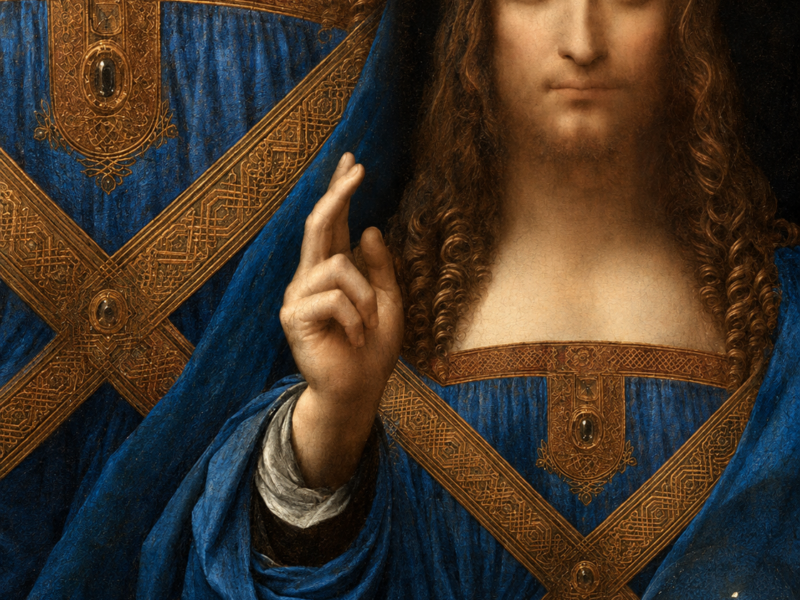
The painting is called Salvator Mundi. Leonardo da Vinci is said to have painted it around the year 1500, and today it holds the record as the most expensive painting ever sold.
In 2017, it was bought for $450 million, turning a Renaissance artwork into a global headline. Yet the real fascination has little to do with the price.
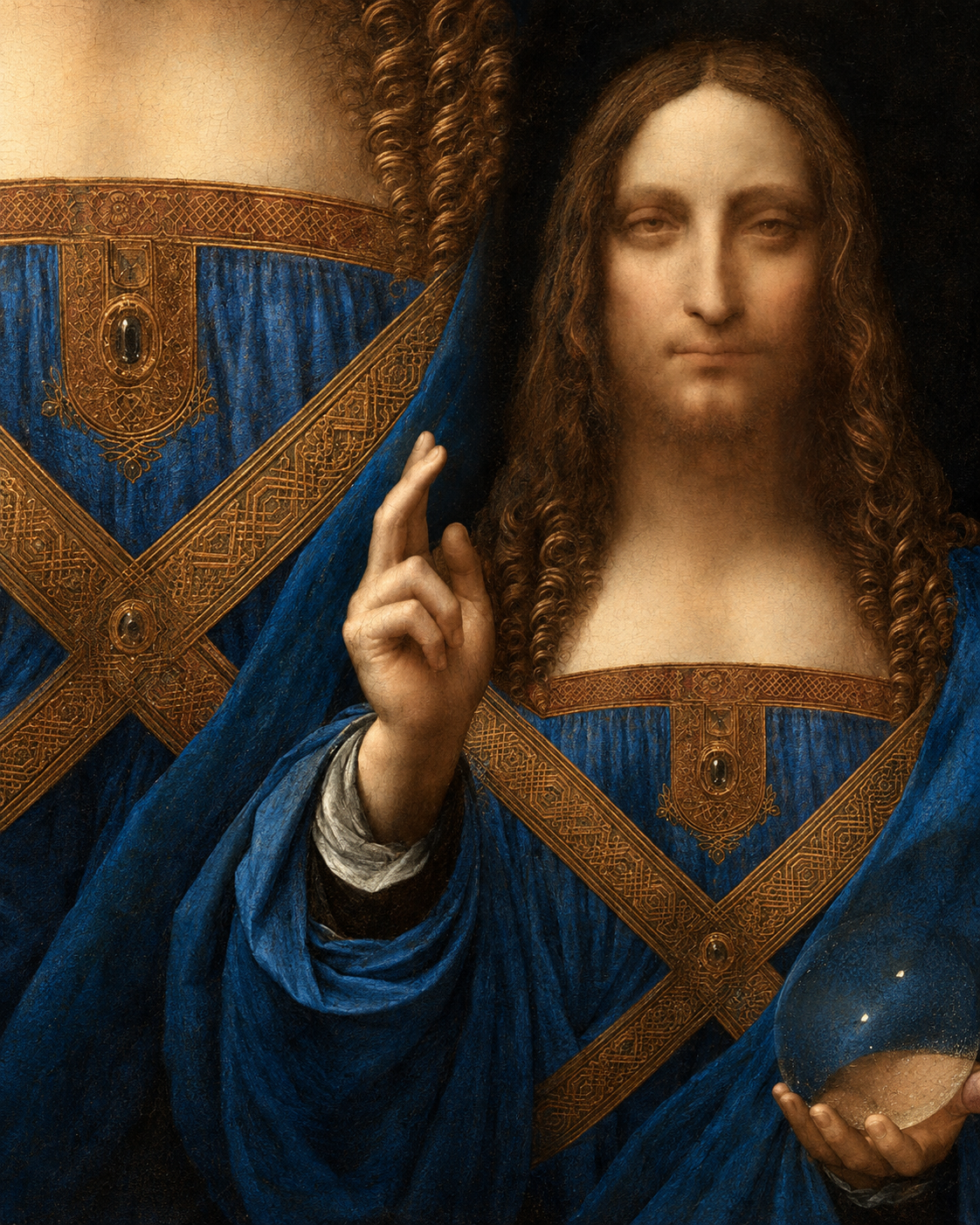
What draws attention is a small transparent orb held in Christ’s left hand. Hidden inside that orb, some argue, is a mystery that may be among the clearest signs of Leonardo’s genius.
At first glance, the orb seems completely ordinary. Leonardo painted it with extraordinary care. Light reflects from its surface, and tiny imperfections hang suspended within it.
The object looks so real it almost feels touchable. Everything about it suggests the artist was carefully studying an actual crystal sphere while he worked.
But the longer you study it, the stranger it becomes. The folds of Christ’s robe can be seen through the orb, and they look surprisingly normal. They are not dramatically bent, compressed or distorted the way we would expect.
That might sound like a small point, but it matters the moment you try a simple experiment. Pick up a glass marble, a crystal paperweight or any transparent sphere and look through it.
The world behind it changes. Objects become distorted, because light bends when it passes through curved transparent material. It is one of the most basic principles of optics.
For centuries, many historians believed they had the answer: Leonardo had made a mistake. The explanation was simple, sensible and easy to accept. Even great artists make errors.
Perhaps he cared more about symbolism than physics. Perhaps he chose beauty over accuracy. The theory became widely accepted because many assumed it was the only reasonable explanation.
The trouble starts with an uncomfortable question. Was Leonardo really the kind of person who would make this particular mistake?
The question matters because Leonardo was no ordinary painter. Most artists of his time focused on appearances. Leonardo was driven by understanding.
When he painted the human body, he studied anatomy. When he wanted to understand movement, he studied water. When he grew interested in flight, he watched birds. Again and again, he refused to stop at the surface of things.
The same pattern shows up in his study of light. Leonardo spent years investigating shadows, reflections, perspective, transparency and vision itself. His notebooks contain diagrams exploring how light behaves on different surfaces.
He examined how images change when seen through curved materials. He was fascinated by the relationship between reality and perception. Long before optics became a formal science, he was asking questions that sound strikingly modern.
That is what makes the orb hard to dismiss. It is not painted carelessly. Leonardo clearly gave it attention. He rendered its reflections and painted subtle internal details, capturing its physical presence with remarkable precision.
Supporters of the “mistake” view have an answer: a painter can be brilliant at some details and still get the physics of a sphere wrong, or simply bend the rules for the sake of the composition. Skeptics of that view reply that it requires believing he caught dozens of subtle optical effects while somehow missing the most obvious one.
As researchers kept studying the painting, another possibility emerged. What if the orb was never meant to be a solid crystal ball at all?
In 2019, a group of researchers suggested that the orb could be hollow rather than solid. If that were true, the expected distortion would be greatly reduced.
Suddenly, the mystery looked different. What generations had read as an error could potentially be understood as a deliberate choice: an orb painted as a thin shell containing space rather than mass.
From there, the account takes a bolder step. The object the orb is traditionally understood to represent, it says, is not a glass ball but the celestial sphere, the heavens, the entire cosmos held in the palm of a single figure.
Think about what that would mean, the argument goes. The universe does not behave like solid glass. At the largest scales, space does not refract, invert or compress what it contains. It holds everything within it without altering it.
Physicists today describe this in terms of the large-scale structure of space-time, using mathematics and instruments Leonardo could never have imagined. And yet, the account notes, he painted something similar with a brush around 1500.
On a walnut panel the size of a large book, the tiny flecks of light suspended inside the orb have been read by some scholars as stars, points of light held in a sphere that does not follow the rules of the physical world because it is the world.
This is the most speculative part of the story, and it deserves caution. There is no known written statement from Leonardo linking the orb to modern ideas about space-time, and many art historians see that link as a modern projection rather than something the painter intended.
Leonardo left no written explanation for the orb. He rarely explained his choices directly. What we do know is that the painting vanished from the records shortly after his death.
It later passed through the English royal collection and was auctioned in 1763. By 1900, it was misattributed to a minor follower and forgotten. In 1958, it sold for 45 pounds.
In 2005, a group of dealers found it at an estate sale in New Orleans and paid 1,175 dollars. Under layers of overpainting, they say, Leonardo’s hand was still there: the soft sfumato, the fingerprints pressed directly into the paint.
Not everyone accepts that attribution. Some scholars argue that the work is largely the product of Leonardo’s workshop, or heavily restored, while its owners’ champions and many experts maintain it is his.
The painting that would sell for $450 million had been sitting in an estate sale, unrecognized, for centuries. It is now widely reported to be in Saudi Arabia, held privately and unseen by the public, though that location has never been officially confirmed.
The most expensive painting in history, containing a detail that some say points toward an understanding of the universe the rest of the world would not reach for four more centuries, sits in a private collection where almost no one can see it.
If the account is right, Leonardo painted a sphere that should not exist. He painted it with full knowledge of why, and placed it in the hands of the one figure who, by definition, is not bound by the rules that govern the rest of us.
Did Leonardo arrive at this deliberately, working through the physics of what the cosmos actually was? Or do some things simply pass through a painter’s hand without him ever fully knowing their source?
The debate is far from settled, and the orb, small as it is, keeps it alive.









