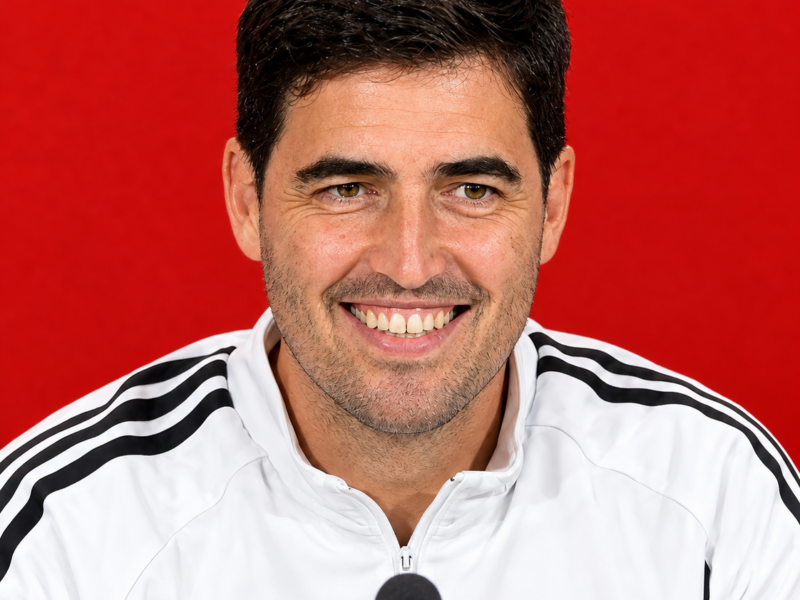
Andoni Iraola Breaks His Silence Before Liverpool vs Tottenham: The Brutal Truth About Rotation, Alisson’s Future, and the Midfield Problem Nobody Wants to Talk About
There is a specific kind of quiet that settles over a press room when a manager refuses to give you the answer you came for.
Not hostility. Not evasion. Something closer to a man politely declining to play a game whose rules he never agreed to in the first place.
That was the mood at Liverpool’s training ground on Monday afternoon, when Andoni Iraola sat down in front of a room that wanted a headline and gave them a philosophy lesson instead.
The question seemed harmless enough. Where does the League Cup rank? How important is it, really, in the grand sweep of a season that already includes a Premier League title chase and a Champions League campaign?
Iraola did not hesitate.
“It’s not about ranking the competition,” he said. “It’s a different competition.”
And with that single sentence, the Spaniard quietly dismantled one of English football’s most tired conversations.
Because here is the thing about ranking trophies before you have won any of them. It assumes a certainty that no manager on earth actually possesses.
“I’m sure if you ask, you would prefer to win the Champions League game or the Premier League game,” he continued. “But there is no guarantee that if you rotate, or if you rest, you are going to win the next one in the Premier.”
Read that again, because it is the closest thing to a manifesto Iraola has offered since he walked through the doors at Anfield this summer.
There is no guarantee.
The Myth of the Saved Game
Every fan has done the mental arithmetic at some point. Rest the big names in the cup, bank the energy, cash it in on Saturday.
It sounds like sound economics. It is also, more often than not, complete fiction.
Football does not work like a savings account. You do not deposit ninety minutes of Virgil van Dijk on a Tuesday and withdraw three points on a Sunday with interest.
Sometimes you rest half the team and lose anyway. Sometimes you play everyone and win twice. The variables are too wild, the sample size too small, the margins too thin.
Iraola knows this better than most, because he spent three years at Bournemouth turning an unfashionable squad into one of the most feared pressing teams in the country with a fraction of Liverpool’s resources.
“At the end, we want to win the game,” he said. “We want to play well, and that’s what we are going to try tomorrow.”
No hedging. No pre-emptive excuse buried in the answer for later retrieval.
It is a small thing, but it matters. Liverpool have spent the last eighteen months listening to explanations. They are now being handed intentions instead.
Three Games in Six Days and the Number That Terrifies Every Coach
The second question cut closer to the bone, and Iraola’s answer was the most revealing thing he said all afternoon.
Liverpool played Atletico Madrid on Wednesday night. They played Fulham on Saturday. They play Tottenham on Tuesday.
That is three matches inside six days, with the third one arriving on legs that have already been asked to do too much.
“It has to affect, definitely,” Iraola admitted, when asked whether the workload would shape his team selection. “The third game is the worst scenario.”
He did not dress it up. He did not pretend the squad was fresh.
Then he did something managers rarely do in public. He explained the actual mechanics of the problem.
“After this one we have a little bit more before we play Bournemouth. Also we had a little bit more between the Atletico Madrid game.”
And then the detail that should be printed on the wall of every fixture-scheduling meeting in English football.
“If it’s four or five days, in comparison to two or three days, it’s a massive difference. But it is what it is.”
Four or five days versus two or three. That gap, invisible to anyone watching on television, is the difference between a player who can press for ninety minutes and a player whose hamstring gives out in the seventy-fourth.
It is the difference between the team that beat Atletico and the team that could not break down Fulham.
The Fulham Hangover
Which brings us to Saturday.
Anfield, a 3pm kickoff, a Fulham side who had arrived having lost their opening three matches and shipped seven goals in the process.
Ninety minutes later, the scoreboard read 0-0, and the ground emptied with the particular grumble of a crowd that has just watched a heavyweight throw jabs at fresh air.
It was, by some distance, the flattest performance of Iraola’s short reign. And he was asked, bluntly, whether it had been the most frustrated he has felt since arriving.
“Probably the most frustrated, yes.”
No qualification. No attempt to reframe a bad day as a learning experience.
“The previous ones were very good. We were coming from winning two games in the same week, and we wanted to continue that line, win the third one, and be pushing, looking forward.”
“And it was a step backwards.”
Then the sentence that will sting, because it is the one thing Liverpool cannot afford to be.
“We were not good enough, especially offensively.”
A Squad Worth Half a Billion, Struggling to Score
Consider the absurdity of that statement for a moment.
This is a Liverpool attack containing Alexander Isak, Florian Wirtz and Bradley Barcola, a front line assembled at a combined cost that would fund several clubs outright.
Against Atletico Madrid, all three started the same match, a first in the club’s history for a trio in that price bracket. Anfield roared. Alexis Mac Allister smashed in a winner from the edge of the box. The Champions League night everybody had been waiting for finally arrived.
Seventy hours later, the same group could not fashion a clear chance against a team that had conceded seven times in three games.
Football is a cruel and hilarious sport, and nothing illustrates it better than that swing.
Iraola, to his credit, did not reach for the tiredness excuse, even though it was sitting right there in front of him.
He acknowledged it. He refused to hide behind it.
“This Happens in Football”
The follow-up question was about patience. About whether the frustration in the stands needed tempering, given how little time he has actually had with his full squad.
His response was the answer of a man who has done this before at a smaller club, without the scrutiny, and knows exactly how the curve bends.
“I understand the frustration the other day, because we were also frustrated.”
That word, also, is doing quiet, important work in that sentence. It places him inside the disappointment rather than above it.
“We were coming from two good games. We were thinking, okay, this is a step forward, this is a step forward against Atletico Madrid, and we wanted it to be step forward, step forward.”
“And then it’s a step backwards.”
Then the shrug that was not a shrug.
“This happens in football. I think we have to accept there are going to be ups and downs in this process.”
But he was not finished. Because acceptance without direction is just surrender, and Iraola made sure to plant the flag.
“We are clear about where we want to go. It is more towards where we’ve been, that kind of style, that kind of football that we want.”
“Now the key is the consistency to perform like this.”
Consistency. The word that has haunted Anfield for the past year, spoken now like a target rather than an accusation.
The Goalkeeper Question Everybody Was Waiting For
Then the room shifted, the way press conferences do when somebody finally asks the thing everyone has been circling.
Will you change the goalkeeper tomorrow?
“Yes.”
One word. No preamble. Georgi Mamardashvili starts against Tottenham.
And then the more delicate part. What exactly does the goalkeeping situation look like at Liverpool right now, with Alisson Becker in the final year of his contract and an expensively acquired Georgian understudy waiting in the wings?
Iraola’s answer was a small masterclass in saying two generous things at once without letting either undercut the other.
“I think there are little doubts with Ali. He’s proven, he’s playing very well.”
That is the foundation laid. The Brazilian remains the man in possession, and the manager is not about to destabilize a goalkeeper who has been one of the few consistently reliable figures in a turbulent eighteen months.
Then the pivot.
“I also rate Georgi very highly. I know him from his years in Spain.”
And here came the detail that nobody in the room saw coming.
“We Tried to Sign Him for Bournemouth”
“I told him,” Iraola said, “we tried to sign him for Bournemouth, before I came here.”
Sit with that for a second.
Before Liverpool, before the Champions League nights and the half-billion-pound squad, Iraola was on the south coast trying to convince his recruitment department that a young goalkeeper from Valencia was worth the gamble.
He did not get him. Liverpool did. And now, by the strangest turn of fate, the man who wanted him has inherited him anyway.
“For me he’s a very good keeper,” Iraola said. “And he’s going to start tomorrow.”
There is something genuinely satisfying about that circle closing at Anfield on a Tuesday night, in a competition the manager refuses to rank.
For Mamardashvili, it is an audition in front of a Premier League opponent rather than a lower-league one. That distinction matters enormously. Nobody builds a reputation by keeping clean sheets against League Two attacks.
Tottenham will test him. That is the point.
Joe Gomez Is Back, and That Matters More Than It Sounds
Asked whether Joe Gomez was fit, Iraola offered a cautious yes.
“He’s training with the team. I think he’s going to be available for tomorrow. Now it’s a matter of deciding how much he can play, or what’s the best thing to do.”
That last clause is where the real management happens.
Available is not the same as ready. Ready is not the same as ninety minutes. And with a defender whose recent career has been a long negotiation with his own body, the difference between forty-five minutes and sixty could define the next two months.
Gomez has been at Liverpool long enough to have played under three managers, won everything there is to win, and spent an unfair share of it watching from a treatment table.
In a squad currently missing bodies at the back, his return is not a headline. It is oxygen.
The Long Road for Bradley and Leoni
The injury news elsewhere was more sobering.
Conor Bradley, whose absence has been felt keenly down the right, is not close.
“He’s not close to training with the team,” Iraola said. “He’s training alone, but he has started touching the ball. Definitely I want him as quick as possible, but these are long-term injuries.”
Then the comparison that sets the timeline.
“Leoni is a little bit ahead of him, and still it’s going to take some time for Conor.”
Giovanni Leoni ahead of Bradley, both still weeks away, both in that purgatory of individual sessions and cautious progress reports.
For a manager whose entire system depends on aggressive full-backs and relentless recovery running, losing that profile of player is not a minor inconvenience. It is a tactical amputation.
Which brings us back to the rotation problem, and the reason Iraola spent so much of his press conference talking about bodies rather than tactics.
“You Can Play the Same Eleven. Then They Break.”
Asked whether facing Premier League opposition made it impossible to rotate as heavily as he might like, Iraola gave the most complete answer of the afternoon.
“You can decide and put the same players every game,” he said. “The problem is there is going to be a moment where they are going to be very tired, and there is more risk of injury.”
Then he immediately complicated his own point, which is what honest people do.
“That’s why we cannot say it doesn’t work for anyone. There are players who play every three days and they have no issues. They are very robust. They can accept it. Their performances don’t change too much.”
“And there are other players where the risk is bigger, and the performances are different.”
This is the part of elite management that never makes the highlight reel. Not formations. Not pressing triggers. Just the unglamorous, endless, deeply personal business of working out which human beings can be asked to do what, and how often.
Learning Bodies One Player at a Time
“We are in an approach where I have to learn who is ready to play three or four games in a row every two or three days,” Iraola said, “and who needs a rest so the performance level doesn’t get affected.”
“I think I have it quite clear in my mind with some of them. But with others, it is new even for them, because they haven’t played as many games. And we are learning.”
Then he named names, or as close to it as he was willing to go.
Take Jeremie Frimpong, a player whose explosive style is perfectly suited to Iraola’s demands and whose body has never been asked to sustain it at this frequency.
“If you ask me how a new player like Jeremie is going to deal with playing every three days for two months, I don’t know,” Iraola admitted. “Because he hasn’t done it.”
“So we are in territory where you have to talk to the players, feel how he recovers.”
Compare that to the certainty he has elsewhere.
“We have other players with experience who have done it. I know they can do it. Virgil can do it, because he has done it before. We have the experience. He has performed, and his performance level doesn’t get so affected.”
Van Dijk, the metronome. Frimpong, the unknown quantity.
“With the younger ones, with the ones coming from abroad, there are more question marks,” Iraola said. “For them, for me, for everyone. We will have to be studying case by case.”
Case by case. Not a system, not a formula, not a sports science spreadsheet handed down from above.
Individual attention, applied relentlessly, in a season that offers almost no time for it.
The Depth Question, Answered With a Warning
Inevitably, somebody asked the question that hangs over every club juggling four competitions. Is this squad big enough?
Iraola’s answer began as a defense and ended as a piece of hard-won wisdom about the nature of football discourse.
“I’m very happy with the squad. I value my players a lot.”
Then the twist.
“If we win games, the squad will look amazing and fantastic. If we don’t win, there are going to be problems. If it’s not the depth, it’s going to be whatever.”
If it’s not the depth, it’s going to be whatever.
That line deserves to outlive the press conference. Because it is the most accurate description of modern football criticism anyone has offered in months.
Win, and the bench is a luxury. Lose, and the same bench becomes evidence of negligence. The players do not change. Only the scoreboard does.
Iraola has clearly been around long enough to recognize the pattern and refuse to be governed by it.
“You Will See Players You Haven’t Seen Yet”
But he did not end on cynicism. He ended on a promise, and it was the most intriguing thing he said.
“I think we will see tomorrow players that we haven’t seen still. And I’m really looking forward to it, because I feel they are going to play well, or they can help us, and they probably still haven’t had the chance.”
Players we haven’t seen. At Anfield. Against Tottenham. In a competition with real stakes.
For a squad this deep, that is not a throwaway line. It is a casting call.
Somewhere in that dressing room is a young player who has spent six weeks training well, watching from the bench, waiting for exactly this fixture. Iraola has just told the world he intends to hand them the ball.
Tuesday nights in the League Cup have launched Liverpool careers before. Trent Alexander-Arnold made his debut in this competition. So did a long line of names who went on to matter enormously.
The cup that nobody wants to rank has a habit of producing the players everybody eventually celebrates.
The Duel Problem: Three From Fourteen
Then the conversation turned technical, and this is where Iraola was at his most compelling.
A reporter raised a statistic from the Fulham match that has been circulating uncomfortably. The starting midfield won three of fourteen ground duels.
Three from fourteen. For a team built on winning the ball back, that number is not a blemish. It is a structural failure.
Iraola did not dispute it. He did something far more interesting. He reframed it.
“Comparing to the previous games, I think we won the ball a lot lower in the pitch.”
“So every time, sometimes it happens, we didn’t concede a lot. The only big chance we conceded was our goal kick that we messed up. After that we defended well. But we were recovering the ball always very low.”
And here is the chain reaction that follows.
“When this happens, you have to attack always against eleven players. And it’s more difficult to make the difference.”
Why the Height of the Press Decides Everything
This is the heart of Iraola’s football, and it explains why the Fulham performance looked so laborious despite the talent on the pitch.
“The previous games, I think we were able to win it a lot higher, and then use our quick transitions, attack against fewer players, use the space better.”
Winning the ball fifty yards from the opposition goal and winning it fifteen yards from your own are not variations of the same action. They are entirely different sports.
One produces a three-on-two with defenders scrambling backwards. The other produces a ninety-yard march into a set defense with ten men behind the ball.
“This is key in our system,” Iraola said. “We need to recover the ball as high as possible, because it makes the offensive side a lot easier.”
“The situations to attack against one v one, or against fewer players, they are bigger than if you recover the ball always in your half of the pitch.”
Against Fulham, Liverpool recovered it low. And so a front line worth more than the GDP of a small nation spent the afternoon playing a game of pass-and-move against a packed penalty area.
The duels were not lost because the midfielders were weak. The duels were lost in positions where losing them was almost inevitable.
“It’s Not Just the Midfielders”
Pressed on whether this is something that can be coached, given that duel numbers have been a nagging issue at the club for some time, Iraola offered the longest and most thoughtful answer of the day.
“I said it and I accept it, and I agree with what he said,” he began, acknowledging the criticism head-on rather than deflecting it.
“But it’s not a matter of just the midfielders. For me it’s something more collective than the midfielders.”
Then the evidence.
“When we’ve been good collectively, the midfielders have looked a lot better and have recovered more balls and won more duels.”
“But it’s not just because they are winning duels. It’s because they’ve played better as a team. It’s because we are helping them more to win the duels.”
The Defender Analogy That Explains Everything
And then came the illustration that should be shown to every young coach learning the game.
“It’s like the defenders,” Iraola said. “Defenders, if the ones up front are doing their job very well, look very good, because all the balls that arrive, they arrive not clean.”
Not clean. Two words that contain an entire defensive philosophy.
A cross delivered by a winger under pressure arrives at a slightly wrong height, a fraction behind the striker, with a little too much pace. The center-back wins it comfortably and looks imperious.
The same center-back, facing the same cross delivered by an unpressured winger with time to pick his spot, ends up in the highlights for all the wrong reasons.
“If we are allowing them to defend one v one all the time, being comfortable on the ball, and we are not aggressive, our defenders will also struggle,” Iraola continued.
“When the players in front of you are doing this job, you look a better defender, you look a better midfielder, you win more duels, because they are easier duels.”
“The ball arrives, but it arrives not in the best condition, and then you have more chances to win the duel.”
“Everyone Looks Better When the Team Plays Well”
He finished with a rejection of the transfer-window mentality that dominates so much analysis.
“It’s much more collective than just thinking, I change this one for that one, so this one doesn’t win and the other one wins duels.”
“There is something more collective going on. That’s the help we have to give to our defenders, the help we have to give to our midfielders, so everyone looks better.”
And then the closing line, delivered with the flat certainty of a man who has built successful teams out of unfashionable parts.
“When the team plays well, everyone looks better. That’s why the key is that we all collectively play well. Then everyone looks smarter, looks better, looks like they are in a better position.”
“But it starts from the collective side for me.”
It is not the answer that sells newspapers. Nobody wants to hear that the solution to a midfield problem is better pressing from the forwards.
It is, however, almost certainly correct.
The Van Dijk Conversation He Would Not Reveal
There was one more topic, and it was handled with the door held politely but firmly shut.
Virgil van Dijk’s international future has been the subject of quiet speculation since the Netherlands appointed Xavi Hernandez as head coach, a move that made the Spaniard the first foreign manager of the Oranje in almost half a century.
Xavi and Van Dijk were reported to be meeting. Naturally, somebody asked whether Iraola knew what had been decided.
“Yes, I talked to Xavi. I talked to Virgil,” he said. “But these are private conversations, and it’s definitely not something that I can say.”
Then, the human detail that made it clear this is not a distant relationship.
“I know Xavi very well. He was here the other day watching our game against Atletico Madrid. We’ve been talking.”
Two Spaniards in English and Dutch football respectively, one of them managing the other’s captain, comparing notes at Anfield on a Champions League night.
Whatever was said, Iraola is not saying it. But the fact that the conversation happened at all tells you the decision about Van Dijk’s international career is being made carefully, by people who understand exactly what it costs.
What This Means for Tuesday Night
So what should we actually expect when Tottenham arrive at Anfield?
Changes. Confirmed at the goalkeeper position, strongly implied elsewhere.
Mamardashvili starts. Gomez returns in some capacity, with the length of his outing yet to be determined. Unfamiliar names will be involved, and Iraola has told us to expect them to be good.
There is also the small matter of Andy Robertson returning to Anfield in a Tottenham shirt for the first time since his summer move, which will produce the kind of ovation that makes even neutral observers feel something.
Spurs are not a soft draw. This is the exact type of fixture that punishes a rotated side whose new patterns have not yet hardened into instinct.
But that, arguably, is the value of it. Iraola will learn more about his squad in ninety minutes against Premier League opposition than in three months of training-ground sessions.
He said as much himself, in a different context. Case by case. Talk to them, feel how they recover, find out what they can take.
You cannot find that out from a laptop.
And Then Bournemouth
Sunday brings a fixture with its own particular flavor.
Liverpool travel to the south coast to face the club Iraola transformed, the club he left last summer after guiding them to their highest ever Premier League finish and a first ever European qualification.
He will walk out at a ground where he is adored, in the away technical area, managing the team he now serves.
There will be applause. There will also, almost certainly, be a Bournemouth side who know exactly how he wants to play and have spent three years learning it from him directly.
Iraola mentioned the extra recovery days before that match more than once on Monday. He clearly has it circled.
And beyond that, the schedule tightens again.
“After the international break we have this period. I think we are playing four games in nine or ten days, something like this,” he said. “So we have to get used to this.”
Four games in ten days. That is where the rotation questions stop being theoretical and start being existential.
The Bigger Picture
Here is what the Iraola era looks like five competitive matches in.
Unbeaten. Three Premier League draws, one league win, one Champions League victory. A points return that is underwhelming. A performance graph that is wildly inconsistent.
There have been passages against Atletico and stretches at Ipswich where the pressing has looked genuinely ferocious, the transitions sharp, the whole thing recognizably his.
There have also been afternoons like Saturday where a very expensive team looked like eleven strangers sharing a postcode.
Both are real. Both are normal. And anyone expecting a new manager with a new idea to install it flawlessly across a squad still absorbing significant summer change has not been paying attention to how football actually works.
Iraola’s great strength at Bournemouth was not tactical novelty. It was patience combined with absolute clarity. He knew exactly what he wanted, he repeated it endlessly, and eventually the players stopped thinking about it and simply did it.
That process took time there. It will take time here too.
The difference is that here, the clock is louder.
The Line That Sums It All Up
If you want the entire press conference distilled into one sentence, it came halfway through, almost in passing.
“If we win games, the squad will look amazing and fantastic. If we don’t win, there are going to be problems.”
Everything else, the rotation, the duels, the goalkeeper, the pressing height, the injured full-backs, the private conversations with a national team manager, exists in the space between those two outcomes.
Iraola knows it. He is not pretending otherwise.
What he is doing instead is refusing to take shortcuts. Refusing to rank competitions before he has earned the right. Refusing to blame his midfielders for a problem that starts with his forwards. Refusing to burn out a squad in September to buy three points he might not even get.
That is not a manager managing his reputation.
That is a manager managing a football club.
Tuesday night at Anfield, against Tottenham, with a changed goalkeeper and unfamiliar names in the lineup, we will find out whether the players are ready to back him.
Because as he said himself, when the team plays well, everyone looks better.
The inverse is also true. And at Liverpool, nobody gets long to prove which version they are.









