An Old Accordion Player Stopped Mid-Waltz When a Military Dog Began to Dance… Then the Truth About Their Shared Past Brought a Battle-Hardened Veteran to Tears
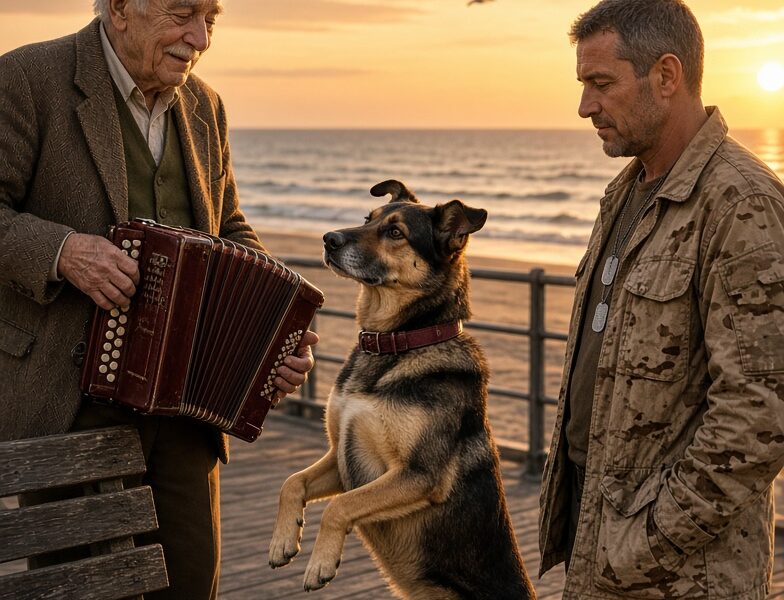
The old German Shepherd stood on his hind legs, his silver muzzle trembling as he danced to a forgotten waltz.
On the sunset boardwalk of Asbury Park, 80-year-old Llo Varga played his battered accordion for a handful of coins.
Then Tango, a retired military dog, began turning to the music, leaving his Navy SEAL owner, Nico Sarandos, speechless.
The old musician stopped playing, his eyes filled with tears.
But before Nico could understand why, a security officer stepped forward, threatening to silence the music forever.
What began as one dog’s impossible dance would uncover unfair penalties, a heartbreaking separation, and a secret buried 8 years in the past.
And when Nico finally discovered who had loved Tango first, even this battle-hardened veteran couldn’t hold back his tears.
The first time Tango danced, Nico Sarandos nearly dropped his coffee into the Atlantic Ocean.
That was strange enough.
What made it unforgettable was the expression on the old musician’s face.
For one brief moment, beneath the fading August sunlight, an 80-year-old stranger looked at Nico’s retired military dog as though someone had returned a piece of his life that had been missing for years.
But that moment came later.
The afternoon began with a broken wooden awning, a stubborn rusted screw, and a man who had forgotten what it felt like to look forward to tomorrow.
At 49, Nico Sarandos had become very good at fixing things that other people considered beyond repair.
Old porch railings, warped deck boards, window frames swollen by years of salty air.
People around Asbury Park knew him as the tall, quiet carpenter who showed up on time, worked without complaining, and rarely stayed long enough to accept an invitation to dinner.
He stood 6’4″ tall with broad shoulders, powerful hands, and the weathered bearing of a man accustomed to demanding work.
His dark, closely cropped Caesar haircut was threaded with silver near his left temple.
Short salt-and-pepper stubble shadowed his square, slightly uneven jaw.
His dark hazel eyes seldom revealed much.
That afternoon, he wore a faded desert camouflage uniform jacket in shades of sand, brown, and olive over a dark olive t-shirt.
Matching camouflage trousers and worn coyote brown boots completed his familiar appearance.
Two silver military dog tags rested against his chest.
Once he had worn similar clothing with purpose and pride; now it simply felt comfortable.
He worked carefully beneath the awning of a small souvenir shop, tightening the last screw with his left hand while his right shoulder complained.
“Almost finished,” he muttered.
Below him, Tango lay in a patch of shade.
The 8-year-old German Shepherd lifted one ear.
“Talking to the screw, buddy. Not you.”
Tango lowered his head again.
Nico smiled despite himself.
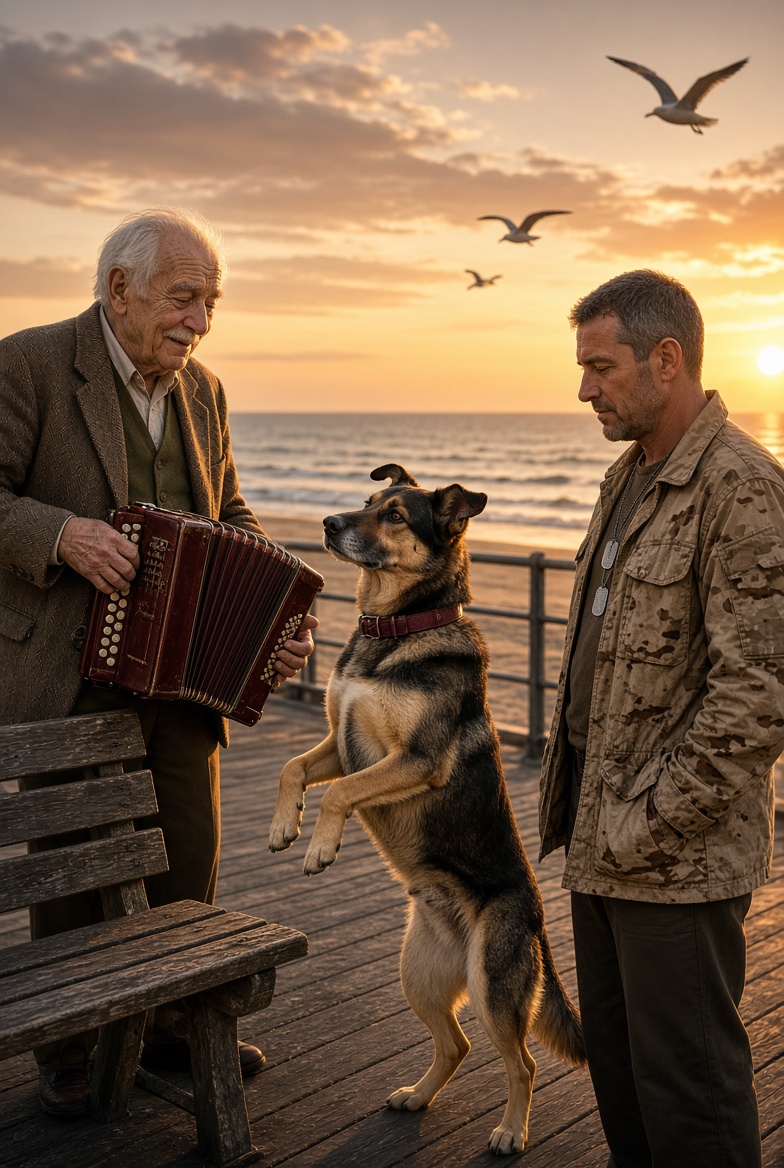
The dog had a black and tan coat, a broad dark saddle across his back, and a small cream-colored triangle of fur on his chest.
A narrow silver streak marked the right side of his muzzle, while the tip of his left ear curved gently outward.
A worn burgundy leather collar circled his neck.
He was a handsome animal, though age had begun making itself known in the quietest ways.
He rose a little more slowly than he once had.
He preferred softer places to sleep.
And after long walks, he sometimes gave Nico a look, suggesting that the United States Navy had never mentioned retirement would involve quite so much unnecessary exercise.
“You’re getting spoiled,” Nico told him.
Tango blinked.
“Yeah, me too.”
By 4:30, the awning was repaired.
The shop owner thanked Nico, handed him a check, and offered him a cold drink.
Nico politely declined.
He had never become comfortable with people being kind to him for reasons he couldn’t immediately explain.
Back in his small second-floor apartment, three blocks from the ocean, the afternoon light fell across a table covered with bills, repair invoices, and one unopened envelope.
The return address belonged to an office handling his veteran’s disability claim.
Nico looked at it.
Then he looked away.
Months earlier, his claim had been denied because the available medical records did not sufficiently establish a connection between his shoulder condition and his military service.
Some records from an earlier deployment were incomplete.
Others had proven difficult to obtain.
He had submitted statements, requested additional documentation, and spent evenings trying to understand language that seemed designed to make ordinary people feel foolish.
There had been deadlines, forms, more forms, and eventually another disappointing answer.
The experience had taught him something he hated believing.
A man could give years of his life to serving his country and still feel invisible when he asked that country to listen.
Nico placed the envelope beneath a hardware catalog.
Tango watched from beside the window.
“Don’t start,” Nico said.
The German Shepherd tilted his head.
“I know. Fresh air.”
Tango stood and walked toward the door.
Nico sighed.
“All right, you win.”
It had been that way for years.
Tango had once served alongside Nico’s unit as a reconnaissance dog, trained to remain calm amid distractions, observe subtle changes, and follow commands with remarkable precision.
When the dog retired, Nico had completed the necessary adoption process.
He liked to tell people he had given Tango a home.
Some nights, however, he suspected it had happened the other way around.
Tango had given him a reason to get up, buy groceries, leave the apartment, and remember that the world existed beyond old memories and unanswered letters.
There was one peculiar thing about the dog: his name.
Back in the unit, somebody had noticed Tango occasionally moving his front paws in a curious little rhythm whenever music played nearby.
A few men joked that he was dancing.
One called him Tango.
The nickname stayed.
Nobody had ever discovered where that strange habit came from, and Nico had long ago stopped wondering — until that afternoon.
The Asbury Park boardwalk was glowing in the warm colors of late summer.
The Atlantic stretched toward the horizon, reflecting long ribbons of gold beneath a peach-colored sky.
Seagulls wheeled overhead.
Bicycles rolled past storefronts.
Families carried paper cups of lemonade.
The smell of salt water mingled with sunscreen, warm pretzels, and fresh coffee.
Near the convention hall, Nico bought a large black coffee from a sidewalk stand.
Tango waited patiently beside him.
“One coffee,” Nico told the young woman behind the counter.
She looked down at the dog.
“And something for your handsome friend?”
“He’s already had dinner.”
Tango glanced at the stand.
Nico followed his gaze.
“Don’t look at me like that. You had the expensive kind.”
The woman laughed.
Nico took his coffee and continued along the wooden boards.
He wasn’t looking for entertainment.
He simply wanted another ordinary afternoon to pass without an argument, a letter, or somebody telling him he needed to complete another application.
Then Tango stopped.
Not gradually, not because a gull had landed nearby or another dog had crossed the walkway.
He stopped so suddenly that Nico felt the leash become gently taut.
“What’s up?”
Tango’s ears lifted.
Somewhere ahead, an accordion began to play.
The notes drifted between the old buildings, delicate and slightly uneven, yet unusually beautiful.
It was a waltz.
Three beats rising and falling like the tide.
Nico followed the sound.
Beside a weathered wooden bench sat an elderly gentleman with a burgundy accordion resting against his chest.
He was slender, with gently stooped shoulders, soft white hair brushing his collar, and a narrow white mustache.
His brown tweed jacket had worn patches at the elbows.
Beneath it were an olive green vest and an ivory shirt.
His shoes were old but carefully polished.
An open instrument case rested near his feet.
Inside lay a handful of coins and a faded photograph of a smiling woman.
A small handwritten card beside the case read “Llo Varga — Music from another time.”
The old man’s fingers moved over the keys with practiced tenderness.
He did not play like someone trying to attract a crowd.
He played as though the melody belonged to a person only he could see.
Nico slowed.
There was something about the music.
It carried sorrow without asking anyone to feel sorry.
The musician closed his eyes briefly and began another phrase.
Three notes, a gentle pause.
Then the melody returned.
Beside Nico, Tango’s entire posture changed.
His tail moved once, his ears stood alert, and his amber-brown eyes remained fixed on the old man.
“Easy, buddy,” Nico whispered.
Tango took two careful steps forward.
Then, without any command, he rose onto his hind legs.
“No.”
“Tango!”
The German Shepherd balanced for a few brief beats, shifted his front paws, and turned in a small, remarkably graceful circle.
Someone nearby gasped.
A little girl laughed with delight.
The musician opened his eyes.
As the final notes floated into the ocean breeze, Tango lowered his front paws and bowed his head.
For a heartbeat, the entire boardwalk seemed to fall silent.
Then the applause began.
“Oh, would you look at him?” an elderly woman exclaimed.
A silver-haired couple stopped walking.
The husband slipped his hand into his wife’s and she smiled as though remembering a dance they had shared decades ago.
Coins clinked into the accordion case.
A visitor raised a phone to capture the moment.
Nico stood frozen, coffee cup halfway to his mouth.
For 8 years, Tango had been one of the most disciplined dogs he had ever known.
He could follow complex commands, remain calm in crowded places, and recognize familiar routines from the smallest signals.
But Nico had never taught him that — not once.
And what unsettled him even more was that Tango looked pleased with himself.
Not excited in the restless way dogs sometimes became around strangers.
Pleased.
Almost relieved.
“Well,” Nico murmured, “that’s a new one.”
The elderly musician had stopped smiling.
He stared at Tango, his pale blue-gray eyes shining beneath deep wrinkles.
His hands rested motionless against the accordion.
“How remarkable,” he whispered, the words softened by a Hungarian accent.
Nico stepped closer.
“Sorry if he interrupted your performance.”
The old man shook his head.
“No, no interruption.”
He looked at Tango again.
“Such a beautiful dog.”
“His name’s Tango.”
At the name, the old man’s expression shifted.
“Tango,” he repeated slowly.
Then he offered a faint smile.
“A very appropriate name.”
Nico chuckled.
“That’s what the guys in my old unit thought. He used to move his paws whenever somebody played music. They said he looked like he was dancing.”
Llo looked down at his accordion.
For a moment, he seemed about to ask something.
Instead, he gently brushed his thumb along the instrument’s ivory-colored keys.
“Music,” he said, “sometimes stays with us longer than words.”
Nico glanced at Tango.
The dog remained seated beside the old gentleman, entirely content.
Nico had seen Tango greet old friends from the service.
He knew the difference between curiosity and recognition, and although he could not explain it, something about this meeting felt closer to the second.
The pleasant gathering ended when a sharp voice came from behind them.
“Sir, you cannot continue performing here.”
A man in a dark navy polo shirt approached, carrying a black clipboard.
He was in his late 30s, lean, with neatly parted dark blonde hair and a narrow face.
A company logo was embroidered on his chest: Shoreline Civic Services.
His name badge read Brent Coyle.
Llo looked up.
“Good afternoon. I was just finishing.”
“You’ve been informed about the location restrictions,” Brent replied.
“I submitted my renewal paperwork.”
“Submission doesn’t mean approval.”
The warmth slowly disappeared from Llo’s face.
“I understand, but I have not received a decision.”
Brent flipped through several pages on his clipboard.
“Then you’ll need to follow up with the appropriate office. This area needs to remain clear.”
Nico looked around.
The bench stood near the edge of a wide section of boardwalk.
People were walking past without difficulty.
“He’s not blocking anybody,” Nico said.
Brent turned.
“Sir, I’m speaking with the performer.”
“I’m standing right here. I can see the walkway.”
Brent’s jaw tightened.
“Are you responsible for this activity?”
“No, I’m responsible for the dog.”
“Then please allow me to finish.”
Nico felt the familiar heat rising in his chest.
It was the same helpless irritation he experienced whenever an official letter arrived with a new demand and no clear explanation.
But Llo raised one trembling hand.
“Please,” the old musician said softly.
“There is no need.”
He began fastening the accordion case.
The small crowd dispersed.
Brent wrote a report noting the disputed activity and location, explaining that it could be referred to an authorized municipal official for further action.
Nico watched the pen move.
Another report.
Another page.
Another man old enough to deserve a little patience being reduced to a problem on somebody’s clipboard.
“Can you at least tell him exactly where he’s allowed to play?” Nico asked.
Brent looked up.
“He can contact the proper department.”
“That’s not an answer.”
“It’s the procedure.”
Nico stared at him for a moment.
He wanted to argue until every person on the boardwalk understood how absurd those words sounded, but he felt Tango lean gently against his leg.
The dog was calm, waiting.
Nico drew a slow breath.
“Come on, Tango.”
Brent made a note of Nico’s objection and warned that further interference could be referred to the appropriate authorities.
Nico ignored the remark.
Llo closed the accordion carefully.
“I’m sorry,” the musician said.
Nico shook his head.
“You haven’t done anything to apologize to me for.”
The old man’s smile was tired.
“Perhaps I have kept your beautiful dog too long.”
“Trust me, he usually decides how long we’re staying anywhere.”
But Tango did not move.
Instead, he lowered himself beside Llo’s shoes.
The musician leaned forward, his long, slender fingers disappearing into the thick fur around Tango’s neck.
His hand rested there for several seconds.
Then Llo whispered something in Hungarian.
Nico could not make out the words.
Tango’s tail moved slowly across the wooden boards.
The old man looked startled by the response, almost afraid to believe what he was seeing.
Nico gave the leash a gentle signal.
“Come on, old friend.”
This time, Tango reluctantly stood.
They had gone only a short distance when the accordion sounded again.
Not an entire song, just three short musical phrases.
A delicate fragment of the waltz.
Tango stopped.
His right ear stood perfectly straight, while the curved tip of his left ear trembled in the ocean breeze.
He turned toward Llo, and from somewhere deep in his chest came a soft, wavering whine.
Nico had heard that sound before when Tango dreamed, but never while the dog was awake, never with such unmistakable longing.
Far behind them, Llo sat motionless, the accordion resting against his heart.
The last note faded beneath the cries of the seagulls.
Nico looked down at the dog who had accompanied him through years of service, loneliness, and quiet recovery.
He had thought he knew every part of Tango’s story.
Now, for the first time, he wondered whether his faithful companion had been carrying another story all along, one that began long before Nico ever knew his name.
And somewhere behind them on an aging boardwalk beside the Atlantic, an old musician seemed to remember the same forgotten song.
For the first time in 8 years, Nico Sarandos wondered whether his dog had been keeping a secret.
It was an absurd thought.
Tango was a retired military German Shepherd, not some mysterious gentleman with a hidden past and a second family in another state.
Still, there was no explaining what had happened on the Asbury Park boardwalk.
And there was certainly no explaining why, at 6:30 the following morning, Nico found himself standing in his kitchen whistling a Hungarian waltz to a dog who appeared thoroughly unimpressed.
“Come on, buddy. You remember this.”
Tango lay beneath the kitchen table, his silver-marked muzzle resting comfortably between his front paws.
Nico raised his phone and played a recording of a classical waltz.
Nothing.
He tried another.
Tango yawned.
A third selection produced an even less encouraging response.
The German Shepherd rolled onto his side and closed his eyes.
Nico folded his arms.
“So, you perform for strangers, but your own family doesn’t even get a rehearsal?”
One amber eye opened.
“That’s cold, Tango.”
Nico turned off the music and poured himself coffee.
As he rinsed the spoon, he absent-mindedly whistled the little sequence the old musician had played the previous evening.
Three short phrases.
A pause.
Then the final notes, rising softly.
Behind him came the faint clicking of claws against the kitchen floor.
Nico turned.
Tango was sitting upright.
Both ears were alert, including the left one with its gently curved tip.
His eyes were fixed on Nico’s face.
Nico lowered the spoon.
“Now that’s interesting.”
He whistled again.
Tango stood, took one step forward, and waited.
But when Nico tried to continue the melody, he lost the tune.
Tango’s head tilted.
“Sorry,” Nico murmured.
“Apparently, the Navy forgot to give me accordion lessons.”
The dog returned to his place beneath the table.
Nico stood for a long moment, considering what he had seen.
Perhaps it was nothing.
Perhaps the dog simply liked a particular sequence of notes.
But he remembered the old musician’s expression, the way his hands had stopped moving, the strange tenderness in his eyes when Tango sat beside him.
By 10:00, Nico had decided to return to the boardwalk.
He told himself it was only because Tango deserved another walk.
Tango, who had already enjoyed a perfectly adequate morning outing, offered no objection.
The boardwalk was quieter than it had been the afternoon before.
Morning sunlight painted the old wooden planks pale gold.
Ocean breezes carried the smell of salt, fresh coffee, and the faint sweetness of pastries from nearby shops.
Nico walked beside Tango at an easy pace.
Near the weathered bench, they found Llo Varga sitting with his accordion across his knees.
The elderly musician was polishing its burgundy body with a soft cloth, moving carefully around the ivory-colored keys and worn leather straps.
He wore the same brown tweed jacket with an olive vest beneath it.
His flat cap rested beside the open instrument case.
When he saw Tango, his tired face brightened.
“Ah, my dancing friend has returned.”
Tango approached without pulling on the leash.
He sniffed the old man’s shoes, circled once, then sat beside his right knee.
Llo chuckled.
“Such beautiful manners. Better than most people I have met.”
“That’s not a particularly high standard these days,” Nico replied.
The old man laughed.
It was a warm, surprisingly youthful sound.
“Nico Sarandos,” Nico said, offering his hand.
“Llo Varga.”
They shook hands.
Llo’s fingers were slender and slightly stiff, but his grip was steady.
“Your dog has excellent taste in music, Mr. Sarandos.”
“Please, Nico.”
“Then you must call me Llo.”
Nico glanced at the accordion.
“How long have you been playing?”
Llo looked at the instrument as though it were an old companion.
“Since I was a boy. My father believed every proper Hungarian household needed three things: good bread, strong opinions, and somebody who could play music.”
“Sounds crowded.”
“Oh, terribly. Especially when my uncles came to visit.”
Nico smiled.
Llo explained that he had grown up surrounded by music in Hungary.
When he came to America as a young man, he brought a small suitcase, a few family photographs, and the determination to earn a living through the one language he understood completely.
For years, he played piano and accordion in chamber concerts, community performances, and local cultural events.
Later, he taught music to students across New Jersey.
Some pupils became professional musicians.
Others never advanced beyond a few simple songs.
Llo spoke fondly of both.
“Music is not always about being good,” he said.
“Sometimes it is about being happy for 3 minutes.”
Then his gaze moved toward the photograph inside his accordion case.
“My wife understood that better than anyone.”
Nico followed his eyes.
The faded photograph showed a smiling woman with softly waved hair.
“Her name was Ela,” Llo continued.
“She loved gardens, stray cats, and people who needed someone to listen. Not necessarily in that order.”
“Sounds like a good woman.”
“The very best.”
Llo smiled, but the expression gradually softened.
“She passed away 8 years ago.”
Nico said nothing.
He knew that particular silence.
There were losses for which condolences felt painfully inadequate.
Llo brushed a thumb along the photograph’s edge.
“After she was gone, the house became very quiet. I used to complain that Ela made too much noise. She sang while washing dishes, talked to the flowers, even argued with the weather.”
He gave a small laugh.
“Then suddenly, nobody argued with the weather anymore.”
A breeze lifted the corner of the photograph.
Llo held it down.
“Every afternoon I play her favorite waltz. It is not the same as having her beside me. But for a little while, the day feels less empty.”
Nico looked toward the ocean.
He had spent years avoiding conversations like this.
Yet somehow, sitting beside an old musician and a patient German shepherd, he found that he did not want to leave.
Llo was still speaking when a woman called from behind them.
“Llo Varga, if you skipped breakfast again, I am telling your wife.”
The old man turned with a smile.
“That would require a rather long-distance telephone call.”
Evelyn, a woman in her early 70s, approached carrying a paper bag and two takeaway cups.
She was short and pleasantly round, with silver-blonde hair gathered into a low bun and red-framed glasses perched on her nose.
A striped cream-and-navy apron covered her pale turquoise blouse.
“This man,” she told Nico, “has been surviving on coffee and stubbornness for years.”
“An excellent diet,” Llo protested.
“For an old accordion, maybe.”
She handed him the bag.
“Egg sandwich. No arguments.”
Nico introduced himself.
“Evelyn Harowell,” she replied.
“Sebrite Diner down the block. Widow, grandmother, and apparently unpaid caretaker of every stubborn man on this boardwalk.”
Her eyes dropped to Tango.
“Oh, and who is this handsome gentleman?”
“Tango.”
“Well, Tango, at least you look like someone who listens.”
Nico almost laughed.
Evelyn had known Llo for many years.
During rainy afternoons, she often invited him into the diner for soup.
When the boardwalk grew quiet in winter, she saved him a seat near the window.
But her good humor faded when she noticed a folded notice protruding from Llo’s jacket pocket.
“Another letter, Llo?”
“Only paperwork, Evelyn,” he said gently.
“Please,” she looked toward Nico.
“Has he told you what’s been happening?”
“Only a little.”
“Then come to the diner, both of you. We ought to have this conversation somewhere with chairs that don’t feel 70 years old.”
Llo raised an eyebrow.
“Unlike the people sitting on them.”
“Keep talking and I’ll charge you for the sandwich.”
Sebrite Diner smelled of fresh coffee, toasted bread, and warm cinnamon.
Sunlight streamed through wide front windows overlooking the street.
Evelyn settled them into a booth near the entrance.
Tango lay beneath the table, his burgundy collar visible against his dark fur.
She brought a folder from behind the counter.
Inside were several notices Llo had asked her to help read.
Nico studied them.
Some listed nearly identical descriptions of the same location.
Others recorded incidents at unusually close times.
One notice still carried the address of a building where Llo no longer lived.
“Why didn’t you challenge these?” Nico asked.
Llo’s cheeks colored slightly.
“I tried. I submitted the renewal paperwork. Then there was an online portal, a password, a confirmation number. After that, I was told I needed to contact another office. And the fees — some are disputed. I don’t know which amount is actually correct anymore.”
Nico looked down at the papers.
He recognized the feeling immediately.
The exhaustion of trying to explain something simple through a process that made every answer seem like another question.
Evelyn folded her arms.
“That security fellow, Brent Coyle, has been writing reports about half the people trying to earn a little money along the boardwalk.”
“Not everyone,” Llo said quietly.
“Enough to make people nervous.”
She explained that Brent worked for Shoreline Civic Services, a private contractor involved in managing certain tourist areas.
His reports could be forwarded to Martin Ellsworth, a 52-year-old municipal enforcement official responsible for reviewing cases within his assigned authority.
“Martin,” she said, “generally works from individual reports. Whether he had noticed any larger pattern was unclear.”
“Brent thinks he’s keeping everything orderly,” Evelyn said.
“But there’s a difference between keeping a walkway clear and making an old man afraid to open his instrument case.”
Nico turned another page.
He noticed two dates.
Two times, two descriptions that were almost identical.
He placed them beside each other.
“Has anyone checked whether these refer to the same incident?”
Evelyn shook her head.
Llo looked uncomfortable.
“I don’t want to make trouble.”
Nico understood that sentence better than he wished to, but he also understood what happened when decent people became too exhausted to keep asking questions.
By late afternoon, Llo returned to the boardwalk.
Nico stayed nearby with Tango while the musician played several gentle melodies for passing visitors.
The sun was beginning to lower when Brent Coyle approached again.
“Mr. Varga, we’ve already discussed this location.”
Llo stopped playing.
“I have the paperwork showing my renewal is under review.”
“That doesn’t authorize you to use this particular space.”
Nico stepped forward.
“Then what does authorize it?”
Brent glanced at him.
“We’ve had this conversation.”
“Not really. You’ve made statements. I’m asking where the actual rules are.”
Brent’s expression hardened.
“Sir, you need to stop interfering.”
Llo closed the accordion before the discussion could continue.
“Please, Nico. It is all right.”
“It isn’t all right.”
Llo looked up at him.
His pale eyes were tired, but his voice remained gentle.
“At my age, I have learned that not every disagreement needs to become a battle.”
Nico fell silent.
The words were not an accusation.
That somehow made them harder to dismiss.
Brent recorded the encounter and moved away after Llo agreed to stop performing there.
Nico watched him leave.
Then he looked down at the folded notices in Llo’s hand.
“What’s the smallest fee they’re asking you to pay?”
Llo hesitated.
Nico continued, “I can cover it. No strings attached.”
The old musician studied him for a moment.
“That is very kind.”
“Then let me.”
“But if I pay money I do not owe simply because I am frightened of another notice, what will I tell myself tomorrow?”
Nico had no answer.
Llo placed a hand over his own chest.
“I do not need someone to buy my dignity, my friend. I only wish to keep it.”
The word stayed with Nico longer than he expected.
He had entered the afternoon believing money might solve the immediate problem.
Llo had reminded him that a person could need help without wanting to surrender the right to stand for himself.
Before leaving, Llo opened his worn wallet.
He took out a small photograph.
It showed Ela standing in a sunlit garden beside a wooden bench.
Flowers crowded the fence and an old wicker basket rested near her feet.
A narrow red scarf hung over one side of the bench.
“She grew roses,” Llo said.
“Terrible roses. Truthfully, half the time they refused to bloom.”
Nico studied the photograph.
“She looks happy.”
“She was. Even when the garden disappointed her.”
Llo smiled.
“Especially then.”
Nico handed back the picture.
They parted with the promise that Nico would return another day.
By the time he reached his apartment, the sky had turned lavender over the Atlantic.
Another official-looking envelope waited beneath his door.
Nico recognized the return address connected to his disability claim.
He picked it up, felt the stiff paper inside, and placed it unopened in the drawer with the others.
Tango watched him.
“Don’t judge me,” Nico said quietly.
The dog walked over and rested his head against Nico’s leg.
For a moment, Nico remained motionless.
Then he bent and rubbed the dog’s curved left ear.
“Yeah,” he whispered.
“I know.”
That evening he found himself thinking about Llo’s words, about dignity, about the courage required to remain gentle when life had given someone every reason to become bitter, and about a piece of music that seemed to mean something to his old dog.
The following afternoon, just before Nico and Tango left the boardwalk, Llo invited them to listen to one final melody.
There was no crowd this time, only the quiet sea breeze, the fading sunlight, and the distant sound of waves.
Llo lifted the accordion.
His fingers moved through the familiar three phrases.
Tango sat beside him.
He did not rise or attempt to dance.
Instead, as the final notes faded, the German Shepherd gently placed one front paw on Llo’s knee.
The old man’s smile trembled.
His fingers stopped.
He looked down at the paw resting against his trousers, then at Tango’s amber eyes.
For several seconds, he said nothing.
Nico noticed his expression changing as though a memory had surfaced before Llo was ready to speak of it.
Finally, the musician whispered, “You know, many years ago, I cared for a little German Shepherd puppy.”
His voice grew softer.
“A funny little fellow. He loved that melody.”
Llo slowly stroked Tango’s paw.
“Whenever I played those notes, he would lift himself up and try to turn around. He was terribly clumsy.”
A faint laugh escaped him.
Then his eyes filled with tears.
“I had almost forgotten how wonderful it was to make him happy.”
Nico looked from the old man’s trembling hand to Tango’s peaceful face.
He did not ask another question.
Not yet.
Because whatever memory had found its way back to Llo that afternoon, it was clearly precious, and for reasons Nico could not understand, Tango seemed unwilling to leave the old man’s side.
The Atlantic wind moved softly around them.
For one quiet moment, an old musician, a retired Navy SEAL, and a German Shepherd sat together beside the sea.
None of them knew how much their lives were about to change, but something gentle had already begun.
The strangest thing about an empty place is how loudly it can remind you of someone.
For nearly a week, Nico Sarandos had grown accustomed to hearing an accordion whenever he walked past the old wooden bench near Asbury Park’s Convention Hall.
Sometimes the music was cheerful.
Sometimes it sounded like a conversation between two people who had loved each other for 50 years and still had things left to say.
But on that gray Thursday morning, there was no music.
Only rain, the kind of late summer rain that rolled in from the Atlantic without much warning, leaving the boardwalk shining beneath a low ceiling of clouds.
Nico stood beside the bench, his faded desert camouflage jacket darkened at the shoulders by the damp air.
Tango stopped walking.
The 8-year-old German Shepherd lowered his silver-marked muzzle toward the wooden boards, sniffed around the legs of the bench, then settled onto the ground.
“Come on, buddy.”
Tango looked up.
Nico gave the leash a gentle tug.
“He’s probably staying home because of the weather.”
The dog remained seated.
Nico glanced toward the spot where Llo Varga usually placed his accordion case.
There was nothing.
No burgundy instrument, no collection of loose coins, not even the old man’s carefully folded flat cap.
It should not have bothered Nico as much as it did.
He had known Llo for barely more than a week.
But there was something unsettling about discovering that a small, familiar piece of the world had disappeared.
“All right,” Nico muttered.
“We’ll check the diner.”
Tango rose immediately.
Nico shook his head.
“Of course you understood that perfectly.”
They crossed the wet boardwalk and headed toward Sebrite Diner.
Inside, the morning crowd was unusually quiet.
Rain tapped against the windows and the smell of fresh coffee filled the room.
Evelyn Harowell stood behind the counter wearing her striped apron and red-framed glasses.
The moment she saw Nico, her expression changed.
“Oh, thank goodness.”
Nico stopped.
“What’s wrong?”
Evelyn put down the coffee pot.
“It’s Llo.”
Something tightened beneath Nico’s ribs.
“Is he sick?”
“No. At least not that I know.”
She lowered her voice.
“He was taken into custody last night.”
For a moment, Nico thought he had misunderstood her.
“Taken into custody? Llo?”
Evelyn nodded.
“There was some kind of old court warrant. Something about not appearing for a hearing.”
Nico stared at her.
“The man plays music on the boardwalk.”
“I know who he is, Nico. He’s 80 years old.”
“I know that, too.”
Evelyn’s voice trembled.
“He called me briefly from the processing facility. Said he’d never received the notice telling him to appear in court.”
Nico looked down at Tango.
The dog stood quietly beside his leg, watching the two humans as if waiting for someone to make sense of their distress.
“Where is he now?”
Evelyn pushed a folded note across the counter.
“I wrote down what he told me.”
Nico picked it up.
There was an address, a telephone number, and a case reference Evelyn had managed to record.
His jaw tightened.
He knew what came next.
Counters, numbers, forms, people asking questions without ever answering his.
He had spent enough time in government offices to develop a deep dislike for chairs arranged in waiting rooms.
But this time, someone else was sitting behind the wrong door, and Nico could not bring himself to walk away.
The trouble had begun months earlier.
Llo’s previous landlord had sold the old rental building where he had lived for nearly 11 years.
He had moved into a smaller room closer to the ocean, carrying his clothes, a few photographs, some music books, and the accordion that had belonged to his happiest memories.
He updated his address with the post office and several agencies, but one municipal case file still contained his former address.
A hearing notice connected to a disputed boardwalk violation had been mailed there.
Llo never received it.
When he failed to appear, the case followed an administrative path he knew nothing about, eventually resulting in a warrant for his appearance.
The previous evening, while Llo was speaking with an officer about an unrelated local ordinance matter, a routine records check revealed the outstanding warrant.
Officer Samuel Greaves had been the one who discovered it.
46 years old, Samuel was a tall, broad-shouldered policeman with closely cropped black hair beginning to gray at the temples and a composed manner that seldom invited argument.
He had listened carefully as Llo explained his confusion.
Samuel saw no indication that the elderly musician posed a danger, but the warrant was active and Samuel could not simply pretend it did not exist.
He explained the next steps, helped Llo retrieve the important telephone numbers from his belongings, and made sure the necessary information was recorded for the court.
Even so, Llo spent the night in custody awaiting review.
There had been no dramatic confrontation, no struggle — only fluorescent lights, unfamiliar procedures, and a tired 80-year-old man wondering how a missed piece of mail could change the course of an ordinary evening.
By the time Nico arrived at the municipal court building, rainwater had collected along the cuffs of his camouflage trousers.
He had left Tango safely with Evelyn at the diner.
The dog had accepted the arrangement reluctantly, taking up position beside the front window where he could watch the street.
Nico stepped into the courthouse lobby and approached the reception counter.
“I’m looking for information about Llo Varga.”
The employee behind the glass asked for a case number.
Nico provided the reference Evelyn had written down.
After checking the computer, she requested additional information to verify the case.
Nico felt his patience thinning.
“He’s 80 years old. He didn’t get his court notice. That’s the problem.”
“Sir, I understand, but I need to confirm the correct record.”
“You have his name.”
“And several records can contain similar names.”
Nico leaned forward.
“I’ve spent years giving offices information they already have.”
The employee paused.
“Mr. Sarandos, I am trying to help you find the right case.”
The words struck him harder than he expected because she sounded tired.
Not cruel, not dismissive — simply tired.
Nico straightened.
“All right,” he took a breath.
“What do you need?”
A voice behind him answered.
“Start with a case number. That’s usually the easiest way.”
Nico turned.
Officer Samuel Greaves stood a few feet away, holding a slim folder.
Nico recognized the name Evelyn had mentioned.
“You’re the officer from last night.”
Samuel nodded.
“I was present when Mr. Varga’s warrant was discovered.”
Nico looked at him carefully.
“Then you know he didn’t understand what was happening.”
“I know he told me he had not received the notice.”
“And that wasn’t enough.”
Samuel remained calm.
“It was important information. I made sure it was included. But resolving the warrant requires the court to examine the record.”
Nico shook his head.
“Everybody keeps telling me what they can’t do.”
Samuel waited until Nico had finished.
Then he spoke quietly.
“Let me tell you what you can do.”
That stopped him.
Samuel pointed toward a door farther down the hall.
“His case is being reviewed this morning. You can ask the clerk about the public schedule and the proper process for providing information. If he needs help challenging the notice, there are legal assistance services that may be able to advise him.”
Nico glanced at the folder.
Samuel continued, “The address discrepancy matters, but it has to be put before the right person.”
For the first time that morning, Nico felt something other than anger.
It was not trust.
Not yet.
But it was the uncomfortable realization that the officer standing before him was trying to point him toward a solution.
“Thank you,” Nico said.
The words came out stiffly.
Samuel gave a small nod.
“He’s been asking about his accordion.”
Nico looked up.
“His accordion?”
“Yes. He seemed more worried about leaving it unattended than anything else.”
Nico closed his eyes briefly.
Of course he was.
Even after a night like that, Llo was thinking about the instrument that connected him to Ela.
And suddenly, Nico found himself determined that the old man would not have to face another morning alone.
By early afternoon, the matter had received an initial review.
With preliminary legal guidance, the court was informed of the possible address error, and Llo was released while the underlying issues awaited further consideration.
Nico waited outside beneath the courthouse awning.
Evelyn had arrived with Tango and a dry jacket for Llo.
The German Shepherd stood beside Nico, staring toward the entrance.
When the doors opened, Llo appeared.
His white hair was untidy, his shoulders more stooped than Nico remembered.
He wore the same brown tweed jacket, but it seemed too large for him now.
“Nico?”
The old man’s voice carried genuine surprise.
Before Nico could answer, Tango stepped forward.
He pressed his broad head gently against Llo’s waist.
Llo stopped walking.
“Oh, my dear fellow.”
He bent carefully and wrapped both arms around the dog’s neck.
His thin fingers disappeared into the black and tan fur.
Tango remained perfectly still, allowing the old man to hold him as long as he needed.
Nico watched without speaking.
He had seen people reunited with family members after long separations.
He had witnessed relief in many forms, but there was something especially moving about the way Llo leaned into that quiet embrace as though the dog were providing the strength his own tired body could not find.
Evelyn approached and offered him the dry jacket.
“You are coming back with us,” she announced.
Llo managed a faint smile.
“Do I get a choice?”
“Not today.”
For the first time since morning, Nico heard the old man laugh.
It was a small sound, but it mattered.
During the drive to his rented room, Llo said very little.
The rain softened to a mist, blurring storefronts and traffic lights beyond the windshield.
Tango rested on a secured mat in the back of Nico’s truck, occasionally lifting his head when Llo spoke.
At a red light, Nico glanced toward the passenger seat.
“You doing okay?”
Llo folded his hands.
“I am embarrassed.”
“You shouldn’t be.”
“I know what you mean.”
He paused.
“But knowing something and feeling it are different matters.”
Nico waited.
“I have lived 80 years,” Llo continued.
“I paid my taxes. I taught children music. I cared for my wife when she was ill. I tried to be decent to my neighbors.”
His voice grew quieter.
“Last night, I was simply another name on a form that nobody seemed to understand.”
Nico tightened his grip on the steering wheel.
The words felt painfully familiar.
“I can understand a mistake,” Llo said.
“What frightened me was the feeling that I could explain the mistake a hundred times and still not be heard.”
Nico swallowed.
For years, he had believed his own frustration was something no one else could truly understand.
Now, an 80-year-old musician had described it in a few simple sentences, and Nico could not find a single word to make it better.
Llo’s rented room occupied the second floor of an aging house on a quiet side street.
The narrow staircase creaked beneath their feet.
Inside, the room was tidy but cold.
A small table stood beside the window.
Music books were stacked along the wall, and a framed photograph of Ela rested on a narrow shelf.
The accordion, safely returned to Llo after the earlier encounter, sat in its case beside the chair.
Nico noticed a dark patch beneath the window.
Rainwater had seeped through the deteriorated wooden frame.
He pressed one finger against the lower sill.
The wood gave slightly.
“When did this start?”
“Only when it rains.”
Nico looked at him.
“Llo, we’re standing in New Jersey, then.”
“I suppose it happens rather often.”
Nico nearly smiled.
He retrieved his tool bag from the truck and began checking the frame.
The damage was manageable.
He could make a temporary repair, then arrange a proper replacement once the weather improved.
Llo protested that he could not afford to pay him.
Nico continued working.
“Good thing I’m not sending you a bill.”
“But your time—”
“Is currently being spent stopping your window from becoming an indoor waterfall.”
Llo sighed.
“Americans are impossible.”
“You’re American, too.”
“Yes, that is how I know.”
Evelyn arrived 20 minutes later carrying a pot of chicken soup, fresh bread, and enough determination to organize the entire household.
While Nico worked, she quietly explained that Llo had fallen behind on rent after losing several opportunities to perform.
The disputed fees had made him fearful of setting up his instrument in public, and without those small contributions from passersby, his already limited budget had become increasingly difficult.
Nico looked toward the old man.
Llo was carefully arranging three bowls on the little table.
He moved slowly but with dignity.
Nico understood then that fixing the window would be easy.
Fixing what had happened to Llo would require something he had spent years avoiding: asking the right people for help.
Evelyn made the introduction that afternoon.
Clara Whitner arrived carrying a cognac-colored leather briefcase and a slim notebook.
She was 43, composed and sharply observant, with warm brown skin, dark eyes, and naturally curly hair gathered into a neat low bun.
Her navy blazer was damp from the rain.
She accepted a cup of tea, introduced herself to Llo, and listened without interrupting.
Clara worked with people facing civil rights concerns and administrative disputes, including older residents who struggled to understand complex procedures.
When Llo finished explaining, she asked to examine the notices he had received.
Nico watched her turn the pages.
“Let me guess,” he said.
“More paperwork.”
Clara looked up.
“Probably.”
“That’s encouraging.”
“It would be dishonest to promise otherwise.”
Nico folded his arms.
“I’ve spent years filling out forms, never changed a thing.”
Clara studied him for a moment.
“I’m sorry you’ve had that experience.”
“Sorry doesn’t change the answer.”
“No,” she agreed.
“It doesn’t.”
She placed two notices beside each other.
“But sometimes an address, a date, or one missing record changes what a court is able to determine.”
Llo leaned forward.
“Can this be corrected?”
“There may be grounds to challenge parts of the process,” Clara answered.
“We need to confirm the notices, the address history, and how the warrant was issued. I can’t promise the outcome.”
Nico shook his head.
“People always say they can’t promise anything.”
Clara closed her notebook.
“Would you trust me more if I promise something I couldn’t guarantee?”
He looked away.
She continued gently, “Evidence doesn’t guarantee justice, Nico. But without evidence, the people who are already struggling have even less chance of being heard.”
For a long moment, no one spoke.
Rain tapped against the repaired window.
Nico looked at Llo, sitting with his hands folded around a warm cup of tea.
The old man’s expression held cautious hope, and Nico realized that his own distrust, however understandable, might become another obstacle for someone who needed help.
“I can gather what he has,” Nico finally said.
Clara nodded.
“That’s a good place to start.”
That evening, Nico insisted Llo come to his apartment for dinner.
Evelyn had left enough soup for several meals, and Nico supplemented it with toasted bread and a simple salad.
Llo examined the kitchen.
“Very tidy.”
“I don’t own enough things to make a mess.”
“That is one solution.”
Tango lay beside the small electric heater, his dark fur glowing softly in the warm light.
Llo watched him for a long time.
“Ela would have loved this dog,” he said.
Nico set the bowls on the table.
“She liked German shepherds?”
“She loved all animals. But she had a special affection for dogs that needed a purpose.”
He smiled faintly.
“Before she passed, she signed us up for a volunteer program. We were supposed to help raise and socialize puppies that might someday become working dogs.”
Nico sat down.
“Did you ever do it?”
“After she was gone, I did.”
Llo glanced toward the heater.
“I wanted to keep one promise to her. So I welcomed a little German Shepherd into our home.”
His expression softened.
“He was a lively fellow. Big paws, curious ears, and absolutely no appreciation for the garden flowers.”
Nico smiled.
“What happened to him?”
“When his time with me was finished, he went on to continue his training.”
Llo looked down.
“I always hoped he found kind people.”
Tango shifted beside the heater.
The old musician watched him settle again.
“And that puppy,” Llo whispered, “loved Ela’s waltz.”
He began softly humming the familiar three phrases.
Tango raised his head.
Llo smiled and spoke a single word.
“Tanoska.”
The German Shepherd stood.
He crossed the room without hesitation and pressed his head against Llo’s chest.
The old man froze.
His fingers rested against Tango’s burgundy collar.
For several seconds, he seemed unable to breathe normally.
Then he whispered, barely louder than the rain outside, “That was what I called him.”
Nico stared.
Llo looked into the dog’s amber eyes.
“My little dancer.”
A tear slid down the old man’s cheek.
“Eight years ago,” he said, his voice trembling, “I called a puppy by that very same name.”
Tango remained close, his head resting peacefully against Llo’s heart.
And Nico, standing beside the dinner table, felt the quiet certainty of his ordinary world begin to shift.
Nico Sarandos had spent most of his adult life believing that every important question deserved a clear answer.
But there was one question he had never thought to ask.
Who had loved Tango before he did?
For 8 years, the German Shepherd had been a steady presence in his life.
First as a working dog attached to his military unit, and later as the retired companion who slept beside his bedroom door.
Nico knew Tango’s commands, his favorite treats, and the exact expression he made when someone opened a refrigerator.
He knew the old dog’s left ear curved slightly outward.
He knew the narrow silver streak on the right side of his muzzle.
He even knew Tango disliked thunder but tolerated fireworks with an almost offended dignity.
Yet he knew almost nothing about the first months of the dog’s life.
And after watching Tango press his head against Llo Varga’s chest when the old musician whispered a Hungarian nickname, that missing piece suddenly mattered more than Nico could explain.
The next morning, Nico sat at his kitchen table with Tango’s adoption papers spread before him.
The records documented the dog’s retirement, medical history, and transfer into civilian ownership, but there was no name listed for the person who had cared for him as a puppy.
Nico picked up his phone.
He knew exactly whom to call.
Owen Kessick answered on the fourth ring.
“If you’re calling to tell me that dog has learned to cook breakfast, I’m retiring again.”
Nico almost smiled.
“Good morning to you, too.”
Owen was 55, a former military dog training and acquisition officer with a stocky build, short reddish-brown hair turning gray, and a dry sense of humor that had survived several decades of difficult work.
He had helped Nico complete Tango’s retirement adoption and remained one of the few men from his old life who could call without making Nico feel obligated to discuss the past.
“I need to find Tango’s original records,” Nico said.
There was a pause.
“Medical records? Earlier.”
“How early?”
“Before training. Before the military. When he was a puppy.”
Owen’s tone changed.
“That’s going back a long way.”
“I know.”
“Something wrong with him?”
“No. That’s the strange part.”
Nico explained the accordion, the old musician, and the Hungarian word that made Tango cross the room without hesitation.
Owen listened quietly.
When Nico finished, his old friend let out a low whistle.
“Well, I’ll be.”
“That’s your professional assessment?”
“Best one you’re getting before coffee.”
Then Owen grew serious.
“Tango came through a private working dog development program. They handled early placement, socialization, and preliminary evaluation before he entered the military training pipeline.”
“Do they keep records?”
“Usually. The question is whether those files were preserved after the program changed hands.”
Nico looked down at Tango.
The dog was asleep beneath the window, his burgundy collar resting against his thick fur.
“Can you find out?”
“I can make some calls. But Nico, they’ll need proof you’re his legal owner. And if you’re asking about another person’s information, that person may have to consent.”
“I’ll get whatever they need.”
Owen chuckled.
“That’s the first time I’ve heard you volunteer for paperwork.”
Nico glanced at the stack on his table.
“Don’t make me regret it.”
That afternoon, Nico met Llo at the Asbury Park Public Library.
The old musician arrived carrying a canvas bag filled with carefully organized papers and a small notebook.
He wore his familiar brown tweed jacket, olive vest, and polished shoes.
Tango greeted him with a slow sweep of his tail.
Llo smiled.
“Good afternoon, my elegant friend.”
Nico explained what Owen had discovered.
Llo listened without interrupting.
When Nico mentioned the possibility of requesting his old volunteer records, the musician removed his glasses and cleaned them carefully with a handkerchief.
“I never imagined those papers would still exist.”
“We don’t know yet.”
“No, of course.”
Nico leaned forward.
“If we ask them to check whether you were involved, they’ll need your permission.”
Llo looked at Tango, who was resting beside his chair.
“Then they have it.”
He signed the necessary consent form slowly, taking care to keep the letters clear.
Nico noticed his hand trembled slightly.
“Are you all right?”
Llo set down the pen.
“I am trying not to hope too much.”
Nico understood.
Hope could be frightening when a person had already learned how much disappointment could cost.
He gathered the forms.
“We’ll take it one step at a time.”
Llo nodded.
“That sounds wise.”
Then he smiled, very unlike the man who argued with the security officer.
“Don’t get used to it.”
The search moved slowly.
Owen contacted the organization that had originally handled Tango’s early training.
Its records had since been transferred to a successor administrative office where older paper files were stored separately from the modern database.
A coordinator requested Tango’s microchip number, original program identification, adoption documentation, and Llo’s signed consent.
Nico sent the information.
Then came the waiting.
During those days, Llo began visiting Nico’s apartment more often.
Sometimes they shared dinner.
Sometimes the old man played a few quiet pieces on his accordion while Nico repaired a chair or sorted through work invoices.
Tango usually lay between them, occasionally lifting his head when a familiar melody began.
One afternoon, Llo arrived with an old photograph of his former home.
It showed a narrow white house with pale blue shutters and a garden crowded with flowers.
“Ela planted everything herself,” he said.
Nico studied the picture.
“Looks like a lot of work.”
“Oh, it was. She had a remarkable talent for making plants grow where they had no business growing.”
Llo pointed to a small patch beside the back fence.
“That was where the puppy liked to sleep.”
Nico looked up.
“The one you told me about?”
Llo nodded.
For a moment, his expression changed.
Then he began to tell the story.
Eight years earlier, the little house had been terribly quiet.
Ela’s gardening gloves still hung beside the kitchen door.
Her favorite blue cup remained on the second shelf.
Llo had not moved it.
Every morning he walked past the garden without opening the gate.
The roses were growing wild.
The grass needed cutting, but he could not bring himself to care.
Before her passing, Ela had applied to volunteer with a program that placed young dogs in temporary homes for early care and socialization.
She believed every animal deserved a gentle beginning, and she loved the thought that a puppy raised with patience might someday help someone in need.
After the funeral, Llo found the acceptance letter among her papers.
For several days, he left it untouched.
Then one morning, he called the program.
He explained that his wife had died.
He asked whether he might still participate.
The coordinator arranged an interview and reviewed his ability to care for a young dog.
Several weeks later, a small German Shepherd arrived at his door.
The puppy had already been weaned and was ready for a supervised home placement.
He was black and tan with oversized paws, bright brown eyes, and one ear that seemed determined to point in a different direction from the other.
A tiny cream-colored marking formed an upside-down triangle on his chest.
Llo remembered looking down at him and wondering how such a small creature could make so much noise simply by walking across a kitchen floor.
“He sounded like a drawer full of wooden spoons,” Llo told Nico.
Nico laughed.
“That sounds familiar.”
The puppy investigated everything.
Chair legs, shoelaces, flower pots.
He once dragged a gardening glove across the kitchen and fell asleep with his nose inside it.
Llo had not laughed properly in weeks.
That afternoon he laughed until tears filled his eyes.
The puppy gave him reasons to follow a routine.
There were meals to prepare, walks to take, and new experiences to introduce carefully.
There were also limits.
The puppy needed rest, gentle training, and quiet time between activities.
Llo discovered that caring for him required attention to the present.
For the first time since Ela’s passing, entire hours went by without Llo staring at the empty chair across the table.
One morning he sat beside the window with his accordion.
He had avoided playing Ela’s favorite waltz because the melody reminded him too much of her absence, but the little dog settled beneath his chair, watching his hands.
Llo began to play.
Three short phrases, a gentle pause, then the melody returned.
The puppy raised his front paws excitedly.
Llo stopped.
The puppy dropped back onto the floor.
When the music began again, the little dog shifted his feet and turned awkwardly toward the sound.
Llo smiled.
Then he laughed, not because the puppy had performed anything extraordinary, but because something in the room had become joyful again.
“Ela,” he whispered toward her photograph.
“You should see this fellow.”
He began calling the puppy Tanoska.
His little dancer.
Over the following weeks, Llo used the familiar melody as part of a gentle game.
The puppy learned to follow a hand signal, make a small turn on all four paws, and lower his head when praised.
Llo rewarded him with appropriate treats and affection, never asking for long or difficult movements.
The music became associated with comfort, attention, and happiness.
As the puppy grew, Llo sometimes visited the training program for supervised socialization sessions.
There, too, the familiar tune could draw an eager movement of those oversized paws.
Then came the day of farewell.
The puppy was ready to continue his development at the training center.
Llo knew that from the beginning.
Still, knowing something would happen did not make it easy.
Ela had prepared a small red scarf for their future foster puppy.
Llo had tied it loosely around the little dog’s neck for photographs taken at home, removing it whenever it was not appropriate for the young animal to wear.
On the morning of the handover, he folded the scarf and placed it in his pocket.
He also wrote a short card for whoever might care for the puppy next.
It was a simple message: “Please be patient with him. He loves music, and he is happiest when someone takes the time to make him feel safe.”
The puppy left in the care of the training staff.
Llo stood by the garden gate for a long time after the vehicle disappeared.
He had kept his promise to Ela, but the silence returned.
Later, after moving homes and losing contact with the program, he never discovered where the puppy went.
When Llo finished, Nico remained quiet.
Tango was sleeping near the old man’s feet.
The silver streak along his muzzle caught the afternoon light.
Nico looked at him differently now — not because he knew the answer.
He still didn’t.
But because he understood what finding that answer might mean.
Two days later, Owen called.
“Nico, sit down.”
Nico was standing in his kitchen.
“That usually means trouble.”
“Not today.”
The former officer explained that the program’s records team had located Tango’s original file.
The coordinator had matched the dog’s microchip to an early identification number, then checked the placement and transfer records.
With Llo’s consent on file, the coordinator had authorized confirmation of the volunteer caregiver’s identity.
“The name is Llo Varga,” Owen said.
Nico gripped the edge of the counter.
For several seconds, he could hear only the refrigerator humming.
“Are you sure?”
“Microchip matches. Identification number matches. Placement dates match.”
Owen paused.
“And there’s something else.”
Nico closed his eyes.
“What?”
“An old behavioral note. The puppy was unusually responsive to a short musical sequence. The volunteer caregiver reported that he liked turning toward accordion music.”
Nico slowly sat down.
Owen continued, “Years later, your unit called him Tango because he moved his paws when someone played music.”
The room seemed very still.
Nico looked toward the dog sleeping beside the window.
“All those years,” he murmured.
Owen’s voice softened.
“Looks like that old habit started long before any of us met him.”
That evening, Nico brought the verified records to Llo’s rented room.
Evelyn had come over with tea, and Clara stopped briefly to discuss the ongoing review of the disputed boardwalk fees.
Clara had noticed inconsistencies in some of the notices and had asked Judith Wescott, a 61-year-old retired public contract accountant, to help organize the dates and charges.
Judith was known for her meticulous work and her refusal to draw conclusions before checking the numbers.
Clara explained that they were still gathering information.
For tonight, however, something else mattered.
Nico handed Llo the confirmation letter.
The old musician put on his reading glasses.
He read the first page, then the second.
His hands began to tremble.
“Oh,” he whispered.
He sat down slowly.
For a long moment, he stared at the name printed beneath the volunteer placement record — his own name — beside the identification number of the puppy he had loved eight years earlier.
Llo covered his mouth.
Then he stood, walked to a small wooden chest, and opened it.
Inside were photographs, old letters, Ela’s gardening gloves, and a carefully folded red scarf.
He took out a picture.
A tiny black and tan German Shepherd sat beside a burgundy accordion.
One ear stood upright, the other tilted outward.
A cream-colored triangle marked his chest.
Around his neck was the red scarf.
Nico held the photograph beside Tango, who had risen from his place near the door.
The same markings, the same curious tilt of the left ear, the same warm amber eyes now set in an older, wiser face.
The records had established the connection.
The photograph made it real.
Llo knelt carefully and offered Tango the folded scarf to sniff.
The dog examined it quietly, then placed his muzzle against the old man’s knee.
Llo rested one hand on his head.
No one asked Tango to dance.
No one needed him to prove anything.
After a while, Llo picked up his accordion and played a few gentle notes of Ela’s waltz.
Tango settled beside him.
The old man smiled through his tears.
Nico stood by the window holding the photograph of a puppy who had once given a lonely widower a reason to smile.
For years, Nico had believed he was the one who gave Tango a home after retirement.
Now he understood that the dog’s first home had been built from grief, kindness, and a promise between husband and wife.
Nico looked at Llo.
Then at Tango.
His voice caught.
“I used to think I was the one who saved him.”
Llo lifted his eyes.
Nico swallowed.
“But eight years ago, he helped you through the darkest time of your life.”
He reached down and gently touched Tango’s silver-marked muzzle.
“And when my own life fell apart, he did the same thing for me.”
Neither man spoke again for a while.
The accordion continued softly.
Outside, the evening wind moved through the streets of Asbury Park, and between two men who had lost more than they ever expected, an old German Shepherd slept peacefully, as if the distance between eight years ago and tonight had finally disappeared.
By the second week of September, Nico Sarandos had discovered that his apartment could hold three living creatures, two generations of stubborn men, and an astonishing number of disagreements about how to make coffee.
It was a considerable change for a place that had once been so quiet he could hear the refrigerator switching on from his bedroom.
Llo Varga had started coming over for dinner several evenings a week.
Sometimes he brought bread from Sebrite Diner.
Sometimes he arrived with a small jar of Hungarian paprika and a suggestion that Nico’s cooking needed rescuing.
And every time, Tango greeted him as though the 80-year-old musician had been expected all along.
That Tuesday evening, Llo stood beside Nico’s stove, inspecting a pan of chicken.
“My friend, you have forgotten something.”
Nico looked over his shoulder.
“Salt.”
“Flavor.”
Nico stared at him.
“That’s encouraging.”
Llo smiled and reached for the paprika.
Tango lay between the kitchen and the small dining table, his black and tan body stretched comfortably across the floor.
The dog had learned to recognize Llo’s footsteps on the stairs.
He no longer rushed toward the door.
Instead, he rose with the dignified confidence of someone who knew exactly whom to expect.
Nico found that comforting.
He had spent years arranging his life so that no one could become necessary to him.
Now there was an extra chair at his table, a second coffee cup beside the sink, and an old musician who occasionally corrected his pronunciation of Hungarian words.
“Say it again,” Llo instructed.
Nico attempted the phrase.
Llo closed his eyes.
“Perhaps we should continue with English.”
Tango wagged his tail.
“Even the dog agrees,” Nico muttered.
They laughed.
It was a simple evening.
And perhaps that was why it meant so much.
For Nico, happiness had once seemed like something that required a reason.
Now it sometimes arrived carrying a jar of paprika.
Yet outside the little apartment, Llo’s problems had not disappeared.
His disputed notices remained unresolved.
Several fees continued to appear in correspondence he received, and he was still uncertain where he could legally perform while his permit renewal was being reviewed.
Clara Whitner had begun examining the records more closely.
On Thursday morning, she invited Nico and Llo to her modest office several blocks from the waterfront.
Files covered one end of her desk.
A large calendar hung beside the window, its dates marked with careful blue handwriting.
Clara wore a navy blazer over an ivory blouse, her dark curls secured in a low bun.
She placed three documents in front of them.
“I want to show you something.”
Nico leaned forward.
“Good news?”
“Not yet.”
“You’re developing a talent for disappointing me.”
Clara offered a small smile.
“I prefer being accurate.”
The first document concerned Llo’s disputed performance location.
The second listed a separate administrative charge.
The third referred to an amount that had been transferred for collection.
“These were not all issued by the same office,” Clara explained.
“And the descriptions do not clearly establish whether each charge relates to a separate incident.”
Llo adjusted his glasses.
“Does that mean they are incorrect?”
“It means we need more information before anyone can say.”
Nico studied the pages.
“Then let’s ask Brent.”
Clara shook her head.
“We’ll request the supporting records through the proper channels.”
“He was standing right there.”
“And if he gives you an explanation without documents, what will you have?”
Nico leaned back.
“An explanation.”
“Exactly. Not a verifiable record.”
He looked toward the window.
There was a time when Nico would have considered patience one of his strongest qualities.
Military life had taught him to observe, wait, and act only when necessary.
But somewhere between his injury, his retirement, and the repeated disappointment of his disability claim, that patience had eroded.
He could spend six hours repairing a crooked wooden railing.
He could not spend six minutes listening to someone explain why another form was required.
Clara seemed to understand.
“We’re not trying to win an argument with Brent,” she said.
“We’re trying to understand what happened.”
Llo nodded.
“That sounds like a much better use of our time.”
Nico sighed.
“Two against one.”
“Three,” Clara said, glancing at Tango, who was sleeping beside the door.
Nico shook his head.
“He’s supposed to be on my side.”
The next person to join their small circle arrived at Sebrite Diner carrying a painting of the Atlantic Ocean.
Harold Fenwick was 76, a retired fisherman with weathered skin, pale blue eyes, and the broad, rough hands of someone who had spent most of his life working around boats.
His white-gray beard was uneven, and a Navy sailor’s cap rested low on his forehead.
He placed the painting against an empty booth.
“Morning, Evelyn.”
“Morning, Harold.”
“Coffee?”
“Only if you promise not to tell my doctor.”
“I make no promises to men who ignore medical advice.”
Harold noticed Nico and Llo sitting nearby.
Evelyn introduced them.
It turned out Harold occasionally sold his small seascape paintings during local events.
He was not especially interested in making money.
Painting kept his hands occupied after retirement, and he liked meeting people who remembered the working waterfront before the newer restaurants arrived.
But one afternoon, after displaying several paintings near a pedestrian area, he had received a notice concerning commercial activity.
He had packed up immediately.
Later, additional correspondence arrived, including charges he did not understand.
“I only had six paintings,” Harold said.
“And I sold one.”
“Which one?” Llo asked.
“The lighthouse.”
Llo considered that.
“A tragedy. It was probably your best.”
Harold chuckled.
“That’s what my sister said.”
Then his smile faded.
“I don’t mind following rules. But if I do something wrong, somebody ought to explain what I did.”
Nico recognized the frustration.
Harold had not been trying to avoid responsibility.
He wanted to know what responsibility actually belonged to him.
Evelyn returned with another customer.
Rosalie Bender, 69, stood near the entrance holding a floral fabric bag.
She was petite, with softly curled white hair, gentle blue eyes, and a lavender cardigan buttoned carefully over her blouse.
For years, Rosalie had sold hand-knitted scarves and mittens at neighborhood markets.
After her husband’s passing, the work provided a little extra income and, more importantly, a reason to leave the house.
Evelyn brought her to the table.
Rosalie sat cautiously.
“I don’t want anyone thinking I’m complaining,” she began.
Harold gave a dry laugh.
“Then you’ve come to the wrong table.”
Nico smiled.
But Rosalie did not.
She explained that she had received a violation notice after setting up a small display near an event area where she believed vendors were permitted.
The rules had differed from those at the community market she normally attended.
When she attempted to find out what to do, she was directed from one contact number to another.
Now she was afraid to challenge the fees.
“What if they add more?” she asked.
No one answered immediately, because it was not a foolish question.
And Nico was beginning to understand that fear could turn a manageable administrative problem into something much larger.
On Friday afternoon, Judith Wescott joined Clara at the public library.
Judith was 61, slender and impeccably organized, with chin-length ash-brown hair streaked with silver and rectangular tortoiseshell glasses.
She had worked for years reviewing public contracts and financial records.
Retirement had not reduced her appreciation for orderly paperwork.
She arrived carrying a navy canvas bag, several folders, and a large calculator.
Nico watched her arrange everything on the table.
“Are we preparing a tax return or launching a space shuttle?”
Judith looked over her glasses.
“That depends on how badly these forms were prepared.”
Llo laughed.
Judith did not.
Then, after a pause, she smiled.
It was the beginning of a productive afternoon.
Together they separated the notices by date, location, issuing authority, description, and mailing address.
They also marked which charges had been paid, contested, or forwarded for collection.
Judith insisted on preserving the original documents and working from copies.
“If we want someone to take our question seriously,” she said, “we need to be able to show exactly where every number came from.”
Nico studied a notice bearing Harold’s name.
“These times are almost identical.”
Judith examined both documents.
“Yes, but don’t assume they describe the same event. We need the supporting reports.”
On another page, Rosalie’s address had been entered incorrectly.
Llo pointed to a similar error in his own record.
Judith made a notation.
“Interesting.”
Nico leaned closer.
“Interesting good or interesting bad?”
“Interesting enough to check.”
That answer, Nico was discovering, was one of Judith’s favorites.
Later that afternoon, the group moved into a small meeting room at the library.
Rosalie had come with her old correspondence, but she kept the papers folded inside her handbag.
Nico could see how uncomfortable she felt.
Across the room, several residents discussed notices they had received.
Everyone seemed to be speaking at once.
Dates became confused.
Amounts were remembered differently.
One man believed a charge had doubled, then admitted he might be remembering a different letter.
Clara gently reminded them to separate what they knew from what they suspected.
Rosalie remained silent.
Nico noticed her glancing toward the door.
He moved to offer her a quieter seat, but Tango reached her first.
The old German Shepherd walked calmly beside her chair.
Rosalie looked down.
“Oh, hello.”
Tango rested his broad head against her open hand.
She stroked his fur.
“You’re a lovely fellow, aren’t you?”
His tail moved once.
Rosalie’s shoulders relaxed.
She opened her handbag.
Inside was a thick envelope, its corners softened from being handled too often.
“My husband used to manage all these things,” she said quietly.
No one interrupted.
“He knew which office to call. He kept the receipts. If something was wrong, he’d sit at the kitchen table until he figured it out.”
Her fingers tightened around the envelope.
“Since he’s been gone, I keep thinking I ought to know how to do it myself.”
Nico felt something shift inside him.
Rosalie was not afraid because she lacked intelligence.
She was afraid because the person who had once shared life’s burdens with her was no longer there.
And asking for help felt like admitting how much she missed him.
“You don’t have to understand every form by yourself,” Nico said.
Rosalie looked up.
He was surprised by how much he meant it.
She handed the envelope to Clara.
“Then perhaps you could help me start.”
Clara smiled.
“Of course.”
Tango remained beside Rosalie until she finished telling her story.
Nico watched him.
His old companion had once performed demanding military tasks that required exceptional discipline.
But this afternoon, his most important contribution was simply making a frightened woman comfortable enough to speak.
And Nico wondered how many people had stories worth hearing if only someone gave them the room to tell them.
The investigation continued over the following days.
Clara obtained publicly available contract documents concerning Shoreline Civic Services, the private company employing Brent Coyle.
Judith examined the sections describing performance measurements and financial arrangements.
One provision allowed for additional compensation tied to recorded and processed service activities.
Another contract identified Atlantic Municipal Recovery as a company involved in collecting eligible debts referred through authorized procedures.
Nico read the documents twice.
“So the more incidents they record, the better the numbers look.”
“Potentially,” Judith replied.
“But we need to understand exactly how the calculation works.”
Clara nodded.
“Performance-based payments are not automatically improper. We need to establish whether reports were accurate, whether the notices followed required procedures, and whether the charges were legally supported.”
Nico rubbed his forehead.
“Can’t anything ever be simple?”
Judith looked up.
“Simple answers are often how complicated mistakes survive.”
Across town, Martin Ellsworth had begun receiving questions about several notices he previously reviewed.
At 52, Martin was a cautious municipal enforcement official who trusted established procedures.
Initially, he believed his staff had acted properly.
The reports had arrived in the expected format.
The required fields appeared complete.
But when he placed two related files side by side, he noticed that a timestamp in one report did not align with the incident description.
He checked another.
There was a similar inconsistency.
Martin sat back, removed his thin-framed glasses, and reopened the original records.
For the first time, he began examining whether the information supplied to his office had been as reliable as he assumed.
Meanwhile, Brent learned that Nico, Clara, and several residents were gathering documents.
He had spent months working under pressure to demonstrate that his team was handling complaints efficiently.
Now the reports he considered proof of good performance were being questioned.
He told himself he had followed instructions, but the possibility of having to defend every entry made him increasingly uneasy.
That evening, Nico found Clara finishing her notes alone in the library.
He stopped beside the table.
“Can I ask you something?”
She closed her folder.
“Of course.”
“Do you actually believe any of this will change anything?”
Clara studied him.
“Some things may change. Others may not.”
Nico let out a humorless laugh.
“That’s what I expected.”
She waited.
He looked toward the windows where the last daylight reflected against the glass.
“When my disability claim was denied, I kept thinking there had to be someone who would understand if I explained it clearly enough.”
His voice lowered.
“Eventually, I stopped believing that.”
Clara folded her hands.
“You don’t have to believe every decision will be fair.”
“Then what am I supposed to believe?”
“That you still have the right to ask for an incorrect decision to be reviewed.”
Nico considered her words.
“They might say no.”
“They might. And all this work could lead nowhere.”
“It could.”
He looked at her.
“You’re not very good at comforting people.”
Clara smiled faintly.
“I’m trying to respect you enough to tell you the truth.”
For a while, they sat in silence.
Then Nico reached for another folder.
“All right, show me what still needs sorting.”
The following morning, Llo joined the group at the community center.
He had brought a notebook, several sharpened pencils, and the calm determination of a teacher preparing students for their first recital.
He suggested arranging each resident’s account in chronological order.
“Let us begin with what happened,” he said.
“Not what we fear happened, not what we wish had happened — only what we truly remember.”
Harold described the day he displayed his paintings.
Rosalie identified the event where she sold her knitted scarves.
Evelyn helped confirm dates using receipts from the diner.
Nico listened and made notes.
For once, he did not interrupt when someone needed extra time.
Llo noticed.
Later, he leaned toward Nico.
“You are becoming quite patient.”
“Don’t spread that rumor.”
“It would ruin your reputation.”
They shared a quiet laugh.
By evening, Judith had assembled a preliminary comparison of the reported incidents.
She sat alone at the library table, checking figures against the public contract reports.
Then she stopped.
She examined the numbers again.
During weeks with major tourist events, the number of recorded notices had risen sharply.
That alone was unsurprising.
More visitors could naturally lead to more activity and more genuine violations.
But something else troubled her.
Several performance totals did not appear to reconcile with the available case resolution records.
She called Nico and Clara over.
“Look at these figures.”
Nico studied the chart.
“What am I looking for?”
Judith pointed to two columns.
“Recorded incidents here. Documented case outcomes here.”
Clara leaned closer.
Judith adjusted her glasses.
“The difference could have several explanations. Different reporting periods, classification rules, incomplete records.”
Nico looked at her.
“But?”
Judith tapped the page gently.
“But the discrepancy is large enough that we need the underlying reports.”
Outside, the streets of Asbury Park were filling with evening traffic.
Somewhere near the ocean, a musician played a familiar melody.
Judith gathered the documents into a folder.
“This is not proof of wrongdoing,” she said.
“Not yet.”
Nico waited.
“But it gives us something important.”
“What’s that?”
She looked at him over her glasses.
“A question the contractor should be required to answer.”
Nico glanced at the stack of papers.
Five years earlier, he might have walked away from such a tedious problem.
A month earlier, he might have confronted Brent in anger.
Now he simply pulled out a chair.
“All right,” he said.
“Let’s make sure we ask it properly.”
The morning everything went wrong, Nico Sarandos had made a promise to himself.
He would keep his temper.
He would listen before speaking, and no matter how unreasonable someone became, he would remember what Clara Whitner had told him.
A calm voice could accomplish more than an angry one.
By 11:00 he would break that promise.
And before the sun went down, the two things that had helped him survive his loneliest years would be gone from his home.
One was Tango.
The other was the quiet certainty that he could always protect the people he loved.
It began on a windy September morning along the Asbury Park boardwalk.
The Atlantic was restless, sending cool salt air across the wooden planks.
Shopkeepers were adjusting their outdoor signs and tourists hurried past with jackets pulled close.
Near the convention hall, Llo Varga sat beside his familiar bench.
His burgundy accordion rested against his chest.
Beside him stood Nico in his faded desert camouflage jacket, dark olive t-shirt, and matching trousers.
His silver dog tags caught the morning light whenever the wind opened his collar.
Tango sat at Nico’s left side, his burgundy leather collar fastened securely beneath the leash.
Llo had not yet begun performing.
He was checking the straps of his instrument and studying a folded paper from the municipal office.
It confirmed that his permit renewal and related questions remained under review.
“I think I should move farther down,” Llo said.
Nico examined the walkway.
“Why?”
“Because I would rather spend the morning playing music than discussing where I am sitting.”
“That’s reasonable.”
“Then perhaps you could look less like a man preparing to argue with the ocean.”
Nico almost smiled.
“I’ve never won an argument with the ocean.”
“Good. It has more experience.”
Tango rested his chin against Nico’s boot.
For a few minutes, everything seemed ordinary.
Then Brent Coyle approached.
The 38-year-old security supervisor wore his dark navy Shoreline Civic Services polo, charcoal tactical trousers, and a black radio clipped near his shoulder.
A younger employee accompanied him, carrying a tablet and several printed forms.
Brent stopped in front of Llo.
“Mr. Varga, you were advised that this location cannot be used for performance until your authorization is confirmed.”
Llo stood slowly.
“I have the acknowledgement from the office.”
He offered the folded paper.
Brent glanced at it.
“This confirms that your submission is being reviewed. It isn’t authorization to perform here.”
“I understand the distinction,” Llo replied.
“But I have asked which locations remain available while the matter is reviewed.”
“You need to contact the department.”
“I have.”
Nico took a slow breath.
He had heard those words before — from claim offices, from telephone representatives, from people whose job seemed to involve directing someone toward another person.
He reached for his phone.
“I’m recording this conversation,” he said evenly.
Brent looked at him.
“Mr. Sarandos, you’re interfering again.”
“I’m standing here with my dog. Llo is asking a reasonable question.”
“He’s been told to clear the area.”
“Then explain the specific rule.”
Brent’s eyes narrowed.
“I don’t have to debate the matter with you.”
Nico reminded himself to stay calm.
He kept the phone steady.
Llo closed the instrument’s bellows.
“Please, gentlemen. I will pack my things.”
But as Llo bent toward the accordion case, the younger employee began moving a small folding stand away from the pedestrian path.
The case was beside it.
“Careful,” Llo said immediately.
The employee paused.
Brent instructed him to place the items in a nearby designated area while the location issue was documented.
Llo reached for his accordion.
“Please leave that with me. It belonged to my wife.”
The employee set the case down.
No one was harmed.
Nothing dramatic happened.
But Nico saw the old man’s fingers tighten around the worn leather strap, and something inside him began to unravel.
“Don’t touch his belongings,” Nico said.
“Mr. Sarandos,” Brent replied. “Step back.”
“He said he’d move. Then allow him to do that.”
“You’re treating him like he’s done something terrible.”
Brent reached for his radio.
Nico moved between the folding stand and the two employees.
Tango stood quietly beside him.
The dog did not growl.
He did not lunge.
He simply watched Nico’s face, waiting for a familiar signal.
Llo spoke gently.
“Nico, please.”
But Nico was no longer hearing the old musician clearly.
He was remembering official letters, unanswered requests.
A lifetime of service reduced to a question about missing medical documentation.
And now an 80-year-old man was standing before him, afraid that someone might take away the instrument that carried the memory of his wife.
Nico raised his voice.
“Get someone here who actually has the authority to make this decision.”
Brent contacted the local authorities.
Within minutes, Officer Samuel Greaves arrived.
Samuel recognized Nico immediately.
He approached calmly, taking in the accordion case, the small gathering of bystanders, and Tango standing on a loose leash.
“Nico,” Samuel said, “I need you to move back so we can sort this out.”
Nico pointed toward Brent.
“They’re interfering with his personal property.”
“I understand that’s your concern. Let me speak with everyone.”
“Then tell them to stop.”
“Nico, give us some room.”
It was a simple request.
Under different circumstances, Nico would have followed it without question, but anger had narrowed his world to one frightened old man and one accordion case.
He remained where he stood.
Samuel repeated the instruction and explained that Nico needed to stop obstructing the officer’s work.
Llo touched Nico’s sleeve.
“My friend, listen to him.”
For one painful moment, Nico almost did.
Then Brent said something about continuing the removal process, and Nico stepped forward again.
Samuel’s expression changed.
“Nico, I need your cooperation now.”
A few minutes later, Nico was informed that he would be temporarily detained while the circumstances of his refusal to comply and the alleged obstruction were reviewed.
There was no struggle.
Nico finally stopped arguing.
But as he looked down at Tango, the consequences of his anger became horribly clear.
“Who’s taking care of my dog?”
It was the first question Nico asked.
Samuel glanced toward Tango.
“Can someone you trust collect him?”
Llo stepped forward.
“I can stay with him—”
But Llo’s face had grown pale.
He was holding the side of the bench, and his breathing had become shallow from stress.
Evelyn Harowell, who had arrived after receiving a call from a nearby shopkeeper, hurried toward him.
“Llo, sit down.”
“I’m all right.”
“You’re not convincing anybody.”
She guided him onto the bench and offered water.
Samuel asked whether he needed medical attention.
Evelyn agreed to accompany Llo for a checkup at a nearby medical facility.
Nico looked between them.
For the first time that morning, he did not have an answer.
Evelyn could not remain to take custody of Tango.
Llo was not well enough to manage a large dog through the busy streets.
And Owen Kessick, the former military dog training officer who had helped Nico adopt Tango, was traveling outside New Jersey.
Samuel contacted the appropriate animal control personnel to arrange temporary care.
Nico provided his name, telephone number, and Tango’s identifying information.
“This is a retired military dog,” he said.
“He’s got an owner. He’s not abandoned.”
“I understand,” Samuel replied.
“That will be documented.”
Tango stood close to Nico, his dark amber eyes following every movement.
When the animal control worker approached, Nico crouched beside him.
The German Shepherd leaned forward and touched his nose to Nico’s cheek.
Nico swallowed.
“Easy, buddy.”
He rubbed the curved tip of Tango’s left ear.
“You’re just going somewhere safe for a little while.”
Tango remained calm as the trained worker accepted the leash.
Before moving away, the dog looked back once, then again.
Nico had watched Tango leave with handlers many times during their years together.
This was different.
For the first time, Nico did not know exactly when he would see him again, and the uncertainty frightened him more than he wanted anyone to know.
The hours that followed seemed to move through thick glass.
Nico answered questions, provided his account, and completed the required procedures.
He was released later that day, while the allegation remained subject to further review.
By then, the afternoon light had faded behind a bank of clouds.
His first call was to the animal care facility.
A staff member confirmed that Tango had been received as an owned dog under temporary care.
The dog was safe.
He had water, food, and a quiet place to rest.
But the facility needed to complete its intake and release verification process before Nico could collect him.
Nico gave the details of his adoption paperwork.
He explained that he could provide the microchip number and retirement documents.
The staff member listened patiently.
“Mr. Sarandos, I understand. We aren’t questioning that he’s your dog. We need to make sure the handover is completed correctly.”
Nico closed his eyes.
More paperwork.
Another procedure.
Another door that would not open simply because he needed it to.
He thanked the staff member with difficulty and ended the call.
Then he called Clara.
She listened to everything without interrupting.
When he finished, she asked one question.
“Did you keep the video?”
Nico checked his phone.
Most of the exchange had been recorded.
“Yes.”
“Good. Don’t edit it or delete anything. Preserve the original file.”
He exhaled.
“I made it worse.”
“We’ll talk about that,” Clara said.
“First, let’s establish what happened to Llo’s property and where Tango is being cared for.”
Clara contacted the relevant offices to identify the correct records and procedures.
Meanwhile, Nico learned that Llo’s accordion had been transferred to a contractor-managed property facility after the confused process of clearing and documenting items from the disputed location.
The property record was incomplete.
There were questions about who had authorized the transfer and why the instrument had not simply been returned to its owner.
Llo had received information indicating that storage-related charges might apply.
An employee had also mentioned a process for handling unclaimed property if it remained in storage beyond the relevant period.
The possibility terrified him.
The accordion was not merely valuable.
It was the instrument Ela had once given him.
Nico imagined the old man being told to pay money simply to recover a piece of his own life.
He wanted to return to the office immediately and demand answers.
Instead, he called Clara again.
“What do we do?”
It was a small question, but for Nico, asking it instead of acting on anger was the beginning of something important.
Across town, Tango lay in a clean, quiet enclosure at the animal care facility.
Dr. Lena Witam, 44, had been called to review the health and welfare of several animals received that afternoon.
She had warm green eyes, reddish-brown hair tied into a low ponytail, and a calm manner that made nervous animals easier to approach.
Wearing teal scrubs, she crouched beside Tango’s enclosure and studied his intake notes.
“Retired working dog,” she murmured.
Tango watched her steadily.
“Well, you certainly look like you have opinions.”
She let him approach at his own pace.
After confirming that he was comfortable, she checked his general condition and noted the slight stiffness expected in an older large-breed dog.
He appeared healthy and well cared for.
Lena made sure his bedding was suitable and that his water bowl was within easy reach.
She asked the staff to minimize unnecessary disturbance while ownership and release arrangements were finalized.
Tango accepted the attention with quiet dignity, but whenever footsteps approached from the corridor, he lifted his head.
Then, when the footsteps moved away, he rested his muzzle on his paws again.
Lena noticed.
“Somebody’s missing you, too, handsome.”
She checked that his identifying information remained attached to the file.
Then she dimmed the nearby light and let him rest.
Nico returned to his apartment after dark.
The building staircase creaked beneath his boots.
He unlocked the door and stepped inside.
Automatically, he glanced toward the window.
Tango was not there.
He closed the door.
The apartment seemed unchanged.
The same kitchen table, the same chair beside the small electric heater, the same stack of repair invoices.
But absence had a way of changing the shape of familiar rooms.
Tango’s water bowl stood beside the wall.
Nico knelt and touched the rim.
The water was still clean.
He had filled it that morning.
His dog’s leash hung on the hook near the door, though its metal clasp was missing the familiar weight of Tango’s collar.
The old blanket remained folded beside the heater.
Nico looked at it for a long time.
There were no claws clicking across the floor, no heavy sigh when Nico sat in the wrong chair, no warm muzzle appearing beside his hand.
He placed his keys on the table.
Then he sat down.
For years, he had believed that keeping people at a distance was the safest way to live.
But Tango had never accepted that arrangement.
The dog had followed him through retirement, sleepless nights, difficult mornings, and evenings when Nico could barely find a reason to speak.
Now, because Nico had allowed anger to take control, his companion was somewhere else — safe, yes, but alone, and Nico could not escape the feeling that he had failed him.
His phone rang.
It was Owen.
Clara had contacted him earlier.
“I’m out of state until tomorrow,” Owen said.
“But I’ll send the adoption documents and the original ownership transfer confirmation tonight.”
“Thanks.”
“How’s Tango?”
“They say he’s doing fine.”
“Then believe them until you have a reason not to.”
Nico rubbed his forehead.
“I should have handled it differently.”
Owen was quiet for a moment.
“Probably.”
Nico gave a tired laugh.
“You’re supposed to make me feel better.”
“I’m your friend, not your public relations department.”
Then Owen’s voice softened.
“You made a mistake. Now do the work to put things right.”
After the call, Nico remained at the table until someone knocked.
It was Evelyn.
Llo stood beside her wearing his navy cardigan beneath a brown coat.
He looked tired but steadier than he had that morning.
In his hand was a small cloth towel.
“I thought you might want this,” Llo said.
Nico took it.
The towel was pale blue, worn soft from repeated washing.
He recognized it immediately.
Llo had begun keeping it near the door of his rented room to wipe Tango’s paws after their walks along the beach.
Nico held it between his hands.
For some reason, that simple piece of cloth nearly undid him.
“Come inside,” he said.
Evelyn put the kettle on without asking permission.
Llo settled into the chair near the heater.
For a while, they spoke about practical things.
Clara had identified the next steps for Tango’s release.
She had also sent a formal request to preserve the accordion and the associated property records while the circumstances of its transfer were reviewed.
Nothing was resolved yet, but the process had begun.
When Evelyn stepped into the kitchen to prepare tea, Llo looked toward Tango’s empty blanket.
“After Ela died,” he said softly, “I stopped opening the curtains.”
Nico looked up.
Llo continued.
“I thought there was no point. The sun came through the windows whether I looked at it or not.”
He folded his hands.
“I had music, but I could not bear to play it. I had a garden, but I could not bring myself to care for the flowers.”
Nico listened.
“Then the puppy arrived.”
Llo smiled faintly.
“Little Tanoska needed breakfast. He needed to go outside. He needed someone to show him that the world was safe.”
His eyes moved toward the towel in Nico’s hands.
“For eight weeks, I had no time to sit and feel sorry for myself all day. A puppy is very demanding, especially one who believes every shoelace in the house belongs to him.”
Nico smiled despite the ache in his chest.
Llo leaned forward.
“I did not suddenly stop missing Ela. I still miss her.”
His voice softened.
“But the puppy taught me that grief did not have to be the only thing living in my home.”
The room became quiet.
Nico stared at the folded towel.
Then slowly he began speaking.
He told Llo about the medical records from his military service, about the shoulder pain, about the appointments, the letters, and the documents that never seemed sufficient.
He explained how each unsuccessful attempt to establish his disability claim had made him feel less like a person and more like a problem somebody wanted to close.
“I served for years,” Nico said.
“And somehow, when I needed help, everything came down to whether somebody had written the right thing on the right piece of paper.”
His voice tightened.
“I stopped believing anyone was actually listening.”
Llo did not interrupt.
He simply waited.
Nico looked at the empty place beside the heater.
“And today, when Brent started moving your things, I saw that same look on your face. Like you were explaining something nobody wanted to hear.”
He shook his head.
“I thought I was protecting you.”
“You wanted to,” Llo replied.
“But I didn’t.”
The old musician considered his words.
“You stood beside me. That mattered.”
Nico looked away.
“Not enough.”
“No,” Llo said gently. “Not by itself.”
Nico raised his eyes.
Llo gave him a sad smile.
“When Ela died, I believed life had closed every door worth opening. But if I had refused to open the door when that little puppy arrived, I would have lost eight precious weeks that I still remember with gratitude.”
He paused.
“Perhaps the mistake is not that a door closes. Perhaps it is believing no other door can ever open.”
Nico said nothing.
There was no easy answer, no sudden cure for years of disappointment.
But the word settled somewhere he had kept guarded for a very long time.
The phone rang again.
Clara.
Nico answered.
“I’ve confirmed the department handling Tango’s release,” she said.
“Owen is sending the remaining documents, and we have a clear way to complete the verification.”
Nico closed his eyes briefly.
“And Llo’s accordion?”
“I’ve submitted a request to preserve the instrument and its records while the transfer is reviewed. We still need answers, but the property should not be treated as abandoned while ownership and the process are being disputed.”
Nico looked at Llo.
The old man was watching him carefully.
For once, Nico did not demand to know why everything had to take so long.
He asked a different question.
“What documents do you need from me?”
Clara paused.
Then she answered.
Nico found a pen and wrote down every item.
When the call ended, Evelyn placed a cup of tea beside him.
“There,” she said.
“That wasn’t so terrible.”
Nico looked at the list.
“Ask me again after the paperwork.”
She smiled.
But he did not put the list away.
Instead, Nico crossed the room and opened the drawer he had avoided for months.
Inside lay the unopened letters connected to his disability claim.
He removed them one by one.
Some were bent at the corners.
Others still carried the stiff folds from the day they had arrived.
He placed them on the table beside Llo’s case documents.
Then he took the newest envelope and opened it.
There was no revelation inside, no promise that everything would suddenly be made right — only another explanation of the process and the options available for requesting review.
Nico read it carefully.
Llo watched from his chair.
Evelyn said nothing.
Outside, the Atlantic wind moved through the darkened streets of Asbury Park.
And somewhere across town, Tango was resting safely, waiting for the familiar footsteps of the man who loved him.
Nico reached for another page.
For years, he had turned away from every door that reminded him of rejection.
Tonight he decided he would knock again.
Not with anger, not with accusations, but with the patience to gather the truth, the courage to ask for help, and the determination to keep going, even when the answer did not come easily.
For the first time in a long while, Nico Sarandos was not trying to fight the entire world.
He was learning how to stand his ground without losing himself.
At 7 the next morning, Nico Sarandos stood in his kitchen with a pen behind his ear, a cold cup of coffee beside his elbow, and a stack of documents arranged in three careful piles.
It was the sort of morning he would once have considered a punishment.
Outside, September sunlight touched the rooftops of Asbury Park.
The Atlantic breeze drifted through his partly opened window, carrying the distant cries of gulls.
Inside, everything was quiet.
Too quiet.
Tango had been away for another night.
Nico glanced toward the empty blanket beside the electric heater.
He had left it exactly where it belonged.
Then he returned to his paperwork.
One pile contained Tango’s retirement and adoption records.
Another held copies of the disputed boardwalk notices.
The third contained letters concerning Nico’s own disability claim.
He had finally opened them.
Not all the information was encouraging.
Some pages described records he still needed to obtain.
Others explained procedures he had little desire to repeat.
But for the first time in years, he was reading them instead of hiding them.
His telephone rang.
Clara Whitner.
“Good morning, Nico. Did Owen send the ownership documents?”
“11:43 last night. I’ve printed everything.”
“Microchip confirmation?”
“First page.”
“Adoption agreement?”
“Second pile. Blue folder.”
There was a pause.
“You’re becoming organized.”
“Don’t tell Judith. She’ll put me to work permanently.”
Clara laughed softly.
Then her voice grew serious.
“We have a path forward for Tango. Dr. Witam has confirmed the facility’s requirements. We need to complete the release verification and arrange the handover.”
Nico looked toward the empty blanket.
“Tell me where to sign.”
By mid-morning, Clara’s small office had become a place of quiet industry.
Judith Wescott sat near the window reviewing a spreadsheet with the concentration of a woman who could detect an incorrect decimal point from across a room.
At 61, Judith had spent enough years working with public contracts to understand that important details often hid beneath perfectly ordinary headings.
Across the table, Harold Fenwick carefully signed a statement about the notices he had received while displaying his seaside paintings.
Rosalie Bender sat beside him, sorting her correspondence into dated envelopes.
“I never thought I’d spend retirement doing homework,” Harold muttered.
Judith did not look up.
“Then you’ll be delighted to know I’m grading it.”
Rosalie laughed.
Nico smiled, but his attention remained on the folder in front of him.
Clara had prepared requests to preserve relevant records and obtain explanations concerning disputed decisions, administrative charges, and the handling of Llo’s accordion.
She was also examining possible legal remedies for actions that might have exceeded the authority granted to Shoreline Civic Services.
“This doesn’t mean we’ve proved misconduct,” she reminded the group.
“It means there are specific questions that deserve documented answers.”
Llo nodded.
The 80-year-old musician sat in his brown tweed jacket holding a notebook filled with dates and careful handwriting.
“We must tell the truth,” he said.
“Even when the truth is less exciting than the story we wish to tell.”
Harold glanced at him.
“That’s going to disappoint half the people on television.”
Llo smiled.
“Only half?”
The room relaxed.
Nico watched them.
A fisherman, a widow who knitted scarves, a retired accountant, an old musician, and a lawyer who refused to promise victories she could not guarantee.
None of them looked like people who could challenge a complicated administrative process.
Yet there they were, and for the first time, Nico understood that courage did not always announce itself loudly.
Sometimes it arrived carrying a folder of receipts.
Across town, Martin Ellsworth was facing a decision he had spent several days trying to avoid.
The 52-year-old municipal enforcement official sat alone in his office, comparing reports submitted by Shoreline Civic Services against the corresponding municipal records.
He had always believed that following procedure protected everyone, but procedure depended on accurate information, and some of the reports before him did not agree with one another.
A location description differed from the attached photograph.
Two timestamps appeared inconsistent with the events recorded.
One entry had been categorized as resolved, although the municipal case file did not contain the expected supporting information.
Martin removed his glasses.
He could explain away one discrepancy, perhaps two, but explaining was not the same as verifying.
He opened the internal reporting system and prepared a written request for supervisory review.
Before submitting it, he sat still for several seconds.
His previous decisions might be questioned.
His own oversight might become part of the investigation.
Then he remembered the elderly musician’s confused expression during an earlier administrative meeting.
Martin clicked submit.
He had spent years believing that being responsible meant avoiding mistakes.
Now he was beginning to understand that responsibility also meant acknowledging them.
Meanwhile, Daphne Belridge, a 34-year-old administrative employee at Shoreline Civic Services, had contacted Clara through an appropriate reporting channel.
Daphne arrived for a meeting carrying a brown laptop bag.
Her chestnut hair was cut just above her shoulders, and she held a paper cup of water between both hands.
She looked nervous.
“I don’t want to accuse anyone of something I can’t prove,” she said.
“Then don’t,” Clara answered gently.
“Tell me only what you personally know.”
Daphne explained how performance targets were communicated to staff and how recorded service activities contributed to internal evaluations.
Some employees felt pressure to produce increasing numbers.
She provided information about policies and records she was authorized to disclose, while Clara arranged to pursue any additional materials through appropriate channels.
“Did anyone instruct you to falsify a report?” Clara asked.
“No, not me.”
“Then we won’t say they did.”
Daphne looked relieved.
For Nico, who listened quietly from the other side of the table, the distinction mattered.
He wanted someone held accountable, but he no longer wanted anger to decide what the evidence meant.
Just after lunch, Nico received the call he had been waiting for.
The animal care facility had completed its ownership verification.
Owen’s documents matched Tango’s microchip and adoption record.
Dr. Lena Witam had signed the health and release notes.
Nico could come to collect his dog.
He drove across town with both hands steady on the steering wheel.
He had rehearsed several things he wanted to say — that he was sorry, that he should have been calmer, that he would never again let his temper create unnecessary trouble for the friend who depended on him.
But when he arrived, every prepared sentence disappeared.
Lena met him near the reception desk.
She wore teal scrubs, her reddish-brown hair tied back neatly.
“He’s doing well,” she said.
“Eating normally, resting comfortably, and being a very polite guest.”
Nico swallowed.
“Thank you for taking care of him.”
“He’s been easy to care for,” she smiled.
“Although I suspect he’s been waiting for someone.”
A staff member opened the door to the adjoining corridor.
Tango appeared.
For a few seconds, the old German Shepherd stood motionless.
His black and tan coat was clean.
The familiar cream-colored triangle showed on his chest, and the silver streak along his right muzzle caught the overhead light.
His curved left ear lifted.
Nico crouched.
“Hey, buddy.”
Tango walked toward him — not running wildly, not barking, just coming forward with the quiet certainty of a dog who had never doubted where he belonged.
Then he pressed his whole body against Nico’s chest.
Nico wrapped his arms around him and everything he had been holding inside finally broke loose.
He bowed his head against Tango’s neck.
His shoulders trembled.
For years, he had trained himself not to let other people see him cry.
He had believed that a man’s strength depended on how much he could carry without showing it.
But there, on the clean floor of an animal care facility, Nico allowed himself to be nothing more than a man who had missed his dog.
“I’m sorry, old friend,” he whispered.
Tango nudged his cheek.
Nico laughed through his tears.
“Yeah, I missed you, too.”
Lena quietly stepped away to give them privacy.
When Nico finally stood, Tango remained pressed against his leg.
Outside, Llo and Evelyn were waiting beside the truck.
Llo opened his arms.
“Tanoska!”
Tango approached him immediately.
The old man rested one hand on the dog’s head.
Tango gently placed a front paw against Llo’s knee.
No music played.
No one applauded.
Yet Nico knew this was one of the most beautiful reunions he would ever witness.
Three companions had found their way back to one another.
For the moment, that was enough.
The accordion, however, remained in storage.
Clara had submitted a formal request to preserve the instrument and all records concerning its transfer while its legal status was reviewed.
The request did not immediately return the accordion to Llo, but it established a documented objection and placed the handling of the instrument under scrutiny.
Llo accepted the news with quiet disappointment.
“I miss the sound of it,” he admitted.
Nico rested a hand on his shoulder.
“We’re working on it.”
“I know.”
The old man smiled faintly.
“Perhaps patience is a kind of music, too.”
Nico considered that.
“Then I’m still learning the first verse.”
That evening, the city council held a previously scheduled public meeting.
The room was brightly lit, with rows of chairs facing the council members.
Nico arrived carrying several organized folders.
He wore his clean desert camouflage jacket over a dark olive shirt.
His silver dog tags rested against his chest.
But he had not come to discuss military service.
He had come to speak as a resident.
Clara sat nearby with Judith, Evelyn, Harold, Rosalie, and Llo.
Tango remained calmly beside Nico in the designated area where his presence had been permitted.
When the public comment portion began, Nico waited for his name.
Then he stood.
He had faced difficult situations before, but speaking into a microphone before neighbors, officials, and strangers made his mouth unexpectedly dry.
He placed his notes on the lectern.
“My name is Nico Sarandos. I live here in Asbury Park.”
He paused.
“There’s an 80-year-old man sitting behind me. His name is Llo Varga. He spent much of his life teaching music.”
Nico looked toward Llo.
“He isn’t asking this city to ignore its rules. He’s asking to understand them and to have his concerns properly considered.”
The room grew quiet.
Nico continued.
He described the confusion surrounding notices, address records, and disputed fees.
He explained that several residents had supplied documents raising similar questions.
He did not accuse every official of corruption.
He did not demand an immediate verdict.
He asked for clear explanations, accurate records, and a process that ordinary residents could navigate without becoming frightened of the next envelope in their mailbox.
Then his voice softened.
“Some people in this room may think, ‘These are small problems.'”
He looked across the audience.
“But a small problem can become enormous when you’re 70 or 80 years old, living alone, and afraid that asking a question will cost more money than you have.”
For a moment, he thought about his own unopened letters.
Then he looked up.
“People should not have to be fearless just to be heard.”
Nico stepped away from the microphone.
He had said everything he intended to say.
No shouting, no threats, no demands for special treatment — only the truth as he understood it.
Llo stood next.
He adjusted his glasses and approached the lectern slowly.
“I am not asking for pity because I am old,” he began.
His Hungarian accent gave the words a gentle musical rhythm.
“I have lived a good life. I have worked, paid taxes, taught children, and buried people I loved.”
He paused.
“I only ask that when someone like me believes a mistake has been made, there is a fair way to explain it.”
Llo looked toward the council.
“Age should not make a person’s voice smaller.”
No one interrupted him.
After the comments concluded, several council members requested further information from the responsible departments about contractor oversight and the process for reviewing disputed notices.
No decision was announced that evening.
No sweeping victory occurred.
But the questions had entered the public record, and Nico knew that mattered.
After the meeting, the group walked to a nearby community arts venue where a small musical program had been arranged weeks earlier.
The organizer had invited Llo to perform.
Since his own accordion was still unavailable, the music center loaned him a different instrument.
It was dark blue with silver trim and newer straps.
Llo examined it with a fond but unfamiliar expression.
“A fine instrument,” he said, “though it sounds like a gentleman who has never had his heart broken.”
Evelyn raised an eyebrow.
“Perhaps that’s why he still has good posture.”
The audience laughed.
Nico sat in the front row with Tango resting beside his boots.
Harold and Rosalie settled nearby.
The room smelled faintly of polished wood and fresh coffee.
Outside, the Atlantic wind moved through the evening streets.
Llo adjusted the accordion.
He looked toward Nico, then toward Tango, and began to play.
The melody was familiar.
Three short phrases, a gentle pause.
The old Hungarian waltz.
Tango raised his head, his ears lifted.
Nico felt the dog’s body become attentive beside him.
Then Tango stood.
For a few brief beats, the retired German Shepherd rose onto his hind legs, made one small, careful turn, and lowered his head.
The audience gasped.
Then applause filled the room.
Llo stopped playing for a moment.
He stared at Tango, his eyes glistening.
Nico felt tears gather again.
But this time, there was no fear.
The dog was not performing to entertain strangers.
He was responding to something that had once meant safety, kindness, and the gentle hands of a lonely man.
Eight years had passed.
The puppy had grown into a working dog.
The working dog had become an old companion.
Yet somewhere inside him, a little piece of that first home remained.
Nico leaned down and rubbed Tango’s shoulder.
“Good boy,” he whispered.
Someone near the back of the room had recorded the moment.
Later that evening, the video was shared online alongside a short account of Llo’s reunion with Tango and the concerns raised at the council meeting.
People began responding.
Some remembered Llo from earlier performances.
Others shared stories of helping elderly relatives navigate difficult paperwork.
A local reporter contacted the arts center.
Then a community legal organization expressed interest in learning more about the disputed notices.
Nico watched the attention grow with mixed feelings.
Clara called him before bedtime.
“The video is reaching people,” she said.
“Maybe it’ll finally make someone listen.”
“It may help,” Clara answered.
“But remember, the video tells people why they should care. Our documents will help establish what actually happened.”
Nico glanced toward Tango, sleeping beside Llo’s chair.
“I understand.”
And this time, he truly did.
Later that night, the three of them sat in Nico’s apartment.
Evelyn had gone home.
The borrowed accordion rested safely in its case.
Llo was stroking Tango’s silver-marked muzzle while the dog lay comfortably at his feet.
Nico’s phone rang.
It was a call concerning the administrative complaints.
The relevant offices had initiated a formal review of the reported cases and requested preservation of the associated records.
The process would take time.
There would be more questions, more documentation, and no guarantee of a particular outcome.
Nico listened carefully.
He thanked the caller.
Then he sat down the phone.
Llo looked up.
“Good news?”
Nico considered the question.
For years, he had measured good news by whether a problem disappeared completely.
Tonight, he saw things differently.
“They’ve opened a formal review,” he said.
“And they’re asking for the records.”
Llo smiled.
“Then someone has begun to listen.”
Nico looked at Tango.
The old dog sighed contentedly beneath Llo’s hand.
He looked at the folders stacked neatly on his table, at the people who had helped him fill them, and at the musician who had once taught a lonely puppy to dance.
The road ahead was still uncertain.
But for the first time in years, Nico believed every closed door was permanent.
Sometimes a person had to return with patience, with evidence, and with enough faith in other people to knock one more time.
By the time the first cold winds of November reached Asbury Park, Nico Sarandos had learned something he wished someone had taught him 20 years earlier.
Sometimes doing the right thing was not a single brave moment.
Sometimes it was answering another telephone call, signing another document, returning to an office where the chairs were uncomfortable and the coffee tasted like disappointment.
And sometimes it was admitting that the people helping you knew things you did not.
Judith Wescott had become particularly skilled at reminding Nico of that last lesson.
“Mr. Sarandos,” she said one rainy morning, “you have put the October documents in the September folder.”
Nico looked up from the library table.
“They looked lonely.”
“Documents do not experience loneliness.”
“Then you’ve never met my electricity bills.”
Judith adjusted her glasses.
Across the table, Llo Varga laughed so hard that he had to remove his own.
Tango lay peacefully beneath Nico’s chair, his silver-marked muzzle resting on his paws.
The old German Shepherd had become a familiar sight during their weekly meetings.
He no longer needed to perform any remarkable trick to make people smile.
His presence was enough.
And as Nico watched Llo reach down to scratch the dog’s gently curved left ear, he realized how much had changed since that first afternoon on the boardwalk.
The music had brought them together, but it was everything they had done afterward that had made them a family.
The legal and administrative process had not moved quickly.
Clara Whitner had warned them it wouldn’t.
Throughout October, the city reviewed complaints concerning the handling of boardwalk notices, the accuracy of reports, and the procedures used by contractors.
The formal review included records from Shoreline Civic Services and the administrative arrangements connected to Atlantic Municipal Recovery.
Clara and other legal advocates submitted additional documents where appropriate, while Judith helped residents organize their individual case histories.
Not every disputed charge was incorrect.
Not every complaint established wrongdoing.
But several cases revealed meaningful problems.
Some notices contained inaccurate addresses.
Others lacked sufficient supporting documentation.
Certain charges had been assessed through procedures that did not match the requirements applicable to those cases.
Llo’s records received particular attention.
The errors surrounding his address and hearing notice were confirmed.
Charges that lacked an adequate basis were cancelled, while related administrative fees were reviewed and corrected.
The earlier warrant issue was formally resolved through the appropriate court process.
For Llo, the written decision was almost difficult to understand.
He read it three times at Evelyn’s diner before finally looking up.
“Does this mean I no longer owe these amounts?”
Clara nodded.
“The ones identified here have been cancelled. The remaining matters are documented separately.”
Llo sat very still.
Then he folded the letter carefully.
“I should be happy,” he said.
“You can be,” Evelyn replied.
“I am. But I keep thinking about all the nights I was afraid to open my mail.”
Evelyn reached across the table and covered his hand with hers.
“Then perhaps tonight you can sleep a little easier.”
He smiled.
“I would enjoy that.”
The review expanded to other residents whose cases showed similar concerns.
Harold Fenwick received confirmation that an improperly assessed charge connected to his painting display would be withdrawn.
Rosalie Bender learned that an address error and a disputed fee in her case would be corrected.
Other residents received individualized reviews, with some decisions upheld and others amended or cancelled.
The city also examined how private contractors were supervised.
Portions of Shoreline Civic Services’ disputed work were suspended during the inquiry.
After further examination identified contractual failures and weaknesses in oversight, the relevant agreements were ended through the applicable process.
The city introduced clearer procedures for residents to request information, contest notices, and receive explanations without being passed endlessly between offices.
Brent Coyle was removed from his position connected to the contract.
The findings concerning his reports and conduct led to professional consequences and further consideration of his individual responsibilities.
Nico did not celebrate Brent’s difficulties.
There had been a time when he might have.
Now he understood that accountability was different from revenge.
Martin Ellsworth, meanwhile, acknowledged that he had relied too heavily on information that should have received closer review.
His cooperation helped clarify how some mistakes had remained unnoticed.
Officer Samuel Greaves continued his ordinary duties.
Nico occasionally encountered him around town.
They were not close friends, but one afternoon when Samuel held a door open for Llo outside a municipal building, Nico thanked him without hesitation.
It was a small exchange.
Years earlier, Nico might not have noticed it.
Now he did.
The accordion came home on a cold Thursday afternoon.
Clara had spent weeks pursuing the records concerning its transfer into storage.
The review eventually determined that the instrument had not been handled according to the required procedure.
It was released back to Llo, and the disputed storage charges were withdrawn.
Nico drove him to collect it.
Llo entered the storage office wearing his brown tweed jacket and carefully polished shoes.
He carried the old leather strap from his previous instrument case, though he had no practical reason to bring it.
When the attendant placed the burgundy accordion on the counter, Llo stopped breathing for a moment.
The instrument looked much as it had before.
Its dark red body still carried the marks of decades of use.
The ivory-colored keys were slightly yellowed.
The leather straps were worn.
And near one corner, just beneath the decorative trim, there was a tiny scratch.
Llo reached toward it.
His finger rested against the mark.
Nico watched his expression change.
“Is something wrong?”
Llo shook his head.
“No.”
He swallowed.
“Ela made that scratch.”
Nico waited.
“It was our third anniversary. I had placed the accordion on the kitchen table, and she dropped her house keys while reaching for a vase.”
A faint smile appeared.
“She apologized for nearly an hour.”
He brushed the scratch again.
“I told her it gave the instrument character.”
His voice broke.
“And after she was gone, I used to look at this mark whenever I missed hearing her laugh.”
Nico felt his throat tighten.
Llo gathered the accordion into his arms — not as a musician reclaiming an expensive instrument, but as a husband receiving something that had once rested in the hands of the woman he loved.
For a long time he simply held it.
Then tears slid down his cheeks.
Nico placed a steady hand on his shoulder.
Neither man spoke.
There was nothing that needed explaining.
Word of the accordion’s return spread quickly among the people who had come to know Llo’s story.
Evelyn placed a small contribution jar near the register at Sebrite Diner.
Harold donated proceeds from two of his seascape paintings.
Rosalie organized a modest sale of handmade scarves.
The community gathered enough money to have the accordion professionally serviced, its worn straps replaced, and several aging keys repaired.
Someone suggested buying Llo a new instrument.
Evelyn immediately shook her head.
“That would miss the entire point.”
She was right.
A new accordion might have sounded brighter.
It might have been lighter.
It might have cost considerably more.
But it would not have carried the scratch left by Ela’s keys, and it would not have known the hands that had played it through so many years.
When the restored instrument was returned, Llo opened the case with trembling excitement.
He tested a few notes.
The sound was warm and full.
His eyes glistened.
“She would have liked this,” he whispered.
Harold presented him with a small painting of the Atlantic at sunset.
Rosalie gave him a deep red knitted scarf.
“It reminded me of that little scarf you kept for Tango,” she explained.
Llo held the gift against his chest.
“My friends,” he said softly.
“You have given me far more than I know how to thank you for.”
Evelyn folded her arms.
“Then stop thanking us and play something.”
Llo did.
By December, Nico’s apartment no longer resembled the lonely place it had once been.
There were two mugs beside the sink.
A spare cardigan hung behind the kitchen door.
One shelf held a small collection of Hungarian music books, and the refrigerator had acquired three handwritten recipes from Llo, each accompanied by corrections after Nico attempted to cook them.
One evening, Llo watched Nico pour paprika into a pot.
“Too much.”
“You said it needed more.”
“Yesterday. Before you added enough for an entire village.”
Nico lowered the spoon.
“You’re impossible.”
“I am Hungarian. There is a difference.”
Tango rested between them, occasionally lifting his head whenever the conversation became animated.
He had returned to his peaceful retirement routine.
Morning walks, afternoon naps, slow journeys along the boardwalk, and the occasional specially prepared dog treat from Evelyn, who insisted that Tango was her most respectful customer.
Llo did not ask him to dance.
Neither did Nico.
At 8 years old, Tango had earned the right to enjoy music without being expected to perform.
Sometimes when Llo played the old waltz, the dog simply lifted one paw or moved his tail against the floor.
That was enough.
Nico had also begun making changes of his own.
With Clara’s encouragement, he met with an accredited veterans benefits representative who helped him review the documents connected to his disability claim.
He contacted former colleagues who might be able to provide relevant information and worked on obtaining medical records that had previously been difficult to locate.
There was no immediate approval, no surprise payment, no letter announcing that all his troubles had disappeared.
But the unopened envelopes were gone from his drawer.
The process was moving forward, and more importantly, so was Nico.
He continued repairing awnings and wooden railings around Asbury Park.
On several weekends, he volunteered to fix benches and worn furniture at a local community center.
Llo began teaching small music sessions for older residents who wanted to learn familiar melodies.
Some students had never touched an instrument.
Others had played years earlier and wanted to begin again.
Llo welcomed them all.
He was not wealthy.
He was not famous.
The widely shared video of Tango’s dance had brought attention, but it had not transformed Llo into a celebrity.
What it had given him was something quieter.
People remembered his name.
They invited him into their homes.
They asked when he would play again.
After so many years of feeling like the world had moved on without him, Llo had found a place where he still belonged.
The community concert took place shortly before Christmas.
Outside, the streets of Asbury Park shimmered beneath holiday lights.
Inside the community arts center, folding chairs filled a modest hall decorated with evergreen branches and handmade paper stars.
The evening was a fundraiser supporting access to legal assistance and cultural activities for older residents.
No expensive tickets, no glamorous stage — just neighbors gathering to help neighbors.
Llo wore his old gray suit, freshly pressed, with a small burgundy bow tie beneath his chin.
His restored accordion rested in its case backstage.
The little scratch from Ela’s keys was still visible.
He had asked the repair specialist to leave it untouched.
Nico arrived wearing his familiar desert camouflage jacket over a dark olive shirt.
In one hand, he carried a small bouquet of winter flowers.
In the other, Tango’s black leash.
The German Shepherd walked beside him with his usual composed dignity, his burgundy collar gleaming softly beneath the hall lights.
Near the stage stood a framed photograph of Ela.
Nico placed the flowers beside it.
Llo watched from a few feet away.
“You didn’t have to do that.”
Nico straightened.
“I know.”
Llo looked at the photograph, then at Tango, then back at Nico.
For a moment, his eyes filled with tears.
“She would have liked you.”
Nico smiled.
“Even my cooking?”
Llo considered the question.
“Perhaps not everything.”
They laughed.
Soon the hall filled.
Evelyn sat near the front with Harold and Rosalie.
Clara and Judith arrived carrying programs.
Owen Kessick had traveled to attend and stood quietly at the back for several minutes, watching Tango settle near Nico’s chair.
He approached and scratched the dog’s shoulder.
“Still running the place, are you?”
Tango wagged his tail.
Owen looked at Nico.
“You look different.”
“Older.”
“That, too.”
Nico shook his head.
Owen smiled, more at ease.
Nico looked around the room — at Evelyn greeting guests, at Judith helping Rosalie find her seat, at Llo adjusting the straps of his accordion.
“Yeah,” he said quietly.
“I think I am.”
When Llo walked onto the small stage, the room grew still.
He looked out across the audience.
For a moment, he seemed almost uncertain.
Then his eyes found Nico and Tango in the front row.
He smiled.
“Many years ago,” Llo began, “my wife told me that music was a little like kindness.”
He paused.
“She said you could give it away without having less of it yourself.”
A few people smiled.
“I did not understand how wise she was until much later.”
He glanced toward her photograph.
“Tonight, I would like to play the melody she loved most.”
Llo settled the accordion against his chest.
His fingers found the keys, and the first notes rose into the quiet hall.
It was the same Hungarian waltz that had drifted across the boardwalk months earlier.
Three gentle musical phrases.
A pause, then the melody returned.
Nico looked down.
Tango had raised his head.
His curved left ear lifted.
The dog’s amber eyes remained fixed on Llo.
Nico felt a familiar warmth spread through his chest.
There was no surprise now.
No mystery that needed solving.
He understood what the music meant.
Tango stood.
He moved toward the open space beside the stage.
Then, for a few short beats, the old German Shepherd rose onto his hind legs and made one small, careful turn.
He lowered his front paws and bowed his head.
The room fell silent.
Llo stopped playing.
He looked at Tango.
Then at the photograph of Ela.
His lips trembled.
For eight years, he had carried the memory of a little puppy who had made him laugh when laughter seemed impossible.
He had wondered whether that puppy had found a good home, whether someone had been gentle with him, whether he had been happy.
Now the answer was sitting before him — older, stronger, his muzzle touched with silver, but still the same little dancer.
Llo pressed one hand against the accordion.
“Oh, Tanoska,” he whispered.
Nico felt tears in his own eyes.
He remembered the empty apartment, the unopened letters, the nights when Tango had remained beside him without asking him to explain why he was sad.
He had once believed he was the person who rescued a retired military dog from an uncertain future.
But perhaps the truth was more beautiful.
Tango had been helping lonely people find their way home for most of his life.
First Llo, then Nico, and finally, by bringing them together, he had given both men something neither knew he was still searching for: family.
The audience rose to its feet.
Applause filled the little hall.
Llo bowed his head, overcome with emotion.
Tango returned to Nico, lay down beside his boots, and released a comfortable sigh.
As far as the dog was concerned, everything important had already happened.
His people were together.
Several weeks later, on a clear winter morning, Nico and Llo walked along the Asbury Park boardwalk.
The Atlantic stretched beneath a pale blue sky.
Cold wind moved through the wooden railings, carrying the sharp smell of salt water.
Shops were preparing to open.
A few gulls drifted above the quiet beach.
Tango walked between the two men.
His steps were unhurried, his silver-marked muzzle lifted toward the breeze.
Llo wore his brown coat and the deep red scarf Rosalie had knitted.
Nico had his desert camouflage jacket zipped against the cold.
For a while they walked without speaking.
Then Llo turned toward him.
“Tell me something, Nico.”
“What is it?”
“After everything that happened, do you believe the world is fair?”
Nico looked toward the ocean.
He considered the question carefully.
Once he would have answered immediately.
He would have spoken about disappointment, broken promises, and all the ways life had failed to reward people for doing what was right.
But now he saw something else.
A policeman who had offered guidance.
A lawyer who had refused to make false promises.
A retired accountant who believed details mattered.
An elderly widow brave enough to speak.
A musician who had chosen kindness even when he had little left.
And a dog who had carried the memory of love through eight long years.
Nico smiled.
“No,” he said quietly.
“I don’t think the world is always fair.”
Llo nodded.
“But I’ve learned something.”
“What is that?”
Nico looked down at Tango.
“I don’t want unfairness to stop me from doing what’s right.”
Llo considered the words.
Then he reached into his coat pocket and brought out a small harmonica.
Nico raised an eyebrow.
“You’re not starting another concert, are you?”
“Only a very short one.”
Llo played three familiar notes.
Tango’s ears lifted immediately.
Nico burst into laughter.
“Don’t even think about it, buddy. You’re retired.”
Tango glanced at him, then toward Llo.
The old musician laughed, too.
Together, the three continued along the boardwalk beneath the gentle winter sun.
There were still difficult days ahead.
Nico’s claim had not yet been resolved.
Llo still missed Ela, and Tango was growing older, as all beloved companions eventually must.
But their lives were no longer defined only by what they had lost.
They had found one another, and that was enough to make the road ahead feel different.
Behind them lay the ocean town where an old man had once played music to ease his loneliness.
Ahead lay another ordinary morning, another chance to be kind, another reason to keep walking.
And somewhere in the quiet rhythm of their footsteps lived the simplest truth of all.
Sometimes courage is not about fighting.
Sometimes it is about having the patience to do what is right, the tenderness to love again, and the hope to believe that an old melody can still lead a lonely heart home.
Sometimes healing arrives in a way we never expected.
For Llo, it came through an old melody and a dog who still remembered being loved.
For Nico, it came through discovering that even after years of disappointment, his heart could open again.
Perhaps someone in your life needs that same quiet kindness today.
A phone call, a listening ear, or simply knowing they haven’t been forgotten — because love doesn’t always bring back what we’ve lost.
Sometimes it gives us a reason to keep living with hope.









