Airport Security Silenced a Screaming Mother… Until a Navy SEAL and His Dog Stepped In
Airport Guards Silenced a Screaming Mother… Until a Navy SEAL and His Dog Stepped In
The automatic doors at Denver International Airport slid open, and Jasper Cole felt the familiar warning settle deep in his chest.
Something was wrong.
Outside, the Colorado afternoon was bright and cold, the Rocky Mountains rising blue beyond the highway. Inside, the terminal roared with the ordinary chaos of a Friday afternoon. Suitcases rattled across polished floors. Gate announcements echoed beneath the high ceilings. A little boy cried over a dropped ice cream cone while his father searched desperately through a backpack for napkins.
Jasper stood still for two seconds, studying the room.
Six months in hostile territory had taught him that trouble rarely announced itself the way people expected. Sometimes it arrived with shouting. Sometimes it came wrapped in an ordinary afternoon, hidden behind familiar faces and official uniforms.
Beside him, Kodiak stopped.
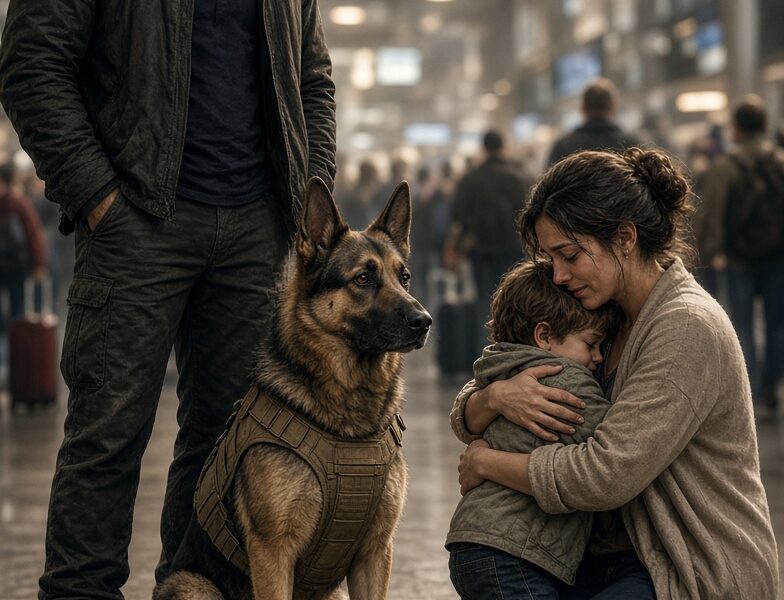
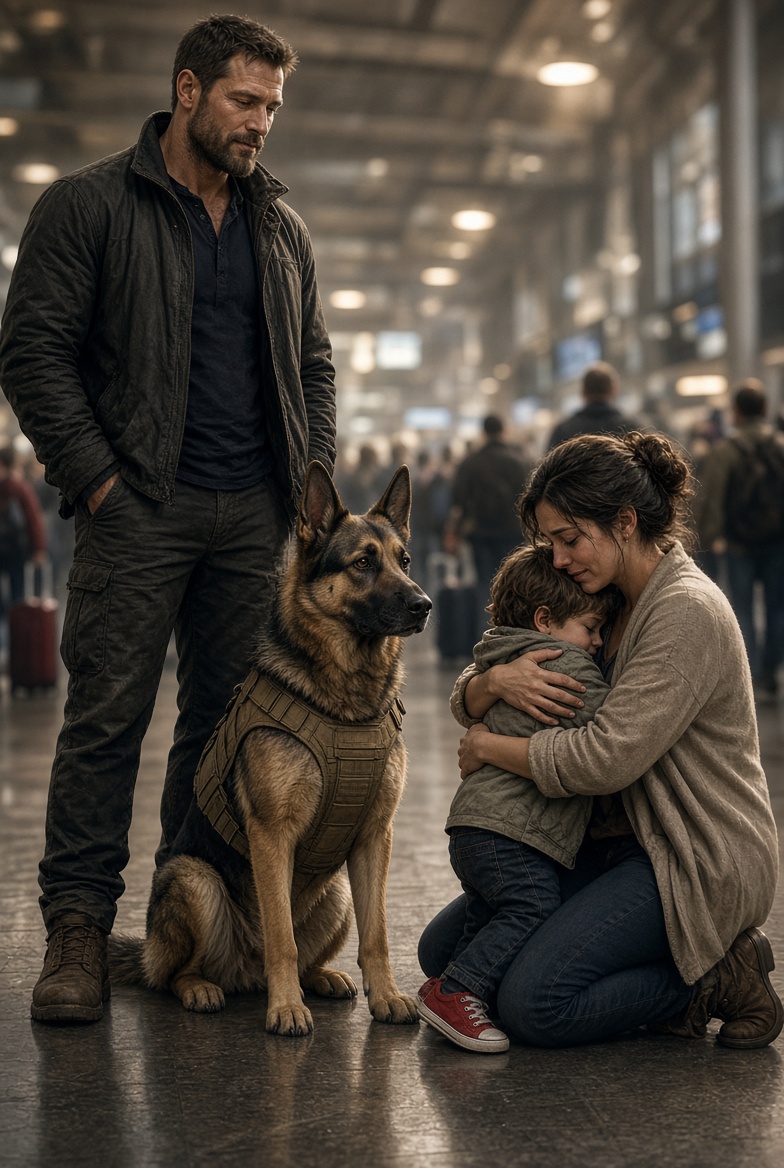
The ninety-four-pound German Shepherd wore a sand-colored military working dog vest with one simple warning printed across the side: DO NOT PET.
His ears turned toward the baggage claim escalators.
Then his body stiffened.
Jasper followed the dog’s gaze, and the quiet vacation he had planned for the next seventeen days began falling apart before he had taken ten steps into the airport.
He had come to Colorado to disappear for a little while.
A rented cabin outside Aspen waited among four hundred acres of pine trees, far from the noise of military installations, emergency briefings, and the endless demands of a life in which someone was always waiting for him to solve a problem.
He had packed one duffel bag, brought his service dog, and deliberately left his work phone buried in the bottom of his luggage.
Seventeen days.
That was all he wanted.
Seventeen days without alarms, orders, or anyone asking him to run toward something everyone else was running away from.
He had made himself a promise before leaving his base.
For once, he would not be responsible for anybody except himself and the dog walking beside him.
It was a reasonable promise.
It was also one he would break before reaching baggage claim.
Kodiak planted all four paws on the floor.
The leash tightened in Jasper’s hand.
“Easy, buddy,” Jasper murmured.
The German Shepherd did not look at him.
His nostrils flared, and the fur along his shoulders rose just enough to tell Jasper that his attention had locked onto something specific.
Kodiak had been trained to distinguish ordinary noise from meaningful danger. He did not waste energy barking at rolling suitcases or reacting to every stranger who crossed his path.
When he stopped like this, Jasper listened.
Always.
He lowered his duffel bag, followed the dog’s line of sight, and noticed a crowd gathered near a bank of seats beneath the digital departures board.
It was not the loose circle people formed around a spilled drink or a broken suitcase.
This crowd had a different shape.
People at the outer edge were stepping backward. Several passengers held their phones above their heads. Others watched with the uncomfortable expressions of people who knew something was wrong but had not yet decided whether they wanted to become involved.
At the center of the circle, a woman was crying.
“Please! Somebody, please listen to me!”
Her voice cracked on the last word.
“He was right here! He was holding my hand!”
Jasper picked up his bag and started walking.
He had spent enough time in dangerous places to understand that the first few minutes of a crisis could determine everything that followed.
He had also learned something less comfortable.
The greatest obstacle was not always the person causing the trouble.
Sometimes it was the room full of people waiting for somebody else to act.
By the time Jasper reached the crowd, the woman’s hands were shaking so badly that she could barely point toward the escalators.
She looked about twenty-eight years old. Her mustard-yellow sweater was twisted at one shoulder, her dark jeans were dusty at the knees, and her hair had come loose from its tie.
Her name, Jasper would soon learn, was Simone Bennett.
“My son is three years old!” she pleaded. “His name is Theo. We were sitting right there, and I looked down at my boarding pass for one second. One second!”
She pointed toward the seating area behind her.
“A man wearing a gray hoodie picked him up and walked toward the south escalators. He just took him!”
A man in a business suit shifted his carry-on behind his legs.
An older couple exchanged a worried glance.
Two teenagers continued filming.
One of them whispered excitedly to his phone, apparently more interested in the growing number of viewers than the desperate woman standing in front of him.
“Somebody call the police!” Simone cried.
Nobody answered.
“Please! He doesn’t know where I am. He’s only three!”
Jasper felt his jaw tighten.
He looked past the woman, toward the security desk at the end of the concourse.
No officers were visible.
No one was directing passengers away from the area. No emergency announcement had begun. There was no indication that anyone had reported a missing child.
The absence of a response bothered him almost as much as the woman’s words.
Then two uniformed airport security officers pushed through the crowd.
The first was broad-shouldered, with a flushed face and a name patch that read BOWER.
The second, CORWIN, was leaner and moved with a restless quickness that Jasper recognized immediately.
Simone nearly collapsed with relief.
“Thank God! Please, you have to help me. A man took my son. He’s wearing a gray hoodie. He went toward the south escalators!”
Bower raised one hand.
“Ma’am, calm down.”
“My son is missing!”
“You’re creating a disturbance.”
Simone stared at him as though she had not understood the words.
“What?”
“You’re alarming other passengers. Lower your voice.”
“A man took my child!”
Bower glanced at the crowd, then back at her.
“Or did you lose him?”
The question landed with the cold finality of a door being slammed.
Simone’s mouth fell open.
“I was sitting right there. I turned to check my boarding pass, and when I looked back—”
“So you took your eyes off a three-year-old in a crowded airport.”
“He was holding my hand!”
“Then how did someone walk away with him?”
Jasper watched Simone’s expression change.
A moment earlier, she had been terrified but hopeful. Now, the very people she had expected to help were making her defend herself.
It was a subtle but devastating shift.
Instead of searching for Theo, the officers were turning his mother into the problem.
“Please,” she whispered. “You can check the cameras. You can ask the people sitting near us. Just call someone. Please.”
Bower sighed as though she had inconvenienced him.
“We’re going to need you to come with us.”
“No! I’m not leaving. My son is somewhere in this airport!”
Corwin moved behind her.
Jasper immediately recognized the positioning.
One officer controlled the conversation while the other took away the person’s ability to leave.
“There’s a family services office,” Corwin said. “We’ll discuss this somewhere quieter.”
“I’m not going anywhere!”
Corwin grabbed Simone’s upper arm.
She twisted away.
“Don’t touch me! I haven’t done anything!”
“Ma’am, stop resisting.”
“You’re wasting time!”
Bower reached toward the restraints attached to his belt.
That was when Jasper stepped forward.
He did not shout. He did not rush. He simply crossed the remaining distance and placed himself between Corwin and Simone.
Kodiak moved beside him, his shoulders level with Jasper’s thigh, his attention fixed on the two officers.
“Step away from her,” Jasper said.
Bower looked him up and down.
His eyes paused on Kodiak’s military vest before returning to Jasper’s face.
“This doesn’t involve you. Keep moving.”
“A three-year-old child has reportedly been taken, and you’re trying to remove his mother from the area.”
Jasper kept his voice even.
“You have radios. Call it in.”
“I don’t take orders from civilians.”
“Then take them from common sense.”
A few people in the crowd lowered their phones.
Bower stepped closer.
“You need to understand something. You’re interfering with an official security matter.”
“And you’re standing in the middle of an active search without broadcasting the description of a missing child.”
Jasper glanced at the officer’s radio.
“Male suspect. Gray hoodie. South escalator corridor. Carrying a three-year-old boy. That’s the first call you should have made.”
Corwin released Simone’s arm, but his expression hardened.
Bower’s face reddened.
“Last warning. Walk away, or you’ll be on the ground beside her.”
Jasper did not move.
Behind him, Simone was breathing in short, panicked bursts.
“Please,” she whispered.
He heard something in that single word that reminded him of voices over military radios, voices from people who had reached the end of their options and were waiting to learn whether anyone had heard them.
He had once promised himself he would stop being the person who always answered.
But promises made in comfortable rooms had a way of disappearing when someone needed help.
“Call it in,” Jasper repeated.
Corwin suddenly reached around him, trying to seize Simone’s wrist.
Jasper intercepted the movement.
He caught Corwin’s wrist, redirected the man’s momentum, and released him as soon as Simone was free.
The movement was brief and controlled.
No punch. No dramatic struggle.
Just enough to stop the grab.
Corwin stumbled half a step, and the plastic restraints slipped from his hand, skittering across the polished floor.
“You just assaulted a security officer!” Bower snapped.
“Then document exactly what happened,” Jasper replied. “Starting with the part where you tried to restrain a frightened mother instead of searching for her missing child.”
The crowd had gone quiet.
A woman in her fifties stood near the edge of the circle, one hand gripping the handle of her rolling suitcase.
“Why aren’t they calling it in?” she asked.
Nobody answered her.
She looked directly at Bower.
“Why haven’t you called the police?”
A second passenger lowered his phone.
“I’ve been standing here for five minutes,” he said. “I haven’t heard either of you mention the child over your radios.”
Another voice followed.
“Neither have I.”
The atmosphere changed.
It was no longer a crowd watching a confrontation for entertainment.
People were beginning to understand that the confrontation itself might be distracting them from something far more important.
Jasper noticed Bower glance toward the south escalators.
Then toward his radio.
Then toward Corwin.
It was a sequence of movements that lasted less than two seconds, but Jasper had spent years learning to read what people did when they thought nobody was watching.
Bower was not merely annoyed.
He was afraid.
And whatever he was afraid of, it was connected to the missing child.
Jasper’s promise to himself was already broken.
Now he needed to know why.
“Where does the south escalator corridor connect on the lower level?” Jasper asked.
Bower said nothing.
“Rental car facility?” Jasper continued. “Shuttle bays? Service access?”
Still nothing.
Simone suddenly spoke behind him.
“There’s a service tunnel.”
Jasper turned slightly.
She wiped her face with the back of her hand, trying to force herself to think through the panic.
“I’ve flown through Denver before. The lower connector leads toward the rental car facility and the shuttle bays. There’s a freight access door along the eastern side.”
“How do you know that?”
“I saw the signs when we arrived.”
She swallowed.
“The man went south. I’m sure of it.”
Jasper looked down.
Kodiak had stopped growling.
The dog was staring toward the corridor, his body angled forward, his ears pointed toward the lower level.
Then he gave one sharp bark.
Not a warning this time.
A decision.
Jasper understood.
“All right, buddy.”
He turned toward the crowd.
“You, in the suit. Call 911. Tell them a three-year-old child may have been taken from the south concourse at Denver International Airport. Give them the description and explain what’s happened here.”
The man blinked.
“Me?”
“Yes. You.”
Jasper held his gaze.
“Tell them the exact truth. Don’t speculate. Don’t leave anything out.”
The man immediately brought his phone to his ear.
Jasper pointed to the woman with the rolling suitcase.
“Please stay with Simone. Don’t let her get separated from the responding officers.”
“I will.”
Simone stepped forward.
“I’m coming with you.”
“No.”
Her expression hardened.
“You don’t get to tell me to sit here while you look for my child.”
“I know.”
“Then let me come.”
Jasper lowered his voice.
“The lower corridor is unfamiliar to you, and if we find the wrong person, I need both hands free. You need to stay here where the responding team can find you immediately.”
Simone looked as if she wanted to argue.
Then her eyes dropped to Kodiak.
The German Shepherd had turned his head toward her.
For one brief moment, his expression seemed almost gentle.
Jasper rested a hand against the dog’s shoulder.
“He’s very good at his job.”
Simone pressed both hands over her mouth.
“Please bring Theo back.”
Jasper looked at her.
“I will do everything I can.”
It was not the easy promise she wanted.
It was the only honest one he could make.
Then he picked up his duffel, secured the leash, and followed Kodiak toward the south escalators.
Behind him, Bower finally reached for his radio.
But he did not call for help.
He called someone else.
And Jasper, already moving toward the lower level, did not hear the words that would later become one of the most important pieces of evidence in the investigation.
The escalator carried them down into a cooler, quieter part of the airport.
The crowds thinned. The bright terminal lights gave way to a more industrial glow. Signs pointed toward the train platform, ground transportation, and the rental car facilities.
Jasper moved at a controlled run.
Kodiak worked ahead of him, nose close to the floor, following a trail that was still fresh enough to hold the dog’s attention.
Jasper watched every change in the animal’s posture.
A slight drop in the left shoulder indicated an approaching turn. A quick lift of the head suggested a change in the scent. The dog’s breathing had become faster, but his movements remained focused.
The trail was leading them away from the public areas.
Toward the service corridors.
Jasper’s military training had taught him to plan around what he knew, identify what he didn’t, and avoid mistaking confidence for certainty.
He knew a child had disappeared.
He knew the mother had described a man in a gray hoodie.
He knew two security officers had behaved in a way that made no sense for an ordinary missing-child report.
But he did not know how many people were involved, whether the suspect had a vehicle, or whether the child was still nearby.
Those unanswered questions made speed important.
They also made caution essential.
At the connector hallway, Kodiak turned toward a gray steel door.
A badge reader glowed red beside the frame.
The dog sniffed along the bottom seam, then placed both front paws against the metal.
He inhaled three times.
Finally, he sat and looked up at Jasper.
The message was unmistakable.
The trail continued beyond the door.
Jasper examined the lock.
A magnetic strike plate held the door closed. Beyond it lay a restricted maintenance area, one that passengers were not supposed to enter.
He tested the handle.
Locked.
He looked back toward the empty corridor.
No security personnel had followed them.
No announcement had yet directed passengers to look for a missing child.
And every second was being spent in a place where the suspect could move without being seen by the traveling public.
Jasper stepped back.
He struck the frame near the locking mechanism with the heel of his boot.
The first impact rattled the door.
The second weakened the frame.
On the third, the locking assembly gave way, and the heavy door swung inward.
Cold air drifted through the opening.
The smell of concrete, dust, exhaust, and rubber filled the corridor.
Somewhere ahead, an engine was running.
Kodiak was already moving.
Jasper followed him down a short flight of stairs and around a bend into a loading area beneath the airport.
Concrete pillars rose into shadow. Equipment carts stood beside stacked pallets. Overhead lights hummed, leaving several sections of the space dim.
Beyond a line of shuttle buses, a gray panel van sat with its engine running.
Its side door was open.
A man stood beside it.
He was lean, perhaps forty years old, wearing a gray hoodie.
In his arms was a small boy with dark hair and red sneakers.
Theo.
The boy was no longer crying.
His face was pale, and his eyes had the distant, frightened look of a child who had run out of ways to ask for help.
Jasper felt something inside him go cold.
The man turned at the sound of the broken door.
He looked at Jasper.
Then he looked at Kodiak.
For a fraction of a second, all three held still.
The man moved first.
He pushed Theo into the van and reached toward his waistband.
Jasper saw the object in his hand.
A conducted-energy device.
“Put it down!” Jasper shouted.
The man fired.
Jasper turned, but not quickly enough to avoid the contact.
The shock hit his left arm and drove him down to one knee. His muscles seized involuntarily, and pain flashed through his shoulder.
He kept his balance long enough to see the man move toward the driver’s door.
Jasper released the leash.
“Go!”
Kodiak surged forward.
The German Shepherd covered the distance in seconds, intercepting the man’s movement before he could reach the driver’s seat.
The man stumbled against the van and went down onto the concrete.
The device clattered away.
Kodiak held him in place, trained and controlled, preventing him from getting back up.
Jasper forced himself to his feet.
His left arm trembled. The shock had left his muscles uncooperative, but he pushed through the discomfort and moved toward the man.
“Stay still,” he ordered.
The man stopped struggling.
Jasper secured his wrists with restraints from his own equipment, then gave Kodiak the command to release.
The dog stepped back immediately.
His breathing was heavy, but his eyes remained fixed on the suspect.
Jasper glanced at him.
“Good work.”
Kodiak’s ears flicked toward the van.
So did Jasper’s.
A small sound came from inside.
Not a word.
Just a frightened, uncertain breath.
Jasper approached the open side door slowly.
He could see Theo pressed against the far wall, his knees drawn toward his chest.
The boy stared at him.
Jasper crouched until his face was closer to the child’s level.
He made no sudden movements.
“Hey, Theo.”
The boy said nothing.
“My name is Jasper.”
Jasper extended one open hand, palm upward.
“I know your mom. She’s waiting upstairs for you.”
Theo’s lower lip trembled.
“Mommy?”
“Yes, buddy. Mommy’s waiting.”
Jasper kept his voice steady.
“She told me she wants to see those red sneakers again.”
The boy glanced down at his shoes.
For the first time, his expression changed.
A tiny spark of recognition appeared beneath the fear.
“Red,” Theo whispered.
“That’s right. Very red.”
Jasper smiled gently.
“Think you can come over here and help me get you back to her?”
Theo looked toward the loading area.
His eyes settled on Kodiak.
The dog sat a few feet away, keeping his body low and his movements quiet.
Theo stared at him for a long moment.
“Doggie?”
“That’s Kodiak,” Jasper said. “He’s my partner.”
Theo hesitated.
Then he reached toward Jasper.
Jasper took the small hand carefully, giving the boy time to decide whether he wanted to come closer.
Theo moved into his arms.
Jasper lifted him from the van and held him against his shoulder.
The boy clung to his shirt with both hands.
For a moment, Jasper closed his eyes.
The relief was overwhelming, but he did not allow himself to mistake the rescue for the end of the situation.
The suspect was secured.
The child was safe.
Now they needed to get back upstairs and make sure the people responsible could not quietly disappear behind their uniforms.
Footsteps echoed through the service corridor.
Flashlights swept across the loading area.
“Federal agents! Keep your hands visible!”
Jasper turned toward the voices, holding Theo securely with one arm and keeping his other hand where the approaching officers could see it.
“Suspect is secured beside the van,” he called. “The child is safe.”
A group of federal agents entered the loading area.
At their front was a woman with silver hair and calm, watchful eyes. She moved with the measured confidence of someone who had spent years arriving after other people had made difficult decisions.
She looked at the suspect.
Then the van.
Then Jasper and the boy.
“Are you the one who called this in?”
“No. A bystander upstairs called 911.”
“Name?”
“Jasper Cole.”
“Occupation?”
“Navy SEAL. Currently on leave.”
Her eyes briefly moved to Kodiak’s vest.
“Military working dog?”
“Yes, ma’am.”
She nodded toward another agent, who immediately moved to secure the suspect and inspect the vehicle.
“I’m Agent Mercer,” she said. “We’re taking over from here.”
Jasper nodded.
“Good. There are two airport security officers upstairs who need to be separated and questioned. Their response to the mother’s report was highly suspicious.”
Agent Mercer studied him.
“What makes you say that?”
“They attempted to restrain the mother instead of broadcasting the description. Neither one initiated an appropriate search while I was present. One appeared afraid when I asked about the service corridors.”
“Did either officer threaten you?”
“Yes.”
“Did you witness anything else?”
Jasper gave her a concise account of what had happened, beginning with the crowd near the departures board and ending with the suspect beside the van.
He did not embellish.
He did not guess.
He told her what he had seen and what he had heard.
Agent Mercer listened without interrupting.
When he finished, she glanced toward the suspect.
“We’ll handle the rest.”
Jasper looked down at Theo.
The boy had buried his face against his shoulder, one small hand gripping the fabric of his shirt.
“His mother is upstairs,” Jasper said. “I want to get him back to her as soon as possible.”
“Understood.”
Agent Mercer stepped aside to let them pass.
Jasper started toward the corridor.
Kodiak fell into step beside him.
The dog brushed his shoulder against Jasper’s leg, a brief contact that helped anchor him as the last traces of the shock faded from his muscles.
They climbed the stairs.
They passed through the damaged door.
And they returned to the airport.
Everything looked different.
The concourse was no longer a place where people stood around waiting to see what happened next.
Uniformed officers were moving in coordinated directions. Airport personnel were directing passengers away from the affected area. A public-address announcement instructed travelers to follow staff guidance while emergency personnel responded to an incident.
Several people who had witnessed Simone’s ordeal were speaking to investigators.
The man in the business suit was still there, his phone in his hand.
The woman with the rolling suitcase stood beside Simone.
And Simone herself was near a temporary boundary line, searching every face that emerged from the corridor.
Her hands were clasped tightly beneath her chin.
Her eyes moved from one uniform to another.
Then she saw the red sneakers.
For a second, she did not move.
Jasper crossed the boundary with Theo in his arms.
An officer began to raise a hand, then recognized the child and stepped aside.
Simone’s mouth opened.
No sound came out.
Then she dropped to her knees.
“Theo!”
The little boy lifted his head.
“Mommy!”
He reached toward her with both arms.
Jasper lowered him gently to the floor.
Theo ran.
His red sneakers slapped against the polished tile as he crossed the distance between them.
Simone caught him and wrapped both arms around his small body.
She held him so tightly that for a moment it looked as if she were trying to protect him from the entire world.
“My baby. Oh, my baby.”
She pressed kisses against his hair, his forehead, and both cheeks.
Theo buried his face against her neck.
“Mommy, doggie.”
Simone laughed through her tears.
“Yes, sweetheart. There’s a doggie.”
She held him closer.
“I’ve got you. I’ve got you.”
The crowd watched.
But the phones that had been raised to record her distress were gradually lowering.
The teenagers who had livestreamed her pleas stood silently at the edge of the group.
The woman with the suitcase wiped her eyes.
The man in the business suit turned away, his expression troubled.
A few people began to cry.
Jasper stepped back, allowing mother and son the space they needed.
Kodiak sat beside him.
The German Shepherd’s posture softened, and his tail moved once against the floor.
The mission was over.
At least, the part that involved bringing Theo home to his mother.
The rest was only beginning.
Fifteen minutes later, Bower and Corwin emerged from the north corridor in handcuffs.
The change in them was striking.
Without the freedom to move through the terminal as uniformed authorities, they seemed smaller. Bower’s face had lost its earlier confidence. Corwin stared at the floor.
Federal agents escorted them past the same crowd they had once tried to control.
Nobody applauded.
Nobody shouted.
The silence was more uncomfortable than either.
Agent Mercer approached Jasper near one of the south pillars.
“The officers are being detained while we investigate their conduct,” she said. “We’ve also secured the vehicle and are documenting the scene.”
“What about the airport’s surveillance footage?”
“We’re preserving it.”
“Good.”
She studied him for a moment.
“You made a number of decisions very quickly down there.”
“I had a missing child.”
“That isn’t what I asked.”
Jasper glanced at Kodiak.
“I saw a situation that needed action.”
Agent Mercer nodded slowly.
“Your witness called 911 before our team arrived. That helped us establish the timeline. We’ll need a full statement from you, and we’ll need the same from the people who witnessed the initial confrontation.”
“You’ll get it.”
“We may also need to discuss your entry into the restricted area.”
Jasper looked at the broken door visible down the corridor.
“I understand.”
Agent Mercer almost smiled.
“Something tells me you do.”
She moved away to speak with another investigator.
Jasper remained near the pillar, watching the airport settle into a more organized rhythm.
He could hear Theo talking to his mother.
The boy was telling her something about the dog, using the urgent, rambling language of a three-year-old who had experienced something frightening and had not yet found the words to explain it.
Simone listened to every syllable.
She did not interrupt.
She did not look at her phone.
She simply held him and listened.
After a few minutes, she noticed Jasper standing nearby.
She adjusted Theo on her hip and approached him.
For a long moment, she seemed unable to decide what to say.
“I don’t know how to thank you,” she finally whispered.
“You don’t need to.”
“Yes, I do.”
Her voice trembled.
“Everyone watched me. I begged them. I told them my son was gone, and people stood there filming me as if I were some kind of entertainment.”
Jasper said nothing.
“I thought the officers would help. I thought that was what they were there for.”
She glanced toward the corridor where Bower and Corwin had disappeared.
“Instead, they made me feel as if I had done something wrong.”
Her eyes filled again.
“I started wondering if anyone believed me.”
Jasper understood that part more than he wanted to.
There were moments when a person could endure fear, exhaustion, and uncertainty because they believed someone was listening.
The damage came when the person asking for help realized that the people who could help had decided not to.
“You were right to keep asking,” he told her.
Simone shook her head.
“I should have held his hand tighter.”
“No.”
The word came out more firmly than he intended.
She looked at him.
Jasper softened his voice.
“Someone else made a choice. Don’t carry that person’s decision as if it were your failure.”
Simone stared at him.
For the first time since he had seen her, she seemed to take a full breath.
Theo leaned over her shoulder.
“Doggie?”
Kodiak rose and approached at a slow walk.
Jasper watched the boy carefully.
“Let him come to you,” he said.
Simone lowered Theo until his feet touched the floor.
The boy took one tentative step toward the German Shepherd.
Kodiak lowered his head.
Theo reached out and touched the thick fur behind the dog’s ear.
The German Shepherd remained perfectly still.
“Soft,” Theo whispered.
“Very soft,” Jasper agreed.
Theo smiled.
It was a small smile, uncertain at the edges, but unmistakably real.
Simone covered her mouth with one hand.
Jasper pretended not to notice her tears.
He had seen enough difficult reunions to understand that sometimes people needed the freedom to cry without being asked to explain why.
She knelt beside Theo and stroked Kodiak’s back.
“Thank you,” she whispered to the dog.
Kodiak leaned into her palm and closed his eyes for a moment.
Jasper felt the familiar weight settle across his shoulders.
He was tired.
His arm hurt.
His duffel bag still sat where he had left it before the crowd gathered, and his planned vacation seemed like something that had happened to a different person on a different day.
He had wanted seventeen days of quiet.
Instead, he had spent the first hour of his leave chasing a missing child through an airport service corridor.
And he would make the same decision again.
Before Jasper could leave, Agent Mercer returned with a tablet and a serious expression.
“There’s something you should know.”
He waited.
“We reviewed the initial camera feeds. The man in the gray hoodie entered the public concourse before the child disappeared. He spent several minutes near the seating area.”
“Watching the mother?”
“Possibly. We’re still establishing the sequence.”
She showed Jasper a still image.
The man stood beside a column, his face partly obscured by the hood.
In another image, he was near a corridor leading toward the south escalators.
A third showed the gray van entering the restricted loading area.
Jasper examined the images carefully.
“How did he get through the service access?”
“That’s one of the questions we’re investigating.”
“And the door?”
“An access log shows an authorized credential was used earlier.”
Jasper looked up.
“Earlier when?”
“Approximately twenty minutes before the child disappeared.”
He felt the pieces shift in his mind.
The officers’ refusal to call for help.
Bower’s fear.
The corridor.
The van.
A door that should have remained secured.
The case was becoming larger than one man in a gray hoodie.
“Do you have the credential information?” he asked.
“We’re reviewing it now.”
Agent Mercer paused.
“I’d advise you not to draw conclusions until we know more.”
“I’m not drawing conclusions.”
Jasper handed the tablet back.
“I’m identifying questions.”
That distinction mattered.
He had seen too many investigations damaged by people who decided they understood everything before the evidence was complete.
He would not become one of them.
Still, he could not ignore the possibility that the suspect had received help from someone with access to the airport’s restricted areas.
And if that was true, the people responsible had counted on the public never noticing the difference between a missing child and a mother who appeared to be making a scene.
The thought stayed with him as he watched Simone and Theo speak with a medical responder.
The responder checked Theo’s condition, asked a few simple questions, and confirmed that the boy could be taken for a more thorough evaluation if his mother wished.
Simone agreed.
She wanted to make sure he was physically all right.
She also wanted to hear him talk, laugh, ask for a snack, and complain about his shoes.
She wanted the ordinary things back.
Jasper understood.
Ordinary things were often the first proof that a frightening moment had ended.
A little while later, an airport supervisor approached Jasper.
He was a neatly dressed man in his fifties, wearing a dark suit and a badge clipped to his belt.
“Mr. Cole? I’m Richard Hale, terminal operations manager.”
Jasper nodded.
“I understand you’ve been involved in an incident.”
“That’s one way to describe it.”
Hale glanced at Kodiak.
“We appreciate your concern for the child, but we need to discuss your entry into a restricted area and the damage to the service door.”
“Of course.”
“The airport has procedures for emergencies.”
“Then I hope the investigation will establish why those procedures weren’t followed when a mother reported her three-year-old missing.”
Hale’s expression tightened.
“Our personnel are trained to handle these situations.”
“Then the footage should make it easy to determine whether they did.”
For several seconds, neither man spoke.
Hale finally cleared his throat.
“We will cooperate with the federal investigation.”
“Good.”
Jasper adjusted the strap of his duffel bag.
“Because the next person who needs help shouldn’t have to rely on a stranger noticing that something is wrong.”
Hale looked away.
Jasper did not wait for a response.
He had no interest in winning an argument with an airport manager.
He wanted the evidence preserved, the facts established, and the people responsible held accountable through the proper process.
Anything less would leave the door open for the same failure to happen again.
At the edge of the concourse, Simone returned from speaking with the responder.
Theo was in her arms, his head resting against her shoulder.
She approached Jasper one last time.
“They’re taking us to get him checked out,” she said. “They told me he seems stable, but I want to make sure.”
“That’s a good idea.”
She looked toward Kodiak.
“Will we ever see you again?”
Jasper glanced at the dog.
“Depends on where life takes us.”
Simone gave a small, watery laugh.
“That’s not a very satisfying answer.”
“No,” he admitted. “It’s not.”
She shifted Theo higher on her hip.
“I want him to remember today differently someday. Not just as the day he was frightened.”
Jasper waited.
“I want him to remember that someone came for him.”
He looked at the boy.
Theo was studying the German Shepherd with great concentration.
“Then tell him that part,” Jasper said. “Tell him someone heard you, and someone came.”
Simone nodded.
She reached toward Jasper as if she wanted to hug him, then hesitated.
He made the decision easy for her by stepping forward.
She wrapped one arm around his shoulders, careful not to disturb the bag, and held him for a moment.
“Thank you for believing me.”
Jasper closed his eyes briefly.
“You didn’t need to convince me.”
When she stepped back, her face had changed.
She was still frightened.
She was still shaken.
But she was no longer alone inside that fear.
Theo reached toward Kodiak one more time.
“Bye, doggie.”
Kodiak tilted his head.
Jasper smiled.
“Say goodbye, buddy.”
The dog gave a quiet huff.
Theo giggled.
It was the first unguarded laugh Jasper had heard from him.
Then Simone turned and walked toward the medical team, carrying her son into the safer, quieter part of the day.
Jasper watched until they disappeared around the corner.
Only then did he pick up his duffel bag.
He had spent months imagining what he would do with seventeen days of leave.
Sleep late.
Walk through the woods.
Cook simple meals in a cabin with no cell signal.
Let his mind become quiet.
The plans had not survived the afternoon.
He looked at Kodiak.
The dog sat beside him, calm again, as if the entire incident had been another assignment completed according to a familiar set of rules.
“Some vacation,” Jasper murmured.
Kodiak wagged his tail once.
Jasper almost laughed.
Then Agent Mercer called his name from across the concourse.
He turned.
“We need you for a formal statement,” she said. “And there’s one more thing.”
Jasper walked back toward her.
“What is it?”
“We’ve recovered a recording from a security camera near the loading area. It shows the suspect’s van arriving before the incident involving the mother.”
“How much earlier?”
“Twenty-three minutes.”
The number settled between them.
Twenty-three minutes.
Long enough for someone to plan a route.
Long enough to arrange access.
Long enough for an ordinary afternoon to become something far more dangerous than the passengers around them had imagined.
Agent Mercer continued.
“We’re also checking whether the same vehicle appeared in any previous reports.”
Jasper looked toward the corridor.
“Do you think this was planned?”
“I think we need to find out.”
She studied him.
“Would you be willing to remain available while we finish the initial interviews?”
Jasper glanced at his duffel.
Then at Kodiak.
“Yes.”
It was a simple answer.
But he knew what it meant.
The quiet he had wanted would have to wait.
As investigators collected statements, preserved camera footage, and documented the damaged door, Jasper answered questions about the confrontation.
He described Bower’s refusal to call for help.
He described Corwin’s attempt to restrain Simone.
He explained the route he and Kodiak had followed and the location where they found Theo.
He did not call the officers criminals.
He did not claim to know why they had acted as they had.
He simply described what happened.
The evidence would have to speak for itself.
One detail, however, stayed with him.
When he had asked Bower where the south escalator corridor led, the officer had not looked confused.
He had looked afraid.
That was not proof of involvement.
But it was a question that deserved an answer.
By early evening, the terminal had returned to something resembling normal.
Flights continued boarding.
Passengers collected their bags.
Families gathered near departure gates.
The airport announcements rolled on overhead, their familiar cadence restoring the illusion that everything had been ordinary all along.
Jasper stood near a window overlooking the roadways outside.
The Rockies were fading into the evening haze.
His phone buzzed for the first time since the incident.
A message from his unit asked whether he had arrived safely.
He typed a short reply.
“Arrived. Delayed by an incident. All good.”
He considered adding more, then decided against it.
There would be reports.
There would be interviews.
There would be questions about the door, the suspect, and the two officers.
There would be paperwork to establish exactly what had happened.
None of that needed to fit into a text message.
He put the phone away.
Kodiak lay beside his boots, resting his chin on his paws.
For the first time that afternoon, the dog appeared completely relaxed.
Jasper rubbed the fur behind his ears.
“You know,” he said quietly, “we were supposed to be in the mountains by now.”
Kodiak’s tail moved against the floor.
“Four hundred acres of pine trees. No radios. No emergencies.”
Another small wag.
Jasper shook his head.
“You’re not even sorry.”
The dog looked up at him.
For the first time all day, Jasper laughed.
It was brief, almost surprised, but real.
Then his expression softened.
He thought of Simone’s face when she saw those red sneakers.
He thought of the people who had filmed her instead of helping.
He thought of the two officers who had used their authority to silence a woman asking for help.
And he thought of the moment Kodiak had stopped near baggage claim.
The dog had not known the whole story.
Neither had Jasper.
They had simply recognized that something was wrong and moved toward it.
That was where everything had begun.
Not with a perfect plan.
Not with certainty.
With a decision.
Jasper picked up his duffel and settled the strap over his shoulder.
He had no idea how the investigation would end.
He did not know whether the airport would change its procedures, whether additional personnel would be disciplined, or whether the evidence would reveal more than anyone yet suspected.
Those answers belonged to the investigators.
His part was simpler.
He had seen a mother asking for help.
He had heard a child was missing.
And he had refused to walk away.
As he headed toward the exit, a young airport employee approached him.
“Sir?”
Jasper stopped.
The employee looked nervous.
“I just wanted to say thank you.”
Jasper glanced at him.
“For what?”
“For going after the boy.”
The young man swallowed.
“I was working near the seating area when it started. I saw the crowd, but I didn’t know what to do. I thought security had everything under control.”
He looked down at his hands.
“Then I saw the officers trying to take the mother away, and I still didn’t say anything.”
Jasper remained silent.
“I should have done something.”
“Next time,” Jasper said, “don’t wait for someone else to make the first move.”
The employee nodded.
“I won’t.”
Jasper started walking again.
He did not know whether the young man would remember the conversation tomorrow or a year from now.
But perhaps he would remember it the next time somebody needed help.
Perhaps he would make a phone call, alert a supervisor, or simply refuse to let a frightened person stand alone in the middle of a crowd.
Small decisions mattered.
Sometimes they mattered more than anyone could see at the time.
Outside, the evening air was cold and clean.
Traffic moved along the airport roadway, headlights stretching into long lines beneath the darkening sky.
Jasper paused near the curb while he arranged transportation.
Kodiak stood beside him, his sand-colored vest catching the glow of the terminal lights.
A mother and her child were safe.
A suspect was in custody.
An investigation was underway.
None of it had been part of the plan.
Jasper looked down at the dog.
“Seventeen days,” he said.
Kodiak leaned against his leg.
Jasper rested a hand on the dog’s head.
“Let’s see if we can get at least one quiet night.”
The German Shepherd’s ears flicked toward a passing siren in the distance.
Jasper sighed.
“Don’t even think about it.”
Kodiak looked up at him.
And for a brief moment, beneath the wide Colorado sky, they were simply a tired man and his dog standing at the end of a very long day.
The world around them kept moving.
Flights departed.
Cars pulled away.
People hurried toward their next appointments, their next dinners, their next ordinary evenings.
Most would never know what had happened beneath the terminal.
Most would never see the broken service door or the gray van or the frightened little boy in red sneakers.
That was how it should have been.
A child had been brought home to his mother.
A frightened woman had been heard.
And somewhere in the middle of an airport crowded with people, one man and one German Shepherd had refused to let the noise drown out the truth.
Jasper had left his cabin plans behind.
He had broken his promise to spend seventeen days doing nothing of consequence.
But as he watched the airport lights shimmer against the evening sky, he understood something he had known long before he ever put on a uniform.
The promises that mattered most were not always the ones made in quiet rooms.
Sometimes they were made without words, in the instant when someone needed help and you had to decide whether to keep walking.
Jasper adjusted the duffel on his shoulder.
Kodiak fell into step beside him.
They walked away from the terminal together, leaving the lights, the crowds, and the long afternoon behind.
And the last thing Jasper remembered was not the broken door, the frightened suspect, or the officers in handcuffs.
It was the sound of a little boy laughing when he touched Kodiak’s fur.
That sound was worth every second.
Because in the end, the measure of a man was never how loudly he could command a room, how impressive his uniform looked, or how many people knew his name.
It was what he did when a frightened mother screamed for help, an entire crowd stood still, and nobody seemed willing to listen.
Jasper had listened.
Kodiak had listened first.
And together, they had reminded everyone watching that courage did not always arrive with flashing lights or a commanding voice.
Sometimes it walked through automatic doors carrying a duffel bag.
Sometimes it had four paws, a military vest, and ears that could hear what others ignored.
And sometimes, when the whole world seemed determined to look away, it was enough for one person to take a step forward.
That was how a child found his way back into his mother’s arms.
That was how a crowd learned the cost of doing nothing.
And that was how seventeen quiet days in Colorado became a reminder Jasper Cole would carry for the rest of his life: when someone is crying for help, the most important question is not whether the problem belongs to you.
It is whether you are willing to be the person who answers.









