A Waitress Dropped Her Tray to Save an Old Woman — Then the Bride Slapped Her in Front of Everyone
“Faster, Lewis. Mrs. Crane wants everything perfect tonight.”
“Yes, sir. Right away.”
The ballroom of the Whitcomb Grand was a cathedral of white roses and crystal, every table set with silver that caught the light like tiny stars.
Amara Lewis moved through it all with a tray balanced on her palm, her black uniform pressed crisp, her name tag pinned straight.
She had been on her feet since 4:00 a.m., and it was now 7:45 in the evening.
Her feet ached in shoes that were half a size too small, but she didn’t show it.
You never showed it in this job.
“Just like my daughter,” Mrs. Crane was saying to a circle of women in silk dresses, gesturing at the bride across the room.
Madison Crane stood under the arch of flowers like a painting, blonde and beautiful and cold as the champagne in her hand.
Amara kept her eyes down and her tray level.
She had learned that much in six years of waiting tables.
“Colin, who is that old woman in the cardigan?” Mrs. Crane’s voice cut across the room like a knife through butter.
“She is not on my list, Mrs. Crane.”
“Move her by the kitchen doors. She is ruining my photos.”
Amara glanced toward the corner and saw her.
An old woman in a faded blue cardigan, silver hair pinned back with a simple clip, sitting alone in a chair near the service entrance.
She looked small in that big room, like a sparrow in a hall of peacocks.
Her chair was positioned right at the top of the grand staircase that swept down into the ballroom, the kind of staircase brides dreamed about.
The old woman’s hands were folded in her lap, and she was watching the crowd with quiet eyes.
“Sir, please,” someone was saying. “The brake on my chair is loose.”
“Then sit still and do not bother the guests.”
Amara’s brow furrowed.
She didn’t like the sound of that.
But she had twelve tables to serve and a head waiter who counted her steps.
“Ma’am, are you all right back here?” she said, stopping beside the old woman on her way to the kitchen.
“Can I bring you a plate?”
The old woman looked up, and her eyes were the color of good whiskey.
“Nobody has spoken to me all night, dear.”
Amara’s heart did something it shouldn’t have done during a shift.
It softened.
“Then I will check on you every chance I get.”
“What is your name, dear?”
“Amara. Amara Lewis.”
“Amara,” the old woman repeated, like she was tasting the name. “That is a beautiful name.”
“Amara, head table, now!” Colin’s voice cracked across the room.
“Excuse me, ma’am.”
Amara hurried away, but she glanced back once.
The old woman was still watching her.
“Has anyone found my grandmother?” a young man’s voice carried across the ballroom. “She said she would come tonight.”
“Babe, forget her. Tonight is about us. I am sure she got lost on the way from her farm.”
The young man was Ethan Whitcomb, the groom, tall and handsome in a tuxedo that probably cost more than Amara’s rent for a year.
He looked worried.
His bride, Madison, looked annoyed.
“Somebody please honor seed for the emerging tigers,” Mrs. Crane was saying to the catering manager, mispronouncing something that was probably supposed to be fancy.
Amara didn’t have time to figure it out.
She had a tray of drinks and a table of guests who snapped their fingers at her like she was a dog.
“Listen, ma’am,” she heard Colin say to the old woman as she passed. “Wait. Iced tea in and out. Okay.”
Amara slowed.
Something was wrong.
The old woman was trying to stand, but her chair was wobbling.
The brake was loose.
Amara had heard the man say it earlier.
She looked at Colin.
He was walking away.
He didn’t care.
“Don’t—” Amara started.
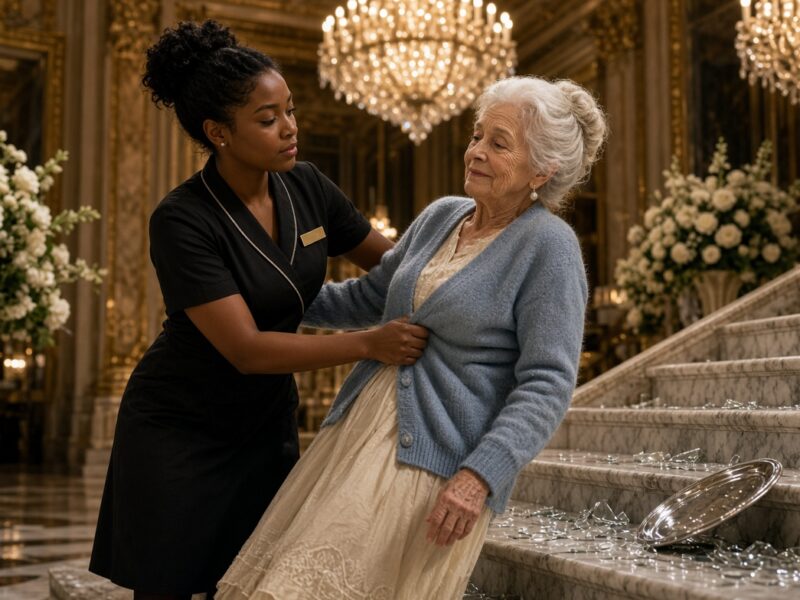
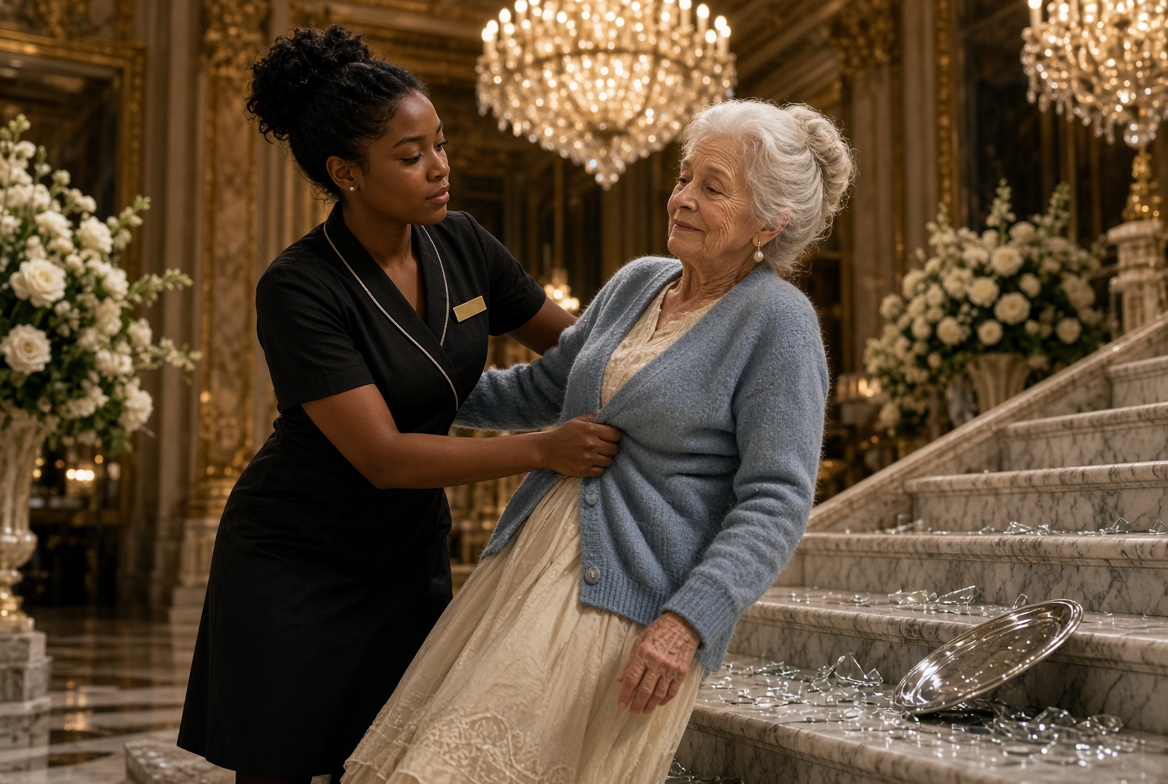
The old woman’s chair tipped.
She was at the top of the stairs.
The grand staircase.
Forty steps of marble.
Amara didn’t think.
She dropped her tray.
Glass shattered on the floor, a sound like a gunshot in the elegant room.
She lunged.
Her hand caught the old woman’s arm, then her waist, then both hands were holding her, pulling her back from the edge, and the chair went over instead, tumbling down the stairs in a terrible clatter of wood and metal.
The old woman was in Amara’s arms, shaking, her cardigan twisted, her silver hair coming loose from its clip.
“I have got you, ma’am,” Amara said, her voice steady even though her heart was pounding. “I have got you.”
The room went silent.
Then Madison Crane’s voice cut through it like a blade.
“My dress. My dress. You stupid, clumsy girl.”
Amara looked up.
Madison was standing at the top of the stairs, staring at her white gown.
There was a splash of something on the skirt.
Iced tea.
From the tray Amara had dropped.
“I am so sorry, ma’am,” Amara said. “She was about to fall down the stairs.”
“I do not care about some old woman. That is for ruining my wedding.”
“Colin,” Mrs. Crane’s voice was ice. “Is this how your staff behaves at a Crane wedding?”
“Lewis, you are fired. Get out of my ballroom.”
“Sir, the brake on her chair was off. Somebody left it—”
“And take your mess with you.”
“Stop this.”
The voice was quiet but it carried.
The old woman.
She was standing now, steady on her feet, her hand still gripping Amara’s arm.
“That girl just saved my life.”
“Nobody asked you, Grandpa,” Madison snapped.
The room went very still.
Ethan Whitcomb’s face went pale.
“What did you just say?”
“Security, take the waitress out the back—”
“Stop.”
Ethan’s voice was louder now.
He was staring at the old woman.
“Grandma?”
The old woman looked at him.
“Hello, Ethan.”
“Grandma, why are you sitting at the edge of the stairs?”
“A waitress caught me at the top of those stairs, and your bride slapped her for it.”
Ethan turned to Madison.
“Ethan, I did not know it was her.”
“That is exactly the problem, dear,” the old woman said.
Her name was Eleanor Whitcomb.
And she owned the hotel.
She owned forty-one hotels like it.
Amara didn’t know that yet.
All she knew was that her tray was broken, her job was gone, and her rent was due Friday.
“Amara,” Colin was saying, his face red. “Colin says you will never work in this city again.”
“I would do it again, Jade,” Amara said, looking at the old woman. “Every single time.”
The old woman smiled.
“He kept your tips,” someone said. “Three weeks of tips.”
“Let him keep them. She is alive.”
“Mrs. Whitcomb, I am so sorry.” Monica, the event coordinator, was rushing over. “Nobody told me you had arrived.”
“Nobody here knew who I was, Monica. Only one girl treated me like I mattered.”
The old woman—Eleanor—looked at Amara.
“Find that waitress for me. Her name is Amara.”
“Grandma, what are you going to do?”
“Monica, not a word about who owns this hotel. Not yet, baby.”
Amara was escorted out the back door by security, her apron still on, her hands still shaking.
She didn’t cry.
She had learned not to cry in uniform.
But when she got to her car—a ten-year-old Honda with a dent in the door—she sat in the driver’s seat and let out a long breath.
She had lost the job.
Three weeks of tips, gone.
Rent due Friday.
Nursing school deposit due Monday.
Forty thousand dollars for the dress, she heard someone say.
She couldn’t even imagine forty thousand dollars.
She drove home to her mother’s apartment, where the lights were always on and the rent was always late.
“What happened to your face?” her mother asked the moment she walked in.
Amara touched her cheek.
She hadn’t realized it was red.
“A bride slapped me.”
“Mama, I dropped a tray to catch an old woman.”
“Then you did exactly right.”
“I lost the job. Rent is due Friday and the nursing school deposit is due Monday.”
Her mother pulled her into a hug.
“We have been poorer than this, baby. We were never unkind.”
The next morning, Amara woke up to her phone blowing up.
She had been tagged in a video.
It was from the wedding.
Someone had filmed the whole thing.
Madison had posted it.
She had cut it, though.
The video showed Amara dropping the tray.
It showed the tea splashing on Madison’s dress.
It showed Madison slapping her.
It did not show Amara catching the old woman.
It did not show the chair falling.
It just showed a clumsy waitress ruining a bride’s perfect day.
Two million views.
Comments calling her a disaster, a klutz, a disgrace.
“Did you see this?” her mother said, holding up her phone. “She posted it, mama. She cut out the part where I caught the chair.”
“The truth has a way of finding the light.”
That afternoon, there was a knock at the door.
Amara opened it to find a woman in a tailored suit holding a thick envelope.
“Miss Lewis, my grandmother wanted to thank you in person.”
“Ma’am, you came all this way.”
Eleanor Whitcomb was standing on the stoop of a cramped apartment in a neighborhood she had probably never visited.
She was wearing the same blue cardigan.
“You let go of a full tray to catch a woman you had never met. Why?”
“You were about to fall. Nothing else mattered.”
“You are studying to be a nurse.”
“I start in January if I can pay the deposit.”
Eleanor nodded slowly.
“Forty thousand dollars for the dress,” she said. “She cannot be serious.”
“I do not have forty dollars, Mr. Whitcomb.”
“Call me Eleanor. And do not pay a cent. This Sunday, my family is hosting a brunch at the hotel. I want you there as my guest.”
“Ma’am, I was fired from that hotel.”
“Not by me, dear.”
Amara didn’t know what to say.
She had never been invited to anything.
She had only ever served at things.
But Eleanor Whitcomb was not asking.
She was telling.
And somewhere in the back of Amara’s mind, a small voice said, this is not over.
Not even close.
That night, Madison posted another video.
Two million views.
“Everyone is on my side, Mom.”
“And our lawyer sent that waitress the bill. Forty thousand. She can pay it in tips.”
Mrs. Crane’s voice was smug on the phone.
“Mrs. Crane, I made some calls. No hotel in this city will hire Amara Lewis.”
“Good. People like that need to learn their place.”
But Amara wasn’t watching Madison’s video.
She was watching the full one.
The one that a guest had posted anonymously that afternoon.
The one that showed the chair tipping.
The one that showed Amara catching Eleanor at the top of the stairs.
The one that showed Madison slapping her while Eleanor was still in her arms.
The one that showed Colin flicking the brake off the chair and walking away.
It was already at three million views.
And climbing.
Amara sat on her mother’s couch and watched the truth spread across the internet like fire across dry grass.
She didn’t smile.
She didn’t gloat.
She just watched.
And somewhere across the city, in a penthouse overlooking the park, Eleanor Whitcomb watched the same video.
She watched it three times.
Then she picked up her phone.
“Monica, I need you to pull the security footage from the ballroom. Camera six. The top of the staircase. And I need you to send it to me before Sunday.”
Sunday came faster than anyone expected.
The Whitcomb Grand was dressed for brunch, every table set with white linens and fresh flowers, the chandeliers glowing like captured sunlight.
Madison Crane arrived in a pale pink dress, her mother on her arm, her smile fixed in place.
“Where is the owner?” Madison demanded. “I want a seat right beside her.”
“Arriving at noon, Mrs. Crane.”
“Security. Get her out of here.”
Colin was at the door.
He had been given strict instructions.
Amara Lewis was not to enter.
But Monica stepped forward.
“Miss Lewis is a guest of the owner, Colin.”
“What? Then take her off the list. When she walks in, I want her thrown out again.”
“I will take care of it, darling,” Mrs. Crane said.
But it was too late.
Amara walked in.
She was wearing a simple blue dress, borrowed from her mother, and her hair was down.
She looked like she belonged.
Because she did.
“Well, well, look who’s here,” Madison said, her voice dripping with contempt.
“Ladies, is there a problem?”
Ethan Whitcomb stepped forward.
He had been quiet all morning.
He had been quiet since the wedding.
“Ethan, why is your grandmother dressed like that?” Madison demanded. “And why is she at the front of the room?”
Madison’s eyes went wide.
“Ethan, you can’t—”
“Madison, stop.”
“Ethan, what are you doing?”
“I said stop.”
The room went quiet.
Eleanor Whitcomb was standing at the front of the ballroom, a microphone in her hand.
She was still wearing the blue cardigan.
“Good afternoon. I own this hotel and forty-one others.”
The silence deepened.
“Last Saturday, I sat by the kitchen doors for three hours. Only one person in this ballroom spoke to me. Amara, come sit beside me.”
Amara walked through the room, past the staring guests, past Madison’s furious face, past Colin’s pale one.
She sat down next to Eleanor.
“Mrs. Whitcomb, I did not know who you were.”
“You did not need to know who I was, dear. You needed to be kind.”
“Madison, what—” Ethan started.
“Your bride slapped this girl,” Eleanor said. “After she saved my life.”
“That was an accident.”
“You were told the brake was loose, Colin. On camera.”
“I only asked for her to be moved,” Mrs. Crane said. “You said she was ruining your photos, Mrs. Crane. I was standing right there.”
“I was upset about my dress.”
“Your dress? Your lawyer sent this girl a bill for forty thousand dollars. Ethan, read it.”
Ethan took the paper from his grandmother’s hand.
“Demand for payment. Forty thousand dollars.”
“Send the bill to me, Patricia. I will pay it the day your daughter apologizes properly.”
“Fine. I am sorry about your face.”
“That is not an apology, Madison.”
“I am on the side of the woman who caught my grandmother.”
“Mr. Hayes, you left an old woman at the top of a staircase with the brake off.”
“Mrs. Whitcomb, I—I can explain.”
“Security will escort you out. You will never work in a Whitcomb hotel again. Your badge, Colin. And the three weeks of tips you kept from Amara. Every dollar, today.”
Colin’s face went white.
He reached into his pocket and pulled out a roll of bills.
He set them on the table in front of Amara.
He didn’t say a word.
He just walked out.
“Sixty-one years ago, I carried trays in this very ballroom,” Eleanor said. “A bride slapped me for one spilled glass of lemonade. I swore that if I ever owned this room, nobody would be slapped in it again. And on my first visit in ten years, my own grandson’s bride did it.”
Madison was crying now.
“Ethan, it was one bad night.”
“It was who you are when you think nobody important is watching.”
“Mom, do something.”
“Come, Madison. We are leaving.”
“The Whitcomb Foundation. A full nursing scholarship every year until you graduate.”
“Mrs. Whitcomb, I cannot accept.”
“You already earned it at the top of those stairs. And until classes begin, I want you as head of guest care at this hotel so nobody sits alone by the kitchen again.”
“Yes, ma’am.”
“Mrs. Whitcomb, may I ask for one thing?”
“Anything, dear.”
“Let Jade run the banquet floor. She stood up for me.”
“Use the staff exit. The reporters are all out front.”
“Colin, call me a car.”
“I do not work for anyone anymore, Mrs. Wickham.”
The Hendersons canceled dinner.
The club suspended Madison’s membership.
Two million people thought she was a monster now.
Ethan filed for an annulment after eight days.
“Sign nothing.”
“Baby, they are showing the whole video now.”
“I do not want her hated, mama. I only wanted the truth.”
“Rent is paid, mama. And the deposit. That is my girl.”
A year later, Amara Lewis stood at the front of a classroom in a nursing uniform, her stethoscope around her neck.
She had finished her first semester at the top of her class.
The scholarship had covered everything.
The job at the hotel had paid for her mother’s rent.
And the video—the full video—had been viewed twelve million times.
“Amara.”
She turned.
Madison Crane was standing in the doorway of the coffee shop near the hospital.
She looked different.
Smaller.
Her hair was pulled back, no makeup, no designer dress.
“Hi, Madison.”
“Two coffees, please.”
“I am sorry. I am so sorry. It is okay. Everyone drops a tray sometimes.”
“I was horrible to you. I lost everything and I deserved it.”
“You did not deserve to lose everything. You needed to learn something.”
Madison nodded.
Tears were standing in her eyes.
“Let’s go.”
One year ago, a waitress dropped a tray in that room.
Tonight, forty hotel workers start school because of it.
Amara Lewis, first in her nursing class.
She had put a plaque on the wall of the Whitcomb Grand, right where she caught Eleanor.
It said: If you ever notice someone about to fall, drop the tray.
Glasses can be replaced.
People cannot.
“Grandma made me promise to say thank you every single year.”
“Once is plenty.”
“Not in this family, baby.”
“Ma’am, are you all right back here? Can I bring you something?”
That is why I gave her the job.
Not because of the catch.
The catch was one moment.
This is every day.
And every day, Amara Lewis showed up.
Every day, she looked for the person sitting alone.
Every day, she remembered what it felt like to be invisible.
And every day, she made sure nobody else had to feel that way.
Because the truth has a way of finding the light.
And so does kindness.
And so does a girl who drops a tray to catch a stranger.
The end.
For now.









