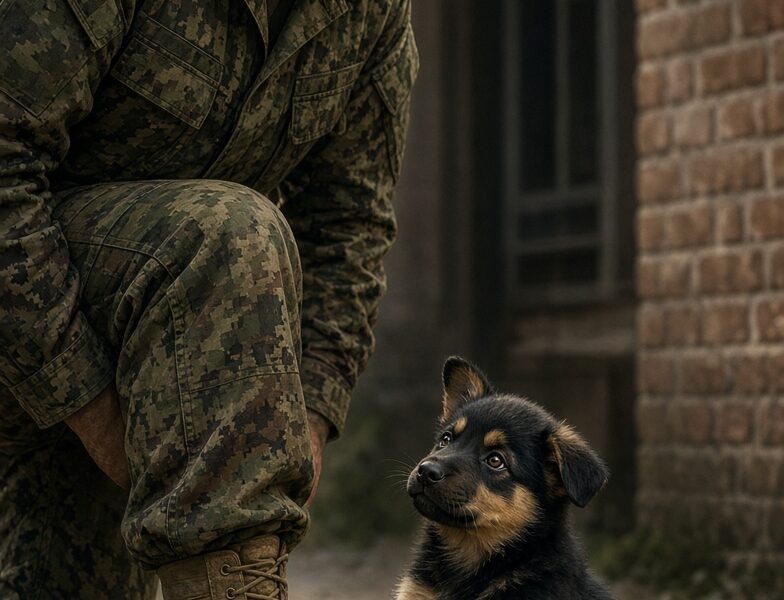
A Tiny Puppy Walked Past Everyone… And Put Its Paw on His Boot
On his first morning at a new job in Richmond, Navy Seal Michael Carter expected paperwork,
introductions, and nothing more.
Then, a tiny German Shepherd puppy appeared beneath a maintenance truck, and walked past everyone
else.
The 8-week old puppy stopped between Michael’s combat boots, looked up at him, and gently placed one
small paw on his left boot.
Michael stepped away.
The puppy followed and did it again.
Stranger still, the puppy was friendly with everyone, but only touched Michael’s boot that way.
Why had this tiny German Shepherd chosen Michael out of an entire building full of people?
And what did those worn tan boots remind the puppy of that Michael knew nothing about?
A first day was supposed to tell a man where he was going.
Michael Carter’s first day began with something that refused to let him move.
It was a mild early autumn morning in Richmond, Virginia, the kind that carried a faint coolness
beneath the sunlight without quite admitting summer was over.
The community training center sat beyond the busier streets, a low brick building surrounded by
clipped grass, a maintenance shed, and a broad parking lot still damp from overnight mist.
Michael arrived early because arriving early was easier than arriving uncertain.
At 45, he had spent enough years as a Navy Seal to make punctuality look less like discipline and
more like instinct.
He stood 6’2 with a broad athletic frame that had lost none of its strength.
Short dark brown hair touched lightly with gray at the temples, a square jaw softened by a neatly
trimmed beard, and blue gray eyes that rarely revealed the first thing he was thinking.
His authentic navy working uniform, type three, sat neatly across his shoulders.
the green, gray, brown camouflage, soft and unarmored, worn as a daily working uniform rather than
combat gear.
There was nothing theatrical about Michael.
He disliked unnecessary attention, distrusted exaggerated enthusiasm, and had learned over the years
that most first impressions improved when people were given less material to work with.
The transfer to Richmond was not a punishment, nor was it a retirement disguised as one.
Michael knew that.
His new assignment involved training, coordination, community programs, and working with veterans
and civilian staff whose jobs required patience more often than urgency.
It was worthwhile work.
He had told himself so several times that morning.
Still, some private part of him regarded the move as evidence that a door behind him had begun
closing before he had decided whether he was ready to hear the latch.
Michael dealt badly with transitions that could not be solved through effort.
Give him a broken schedule and he would rebuild it.
Give him an equipment failure and he would find the problem.
give him an emotion without instructions and he had a habit of standing very still until it passed.
Rachel Morgan met him inside the entrance.
At 52, Rachel was a tall, straightbacked woman with warm brown skin, short black hair threaded
naturally with silver, dark, attentive eyes, and the efficient stride of someone who had spent years
managing people without needing to raise her voice.
She directed the center with a calm practicality that could feel almost maternal until someone
ignored a procedure twice.
Rachel was friendly without being sugary, something Michael appreciated immediately.
She gave him a quick tour, introduced him to names he knew he would need to hear again, handed him a
folder of schedules, and warned him that the cent’s coffee had survived several complaints and
apparently become stronger because of them.
Michael almost smiled.
Almost.
By late morning, Rachel had gathered the small staff outside the main entrance for an updated group
photograph.
Michael disliked group photographs for the same reason he disliked birthday songs.
There was always a point where everyone became aware of where their hands were.
He took his place near the end of the line, holding a folder against one side and waiting for the
photographer to finish rearranging people by height.
A maintenance truck stood several yards away near the side of the building.
Nobody paid attention to the small movement beneath it.
At first, there was only a dark shape slipping from the shadow underneath the vehicle.
Then, a tiny German Shepherd puppy emerged into the light.
He could not have been much more than 8 weeks old.
Black and tan fur covered a body still round with puppy softness, though his legs seemed slightly
too long, and his paws looked almost comically oversized.
One ear was beginning to rise, while the other still folded partly sideways, giving his serious
little face an accidental expression of doubt.
His brown eyes were bright, but cautious.
He paused beside the truck, nose working rapidly, studying the collection of unfamiliar people with
the concentration of someone trying to solve a room much larger than himself.
Someone near Rachel made a soft kissing sound.
Another employee crouched and held out a hand.
The puppy took two steps toward the group, reconsidered, and moved sideways instead.
He was not trembling, nor did he appear frantic.
He simply seemed careful.
Each time someone leaned toward him too quickly, he changed direction.
That small stubbornness caught Michael’s attention.
The puppy was not asking everyone to like him.
Then he walked directly toward Michael.
The movement was so uncomplicated that Michael initially assumed the puppy was merely crossing the
group.
The little German Shepherd passed one pair of shoes, then another.
He ignored a hand lowered toward him.
His nose briefly touched the pavement before he continued forward and stopped between Michael’s tan
combat boots.
The puppy looked up.
Michael looked down.
For several seconds, nothing happened.
Then the puppy lifted his left front paw and placed it carefully on the toe of Michael’s left boot.
The staff laughed.
Well, Rachel said, her amusement quiet.
That didn’t take long.
Michael glanced around as if someone else might be responsible for whatever had just happened.
The puppy remained seated between his boots, paw resting on the tan leather, eyes fixed upward.
There was nothing dramatic in the gesture.
If anything, its simplicity made Michael more uncomfortable.
He had known working dogs trained to perform complex tasks on command.
This was not that.
This was an 8-week old puppy behaving as though Michael had stopped in precisely the place he had
been waiting for.
Michael moved one step sideways.
The puppy’s paw slipped from the boot.
For a moment, Michael thought that would settle it.
The puppy stood, followed him, sat beside the same boot again, and put the paw back.
The laughter grew warmer.
Michael finally said, “I don’t think this is as meaningful as everybody wants it to be.”
The puppy tilted his head.
That earned another laugh, and even Michael had to admit the timing was unfair.
Rachel crouched several feet away rather than reaching immediately for him.
Her expression changed from amusement to concern.
No collar was visible.
The puppy’s coat was dusty along the belly, and although he did not look seriously unwell, he was
lean enough for his ribs to be faintly noticeable when he turned.
Rachel told the others to give him space, then asked if anyone had seen a puppy around the property
before.
That was when Tom Jenkins spoke.
Tom was 63, compact and thick through the shoulders with weathered fair skin, a gray mustache,
thinning white hair beneath a faded baseball cap, and hands that looked permanently shaped around
tools.
He handled maintenance 3 days a week and had the suspicious expression of a man who expected most
machines and occasionally most people to disappoint him eventually.
Beneath that gruffness, however, he possessed a badly concealed soft spot for animals.
Tom admitted that an adult female German Shepherd had been appearing near the back edge of the
property for several weeks.
She was a lean, black, and tan dog, cautious around people, and usually seen near the maintenance
shed early in the day.
Tom had quietly left food and fresh water behind the shed, despite the cent’s rule against feeding
roaming animals without contacting the proper local services.
Rachel gave him a look.
Tom shrugged.
She looked hungry.
3 days earlier, he said the adult dog had stopped appearing.
Until that morning, nobody had seen a puppy.
Michael looked down again.
The little German Shepherd had finally removed his paw, but had not left.
He now sat against the outside of Michael’s left boot as though it provided a perfectly acceptable
wall.
“We should contact the shelter,” Michael said.
“Let someone who handles this properly take over.”
“It was a sensible answer, which was why Michael trusted it.”
Rachel agreed that they would notify the appropriate local shelter and veterinary contacts, but she
wanted the puppy kept safely inside for a few hours while the staff checked security footage, posted
a found dog notice, and determined whether anyone nearby was searching for him.
Michael saw no reason to object.
The matter had a procedure now.
Procedures were comforting.
The staff photograph was abandoned.
For the rest of the afternoon, the puppy occupied a quiet office near reception where Rachel found a
soft-sided crate, clean water, and an old towel.
Someone began calling him Toby because the puppy quickly became impractical.
Though Rachel reminded everyone that the name was temporary until an owner was found.
Toby accepted water, investigated a cardboard box with intense suspicion, and fell asleep for nearly
an hour with his chin resting on one oversized paw.
Michael went through orientation meetings, reviewed schedules, answered emails, and told himself
several times that the animal in the other room had nothing to do with him.
Near the end of the day, Michael walked toward the parking lot carrying his folder beneath one arm.
His first day had turned out differently than expected, but it was over.
That should have been enough.
Behind him, a door closed.
From inside the building came a small, uncertain whine.
Michael stopped.
He stood there for several seconds, irritated by the fact that he had stopped at all.
Then he turned back, telling himself he merely wanted to make sure someone was still with the puppy.
Rachel was near the reception desk when he returned.
Toby was awake inside the soft crate, sitting quietly but watching the door.
Rachel opened the crate while adjusting the towel.
Toby stepped out.
He did not run around the room.
He did not go to Rachel.
He crossed the floor directly toward Michael, sat in front of him, and placed one small paw on the
left combat boot.
Then Toby lowered himself onto the floor and rested against it.
Nobody laughed this time.
Michael stared at the tiny paw lying across the worn tan leather.
He had spent most of his adult life believing that behavior had reasons, patterns had causes, and
unanswered questions simply required better observation.
But standing in that quiet office at the end of his first day in Richmond, Michael found himself
facing a question that felt strangely personal.
There had been an entire building full of people.
Why did this puppy keep choosing him?
By the second morning, Michael Carter had already decided there was a reasonable explanation for the
puppy’s behavior.
He simply had not found it yet.
Richmond woke beneath a pale early autumn sky, cool enough for dew to remain on the grass around the
community training center and warm enough that the day promised to soften by noon.
Michael arrived wearing the same authentic Navy working uniform type 3 he had worn the day before,
its green gray brown camouflage neat over his tall athletic frame.
The familiar tan combat boots carrying faint marks from years of ordinary use.
He told himself he had not thought about Toby during the drive.
That was almost true.
He had thought instead about schedules, orientation paperwork, the training calendar Rachel had
given him, and whether the cent’s coffee could legally be classified as coffee.
Toby had simply occupied the small spaces between those thoughts.
Rachel Morgan was already at reception when Michael entered.
Her short black and silver hair was still slightly damp from the morning air, and a paper cup sat
beside a stack of intake forms.
Toby was gone.
Michael noticed that immediately, which irritated him more than the puppy’s absence should have.
Rachel explained that she had taken Toby to a nearby veterinary clinic before opening hours.
The veterinarian estimated the little German Shepherd at roughly 8 weeks old.
He was somewhat underweight, but alert, responsive, and otherwise in encouraging condition.
No microchip had been found, and no matching lost dog report had appeared overnight.
The clinic had recommended proper puppy food, rest, routine care, and continued efforts to locate
whoever had been responsible for him.
“He’ll be back in 20 minutes,” Rachel said.
Michael nodded as though the information meant nothing more than a completed checklist.
item.
Rachel studied him.
You can look less disappointed.
Nobody here will report you.
I’m not disappointed.
Of course not.
Michael carried his folder toward the training room before she could continue.
Toby returned with Ton Jenkins shortly afterward.
The 63-year-old maintenance worker carried a small bag of puppy food in one hand while the puppy
trotted beside him on a lightweight temporary leash.
Tom’s gray mustache seemed almost pleased despite his habitual expression of mild dissatisfaction
with the universe.
Toby had apparently spent part of the ride trying to climb into the bag of food and the other part
falling asleep against Tom’s boot.
The puppy accepted Rachel easily.
He ate a few pieces of food from Tom’s broad weathered palm.
He investigated the legs of two office chairs, discovered a waste basket, was removed from the waste
basket, and then became deeply offended by the injustice.
Michael watched from the doorway with reluctant amusement.
Then Toby saw him.
The puppy stopped.
His ears shifted forward, including the one that had not yet fully decided whether standing upright
was worth the effort.
He crossed the room at a quick little trot, ignored Rachel’s call, and sat beside Michael’s left
foot.
The paw rose.
It landed on the toe of the tan combat boot.
Michael stared down.
Tom folded his arms.
There it is again.
Michael stepped backward.
Toby followed.
The paw returned.
Rachel did not laugh this time.
Neither did Michael.
Repetition had changed the gesture.
Yesterday it had been charming.
Today it was becoming information.
Over the next several hours, Michael began watching the puppy with the concentration he usually
reserved for people who claimed there was nothing wrong with a malfunctioning piece of equipment.
Toby was not unusually attached to him.
That was the first important thing Michael noticed.
The puppy followed Rachel willingly when she carried the food bowl.
He allowed Tom to scratch beneath his chin.
He slept near the reception desk while two staff members walked past repeatedly without concern.
When Michael disappeared into a meeting room for almost an hour, Toby did not sit outside waiting
for him.
He fell asleep upside down with all four feet pointed toward a filing cabinet.
Michael found that oddly reassuring.
The puppy was not obsessed with him, only with something connected to him.
At lunch, Michael decided to test the idea.
He kept a pair of dark athletic shoes in his truck for physical training and changed into them
before returning inside.
He felt faintly ridiculous while doing it.
A 45-year-old Navy Seal was conducting an experiment whose entire scientific method consisted of
changing footwear to see whether a puppy cared.
Toby was awake beside Rachel’s desk when Michael entered.
The puppy approached, sniffed one athletic shoe, then the other.
Michael waited.
Nothing.
Toby wandered away, and began examining a cardboard box.
Michael frowned.
Rachel noticed.
Problem?
No.
You look personally rejected.
I’m gathering information about whether the dog likes your shoes.
Michael gave her a flat look.
Rachel returned to her paperwork, visibly pleased with herself.
The result bothered him more than he wanted to admit.
If Toby had simply liked him, that would have been uncomplicated.
Strange perhaps, but uncomplicated.
Instead, the behavior appeared attached to the tan boots.
Michael examined them later in the day.
They were ordinary military footwear, worn, but well-maintained.
Was no unusual smell he could detect beyond leather, dust, grass, and the accumulated anonymity of
daily use.
That evening, his phone rang as he was preparing to leave.
The screen displayed, “Mom.”
Michael hesitated for half a second before answering.
Linda Carter was 69, a slender woman of medium height with fair skin, soft hazel eyes, and silver
blonde hair cut just above her shoulders.
Age had narrowed her face without diminishing its strength.
She had spent 34 years working as an elementary school administrative assistant, a job that had
taught her how to identify excuses before the people making them had finished speaking.
Since Michael’s father died 3 years earlier, Linda had remained in the modest Virginia house where
she and her husband had raised two children.
She was independent, almost to the point of stubbornness, and had developed the irritating habit of
insisting she needed no help while keeping an extremely detailed list of things Michael could fix
whenever he visited.
“How was the first day?”
she asked.
Michael told her about the training schedule, the staff, the building, and Rachel’s coffee.
He did not mention Toby.
Their conversations had become oddly efficient since his father’s death.
They discussed the weather, Linda’s garden, insurance letters, appointments, and household repairs.
Information traveled between them smoothly.
Feelings rarely did.
Linda mentioned that the gutter above the back porch needed attention before winter.
Michael told her he would handle it.
She said the tomatoes had finally stopped producing.
Michael said he expected they would.
Then Linda added almost casually, “I found your father’s old work boots in the garage yesterday.”
Something inside the conversation changed.
Michael pictured his father, Robert Carter, not during his final months, but years earlier, stepping
through the kitchen door with dust on his boots and some home repair problem already occupying his
attention.
Robert had been an electrician for most of his working life.
Broad-handed, patient with machinery, impatient with instructions, and capable of wearing the same
pair of boots until Michael’s mother threatened to dispose of them herself.
“What are you going to do with them?”
Michael [clears throat] asked.
“I don’t know yet.”
“You can donate them?”
A pause followed.
“I suppose I could.”
Michael heard the slight disappointment beneath her answer and immediately moved the conversation
elsewhere.
After the call ended, Rachel was standing several feet away with a box of files.
Michael suspected from her expression that she had heard more than he preferred.
“You can brief 20 people without blinking,” she said.
“But whenever your mother calls, you sound like somebody put furniture in the middle of a dark
room.”
Michael picked up his folder.
Do you always analyze new employees this much?
Only the interesting ones.
I’ll try harder to be boring.
Rachel smiled.
You’ve got a puppy investigating your boots.
You may have missed your chance.
The following morning, Michael returned in his uniform and tan combat boots.
Toby was near Tom when he entered.
The puppy glanced up, saw Michael, and immediately crossed the reception area.
Michael remained still.
Toby sniffed the left boot once, then the familiar little paw settled onto the leather.
There it was.
Not the athletic shoes, these boots.
By evening, Michael had stopped treating the pattern as cute.
He asked Rachel for access to exterior security footage from the previous two weeks.
They sat together in a small office while recorded mornings flickered across the monitor.
Employees arriving, delivery vehicles turning through the lot, Tom pushing a wheeled trash bin, wind
moving branches near the maintenance shed.
Then the adult German Shepherd appeared.
She was lean, black, and tan, moving cautiously along the far edge of the property.
Michael leaned closer.
On another morning, she appeared again near the maintenance building.
Rachel slowed the video.
A person stood beside her.
The image was distant and imperfect, but Michael could make out an older male figure wearing work
pants and tan boots strikingly similar in color and shape to his own.
The dog remained near him without fear.
Michael froze the frame.
“That isn’t Tom,” Rachel said.
“No.”
Michael moved closer to the screen.
Near the German Shepherd’s rear legs, something shifted in the shadow beneath the building.
He replayed the footage once, twice.
On the third viewing, the movement became difficult to dismiss.
It was small, very small.
Michael stared at the faint shape beside the adult dog, then down at his own boots.
Perhaps Toby had never chosen Michael at all.
Perhaps Toby had recognized something, and whatever he remembered seemed to have begun long before
Michael’s first day in Richmond.
By the third morning, Michael Carter no longer believed Toby’s interest in his boots was random, and
that bothered him more than he expected.
Richmond had turned cooler overnight, the early autumn air carrying a dry edge beneath a pale blue
sky.
At the community training center, fallen leaves had begun collecting along the curb near the
maintenance building, and the parking lot was still mostly empty when Michael arrived.
He entered wearing the same navy working uniform type three, the green gray brown camouflage neat
across his tall, athletic frame, and the same tan combat boots Toby had singled out from the
beginning.
Michael had spent enough of his life studying patterns to know that repetition eventually became
evidence.
The problem was that evidence often led somewhere a person had not intended to go.
He returned almost immediately to the security footage.
Rachel Morgan joined him in the small office shortly after sunrise, carrying two coffees and the
patient expression of someone who had already accepted that the morning schedule was about to be
rearranged.
Together, they reviewed recordings from the previous month.
The adult female German Shepherd appeared more often than Michael had first realized.
She usually came near the property very early before most employees arrived, moving along the outer
fence or pausing behind the maintenance shed.
She did not wander randomly.
She repeated nearly the same route.
Michael began marking dates.
Tom Jenkins eventually wandered into the office after noticing the light under the door.
The older maintenance worker stopped when he saw the frozen image of the German Shepherd on the
screen.
His weathered face changed in the subtle way older men often allowed emotion to show.
“Not dramatically, but through a tightening around the eyes.”
“You saw her more than you told us,” Michael said.
Tom rubbed one thumb along the edge of his gray mustache.
“Maybe.”
Rachel turned in her chair.
“Tom, that one word was enough.”
Tom sighed and admitted that he had first noticed the dog nearly 6 weeks earlier.
At the beginning, she had stayed close to the far side of the property and vanished whenever someone
approached.
Then, an older volunteer named Walter Green had begun arriving before regular hours.
Walter was 72, tall despite a slight stoop through his shoulders, with a narrow, deeply lined face,
pale blue eyes, and thick silver hair.
he kept combed back from his forehead.
A retired high school shop teacher, he had spent most of his life repairing things.
Because, according to Tom, Walter believed throwing something away should be a last resort rather
than a first instinct.
He volunteered at the center several mornings a week, fixing loose chair legs, replacing cabinet
hinges, touching up railings, and taking on minor jobs nobody considered important until they
stopped working.
He had large hands, a dry sense of humor, and the quiet patience of someone accustomed to teenagers
holding power tools.
Nearly every morning, Walter wore faded canvas workpants and the same pair of tan leather boots.
Michael looked again at the grainy figure on the screen.
The resemblance was not exact.
Walter’s footwear was work wear while Michael’s boots were military issue.
But from the height of an 8-week old puppy surrounded by scent, shape, and memory, the distinction
might have meant very little.
Tom explained that the German Shepherd had gradually begun tolerating Walter’s presence.
Walter never tried to catch her or crowd her.
He simply sat on an overturned bucket outside the maintenance shed during his morning break and ate
breakfast.
Sometimes he tore off a small piece of plain sandwich filling or left some food at a safe distance,
then waited.
Over time, the dog came closer.
She never acted like his dog, Tom said, more like she decided he wasn’t trouble.
That description stayed with Michael.
Trust, he thought, was often less romantic than people made it sound.
Sometimes trust was not affection.
Sometimes it was simply the absence of danger repeated often enough to become familiar.
“What happened to him?”
Michael [clears throat] asked.
Tom’s face softened.
Several weeks earlier, Walter had experienced a sudden health problem at home and was taken to the
hospital.
The center had heard that he was recovering at a rehabilitation facility, but he had not returned.
No one knew when he would be able to volunteer again.
After Walter disappeared from the morning routine, the German Shepherd continued visiting the
maintenance area for several days.
She waited near the usual spot, paced part of the fence line, and eventually stopped coming.
Then Toby appeared.
Michael studied the frozen frame again.
Near the adult dog was that tiny movement he had noticed the previous night.
too indistinct to prove anything, but enough to change the question.
Perhaps Toby had encountered Walter.
Perhaps the boots had become associated with him.
The explanation should have satisfied Michael.
In fact, it offered relief.
The puppy had not mysteriously selected him for some sentimental reason.
Toby had probably seen familiar footwear, smelled leather and dust, and followed a memory.
simple, understandable, finished.
And yet, Michael felt an unexpected hollowess when the mystery shrank into something ordinary.
He disliked that reaction immediately.
Why should it matter whether Toby had actually chosen him?
The puppy needed practical care, not symbolism.
Michael knew better than to turn coincidence into meaning simply because it felt good.
Rachel noticed his expression.
“Disappointed?”
she asked.
“No, that was quick.
There’s nothing to be disappointed about.”
Rachel lifted one eyebrow, but let him keep the lie.
By midday, the local shelter called back.
They were operating near capacity and had no confirmed match for Toby.
Because the puppy was already in a safe environment and the center was coordinating identification
efforts, they asked whether someone could provide temporary care through the weekend while they
continued searching and arranged the next steps.
Rachel looked directly at Michael.
No, she had not even spoken yet.
You live alone.
That isn’t a qualification.
You have a fenced backyard.
Michael narrowed his eyes.
How do you know that you filled out an emergency housing form yesterday?
That information was not intended for puppy placement.
Tom, passing behind them, made the mistake of laughing aloud.
Michael insisted that he was not a dog person.
He had experience around trained working dogs certainly, but experience and desire were different
things.
Dogs required schedules, feeding, house training, veterinary care, and supervision.
Puppies required all of those things, plus an apparently supernatural ability to locate whatever
object a human most preferred they not touch.
Toby proved the point less than 5 minutes later by stealing a newspaper from a low table.
Rachel recovered it.
Toby stole a corner of a cleaning cloth.
Tom recovered that.
Then the puppy discovered the loose end of Michael’s boot lace and chewed long enough to fray it
before Michael noticed.
Rachel looked at the damaged lace.
“Well,” she said, “he’s clearly not a perfect Michael person either.”
Michael stared at her.
Tom turned away so Michael would not see him smiling.
By late afternoon, Michael agreed to one weekend.
He used the phrase temporary care three times.
Rachel used the phrase of course in a tone that made him distrust her.
Toby rode home secured in a borrowed travel crate on the backseat of Michael’s truck.
The puppy complained for approximately 2 minutes, fell asleep halfway through the drive, and arrived
at Michael’s modest brick house with the confidence of someone who had contributed nothing to the
mortgage.
The house was clean, quiet, and organized.
Darkwood furniture, neutral walls, books arranged by subject, shoes where shoes belonged.
Toby spent his first 20 minutes challenging nearly every principle upon which the room had been
constructed.
He investigated the kitchen mat, attempted to carry a sock from the laundry basket, followed the mop
as Michael cleaned a small spill, and became convinced the mop had personally insulted him.
Michael redirected the puppy with a chew toy, only for Toby to abandon it in favor of a folded
newspaper.
“You have options,” Michael told him.
Toby sneezed and sat on the newspaper.
Michael discovered that reasoning with a German Shepherd puppy was less productive than most
military meetings, though not necessarily by a large margin.
As evening settled outside the windows, Toby’s energy faded.
The house became quiet again.
Michael placed a folded blanket near the living room and expected the puppy to settle there.
Toby did not.
Instead, he wandered slowly through the downstairs rooms, sniffing furniture legs and door frames.
He seemed less playful now, more thoughtful.
Eventually, he reached the entryway where Michael had removed his tan combat boots.
The puppy stopped.
He sniffed them carefully.
Then he turned in a small circle and curled himself beside them, his back pressed against the
leather.
Michael stood several feet away.
There was something about the sight that unsettled him.
Toby was not playing with the boots.
He was not chewing the laces.
He was resting against them.
Michael waited until the puppy lifted his head, then carried the boots to the hallway closet and
placed them inside.
It seemed sensible.
Toby did not need to make a habit of sleeping against dirty footwear.
When Michael closed the closet door, Toby walked over.
The puppy sat in front of it.
He stayed there.
No scratching, no whining, no demand, just waiting.
Michael leaned against the wall and watched the small German Shepherd face a closed door behind
which sat two ordinary tan boots.
For the first time, the explanation felt larger rather than smaller.
Maybe Toby was not simply recognizing footwear.
Maybe those boots carried the last familiar shape of someone who had once made the world feel
predictable.
And maybe to a puppy who had already lost track of so much, familiarity and safety had become almost
the same thing.
Some answers arrive like explanations.
Others arrive like mirrors.
and Michael Carter had never been especially comfortable with mirrors that spoke back.
The following afternoon in Richmond was bright and cool, the kind of early autumn day when sunlight
sharpened every edge without warming the air very much.
Michael finished the first half of his schedule at the community training center, reviewed a set of
volunteer records with Rachel, and then asked for Walter Green’s current contact information.
He made the request sound administrative.
Rachel knew better, but for once she did not tease him.
She only wrote down the name of a rehabilitation facility on the west side of the city and told him
Walter had recently begun receiving visitors again.
Michael left Toby at the center with Rachel and Tom.
The puppy had spent most of the morning discovering that chair legs were less interesting than
shoelaces and that Tom, despite his complaints, could be persuaded to surrender small pieces of
approved puppy food simply by being stared at long enough.
Michael had become aware that Toby was changing the rhythm of the building.
People who normally passed reception without looking up now slowed down.
Tom, who usually considered conversation an interruption to useful labor, had begun reporting Toby’s
naps as though they were maintenance updates.
Even Rachel’s voice softened by half a degree whenever the puppy wandered under her desk.
Michael noticed all of it while pretending not to.
The rehabilitation facility stood among mature maples whose leaves had begun turning at the edges.
Inside, the hallways were quiet and warm, smelling faintly of coffee, clean linen, and the floral
hand lotion someone had clearly applied with enthusiasm.
Michael found Walter Green near a wide window in a common room, seated beside a table covered with
an unfinished wooden birdhouse.
Walter was exactly the kind of man the security footage had only hinted at.
At 72, he remained tall, though age and recent illness had pulled his shoulders slightly forward.
His face was narrow and deeply lined with pale blue eyes that seemed sharper than the rest of him.
Thick silver hair was combed straight back, and a short white beard now covered a jaw that
photographs in the volunteer file showed had once been clean shaven.
His hands were broad and rough, the fingers marked by decades of woodworking and repair work.
Even in rehabilitation, Walter wore canvas workpants.
On his feet were soft indoor shoes rather than the tan boots Michael had come to ask about.
Walter looked at Michael’s uniform first, then his face.
“You’re not here about the birdhouse, I assume.”
Michael almost smiled.
He introduced himself, explained his new assignment at the center, and took out his phone.
The moment Walter saw Toby’s photograph, something changed in his expression.
The older man leaned closer.
“Well, I’ll be.”
Michael watched carefully.
There was recognition, but not ownership.
Walter did not ask where his dog had been found.
He did not reach for the phone as though recovering something lost.
He simply stared at the image of the small German shepherd sitting beside Michael’s boot.
“You know him?”
Michael said.
Walter nodded slowly.
“I know that face.”
Then, before Michael could ask the obvious question, Walter added, “He isn’t mine.”
That answer eliminated one possibility and opened several others.
Michael sat across from him.
Walter explained that nearly two months earlier, an adult female German Shepherd had begun appearing
near the rear edge of the community center.
She was lean, cautious, and deliberate.
Walter had seen enough nervous animals over the years to understand that walking directly toward her
would accomplish nothing useful.
So he did what he had often done with difficult students during three decades teaching high school
shop.
He gave her room, remained predictable, and let curiosity do the work.
He began leaving water near the maintenance building, then food placed well away from where he sat.
He never tried to touch her.
For almost a week, the dog kept her distance.
Then one morning she approached while Walter was eating breakfast on an overturned bucket.
She did not come close enough to be handled, but she stayed.
That became their arrangement.
She wasn’t looking for a friend.
Walter said she was deciding whether I was a problem.
Michael understood that more easily than he wanted to.
A few mornings later, the German Shepherd did something different.
Instead of leaving after eating, she walked toward an older storage structure behind the maintenance
area, stopped, looked back, and waited.
Walter followed at a distance.
Beneath a sheltered section near the building, he discovered a small litter of very young German
Shepherd puppies tucked safely together.
They were too young then to wander far.
All dark little bodies, soft ears, and oversized feet.
Walter did not know whether the mother had once belonged to someone nearby or had simply learned to
survive around people without trusting them completely.
There was no caller and no identification he could see from the distance she allowed.
Michael listened without interrupting.
Walter admitted he had made a decision that in retrospect he might have handled differently.
He did not immediately report the litter to the center.
His concern was that too many people arriving at once would frighten the mother and cause her to
relocate the puppies before anyone could establish a safe plan.
Instead, he contacted a local rescue organization privately and arranged for an experienced
volunteer to meet him at the property.
The meeting never happened.
The evening before, Walter became unwell at home and was taken to the hospital.
His recovery had been steady but slow.
By the time he had access to his phone and enough energy to begin asking questions, the rescue
volunteer had already checked the location.
The mother and puppies were gone.
Walter’s expression changed as he said it.
Not guilt exactly, but the quiet discomfort of someone who had spent weeks wondering whether a
different decision would have produced a better outcome.
Michael knew that feeling, too.
You think Toby was one of them?
Walter extended a hand toward the phone.
Michael passed it over.
Walter enlarged the photograph, studying the puppy’s face.
That ear, he said.
Toby’s left ear was beginning to rise while the right still folded slightly outward.
Walter smiled.
There was one little fellow who always looked like he was trying to hear two different opinions at
once.
Michael laughed before he could stop himself.
The sound surprised him.
Walter continued looking at the picture and then his eyes dropped to Michael’s boots.
His smile faded into recognition.
There it is.
Michael followed his gaze.
The boots?
Walter nodded.
What followed was the detail Michael had driven across Richmond without knowing he needed.
Whenever Walter had approached the litter slowly enough for the mother to remain calm, one puppy had
behaved differently from the others.
The little male would crawl or stumble forward, stop beside Walter’s tan work boot, and place one
paw on the toe.
Sometimes he stayed for only a second before returning to his mother.
Sometimes he leaned there briefly, watching Walter’s hands.
Walter had assumed at first that the puppy was attracted to the smell of food.
Then he noticed the puppy did it even when Walter brought nothing.
Michael sat very still.
The first day I met Toby, he said, he did exactly that to me.
Walter’s eyes softened.
Michael described how Toby had ignored the athletic shoes, returned to the tan combat boots, slept
beside them, and waited outside the closet after Michael put them away.
Walter listened without interrupting.
Then he gave a quiet laugh.
That little fellow never cared who owned the boots.
He cared whether the person wearing them stayed still long enough.
The sentence entered Michael quietly.
That was probably why it reached so far.
For a moment, the rehabilitation room disappeared behind an older memory.
His father, Robert, standing in the Carter garage years earlier while Michael prepared to leave
after fixing a leaking outdoor faucet.
His father had asked him to stay for coffee.
Michael had said he had another appointment.
Robert had smiled, but not entirely.
You’re always good at showing up when there’s a job, his father had said.
One day you might learn how to stick around after the job’s done.
Michael had forgotten the exact afternoon.
He had not forgotten the sentence.
For 3 years after Robert’s death, Michael had translated love into usefulness.
Linda needed a repair, he came.
She needed a bill reviewed, he handled it.
She needed something moved, replaced, scheduled, checked, or fixed.
Michael was dependable.
But sitting still with her in the quiet house his father no longer occupied had always felt harder.
Walter handed the phone back.
Sometimes staying put is the useful thing, the older man said.
Michael looked through the window at the maples outside.
He had come to Richmond seeking an explanation for a puppy’s behavior.
He left with one.
It simply was not the explanation he had expected to matter most.
That evening, Toby was back at Michael’s house.
The puppy lay on the floor near the entryway, half asleep.
One paw stretched across the toe of Michael’s left combat boot.
[clears throat] Michael picked up his phone.
Linda answered on the fourth ring.
Everything all right?
Michael almost said yes and ended the conversation there.
Instead, he sat down.
Yeah.
[sighs] A pause.
Then what do you need?
Michael looked at Toby.
The puppy opened one brown eye and closed it again.
Nothing, Michael said.
I just thought I’d stay on the phone a while.
Linda did not answer immediately.
Then her voice softened.
All right.
They talked about almost nothing, and for once, Michael did not try to fix any of it.
Knowing where a story began did not mean knowing where everyone in it had gone.
By the middle of the following week, that thought had settled into Michael Carter’s mind with the
persistence of a question he could no longer dismiss.
Richmond had entered one of those clear early autumn stretches when mornings arrived cool and
silver, afternoons warmed gently, and the first dry leaves scraped across parking lots like paper
being shuffled.
At the community training center, ordinary work continued around Toby’s temporary presence.
Classes started on time.
Volunteers carried boxes through the hallways.
Tom complained about a storage room hinge that had been fixed three times by people who should have
left it alone.
And Rachel moved through the building with her usual controlled efficiency.
But beneath the ordinary schedule, another effort had begun.
Walter’s description of the litter had given them something they had not possessed before.
A location, a pattern, and a reason to believe Toby had not appeared from nowhere.
Rachel contacted a local nonprofit rescue that routinely worked with cautious dogs and young
litters.
The coordinator who arrived that afternoon was Carla Bennett, 48, a compact woman with olive toneed
skin, dark auburn hair tied into a loose braid, and steady green eyes that seemed to assess a room
without judging anyone in it.
She wore jeans, hiking shoes, and a faded gray sweatshirt bearing the rescue’s small logo.
Carla had spent nearly 15 years working with animals that needed time more than force, and that
experience had given her an almost stubborn patience.
She disliked dramatic language, distrusted rushed decisions, and had a habit of asking people to
slow down precisely when they felt most compelled to hurry.
Michael respected her before he particularly liked her.
Carla reviewed Walter’s account, the security footage, and the approximate area behind the old
storage buildings.
She listened to Michael’s theory that the mother dog might still be nearby, then nodded without
agreeing too quickly.
“Possible,” she said, “but possible isn’t the same as proven.”
Michael appreciated the distinction.
For several days, nothing happened.
That became its own kind of work.
They checked exterior cameras at dawn and again near dusk.
Carla placed food and fresh water in carefully chosen areas where the mother dog had once traveled,
then instructed everyone not to crowd the sites.
Tom helped install two small motionactivated cameras provided by the rescue.
Michael volunteered to check footage before work and after the center closed.
Rachel kept a simple log of sightings from nearby properties.
No one chased anything through the woods.
No one turned uncertainty into urgency simply because uncertainty was uncomfortable.
Michael found waiting harder than he expected.
He was accustomed to effort producing some visible result.
Waiting demanded a different discipline.
Doing enough then refusing to do too much.
The resemblance to his conversation with Linda was not lost on him.
At home, Toby was becoming less like a mystery and more like a small domestic complication with
teeth.
The puppy had discovered that the bathroom rug could be dragged halfway down the hallway if
approached with sufficient determination.
He had also learned that Michael’s laundry basket occasionally contained socks, and that one sock
was apparently worth abandoning every approved chew toy in the house.
Michael had begun puppy proofing rooms in stages, each adjustment followed by Toby identifying the
next weakness in the system.
Michael called it adaptation.
Rachel called it losing a negotiation to a dog who still tripped over his own feet.
The weekend approached and Michael did something even he found surprising.
He called Linda.
She answered with suspicion almost immediately.
What broke?
Nothing.
Did you forget something?
No.
There was a pause.
Are you in debt?
Michael closed his eyes.
No, Mom.
Another pause longer this time.
Are you getting married?
Michael laughed despite himself.
I’m inviting you to Richmond.
That was not a no.
It was absolutely a no.
He told her she could stay for the weekend.
He did not frame the invitation around a repair, paperwork, or an appointment.
When Linda asked why, Michael glanced down at Toby, who was lying beneath the kitchen table,
attempting to look innocent beside a second damaged shoelace.
I want you to meet someone who’s eaten two shoelaces and shown no remorse whatsoever.
Linda was silent for a second.
You got a dog?
temporary dog.
Those are famous last words.
Michael declined to continue that line of discussion.
Linda arrived Saturday morning carrying an overnight bag and enough baked food to suggest she
believed Richmond had stopped selling groceries.
At 69, she remained slender and upright, her silver blonde hair brushing her shoulders and her hazel
eyes as observant as Michael remembered from childhood.
She entered his house, saw Toby sitting near the hallway, and immediately pointed one finger at
Michael.
I do not want a dog climbing on me.
Toby stared at her.
I mean it.
Toby sat.
Linda narrowed her eyes as if suspicious of the obedience.
17 minutes later, Michael found her on the sofa cutting an apple into very small pieces and asking
whether puppies could safely have any.
You said you didn’t like dogs in the house.
I said I didn’t want him climbing on me.
Toby had both front paws resting against her knee.
Linda looked down.
This is different.
Michael leaned against the doorway and smiled.
Something about seeing his mother occupy his living room without a toolbox nearby made the house
feel unfamiliar in a good way.
Linda told Toby he had entirely too much confidence for someone with one ear still undecided and
Toby responded by falling asleep against her slipper.
The next morning, Carla called.
One of the cameras had recorded movement.
Michael drove to the center with Linda and Toby later than he would normally have chosen because
Carla had been very clear that additional people should remain away until the rescue team assessed
the footage.
In the office, they watched the recording together.
The adult German Shepherd appeared first.
She emerged from a narrow strip of trees nearly a mile from the center, recognizable by her dark
saddle markings, lean frame, and cautious way of stopping before stepping into open ground.
Her coat looked dusty but intact, and her ears shifted constantly as she surveyed the area.
Behind her camement, one puppy, then another.
Both were German Shepherds roughly Toby’s age, black and tan and awkward in the same unfinished way,
with oversized paws and ears still deciding what adulthood would require of them.
Michael felt something inside him release.
He had not realized how firmly one idea had taken hold until evidence replaced it.
Toby had not simply been left behind by a mother who walked away.
The more likely explanation was quieter and sadder, but also kinder.
Construction activity had recently increased near the old storage structures.
The mother had probably moved the litter when the area stopped feeling secure.
Toby, small enough to become separated during that transition, may have followed familiar scent or
memory back toward the maintenance shed, back toward Walter, back toward the boots.
The rescue team spent the next two days working slowly.
Carla coordinated everything with the same calm refusal to manufacture drama.
Food was placed on a consistent schedule.
Distance was maintained.
By the second evening, the mother and both puppies had been safely transferred into the rescue’s
care without chaos.
They were tired and cautious, but responsive, and preliminary checks suggested they mainly needed
nutrition, routine veterinary attention, and time.
When Michael brought Toby to the rescue facility the following afternoon, he told himself he was
only helping confirm whether the dogs recognized one another.
Toby noticed them before Michael had fully entered the room.
His whole body changed.
His ears lifted.
His tail began moving so quickly that his back end followed it.
The moment Carla allowed the supervised introduction, Toby rushed forward with a burst of puppy
excitement that nearly sent him sideways across the floor.
The two other puppies met him halfway.
Their mother approached more slowly, sniffed him carefully, and remained close while the puppies
circled, bumped shoulders, and tumbled through the kind of reunion that required no human
interpretation.
Michael stood near the wall.
He should have felt only relief.
Instead, an unexpected emptiness opened beneath it.
Of course, Toby belonged with them.
Of course, this was good.
Michael had spent days hoping the puppy’s family might still be somewhere nearby.
Yet, now that they were in front of him, Michael suddenly became aware of how temporary his place in
Toby’s story might have been.
Linda stood beside him without speaking.
Perhaps that was the greatest change between them.
A month earlier, one of them would have filled the silence with a practical question.
Michael did not.
Toby played until his movement slowed.
Then the puppy paused in the middle of the room.
He looked toward Michael.
Michael stayed where he was.
Toby walked past Carla, past Linda, past the other puppies, and crossed the floor.
He stopped at Michael’s left side.
Then he raised one small paw and placed it on the familiar tan combat boot.
Michael looked down.
The gesture was exactly the same.
The meaning was not.
This time, Toby knew who was wearing the boots.
There were decisions a man delayed because he needed more information.
And there were decisions he buried beneath information because he already knew the answer.
Michael Carter had spent most of his adult life believing those were the same thing.
The following week brought cooler mornings to Richmond, Virginia.
Thin clouds softened the early autumn sunlight, and dry leaves had begun gathering along Michael’s
driveway in small copper-colored piles.
Toby had been staying with him long enough that the house no longer looked entirely like the home of
one disciplined 45-year-old Navy Seal.
A rubber chew toy rested beneath the coffee table.
A folded puppy blanket occupied one corner of the living room.
A lightweight leash hung beside Michael’s keys near the door, and one kitchen cabinet now contained
a bag of puppy food, where Michael had once stored nothing but spare batteries and cleaning
supplies.
None of these changes were dramatic.
That was precisely what made them dangerous to a man who preferred temporary arrangements to
announce themselves clearly.
At the community training center that morning, Carla Bennett from the local rescue gave Michael,
Rachel, and Tom an encouraging update.
The German Shepherd mother and her three puppies were adjusting well to regular meals, routine
veterinary care, and the quieter rhythm of the rescue facility.
No owner had come forward, and after the remaining administrative and veterinary steps were
completed, the puppies would soon become eligible for adoption.
The mother would follow when the rescue team felt she was ready.
Michael heard the word adoption and immediately began thinking like a coordinator.
By lunch, he had created a spreadsheet.
He listed fenced yard size, daily work schedules, previous experience with German shepherds,
proximity to veterinary clinics, household composition, expected exercise time, training plans, and
even average commuting distance.
He told himself this was responsible.
Toby was an intelligent working breed puppy who would eventually become a large, energetic dog.
Affection alone was not enough.
A suitable household mattered.
All of that was true.
It was also incomplete.
Rachel Morgan stood beside his desk that afternoon reading the document over his shoulder.
At 52, with her tall posture, warm brown skin, and short black hair threaded with silver, Rachel had
the unnerving ability to remain silent until another person became aware of what they were avoiding.
Her dark eyes moved slowly down Michael’s carefully organized columns.
You ranked them.
I compared them.
There are numbers beside their names.
That’s how comparisons work.
Rachel leaned closer.
Michael had color-coded the applicants.
She looked at him.
He looked at the screen.
Finally, she asked, “And where are you on it?”
Michael’s fingers stopped above the keyboard.
The question should have been easy to dismiss.
His Navy career had never been built around predictability.
Schedules shifted, assignments changed, long days happened.
Toby deserved a home where someone could promise routine stability and time.
Michael had already developed the argument so thoroughly that he could have presented it to a
committee.
I’m not applying.
Rachel did not move.
That wasn’t my question.
Michael closed the spreadsheet.
The conversation ended there, but the question followed him home.
Toby met him at the door with a toy in his mouth.
forgot why he had brought the toy, dropped it, then became distracted by the loose end of the
hallway rug.
Michael watched the puppy wrestle with a problem that existed entirely because Toby had decided it
did.
One ear now stood almost fully upright, while the other remained slightly off angle, giving him the
permanent appearance of listening to two different conversations.
His black and tan coat had begun to look fuller with regular care, and his oversized paws promised a
future body considerably larger than the clumsy creature currently backing himself into a table leg.
Michael redirected him.
Toby immediately found something else to investigate.
There was comfort in the absurdity of it.
Michael told himself again that finding Toby another home was the sensible choice.
Then he imagined the house without the leash by the door.
The thought arrived too quickly.
He pushed it aside.
Linda was still in Richmond after extending her weekend visit by several days, though she had made
it clear she considered this an independent decision rather than evidence that she enjoyed Toby’s
company.
At 69, Michael’s mother remained slender and straightbacked with fair skin, hazel eyes that missed
very little, and silver blonde hair falling just above her shoulders.
She had spent most of her adult life managing a school office where hundreds of children had
eventually learned that lying to Mrs.
Carter required more preparation than most of them possessed.
Retirement had not weakened that ability.
That evening, she noticed Michael reading adoption applications at the kitchen table.
What are those potential homes for Toby?
Michael nodded.
Linda poured herself water and sat across from him.
He has a home.
He has temporary housing.
Linda’s expression hardened slightly with you for now.
Michael expected an argument about the puppy.
Instead, Linda said, “You do this every time something starts to matter.”
Michael looked up.
“Do what?”
“Turn it into a job.”
The words landed harder than Rachel’s question because they came from somewhere older.
Michael set the papers down.
Linda continued, not angrily at first, but with the controlled frustration of someone who had
rehearsed a conversation privately for several years.
After Robert died, Michael had never stopped helping her.
That was not the problem.
He had replaced a bathroom faucet within days of her mentioning it.
He had arranged an insurance review, repaired the porch rail, cleaned the gutters, inspected the
roof, changed the smoke detector batteries, and reorganized paperwork she had not asked him to
reorganize.
Then he [clears throat] had left, sometimes before dinner, sometimes after only 2 hours.
Linda remembered setting out a second plate more than once and returning it to the cabinet unused.
“You were dependable,” she said.
“You just weren’t there.”
Michael’s instinct was to defend himself.
His schedule had been complicated.
The drives were long.
Some weekends he genuinely had responsibilities.
But explanations were not always answers.
“You could have asked me to stay.”
Linda gave him a tired look.
I was your mother, Michael.
I had just lost my husband.
I didn’t want to file a request.
He looked toward the living room.
Toby was asleep near the doorway.
The silence became uncomfortable.
Michael had endured silence in places where uncertainty carried far greater consequences.
But this silence required something different from endurance.
It required honesty.
I didn’t know what to do there.
Linda’s face changed.
Michael continued before he could reconsider.
After his father’s death, the family house had seemed wrong.
Robert’s chair remained where it had always been.
His tools stayed in the garage.
His coffee mug disappeared from the counter because Linda had eventually put it away.
And somehow that had been worse than seeing it there.
Michael could fix the railing.
He could replace a faucet.
He could review documents.
He could not repair an empty chair.
He could not make his mother stop looking toward the driveway at the time Robert once came home.
He could not make the house become what it had been.
I hated being there when there was nothing I could do, Michael admitted.
It made me feel useless.
Linda’s eyes shone, but she did not rescue him from the discomfort.
So, you left me there with it.
Michael lowered his head.
The sentence hurt because it was fair.
I guess I did.
Linda was quiet for a long moment.
Michael had imagined many versions of an eventual conversation about his father.
In most of them, Linda forgave him immediately once she understood.
Reality was less convenient.
I was angry with you, she said for a long time.
He nodded.
I know.
No, I don’t think you did.
He looked at her.
For once, he did not offer an excuse.
Linda inhaled slowly and glanced toward Toby.
That dog isn’t your father.
I know.
And loving him won’t guarantee he stays forever.
Michael’s jaw tightened.
There it was.
The part he had disguised beneath schedules, military obligations, and applicant rankings.
Toby was young, healthy, ridiculously energetic.
Michael could care for him responsibly, rearrange schedules, hire support when necessary, and build
a stable routine.
But none of those things could guarantee that one day Michael would not lose him.
That was the truth he had been organizing spreadsheets to avoid.
If Toby belonged to someone else, Michael could miss him safely.
He could tell himself he had done the right thing.
There would be no future empty dog bed, no collar hanging unused, no familiar sound suddenly absent
from a house.
Michael had confused avoiding ownership with avoiding grief.
Linda studied her son.
I don’t know how to do that part, he said quietly.
I know.
He waited for reassurance.
Linda did not give it.
Instead, she said, “Then maybe you should practice.”
Later that night, Michael made two cups of coffee and carried them to the front porch.
He did not bring the adoption applications.
He did not bring his phone.
Linda joined him.
Toby followed.
The puppies settled between their feet while autumn air moved through the trees beyond the yard.
They sat without solving anything.
5 minutes passed, then 10.
Michael discovered that silence did not always mean something was missing.
Sometimes it meant nobody had run away from the moment.
Toby stretched, placed one front paw on Michael’s tan boot, then reached the other toward Linda’s
soft house slipper.
Linda looked down.
A laugh escaped her before she could prevent it.
Well, she said, “Apparently, he’s running family therapy now.”
Michael smiled into his coffee, and for once he stayed where he was.
There are moments when doing the responsible thing feels almost identical to running away, and
Michael Carter had begun to understand that the difference could not always be found on a
spreadsheet.
A cool Saturday morning settled over Richmond beneath a soft gray sky.
The early autumn air dry enough to carry fallen leaves across the parking lot of the community
training center.
Michael arrived before most of the staff, wearing his usual navy working uniform type three, the
green gay brown camouflage neat against his tall athletic frame and the familiar tan combat boots
showing the ordinary wear of daily use.
Toby rode with him in the truck, no longer the dusty 8-week old puppy who had appeared beneath a
maintenance vehicle on Michael’s first day, but still small enough for his paws to seem oversized
and his partly uneven ears to make every serious expression look slightly unfinished.
The puppy had gained weight, energy, and confidence.
What Michael had not gained was certainty.
3 days earlier, Carla Bennett had forwarded an adoption application that was difficult to criticize.
Paul and Denise Walker lived outside Richmond in a quiet neighborhood with a large fenced backyard.
Paul was 59, a broad-shouldered man of average height with closely cropped gray hair, a short salt
and pepper beard, rectangular glasses, and the careful movements of someone who thought before
touching unfamiliar things.
He had spent 30 years working as a civil engineer and tended to approach problems methodically
without assuming every problem needed immediate intervention.
Denise, 57, was slim and energetic with fair skin, shoulderlength auburn hair beginning to silver
around the temples and soft brown eyes behind thin framed glasses.
She worked part-time at a public library and possessed a warm but unscentimental manner that Michael
immediately trusted more than exaggerated enthusiasm.
The walkers had owned a German Shepherd named Maggie for 12 years.
Maggie had been gone for almost 2 years, and they had deliberately waited before considering another
dog.
That detail bothered Michael, not because it was negative, because it made them better candidates.
They knew that loving one dog did not make the next dog a replacement.
They understood the exercise, training, shedding, adolescent stubbornness, and eventual size that
came with the breed.
Their references were good.
Their veterinarian had confirmed years of consistent care.
Their schedule allowed someone to be home most afternoons.
On Michael’s color-coded spreadsheet, they had scored higher than anyone else.
Rachel had looked at the score and said nothing.
She no longer needed to.
Michael had arranged the meeting himself.
He told himself that mattered.
If Toby was going to another family, Michael wanted to know who they were.
When the walkers arrived, Denise did not rush toward the puppy.
She crouched several feet away and allowed Toby to investigate on his own terms.
Paul remained standing slightly behind her, hands relaxed at his sides.
Toby sniffed Denise’s shoes, then Paul’s, then the canvas bag Denise had brought.
The bag contained a rubber ball, a folded towel, and a few treats approved by Carla.
Within minutes, Toby had decided the walkers were interesting.
Within 10, he was chasing the ball across the small fenced exercise yard behind the rescue room.
Michael watched from beside the gate.
Toby was happy.
That should have helped.
Instead, every easy interaction seemed to tighten something inside Michael.
Denise laughed when Toby ran past the ball and had to circle back for it.
Paul lowered one hand and the puppy pressed his nose against the knuckles before allowing a brief
scratch beneath the chin.
Neither of them tried too hard.
Neither treated Toby like a broken thing needing gratitude.
They were exactly the kind of people Michael had been looking for.
Paul glanced toward him.
He’s got confidence.
Michael nodded more than judgment.
Denise smiled.
That sounds familiar.
Toby tried to carry the rubber ball and a fallen leaf at the same time, failed, then stood staring
at both as if the universe had created an unreasonable logistical problem.
Michael almost laughed.
Almost.
The strange part was that he genuinely liked the walkers.
If they had been careless, inexperienced, or impulsive, rejecting them would have been easy.
But nothing about them gave Michael an excuse.
That forced him toward the one explanation he had spent weeks avoiding.
The problem was not their home.
The problem was that Toby had already become part of his.
Carla suggested the walkers spend another 20 minutes with Toby in a separate indoor area while
Michael remained outside.
It was a normal step designed to see how the puppy behaved without the temporary caregiver present.
Michael agreed immediately.
Two immediately.
Denise clipped Toby’s lightweight leash on carefully.
Paul opened the door.
Toby followed them several steps, then stopped.
He turned.
His brown eyes found Michael across the room.
Nobody called him.
Nobody pulled the leash.
Toby simply walked back.
He sat in front of Michael.
There was no whining, no frantic movement, no refusal to interact with the walkers.
The puppy looked perfectly calm.
Then the left paw rose.
It settled onto the toe of Michael’s tan combat boot.
The same gesture, the same place, the gesture that had begun everything.
Michael looked down.
For weeks, he had explained it through scent, memory, Walter, familiarity, and safety.
All of those explanations had probably been true at one point.
They were no longer enough.
A cane tapped softly against the hallway floor.
Walter Green had arrived.
At 72, Walter still carried the physical traces of his recent recovery.
He moved more slowly now, using a dark wooden cane in his right hand, but his tall frame remained
recognizable beneath a brown cardigan and canvas trousers.
His thick silver hair had been trimmed, his short white beard neatly shaped, and the pale blue eyes
beneath heavy brows still carried the dry intelligence Michael remembered from the rehabilitation
facility.
Walter had asked Rachel whether he could stop by.
He had not known an adoption meeting was happening.
When he saw Toby sitting against Michael’s boot, he stopped.
The puppy noticed him almost immediately.
Toby rose.
Michael felt the old question return.
The puppy walked toward Walter.
Walter lowered one hand.
Toby sniffed it.
Tail moving.
He clearly remembered something.
Perhaps the voice.
Perhaps the smell.
Perhaps simply the calm presence Walter had represented during the earliest weeks of his life.
But Toby did not place a paw on Walter’s shoe.
After greeting him, he returned to Michael.
Walter noticed.
Of course, he did.
The older man sat slowly in a chair near the wall while Michael explained the walkers, the
application, and the planned adoption process.
Walter listened.
Then he looked toward Toby.
When he first started touching my boot, Walter said, “I figured he wanted breakfast.”
Michael smiled faintly.
Walter remembered eventually realizing that Toby did the strange little gesture most often when
something changed around him.
A new sound, a person moving away, his mother shifting position.
Walter preparing to stand.
I think he was checking, Walter said.
Checking what?
Whether I was leaving.
Michael looked at Toby.
The puppy was now trying to bite his own leash.
Walter leaned both hands over the handle of his cane.
That little dog had a whole world he couldn’t control.
Maybe one boot staying in the same place was enough.
The words did not feel sentimental.
That was why Michael believed them.
Walter studied him for another moment.
Maybe the question isn’t why he chose you anymore.
Michael already knew what was coming.
Walter continued anyway.
Maybe it’s whether you’re finally willing to choose him back.
Michael looked toward the walkers.
They had heard enough to understand.
Denise did not look offended.
If anything, there was recognition in her expression.
We can give you a few minutes, she said.
Michael thanked them.
He stepped outside alone.
Toby remained inside with Carla.
Michael needed that.
If the puppy followed him, if Toby sat on his boot again, Michael could pretend the decision
belonged to the dog.
It did not.
The parking lot was quiet.
Leaves moved around the curb.
Michael stood beside his truck and began doing what he had always done when emotion threatened to
outrun logic.
He checked facts.
First, he called his commanding officer and confirmed what he already suspected.
His current Richmond assignment was expected to remain relatively stable for the foreseeable future.
Occasional schedule changes were possible, but nothing made responsible dog ownership unrealistic.
Then, Michael called his landlord.
Pets were allowed with documentation and a deposit.
He opened the contact information for a reputable trainer Carla had recommended.
He checked boarding options, daycare support, and emergency care.
He calculated expenses.
Every practical obstacle he had been hiding behind became something manageable.
One by one, the excuses disappeared.
When there was only one phone call left to make, Michael stared at Linda’s name.
Then he pressed it.
she answered.
Michael began explaining the walkers.
He explained their yard, their schedule, their German Shepherd experience, the rescue process, the
possible changes in his own schedule, the trainer, the landlord.
Linda allowed him to continue for nearly a minute.
Then she interrupted.
Michael, he stopped.
Are you asking your mother for permission to keep your own dog at 45?
Michael stared across the parking lot.
For a moment, he said nothing.
Then something inside him finally gave way.
He laughed.
Not politely, not quietly.
He laughed until he had to lower his head, one hand resting against the hood of the truck.
On the other end of the phone, Linda began laughing too.
And for the first time in a very long while, Michael Carter realized he had reached the edge of a
decision without wanting someone else to make it for him.
Choosing something was easy when the future looked safe.
Michael Carter was beginning to understand that the choices that mattered most were usually the ones
made after a man accepted that nothing he loved came with a guarantee.
The following Monday morning arrived cool and clear over Richmond, Virginia with pale autumn
sunlight stretching across the community training center parking lot.
Michael came in earlier than necessary, though that was hardly unusual for him.
He wore his navy working uniform type three.
The green gay brown camouflage soft and neat across his 6’2 athletic frame.
His short dark brown hair touched with gray at the temples and his trimmed beard giving his square
face the same controlled appearance he had carried through every chapter of his adult life.
But something in him had changed since the Saturday meeting with the walkers.
Not dramatically.
Michael still liked schedules.
He still checked doors twice.
He still believed a properly labeled folder was evidence civilization had not completely failed.
The difference was that he had finally stopped pretending practicality and fear were the same thing.
Paul and Denise Walker returned that morning because Michael had asked to speak with them
personally.
He felt they deserved more than an administrative phone call.
Denise listened as Michael explained that he had reconsidered Toby’s placement and intended to apply
for the adoption himself.
Michael expected disappointment.
Instead, Denise smiled with the restrained understanding of someone who had already guessed the
ending before he reached it.
Paul shook Michael’s hand and said only that Toby had made his preference fairly obvious.
They had not come to the rescue looking for one specific puppy, and Carla assured them that another
German Shepherd would eventually need the kind of home they could offer.
Michael appreciated their grace more than he knew how to say.
The adoption itself was deliberately unremarkable.
There were forms, there were signatures, there was a veterinary schedule, a training plan, proof of
housing permission, and an adoption fee Michael paid without complaint, although Toby attempted to
steal the corner of one form while Carla was explaining vaccinations.
Rachel stood near the doorway watching.
“So, this is official?”
Michael signed the final page.
Apparently, Rachel smiled.
Try to contain your enthusiasm.
Toby, meanwhile, had found Michael’s loose bootlace and was chewing it.
Michael looked down.
This is exactly the level of enthusiasm he deserves.
The truth was that Michael felt something deeper than excitement.
Excitement was simple.
This was a mixture of responsibility, affection, and fear.
braided tightly enough that he could no longer separate one from another.
Toby belonged to him now, not as property in any emotional sense, but as a life Michael had
deliberately agreed to care for.
There would be early mornings, training classes, veterinary visits, rearranged schedules, and
probably several household objects that would not survive puppyhood with their dignity intact.
And someday, far beyond anything he wanted to imagine, there would be loss.
Michael knew that now.
He signed anyway.
That was the choice.
The weeks that followed were not a sentimental montage of perfect companionship.
Toby remained Toby.
He stole socks with strategic brilliance.
He developed a personal disagreement with Michael’s vacuum cleaner and attempted to challenge it
each time it emerged from the closet.
He discovered a roll of toilet paper one Saturday morning and carried the loose end through enough
of the house that Michael spent several minutes staring at a white trail weaving between furniture
like evidence from an unusually domestic crime scene.
Toby also began obedience classes with a trainer recommended by Carla.
He learned quickly when interested, slowly when distracted, and not at all when a leaf moved in what
he considered an important way.
Michael found the disorder strangely useful.
A puppy did not care whether a man had once commanded difficult operations or managed complicated
schedules.
A puppy cared whether breakfast arrived, whether a door opened when necessary, whether boundaries
remained consistent, and whether the human at the other end of the leash stayed patient when
progress became repetitive.
Michael had once believed patience meant enduring delay.
Toby taught him that patience was often remaining emotionally present during it.
Each morning when Michael dressed for work, Toby usually appeared near the entryway before Michael
finished lacing his boots.
The little German Shepherd had grown steadily.
His black and tan coat had become fuller, his legs longer, and his ears were finally upright most of
the time, though one still tilted slightly outward whenever he was tired or confused.
His paws remained absurdly large for the rest of him.
Sometimes Toby simply sat.
Sometimes the left paw rose and touched Michael’s left boot.
Michael no longer analyzed it.
The gesture had outgrown its original reason.
It was simply theirs.
Elsewhere, the rest of Toby’s family moved forward as well.
The adult German Shepherd mother recovered steadily under the rescue’s care and was eventually
adopted by a retired couple in a quiet neighborhood outside Richmond.
Harold and June Mercer were both in their late60s.
Harold was tall and thin with white hair and a gentle stoop from years working as an accountant,
while June was a small, energetic woman with short silver curls and the habit of speaking to dogs as
if expecting thoughtful replies.
They had owned large dogs before and wanted an adult companion rather than a puppy.
The two other young German Shepherds were placed separately with carefully screened homes that match
their needs.
Michael was relieved by something he had once resisted admitting.
A family could separate and still remain safe.
Walter also returned to the community center.
At first, he volunteered only 2 hours a week, moving carefully with his cane and refusing assistance
whenever he could reasonably manage without it.
He resumed fixing chair legs, loose drawer pulls, and small wooden items nobody else had noticed
were broken.
Toby greeted him every time with enthusiasm, but the old ritual never returned.
Toby sniffed Walter’s shoes, accepted a scratch under the chin, and then usually went searching for
Michael or Tom.
Walter seemed pleased by that.
He upgraded,” he once said.
Michael shook his head.
He downgraded considerably.
Walter laughed.
Linda’s relationship with her son changed more slowly.
That made Michael trust the change.
There was no single conversation that erased 3 years of hurt.
Instead, there were small adjustments.
Linda visited Richmond more often.
[clears throat] Michael drove to her house more often.
Sometimes they spoke about Robert.
Sometimes they did not.
Michael began staying through dinner, then through coffee afterward.
One Sunday afternoon, Toby slept beneath Linda’s kitchen table while Michael sat across from her
drinking iced tea.
Linda pointed toward a cabinet door.
That hinge has been making that sound for 3 weeks.
Michael opened and closed it once.
A faint squeak answered.
A year earlier, he would already have been looking for a screwdriver.
Instead, he sat back.
It can wait until next weekend.
Linda studied him.
Then she smiled.
I never thought I’d live to see the day.
Michael knew she was not talking about the hinge.
Spring eventually returned to Richmond.
Several months had passed since Michael’s first morning at the center.
Trees along the parking lot carried new green leaves, and Toby had become a lanky adolescent German
Shepherd with long legs, a deeper chest, and the same oversized paws that suggested he still had
growing left to do.
One morning, Michael stood outside the building while a newly hired staff member approached for her
first day.
She was a woman in her early 50s named Carol Evans, short and sturdy with sandy gay hair cut neatly
around her ears and the nervous brightness of someone trying not to appear nervous.
Toby sat beside Michael.
Carol noticed the puppy touch one paw to Michael’s boot.
“That’s interesting,” she said.
“Why does he do that?”
Michael looked down.
For a moment, he saw the tiny puppy who had once crawled from beneath a maintenance truck and walked
past everyone else.
Back then, Michael had assumed the gesture meant, “Don’t leave me.”
Now, he understood it differently.
He smiled.
At first, I thought he was asking me not to leave.
Took me a while to understand he was teaching me how to stay.
A car door closed behind them.
Linda was crossing the parking lot carrying a cloth bag filled with homemade treats she insisted
were for everyone, though nobody at the center had ever received as many as Toby.
The young German Shepherd saw her and immediately pulled his paw away from Michael’s boot.
Then he ran toward her.
Michael watched him go.
Once that might have felt like being left.
Now it felt like proof that Toby understood something Michael had spent years learning.
Love did not become weaker when it had more than one place to go.
Michael followed.
On his first day in Richmond, he had believed a lost little puppy had chosen the wrong man.
He had been mistaken.
Some homes were not waiting to be found.
They were built quietly from repeated mournings, shared silences, chewed shoelaces, unfinished
grief, second chances, and the decision to remain present when leaving would be easier.
Toby had chosen first.
This time, Michael chose two.
Maybe the miracle in Michael and Toby’s story was never that a puppy chose a man on his first day at
work.
Maybe the miracle was that God used one small paw resting on one worn boot to reach a place in
Michael that years of discipline and responsibility could not.
Michael had spent so long believing love meant fixing problems that he forgot something most of us
eventually have to learn.
The people we love do not always need answers.
Sometimes they need our time, our patience, our willingness to sit beside them when nothing can be
repaired.
Toby did not erase Michael’s grief.
And faith did not make loss disappear.
But perhaps God sometimes sends healing quietly, not by changing the past, but by placing someone in
our path who teaches us how to live with an open heart again.









