A Tiny Puppy Stood on Its Hind Legs and Dragged the Mailman to a Door… What He Found Inside Shocked Him
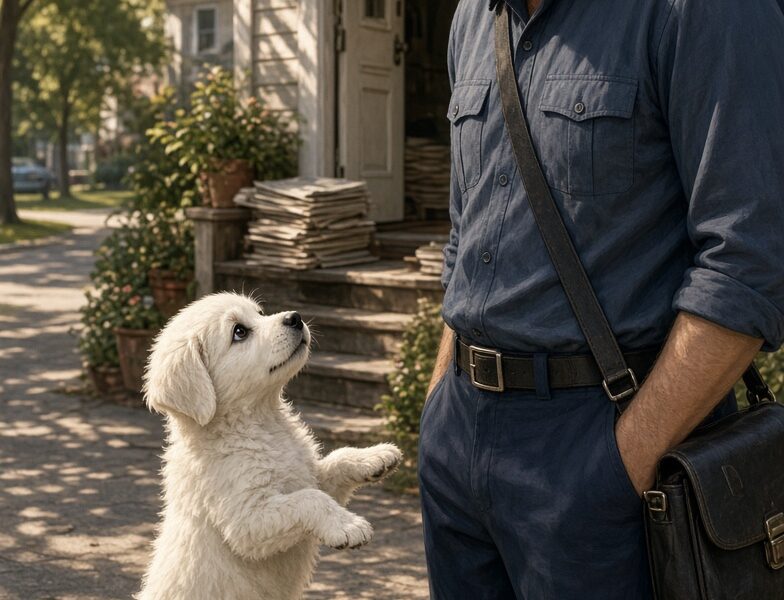
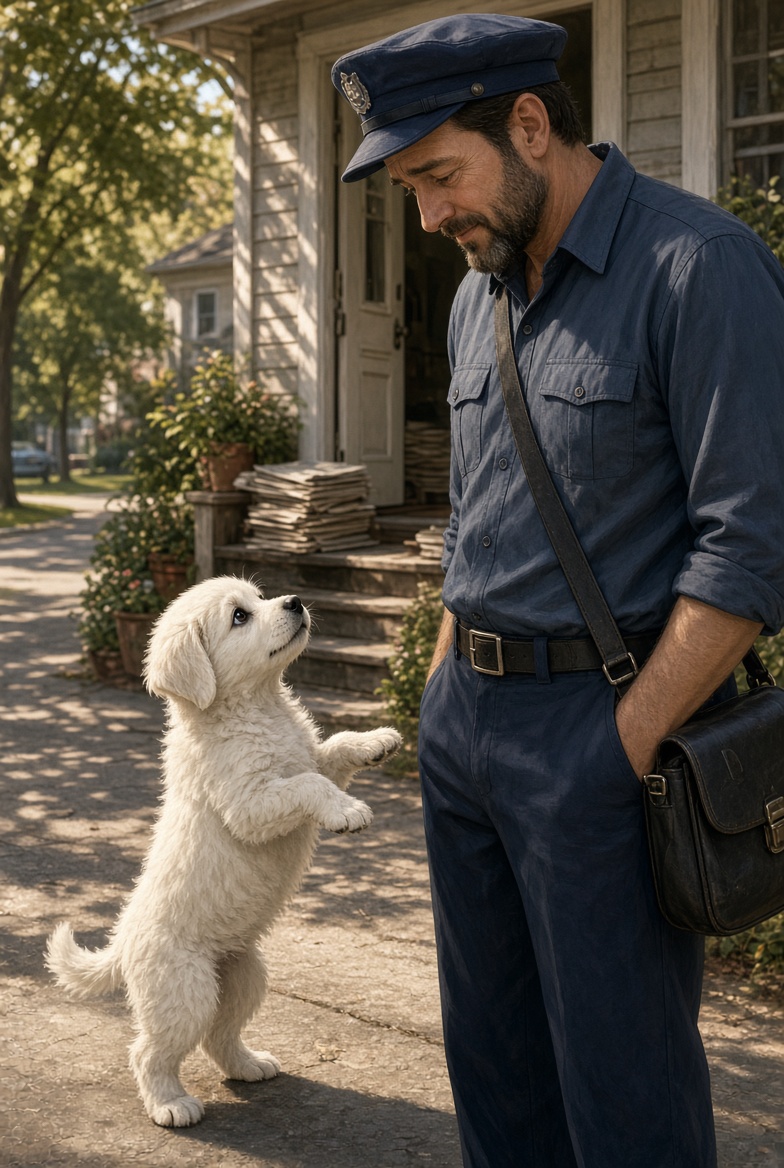
The mailman froze on the sidewalk, staring at the tiny white puppy standing on its hind legs, trembling so violently that its little body seemed ready to collapse. Its front paws reached toward him, its dark eyes wide with panic, and a desperate whine escaped its throat. Then it grabbed the cuff of his uniform pants and pulled.
“Hey, buddy. What’s wrong?”
The puppy didn’t answer, of course. Instead, it dragged him toward the house behind it, stopping every few steps to make sure he was following.
The porch was buried beneath three days of unopened newspapers. The mailbox overflowed with letters. The front door stood slightly open, and behind the drawn curtains, the house was unnaturally quiet.
Henry Walker had delivered mail on Maple Street for nearly fifteen years.
He had never seen anything like this.
And when the little dog finally led him inside, Henry discovered something that would change three lives forever.
Before that morning ended, a forgotten house, a frightened puppy, and one ordinary mail carrier would become the center of a story no one in the neighborhood would ever forget.
But the most heartbreaking part wasn’t what Henry found inside that house.
It was what the puppy had been trying to do for hours before anyone listened.
Maple Street, in a quiet American suburb where the lawns were neatly trimmed and the sidewalks were shaded by old maple trees, was usually the kind of place where nothing unexpected happened.
Every morning, sprinklers ticked across freshly cut grass. Neighbors collected newspapers in slippers and coffee-stained sweatshirts. Golden retrievers barked behind white picket fences, while bored cats watched the world from sunny windowsills.
Henry Walker knew every detail of the neighborhood.
At fifty-two, he had spent almost fifteen years delivering letters, packages, and birthday cards along the same familiar route. He knew which families left their porch lights on, which children raced to the mailbox after school, and which elderly residents appreciated an extra minute of conversation.
To Henry, delivering mail had never been only about envelopes.
It was about noticing people.
Sometimes, a simple question about someone’s morning was the only conversation they had all day.
Sometimes, a familiar face was the only reminder they needed that they hadn’t been forgotten.
And sometimes, Henry believed, paying attention could make the difference between an ordinary day and something far more important.
He had learned that lesson long before he became a mail carrier, although he rarely spoke about it.
Years earlier, after losing his wife to an illness that had progressed faster than either of them expected, Henry had discovered how painfully quiet a house could become.
The world kept moving.
People still went to work, bought groceries, and complained about the weather.
Meanwhile, he had struggled to understand how ordinary life could continue when the person who had made his own life meaningful was no longer there.
His wife, Sarah, had always insisted that kindness wasn’t measured by grand gestures.
“Henry,” she used to tell him, “you don’t have to save the whole world. Just don’t ignore someone who needs you.”
He had carried those words with him ever since.
They were the reason he remembered birthdays, checked on older neighbors, and occasionally stayed a few minutes longer when someone seemed unusually lonely.
They were also the reason he stopped walking that morning.
It began when he turned onto the walkway of house number 14.
Something white moved near the edge of his vision.
At first, Henry assumed it was a plastic grocery bag caught in the breeze.
Then the movement stopped.
He looked again.
A tiny white puppy stood in the middle of the path.
It was so small that Henry could easily have lifted it with one arm. Its fluffy coat was uneven and slightly matted, and its oversized paws looked almost comically large beneath its delicate body.
Its ears drooped.
Its tail was tucked tightly against its hind legs.
Most unusual of all, the puppy wasn’t trying to approach him for affection or backing away in fear.
It simply stared at him.
“Hey there, little guy,” Henry said, lowering his voice.
“You lost?”
The puppy’s chest rose and fell rapidly.
Henry crouched, expecting it to run toward him or retreat toward the porch.
Instead, the puppy lifted both front paws and struggled upright on its hind legs.
For one unsteady moment, it stood there, balancing awkwardly as it reached toward him.
Henry blinked.
“Well, I’ll be.”
The puppy let out a tiny, trembling whine.
Then it dropped to all fours, ran three steps toward the house, turned around, and barked.
It ran back to Henry and grabbed his pant leg.
Not hard enough to hurt him.
Just hard enough to make its intentions unmistakable.
“Whoa, easy,” Henry murmured.
The puppy pulled again.
Henry looked toward the house.
Mrs. Eleanor Foster lived there, an elderly widow who had always greeted him with a warm smile. She was a small woman with silver hair, gentle eyes, and a habit of offering cookies to anyone who stopped long enough to speak with her.
Henry hadn’t seen her recently.
He had assumed she was visiting family or taking a break from her usual routine.
Now, looking at the frightened puppy, he wasn’t so sure.
“Is something wrong inside?” he asked.
The puppy barked once.
Then it tugged his pants again.
Henry glanced at his watch.
He had dozens of houses left on his route, and his supervisor expected him to keep moving.
But the puppy’s expression reminded him of something he had seen only a few times in his life: the desperate look of someone who had run out of ways to ask for help.
“Okay,” he said quietly. “Show me.”
The puppy released his pants and raced toward the porch.
Henry followed.
Three damp newspapers lay scattered near the steps. Another rested against the door, its edges curled from the morning dew.
The dates on the front pages caught his attention.
Three days old.
Henry looked at the mailbox.
It was stuffed with envelopes, catalogs, and bills.
Mrs. Foster never left her mail untouched for three days.
Not once in all the years he had known her.
He remembered the last time they had spoken, about two weeks earlier.
She had been standing near her flower beds, holding a small watering can while a tiny white puppy watched her from the porch.
“Meet my newest family member,” she had told him proudly.
Henry had laughed.
“He looks like a cotton ball with legs.”
Mrs. Foster had smiled and lifted the puppy into her arms.
“His name is Angel. I found him behind the grocery store, frightened and hungry. I couldn’t leave him there.”
“You’ve got a good heart, Mrs. Foster.”
She had looked down at the puppy.
“Sometimes, Henry, I think the ones who need saving end up saving us, too.”
At the time, he had assumed she meant that Angel kept her company.
Now, those words returned with a strange weight.
Henry stepped onto the porch.
The puppy scratched at the bottom of the front door and whimpered.
“Mrs. Foster?” Henry called.
No answer.
He knocked.
Nothing.
He tried again, harder.
“Mrs. Foster, it’s Henry from the postal service. Are you home?”
Silence.
The puppy rushed to his feet and nudged his hand, then darted toward the door again.
Henry reached for the knob.
It turned easily.
The door opened a few inches with a long, tired creak.
He hesitated.
Postal workers weren’t supposed to enter people’s homes without a legitimate reason. Henry understood that boundary and respected it.
But the door had been left open, the mail had accumulated for days, and a frightened puppy was practically begging him to investigate.
He pushed the door open a little farther.
“Mrs. Foster?”
His voice disappeared into the house.
A faint, stale smell drifted through the entryway. It wasn’t overpowering, but it carried the uncomfortable impression of a place that had missed several ordinary mornings in a row.
Henry stepped across the threshold.
“I’m coming in just to check on you,” he called. “If you’re here, please say something.”
The puppy squeezed past his legs and hurried down the hallway.
Every few steps, it stopped and looked back.
Henry followed.
Family photographs lined the walls.
In one, Mrs. Foster stood beside her late husband, Robert, on a beach somewhere along the Carolina coast. In another, she held a birthday cake while three grandchildren crowded around her.
A framed photograph of Robert rested beside a wooden clock.
Henry remembered him as a cheerful man who had passed away several years earlier. After that loss, Mrs. Foster had gradually become quieter, though she had never lost her kindness.
Now the house seemed to hold the memory of a life that had suddenly stopped in the middle of an ordinary day.
A lamp lay on its side in the living room.
A mug had shattered near the hallway.
Dust floated through a narrow beam of sunlight.
Henry’s heartbeat quickened.
“Mrs. Foster?”
The puppy ran toward a closed door at the far end of the hall.
It scratched at the wood, whining louder with every passing second.
Henry recognized the door immediately.
Her bedroom.
He approached slowly.
“Mrs. Foster, can you hear me?”
For a moment, there was nothing.
Then he heard it.
A faint thump.
A weak, almost inaudible moan.
Henry stopped breathing for a second.
He pressed his ear toward the door.
“Mrs. Foster?”
Another faint sound came from inside.
The puppy barked sharply and pawed at the door.
Henry tried the handle.
It opened.
The bedroom curtains were half drawn, leaving the room dim despite the bright morning outside.
A bedside table had overturned.
A cup lay broken on the floor, and a medication bottle rested nearby with several pills scattered around it.
A dish towel had fallen beside the table, one corner darkened by what looked like a small scorch mark.
Henry’s eyes moved across the room, searching desperately for movement.
Then he saw her.
Mrs. Foster lay on the floor beside the bed, one arm trapped awkwardly beneath her body. Her silver hair was disheveled, and her face was pale.
Her eyes opened briefly when Henry approached, but she seemed too weak to focus.
“Mrs. Foster!”
Henry dropped to his knees.
The puppy rushed past him, pressing its little body against the woman’s arm.
It licked her fingers, whined, and nudged her hand repeatedly.
“Easy, buddy,” Henry said, though he could barely keep his own voice steady.
He leaned close enough to see that Mrs. Foster was breathing.
Weakly, but breathing.
“Can you hear me?” he asked her.
Her lips moved.
No clear words emerged.
Henry reached for his phone.
“I’m calling 911. You’re not alone anymore.”
He gave the dispatcher the address, explained that an elderly woman was on the floor and appeared seriously unwell, and followed the operator’s instructions.
He didn’t try to lift her unnecessarily.
He didn’t attempt to make her drink anything or give her medication.
He stayed beside her, watching her breathing and answering the dispatcher’s questions as carefully as he could.
The puppy, meanwhile, refused to leave her side.
Every few seconds, it looked at Henry and let out another urgent bark.
Henry glanced at the little dog.
“You found me, didn’t you?”
Angel pressed his head against Mrs. Foster’s hand.
“You knew she needed help.”
The puppy whined.
Henry felt his throat tighten.
He had spent years walking past hundreds of doors, never knowing what was happening on the other side.
That morning, a puppy had made certain he didn’t walk past this one.
And now Henry understood why the animal had been so desperate.
Someone inside this house had been waiting for help.
Someone who might not have had the strength to ask for it.
The dispatcher told Henry that emergency responders were on their way.
He stayed on the line, answering questions and keeping his voice calm as he spoke to Mrs. Foster.
“Help is coming,” he told her. “You just hold on.”
The puppy rested its chin against her wrist.
“Your little friend here did a good job getting my attention.”
Mrs. Foster’s eyelids fluttered.
For a moment, Henry thought she might have heard him.
Then her lips moved again.
He leaned closer.
“What’s that, Mrs. Foster?”
A faint whisper escaped her.
“Baby.”
Henry looked down at Angel.
The puppy lifted its head immediately, as if the single word had called it by name.
“Oh,” Henry whispered. “You mean your baby.”
Angel pressed closer to her hand.
Henry remembered the grocery store conversation, the story of the abandoned puppy, and the way Mrs. Foster had held him as though she had discovered something precious.
She had rescued him when he was helpless.
Now he was trying to do the same for her.
The realization struck Henry harder than he expected.
This little animal couldn’t call 911.
It couldn’t explain what had happened or tell a neighbor where to find her.
But it could refuse to give up.
It could bark, tug at a stranger’s clothing, and lead him toward the one place where help was needed.
And that was exactly what it had done.
Outside, the neighborhood continued its ordinary morning.
A lawn mower started somewhere down the street.
A delivery truck passed the intersection.
A child laughed behind a nearby fence.
Inside the bedroom, Henry watched Mrs. Foster struggle through another shallow breath and silently prayed that the ambulance would arrive soon.
He had no idea how long she had been lying there.
He only knew that the three days of untouched mail and newspapers suggested she had missed more than one morning.
The uncertainty was unbearable.
“Stay with us,” he whispered. “Angel needs you.”
The puppy let out a small bark.
For the first time since Henry had entered the house, it sounded less like a warning and more like an answer.
Then, faintly, the sirens began.
Henry had never been so relieved to hear a sound in his life.
He hurried toward the front door to guide the paramedics inside, calling back to Mrs. Foster as he went.
“They’re here! Help is here!”
Red and blue lights flashed across the windows.
Two paramedics entered with their equipment, followed by another responder who began asking Henry questions.
“What happened?”
“I found her on the bedroom floor,” Henry explained. “Her puppy led me here. She was conscious for a moment, but she’s very weak.”
One paramedic knelt beside Mrs. Foster while the other began assessing her condition.
They checked her vital signs, administered appropriate emergency care, and prepared to move her.
Henry stepped back to give them room.
Angel tried to follow them as they worked, but one of the responders gently guided the little dog away from the equipment.
“Easy, little guy,” he said. “We’re helping her.”
Angel didn’t understand.
He paced in small circles, whining and staring at the woman who had become his entire world.
When the paramedics prepared to move Mrs. Foster onto a stretcher, Angel rushed forward and pressed his face against her fingers.
Her hand moved slightly.
Whether she recognized him or simply responded to the familiar touch, Henry couldn’t tell.
But the puppy seemed to take comfort in it.
“She’s going to the hospital,” Henry whispered as he carefully lifted Angel into his arms. “They’re going to take care of her.”
The paramedics wheeled Mrs. Foster through the hallway and out onto the porch.
A few neighbors had stepped outside after hearing the sirens.
Across the street, a woman in a blue robe stood beside her mailbox, one hand covering her mouth.
“Is that Eleanor?” she called.
Henry nodded.
“What happened?”
“She needs medical help,” he answered. “Please give the paramedics room.”
The ambulance doors closed.
The siren sounded again.
And then Mrs. Foster was gone, carried toward a hospital where strangers would fight to help her recover.
Henry stood on the sidewalk with Angel pressed against his chest.
The little puppy watched the ambulance disappear down Maple Street.
Its body trembled.
Its ears drooped.
And when the flashing lights vanished around the corner, Angel released a small, broken whimper that Henry would remember for the rest of his life.
For several seconds, neither of them moved.
Then Henry looked down at the puppy.
“Come on, little hero,” he murmured. “Let’s make sure you’re safe, too.”
He sat on the porch steps and held Angel close while he called his supervisor to explain the emergency.
His supervisor immediately told him not to worry about finishing the route until everything had been sorted out.
Henry thanked him, then looked at the house again.
It felt different now.
The same photographs lined the walls.
The same curtains hung in the windows.
The same flowers grew beside the porch.
But the place no longer seemed merely quiet.
It seemed to be waiting.
Henry thought of the three days of unopened mail.
He thought of the overturned table, the broken cup, and the woman lying on the floor.
And he thought of Angel, who had somehow recognized that something was terribly wrong.
“Where did you get that courage?” Henry asked softly.
The puppy lifted its head.
Its nose brushed Henry’s hand.
Then Angel turned toward the open doorway.
Henry followed his gaze and remembered something Mrs. Foster had told him several weeks earlier.
She had found Angel behind the grocery store, huddled near a dumpster on a cold afternoon.
He had been so small that she initially thought he was a bundle of discarded fabric.
When he moved, she realized he was alive.
She had wrapped him in her cardigan, taken him home, and spent the following days feeding him carefully and helping him regain his strength.
She had never asked for anything in return.
“I couldn’t leave him there,” she had told Henry.
“He needed someone.”
Now Henry looked at the frightened puppy in his arms and felt the full weight of that simple sentence.
Mrs. Foster had given Angel a home when he had nowhere else to go.
She had given him warmth, food, safety, and the kind of affection that teaches a frightened creature the world can still be kind.
And when she needed help, Angel had tried to repay every bit of it.
He couldn’t explain his intentions in words.
He couldn’t understand medical emergencies.
He could only recognize that his person wasn’t getting up.
So he had gone looking for someone who might listen.
Henry stroked the puppy’s head.
“You’ve done enough for one day,” he whispered.
But Angel continued to stare toward the street where the ambulance had disappeared.
His entire world had gone somewhere he couldn’t follow.
Henry understood that feeling more than he wished he did.
After Sarah died, he had spent months looking at the empty chair across his kitchen table, expecting to hear her voice in the next room.
He knew that grief could make even a familiar house feel unfamiliar.
And he knew what it meant to be frightened of losing the one presence that made everything feel right.
“I’m going to find out how she’s doing,” he promised the puppy. “And I’m going to make sure you see her again.”
Angel looked up.
Henry held his gaze.
It was a promise he intended to keep.
The hospital was fifteen minutes away.
Henry arranged for a coworker to collect his mailbag, then drove there as soon as he could.
He carried Angel in a small blanket borrowed from a neighbor, stopping at the front desk to explain what had happened.
The receptionist listened with growing concern.
“Mrs. Foster was brought in by ambulance?”
“Yes,” Henry replied. “I found her at home. Her puppy led me to her.”
The receptionist glanced at Angel.
“This little fellow?”
Henry nodded.
“He wouldn’t let me walk away.”
The receptionist’s expression softened.
“Let me contact the staff and find out where she is. Animals aren’t normally allowed in patient areas, but we’ll see what arrangements can be made.”
Henry thanked her and sat in the waiting area.
Angel settled against his chest, exhausted after a morning of barking, running, and searching for help.
Every time a door opened, however, the puppy raised his head.
Every time footsteps approached, his ears lifted.
He was waiting for the one person who hadn’t yet come through the door.
Henry knew the feeling.
He had waited outside hospital rooms before, watching clocks move while trying not to imagine all the things that could go wrong.
He had learned that the hardest part of waiting was how little control a person had over it.
You could make the call.
You could find help.
You could sit beside someone and tell them you loved them.
But you couldn’t bargain with time.
And you couldn’t promise yourself that everything would turn out the way you wanted.
A nurse finally approached.
“Are you Henry Walker?”
He stood immediately.
“Yes. How is Mrs. Foster?”
The nurse consulted her notes.
“She’s receiving treatment. She’s very weak, and the doctors are still evaluating what happened, but she’s stable enough for us to continue caring for her here.”
Henry exhaled slowly.
“Can I see her?”
“Not just yet. The medical team needs a little more time.”
He nodded, accepting the answer.
Then the nurse noticed Angel.
“And who do we have here?”
“This is Angel. He’s Mrs. Foster’s puppy.”
The nurse crouched slightly, smiling when the little dog sniffed her fingers.
“I heard about you,” she whispered. “Apparently, you’ve had quite a morning.”
Angel gave a soft whine.
The nurse’s smile faded into something more tender.
“I’ll see what we can do. If her care team approves a brief visit, we’ll let you know.”
Henry thanked her.
For the next hour, he remained in the waiting area, holding Angel and watching the doors.
He thought about the moment he had first seen the puppy standing on the sidewalk.
If he had mistaken the animal’s behavior for a simple request for food, he might have continued down the street.
If he had assumed Mrs. Foster was away visiting relatives, he might have left without checking.
If he had been too concerned about finishing his route to investigate, he might never have discovered what was happening inside the house.
He didn’t blame himself for the possibility.
He had stopped.
That was what mattered.
But the thought made him more determined than ever to pay attention when something felt wrong.
A little after noon, a doctor approached the waiting area.
“Mr. Walker?”
Henry stood so quickly that Angel nearly slipped from his arms.
“I’m Henry.”
The doctor introduced himself and explained that Mrs. Foster was receiving care for a serious medical emergency.
The exact cause of her collapse was still being assessed, and it would take time to understand everything that had happened.
“She was fortunate someone found her when they did,” the doctor said. “We can’t say how things would have turned out otherwise, but getting her medical attention was important.”
Henry closed his eyes briefly.
“Thank goodness.”
The doctor glanced at Angel.
“And I understand this little fellow had something to do with that.”
Henry looked down.
“He did more than something. He made sure I followed him.”
The doctor smiled.
“Animals can form remarkable bonds with the people who care for them. We see that connection in all kinds of ways.”
He explained that Mrs. Foster needed rest, monitoring, and additional treatment before anyone could predict when she would be ready to return home.
Henry nodded, absorbing every word.
“Can I tell her the puppy is here?”
“She was awake briefly earlier. She asked about him.”
Henry’s breath caught.
“She did?”
The doctor nodded.
“Just one word, actually. She kept asking for her baby.”
Henry looked at Angel.
The puppy had lifted his head, ears alert.
For the first time that day, Henry felt something other than fear.
He felt hope.
It was small and fragile, but it was there.
The doctor promised to ask the care team whether a short visit could be arranged once Mrs. Foster was ready.
Henry sat again.
Angel rested his chin against Henry’s arm.
And together they waited.
By late afternoon, the hospital staff had heard the basic outline of what happened on Maple Street.
A mail carrier had entered a home after a puppy refused to stop begging for help.
An elderly woman had been found in serious condition.
The puppy had stayed beside her until emergency responders arrived.
It was the kind of story people repeated quietly because they couldn’t quite believe it.
A nurse passing through the waiting area paused to look at Angel.
“Is he the one who stood on his hind legs?”
Henry smiled faintly.
“That’s what he did. Just lifted those little paws and stared at me like I was supposed to understand.”
The nurse shook her head in amazement.
“I’m glad you did.”
“So am I.”
She glanced at the puppy’s small, tired face.
“What’s his name?”
“Angel.”
The nurse looked at him again.
“That’s a fitting name.”
Henry stroked his fur.
“His owner found him abandoned behind a store. She took him in when nobody else had.”
The nurse’s eyes softened.
“And now he’s looking after her.”
Henry nodded.
“Seems that way.”
The nurse moved on, but her words stayed with him.
For years, Henry had thought of himself as someone who helped in small, ordinary ways.
He delivered mail.
He checked on neighbors.
He listened when someone wanted to talk.
He didn’t consider himself a hero.
That word belonged to people who ran into burning buildings, rescued strangers from dangerous situations, or performed extraordinary acts under pressure.
But the more he thought about that morning, the more he understood something.
Heroism didn’t always begin with courage.
Sometimes it began with paying attention.
Sometimes it began with the decision not to walk away.
And sometimes it arrived on four tiny paws, trembling so badly that the whole world seemed too big to face alone.
At last, a nurse returned with permission for a brief visit.
“Mrs. Foster is awake,” she told Henry. “She’s still very tired, so we need to keep the visit quiet and short. But the doctor has approved bringing Angel in for a few minutes.”
Henry’s eyes filled with relief.
“Thank you.”
The nurse led them down a quiet hallway.
Angel grew more alert with every step.
His nose twitched.
His ears stood upright.
By the time they reached Mrs. Foster’s room, he was leaning forward in Henry’s arms, searching for something familiar.
The nurse opened the door.
Soft afternoon sunlight filtered through the blinds, falling across the hospital bed.
Mrs. Foster lay propped against her pillows, an IV line attached to her arm and a small monitor beside the bed.
She looked pale and exhausted.
But her eyes were open.
When she saw Henry, she managed a faint smile.
“Henry?”
“I’m here, Mrs. Foster.”
She tried to lift her hand.
“Where’s my baby?”
Henry could no longer hold back his tears.
“He’s right here.”
He carefully lowered Angel onto the bed, making sure the nurse was comfortable with the arrangement.
The puppy immediately moved toward Mrs. Foster’s hand.
He sniffed her fingers, pressed his nose against her palm, and released a trembling whine.
Then he began licking her hand with such frantic relief that Henry had to look away for a moment.
Mrs. Foster’s fingers curled gently into his fur.
“Oh, my sweet boy,” she whispered.
Angel pushed his head beneath her hand.
“I’m here,” she murmured. “I’m still here.”
The puppy settled against her arm, his small body shaking as though all the fear he had held inside was finally escaping.
Mrs. Foster stroked his head.
Tears slipped down her cheeks.
“I heard you,” she whispered. “I heard you trying to get someone.”
Henry stood beside the bed.
“He found me on the sidewalk. I thought he was lost at first.”
Mrs. Foster looked at him.
“He wouldn’t leave me?”
“Not for a second.”
She closed her eyes briefly, holding Angel close.
“He saved my life.”
Henry shook his head gently.
“He made sure you got help. That’s what matters.”
Mrs. Foster looked down at the puppy.
“He was so little when I found him,” she whispered. “He was frightened of everything. Even the sound of the refrigerator starting up made him jump.”
Henry smiled.
“I remember you telling me about that.”
“I used to sit on the floor beside him until he fell asleep. Sometimes, I’d wake up in the middle of the night and find him curled against my slippers.”
She stroked Angel’s fur.
“I thought I was teaching him that he was safe.”
Her voice broke.
“But he was teaching me something, too.”
Henry pulled a chair closer to the bed.
“What was that?”
Mrs. Foster looked at Angel, who had finally stopped trembling.
“That love doesn’t have to be big to be strong.”
The room fell quiet.
The monitor continued its steady rhythm.
Outside the window, the afternoon traffic moved along the road, and sunlight slipped slowly across the floor.
For the first time since that terrible morning, the world seemed gentle again.
Angel curled against Mrs. Foster’s side, his head resting near her hand.
She closed her eyes, still touching him.
Henry remained in the chair until the nurse reminded them that Mrs. Foster needed rest.
Before he left, Mrs. Foster reached for his hand.
“Thank you,” she whispered.
Henry shook his head.
“You don’t owe me anything.”
“I do,” she insisted. “You listened to him.”
Henry looked toward Angel.
“He made it pretty hard not to.”
Mrs. Foster managed a weak laugh.
Then her expression grew serious.
“Henry, I live alone. I’ve been managing for a long time, but this frightened me more than I can explain.”
He listened without interrupting.
“I don’t like asking people for help,” she admitted. “I don’t want to become a burden to anyone. But I realize now that trying to do everything alone isn’t always strength.”
Henry nodded.
“There’s nothing wrong with needing someone.”
She glanced at Angel.
“If something like this ever happens again, I don’t want him left helpless. I want to make sure someone will look after him.”
Henry understood what she meant.
She wasn’t giving up.
She was thinking ahead.
“I’ll check on you,” he promised. “When you get home, I’ll stop by regularly. And if you need help arranging anything, we’ll figure it out.”
Mrs. Foster’s eyes glistened.
“You would do that?”
“Of course.”
He paused, then added, “And we’ll make sure Angel has people looking out for him, too.”
The puppy lifted his head at the sound of his name.
Henry smiled.
“Although, judging by what he did today, I suspect he’ll be keeping an eye on all of us.”
Mrs. Foster laughed softly.
It was a small sound, weakened by exhaustion, but it was unmistakably her.
And Henry knew he would remember it for a long time.
Over the following days, Mrs. Foster continued receiving treatment.
Her recovery was gradual, and there were difficult moments when fatigue left her discouraged.
But she was no longer facing those moments alone.
Henry visited whenever his schedule allowed.
Sometimes he brought coffee for the nurses.
Sometimes he brought a small bag of groceries for Mrs. Foster to have ready when she returned home.
Mostly, he brought Angel.
The puppy had become calmer since the day of the emergency, although he still reacted whenever someone mentioned Mrs. Foster’s name.
He would lift his head, wag his tail, and search the room as though making certain she hadn’t disappeared.
At the hospital, the staff grew fond of him.
Whenever an approved visit was arranged, a nurse would help Henry bring Angel to Mrs. Foster’s bedside.
The little dog would climb carefully onto the blanket, circle once, and settle beside her hand.
Mrs. Foster would stroke his head and tell him about the things they would do when she returned home.
“We’re going to sit in the garden again,” she promised him one afternoon. “And you’re going to watch the birds from your favorite spot.”
Angel wagged his tail.
“And perhaps,” she continued, “we’ll finally get you to stop stealing my slippers.”
The puppy licked her fingers.
Henry chuckled from the chair near the window.
“I wouldn’t count on that last part.”
Mrs. Foster smiled.
For the first time in years, she had something to look forward to beyond the next ordinary day.
She had a little companion who depended on her.
She had neighbors who had begun checking in.
And she had discovered that accepting help didn’t diminish her independence.
It made it possible for her to keep living the life she loved.
One afternoon, the doctor entered with an encouraging update.
Mrs. Foster was making progress.
She would need follow-up appointments, some temporary assistance, and a little time to regain her strength, but going home was becoming a realistic possibility.
Mrs. Foster pressed a hand to her chest.
“Home,” she whispered.
Henry smiled.
“Maple Street has missed you.”
“And my garden?”
“Still there.”
“My flowers?”
“Still there.”
She looked down at Angel.
“And my baby?”
Henry lifted the puppy into her arms.
“Right here.”
Angel immediately pressed his face against her shoulder.
Mrs. Foster laughed through her tears.
“Then I suppose I have everything I need.”
But before she could leave the hospital, she wanted to make one more decision.
She asked Henry to sit with her while Angel rested beside her bed.
“Do you remember when I first found him?” she asked.
“I remember you telling me.”
“I had gone to the grocery store after a rainstorm. On my way back, I heard this tiny sound behind the building. At first, I thought it was a bird.”
She paused, looking at Angel.
“He was curled up beside a cardboard box. His fur was dirty, and he was so frightened he wouldn’t let me get close.”
Henry listened.
“I sat there for almost twenty minutes. I didn’t want to scare him. Eventually, he came to me.”
She stroked his head.
“I brought him home, gave him food and water, and wrapped him in a blanket. I didn’t know whether he’d trust me.”
“But he did,” Henry said.
“Eventually. And after a while, I realized I wasn’t the only one who needed a little company.”
She looked toward the window.
“After Robert died, I kept telling everyone I was fine. I learned how to fix things around the house, take care of the garden, and manage the bills. I was proud of being able to do it all myself.”
Her eyes softened.
“But there were evenings when I would sit in that big living room and realize I hadn’t spoken to another person all day.”
Henry understood.
He knew the quiet that followed loss.
He knew how easy it was to convince yourself that loneliness was simply part of being independent.
“And then Angel came along,” Mrs. Foster continued. “He needed me to feed him, teach him, and make him feel safe. Suddenly, I had a reason to get up early again. I had someone waiting for me when I came home.”
She looked down at the puppy.
“I thought I was rescuing him.”
Her voice grew quiet.
“But perhaps we rescued each other.”
Henry glanced away, blinking back tears.
“That sounds about right.”
Mrs. Foster took a breath.
“Before I collapsed, I had been thinking about how much comfort Angel could bring other people. He’s gentle, and he seems to know when someone is sad. I was considering asking a local animal-assisted therapy organization about training him properly when he was older.”
Henry looked at the little dog.
“You think he could help people?”
“I do. Not because he can perform miracles. But because he knows how it feels to be frightened, and he knows what it means when someone stays.”
She smiled faintly.
“I wanted him to have a purpose beyond simply keeping me company.”
Henry thought about the hospital staff who had smiled whenever Angel entered the room.
He thought about the way people softened when they heard what the puppy had done.
“He’s already bringing people together,” he said.
Mrs. Foster nodded.
“Yes. But first, I need to make sure he always has a safe home.”
She hesitated before continuing.
“I don’t want to sound dramatic, Henry, but what happened frightened me. I live alone, and I understand now that there are things I can’t always predict. If I ever need more help than I can manage, I want Angel to be cared for properly.”
Henry leaned forward.
“We can talk about that. We’ll make a plan, find people you trust, and make sure you have support.”
“And if I couldn’t care for him anymore?”
Henry understood the question beneath her words.
She wasn’t asking him to take Angel away.
She was asking whether the little dog who had already lost one home would ever have to face that uncertainty again.
“If you ever needed me to care for him,” Henry said, “I would.”
Mrs. Foster’s eyes filled.
“You mean that?”
“I do.”
He took her hand gently.
“But let’s not get ahead of ourselves. You’ve got a house to return to, a garden to tend, and a puppy who still needs to learn that slippers aren’t toys.”
Mrs. Foster laughed.
Angel wagged his tail, apparently pleased that everyone had returned to a happier subject.
The promise settled between them.
It wasn’t a grand oath.
It wasn’t a dramatic declaration made in front of a crowd.
It was a simple commitment between two people who understood what it meant to care for someone vulnerable.
And it would matter more than either of them knew.
A few days later, Mrs. Foster was discharged from the hospital with instructions for follow-up care and temporary assistance at home.
Henry arrived early to help her return to Maple Street.
He had arranged for a neighbor to check on her during the first few days, and he had made sure her porch was clear, her groceries were ready, and the pathway to the front door was safe.
Angel rode beside him in the car, restless with excitement.
Every time Henry glanced over, the puppy was looking toward the window.
“Almost home,” Henry told him.
Angel let out a small bark.
When they arrived, Mrs. Foster paused at the entrance to her house.
She looked at the front door, the flower beds, and the porch where she had spent countless quiet mornings.
For a moment, she seemed overwhelmed.
“I never thought I’d be so happy to see this old place,” she whispered.
Henry offered his arm.
“Take your time.”
She stepped inside slowly.
The house had been tidied, the broken cup and overturned table removed, and the rooms made comfortable for her return.
But the most important change was not something Henry had arranged.
It was the sound of Angel’s paws racing across the hardwood floor.
The puppy ran from the hallway to the living room, then returned to Mrs. Foster as if checking that she was really there.
He pressed against her legs.
She bent carefully and stroked his head.
“I’m home, baby.”
Angel wagged his tail so vigorously that his entire body seemed to move with it.
Henry stood by the doorway, smiling.
He had witnessed plenty of emotional reunions in his life, but there was something extraordinary about watching this little creature rediscover the place where he belonged.
Mrs. Foster settled into her favorite chair.
Angel curled at her feet.
For several minutes, neither of them moved.
Then she looked at Henry.
“I think we should do something for him.”
Henry tilted his head.
“Like what?”
“I want to help other people understand how important it is to notice the animals around us. And I want to find out whether Angel might eventually be suited for therapy work.”
Henry smiled.
“I think that’s a wonderful idea.”
They began by speaking with their neighbors.
The first to arrive was Margaret Ellis, the woman who lived across the street.
She brought a casserole, a bouquet of flowers, and a list of local services that helped older residents with transportation and household tasks.
“I should have checked on you sooner,” Margaret admitted, sitting beside Mrs. Foster.
Mrs. Foster shook her head.
“You couldn’t have known.”
“But I knew you lived alone. I knew I hadn’t seen you for a few days. I kept telling myself you were probably busy.”
She glanced at Angel.
“I’m glad this little fellow didn’t make the same assumption.”
Margaret reached down and gently scratched the puppy’s ears.
Angel leaned into her hand.
Soon, another neighbor arrived.
Then another.
Some brought food.
Some offered to help with the garden.
One offered to drive Mrs. Foster to her follow-up appointments.
Another volunteered to collect her mail whenever she planned to be away.
Before long, the quiet house on Maple Street was filled with voices.
Mrs. Foster sat in her chair, watching neighbors who had once exchanged little more than polite waves now talking across her living room.
It was a change she had never expected.
She had spent years believing that asking for help might make her seem weak.
Instead, she discovered that people were often waiting for an opportunity to be useful.
They simply needed to know there was a reason.
And in the middle of all the conversation, Angel wandered from person to person, accepting gentle pats and curling up beside anyone who sat quietly enough.
Margaret laughed when the puppy rested his head on her knee.
“He’s making his rounds.”
Henry smiled.
“Apparently, he’s decided the whole street needs checking on.”
The neighbors laughed.
But as the afternoon continued, something more meaningful began to emerge.
People started talking about the elderly residents they hadn’t seen recently.
They discussed ways to check on neighbors who lived alone.
They exchanged phone numbers and agreed to contact one another if someone missed a regular appointment or seemed unusually absent.
No one wanted to intrude on another person’s privacy.
They simply wanted to make it easier to notice when something might be wrong.
Mrs. Foster listened with growing emotion.
Angel had begun the morning by begging one stranger to pay attention.
By the end of the week, he had reminded an entire neighborhood why attention mattered.
Henry saw it happening and thought of Sarah.
You don’t have to save the whole world, he remembered her saying.
Just don’t ignore someone who needs you.
Perhaps that was all any of them could do.
Notice.
Listen.
Show up.
And when a small, frightened creature asked for help, take the time to understand what it was trying to say.
In the weeks that followed, Maple Street slowly returned to its usual rhythm.
Sprinklers ticked across the lawns.
Children rode their bikes.
The mail truck moved from house to house.
But the residents began looking at their surroundings differently.
Margaret started checking on the widower two doors down.
A young couple offered to mow the lawn of an elderly neighbor recovering from surgery.
Henry himself became more attentive to changes along his route, not because he believed every quiet house concealed an emergency, but because he had learned that familiar routines could reveal when something was out of place.
And Angel?
Angel became the most recognized dog on Maple Street.
Neighbors waved whenever they saw him in the front window.
Children asked permission to visit.
People who had never paid much attention to the little white puppy now stopped to ask how he was doing.
Mrs. Foster was careful not to let the attention overwhelm him.
She wanted him to enjoy a peaceful life, with plenty of rest, play, and affection.
If he eventually qualified for therapy work, she would explore that opportunity with qualified professionals.
If he preferred to remain her companion, that would be enough.
His worth had never depended on how many people he helped.
He was loved because he was Angel.
And that was all he had ever needed to be.
One sunny afternoon, Henry stopped by after finishing his mail route.
He found Mrs. Foster sitting on the porch with a glass of iced tea and Angel stretched out beside her chair.
A newspaper lay folded on her lap.
For the first time in days, there were no unopened envelopes piled near the door, no unanswered questions hanging over the house, and no sense that the world had stopped moving.
“Afternoon, Mrs. Foster,” Henry called.
She looked up and smiled.
“Henry! Come sit down.”
He joined her on the porch.
Angel rose immediately, trotting over to greet him.
“Well, hello to you, too,” Henry said, scratching behind the puppy’s ears.
Angel leaned against his leg.
Mrs. Foster watched them with a soft expression.
“He knows your footsteps now.”
“I’m beginning to think he knows everyone’s footsteps.”
“He’s very observant.”
Henry glanced at the puppy.
“I wonder where he learned that.”
Mrs. Foster laughed.
They sat quietly for a while, listening to the breeze move through the maple trees.
Then Mrs. Foster folded her newspaper and looked at Henry.
“Do you ever think about what would have happened if you hadn’t stopped?”
Henry considered the question.
Of course he did.
He thought about it more often than he admitted.
He imagined himself continuing down the sidewalk, the puppy left behind to try another person, another house, another desperate attempt to get someone to understand.
He imagined the untouched newspapers and the silent front door.
He thought about how easily an ordinary morning could have passed without anyone realizing that something was wrong.
“I think about it,” he admitted.
Mrs. Foster looked down at Angel.
“So do I.”
She stroked the puppy’s head.
“I remember being on the floor. I remember trying to move, and I remember feeling frightened because I couldn’t seem to make my body do what I wanted.”
Her voice grew softer.
“I didn’t know whether anyone would come.”
Henry listened.
“Then I heard Angel,” she continued. “He was crying and scratching, and I wanted to tell him it was all right. I wanted him to stop worrying.”
She paused.
“But I couldn’t get the words out.”
Angel lifted his head, sensing the change in her voice.
Mrs. Foster smiled at him.
“I think he understood anyway.”
Henry nodded.
“He knew you needed help.”
She looked toward the street.
“And you heard him.”
Henry remembered the first moment he had seen the puppy standing on his hind legs, trembling in the morning sunlight.
He remembered how strange the behavior had seemed.
He remembered almost dismissing it as a frightened animal acting unpredictably.
And he remembered the decision to stop.
“I don’t think I’ll ever forget those eyes,” he said.
“Neither will I.”
Mrs. Foster reached down and lifted Angel into her lap.
He settled against her, content and warm.
For a moment, Henry saw the little dog as he must have looked when Mrs. Foster first found him behind the grocery store.
Small.
Frightened.
Unsure whether the world would offer him anything except another reason to hide.
She had taken him home anyway.
She had given him time to trust.
And when she became the one who needed saving, he had returned that kindness in the only way he could.
Henry looked at the puppy and smiled.
“You know, Angel, I think you owe me a favor.”
The puppy tilted his head.
Mrs. Foster laughed.
“What kind of favor?”
“Next time you need help, try barking before you start pulling my pants apart.”
Angel wagged his tail.
“He makes no promises,” Mrs. Foster replied.
The three of them laughed together.
It was an ordinary sound on an ordinary afternoon.
But for Henry, it carried the weight of something extraordinary.
He had begun the week thinking that he was simply delivering mail.
Instead, he had discovered a story about a tiny animal whose courage had brought a stranger to a door, a woman whose kindness had saved a life, and a neighborhood that had learned to look out for one another.
He had also discovered that the promises we make in difficult moments can become the foundations of relationships we never expected.
He had promised to check on Mrs. Foster.
He kept that promise.
He promised to help ensure Angel would always have someone to care for him.
He kept that promise, too.
As the seasons changed, Henry continued stopping by the house on Maple Street.
Sometimes he brought groceries.
Sometimes he helped carry packages.
Sometimes he simply sat on the porch and listened while Mrs. Foster told him stories about her husband, her grandchildren, and the small joys of daily life.
Angel grew stronger and more confident.
His fur became clean and fluffy.
His steps grew steadier.
The frightened puppy who had once trembled on the sidewalk began greeting familiar visitors with a wagging tail.
But he never lost his habit of checking on Mrs. Foster.
If she moved from the living room to the kitchen, he followed.
If she sat down to read, he settled nearby.
If she went into the garden, he waited by the door until she returned.
Mrs. Foster didn’t mind.
She called him her little shadow.
And whenever Henry heard her use that nickname, he remembered the morning when Angel had refused to let him walk away.
Months later, Mrs. Foster began exploring a local animal-assisted therapy program.
She learned that not every friendly dog was suited to that work, and any training would need to happen gradually, with attention to Angel’s comfort and temperament.
She didn’t rush him.
There was no need to turn his extraordinary morning into an obligation.
If he enjoyed the training, they would continue.
If he didn’t, he would remain exactly where he belonged: at home, beside the woman who had given him a second chance.
The idea of helping others, however, stayed with Mrs. Foster.
She began volunteering to organize small gatherings for older residents in the neighborhood.
They shared coffee, talked about their lives, and arranged practical ways to support anyone who needed assistance.
Sometimes Angel attended.
He would settle near a chair, rest his head on someone’s knee, and accept the occasional gentle scratch behind the ears.
His presence made people smile.
It reminded them of the mailman who had listened, the woman who had rescued a puppy, and the little dog who had refused to give up.
One afternoon, a woman who had recently lost her husband sat quietly near the window while the others talked.
Angel wandered over and rested beside her chair.
She looked down at him.
Then she reached out and stroked his fur.
For several minutes, she said nothing.
Eventually, she looked up at Mrs. Foster.
“There’s something comforting about having someone sit beside you without expecting you to explain how you feel.”
Mrs. Foster smiled.
“Yes,” she said. “There really is.”
Henry, who had stopped by to help carry refreshments, heard the conversation from the doorway.
He didn’t interrupt.
He simply watched Angel resting beside the woman, his eyes half closed, his small body relaxed.
Perhaps Angel would one day become a trained therapy dog.
Perhaps he would never do anything more than sit beside the people he loved.
Either way, he was already offering something valuable.
He was reminding people that they didn’t have to be perfect, strong, or cheerful every minute of the day to deserve companionship.
Sometimes, they simply needed someone willing to stay.
Henry thought of Sarah again.
He remembered her belief that kindness rarely required grand gestures.
He had spent years trying to live by that principle without fully understanding how far one small act could travel.
Now he saw it more clearly.
A puppy had needed help.
A mailman had stopped.
An elderly woman had survived a frightening emergency.
A neighborhood had grown closer.
And a simple promise had become a network of care that would continue long after the details of that morning faded from memory.
When Henry left that afternoon, Angel followed him to the porch.
He sat beside Mrs. Foster’s chair, watching Henry walk down the steps.
Henry turned and raised a hand.
“See you tomorrow, buddy.”
Angel barked once.
Mrs. Foster laughed.
“He’ll hold you to that.”
“I know,” Henry called back.
He continued down the sidewalk, his mailbag resting against his hip, the late afternoon sun shining through the maple leaves.
For the first time in a long while, the familiar street seemed different to him.
Not because the houses had changed.
Not because the lawns were greener or the neighbors were friendlier.
But because he understood something he had previously known only in pieces.
Every door contained a life he couldn’t fully see.
Every quiet house belonged to someone with worries, memories, and hopes that might never be obvious from the sidewalk.
And every once in a while, someone who needed help would find a way to ask for it.
The question was whether anyone would notice.
Henry had noticed.
And he would never forget the small white puppy who had made sure of it.
On the anniversary of that morning, Mrs. Foster invited Henry and several neighbors to her house for a simple lunch.
There were sandwiches, homemade cookies, iced tea, and a small cake decorated with white frosting.
Angel wore a blue bandanna that Margaret had bought for him.
He looked thoroughly pleased with the attention, especially when the children took turns offering him gentle pats.
Mrs. Foster raised her glass.
“I’d like to thank everyone for being here,” she said. “This past year has taught me more than I expected about accepting help, appreciating the people around me, and never underestimating the heart of a little animal.”
Everyone smiled at Angel.
He sat beside her chair, looking from one face to another.
“And I’d like to thank Henry,” she continued. “Because when Angel needed someone to listen, Henry did.”
Henry shook his head.
“I just stopped walking.”
Mrs. Foster smiled.
“Sometimes, that’s exactly what makes the difference.”
The neighbors raised their glasses.
Angel barked at the sudden movement, making everyone laugh.
After lunch, Mrs. Foster walked slowly into the garden, with Henry beside her and Angel trotting ahead.
The maple tree near the walkway had begun dropping its leaves.
A few lay scattered across the grass, their edges turning gold.
Mrs. Foster stopped beside the flower beds and looked toward the front door.
“That was where I first found him,” she said softly.
Henry followed her gaze.
“And that’s where he found you.”
She nodded.
“Funny how life works, isn’t it?”
Henry smiled.
“Sometimes.”
Angel returned from the garden and pressed himself against her legs.
Mrs. Foster bent carefully to stroke his head.
“You know something, baby? I used to think the best thing I’d ever done was rescue you.”
She paused, her eyes shining.
“Now I think the best thing you ever did was remind me that I wasn’t alone.”
Angel licked her fingers.
Henry stood quietly beside them.
He knew that the puppy couldn’t understand the words.
But he didn’t think understanding words was necessary.
Angel had understood the most important things long before that day.
He had understood that someone he loved was in trouble.
He had understood that he couldn’t solve the problem by himself.
And he had understood that he had to keep trying until someone listened.
That was enough.
As the afternoon sunlight spread across the garden, Mrs. Foster sat on the porch steps with Angel beside her.
Henry prepared to leave for the day.
He adjusted his mailbag, checked his route notes, and glanced back one final time.
Mrs. Foster was smiling.
Angel rested his head on her knee.
The house was no longer silent.
The mailbox was no longer overflowing.
And the porch, once covered with three days of forgotten newspapers, had become the place where neighbors gathered to talk.
Henry raised his hand.
“Take care of each other.”
Mrs. Foster smiled.
“We will.”
Angel lifted his head and gave a small bark.
Henry laughed.
“I was talking to both of you.”
Then he turned toward the sidewalk and continued down Maple Street.
Behind him, the little white puppy settled beside the woman who had once rescued him.
And somewhere in the quiet rhythm of that ordinary neighborhood, a simple truth remained.
Love does not always arrive with a grand entrance.
Sometimes it appears behind a grocery store, shivering beside a discarded box.
Sometimes it comes through a front door left open on a quiet morning.
And sometimes it stands on two tiny hind legs, trembling in the sunlight, begging a stranger to stop.
Angel had been helpless when Mrs. Foster found him.
She had given him a home, a name, and a reason to trust the world again.
When she needed help, he gave her everything he had.
He couldn’t call an ambulance.
He couldn’t explain what had happened.
He couldn’t promise that everything would be all right.
But he could refuse to give up.
And because he refused to give up, Henry stopped walking.
That was how a tiny puppy helped save the woman who had saved him.
That was how one ordinary mailman discovered the extraordinary power of paying attention.
And that was how a quiet street learned that sometimes the smallest member of a family can become its greatest hero.
Long after the newspapers had been collected, the broken cup had been replaced, and the details of that frightening morning had softened into memory, Henry would still remember the first sight of Angel on the sidewalk.
The trembling paws.
The desperate eyes.
The little tug on his pant leg.
And the promise he had made while holding the puppy outside the ambulance.
He had promised to make sure neither of them would be alone again.
He kept that promise, not with a dramatic act or a public declaration, but through ordinary visits, shared meals, helpful neighbors, and the quiet decision to keep showing up.
Mrs. Foster recovered.
Angel grew up surrounded by love.
And Henry learned that sometimes the most important moment in a person’s day is the one that looks, at first, like a small interruption.
So the next time life asks you to slow down, pay attention.
The next time someone seems frightened, listen.
And the next time a small creature looks at you as though you are the only person who might understand, remember Angel.
Because heroes do not always wear uniforms.
They do not always know what to do.
And they do not always have the strength to change the world.
Sometimes, they are simply brave enough to keep asking for help until someone finally hears them.
Angel did.
And on one unforgettable morning on Maple Street, the whole world changed because of it.









