A Terrified Girl Begged a Navy SEAL to Hide Her—Then He Uncovered a Sheriff’s Deadly Secret
The bell over the door of Marlowe’s diner rang at 11:40 on a freezing Tuesday night, and a girl with blood on her lip ran inside and begged a stranger to hide her.
Troy Butler did not jump.
Twelve years as a Navy SEAL had burned the jump out of him.
He set his coffee cup down slowly and looked at her.
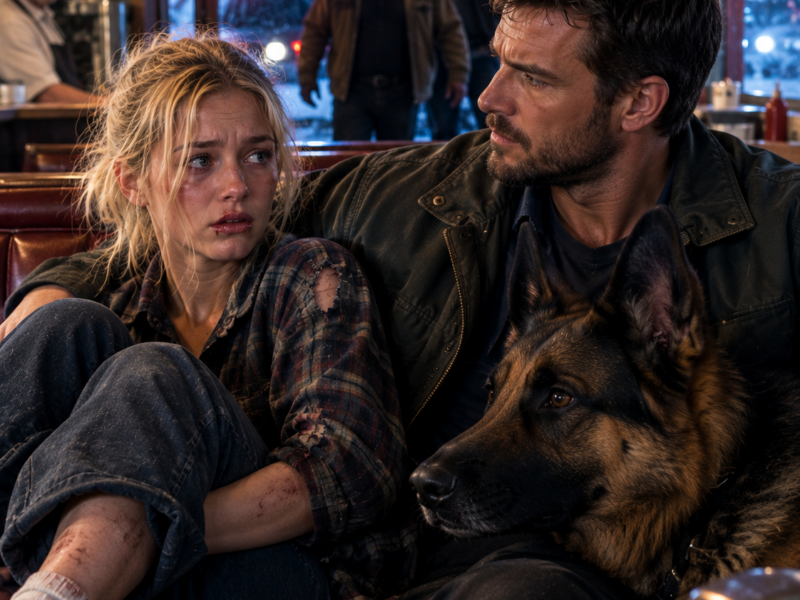
She was maybe 22, blond hair full of burrs and dried mud, a plaid shirt torn at the shoulder, and fresh bruises coming up along her jaw and both forearms, dark as plums.
She was barefoot except for one sock, and her feet left red prints on the linoleum.
“Please,” she said, her voice nearly gone. “Can I sit with you? Just for a minute, please.”
Troy had come to Eastern Oregon to be left alone.
Three weeks of leave, a rented truck, a duffel bag, and Ranger, his 80-pound German Shepherd who had logged more combat hours than most men Troy knew.
No plans, no people. That was the whole idea.
Ranger was already on his feet.
The dog stood on the vinyl bench with his ears forward, nose working, and then he did something Troy had seen him do only a handful of times.
He stepped across the seat, pressed his shoulder against the girl’s trembling leg, and sat down against her like a wall.
Troy scooted over. “Sit.”
She slid in beside him and folded herself into the corner, her whole body shaking.
Ranger put his chin on her knee.
“I’m Troy. That’s Ranger. What’s your name?”
“Shelby.” She was staring at the front windows. “Shelby Young.”
“They’re right behind me. They’ll come in.”
“You don’t understand. They’ll just come in.”
“Who?”
She swallowed. “The whole county.”
Troy looked toward the counter.
The owner was a heavyset man in a stained apron, maybe sixty, with a gray mustache.
Dennis, according to the faded name tag.
Dennis had not asked if the girl needed help, and he had not asked if she needed water or a doctor.
He had picked up the old wall phone, turned his back, and said four quiet words into it.
Then he hung up and went back to wiping the counter, and he did not look at the booth again.
That told Troy more than anything the girl could have said.
A man who is surprised looks. A man who has already made his call does not.
Troy felt the old calm settle over him, the one that came down before a breach.
His heart rate dropped, and the room sharpened.
Four exits counted. Two windows. One kitchen door behind the counter.
Nothing in the diner heavier than a ketchup bottle.
He wore his Navy utilities because he had driven straight from base and never changed.
He carried no firearm on leave, and that had seemed like a fine policy ninety minutes ago.
“Shelby, listen to me. How long ago did you run?”
“I don’t know. An hour, more.” Her teeth chattered. “There’s a place about twelve miles out, an old potash plant. They keep us in the old storage rooms. There’s thirty of us. Thirty-one, I think. Somebody new came Sunday.”
Troy said nothing, and he kept his face still.
Underneath it, something cold and heavy turned over.
Headlights swept across the window.
A truck rolled into the gravel lot and stopped with its nose pointed at the door.
Two men climbed out.
The first was bald and thick through the chest, wearing a canvas work coat and boots caked with red clay.
The second was taller with a scar through one eyebrow and a leather holster riding his hip.
The bald one came in first.
He didn’t look at Dennis. He didn’t look at the empty stools. He looked straight at the corner booth and smiled the way a man smiles at a lost dog he’s finally caught.
“There you are, sweetheart,” he said. “You gave everybody a real scare.”
Shelby made a sound like a hurt animal.
Ranger’s lip lifted off his teeth, and it was a low, quiet growl, almost a vibration more than a noise.
Troy kept both hands flat on the table. “Evening.”
The man’s eyes moved to him, took in the camouflage, took in the patch, and flicked to the dog.
For half a second something uncertain crossed his face, and then it passed, because arrogance is a thick wall and nobody has ever seen through it from the inside.
“Evening, sailor. Go back to your pie. This is family business.”
“She doesn’t look like she’s with family.”
“She’s got a problem with the truth. Happens with her.” He slid his hand under his coat and came out holding a black pistol, the barrel pointed at the floor. He wanted Troy to see it. That was the point. “Now slide out and let her walk to the truck, and nobody has to bleed in Dennis’s diner.”
The taller man had moved to the right, drifting along the counter with his hand resting on his holster.
Spacing. Not bad for a civilian.
Troy did the math.
The bald man had a gun and no discipline, the pistol down, finger indexed along the frame, which meant he had at least read a pamphlet once.
The taller one had a holster with the snap still fastened.
Ten feet to the first, fourteen to the second.
The table between them was bolted to the floor.
And Ranger.
“Okay,” Troy said quietly, and began to slide out of the booth, slowly, palms open.
He saw the bald man’s shoulders relax, and he saw the barrel drift another inch toward the floor.
Troy tapped two fingers against his thigh.
Ranger went off the bench like something fired from a cannon.
Eighty pounds of muscle hit the gun arm at the elbow, the pistol cracked once, a deafening bang that blew a hole in the ceiling tile and sent the gun skittering across the floor, and the man screamed.
The dog did not let go.
The taller man fumbled at the snap on his holster.
Troy was already moving.
He grabbed the heavy glass sugar dispenser off the table and threw it, a short hard throw that caught the man across the bridge of the nose.
He staggered, and Troy closed the gap in two steps, caught the man’s gun wrist with his left hand, and drove his right forearm up under the jaw.
The man’s head snapped back, his knees went, and Troy turned him, folded the arm behind his back, and put him face-first into the Formica counter.
There was a crack of bone, and the man slid to the floor and stayed there.
Across the room the first man was still shrieking with the dog hanging off his arm.
Troy crossed to him, pulled the dog off with a single word, and finished it with a short, ugly strike to the side of the neck.
He dropped like a sack of wet cement.
Four seconds, maybe five.
The diner was quiet except for the old refrigerator humming.
Troy turned.
Dennis had a shotgun halfway out from under the counter.
“Don’t,” Troy said.
The old man froze, the barrel of the twelve-gauge pointed at the floor, his thumb on the hammer.
He looked at the two men on the linoleum, and then at the dog, who was standing perfectly still with his eyes locked on Dennis’s throat and a thread of blood on his muzzle.
Dennis let the shotgun fall. It clattered against the tile.
“Phone’s yours?” Troy asked.
“It’s the diner’s.”
“Who’d you call?”
Dennis didn’t answer. His mustache trembled.
“Russell,” Shelby whispered from the booth. “He called Sheriff Hunt.”
Troy went still.
A sheriff.
Of course it was a sheriff.
A camp with thirty women locked in a dead factory twelve miles from a county seat, for who knew how long.
No one runs something like that in the dark.
You need a man with a badge standing in the doorway to keep the daylight out.
“How long till he gets here?”
“Twenty minutes,” Dennis said, his voice flat. “Maybe less. He was on the highway.”
Troy scooped the pistol off the floor, checked the chamber, dropped the magazine.
Nine rounds.
He thumbed it back in and shoved the gun in his waistband.
He stripped the second man’s holster, took the revolver, took the keys from both men’s pockets, and yanked the phone cord out of the wall.
“Shelby, can you run?”
“I already did.”
“Then you can do it again. Come on.”
They went out the back door, past the dumpsters, and into the dark.
Troy’s rented truck sat at the far edge of the lot where he’d left it, a good ninety feet from the neon.
He threw his duffel in the back, put the girl in the cab, whistled Ranger up beside her, and turned the key.
Nothing.
He tried it again. Nothing, not a click.
Troy got out, popped the hood, and found the battery cables lying loose on the ground.
Cut clean.
Somebody had been here before the girl ever ran through the door.
He stood there for a moment in the freezing wind, looking at the severed wires, and understood just how long this net had been hanging.
Dennis had been told to keep the truck dead in case the girl came.
The whole town had been waiting for her.
Headlights appeared on the highway, far off, red and blue flickering along the top. A lot of them.
“They’re early,” Shelby whispered.
“We walk,” Troy said.
They went north, away from the road, into scrub country.
High desert in January, no snow yet, but the cold came up through the soles of Troy’s boots and the wind had a knife in it.
Shelby had Troy’s field jacket wrapped around her, the sleeves hanging past her hands.
Ranger ranged ahead twenty yards, then dropped back, then ranged ahead again, working the dark.
They moved for an hour, then a second.
Behind them, a pack of hounds began to bay.
Shelby grabbed his arm. “Oh God. Bloodhounds. That’s what they used on Amy.”
“Who’s Amy?”
“A girl who ran last fall.” Her voice cracked. “They brought her back. Sheriff Hunt made all of us watch what happened next.”
Troy’s jaw tightened, and he did not answer.
He had learned long ago that the right response to some stories is silence and a faster pace.
He steered them toward the sound of running water.
A creek cut through the draw, half-skinned with ice, and he walked them straight into it.
The water hit his shins like needles.
“We stay in the creek,” he said. “Two hundred yards. The dogs lose us at the water.”
“Troy, I can’t feel my feet.”
“I know. I’ll carry you if I have to.”
She almost laughed. It broke halfway through. “You really are crazy.”
“My wife used to say that.”
“You’re married?”
“Was.” He picked his way over a slick stone. “She said I was good at everything except coming home.”
Shelby didn’t say anything to that, and neither did he.
Behind them, the baying faded, confused, circling at the bank where the scent ended.
They climbed out onto a rocky shelf, and Troy found them a crevice under an overhang, out of the wind.
He built no fire.
He pulled a space blanket from the thigh pocket of his trousers and wrapped it around her shoulders.
She leaned against Ranger, and the dog’s warmth was the only warm thing for a mile.
He cleaned her feet with a strip torn from his undershirt and wrapped them in what he had.
He kept his face neutral when he saw the damage.
“Why are you doing this?” she asked. “You don’t know me.”
Troy considered it.
He was not a talker, and most of what he felt had no words attached.
“I spent twelve years doing things I couldn’t explain to anyone I loved,” he said finally. “Some of those things were right. Some I’m still not sure about. But that diner tonight, that one’s easy. I’ll be able to explain that one to anybody.”
Shelby’s eyes were wet.
She nodded, and for the first time in what must have been months, she rested her head on someone’s shoulder without being afraid of what came next.
The hounds picked up again an hour before dawn, closer this time.
The sheriff had split his people.
Troy counted flashlights on the ridge to the east, six, maybe seven.
He counted trucks on the ranch road to the south, two.
Men fanned out along the draw, and every few minutes a radio crackled.
There was no way out.
Not on foot, not in daylight, not with a barefoot girl and thirty miles of open country.
Which meant they could not run to a rescue.
The rescue would have to be built here.
He took the radio he had lifted from the second man’s coat before they left the diner, switched it on, and listened.
Hunt’s voice came through, dry and unhurried, a voice used to being obeyed.
“Keep it tight, boys. Remember, no one fires unless you’ve got the young girl in the clear. I want her breathing. Sir wants to talk to her.”
Sir. Somebody above the sheriff.
Troy filed it away.
“Shelby, I need to know where the camp is. Exactly.”
She told him.
The old potash plant lay in a bowl of dry hills, three buildings and a smokestack, a single gravel road in and out.
One generator, floodlights on poles, eight or nine guards at any time, plus whoever the sheriff brought with him on his rounds.
“Where do they keep the keys?”
“In a wooden box by the front door. The big iron ring.”
“Is there a phone line?”
“There’s a satellite phone in the office. Sheriff has the only other one.”
“Good,” Troy said. “That’s where we’re going.”
She stared at him. “Back into the camp?”
“The camp’s the one place nobody’s looking for us right now. They’re all out here on the hillside.”
He watched the logic settle on her face.
Fear first, and then something harder underneath it.
“There are thirty-one girls in there,” she said, “and Amy’s buried behind the smokestack.”
“Then we get the thirty-one.”
They moved at first light, circling wide through a dry wash, Ranger leading, nose to the ground.
Twice the dog stopped and went rigid, and twice Troy signaled Shelby flat against the rocks while a pair of deputies crossed forty yards away, close enough to hear them argue about whether the sheriff would pay overtime.
The potash plant rose out of the haze, gray and crooked.
Troy lay on his belly on a rim of rock above it and studied the layout.
One guard at the gate, bored, eating something out of a bag.
Another on the roof of the main building. Two more by the generator shed.
The rest of the guards were out hunting, a skeleton crew, exactly what he’d hoped.
He took the guard at the gate first.
Ranger went in low and silent from the left, and while the man was staring at the dog, Troy came in from the right and put him down with a rear choke.
Cable ties from the man’s own belt. The radio in the dirt.
The roof guard saw nothing until Troy was already on the ladder.
A kick, a drop, a short scuffle.
Nobody fired, and nobody shouted.
By the time the sun cleared the ridge, four men were hog-tied in the sand.
The wooden key box hung by the front door, and the iron ring was heavy as a child.
Shelby led him down a corridor that stank of mildew and old fear.
Doors on both sides, steel with narrow slots at eye level.
She stopped at the first, and her hands shook so badly she couldn’t fit the key.
Troy took it from her gently and turned it.
The door swung open.
Thirty-one faces turned toward the light.
Nobody spoke. Nobody moved.
Then a woman in the back, maybe forty, with gray at her temples and a ripped sweatshirt, stood up slowly, as if standing might be punished.
“Is it real?” she asked.
“It’s real,” Shelby said, and her voice broke on it. “Joyce, it’s real. We’re going home.”
The corridor filled with crying.
Some of the women collapsed against the walls, and some clung to each other.
One young girl, hardly more than a teenager, walked straight up to Ranger and buried her face in his fur.
The dog stood still and let her.
Troy found the office.
Dust, a metal desk, a ledger in the top drawer.
He opened it and read for a full minute without moving.
Names, dates, dollar figures, a running tally of payments, each one labeled with initials.
The same initials every month in a firm square hand.
R.H.
One hundred forty thousand dollars last quarter alone.
Beneath the sheriff’s initials, another set: M.C.
Sums three times larger.
He photographed every page with his phone, then picked up the satellite handset on the desk, a heavy yellow brick, and dialed a number he had never written down.
It rang twice.
“This is Hollis.”
“Mark, it’s Troy Butler.”
A pause, and then the voice at the other end changed completely.
“Troy, where are you?”
“Harney County, Oregon. Potash plant off the Burns Junction Road. I’ve got thirty-one victims, a trafficking operation, and a ledger with a sheriff’s initials in it. I need the Bureau, and I need them without anyone in that county hearing about it.”
There was a silence long enough to measure.
“How long can you hold?”
Troy looked at the corridor, at the women, at the gray light coming through a broken skylight.
“Not long.”
“Forty minutes,” Hollis said. “I’ll have a hostage rescue team in the air in twelve. Don’t engage.”
“I will if I have to.”
“Yeah,” Hollis said. “I know you will.”
Forty minutes was a long time.
The first shots came at minute eleven.
Troy heard the trucks first, engines grinding up the gravel road.
Six pickups, nose to tail, lights bouncing.
They’d found the gate guard’s radio and realized where the targets had gone.
“Everybody down,” he shouted. “Into the back rooms, lock the doors, stay on the floor.”
He posted Ranger at the head of the corridor, the shotgun they’d taken off the roof guard in his hands, the pistol in his belt.
Shelby crouched behind a steel door, holding the revolver in two shaking hands, her eyes huge.
“You don’t have to use it,” he told her. “But if somebody comes through that door, and it isn’t me or the dog, don’t wait.”
“Okay,” she whispered.
The first truck slid to a stop, and doors slammed.
Troy saw tactical vests, rifles, a dozen men in the yard, and in front of them, striding with his hat pulled low and his badge catching the light, the sheriff.
Russell Hunt was a tall man in his late fifties, gray at the temples, with the easy posture of someone who had never been told no.
He stopped forty feet from the building and raised a bullhorn.
“Son, my name is Sheriff Russell Hunt of Harney County. I understand there’s been some kind of misunderstanding.”
Troy did not answer.
“You’ve got a dangerous young woman in there, a runaway with a record of psychiatric episodes. We just want to bring her in for treatment. You help us do that, and I’ll make sure you walk out of here with no charges. You have my word as a lawman.”
From somewhere in the building, one of the women began to cry.
Troy stepped to a broken window and put his face where Hunt could see it.
“Sheriff,” he called, “I’ve got a ledger with your initials in it. Eight pages. And I’ve already sent it out.”
The yard went very quiet.
For the first time, Hunt’s smile slipped, a small thing, a sliver, like a crack opening in a windshield.
Then he lowered the bullhorn and said something to the deputy beside him.
“Take the building,” Hunt said.
They came in two groups, four at the front, three around the back, rifles up, boots hammering the gravel.
Troy fired through the window, and a deputy went down clutching his thigh.
The others scattered for cover.
Return fire tore through the wall, and plaster dust and splinters filled the air.
Troy ducked, rolled, came up at a different window.
Ranger took the first man through the side door.
The dog hit him at the chest, and the deputy’s rifle went sliding across the floor.
Troy heard a scream, and then the clean sound of a man being pinned.
The second deputy turned to run and found himself looking down the barrel of the shotgun.
“Drop it,” Troy said.
The rifle hit the floor.
“On your face.”
The man dropped.
Troy zip-tied his hands and kicked the rifle into the corridor.
Four down, eight left at least, and those eight now knew exactly where he was.
A bullet zipped past his ear, and another blew a chunk out of the doorframe.
Troy backed up, counting.
His shotgun had four shells. The pistol had nine.
There were thirty-one women at his back, and the time on his watch read twenty-six minutes until Hollis.
They pushed him back room by room, and he fought every foot of it.
He took a second man out with the butt of the shotgun, and a third with a thrown fire extinguisher.
At one point he was behind a collapsed rack of shelving with his ears ringing and blood running down the side of his face from a splinter.
And he heard a voice, close, young, quavering.
“Please,” it said. “I don’t want to die for him.”
Troy peered through the gap.
A kid in a deputy’s uniform, maybe twenty-three, rifle shaking in his hands.
“Then don’t,” Troy said. “Put it down. When this is over, say you did.”
The kid’s eyes flicked to the doorway, to the sheriff outside, then back.
He set the rifle on the floor.
He sat down against the wall with his hands on his head.
Then it went wrong.
A deputy Troy hadn’t counted came through the back, silent, and put a rifle to the back of Shelby’s skull.
“Drop it,” the man said to Troy.
Troy stopped.
Shelby stood rigid, eyes closed, the revolver slack in her hand.
“Drop the gun, soldier,” Hunt’s voice said from the front door.
The sheriff walked in, unhurried, a pistol held easy at his side.
Behind him came four more men.
Troy counted the odds and didn’t like any of the answers.
He set the shotgun on the floor.
“Smart,” Hunt said. “Now the pistol.”
He set that down too.
Hunt crossed the room and looked down at him with the mild disappointment of a man whose dog had misbehaved.
“You know, I looked you up. Just ran your plate from the diner. Navy SEAL, decorated. Wife passed away two years ago. Car accident.”
He smiled.
“That’s a hell of a thing, Troy. Man loses everything, goes looking for a cause. I understand it. I really do.”
“You understand nothing.”
“I understand money,” Hunt said. “I understand that a girl like that is worth about forty thousand dollars to a man in Reno, and a ledger is just paper.”
He raised the pistol until the muzzle was an inch from Troy’s forehead.
“Where’s the phone?”
Troy looked at him.
He did not look afraid. He looked almost relieved.
“Sheriff,” he said, “what time do you have?”
Hunt frowned. “What?”
“Check your watch.”
Hunt glanced down.
The movement lasted half a second.
In that half second, Ranger came through the side window.
The dog hit the man behind Shelby so hard the rifle went off into the ceiling.
Troy drove forward, shoving Hunt’s gun arm up.
The pistol fired once, a flat crack that filled the room, and then Troy’s elbow caught Hunt under the chin and the sheriff went backward into the wall.
Troy was on him, hands closing around his wrist, twisting.
The gun came loose and spun away.
Shelby screamed something, and Troy didn’t hear what.
Then the roof shook.
A deep, rhythmic thudding rolled over the building, and the windows buzzed in their frames.
It took Troy a moment to recognize it.
Rotor blades. Not one helicopter. Several.
Through the broken skylight, three black shapes dropped out of the morning sky.
“FBI!” a voice thundered through a loudspeaker. “Drop your weapons. Everyone on the ground, now!”
The deputies at the door looked at each other.
One of them ran. Not far.
A line of agents in dark tactical gear came sweeping around the corner and put him on the gravel in a matter of seconds.
The others dropped their guns like they were red hot.
Hunt scrambled for the pistol on the floor.
A pair of boots came down on it.
Mark Hollis looked down at the sheriff, tall and tired in a Bureau windbreaker, with the air of a man who had flown through the night and gotten no sleep.
“Russell Hunt,” he said, “you’re under arrest for racketeering, kidnapping, conspiracy to commit human trafficking, and the murder of a woman named Amy Collins.”
Hunt’s face drained of color.
“You can’t do this. I’m a duly elected officer. I’ve got friends in Salem.”
“You did,” Hollis said. “Craig Cole was arrested in Reno forty minutes ago. He gave your name before they finished reading him his rights.”
M.C.
Troy remembered the initials.
Hunt opened his mouth, and nothing came out.
Two agents hauled him up by the arms, and one of them reached over and unpinned the gold star from his chest.
He dropped it in an evidence bag.
They walked Russell Hunt out through the front door, past every one of his deputies sitting zip-tied in the gravel, past the trucks, past the line of women who had come out of the building into daylight, blinking, wrapped in Bureau blankets.
Dozens of eyes followed him. Nobody spoke.
An old woman in the line spat on the ground at his feet.
A girl who couldn’t have been more than nineteen stared straight at him and did not look away until the car door closed.
The women had waited a long time to see that face afraid.
Later, in the cold sun, with paramedics moving among the survivors and Bureau trucks crowding the yard, Troy sat on the bumper of an ambulance with a bandage wound around his head.
Ranger lay beside him, chin on his boot, flank rising and falling.
Shelby sat down on the bumper next to him.
Someone had cleaned her face and put a clean coat on her, and her feet were in thick medical socks.
She looked like a girl again, not a ghost.
“They’re saying Dennis flipped,” she said, “before the agents even got there. He’s telling them everything. Names, dates, who got paid, who looked the other way. They think forty people could go down.”
“Good.”
“They found Amy,” she said quietly, “behind the smokestack, right where I said.”
Troy nodded. He did not trust his voice.
She was quiet for a time, and the wind pulled at the edge of the blanket.
Out in the yard, an agent was carrying one of the women’s bags to a van, and the woman was walking behind it, slowly, one hand pressed against her mouth, as if she still couldn’t believe the road ahead was hers.
“Troy.”
“Yeah.”
“My mom thinks I’m dead,” Shelby said. “She hasn’t heard my voice in fourteen months.”
Troy reached into the pocket of his torn jacket and pulled out the Bureau handset Hollis had left him.
He held it out. “Call her.”
She stared at it, and her hands shook.
She took it and punched in the number with a thumb that knew it by heart and held it to her ear.
Troy turned his head away to give her the privacy of a few seconds.
He heard it ring. He heard it pick up. He heard a woman’s voice, thin and far away, say hello.
And he heard Shelby say, in a voice so small it barely existed, “Mom, it’s me. I’m okay. I’m coming home.”
He didn’t turn around.
He sat there looking at the hills, and he let the dog lean into him.
And for the first time since the funeral, he felt something loosen in his chest.
Months later, the news would report that Sheriff Russell Hunt had been sentenced to life without parole in federal prison, and that thirty-eight other people, from deputies to a county commissioner to a state licensing official, had been indicted in what prosecutors called the largest corruption case in Oregon history.
The ledger carried most of the weight.
So did thirty-one women who walked into a courtroom, one after another, and told a jury exactly what they had seen.
Hunt sat at the defense table the whole time and never once looked up.
Dennis got twelve years.
The two men from the diner got twenty-five each.
And Marlowe’s diner closed its doors for good.
Somebody spray-painted the front window one night, three words, black letters, in a handwriting nobody claimed.
They read: “She got out.”
Troy did not stay for the sentencing.
He had a truck to return and a leave to finish.
But a month later, a letter arrived at his base, a thick envelope forwarded through three offices.
Inside was a photograph of a young woman standing on a porch in Ohio with her arms around an older woman, both of them laughing.
She was wearing real shoes.
On the back, in blue ink, a short note.
“Thank you for sitting me down. Say hi to Ranger.”
Troy pinned the photo above his desk.
Ranger, lying under it, thumped his tail twice against the floor.
The bell over the door of Marlowe’s diner rang at 11:40 on a freezing Tuesday night, and a girl with blood on her lip ran inside and begged a stranger to hide her.
The stranger moved over in the booth, and everything after that was just what follows when somebody refuses to look away.
There are diners like that in every corner of this country, and somewhere on some cold night, someone will push through a door with fear in their eyes and ask a stranger for room to sit.
You will not get a trumpet. You will not get a warning.
You will only get a second to decide who you are.
Move over. Make room. Everything else will find you.









