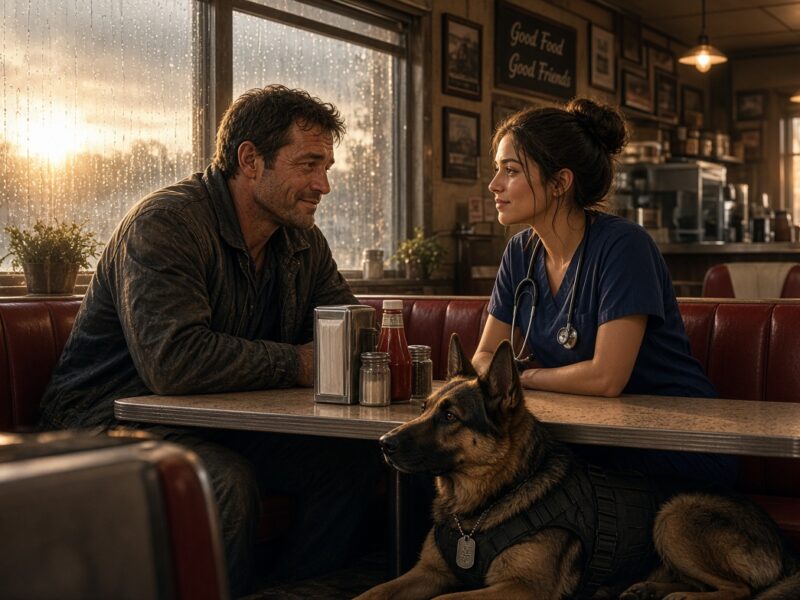
A Soaked Woman Sat Across From Him With a Military Dog… Wearing the Exact Vest of the Man Who Died Saving His Life
Rain hammered the windows of Rosie’s Diner like it had a grudge against the glass.
Midnight on Route 9, half the booths empty, the kind of place where nobody talked.
He liked it that way.
Six years out of the Teams, and silence was the closest thing he had to peace.
Then the bell over the door jangled.
A woman stumbled in, soaked to the bone. Mascara running in dark streaks down her cheeks.
Her hands were shaking so badly she could barely hold the leash.
Beside her stood a German Shepherd in a tactical vest and a working harness.
The kind of gear you don’t buy at a pet store.
The kind of gear he used to clip onto dogs just like this one, back before three of his men didn’t come home.
She scanned the room, found the only open seat, which happened to be across from him, and asked the question that stopped his coffee halfway to his mouth.
“Can we sit here?”
He wasn’t looking at her.
He was looking at the patch on that dog’s vest.
A unit designation he hadn’t seen in six years. One that belonged to a program that didn’t exist anymore.
He should have said “Sure” and gone back to his coffee.
Instead, he said four words that surprised even him.
“Where’d you get that vest?”
She looked down at the dog, then back up at him.
And for the first time all night, she looked like she might actually cry.
What happened next would change both of their lives.
His name was Jake Mercer.
Thirty-eight years old. Six-foot-one. Built like a man who used to haul eighty pounds of gear up mountains for a living, because he did.
Fourteen years a Navy SEAL. Four deployments. Two Purple Hearts he never talked about.
And one memory he couldn’t put down, no matter how many years piled on top of it.
Now he drove a tow truck.
Not because he had to. Because it was quiet.
Nobody stranded in a broken-down Honda on the shoulder of I-84 at two in the morning wants to make conversation.
They want their car hooked up, and they want him gone.
That suited Jake fine.
He’d tried the other stuff after he got out. The speaking engagements at Rotary Club lunches. The “transition coaching” in a strip-mall office that smelled like burnt Keurig pods.
A woman at the VA office once handed him a glossy pamphlet titled Finding Purpose After Service.
Like purpose was something you could pick up at the CVS counter with your prescriptions.
He dropped it in a trash can in the parking lot before he even reached his truck.
Every night, the same routine.
Finish his shift around eleven. Drive to Rosie’s, off Route 9, a chrome-and-red-vinyl place that hadn’t changed its laminated menu since 1987.
Sit in the corner booth. Back to the wall. Facing the door.
Old habit. The kind that doesn’t leave, even after the war does.
He’d order black coffee and whatever the meatloaf special was, and he’d eat slow, because there was nowhere else he needed to be.
And nobody waiting for him to get there.
That was the arrangement he’d made with his life.
Small. Quiet. Contained.
He told himself he liked it.
Most nights, he almost believed it.
Jake hadn’t come home from his last deployment the same man who left.
Nobody does. Not really.
But Jake carried something heavier than most.
His name was Danny Reyes.
Everybody called him Doc, because before he was a Navy corpsman attached to the Teams, he’d wanted to be a paramedic back home in San Antonio.
He could stitch a split knuckle cleaner than half the surgeons at Bethesda, and he did it while telling the worst jokes anyone had ever heard.
Doc had a dog.
A German Shepherd named Titan. Trained for detection, for protection, for finding things buried under rubble that no human nose ever could.
“He gets me better than most people,” Doc used to say, scratching behind Titan’s ears in the ready room.
“Most people aren’t a high bar, Doc,” Jake would tell him.
“Yeah, well. He knows when I’m scared before I do. Try saying that about your ex-wife.”
The whole room would crack up. Even Jake.
Six years ago, on a joint operation that went sideways in a village whose name never made the evening news, Doc shoved Jake out of the path of a blast that should have killed them both.
It killed Doc instead.
Jake walked away with a concussion, two cracked ribs, and a debt he could never repay.
Because the only man who could accept the payment was six feet under a flag in Arlington.
Titan went stateside with the unit’s K9 program.
Then the program got folded. Funding got cut in some budget meeting a thousand miles from anyone who’d ever bled for it.
Dogs got reassigned. Dogs got adopted out.
And Jake never found out what happened to Titan.
He never let himself ask.
Some doors you don’t open. You just build a wall in front of them and hope it holds.
That was Jake’s whole life, boiled down.
A wall. A booth. A cup of coffee. And a door he refused to look at.
His apartment told the same story, if you knew how to read it.
One bedroom over a laundromat in a town outside Hartford, Connecticut. Bare walls.
Except for a single shelf near the window.
On it sat a folded flag in a glass case.
A photograph of nine men grinning in front of a helicopter, most of whom would never see that helicopter again in one piece.
And a dog tag that wasn’t his.
REYES, DANIEL A. Blood type O POS. The edges worn smooth.
He’d found it in his own gear bag weeks after the funeral, tucked into a side pocket he never used.
He never figured out how it got there.
A quiet act of fate, maybe.
Or maybe Doc slipped it in himself. Some private joke. Some private promise Jake never got the chance to ask about.
Military men get two tags. Jake had always known that.
He’d spent six years not thinking about where the other one went.
He looked at that shelf every morning.
Never touched it. Never dusted it.
Just looked. The way you check a wound to make sure it’s still there. Still closed. Still yours to carry.
The guys from the old unit still texted sometimes.
A reunion in Virginia Beach. A golf fundraiser in San Diego. A wedding here. A funeral there, because that’s how it goes, eventually, for men who did what they did.
Jake always had an excuse ready.
Work. Distance. A phone that conveniently died at the wrong moment.
It wasn’t that he didn’t love them.
He loved them more than he knew how to say out loud.
It was that being around them meant being around the memory of a room that used to hold nine men and now only held eight.
The math never stopped bothering him.
It never would.
So he built himself a life with no math in it.
No headcounts. No formations. Nobody to lose, because nobody was close enough to be lost.
A tow truck. A diner booth. A shelf he never touched.
The only problem with a wall is that it keeps everything out, including the one thing that might save you.
Tonight was supposed to be like every other night.
Rain had been coming down since six. The kind of rain that turns headlights into blurry halos and makes the whole world sound like radio static.
Rosie’s was quieter than usual.
An older couple two booths down, murmuring over a shared slice of apple pie.
The night cook, Earl, humming an off-key Johnny Cash song behind the pass-through.
Denise, the waitress who’d poured Jake roughly four thousand cups of coffee over the years, reading a paperback by the register.
Jake had his coffee. He had his booth. He had his silence.
Then the bell over the door jingled, sharp and sudden, cutting through the hum of the diner like a wire pulled tight.
He looked up.
Old habit. Always know who’s coming through the door.
What he saw made him go completely still.
A woman. Late twenties, maybe. Hair plastered to her face.
She was wearing navy-blue scrubs under an open rain jacket, both soaked through, clinging to her like a second skin.
And she was shaking.
Not from the cold, Jake realized.
Shaking the way people shake when they’ve been running from something, and their nervous system hasn’t figured out yet that they’ve stopped.
Beside her, pressed tight against her leg like it was guarding her, was the German Shepherd.
Full tactical vest. MOLLE webbing. A leash clipped to a working harness, not some leather strap from a big-box pet aisle.
And on the side of that vest, stitched in faded thread that had clearly survived more washes and more miles than any civilian dog ever sees, a patch.
Jake’s stomach dropped straight through the floor.
He knew that patch.
He’d worn that patch.
It was his unit’s K9 program insignia. The exact one Titan used to wear.
The room tilted, just for a second.
The way rooms used to tilt right before something bad happened.
Except there was no threat here. No gunfire. No tripwire. Just a soaked stranger and a dog wearing a ghost.
She scanned the diner, found the empty side of Jake’s booth, and walked toward it like it was the last safe place left on earth.
She stopped at the edge of the table.
Up close, Jake could see her knuckles going white around the leash.
Could see something in her eyes that looked less like fear of the storm and more like fear of something that might still be behind her.
“Can we sit here?” she asked.
Her voice cracked on the last word.
Jake didn’t answer right away.
He was looking at the dog. At the patch. At six years of silence suddenly splitting down the middle like ice on a pond that was never as solid as he’d thought.
“Yeah,” he finally said. “Sit.”
It came out rougher than he meant it to. Like a command.
The woman flinched.
Jake immediately felt like an idiot. Soaked, terrified, and now sitting across from a stranger who sounded like he was barking orders at a recruit.
“Sorry,” he added, softer. “Long day. Please. Sit down.”
She slid into the booth across from him.
The dog folded down beside her feet with a trained, practiced stillness. The kind you only get from thousands of hours of repetition.
Sit. Stay. Guard.
Jake knew that stillness.
He’d helped build it into dogs just like this one, back when Titan was young and dumb and still believed the whole world was one long game of fetch.
Denise came by and set down a glass of ice water without being asked.
She took one look at the woman’s face, slid a stack of napkins next to it, and quietly melted back toward the register.
Small towns. People know when not to hover.
Jake wrapped both hands around his coffee mug, mostly to give them something to do besides shake.
But his eyes kept dragging back to that patch.
“Where’d you get that vest?” he asked.
The woman blinked, thrown.
Of all the things a stranger might say to a crying woman who’d just sat down uninvited at his table, that clearly wasn’t on her list.
“What? The vest?”
Jake nodded toward it. “That patch. Where’d you get it?”
She looked down at the dog like she was seeing the vest for the first time in a long time.
“It was my brother’s,” she said quietly. “The dog was his, too. He passed away a few years ago.”
She swallowed.
“This was his gear.”
The word brother hit Jake like a pressure change in a room right before a door gets blown.
“What was his name?”
His voice had gone very quiet. Very careful.
The voice he used to use stacked outside a doorway, when one wrong move meant somebody didn’t walk back out.
The woman studied him. Something wary flickered behind the exhaustion.
Strangers didn’t usually ask this many questions. Strangers usually said, “Sorry for your loss,” and went back to their meatloaf.
“Danny,” she said finally. “Danny Reyes. He was a Navy corpsman. Everybody called him Doc.”
The mug nearly slipped out of Jake’s hands.
Six years.
Six years of carrying a guilt that had hardened into something he thought was permanent. Load-bearing. Part of his skeleton.
And not once had he let himself imagine this moment.
Sitting across a diner table from Doc’s sister.
Seeing Titan again.
And here she was.
Soaked. Terrified. Three feet away, with Doc’s dog at her feet, because a storm had pushed her through the nearest door.
And the nearest door happened to be the one Jake had been hiding behind.
Some debts don’t wait for you to be ready; they just walk in out of the rain and sit down.
“I knew him,” Jake said.
His voice barely made it out.
“I served with him.”
The woman went very still. “You knew Danny?”
“I was there.”
And because there was no way to say the next part gently, no way to soften six years of carrying it, he said the rest.
“I was there when he died.”
The color drained out of her face.
For a second, Jake thought she might get up and walk straight back out into the storm rather than hear whatever came next.
Instead, her hand found the edge of the table and gripped it, like she needed something solid to hold.
“You’re one of the guys from his unit,” she said slowly, putting it together in real time.
Then her eyes went wide.
“Oh my God. You’re Jake.”
He nodded once. “Jake Mercer.”
Her breath caught.
“He talked about you,” she whispered. “In his letters. He talked about you all the time.”
Now it was Jake’s turn to go still.
“I’m Emily,” she said, wiping her face with the back of her wrist, though it was impossible to tell anymore what was rain and what was tears. “Emily Reyes. Danny was my little brother.”
The diner faded out around them.
The clink of dishes. Earl’s humming. The radio murmuring a Red Sox postgame show behind the counter.
All of it dimmed, the way sound dims when the whole world narrows down to a single point.
Jake looked at the dog again. Really looked.
The gray creeping into the muzzle. The notch in the left ear from a training accident at Fort Bragg that Doc had stitched himself, swearing the whole time.
“Titan,” Jake said.
Just the name. Barely louder than a breath.
The dog’s ears snapped up.
His head turned. Slowly. Deliberately.
And he looked at Jake with those same patient, amber eyes, like he was running a scent he hadn’t caught in a very long time.
His tail swept once across the checkered floor.
Then again.
“He remembers you,” Emily whispered.
“Can’t be,” Jake said. “It’s been six years.”
“He doesn’t wag at anybody. Not the vet. Not my neighbors. Not—” She stopped. Her jaw tightened. “Not anybody.”
That’s when Jake noticed the collar under the harness.
An old metal ring. And hanging from it, half hidden in the thick fur of Titan’s neck, a small rectangle of stamped steel, worn smooth at the edges.
He couldn’t read it from where he sat.
He didn’t need to.
He’d been staring at its twin on a shelf every single morning for six years.
“How’d you end up with him?” Jake asked, when he trusted his voice again.
Emily let out a breath that was almost a laugh.
“Fourteen months of paperwork. That’s how.”
She turned the water glass slowly on the Formica.
“When the program shut down, they told me retired working dogs go to their handlers first. But Danny was gone. Then it’s the handler’s family, if they can prove they can take care of him. I was in nursing school. I lived in a studio over a nail salon in New Britain.”
“They didn’t think you could do it.”
“They told me that to my face.” A ghost of Doc’s stubbornness crossed her face. “So I got a bigger apartment. I took a second job. I drove to a kennel in Texas twice. On the second trip, they handed me his leash.”
She looked down at Titan.
“He’s the last piece of Danny I’ve got. The vest, the collar, all of it. I keep him in it when we go out. I know that sounds crazy.”
“It doesn’t,” Jake said.
And he meant it more than she could possibly know.
He thought of the night before that last operation.
The two of them sitting on overturned ammo crates behind the team house, the sky so full of stars it looked fake.
Doc had been quiet. Doc was never quiet.
“Hey,” Doc had said finally. “If something happens to me, you look in on Em, okay?”
“Nothing’s gonna happen to you.”
“Humor me, Chief.” Doc had flicked a pebble into the dark. “She acts like she’s made of rebar. She’s not. She just never lets anybody see the cracks.”
“Fine,” Jake had said. “I promise. Now go to sleep before you get sentimental.”
Doc had grinned. “Too late.”
It was the last real conversation they ever had.
And for six years, Jake had broken that promise every single day, telling himself that showing up on her doorstep would only reopen a wound.
The truth was simpler and uglier.
He’d been afraid to look her in the eye.
A promise you keep avoiding doesn’t disappear; it just waits for a night when you can’t avoid it anymore.
“Emily,” Jake said carefully. “Why were you running?”
She flinched like he’d touched a bruise.
For a long moment, she said nothing.
Then she pulled her phone out of her jacket pocket and set it face-up on the table between them.
The lock screen was a photo of Titan in the snow.
And stacked on top of it, a notification that made Jake’s jaw tighten.
47 missed calls — Marcus.
“Forty-seven,” Jake said flatly. “Tonight?”
“Since six o’clock.”
“Who’s Marcus?”
“My ex.” She said the word like it tasted bad. “We were together almost two years. He was charming at first. They always are, right? Then he wasn’t.”
She kept her eyes on the phone.
“He started checking my texts. Then my mileage. Then my bank account. By the time I figured out what was happening, he’d drained eight thousand two hundred dollars out of my savings. Money I was putting toward Titan’s hip surgery.”
Jake didn’t say anything. He didn’t trust what would come out.
“I left in August,” she said. “Got a restraining order three weeks ago. He’s supposed to stay five hundred feet away from me. He doesn’t care. He shows up at the ER parking garage. He leaves things on my windshield.”
“Tonight?”
“I got off a twelve-hour shift at Hartford Hospital. Picked up Titan from the dog walker. I was driving home and I saw his headlights behind me. I took three wrong turns on purpose. He took all three.”
Her voice cracked.
“About a mile back, I pulled into a gas station lot, and he pulled in right behind me. So I grabbed Titan and I just ran. I didn’t even think.”
She pressed her palms against her eyes.
“I saw the diner sign. The lights were on. I thought if I could just get somewhere with people, somewhere public, he wouldn’t—”
She stopped.
“He wouldn’t do anything stupid in front of witnesses,” Jake finished, his voice flat.
Emily nodded, not trusting herself to speak.
Under the table, Titan had lifted his head.
Ears forward. A low, barely audible rumble building somewhere deep in his chest.
Not quite a growl. More like an engine turning over.
Dogs like Titan didn’t panic. They processed.
And right now, something outside that diner window had his full attention.
Jake followed the dog’s gaze through the rain-streaked glass, out past the flickering neon sign that read ROSIE’S — OPEN 24 HRS with the S in HRS burned out.
A pickup truck had rolled into the far end of the parking lot.
A dark Silverado. Lifted. Headlights off. Engine running.
Just sitting there.
Watching.
Jake’s whole body slid into a mode he hadn’t used in years.
Not panic.
The opposite of panic. A cold, methodical calm that used to keep him and his team alive in rooms full of people who wanted them dead.
“Emily,” he said quietly, eyes still on the window. “Don’t look right at it. There’s a truck at the far end of the lot. Headlights off.”
Her breath hitched.
She didn’t need to look. She already knew.
“That’s him,” she whispered. “That’s Marcus.”
Something settled into place inside Jake.
Not rage. Not yet.
Something quieter, and more dangerous than rage.
Focus.
“Okay,” he said. “Here’s what we’re going to do. You’re going to stay right here in this booth with Titan. I’m calling 911.”
“The police already have a file on him,” Emily said. “They know about the restraining order.”
“Good. That helps.”
Jake was already thumbing his phone, steady-handed.
“But it’s going to take them time to get out here in this weather, and I’m not going to sit in a booth and hope he loses his nerve.”
“Jake.” Emily’s voice was tight. Not just afraid for herself, Jake realized. Afraid for him. “Please don’t do anything. He’s not stable. I don’t know what he’s capable of.”
Jake looked at her for a long moment.
The exhaustion carved into her face. The way her hand hadn’t left Titan’s head since she sat down, like the dog was the only anchor she had left.
And underneath the fear, he saw something else.
Something that looked a whole lot like Doc.
The same stubborn set of the jaw. The same refusal to fall apart, even when falling apart would be so much easier.
“Emily,” Jake said, low and steady. “I made your brother a promise a long time ago. On a night I’ve never told anybody about. I promised him that if anything ever happened, I’d look out for you.”
Her eyes filled again. This time, not from fear.
“You don’t owe me anything,” she whispered.
“I owe your brother everything,” Jake said. “And this is the first chance I’ve had in six years to pay any of it back. I’m not walking away from that because some coward is sitting in a parking lot with his lights off.”
The dispatcher picked up.
Jake gave the address. Described the truck. Mentioned the active restraining order and the forty-seven calls.
His voice was calm and precise the whole time. Clean. Clipped. No wasted words.
The same voice he used to use calling in coordinates over a radio.
When he hung up, he looked back at Emily.
“They’re sending a unit. Fifteen minutes. Maybe less.”
“Fifteen minutes,” Emily repeated, staring at the truck that hadn’t moved.
“Fifteen minutes is nothing,” Jake said. “I’ve held rooms longer than that with worse odds.”
He didn’t say it to sound tough.
He said it because it was true, and because right now Emily needed to hear something true and solid. Something that wasn’t shaking apart at the edges like everything else in her life.
Nobody in the diner moved.
Earl had stopped humming. He stood frozen behind the counter with a spatula in one hand.
The older couple two booths down had given up pretending to eat their pie.
The man, maybe seventy-five, with a faded Vietnam Veteran cap on the seat beside him, had shifted so he could see the window.
Then Emily’s phone buzzed on the table.
A text.
She picked it up with shaking hands, read it, and every drop of color left her face at once.
She turned the screen toward Jake without a word.
I can see you in there. Both of you. Come out and talk to me or I’m coming in.
Jake read it twice.
Something cold and precise settled over him. Not fear. Something that had replaced fear a long time ago, in rooms much darker than this one.
“He’s watching the window,” Jake said quietly. “He’s not just parked out there. He’s been watching this whole time.”
Emily’s breathing went fast and shallow.
“Jake, he’s done things before. Not like this. But he put his fist through a door at my old apartment. That police report’s still open, too.”
“Then we don’t give him a door to put his fist through.”
He kept his voice level. The tone he used to use talking scared new guys through their first firefight.
Steady isn’t just a sound.
It’s something you hand to another person on purpose, when they’ve got none left of their own.
Under the table, Titan’s rumble deepened.
Out in the lot, the truck door swung open.
A man stepped out into the rain.
Mid-thirties. Broad-shouldered. Moving with the loose, uneven gait of somebody who’d spent the evening at a bar and the drive home making bad decisions.
He stood beside his truck, staring at the fogged diner windows like he was trying to see through them.
“That’s him,” Emily breathed.
Jake stood up.
“Jake, please.”
“I’m not going out there to fight him,” Jake said. And it was mostly true. “I’m going to stand between that door and this booth. That’s all.”
He glanced down at Titan.
“Can he hold a position if I need him to? Guard command?”
Emily blinked, startled. Then nodded slowly.
“Danny trained him on basic protection before. I’ve kept it up. Just in case.”
“Good. Keep him with you. If that door opens and it’s not me walking back through it, you give the command. Understand?”
Emily nodded, her throat too tight to speak.
Behind the counter, Earl reached under the register and came up with an aluminum Louisville Slugger.
“You want backup, Jake?”
“Put it away, Earl,” Jake said gently. “Nobody’s swinging anything tonight. Just keep an eye on her.”
The old man in the Vietnam cap was already on his feet.
He didn’t say a word. He just walked over and sat down at the counter stool nearest Emily’s booth, folded his arms, and planted himself there like a fence post.
Jake caught his eye.
The old man gave him a single nod.
I’ve got the six.
Some men never stop being soldiers; they just wait for a reason to stand up again.
Jake walked to the front of the diner.
He didn’t puff himself up. Didn’t clench his fists or plant his feet like some action-movie hero.
He simply opened the door and stepped out into the rain.
Calm. Unhurried.
The way you walk toward a problem you’ve already solved a hundred times in your head before your body catches up.
The cold hit him like a slap. Within three steps his flannel shirt was soaked through.
Marcus saw him immediately.
He stopped in the middle of the lot, blinking through the downpour.
“Who the hell are you?” Marcus called out. His words were slurred at the edges.
“Doesn’t matter who I am,” Jake said.
His voice carried easily over the rain. The same voice he’d used to calm terrified villagers, brief nervous rookies, and talk down men holding more anger than sense.
“What matters is you’re about five hundred feet closer to Emily than a judge says you’re allowed to be.”
Marcus’s face twisted.
“This isn’t your business, man. This is between me and her.”
“It stopped being between you and her the second you violated a court order.”
Jake took one slow, deliberate step forward.
“The police are already on their way. You can turn around right now, and this ends with you driving home. Or you can keep standing in this parking lot, and it ends a lot worse for you.”
Marcus’s eyes flicked toward the diner window. Toward the blurry shape of Emily behind the fogged glass.
Then back to Jake.
“She’s not yours to protect,” Marcus spat.
“No,” Jake agreed. “She’s not.”
He let the rain fill the silence for a beat.
“But her brother was one of mine. And where I come from, that means something.”
Something in Jake’s voice, flat and certain and completely without doubt, seemed to finally cut through the alcohol and the anger clouding Marcus’s judgment.
He took a step back.
Then another.
“This isn’t over,” Marcus muttered, backing toward his truck.
“It is tonight,” Jake said. “There’s a police report with your name already on it. There’s a security camera over that door that’s been recording you for the last five minutes. Next time you come near her, it’s not a violation anymore. It’s an arrest.”
For a long, tense moment, Marcus just stood there.
Fists clenched. Jaw working. Looking like a man trying to decide whether his pride was worth what it was about to cost him.
Then, somewhere in the distance, faint red and blue lights began to bleed into the wet night sky.
Marcus saw them too.
He cursed, yanked open his truck door, and peeled out of the lot, tires hissing across the flooded asphalt, just as the first state police cruiser swung in from Route 9.
Jake stood in the rain a moment longer.
He let the adrenaline drain slowly out of his system. Let his heartbeat find its way back to something human.
Then he turned around and walked back inside.
Emily met him halfway across the diner, Titan pressed tight against her leg.
Her hands were shaking worse than before, but her eyes were dry now. Something sharper had replaced the tears.
Something like disbelief.
“You’re insane,” she said. “You walked out there with nothing. Not even a jacket.”
“I’ve walked into worse with less,” Jake said, sinking back into the booth, suddenly aware of how soaked he was.
Denise appeared with a dry dish towel and a fresh pot of coffee. She set both down in front of him and squeezed his shoulder once on her way past.
In four years, she had never touched him.
The trooper who came in was a woman named Sergeant Alvarez, rain dripping off the brim of her campaign hat.
She took statements from Emily, from Jake, from Earl, and from the old man in the Vietnam cap, whose name turned out to be Walt.
Denise pulled up the security footage on the little monitor behind the register.
Four minutes and thirty-eight seconds of a lifted Silverado idling with its lights off. A clear shot of the license plate. A clear shot of Marcus’s face under the neon.
“This is good,” Alvarez said, jotting down the plate. “This is very good. Between this, the forty-seven calls, and that text message, a judge isn’t going to need much convincing.”
She put out an alert on the truck.
She told Emily that tonight’s incident would strengthen any future legal action, and she handed her a card with a victim advocate’s direct number written on the back.
It wasn’t a perfect ending.
Men like Marcus rarely get neatly resolved in one night.
But it was something.
A wall built a little higher. A door locked a little tighter.
And for the first time in a very long time, Jake had been the one standing in front of the door instead of hiding behind it.
When the cruiser finally pulled away, Rosie’s settled back into its late-night hum.
Walt and his wife paid their check. On the way out, Walt stopped at Jake’s booth and laid a weathered hand flat on the table.
“Thirty-one years I’ve been coming here,” he said. “Never seen anybody do it cleaner.”
“Thanks for holding the line, sir.”
“Don’t call me sir. I worked for a living.” A dry smile cracked his face. “Welcome home, son.”
Then he was gone, the bell jingling softly behind him.
Emily sat back down across from Jake.
Titan curled up at her feet again, and this time his body was loose. Guard stood down. He’d decided the danger was over.
For a while, neither of them said anything.
The rain had softened outside. The hammering downpour had turned into something gentler. Almost peaceful.
“You said you were there,” Emily said quietly. “When Danny died.”
She hesitated.
“You never finished telling me what happened.”
Jake’s hands tightened around his coffee mug. The coffee had gone stone cold.
“You don’t have to,” Emily added quickly. “If it’s too hard. I don’t want you to relive something just because I’m—”
“No,” Jake said slowly. “You deserve to know. You’ve deserved to know for six years. And I never had the guts to find you and tell you myself.”
He took a breath.
The kind of breath that feels like lowering yourself into ice water. Necessary. Impossible to do slowly.
“We were on a joint operation,” Jake began. “The village doesn’t matter for the story. Except it was raining that day, too.”
He almost laughed. “Funny how that works.”
Emily didn’t move. Didn’t blink.
“We got ambushed. Bad intel. Worse luck. Then there was an explosion. A secondary device none of us saw coming.”
His voice thinned.
“I was closest to it. Danny saw it maybe half a second before I did.”
The words were coming slower now, like each one had to be hauled up from somewhere very deep.
“He didn’t think. He just moved. Put himself between me and the blast.”
The diner went completely silent.
Even Earl, pretending to scrape down the flat-top, had gone still.
“I walked away with a concussion and two cracked ribs,” Jake said. “Danny didn’t walk away at all.”
Tears were running freely down Emily’s face now. But she didn’t look away. Didn’t ask him to stop.
“I’ve spent six years telling myself I don’t deserve to still be here,” Jake said, barely above a whisper. “Six years building a life small enough that it wouldn’t matter if I disappeared out of it. A tow truck. An empty apartment. A booth nobody bothers me in.”
He looked up at her.
And for the first time since she’d walked through that door, his composure cracked all the way down.
“Your brother gave me every single day I’ve had since that night. And I never even had the guts to find his family and tell them that.”
He shook his head.
“I told myself seeing me would only hurt you more. But really, I think I was protecting myself. From having to say it out loud.”
Emily reached across the table.
Before Jake fully registered what was happening, her hand had closed over his.
“He wrote to me about you,” she said. “In almost every letter.”
She smiled through the tears.
“He said you were the most stubborn, hardheaded, overprotective human being he’d ever served with. And that you’d probably get yourself killed one day trying to save everybody else first.”
A wet, broken laugh escaped Jake despite himself.
“Sounds about right.”
“He also said,” Emily continued, her voice thick, “that if anything ever happened to him, he wanted you to know it wasn’t your fault. He wrote it in one of his last letters home. Like he already knew.”
Jake’s whole body went rigid.
“He knew?”
“Not specifics. But guys like Danny, the ones who run toward the explosion instead of away from it, I think some part of them always knows it’s possible.”
She squeezed his hand.
“He wasn’t scared of it, Jake. He told me that. He said the only thing that scared him was the thought of one of you blaming yourself for something that was his choice. Not yours.”
The hardest thing to carry isn’t the weight; it’s the belief that you’re not allowed to set it down.
Emily let go of his hand.
She reached down and unbuckled the harness from Titan’s chest. Then her fingers found the old metal ring of his collar.
She worked the small steel rectangle free and laid it on the table between them.
It clicked softly against the Formica.
REYES, DANIEL A. Blood type O POS.
The same worn edges. The same faint dent near the top corner.
Jake stared at it.
He couldn’t breathe.
“That’s the thing about the last letter,” Emily said quietly. “It came three weeks after the funeral. The Navy mail was slow. There was a note inside, and this tag.”
She pulled her phone out, opened a photo, and slid it across the table.
A picture of a single sheet of lined paper, creased into thirds. Doc’s handwriting, a crooked, rushed scrawl Jake would have recognized anywhere.
Jake read it once.
Then he read it again, because the first time the words wouldn’t hold still.
Em — Put this on Titan’s collar. Keep it there for me.
The other one’s with Jake. I stuck it in the side pocket of his bag, the one he never uses. He doesn’t know yet. Don’t tell him.
That way, if something happens, he has to carry me home no matter what. And someday you two will have to find each other to make it a set.
He’s going to blame himself. He always does. When you find him, tell him I said to knock it off.
Love you, big sis. — D.
Jake put the phone down very carefully, like it might shatter.
Six years.
Six years of looking at that tag on his shelf every single morning, wondering how it got into his bag.
Six years of thinking it was a sentence he was serving.
And it had never been a sentence.
It had been an invitation.
“He planned this,” Jake said hoarsely. “That son of a gun planned this.”
“He planned everything,” Emily said, laughing and crying at the same time. “He planned surprise parties two months out. He planned his Halloween costumes in June.”
Jake closed his eyes.
Six years of silence. Six years of a debt he thought could never be paid.
And here it was, being paid. Not through some grand act of redemption. Through a handwritten note from a dead man who had forgiven him before Jake even knew he needed forgiving.
“I’ve carried this alone for so long,” Jake admitted. “I didn’t think there was anybody left who could tell me it was okay to put it down.”
“There’s Titan,” Emily said softly, glancing at the dog. “And there’s me. And I think Danny would want both of us to stop carrying this by ourselves.”
Titan, as if he’d understood every word, lifted his head and laid his chin gently on Jake’s knee under the table.
Jake froze.
He stared down at the graying muzzle of a dog he hadn’t seen in six years. A dog who somehow still remembered the hands that had once helped train him.
Slowly, he reached down and rested his palm on Titan’s head.
The dog leaned into it immediately.
Exactly the way he used to lean into Doc’s hand, all those years and all those miles ago.
And there, in a run-down diner off Route 9, at nearly three in the morning, with the rain fading to a soft patter on the windows, Jake Mercer let himself cry for the first time in six years.
Not the quiet, rationed kind of grief he’d allowed himself in private.
Real grief. Loud. Ugly. Long overdue.
The kind that only comes out when you finally feel safe enough to let it.
Emily didn’t say anything.
She didn’t need to.
She simply slid out of her side of the booth, came around, and sat beside him. One hand on his shoulder. The other resting on Titan’s back.
And she let him have the moment he’d been owed for six long years.
The sun came up a little after six.
Jake and Emily were still in that same booth. Three more pots of coffee. A plate of Earl’s hash browns neither of them really ate. And every memory of Danny either of them could summon.
The good ones. The funny ones. The ones that made them laugh through the last of the tears.
“He was ten,” Emily said, wiping her eyes, “and he decided he was going to build a treehouse in the backyard. No plans. No measurements. Just two-by-fours he stole from the neighbor’s garage.”
“How far did he get?”
“He finished it. He climbed up, raised his arms like Rocky, and the whole thing collapsed under him. Broke his wrist in two places.”
Jake laughed so hard Denise looked over from the register.
“That tracks,” he said. “When he was twenty-six, he ran a prank war against our master chief for three straight weeks. Saran-wrapped his truck. Filled his locker with packing peanuts. Swapped his coffee for decaf for nine days and logged his mood changes on a whiteboard.”
“No.”
“He got caught on day ten. Nearly got both of us written up.” Jake shook his head. “Absolutely worth it.”
For the first time in six years, Jake talked about Danny like he was something to celebrate.
Not something to bury.
By the time the morning shift arrived to relieve a bleary-eyed Earl, something had shifted between them.
Not romance. Not yet. Maybe not ever, not that way.
But something just as important. A connection neither of them had realized they were both quietly starving for.
They stood to leave.
The storm had passed completely. Pale sunlight was breaking weakly through the clouds over the parking lot, glinting off a hundred puddles.
“What happens now?” Emily asked.
Jake slid the dog tag back across the table toward her.
“Now,” he said, “I think it’s time I stopped hiding behind a tow truck and a booth nobody bothers me in.”
He looked down at Titan. The dog was watching him with those same patient, knowing eyes.
“Would it be all right,” Jake asked carefully, “if I came by sometimes to see him? Maybe take him for walks? I know he’s yours. I’m not trying to intrude.”
Emily smiled. The first full, unguarded smile Jake had seen from her all night.
“Jake,” she said, “I think Danny would be furious with both of us if we let this be a one-time thing.”
Over the following weeks, what started as occasional visits slowly became something steady.
Twice a week, Jake showed up at Emily’s apartment in West Hartford and walked Titan through Elizabeth Park, past the rose gardens that had already gone brown for the season.
Sometimes Emily came along.
Sometimes it was just Jake and the dog, walking in comfortable silence.
The same kind of silence Jake used to hide inside.
Except now it didn’t feel empty.
It felt earned.
Titan walked slower than he used to. His back left leg hitched on the hills.
“It’s his hip,” Emily said one afternoon, watching him take the stairs to her building one careful step at a time. “The vet says he needs the surgery. Sixty-four hundred dollars.”
She didn’t have to say the rest.
That money had been sitting in a savings account until Marcus emptied it.
Jake didn’t say anything either.
But he went home that night, sat on the edge of his bed, and stared at his phone for a long time.
Then he opened a group text he’d muted four years ago.
The last message in the thread was from a guy named Hollis. A photo of a cake from somebody’s retirement party.
Nineteen unread messages below it that Jake had never answered.
He typed for ten minutes. Deleted all of it.
Then he typed four words.
Found Doc’s sister. Call me.
His phone rang in less than ninety seconds.
Marcus didn’t go quietly.
Three days after the night at Rosie’s, a post showed up on a local Facebook community page.
No names, but everyone in town could figure it out. A long, rambling story about a woman who’d “ruined a good man’s life” and the “washed-up tow truck guy” who was “filling her head with lies.”
By that evening, it had two hundred shares.
By the next morning, somebody had left a note on Jake’s tow truck in the lot behind the laundromat. Two words, written in black marker.
Mind yours.
Emily called him in tears.
“Jake, people at work are asking me about it. One of the charge nurses pulled me aside. I don’t know what to do.”
“You don’t do anything,” Jake said. “You don’t respond. You don’t argue in the comments. You screenshot every word and you send it to Sergeant Alvarez.”
“That’s it?”
“That’s it. Men like him want a fight in public, because a fight is something they can win. Paperwork is something they can’t.”
Then Rosie herself got involved.
Rosie Kowalski, seventy-two years old, four-foot-eleven, owner of the diner for thirty-eight years, logged into Facebook for what Denise swore was the first time since 2015.
She posted a single still image from the security footage. A lifted Silverado with its headlights off, idling in her lot at 12:47 a.m.
Under it, she wrote three sentences.
This truck sat in my parking lot watching a young woman who had a court order to keep him away. A veteran walked out in the rain and asked him to leave. I know which one I’d trust.
By noon, the anonymous post had been taken down.
Rosie’s had a line out the door for the first time since the Fourth of July.
And three different people walked up to Jake’s booth that week to shake his hand.
He didn’t know what to do with any of it.
So he did what Doc would have done. He said “Thanks,” cracked a bad joke, and changed the subject.
The truth has a way of being quieter than a lie, right up until it isn’t.
Two weeks after the storm, on a cold, bright Saturday, Marcus made his last mistake.
Jake and Emily were walking Titan on the loop trail by the pond when Jake saw him.
Standing by a parked car near the park entrance. Hands in his jacket pockets. Watching.
Jake didn’t change his pace.
“Em,” he said quietly. “Twelve o’clock. By the gate. Keep walking.”
Emily’s breath stopped. Then started again.
“What do I do?”
“Exactly what we talked about. Phone out. Call 911. Tell them you have an active order and he’s in violation. Stay on the line.”
She did.
Her voice shook, but her hands didn’t.
Marcus started walking toward them across the grass.
That’s when Titan stepped forward.
He didn’t lunge. Didn’t bark.
He planted himself between Emily and Marcus, front feet square, head low, and let out a single deep, steady growl that seemed to come up out of the ground itself.
The kind of sound that doesn’t need translation.
Marcus stopped dead fifteen feet away.
“Call off your dog,” he snapped.
“He’s not doing anything,” Jake said evenly. “He’s standing still. You’re the one walking toward a woman who has a court order against you. In broad daylight. In front of about thirty witnesses.”
Marcus looked around.
A mom with a stroller had stopped on the path. Two joggers had their phones out. A retired couple on a bench were openly staring.
He was still standing there, trying to decide what to do with his pride, when the West Hartford police cruiser rolled up onto the grass.
This time, he didn’t get to peel away.
The officers ran his name, saw the open file, the prior violation, the footage from Rosie’s, and the forty-seven calls.
They put him in handcuffs right there next to the pond.
Titan didn’t relax until the cruiser door shut.
Then he turned around, walked back to Emily, and pressed his whole body against her legs like he was making sure she was still there.
She dropped to her knees on the frozen grass and wrapped her arms around his neck.
“Good boy,” she whispered. “Good boy, good boy.”
Jake looked away.
Not because of the cold.
The hearing for the permanent protective order took place a month later at the Hartford Superior Court.
Jake wore the only suit he owned. It still smelled faintly of the funeral he’d bought it for.
He testified for eleven minutes.
He described the truck. The text message. The parking lot. The park.
He kept his voice calm and precise the entire time, the way he’d learned to give a report to men who needed facts, not feelings.
Marcus’s lawyer tried to rattle him.
“Mr. Mercer, isn’t it true you have a personal relationship with Ms. Reyes? That you have a reason to be biased?”
Jake looked at him for a long moment.
“Yes, sir,” he said. “Her brother died saving my life. If that makes me biased, then I’m biased toward the truth. Because that’s the only thing I’ve got left to give him.”
The courtroom went quiet.
The judge granted the permanent order.
She also ordered Marcus to repay Emily the full eight thousand two hundred dollars, plus court costs.
Outside on the courthouse steps, Emily stood in the thin November sunlight, holding the paperwork like she couldn’t quite believe it was real.
“I’m going to sleep tonight,” she said. “Like, actually sleep. All the way through.”
She did.
And she kept doing it, night after night, for the first time in over a year.
The phone call with Hollis had turned into something bigger than Jake expected.
Within a week, all seven surviving men from the old team had heard the story.
Within two, they’d planned a reunion. Not in Virginia Beach. In Connecticut. At Rosie’s.
Jake almost backed out three times.
The night before, he sat at his kitchen table until two in the morning, staring at the shelf by the window.
At the photograph of nine men in front of a helicopter.
Nine. Then eight. The math he’d never been able to stop doing.
He went anyway.
They filled the back room of the diner on a Saturday night in early December.
Hollis, gray at the temples now, with a prosthetic below his left knee. Big Teddy Brooks, who’d become a high school football coach in Ohio. Ramos, who ran a roofing company in El Paso and showed everyone pictures of his twin daughters.
And Emily, sitting at the head of the table, with Titan stretched out under her chair.
When Jake walked in, the room went silent.
Then Teddy stood up, crossed the room in three strides, and wrapped him in a bear hug that cracked his back.
“Six years, Mercer,” Teddy said into his shoulder. “Six years you’ve been ghosting us.”
“I know.”
“We thought you were dead, man. We thought you were dead, and nobody told us.”
“I know,” Jake said again. His voice broke on it. “I’m sorry.”
“Don’t be sorry. Just don’t do it again.”
They ate meatloaf and drank too much coffee. They told Doc stories until two in the morning, and Emily laughed until she cried, and then cried until she laughed again.
At one point, Jake looked around the table and counted out of habit.
Seven men. One woman. One dog.
For the first time, the math didn’t feel like a subtraction.
It felt like a roll call.
Near the end of the night, Hollis tapped his water glass with a fork.
“Okay,” he said, “before Mercer gets weepy and ruins the vibe, there’s some business.”
He slid a white envelope across the table to Emily.
“We passed the hat. Wives, kids, guys from other teams who knew Doc. Some old instructors. A couple of the dog handlers from Bragg.”
Emily opened it.
She stared at the cashier’s check inside, then looked up, white as a sheet.
“Nineteen thousand five hundred dollars,” she whispered.
“Sixty-four hundred is for the big guy’s hip,” Hollis said, nodding toward Titan. “The rest, we figured Mercer would know what to do with.”
Everyone turned to look at Jake.
He didn’t have an answer.
Not yet.
But he looked down at Titan, asleep under Emily’s chair with his chin on her shoe, and he felt the beginning of one.
Sometimes the thing you’ve been running from turns out to be the thing that was trying to catch you so it could hand you something.
In January, Jake walked back into the VA office in Newington.
Not because somebody made him.
Because he wanted to.
The same woman was still at the front desk. She didn’t recognize him.
She reached for a pamphlet.
“I’m good on pamphlets,” Jake said, with something that was almost a smile. “I’d like to talk to somebody. An actual person. Every week, if that’s possible.”
He started therapy. Real therapy. Not the glossy-brochure kind.
His counselor was a former Army medic named Dr. Okafor, who kept a bowl of peppermints on her desk and never once told him how he should feel.
In the third session, Jake talked about Doc out loud for the first time in a room designed for exactly that kind of talking.
It didn’t fix everything overnight.
Some nights, he still woke up at 3:00 a.m. with the smell of smoke in his nose and his heart going like a jackhammer.
But it started something moving that had been frozen solid for six years.
That same month, Titan had his surgery.
Jake sat with Emily in the waiting room of the veterinary hospital for four hours, splitting a bag of vending machine pretzels and pretending neither of them was terrified.
When the surgeon finally came out, pulling off her cap, she was smiling.
“He did great,” she said. “Tough old soldier. He’ll be chasing squirrels by spring.”
Emily burst into tears.
Jake didn’t. Not right then.
He waited until he was alone in his tow truck in the parking lot, and then he put his forehead against the steering wheel and let it come.
This time, it didn’t feel like drowning.
It felt like rain after a long drought.
The remaining thirteen thousand one hundred dollars sat in a bank account for exactly nine days.
Then Jake knew what to do with it.
He started a small program. Unofficial at first. Just something he cobbled together with Hollis, Teddy, and a couple of retired dog handlers from the old K9 unit.
The idea was simple.
Pair retired military working dogs with veterans who were struggling the way he had struggled.
No red tape. No bureaucracy. No fourteen months of paperwork.
Just people who understood loss, finding their way to dogs who understood loyalty better than almost anything on earth.
He named it after the only person who deserved it.
The Doc Reyes Project.
The first time Jake said that name out loud to a room full of strangers, it was at a small fundraiser held in, of all places, the back room of Rosie’s Diner.
Rosie had insisted.
“You think you’re holding this anywhere else, you’ve got another think coming,” she’d told him, jabbing a finger at his chest. “This is where it started. This is where it happens.”
There were maybe sixty people crammed into the room. Folding chairs. A projector borrowed from the local Elks lodge. A sheet cake with a crooked frosting paw print that Earl had decorated himself.
Jake stood at the front holding a single index card.
“Six years ago,” he began, “a man named Danny Reyes—”
His voice caught halfway through the sentence.
He stopped.
The room waited.
Emily was in the front row.
She didn’t rush to comfort him. Didn’t jump up to smooth over the moment.
She just waited.
The way you wait for someone to find their footing on ice, trusting that they will.
Titan sat at her feet, his healing hip wrapped in a bright blue bandage, his eyes fixed on Jake.
Jake took a breath.
He started again.
“Six years ago, a man named Danny Reyes saved my life. He didn’t hesitate. He didn’t ask for anything back. And I spent six years trying to figure out how to repay a debt to someone who wasn’t here to collect.”
He looked down at the dog.
“Turns out he left instructions.”
A ripple of laughter. A few sniffles.
Jake found his footing.
He finished the speech.
By the end of the night, four local veterans had signed up for the program’s first pilot class.
And a retired Army colonel sitting two tables back, a quiet man in a tweed jacket who hadn’t said a word all evening, walked up to Jake afterward and pressed a folded check into his hand.
“My son came home from Kandahar in 2011,” the colonel said. “He didn’t come home all the way, if you understand me. A dog would have helped him. I’m sure of it.”
Jake unfolded the check after the colonel had gone.
Sixty thousand dollars.
Enough to run the program for the next six months without either Jake or Emily ever having to ask anyone for anything.
Sometimes the only thing standing between grief and purpose is one person brave enough to say a name out loud.
Word spread slowly at first, the way good things usually do.
A segment on the local NBC affiliate. A shared post from a veterans’ group in Rhode Island. A write-up in the Hartford Courant.
But it spread.
Within a year, the Doc Reyes Project had placed eleven retired working dogs with veterans who needed them just as badly as the dogs needed somewhere to belong.
Jake kept a new photo on the shelf in his apartment now.
It sat right next to the folded flag and the picture of nine men in front of a helicopter.
A shot from that first full class. Eleven veterans. Eleven dogs. All crowded together on the grass in Elizabeth Park on a bright Saturday morning in May.
None of them looked anything like the hollowed-out versions of themselves who had walked through the door months before.
He still looked at that shelf every morning.
But now, it didn’t feel like checking a wound.
It felt like keeping score of something worth keeping score of.
The only thing missing from the shelf was the dog tag.
Because it wasn’t his to keep anymore.
Six months after that stormy night at Rosie’s, Jake stood in a community center parking lot in Bristol, watching a nervous nineteen-year-old former Marine meet his new dog for the first time.
The kid’s name was Tyler. He’d been out of the Corps for eleven months. He hadn’t slept more than four hours a night in all that time.
The dog was a scarred, gentle Belgian Malinois named Scout. Three tours. A healed burn on his left flank. He deserved a whole lot better than an anonymous kennel to grow old in.
Tyler knelt down on the asphalt.
Scout walked straight up to him, sniffed his hands, and then pressed his whole head flat against the young man’s chest.
Tyler’s shoulders began to shake.
Emily stood beside Jake, with Titan sitting patiently at her feet. His hip had healed clean. His tail thumped softly against the pavement.
And hanging from the old metal ring of his collar, side by side for the first time in six years, were two small rectangles of stamped steel.
REYES, DANIEL A. Blood type O POS.
REYES, DANIEL A. Blood type O POS.
Jake had brought the second tag over on the morning of the first pilot class. He’d taken it down from the shelf, the first time he’d ever touched it on purpose, and held it in his palm for a long time.
Then he’d knelt in front of Titan and clipped it onto the ring beside its twin.
They’d clinked together, soft as a heartbeat.
“He said we’d have to find each other to make it a set,” Emily had whispered.
“Guess we did,” Jake had said.
Now, in the parking lot, Emily watched Tyler bury his face in Scout’s fur.
“You did this,” she said.
“We did this,” Jake corrected gently. “You gave me a reason to stop hiding.”
Emily smiled and looked down at Titan, who glanced up at her like he’d understood every word spoken over his head.
“Danny would be so proud of you,” she said. “Of both of you.”
Jake looked out across the parking lot.
At the young Marine crying quiet, relieved tears into the fur of a dog who somehow already understood him better than any human ever could.
And he felt something settle deep in his chest. Something that had been unsettled for six long years.
Not closure, exactly.
Grief doesn’t work that way. It doesn’t close up neatly and disappear.
But peace.
Something close enough to peace that he could finally breathe around it, instead of constantly bracing against its weight.
He thought about that rainy night.
A woman soaked to the bone, walking through a diner door, asking four simple words that cracked open a wall he’d spent six years building.
Can we sit here?
Turns out that one question hadn’t just changed one night.
It had given him his life back.
Jake still eats at Rosie’s.
Same booth. Back to the wall. Facing the door.
Some habits don’t leave.
But now, more often than not, there’s an old German Shepherd curled up at his feet, two dog tags clinking softly every time he shifts.
There’s a friend sitting across the table, stealing his fries and arguing with him about the Red Sox bullpen.
Sometimes there’s Walt at the counter, raising a coffee cup in salute. Sometimes there’s a new veteran from the program, nervous and quiet, with a new dog at his side, who just needs a place to sit.
And whenever the bell over the door jingles and someone walks in out of the rain looking lost, Jake is the first one to slide over in the booth.
“Go ahead,” he tells them. “Sit.”
He says it softer now.
The silence he used to hide inside doesn’t feel like a cage anymore.
It feels like a place he chose. Not a place he was trapped.
Danny Reyes never got to see the life he made possible for the people he loved.
He never got to see his sister find her strength again.
Never got to see his dog find his way home to someone who remembered exactly how to love him.
But somewhere, in whatever way these things work, maybe he knows.
Maybe he planned it that way all along. He planned everything, after all.
And maybe he’d tell you that some of the most important battles aren’t fought overseas.
Some of them are fought quietly, at two in the morning, in the corner booth of a diner nobody bothers you in.
In the moment you finally decide to stop carrying something alone.
Because sometimes the people who need saving most are the ones who’ve spent their whole lives saving everyone else.
And sometimes all it takes to save them is someone walking in out of the storm and asking a simple question.
“Can we sit here?”









