A Silent Veteran and His Military Dog Stood Up When No One Else Would — What Happened After They Moved an Elderly Woman’s Walker Will Leave You Speechless
The walker hit the floor before anyone in the waiting room understood what had happened.
One second, Lucille was seated in the accessibility zone of Mercy General’s oncology wing, hands folded over the small Bible she carried everywhere, waiting for her name to be called for the scan her doctor had ordered three weeks ago.
The next, Dodd, six foot three, neck like a dock cleat, dressed in a tactical polo one size too small for his chest, had swept her aluminum walker to the side with one casual arm, grabbed the adjacent chair, and dragged the whole arrangement three feet to the left.
All so Gerald Horn’s family could have, in Gerald’s own words, a little breathing room.
Forty-two people in that waiting room watched it happen.
Not one of them moved.
What none of them noticed was the man in the corner seat by the water fountain.
He sat with his back against the wall, the way men who have been shot at always sit, close to the exit, facing the room, aware of every entrance point without appearing to be.
His name was Ryder.
He wore a plain olive-green T-shirt, worn jeans, and the kind of stillness that people who have never been to war tend to mistake for calm.
It wasn’t calm.
It was control.
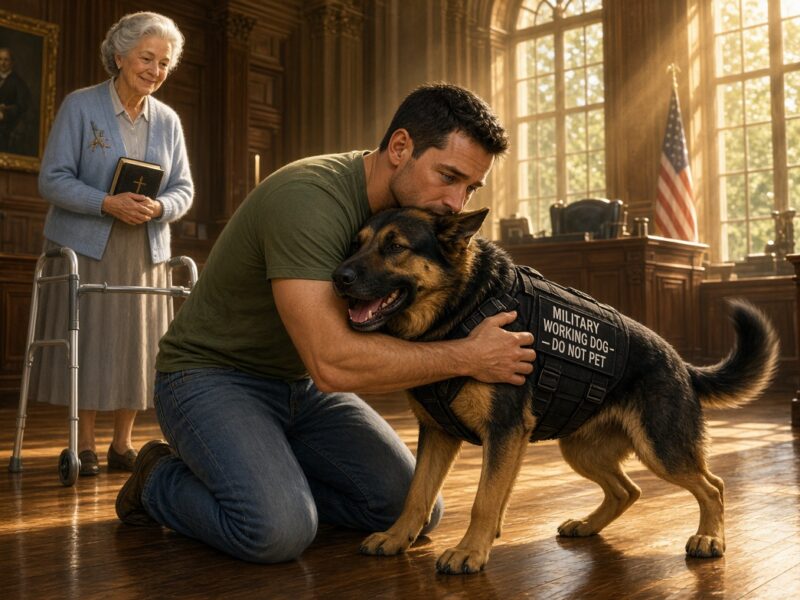
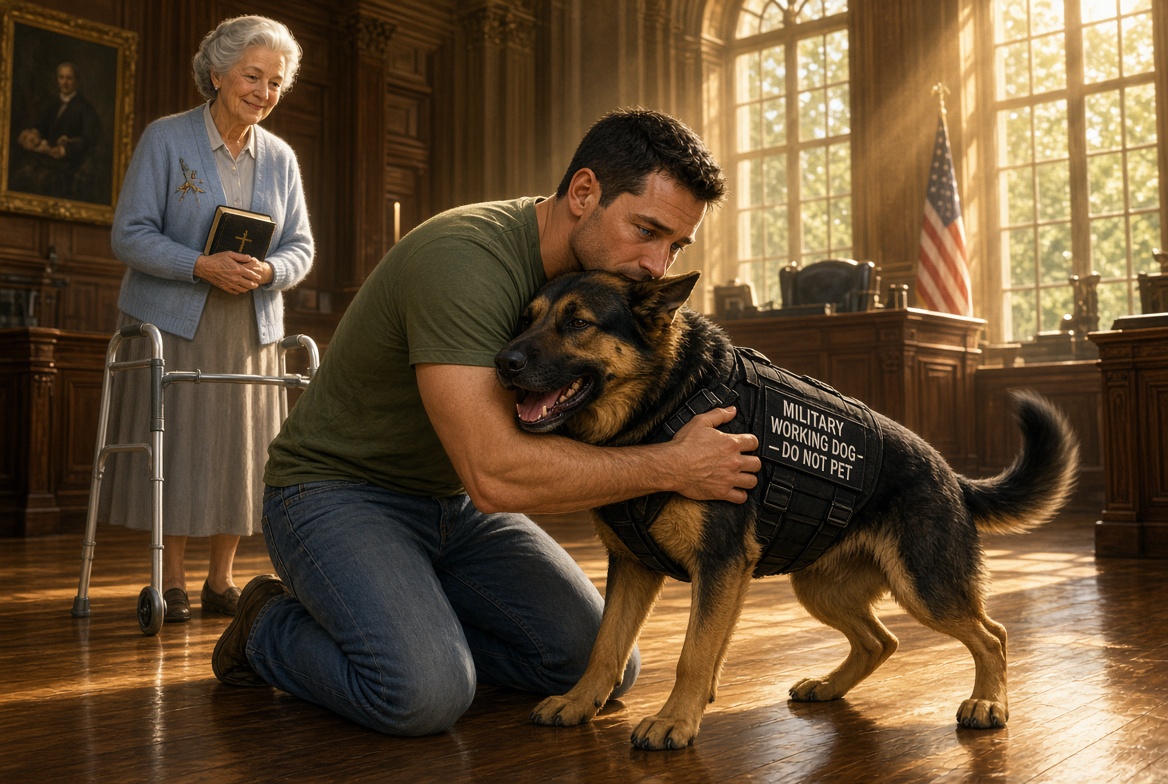
Beneath that gray plastic chair, stretched flat against the cool tile with his chin resting on crossed paws, lay Halo, a ninety-pound German Shepherd in a black tactical vest.
The words “MILITARY WORKING DOG — DO NOT PET” were stitched in white across his back.
Halo’s ears had already moved.
Ryder had been watching for six minutes.
He wasn’t supposed to be at Mercy General that afternoon.
He was supposed to be at his sister’s house in Glendale, sleeping on her couch for the remaining eleven days of leave.
He had come to the hospital only because she had asked him to pick up her prescription.
And he had said yes the way he said yes to most things, without discussion and without complaint.
He had taken a number at the pharmacy window.
The wait was forty minutes.
He had found a chair.
That was how simple it had been.
Ryder was thirty-seven years old and had spent thirteen of those years in the water, in the desert, in places that don’t show up on civilian maps.
He had the kind of face that looked younger than his service record and older than his age at the same time.
He didn’t think about a lot of things.
He thought about exit points.
He thought about the spacing between a man’s shoulders and the way a man’s weight shifted when he was about to do something his body knew was wrong.
Dodd’s weight had been shifting for four minutes before the walker hit the floor.
Halo had known in two.
There are people in this world who wear their power like a warning.
Gerald was one of them.
He had walked into Mercy General the way he walked into everything.
Already impatient.
Already offended by the presence of other people.
Already calculating how the space could be rearranged to better accommodate his comfort.
He was fifty-four, heavyset, dressed in clothes that don’t have visible price tags because the people who buy them already know.
His wife, Greta, followed two paces behind him with the practiced posture of a woman who had spent years learning when to speak and when to arrange her expression into something neutral.
Behind her came two sons in their early twenties, identical in their boredom.
The accessibility zone in Mercy General’s oncology wing was marked with a blue placard bolted to the wall and a row of low chairs set aside for patients who needed additional space.
Patients with walkers.
Patients in wheelchairs.
Patients who had been through enough that the hospital had decided they deserved a small protected corner to wait in.
Lucille had been sitting in that corner for twenty minutes.
She was seventy-one years old.
She had arthritis in both hips and a scan scheduled for 2:15.
She had come alone because she always came alone, and because she had long ago stopped apologizing for the kind of strength that doesn’t need an audience.
Her hair was silver and pinned neatly at the back of her neck.
She wore a light blue cardigan with a small embroidered bird on the collar, a gift from her granddaughter.
She held her Bible the way some people hold coffee.
Not reading it.
Just holding it.
She did not look like someone who needed pity.
She looked like someone who had built a life out of paying attention to details other people missed.
When Gerald surveyed the room and decided the accessibility zone was simply too good to waste on one elderly woman, he didn’t look at Lucille as a person.
He looked at her as an obstacle.
He gave Dodd one nod.
Dodd moved.
“Excuse me,” Lucille’s voice was quiet, but it carried.
“This area is reserved for patients with mobility needs. There’s general seating available on both sides of the main hall.”
Gerald didn’t stop walking.
“We’ve got family here who needs to be seen. We’re not going to stand in a hallway.”
“I understand, sir, but this seating is designated by the hospital for accessibility reasons.”
She kept her hand still on the Bible.
“The front desk can direct you to available space.”
Greta stepped forward with the particular smile women learn when they want to appear pleasant while saying something unkind.
“It’s just a waiting room, sweetheart. I think you can slide over a little.”
“I cannot slide over. My walker needs the clearance.”
Lucille’s voice was patient the way a teacher’s is patient after the fifteenth year of explaining the same thing.
“This is not a preference. It is a medical need.”
Gerald’s jaw tightened.
He looked at Dodd.
“Move the chair.”
Dodd moved the chair and the walker and Lucille.
When the aluminum walker skidded across the tile, the sound cut through the low hum of the room like a blade.
Lucille’s hand reached out for it and found nothing.
She grabbed the armrest of her chair.
Dodd was already pushing the chair itself, forcing her into the edge of the row, her back pressed against a hard plastic divider, her access to the aisle completely blocked by three oversized carry-ons that the sons were dropping into the surrounding seats with the indifference of people who have never once had to think about how they take up space.
She couldn’t get up.
She couldn’t reach the walker.
She couldn’t get to the front desk.
She sat very still, her hands flat on her knees.
She breathed deliberately.
Steadily.
The way you breathe when you are furious and you have spent a lifetime choosing your moments.
“Please,” she said one final time.
“You’re blocking my access to the aisle. This is a safety issue.”
Gerald had already stopped listening.
He was looking at his phone.
Dodd looked down at her with an expression that held no hostility, which was somehow worse than hostility.
He simply didn’t see a person.
He saw a problem that had already been handled.
He turned away.
Forty-two people did nothing.
The man by the water fountain stood up.
Ryder didn’t run.
Running was for emergencies where speed was the only variable.
This wasn’t that.
He moved with the quiet efficiency of someone who had spent years learning how to close a distance without being noticed until it was too late to matter.
He was halfway across the room before Gerald’s sons registered the movement.
He was at the edge of the accessibility zone before Dodd turned around.
Halo moved with him, not beside him, slightly ahead.
The leash was slack because the leash was a formality.
Halo understood the situation the same way he had understood situations in three countries over four years of deployment.
Ears back.
Tail low.
Eyes on Dodd.
“Sir.”
Ryder’s voice was not loud.
It didn’t need to be.
“Step away from the woman.”
Dodd looked at Ryder the way large men look at men who are not quite as large, with the reflexive confidence of someone who has never been wrong about that calculation before.
He cracked his knuckles.
Slow.
Deliberate.
“Walk away,” Dodd said.
“Last chance,” Ryder said.
There were five seconds between those two sentences.
Dodd filled them with the wrong choice.
He stepped forward, left shoulder dropped, weight shifting to his right foot.
The telegraphed first move of a man who had thrown a lot of punches at people who weren’t ready for them.
Ryder was always ready.
He moved inside the punch before it was a punch.
His left hand found Dodd’s wrist.
His right found the pressure point beneath the jaw with a precision that didn’t look like force.
It looked like a touch.
Dodd’s knees buckled.
Ryder guided him to the floor in one smooth arc, the way you set down something fragile, and held him there with a wrist lock that Dodd’s gym training had given him no preparation for.
Four seconds.
Gerald rushed forward.
His briefcase swung wide, the clumsy, instinctive arc of a man whose fear had just overtaken his arrogance.
Ryder released Dodd, stepped aside, caught the briefcase arm, and redirected Gerald’s momentum into the chair Dodd had just been occupying.
Gerald sat down hard.
He did not get back up.
The two sons looked at Ryder’s eyes.
They stayed exactly where they were.
Halo positioned himself between Lucille and the rest of the room.
Ninety pounds of trained military dog standing between an old woman and everything that had frightened her.
His growl was barely audible.
It didn’t need to be.
Eleven seconds total.
Then the security guards arrived.
They took in the scene.
The wealthy-looking family spread across the furniture.
The man in the olive-green T-shirt standing perfectly still.
The dog.
And they made the decision that people with partial information almost always make.
They pointed at Ryder.
“Hands where I can see them. Now.”
Some kinds of injustice arrive loudly.
Some arrive in the quiet click of a zip tie.
Ryder put his hands up.
He had been on the wrong side of authority before, in places where the authority was bought.
He knew how to navigate it.
The knowledge didn’t make it sit easier.
“He saved me.”
Lucille’s voice cut across the room.
“That man saved me. The one you want is—”
“Ma’am. Step back.”
Pruit, the security supervisor, held up a hand in her direction without looking at her.
His eyes stayed on Ryder.
“Sir, you’re coming with us. The dog gets turned over to animal control.”
Ryder looked at Halo.
Halo looked at Ryder.
“He’s a military working dog,” Ryder said quietly.
“Active service animal.”
“Facility policy,” Pruit said.
“Dog goes with them.”
Gerald was already on his phone, speaking in that precise, quiet register men use when they are not making a call but placing one.
By the time Ryder was processed into the county holding facility, the story had already been written somewhere else.
A preliminary statement distributed through one of Gerald’s PR contacts described a violent confrontation initiated by an unknown man and his dog.
The Horn family’s attorney, a man named Sinclair, silver-haired and deliberate as a surgeon, had met with hospital administration before dinner.
Two of the waiting area’s security cameras, it was determined, had been experiencing intermittent recording issues in the afternoon hours.
In a concrete room that smelled of industrial cleaner and old coffee, Ryder sat across from Sinclair and listened to the offer.
Drop the incident.
Sign a statement acknowledging he had misread the situation.
Agree to voluntary separation from service on medical grounds.
Post-traumatic stress, the paperwork would say.
In exchange, all charges disappear.
His record stays clean.
Ryder didn’t touch the paperwork.
“And Halo,” he said.
Sinclair placed a second document on the table, an animal control classification notice, a red stamp in the upper corner.
“Dangerous animal. Tier three. Mandatory hold pending euthanasia review.”
The timeline on the dog’s evaluation, Sinclair said, his voice the voice of a man who had practiced not feeling things until he genuinely no longer could, is flexible, depending on how cooperative you choose to be.
The room went quiet.
Ryder looked at the document.
He thought about Halo alone in a metal kennel somewhere, turning in small circles, trying to understand a world that had stopped making sense.
“No,” Ryder said.
Sinclair left without another word.
His shoes made a precise sound on the tile going out.
Ryder closed his eyes.
He thought about the problem the way he thought about every problem.
Methodically.
From the available assets outward.
Without panic.
One of those assets was a seventy-one-year-old woman in a light blue cardigan.
He didn’t know yet how many doors she held the keys to.
He suspected it was more than anyone in that room had thought to wonder about.
There are people in this world who appear small until the moment they are not.
Lucille had spent twenty-seven years as a federal judge in the Ninth Circuit before she retired.
She had written opinions still cited in law school classrooms.
She knew every procedural trick Sinclair had just tried on Ryder.
She had watched lawyers try those tricks from the bench.
She had written the rulings that closed them down.
She had also quietly, carefully, in the twenty minutes before animal control arrived at the hospital, used her phone.
The oncology wing of Mercy General sat directly beneath a federal law enforcement coordination node installed as part of a homeland security infrastructure upgrade.
The node included two overhead recording units that ran on a completely separate server from the hospital’s own security system.
They were not connected to the hospital’s intermittent recording issues.
They had captured everything.
Every word.
Every frame.
She had made three calls.
One to her former clerk, who now worked in the U.S. Attorney’s Office.
One to her granddaughter, who was a technology attorney.
One to a retired colleague who knew the district court judge presiding over several of Gerald’s active civil matters.
By the time Ryder appeared in court, Lucille was already there.
The courtroom felt like a sealed chamber.
The prosecution had done careful work, framing Ryder as a trained combatant who had introduced violence into a civilian space, a man whose service had left him unable to distinguish between a threat and a misunderstanding.
Gerald sat in the second row wearing a neck brace.
Greta touched a handkerchief to her eyes at the appropriate intervals.
Apprentice, the public defender assigned to Ryder, twenty-nine years old and visibly outgunned, had spent three days trying to obtain the hospital security footage and had been told three times it was unavailable.
He hadn’t known about the federal node.
Lucille had told him forty minutes before the session began.
When Apprentice called her to the stand, the prosecution was on its feet before Lucille reached the rail.
She was not on the approved witness list.
Sinclair had filed procedural exclusions on the first day.
Apprentice straightened.
For the first time all week, he looked like he had ground under his feet.
“Your Honor, the witness’s testimony was previously restricted under a federal records hold that was lifted this morning at 9:47 a.m. I have the documentation.”
The judge, Whitmore, a woman with a reputation for running a clean courtroom and tolerating nothing that smelled manufactured, looked at Lucille.
“State your name and occupation for the record.”
Lucille folded her hands on the railing.
Her voice was the same quiet, carrying voice she had used in the waiting room.
“Lucille Vane. Retired federal circuit judge, Ninth District, twenty-seven years. Currently serving on the Federal Judiciary Oversight Advisory Panel.”
The silence that followed was the particular kind that happens when the pressure in a room changes all at once.
Gerald’s hand on his knee went still.
Sinclair’s pen stopped moving.
Greta forgot to dab.
“Judge Vane,” Apprentice said.
“You have provided the court with footage from the federal coordination node above the Mercy General oncology wing. Can you describe what that footage shows?”
“Yes.”
Lucille didn’t look at the lawyers or the gallery.
She looked at the jury.
“It shows my walker being moved without my consent. It shows me being physically displaced from a designated accessibility zone. It shows the defendant crossing the room when no one else moved, and it shows the complete sequence of events this court has been told incorrectly was not on record.”
Apprentice loaded the footage.
The courtroom watched it.
All of it.
The nod Gerald gave Dodd.
The walker hitting the tile.
Lucille’s hand reaching out and finding nothing.
Ryder moving across the room.
Not charging.
Not wild.
Deliberate.
Halo positioning himself between Lucille and the Horn family while Ryder held Dodd with a wrist lock that lasted exactly as long as it needed to and no longer.
Security arriving, looking at the scene, pointing at the wrong man.
Not one person in the gallery looked away.
When the footage ended, Apprentice turned and faced Gerald directly.
“The man you had charged was on approved military leave with a decorated service animal. The woman you displaced holds a federal judicial appointment. The footage you arranged to suppress was stored on a federal server your legal team had no access to. And the animal control hold currently on that service dog is, as of forty-five minutes ago, a violation of three separate federal statutes.”
The back doors of the courtroom opened.
The sound of boots on hardwood came in a rhythm the room recognized before anyone turned to look.
Eight men.
Full dress uniform.
A commander named Haynes led the line.
Silver oak leaves on his collar.
Face weathered and without expression.
Behind him, seven operators in a formation that doesn’t get learned in civilian contexts.
They walked to the front of the gallery and stopped directly behind Ryder without a word said between them.
Haynes addressed the judge.
“Your Honor, the United States Navy has conducted an independent review of the incident at Mercy General. Chief Petty Officer Ryder acted within every protocol of engagement applicable to a civilian setting. He identified an assault in progress against a vulnerable civilian and neutralized that threat using proportional and controlled force. We do not release our operators, and we do not concede their service record. Not for manufactured charges. Not for anyone.”
Judge Whitmore looked at the footage monitor.
She looked at Ryder.
She looked at the second row.
She picked up her gavel.
“All charges against the defendant are dismissed with prejudice.”
She turned to the bailiffs.
“The service animal Halo is to be released to military custody immediately.”
Then she looked at the second row and did not look away.
“As for the Horn family, Mr. Dodd, and counsel of record, based on the footage entered into evidence, I am referring this matter to the U.S. Attorney’s Office for investigation into felony assault, obstruction of justice, and witness tampering. Bailiffs.”
Gerald stood up.
His mouth opened.
Nothing came out.
The same bailiffs who had processed Ryder three days ago walked to the second row with a different kind of purpose.
Gerald’s neck brace slipped as they guided his hands behind his back.
No one fixed it for him.
Greta stopped touching the handkerchief.
The sons looked at each other, then at the floor.
They were led out through the side door.
The room watched them go in complete silence.
The side door opened again eleven minutes later.
Halo came through it at a full run.
He didn’t slow down.
He covered the distance between the door and Ryder in four seconds, launched himself against Ryder’s chest, and pressed his entire face into the side of Ryder’s neck.
His tail moved so fast it was a blur.
He made no sound.
He didn’t need to.
Ryder went down to one knee on the courtroom floor.
He put both arms around the dog.
He didn’t say anything either.
Lucille watched from the gallery, her walker beside her, her Bible on her lap.
Her eyes were bright.
She didn’t blink for a long time.
Haynes stood at the front of the room and watched the two of them on the floor, and something moved briefly through his expression, a private thing that didn’t stay long before the commander’s face returned to what it usually was.
Apprentice stood at the defense table with his case files pressed against his chest, looking like a man who would remember this afternoon for a long time.
Later, after the paperwork, after the formal release, after Haynes shook Ryder’s hand in the corridor without saying much, because men like that rarely need to say, Ryder walked Lucille to her car at the curb.
She didn’t need the company.
She had been navigating parking lots alone for years.
She let him come anyway.
“You could have signed the paper,” she said when they reached the car.
The afternoon light was flat and gold across the concrete.
“They were going to take the dog.”
“I know,” Ryder said.
“Why didn’t you?”
He thought about it.
Not long.
He wasn’t someone who needed long to answer honest questions.
“Because then it still happened,” he said.
“The part where nobody moved. Signing the paper makes that the ending.”
Lucille looked at him the way she had looked at people for twenty-seven years from a bench, measuring the distance between what someone said and what they meant.
This time there was no distance.
“I’ll need a statement,” she said, “for the U.S. Attorney. Will you give one?”
“Yes.”
“It’ll take months. The Horn family has resources. They’ll make it uncomfortable.”
“They already did,” Ryder said.
Lucille got into the car.
She wound down the window.
“My granddaughter clerks for the U.S. Attorney. She said she’s going to want to talk to you. She’s sharp. Asks a lot of questions.”
“So do I,” Ryder said.
Lucille smiled.
Small.
Real.
The kind that takes a lifetime to earn the composure for.
She drove away.
Ryder stood at the curb.
Halo pressed against his left leg, the tactical vest still buckled across his back.
The city moved around them.
Taxis.
Foot traffic.
A distant siren tracking somewhere it needed to be.
A man walking past glanced at the dog, then at Ryder, then kept moving.
Nobody on that street knew what had happened inside that courtroom.
Nobody knew what Halo had done or what Ryder had caused himself by refusing to walk away from something when walking away would have been so much easier.
But Halo knew, and Ryder knew.
And somewhere across the city, a seventy-one-year-old retired federal judge in a light blue cardigan was already making another call, pulling another thread, doing what she had spent a lifetime doing.
Making sure the quiet, careful truth outlasted the loud and expensive lie.









