A Shattered Cup Exposed a Billionaire’s Locked Family Secret
Part 1
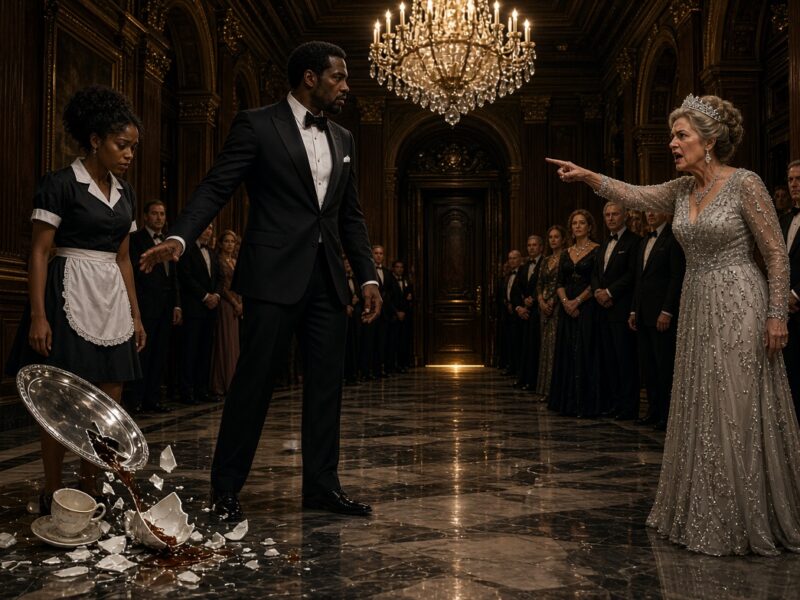
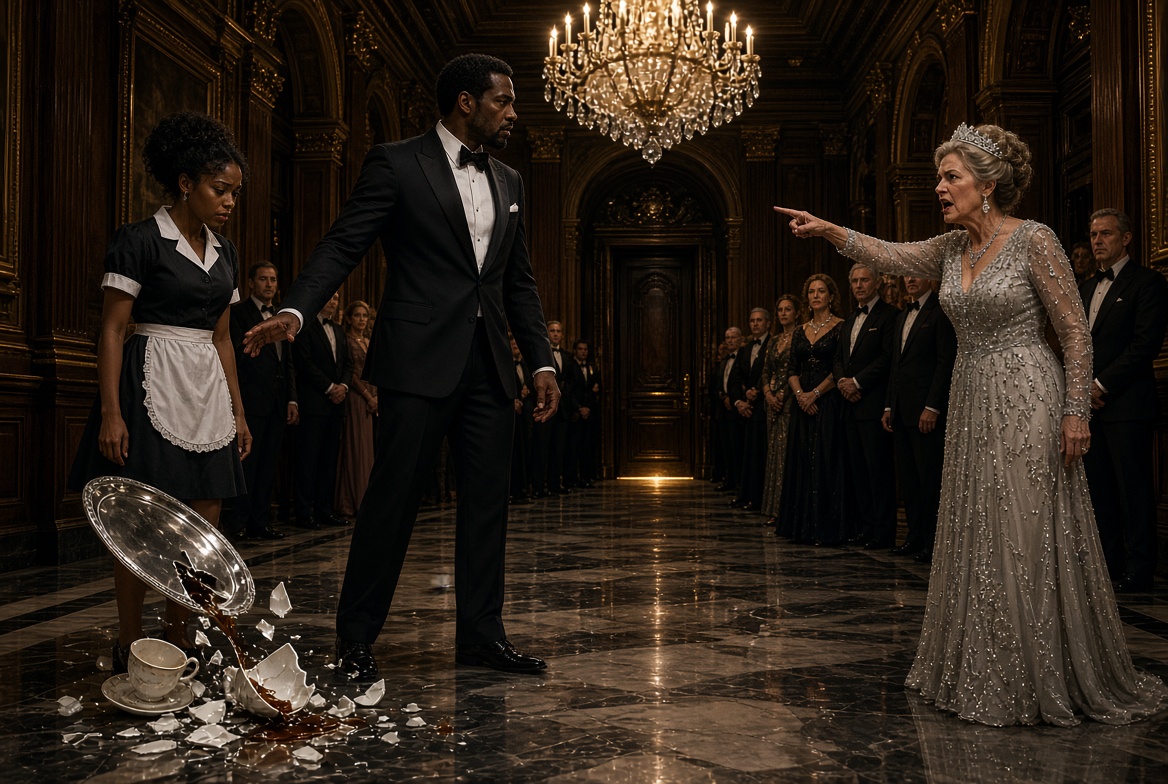
The silver tray hit the marble floor before the porcelain did.
Lena Hart watched the cup shatter into a dozen pieces, each one catching the light from the chandelier like a small, accusatory star.
She had been a maid at the Vale estate for exactly eleven days, and she already knew this was the moment that would define her time here, one way or another.
“You clumsy, careless girl.”
Evelyn Vale’s voice cut through the murmur of the gala like a blade through silk, and every conversation in the east corridor died in an instant.
The diamonds on Evelyn’s raised hand flashed as she pointed one manicured finger at the mess on the floor, at the trembling girl in the plain black uniform, at everything she clearly considered beneath her.
“Do you have any idea what that cup cost?”
Lena opened her mouth to answer, but no words came out.
Because it wasn’t the cup that had made her drop the tray.
It wasn’t the weight of the silver, or the late hour, or the exhaustion that came from sixteen-hour shifts on feet that had never been given time to heal.
It was the music.
—
Marcus Vale had closed billion-dollar deals without ever raising his voice.
He had stared down hedge fund managers, negotiated with foreign governments, and walked away from acquisitions that would have made lesser men weep.
But the moment he heard his mother shouting at a maid in the east corridor of the family mansion, something ancient and furious woke inside him.
He crossed the marble floor like a man chasing a memory he had spent half his life trying to outrun.
The tuxedo felt wrong on his shoulders, the champagne glass still in his hand felt absurd, and the polished smile he had worn all evening for the anniversary gala slid off his face like water.
He arrived just in time to see his mother standing beneath the crystal chandelier with one hand lifted, her diamonds flashing as sharply as her anger.
A silver tray trembled in the maid’s hands.
A porcelain cup lay shattered across the floor.
And relatives in formal clothes lingered a few steps away, pretending to be offended by the scene while refusing to miss a single word.
“I asked you a simple question,” Evelyn said, each syllable clipped and cold.
“Why were you standing near that hallway?”
—
The maid was young, African-American, dressed in a plain black uniform with a white collar.
And although fear showed clearly in her face, it was not the fear of someone guilty.
It was the fear of someone who had walked too close to something hidden and realized too late that the people around her had been guarding it for years.
Her name was Lena Hart, and she had been hired three weeks ago through an agency that specialized in discreet household staff for families who valued privacy above all else.
She had passed every background check, signed every confidentiality agreement, and been trained to move through the mansion like a ghost.
But ghosts, Marcus knew, had a way of finding the rooms where old secrets lived.
He followed Lena’s gaze without meaning to, and felt an old chill rise in him.
At the far end of the corridor stood the narrow walnut door that had remained locked for as long as he could remember.
As a child, he had once reached for that handle and been stopped so sharply that even adulthood had failed to soften the memory.
“Never touch that door again.”
“Not tomorrow.”
“Not ever.”
—
Now his mother stood in front of that old silence like a woman protecting more than wood and brass.
The quartet in the ballroom beyond the archway faltered, the music dissolving into uncertain silence.
A cousin lowered his champagne glass.
One aunt slowly turned away and then, realizing nobody else had the decency to pretend, turned back again.
Marcus stepped between Evelyn and the maid without asking for details first.
He had learned long ago that in this house, details were weapons, and whoever asked for them first usually ended up bleeding.
“Whatever this is,” he said quietly, “you will not handle it like this.”
Evelyn’s expression hardened into something he recognized from childhood, the look she wore when she was about to remind him exactly whose name was on the deed.
“You came home early.”
“And you seem busy.”
Marcus turned to the maid, whose hands were still trembling around the edges of the silver tray.
“What’s your name?”
She swallowed hard, and he watched her throat move with the effort of holding back tears.
“Lena Heart, sir.”
—
Lena opened her mouth, but instead of explaining herself, she lifted one trembling hand and pointed past his shoulder straight at the locked room.
When she spoke, her voice was barely above a whisper, yet it changed the temperature of the entire corridor.
“Sir, please don’t ask me what happened to me.”
Her eyes stayed fixed on the door, as if she could see through the walnut panels to whatever waited on the other side.
“Ask them why that room has been locked for so many years.”
The silence that followed was so complete, Marcus could hear the grandfather clock in the next hall marking each second like a warning.
He turned slowly toward the door, and something old and buried shifted inside him.
He remembered almost nothing clearly about the room.
That was part of what made it so disturbing.
It lived inside him like a torn page from a book he had once loved, a page he could feel the shape of but could no longer read.
—
He remembered blue pajamas, bare feet on cold floors, a line of light under a door.
He remembered a silver melody from the other side, thin and sweet and impossibly sad.
He remembered wanting to go in.
He remembered being stopped.
“Sir?”
Lena’s voice pulled him back to the present, and he realized his hand had drifted toward the corridor as if it belonged to someone else.
“What did you hear?” he asked.
She hesitated, and in that hesitation he saw the truth: whatever she had heard, it had frightened her more than his mother’s anger ever could.
“A music box,” she finally said.
“I heard a music box.”
—
The words landed with impossible force.
Marcus had not thought about a music box in years.
Not consciously, not deliberately, not in any way he could have explained to a therapist or a friend or the board of directors who thought they knew everything about him.
Yet in the instant she said it, three descending notes and one rising note flashed through his mind so vividly that he almost felt dizzy.
He saw a small room with a slanted ceiling.
He saw a window with lace curtains that filtered the afternoon light into something soft and golden.
He saw a woman’s hands, dark and gentle, winding a silver key shaped like a star.
Evelyn snapped, “This is absurd.”
But the denial came too fast, too polished, like a statement prepared by lawyers and rehearsed in front of a mirror.
Marcus looked from his mother to the locked room and back again.
He had spent years building a reputation for calm intelligence, for never reacting before he understood the full shape of a problem.
But this was not business.
This was a hallway in the house where he had grown up feeling provided for and somehow still emotionally homeless.
—
When the corridor had emptied, only Marcus, Evelyn, and Lena remained with the locked room at the end of the hall like a witness that had finally been called to testify.
The relatives had drifted back to the ballroom, their curiosity temporarily satisfied by the promise of champagne and gossip.
The quartet had resumed playing, though the music sounded thinner now, as if even the instruments understood that something had shifted.
Evelyn folded her arms, a gesture Marcus recognized as her way of closing a conversation before it could begin.
“You are creating drama where there is none.”
Her voice was steady now, controlled, the voice she used with reporters and rival executives and anyone else she considered beneath her notice.
“It was part of the old nursery wing.”
“It was sealed years ago.”
“That is all.”
Marcus held her gaze, and for a long moment neither of them spoke.
“Then why does a maid looking at it upset you this much?”
—
“Because this is my house.”
The words came out sharp and automatic, the answer of a woman who had spent decades believing that ownership was the same thing as authority.
“No,” Marcus said quietly.
“That answer used to work when I was eight.”
The sentence struck harder than he intended.
He saw it in the way her expression changed, not dramatically, just enough.
Alarm.
Memory.
Fear.
Lena lowered her eyes, but Marcus had already noticed the tears gathered there.
“I shouldn’t have stopped,” she said softly, and her voice cracked on the last word.
“I was taking tea to the terrace, but when I passed the hall, I heard the melody, and I knew I was standing in front of the right door.”
The right door.
Not a door.
The right door.
—
Marcus felt the distinction land in his chest like a key turning in a lock he hadn’t known was there.
“Come to my father’s study in ten minutes,” he told her.
Evelyn took a step forward.
“Marcus.”
He didn’t turn around.
He didn’t acknowledge the warning in her voice, the way her hand had risen as if to grab his sleeve, the way her breath had caught in her throat.
He simply walked toward the west wing, his footsteps echoing on the marble, and left his mother standing alone beneath the chandelier with a shattered cup at her feet.
Because there are moments when a son stops behaving like a son and becomes the only adult in the room.
—
The study had not changed since Theodore Vale died.
Dark shelves lined the walls, filled with leather-bound books that no one had read in decades.
Leather chairs sat arranged around a massive desk, their surfaces cracked with age and disuse.
A brass lamp angled over the desk, casting a pool of golden light that made the room feel like a stage set for a play that had ended years ago.
The desk itself was still so carefully arranged it felt less like furniture and more like preserved performance.
A fountain pen lay parallel to a leather notebook.
A crystal paperweight held down a single sheet of stationery.
A photograph of Evelyn and Theodore at a charity gala smiled out from a silver frame.
Evelyn had always called this room a tribute.
Marcus had quietly suspected it was guilt.
He had almost skipped the anniversary gala entirely.
That was the truth beneath the tuxedo and the polished smile and the champagne glass he had barely touched.
He respected the company, protected the family name, signed the charitable checks, funded the museum wing his mother wanted, attended the galas, shook the hands, made the speeches.
But emotionally, he had never fully come home.
Not to this mansion.
Not to the people in it.
Not to the version of himself that this house seemed to expect.
He had learned early that comfort and closeness were not the same thing.
The mansion looked magnificent from the outside, all stone and iron and manicured gardens that photographers loved.
Inside, it had always felt curated rather than warm.
And somewhere inside that perfection was a locked room no one could mention without panic.
—
When Lena entered, she closed the study door softly behind her and remained standing.
Marcus gestured toward the chair across from the desk.
“Sit.”
She shook her head.
“If I sit down, I might not be able to say this.”
He studied her for a moment, noting the way her hands had stopped trembling now that she had a purpose, the way her spine had straightened despite the fear still visible in her eyes.
“Then stand and say it.”
A faint, sad smile touched her face.
“You sound like him.”
Marcus straightened.
“My father?”
She nodded.
—
He stared at her.
“You have exactly one chance not to make that sentence a mistake.”
Lena reached into the hidden seam of her apron, the kind of pocket that servants had used for centuries to carry things they weren’t supposed to have, and placed a small velvet pouch on the desk.
Marcus frowned.
“What is that?”
“Something that belongs to the room.”
He untied the cord, and a brass key slid into his palm.
Old, tarnished, its head shaped like a star.
The sight of it hit him so hard he had to brace one hand against the desk.
—
He knew the key.
Not in the clear way of memory, but in the deep physical way the body remembers long after the mind has been instructed to forget.
He could almost feel smaller fingers turning it, the metal cold against skin that had not yet learned to be afraid.
He could almost hear a woman’s voice telling him gently, “Slow hands, Marcus.”
“It only sings when you’re gentle.”
He looked up sharply.
“Who?”
Lena’s eyes filled with tears, but she did not retreat.
“I have to.”
“I’m not deciding what you’re allowed to hear.”
“I’m trying to keep you from hearing it in the wrong order.”
Marcus said nothing, but his grip on the key tightened.
—
“If I tell you everything first,” Lena continued, “you will hear accusation.”
“If you see the room first, you may hear love.”
“Told by whom?”
Again, his patience tightened, a rope pulled taut by years of learning that information was power and power was never given freely.
But all she said was, “Someone who loved you enough to leave.”
Marcus had spent years disguising certain injuries as discipline.
Powerful men learn to do that.
They learn to call loneliness focus, distance maturity, grief efficiency.
But that sentence touched the oldest wound in him, the one he never named aloud.
The suspicion that at some point in his childhood, someone essential had gone away, and no one had thought he deserved the truth.
—
“Give me something real,” he said.
Lena nodded and took out a photograph.
It was old, the colors faded to soft sepia, the edges worn from handling.
A boy of perhaps five sat on a rug in striped pajamas, laughing at something outside the frame.
Beside him knelt Theodore Vale, smiling faintly, his hand resting on the boy’s shoulder.
And at the edge of the frame, nearly cut away, was the arm and hand of a woman kneeling toward the boy.
In her hand was a silver music box.
Marcus stared at the photograph until the room seemed to narrow around it.
Someone had deliberately trimmed that image to remove her face.
—
“Who is she?” he asked.
Lena’s throat moved as she swallowed.
“That,” she said, “is the question your mother has spent years trying to make impossible.”
Marcus looked down at the photograph again, at the small hand reaching for the music box, at the way the boy’s whole body leaned toward the woman who had been erased.
He thought about the gala still going on in the ballroom, the guests who had come to celebrate the company his father had built, the speeches he was supposed to give, the performance he was supposed to maintain.
And he thought about the key in his hand, warm now from his grip, and the door at the end of the east corridor that had been waiting for him his entire life.
—
“I need to go back to the gala,” he said.
Lena nodded, but her eyes held a question she didn’t ask.
“For now,” he added.
“Tell no one about this.”
“I won’t.”
“And Lena.”
She paused at the door.
“Yes, sir?”
“Thank you.”
The words felt inadequate, but they were all he had.
She nodded once and slipped out of the study, leaving him alone with the photograph and the key and the weight of a truth he could feel pressing against the walls of his carefully constructed life.
—
When his turn came to speak, Marcus rose slowly with a glass in hand and looked out over the room full of polished faces waiting to be reassured.
The ballroom glittered with the kind of wealth that only old money could produce, diamonds and pearls and watches that cost more than most people’s houses.
He saw his mother seated at the head table, her expression perfectly composed, her eyes fixed on him with an intensity that bordered on warning.
He saw the board members who had come to celebrate Vale Holdings’ anniversary, their wives in designer gowns, their husbands in tailored suits, all of them waiting for the speech they had been promised.
“A family,” he said, “is often judged by what it builds in public.”
He paused, and the room leaned in.
“But sometimes its true character is hidden in the things it refuses to remember.”
A small silence followed.
People smiled uncertainly, unsure whether this was leading to a toast or a confession.
Marcus raised his glass anyway.
“To truth, however late it arrives.”
He drank and sat.
His mother did not.
—
After dessert, while the guests drifted toward the terrace and the string quartet played something soft and forgettable, Marcus went to the archive room on the second floor.
He had discovered this room as a teenager, looking for a quiet place to hide from the endless parade of relatives and business associates who filled the mansion during holidays.
It had become his sanctuary, the one place in the house where he could breathe.
If there was one lesson Theodore Vale had given him that business school had never improved upon, it was this: when a story feels polished, inspect the records.
The archive room held household ledgers, renovation plans, staff files, event books, correspondence logs.
Most people found it dull.
Marcus found it honest.
—
He unlocked the cabinets and began with the years surrounding his earliest memories.
The ledgers were leather-bound, their pages yellowed with age, filled with the meticulous handwriting of a series of household managers who had come and gone over the decades.
At first, nothing seemed unusual.
Payroll records, floral orders, repairs, catering invoices, seasonal maintenance.
The mundane details of running a mansion that employed dozens of people and hosted events for hundreds.
Then the year he turned seven began to fracture.
Pages that should have been there were missing, torn out so cleanly that only the stubs remained.
Entries that should have been complete simply stopped mid-sentence.
The guest log skipped an entire summer.
—
Marcus pulled the log closer to the lamp, squinting at the faded ink.
Someone had tried to black out the name, but the ink had not fully covered the letters beneath.
Under the black strokes, he could still make it out.
Aurelia Ray.
Not temporary caregiver.
Not household staff reassigned.
A name.
He wrote it down on a scrap of paper, his handwriting steady despite the way his heart was pounding.
He flipped through more pages, looking for other mentions of the name, other evidence of this woman who had been so carefully erased.
—
The archive room door opened.
Marcus looked up, and there was his mother, still in her gown from the gala, her diamonds catching the light from the single lamp on the desk.
She shut the door behind her, and the click of the latch sounded like a lock engaging.
“Whatever that girl told you, it is incomplete.”
Evelyn moved to the far side of the table and rested two fingers on the ledger without opening it.
“The room at the end of the east corridor belonged to a woman who worked here when you were very young.”
“A caregiver.”
“A nanny?”
Marcus slid the note with Aurelia Ray written on it across the table.
“What was her name?”
—
For the first time that night, Evelyn’s face changed in a way she could not fully control.
Not denial.
Something deeper.
Something that looked almost like grief.
“She became too attached.”
“To me?”
Her jaw tightened.
“She forgot her place.”
Marcus’s jaw tightened.
“Or maybe the problem was that I remembered it.”
A flash of anger crossed her face, quick and hot and real.
“You were a child.”
“You do not understand the pressure your father and I were under.”
“Did father know her well?”
Marcus leaned forward, watching his mother’s face for the truth she was trying so hard to hide.
“And what exactly did she do?”
—
Evelyn answered too quickly.
“Nothing criminal, nothing dramatic.”
“But she made this house impossible.”
That was when Marcus understood two things at once.
First, his mother was still protecting something bigger than reputation.
Second, she was no longer telling the same story twice in the same way.
“The records are missing because of her,” he said.
“No.”
“The records are missing because some seasons deserve silence.”
He almost laughed at the honesty hidden inside the lie.
She was no longer denying the burial, only defending it.
—
“The caregiver called Aurelia,” Marcus said slowly, testing the name.
“The one who left.”
Lena closed her eyes.
“That was her favorite way to make love sound replaceable.”
Marcus stared.
“You know her?”
“Yes.”
“How?”
She opened her eyes again, and there it was at last, the first piece of truth offered without strategy.
“Aurelia Ray raised me in Savannah.”
The sentence moved through him like distant thunder.
—
“She died two years ago,” Lena said.
“Before she died, she gave me the key, the photograph, and a letter.”
“She told me that one day I would need to come here, no matter how long it took.”
“And make sure you opened that room yourself.”
“Why me?”
“Because the truth inside it belongs to your childhood.”
“That doesn’t answer the question.”
Her voice dropped.
“She said there was one thing you must never keep believing.”
“That you had been easy to leave.”
—
He turned away so she would not see how directly the sentence struck.
“Why didn’t she come herself?”
“Because by the time she was ready, she was too ill.”
Lena said it gently, but the words still landed like stones.
“And because she knew this house would not welcome her while the past remained locked inside it.”
“I opened the room tonight.”
He said it as a statement, but it came out as a question.
Lena shook her head.
“Not while the house is full.”
“Not while your mother can turn it into a scene before it becomes the truth.”
Marcus looked down at the little brass key in his hand.
“She doesn’t control this anymore.”
“She controlled it for years.”
“Don’t underestimate what people can destroy when panic reaches them before honesty does.”
Marcus hated that she was right.
—
## Part 2
Marcus dismissed everyone from the East Wing except Lena.
The guests had finally begun to leave, their cars pulling away from the circular drive, their laughter fading into the night.
The staff had been sent to their quarters with instructions not to disturb the family.
His mother had retreated to her rooms without another word, though he could feel her presence in the house like a storm waiting to break.
He walked the corridor with Lena at his side.
The house felt different at night, stripped of performance.
Portraits watched in silence, generations of Vales staring down at him with painted eyes that revealed nothing.
The runner softened their steps, muffling the sound of two people approaching a door that had been closed for decades.
—
At the end of the hall, the locked door waited exactly as it had in memory.
Narrow and ordinary looking enough to seem harmless if you did not know how hard people had worked to keep it closed.
Lena pointed to the carved molding near the baseboard.
“She said the real lock was hidden.”
Marcus knelt, the marble floor cold through the knees of his tuxedo pants, and ran his fingers along the wood until he found a tiny indentation shaped like a star.
His pulse climbed.
He slid the key into the slot, and it fit perfectly, as if the lock had been waiting for this exact moment for years.
—
Marcus stood, turned the handle, and opened the door.
The room inhaled time.
Cedar, dust, lavender long faded but not gone.
Moonlight stretched across the floor through sheer curtains silvered by rain.
A rocking chair beside a lamp table.
A child’s bookshelf with worn storybooks arranged by size.
A low rug with a wooden train on one side.
And on a small table near the window, a silver music box shaped like a little house with a midnight blue roof.
Marcus stepped inside as though entering a chapel built for a forgotten version of himself.
—
He crossed first to the wall of drawings.
They were pinned there with careful precision, as if someone had wanted to preserve them exactly as they had been arranged years ago.
One showed a tall man in a black suit with the word “Daddy” written beneath it in a child’s uncertain hand.
One showed a garden with flowers taller than the stick figure standing among them.
One showed a woman with brown skin and dark hair, her arms outstretched, with the words “Mama Rea” written in wobbly letters.
Marcus stared at that drawing for a long time.
—
For Marcus, from Aurelia Ray.
He reached out and touched the frame, his fingers leaving prints in the dust.
“Aurelia Ray.”
He could almost hear himself saying it in a child’s voice, turning an adult name into something soft enough to belong only to them.
He moved to the bookshelf next, scanning the titles.
Goodnight Moon.
The Little Engine That Could.
Where the Wild Things Are.
Stories that had been read to him by someone who had loved him enough to leave them behind.
—
When he reached the music box, his hands were shaking.
It was smaller than he remembered, but then again, he had been smaller too.
The silver was tarnished, the midnight blue roof faded, but the keyhole was clean, as if someone had oiled it recently.
He wound it, and the melody drifted into the room like memory given shape.
Three descending notes.
One rising note.
He saw himself on the rug in striped pajamas while Aurelia tucked the quilt around his shoulders.
He saw Theodore leaning in the doorway, smiling.
He heard a story about a train conductor who never lost his way because he listened for the right bell.
He felt a warm hand smoothing his hair.
And suddenly, the air around him was no longer empty.
—
Voices.
Evelyn at the door, brittle with contained emotion.
“He needs peace.”
Theodore saying something Marcus couldn’t quite hear.
A woman’s voice, low and calm, saying, “He needs love.”
The memory broke so sharply Marcus nearly dropped the music box.
He set it down on the table and turned to find Lena standing in the doorway, her face half in shadow.
“What happened to her?” he asked.
Lena stepped inside, and for a moment she just looked around the room, taking in the drawings, the books, the small bed in the corner with its blue and gold quilt.
“She was sent away.”
“By whom?”
“Your father signed the papers.”
—
Lena moved to the small desk in the corner and opened a drawer.
Inside were papers, yellowed with age but still legible.
Confidential household agreements.
Theodore’s signature.
Marcus’s throat tightened.
“They exiled her.”
“They called it protection,” Lena said.
“Your mother called it necessary.”
“Your father called it temporary.”
“It lasted until she died.”
He opened the letters next, his hands moving through them with the urgency of someone who had been denied the truth for too long.
—
The first letters were warm, full of details about Savannah, about the cottage with the lemon trees, about the garden she was planting.
Updates without warmth allowed to show too openly.
Then the letters changed.
Shorter, more formal.
Written from Savannah, yes, but colder.
As if the writer had been warned to keep her distance.
As if someone had told her that love, when expressed too freely, became a threat.
He broke the seal on the final letter.
—
The room around you belonged to the woman who gave you the safest years of your childhood.
Her name is Aurelia Ray.
You called her Rea.
She entered this house as an employee, but no truthful person could leave the story there.
When your mother became seriously unwell after your birth, Aurelia stepped into the hours that frightened us most.
She held you when Evelyn could not, soothed you when I was absent, and built ordinary peace in a house that knew more about status than tenderness.
Your mother loved you.
That is true.
It is also true that love can become distorted when shame enters it.
—
Evelyn saw how easily you rested with Aurelia and began to experience that comfort as a judgment on everything she was struggling to be.
Aurelia was not only your caregiver.
She was your mother’s younger sister.
Marcus stopped breathing for a second.
He read the sentence again, then again, as if repetition could make the words less impossible.
His mother’s sister.
Aurelia Ray was Evelyn’s sister.
Which meant Lena, who had been raised by Aurelia in Savannah, was his cousin.
He forced himself to continue.
—
She asked only one thing of me.
That one day you would know she had not left because you were unwanted.
I failed that promise for too long.
Love, Father.
Marcus set the letter down on the desk and stood very still for a long moment.
The music box had stopped playing.
The room was silent except for the rain that had begun to fall outside, soft and steady against the windows.
“Not every detail,” Lena said, and he realized she was crying openly now.
“But enough.”
“How?”
She took out another envelope.
“She left this for you, too.”
“But only after the room opened.”
—
He knew it before he unfolded the page.
If this reaches you, then the door has finally opened and silence no longer owns the room where you once learned to sleep without fear.
I left because the house had become full of wounded pride and I could not bear for you to grow inside that storm.
Your mother was hurting in ways no one named honestly.
Your father was trying to hold peace together with arrangements.
I chose absence because it seemed kinder than letting you become the rope in a struggle between sisters.
That choice broke me.
But I would still make any sacrifice that kept your childhood from turning cruel.
—
Please do not turn your pain into contempt.
Truth matters.
So does mercy.
If you learn what was hidden, hold both.
Marcus read the letter three times, each pass revealing something new.
Not because he had missed the meaning, but because for the first time in his life, a message from his childhood had reached him unedited.
No one had softened it.
No one had decided what he was allowed to know.
Aurelia had trusted him to hold the truth, even when he was too young to understand it.
And she had waited, all these years, for him to be ready.
—
Marcus stood there with Theodore’s confession in one hand and Rea’s letter in the other.
And for a long moment, the room seemed to divide his life into two clean halves.
In one half was the world that had made him.
The immaculate dinners, the polished speeches, the expensive schools, the boardrooms where nobody ever trembled.
The mansion where every flower arrangement was perfect and every emotion arrived dressed for inspection.
In the other half was this hidden room with its worn rug, its soft quilt, its patient music box, and the undeniable evidence that somewhere, before power taught him how to stay composed, love had once taught him how to feel safe.
That realization hurt more than any accusation could have.
—
It showed him exactly what had been stolen.
Not his inheritance, not his future.
The thing taken from him had been simpler and far more precious.
The right to remember the person who had made childhood gentler.
He understood then why his mother had feared the room.
Why his father had delayed the truth.
Why Lena had come into the house wearing a uniform instead of a claim.
The room did not contain scandal.
It contained comparison.
It proved that tenderness had lived inside the family once in a form no title, no marriage, and no fortune could command.
—
Footsteps sounded in the corridor.
Marcus knew who it would be before he turned.
Evelyn stood in the doorway, looking past him into the room she had sealed from sight for decades.
Moonlight cut across her face, revealing lines that makeup had hidden earlier.
Whatever authority she had worn at the gala was gone.
In its place was the terrible nakedness of a person standing before the evidence of what she had done and what she had lost.
“She should have burned that letter,” Evelyn said, though her voice held no strength.
Marcus rose, Aurelia’s page in one hand and Theodore’s in the other.
“She was your sister.”
Evelyn closed her eyes.
“Yes.”
—
“Why erase the records?”
Evelyn stepped inside slowly, as if the floor itself might reject her.
“Because every time I saw her with you,” she said, “I saw what I could not do without effort.”
“She made care look natural.”
“I made it look planned.”
“And after you were born, when my mind went dark and everyone expected gratitude, Aurelia stepped in quietly and saved more than one of us.”
“She never humiliated me.”
“That almost made it worse.”
Tears filled her eyes, but she kept talking, perhaps because there was no point in stopping now.
—
“You reached for her before you reached for me.”
“At first I told myself it was temporary.”
“Then I saw how your whole body changed when she entered a room.”
“You relaxed.”
“You laughed.”
“You slept.”
“I began to feel like a guest in my own motherhood.”
He wanted anger.
What came instead was grief sharpened by comprehension.
“The night you called her Mama Rea,” Evelyn went on, looking at the rocking chair.
“I felt something collapse inside me.”
“Not because you had done anything wrong.”
“You were innocent.”
“But I heard, in one sentence, every fear I had buried since your birth.”
—
Marcus looked at her and finally understood that his mother had not spent all these years guarding a scandal.
She had been guarding a shame too intimate to confess.
That jealousy had once been stronger in her than gratitude.
And once acted upon, that jealousy had built a prison around the whole family.
“Wounded people can do terrible things without becoming monsters,” Evelyn whispered.
“She refused to let me come here seeking revenge.”
Evelyn covered her mouth and turned away, shoulders trembling.
—
He turned to Lena.
“Why come as a maid?”
She let out a shaky breath.
“Because if I arrived with letters and claims, your mother would never let me near you.”
“But wealthy houses see uniforms before they see people.”
“Aurelia understood that.”
“She said, ‘Truth enters proud homes quietly if it wants to get close enough to be heard.'”
The opening scene flashed through Marcus with new force.
The tray, the shouting, Lena’s silence, the corridor.
She had not come into the house to ask for rescue.
She had come carrying history in the only form the house would overlook.
—
Another memory surfaced, clearer than the rest.
He was lying beneath the blue and gold quilt while Aurelia told him that brave conductors always keep one light burning for travelers who feel lost.
The pendant had glowed against her dress every time she leaned over to wind the music box.
A star-shaped pendant.
The same shape as the key.
“Aurelia left this to me,” Lena said.
“With instructions that if you remembered the train story, I should tell you the last truth.”
Lena’s hands shook as she closed her fingers around the pendant.
—
“After Aurelia left this house, she went to Savannah and lived in the cottage your father purchased through the trust.”
“A year later, a cousin of hers died, leaving behind a little girl.”
“Me.”
“Aurelia raised me as her own, but before she died, she told me something she had never written down.”
“She said the reason she protected your mother’s dignity for so long was because on the night she left, Evelyn begged her for one final mercy.”
“She asked Aurelia not to tell you the full truth while she was alive because she wanted one more chance to become the mother she had failed to be.”
His mother was crying without hiding it now.
—
“I waited,” Evelyn whispered.
“And then I kept waiting because every year that passed made confession harder.”
“I told myself I would speak after the next birthday, the next success, the next loss, the next moment that felt stable enough.”
“Then your father died and the lie became the architecture of everything.”
Marcus listened, and what he felt was not forgiveness, not yet.
But the possibility of understanding how ordinary weakness protected long enough becomes legacy.
He walked to the bookshelf and ran a finger across the spines.
Stories Aurelia must have read to him.
Stories his mother had locked away because they hurt.
—
When he turned back, his voice carried the calm that made boardrooms listen.
“No more locks.”
“No more erased names.”
“No more hidden letters.”
He looked around the room, at the drawings and the books and the music box that had waited so patiently for someone to wind it again.
“Aurelia goes back into the family record.”
“Publicly.”
“Truthfully.”
Evelyn closed her eyes, then nodded once, slowly, like a woman accepting a sentence she had written herself years ago.
—
Marcus turned to Lena.
“And you do not leave this house through the service entrance.”
He looked at the letters on the desk, then back at her.
“I’m creating something in Aurelia’s name.”
“A foundation for caregivers, especially women whose labor holds families together while history only remembers the people with titles.”
“Housing support, legal aid, mental health services, scholarships.”
“Not performative charity.”
“Real structure.”
Then he faced his mother.
“You can help if you are willing to tell the truth and live with what follows.”
“Not manage it.”
“Tell it.”
—
Evelyn wiped her face with trembling fingers.
“I don’t know if I deserve to stand inside her memory.”
“That is not for you to decide alone anymore,” Marcus said.
“But silence is over.”
The three of them spent the rest of the night carrying boxes, letters, and drawings into Theodore’s study so they could be cataloged properly.
No servants, no attorneys, no publicists.
Just family history finally handled by human hands instead of buried by legal ones.
Evelyn stood for a long time with the blue and gold quilt in her arms, pressing her palm against the stitched fabric as if it might still hold her sister’s warmth.
When morning light entered the east corridor, the mansion no longer felt immaculate.
—
## Part 3
A week later, Marcus shocked the board, the press, and most of the city by postponing the glamorous anniversary campaign everyone had prepared for months.
The campaign had been in development for over a year, a celebration of Vale Holdings’ seventy-fifth anniversary that would have featured celebrity endorsements, a documentary series, and a gala that would have cost more than most people earned in a lifetime.
In its place, he released a statement announcing the Aurelia Ray Foundation.
Created to honor a woman whose care had shaped his life and whose name should never have been removed from his family’s story.
The statement was short, direct, and devoid of the corporate language that usually characterized such announcements.
It said, simply, that the foundation would support caregivers and domestic workers, providing resources that had too long been denied to the people who held families together.
—
The board was furious.
The press was confused.
The public was fascinated.
Marcus held a press conference at the foundation’s temporary offices, a modest space in a building that had once been a school.
He wore a simple gray suit, no tie, and stood at a podium that had been borrowed from a community center.
Reporters packed the room, their cameras and recorders ready to capture whatever scandal they had been promised.
They expected a story about inheritance disputes, about family secrets, about a billionaire’s dramatic break from his mother’s control.
What they got was something rarer.
—
And at the first press conference, he asked Lena Hart to stand beside him.
Not as staff.
As founding director.
She wore a simple navy dress, her hair pulled back, her hands clasped in front of her.
She looked nervous, but she also looked determined, like someone who had spent years preparing for a moment she never thought would arrive.
Reporters expected scandal.
They expected betrayal.
They expected inheritance disputes or some cruel twist fit for gossip.
What they got instead was rarer.
—
A powerful man admitting that the most valuable thing taken from him had not been money, but truth.
And that the woman who returned it had entered his house carrying a silver tray because pride had left no other door open.
The headline the next morning read: “Billionaire Opens Family’s Locked Room, Finds Lost Aunt and Lost Self.”
Marcus read it over coffee in the kitchen of his apartment, the one he kept in the city, the one that had never felt like home.
It was not the story he would have written.
But it was the truth, or close enough.
—
The foundation’s first initiative was the Aurelia Ray Residence, a restored home in Savannah where caregivers could find temporary housing, legal support, and mental health services.
The house had once belonged to Aurelia herself, purchased by Theodore through a trust that Evelyn had never known about.
It had sat empty for years after Aurelia’s death, maintained by a local caretaker who had been paid through the same trust.
When Marcus visited for the first time, he stood on the porch and looked out at the lemon trees Aurelia had planted.
They were still there, still bearing fruit, still growing toward the sun.
—
Lena stood beside him, her eyes on the house.
“She used to tell me stories about this place,” she said.
“She said it was the first place she ever felt like she could breathe.”
Marcus nodded, not trusting his voice.
“She would have wanted you to know that,” Lena added.
“That you were the reason she kept going.”
“I didn’t know.”
“You do now.”
He looked at her, at the cousin he had never known he had, and felt something shift in his chest.
Not forgiveness, not yet.
But the beginning of something that might, with time, become family.
—
Months later, the foundation opened its first residence in Savannah in the restored home where Aurelia had raised Lena.
The porch rails were painted soft blue.
Lemon trees lined the path.
In the entryway stood a framed photograph of Aurelia Ray smiling in a gold scarf, and beneath it, a brass plaque carried the words Marcus chose from her letter.
Truth matters.
So does mercy.
On opening day, caregivers, donors, and families filled the garden with laughter.
—
Lena spoke first, her voice clear and steady.
She talked about Aurelia, about the woman who had raised her, about the lessons she had learned from someone who had spent her life caring for others without ever asking for recognition.
Marcus spoke after her about dignity, memory, and the invisible labor that teaches children what safety feels like.
He did not mention his mother by name.
He did not need to.
Evelyn came, too, quietly, without demanding attention.
She stood near the back, holding a single white flower she eventually placed beneath Aurelia’s portrait.
—
At the close of the ceremony, Marcus stepped to a small table where the silver music box rested beneath glass.
He lifted the cover, took out the star-shaped key, and wound it gently.
For one aching, beautiful second, he was seven again, waiting beneath a quilt for a story about trains and courage.
But this time, the memory did not vanish when he reached for it.
It remained, not locked behind someone else’s shame.
He looked at Lena, who smiled back through shining eyes.
—
He looked at his mother, whose face now held sorrow and humility in equal measure.
Then he looked at the children running between the lemon trees, laughing without fear, and understood at last why Lena had pointed toward the locked room instead of defending herself in the corridor that night.
The mansion still stood in Brookshire.
Vale Holdings still expanded.
Marcus Vale was still a billionaire, still respected, still powerful enough to bend markets with a signature.
But none of that became the most important inheritance of his life.
—
His real inheritance was waiting behind a locked walnut door in the east corridor, preserved by guilt, guarded by fear, and returned at last by a young maid who had never come to be rescued.
And when that door finally opened, Marcus discovered that the mystery hidden at the center of his family was not a crime, not a scandal, not a servant wrongly blamed.
It was a woman named Aurelia Ray.
A woman who had loved him enough to leave.
A woman whose name had been erased from the record but never from his heart.
A woman who had trusted him to hold the truth, even when the truth was too heavy for a child to carry.
—
The music box played on, its melody drifting through the garden like a blessing.
Three descending notes.
One rising note.
And in that moment, Marcus understood what Aurelia had meant in her letter.
Truth matters.
So does mercy.
He held both, and finally, after all these years, he felt whole.
—
Evelyn approached him as the guests began to drift away, her steps hesitant, her eyes on the ground.
“I’ve been thinking,” she said.
“About what?”
“About what she said.”
“About holding both truth and mercy.”
She looked up at him, and he saw something in her eyes he had never seen before.
Not guilt, exactly.
Not regret.
But the beginning of understanding.
—
“I want to tell the story,” she said.
“Not manage it.”
“Tell it.”
Marcus studied her for a long moment.
“To whom?”
“To everyone.”
“To the press, to the family, to anyone who will listen.”
“I want people to know who she was.”
“I want people to know what I did.”
“I want people to know why.”
Marcus nodded slowly.
“Then tell it.”
“Start with the truth.”
—
Evelyn gave her first interview three weeks later.
She sat in the study where Theodore’s desk still stood, where the photograph of Aurelia still rested on the shelf, and she told the story she had spent decades hiding.
She talked about her sister, about the years they had been close before jealousy had driven them apart.
She talked about her own struggle with mental health after Marcus was born, about the darkness that had threatened to consume her.
She talked about the shame that had made her push Aurelia away, and the guilt that had made her lock the door.
She did not excuse herself.
She did not ask for sympathy.
She simply told the truth.
—
The response was overwhelming.
Not because people were shocked by the scandal, though some were.
But because so many recognized themselves in her story.
The fear of not being enough.
The jealousy that came from love, twisted by insecurity.
The choices made in moments of weakness that shaped lives for decades.
Letters poured into the foundation’s office.
Emails from caregivers who had felt invisible.
Calls from parents who had struggled with their own mental health.
Messages from siblings who had lost touch and wanted to reconnect.
—
Marcus read every one of them.
He read them late at night, in the apartment that still didn’t feel like home, and he felt something he hadn’t expected.
Not anger.
Not even sadness.
But a strange kind of peace.
The foundation was growing.
The residence in Savannah was full, its rooms filled with women who had spent their lives caring for others and finally had a place to rest.
Lena was running the operation with a competence that reminded him of Aurelia, the aunt he had never known, the woman who had raised her.
And Evelyn was slowly, carefully, trying to rebuild what she had broken.
—
The mansion in Brookshire was no longer locked.
The room at the end of the east corridor had been cleaned and preserved, its drawings still on the wall, its books still on the shelf, its music box still on the table.
Marcus visited sometimes, when the city felt too loud and the world felt too heavy.
He would sit in the rocking chair and wind the music box and let the memory of Aurelia wrap around him like the blue and gold quilt.
He would think about what she had written in her letter.
Truth matters.
So does mercy.
And he would hold both.
—
The money mattered, of course.
The foundation needed funding, and Marcus had provided it.
Nineteen thousand five hundred dollars was the first grant awarded to a caregiver who needed help with rent.
Seven thousand was the second.
The numbers added up, each one a small piece of the structure he was building.
But the money was not the point.
The point was the name on the letterhead.
Aurelia Ray.
A woman whose life had been erased.
A woman whose love had been replaced by silence.
A woman who had finally, after all these years, been given back her place.
—
Marcus stood in the garden of the Savannah residence on the first anniversary of the foundation’s opening.
The lemon trees were heavy with fruit.
The porch was filled with people.
Lena stood beside him, holding a child who had been left in the foundation’s care, a little girl with dark eyes and a bright smile.
Evelyn stood a few steps away, watching, her face soft in a way it had never been before.
The music box was playing.
He had wound it himself, standing at the table where it rested beneath glass, turning the star-shaped key with gentle hands.
Three descending notes.
One rising note.
—
The little girl laughed.
Lena smiled.
Evelyn wiped her eyes.
And Marcus, billionaire, heir, son, finally understood what Aurelia had meant.
The right door.
The locked room.
The maid who had pointed instead of explaining.
All of it had led to this moment.
Not a moment of wealth or power or reputation.
A moment of truth.
A moment of mercy.
A moment of love that had been waiting, patient as a music box, for someone to wind it again.
—
He thought about the key in his pocket, the star-shaped key that had unlocked the room.
He thought about the photograph, the one with the woman cut away, the one that had started all of this.
He thought about Aurelia’s letter, the final words she had left for him.
Please do not turn your pain into contempt.
Truth matters.
So does mercy.
If you learn what was hidden, hold both.
He had learned what was hidden.
He had held both.
And finally, after all these years, he was free.
—
**THE END**









