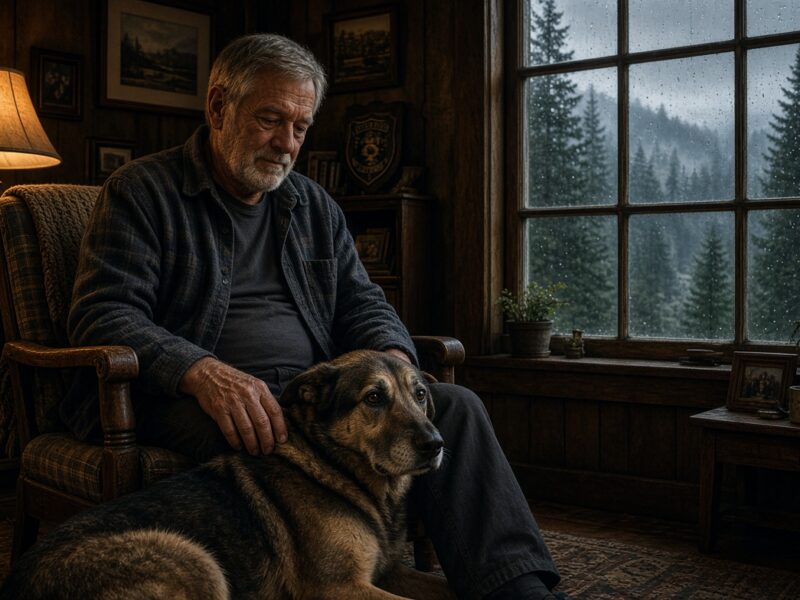
A Retired Cop Walked Into a Rescue Looking for a Quiet Companion… The Old German Shepherd He Found Was a Missing Police K-9 With a Secret No One Expected
The rain had not stopped for eleven days when Raymond Talbet pulled into the gravel lot of the Willamette Valley Animal Rescue Center, and the sky above Eugene, Oregon, pressed down like a wet wool blanket.
His wipers dragged across the windshield with a sound like something tearing.
Raymond was sixty-four years old, a police officer with thirty-one years on the force, and he had not told a single person at the rescue who he was.
No badge. No radio. Just a plain jacket, worn boots, and the quiet weight of a man who had spent his whole career reading rooms before anyone else noticed they had changed.
He had come to look at an older dog.
Not a puppy. Not some bright-eyed animal that would need constant motion. Something that understood slow mornings and quiet rooms.
That was the plan, anyway.
The plan lasted about nine minutes.
—
Raymond walked the front kennel row the way he walked everything—methodically, without hurry, letting details arrange themselves.
Clean floors. Full water bowls. Blankets folded with care.
Most of the dogs reacted to him. A few barked. Some wagged. One old hound pressed its nose through the wire and watched him with the patience of something that had already given up hoping.
Raymond almost walked past the German Shepherd at the far end of the row.
The dog was about ten years old. Silver spread around the muzzle. Leaner than he probably used to be, but not neglected.
A small card hung on the kennel door.
The name printed there meant nothing to Raymond.
He glanced at the dog, then kept walking.
Behind him, claws touched the floor.
Raymond stopped.
Most of the other dogs had reacted before he reached them. This one had barely moved for anyone.
Now the dog was standing.
Raymond turned slowly.
The shepherd stared directly at him. No barking. No jumping.
Just watching.
Raymond took one step back toward the kennel.
The dog came forward.
Then, without being called, without food, without any cue from the staff, the old German Shepherd moved as close as the kennel allowed and positioned himself toward Raymond’s left side.
Then he sat.
Raymond’s attention sharpened immediately.
That was not a dog sitting for attention. The angle was too precise. The shoulders aligned exactly where a trained working dog would place them beside a handler’s leg.
He had seen that position thousands of times.
Police canines learned it early.
They practiced it constantly.
They carried it long after active service ended.
Raymond looked at the card again.
The name still meant nothing.
He raised one hand almost without thinking and gave a small signal—one he had used during joint canine training years earlier.
The shepherd responded at once.
No hesitation. No confusion.
The dog adjusted position exactly as a trained canine would.
Raymond lowered his hand.
For the first time since entering the building, the thought of adoption disappeared from his mind.
Something about this dog was familiar.
—
He studied the shepherd more carefully, but age had changed too much. The muzzle had gone gray. The face had narrowed. The powerful frame he might have remembered had softened with time.
Many German Shepherds from working lines shared similar features.
Raymond knew better than to convince himself of something just because he wanted an explanation.
Then the dog leaned closer.
Raymond rested one hand near the kennel door.
The shepherd lowered his nose and gave the inside of Raymond’s wrist one gentle touch.
Raymond went still.
That tiny gesture opened a memory far more clearly than the dog’s face had.
Years earlier, during training sessions with a neighboring canine unit, one German Shepherd had developed an unusual habit. After completing a heel and sitting beside the handler, the dog would sometimes touch the handler’s wrist with his nose.
Almost like a quiet confirmation that the job had been done correctly.
It had never been an official command. Just something the dog did.
Raymond remembered laughing about it with the handler.
He remembered the dog’s name.
Ranger.
—
Ranger had been a highly experienced police canine who had worked with a nearby unit for years. Raymond had crossed paths with him during joint exercises and regional training days.
Ranger had been steady. Observant. Remarkably disciplined.
Then, after the dog retired, something had gone wrong during the process of transferring him to a retirement placement.
Ranger disappeared from the chain of custody.
There had been calls. Paperwork. Searches. Questions.
But no confirmed location had ever been found.
As months became years, most people accepted the possibility that Ranger would never be recovered.
That had been three years ago.
Raymond looked at the old shepherd again.
The possibility seemed absurd.
Yet the dog was sitting in front of him, performing habits that had belonged to a canine Raymond once knew.
Raymond moved closer to the kennel.
His voice was quieter when he spoke.
“Ranger.”
The response was immediate.
The shepherd’s ears rose sharply. The tail struck the floor once, then again.
Raymond felt something tighten in his chest.
The dog did not leap or bark. Ranger had never been that kind of dog.
Instead, the old German Shepherd leaned forward, eyes fixed on Raymond, as if a name buried beneath three years of silence had suddenly been returned.
Raymond looked once more at the card attached to the kennel.
It carried another name.
Not Ranger.
He stood there for several seconds, caught between what the paperwork told him and what the dog had just answered.
Then Ranger’s attention suddenly shifted.
The ears turned first, then the head.
At the far end of the hallway stood a solid door separating the public kennel area from a section marked RESTRICTED INTAKE—AUTHORIZED STAFF ONLY.
Ranger rose.
The old shepherd took two slow steps toward the side of the kennel closest to that door, then stopped.
A faint whine came from the dog’s throat.
Raymond watched carefully.
Ranger looked toward the restricted door, then back at Raymond, then toward the door again.
There was no excitement in the movement.
There was concern.
—
Raymond stepped closer to the kennel, but Ranger did not return to him. The shepherd remained focused on the far end of the corridor, body still, ears forward.
Only minutes earlier, Raymond had believed the greatest mystery in the building was how a missing police dog had ended up behind a rescue kennel door under another name.
Now Ranger seemed to be telling him that this was not the question he should be asking.
Raymond looked down the quiet hallway toward the restricted section.
Three years after disappearing from official records, Ranger had finally been recognized.
But instead of asking to be taken away, the old K-9 was looking toward a place Raymond was not allowed to enter.
And whatever Ranger remembered about that door seemed to matter more to him than his own freedom.
—
The next afternoon, the rain had eased into a fine mist that darkened the pavement outside the rescue center.
Raymond returned in the same plain clothes, carrying himself like an older man who had simply come back for another look at a dog he might adopt.
He had spent much of the previous night thinking about Ranger.
The response to the old name. The familiar heel position. That quiet touch against his wrist.
Difficult to dismiss.
Still, Raymond knew experience could become dangerous when it encouraged someone to see only what they expected to see.
He needed more than recognition.
He needed to understand what Ranger was trying to tell him.
—
The moment Raymond entered the kennel corridor, Ranger saw him.
The old German Shepherd rose from the bedding and came toward the gate. His tail moved once, then again, but there was no frantic greeting.
Ranger watched Raymond for several seconds, almost as if confirming that the man who had left yesterday had actually returned.
Raymond crouched beside the kennel.
“Good to see you, too.”
Ranger stepped close to the wire, then turned his head toward the rest of the corridor.
That caught Raymond’s attention.
A dog waiting three years to be recognized might have been expected to remain near the one familiar person who had finally called him by his real name.
Ranger did the opposite.
When a staff member later clipped on his leash and brought him into the hallway for a short walk, Ranger stayed beside Raymond only briefly before moving toward the neighboring kennels.
His first stop was an older German Shepherd several doors down. Ranger stood quietly in front of the enclosure, exchanged a long sniff through the wire, then moved on.
Next came a Labrador with silver around the muzzle. Ranger paused there as well, waiting until the Labrador lifted its head before continuing.
He was not wandering.
Raymond knew enough about working dogs to recognize intention when he saw it.
Then Ranger reached the kennel nearest the rear section.
Inside was Belle, a nine-year-old Belgian Malinois who had been living at the rescue as an older working breed dog awaiting placement.
She was lean, alert, and quieter than the younger dogs nearby.
When Ranger approached, Belle stood immediately.
Ranger stopped.
Belle moved to the front of her kennel.
Neither dog barked.
They simply remained there for a few seconds, noses close through the barrier.
The interaction was small, but Raymond noticed what happened when the staff member encouraged Ranger to continue walking.
Ranger followed—yet looked back twice before reaching the end of the corridor.
—
Later, when Ranger was returned to his kennel, he did not settle on the center of his bedding.
He lay against the side closest to Belle’s section.
Raymond began watching Belle more carefully.
Whenever footsteps sounded near the rear hallway, Belle’s posture changed. She would rise and look toward the sound.
Almost every time she did, Ranger lifted his head, too.
If Belle settled, Ranger eventually relaxed.
If she remained standing, Ranger remained alert.
Whatever had formed between those two dogs had not begun that afternoon.
They had learned each other’s rhythms.
Raymond did not need anyone to explain that.
—
By late afternoon, the quiet pattern changed.
An engine rolled across the gravel outside. A white transport van entered the lot and stopped near the side of the building.
Raymond happened to be standing where he could see part of the parking area through a window.
Ranger heard the vehicle before he saw it.
The reaction was immediate.
He had been eating from his bowl. He stopped with food still in front of him and raised his head.
His ears shifted backward. The muscles through his shoulders tightened.
Raymond watched without moving.
Ranger stepped away from the food. He went to the kennel door.
Then he looked toward Belle.
Not toward Raymond. Not toward the exit.
Toward Belle.
A rescue employee carrying a clipboard appeared at the far end of the corridor. The employee checked several kennel cards, walked past Ranger, then stopped near an older dog farther down the row.
The dog was leashed and brought into the hallway.
Ranger barked.
It was nothing like the casual noise Raymond had heard from the kennels earlier.
Short. Sharp. Repeated.
A working dog’s warning.
The employee glanced toward Ranger, but Ranger showed no aggression toward the person. His attention followed the older dog being led toward the side exit.
Then his head snapped back toward Belle.
Raymond felt the pieces begin to shift into a different shape.
Ranger was not frightened of strangers. He had shown no fear of the staff. He had walked calmly through the corridor.
The change had begun only when the white van arrived.
The older dog disappeared through the side door.
The door closed.
Ranger remained standing at the kennel gate long after the hallway became quiet again.
Raymond looked at Belle.
She was standing, too.
—
He could not know what Ranger remembered. He could not know where previous dogs had been taken or whether every transport had ended badly.
But the pattern was strong enough to raise a question Raymond could no longer ignore.
Perhaps Ranger had seen dogs leave this building before.
Perhaps some of them had never returned.
And somehow Belle mattered enough that Ranger watched her whenever that vehicle appeared.
Raymond left the kennel area without confronting anyone. There was still too little he could prove, and he had no intention of turning suspicion into accusation.
Instead, he called someone who understood old canine records better than almost anyone he knew.
Nancy Hollis, sixty-nine, was a retired records administrator who had spent years maintaining transfer, retirement, and placement files for police dogs across several agencies in the region.
Raymond trusted her because she was careful.
Nancy did not turn uncertainty into fact.
He gave her only what was necessary: a roughly ten-year-old German Shepherd, a nine-year-old Malinois, an older Labrador, a private rescue in Eugene, several apparent working dog behaviors, and one dog he strongly believed might be Ranger.
There was silence on the line for several moments.
Nancy asked him to repeat the rescue’s name, then she went quiet again.
When she spoke, her tone had changed.
She remembered more than one retired canine whose records had become unclear after leaving agency control. The cases were not identical. Some dogs had officially been transferred to another facility. Others had moved through several temporary placements until the records no longer showed a verified final destination.
And a smaller number—perhaps three or four over several years—had been listed as having no confirmed location after transfer.
Ranger was one of them.
Raymond did not ask Nancy to decide what it meant. Not yet.
He asked her only to check the old records carefully.
When the call ended, he returned to the corridor one final time before leaving.
Ranger was standing near the side of his kennel again, but he was not watching Raymond.
Belle had moved to the front of her enclosure, listening to footsteps somewhere beyond the rear hallway.
Ranger stood facing her.
Three years ago, Ranger had disappeared from a system that was supposed to know where he went.
Now, with someone finally beginning to recognize him, the old canine still seemed less concerned with escaping than with keeping watch over another dog.
Raymond looked once toward the parking lot where the white van had been, then back at Ranger.
The question was no longer simply what had happened to one missing police dog.
It was what Ranger had already seen happen to the others—and why he seemed determined not to let the same thing happen to Belle.
—
The following morning, Eugene woke beneath another low ceiling of clouds, and the streets still carried the damp shine of overnight rain.
Raymond met Nancy away from the rescue center, where they could compare what they knew without drawing attention to the fact that anyone had begun looking closely at the old K-9 records.
Nancy had already started searching through archived files.
She worked carefully, beginning with Ranger.
The old record was more complete than Raymond expected. It listed Ranger’s date of birth, training certifications, service history, identifying marks, retirement status, and the final agency that had been responsible for arranging his transfer.
Near the bottom of the file was the detail Raymond needed most.
A microchip number.
Nancy read it twice before writing it down.
The number gave them something memory could not.
Raymond might recognize a working habit. A former handler might recognize a scar or a particular way a dog responded to a command.
But those things could still be questioned.
A microchip could not be mistaken for familiarity.
Nancy continued through the transfer history. Ranger’s records remained clear until the final stage.
After retirement, he had been scheduled to move through a temporary placement before reaching a permanent retirement home.
One form showed the transfer had been initiated.
Another showed the dog had been received by an intermediate facility.
After that, the chain became unclear.
There was no verified final placement. No signed confirmation from a retirement home.
Only a later notation that Ranger’s location could no longer be confirmed.
Raymond stared at the page.
Three years of uncertainty had been reduced to a few incomplete lines.
Nancy moved on to the descriptions of the other dogs Raymond had seen. She did not make immediate claims. She compared breed, age range, retirement dates, old transfer routes, and identifying details.
The matches were not exact enough to prove anything yet, but several records raised the same kind of question.
A dog listed as transferred to a facility that later closed.
Another whose paperwork named a temporary destination but no final one.
A retired working dog whose record ended after a second transfer.
The more Nancy looked, the less the problem resembled a single lost dog.
Still, Raymond kept himself focused on Ranger.
If Ranger’s identity could be proven, everything else could be examined from solid ground.
—
That afternoon, Raymond contacted Dr. Laura Keating, fifty-three, a veterinarian who had treated several older dogs from the rescue center over the previous few years.
Laura had no interest in becoming part of a confrontation, and Raymond did not ask her to.
He explained only that there was concern over the identity of an older German Shepherd and that a microchip needed to be checked against an archived police canine record.
Laura agreed to help.
The examination itself was simple.
No dramatic search. No argument. No hidden room.
Just a scanner passed carefully over Ranger’s shoulders and neck.
The device gave a short tone.
Laura looked at the number on the screen.
Raymond already had Ranger’s archived number written in front of him.
He compared the digits once, then again.
They matched.
Every number.
There was no room left for doubt.
The German Shepherd living at the private rescue under another name was Canine Ranger.
The dog who had disappeared from the official chain of transfer three years earlier had never vanished into the wilderness, never been lost on a roadside, and never simply ceased to exist.
Ranger had remained inside the system.
Only his name had disappeared.
Raymond looked through the glass toward the old shepherd.
For a moment, the discovery brought relief.
Ranger was alive.
That fact alone should have felt like an ending.
Instead, it opened a larger question.
—
Laura checked several older veterinary entries connected to dogs from the same rescue.
She did not have access to police retirement records, but Nancy did.
Working separately and carefully, they found that a few chip numbers associated with current or recent rescue dogs did not sit comfortably beside the names now attached to them.
The cases were not identical.
One dog had been officially moved between several facilities.
Another had been listed under an incomplete transfer file.
A third had no clearly documented final placement after retirement.
What linked them was not a single dramatic event.
It was something quieter.
Their original identities had become separated from the dogs themselves somewhere along the chain.
Raymond felt anger beginning to rise, but he pushed it aside.
Anger could wait.
The dogs could not.
His first instinct was to take Ranger out immediately. Now that the chip proved who he was, Raymond believed there should be no reason to leave him behind another night.
But Nancy stopped him before that decision became action.
The current rescue record showed a different registered name and a conflicting ownership trail. Ranger’s original identity was clear, but the legal path between his retirement and his current placement was not.
If Raymond removed him without resolving that contradiction, the rescue could claim improper seizure, and the larger pattern involving the other dogs might disappear behind paperwork and argument.
Worse, if someone inside the system realized only Ranger had been identified, the remaining dogs might be moved before their records could be checked.
Raymond understood the logic.
He hated it anyway.
Ranger had already waited three years.
The idea of asking him to wait again felt deeply wrong.
—
Late that afternoon, Raymond returned to the rescue center.
He did not tell the staff what had been confirmed.
He spent time near Ranger instead.
The old shepherd seemed calmer when Raymond was there. Ranger followed him with his eyes, then stood when the kennel was opened for a short walk.
They moved through the corridor and out toward the enclosed yard.
Ranger stayed close—not in the rigid heel position from their first meeting, just near enough that Raymond could feel the dog’s quiet attention beside him.
When the walk ended, Raymond headed toward the parking area.
Ranger came as far as the leash allowed.
At first, nothing changed.
Then Raymond reached his vehicle.
Ranger stopped.
The old shepherd’s body became still.
Raymond turned.
Ranger was watching him.
There was no bark, no pull against the leash, no attempt to follow.
That made the moment harder.
The day before, Ranger had reacted to the white transport van with visible tension.
Now there was no van. Only Raymond’s car. Only Raymond leaving.
A staff member waited several steps behind Ranger, giving the dog time.
Raymond almost went back. He almost ignored every warning Nancy had given him.
Then he thought of Belle.
He thought of the other dogs whose records had begun to look uncertain.
Taking Ranger now might save one dog and cost them the chance to understand what had happened to the rest.
Raymond placed one hand on the open car door.
“I’ll come back.”
Ranger could not understand the promise in words the way a person would, but he knew Raymond was leaving.
Raymond got into the car.
The engine started.
Ranger did not move.
As the vehicle rolled slowly toward the road, Raymond checked the mirror.
Ranger was still there. Still watching.
Then the distance widened. The rescue building blocked the view.
Raymond drove away with Ranger’s real name finally restored in his mind and in the records Nancy had uncovered.
But Ranger remained behind a door carrying a name that was not his.
And for the first time since Raymond had found him, the old canine no longer looked like a dog waiting for someone to recognize him.
He looked like a dog wondering whether recognition had changed anything at all.
—
The next morning, Eugene remained wrapped in the same wet November cold, the sky pale and heavy above the rescue center.
Raymond returned earlier than he had on previous visits.
This time, he knew that what waited behind those walls was no longer only a suspicion.
Ranger heard him before he saw him.
A familiar set of footsteps entered the kennel corridor, and the old German Shepherd lifted his head from the bedding.
For a moment, he did not move. He simply listened.
Then Raymond appeared.
Ranger stood slowly.
There was no sudden rush toward the gate. No eager movement like the first time recognition had passed between them.
Ranger remained where he was and looked at Raymond for several quiet seconds.
Raymond understood why.
The day before, he had walked away. He had promised to return, but promises meant little to a dog that had already been moved from one place to another under names that were not his own.
Ranger could not know why Raymond had left.
He only knew that another familiar person had disappeared through a door.
Raymond stopped beside the kennel and waited. He did not reach in. He did not call Ranger repeatedly.
He simply stood there.
Ranger finally crossed the enclosure.
The kennel door was opened, and the old shepherd stepped into the corridor. He paused near Raymond, then moved into the familiar place beside Raymond’s left leg and sat.
Raymond rested one hand gently against Ranger’s shoulder.
That was enough.
Something small had been repaired. Not completely, but enough.
—
The evidence Nancy and Laura had gathered had now reached the proper authorities.
Ranger’s confirmed microchip, the conflicting ownership records, and the irregular histories of several other retired working dogs were enough to justify an official review of the rescue’s transfer files.
Raymond did not lead that review. He did not search offices, force open doors, or remove animals on his own authority.
His role was simpler.
He knew Ranger, and Ranger seemed to know where attention needed to go.
The rescue remained open during the first part of the inspection, though the atmosphere inside had changed. Staff members spoke more quietly. File boxes were brought from an office. Transfer records were placed on a table. Kennel numbers were compared against veterinary entries and intake forms.
For the first time since Raymond had arrived days earlier, the restricted section at the rear of the building was no longer being treated as something visitors simply ignored.
Ranger was brought out during the review.
Raymond expected him to turn toward the yard.
Instead, Ranger looked down the corridor.
Then he began walking toward the rear.
There was no hesitation.
He passed the public kennels where he had stopped before. He passed the corner where he had watched Belle. He continued until he reached the same restricted intake door he had stared at on Raymond’s first visit.
Ranger stopped directly in front of it.
His ears moved forward.
A faint sound came from beyond the door, then another.
Dogs shifting in kennels.
Ranger stood completely still.
Raymond looked down at him.
Ranger did not know anything about paperwork. He did not know the meaning of an ownership record, a transfer signature, or a microchip database.
But he knew dogs were behind that door.
He had always known.
—
As part of the official inspection, the restricted intake area was opened.
The door swung inward.
The smell changed first. Older dogs. Disinfectant. Clean bedding. Stored food.
Then Raymond saw the kennels.
There was no horrifying scene waiting inside. The dogs had water. They had food. Their enclosures were maintained.
That almost made what Raymond saw next more unsettling.
Each kennel carried a name—and Nancy, standing with copies of the old records, began comparing those names against the numbers connected to the dogs.
The names did not match.
One retired working dog had a kennel card identifying him under a name that did not appear anywhere in the original transfer history.
Another had been listed by the rescue as an ordinary surrendered dog, even though the physical description matched a retired canine whose final destination had never been verified.
Not every dog in the restricted section was a former police dog. Not every record was wrong.
But enough were wrong to establish a pattern.
Ranger moved slowly down the corridor. He stopped once beside an older dog, sniffed briefly through the kennel door, then continued.
When he reached Belle, he stopped completely.
Belle was standing near the front of her enclosure.
The Malinois stepped closer.
Ranger lowered his head and pressed his nose toward the narrow opening between the bars.
Belle did the same.
For several seconds, neither dog moved.
Raymond watched from a few feet away.
All the paperwork on the table outside suddenly seemed secondary.
Ranger had been trying to bring attention here from the beginning.
Not because he understood that this room contained proof—because this room contained dogs he knew.
Dogs he had lived beside.
Dogs he had watched leave.
Dogs he had watched return—or perhaps not return at all.
—
Nancy continued reviewing the files.
By early afternoon, she had identified eleven transfer records with significant irregularities.
The cases varied.
Three dogs had at one point been listed without a confirmed location after retirement.
Others had officially been transferred, but the receiving facilities named in the paperwork could not later be verified as their actual final placements.
A few records appeared to have been rewritten under new rescue identities after the original chain of transfer had weakened.
The number eleven did not mean eleven stolen canines.
It meant eleven cases that now demanded explanation.
That distinction mattered.
Raymond wanted the truth, not a larger story than the evidence supported.
—
The person responsible for the rescue’s operations was Martin Greeley, fifty-nine, the private facility owner who had managed its intake, placement, and funding agreements for several years.
Martin maintained that many discrepancies came from poor recordkeeping inherited from earlier transfers. Some dogs, he said, had arrived through complicated placement chains. Others had been renamed because rescue animals were often given new names before adoption.
On its own, that explanation might have sounded reasonable.
But the record showed repeated gaps in the same part of the process.
Older working dogs arrived. Their original transfer histories became harder to trace. New rescue identities appeared.
Meanwhile, the facility continued receiving payments, care reimbursements, donations, or support connected to housing dogs with long-term placement needs.
The pattern suggested that Martin had learned how easily a retired canine could disappear between agencies once direct police oversight ended.
The dogs did not need to vanish physically.
Their histories only needed to become unclear.
Raymond listened to the explanation without confronting Martin. He had little interest in turning the day into an argument between two men.
His attention remained on Ranger.
Three years ago, Ranger had passed through a system built to move him toward retirement. Somewhere inside that system, his name had been separated from him.
Yet Ranger himself had remembered.
He remembered working behavior. He remembered Raymond. He remembered the restricted corridor.
And most clearly of all, he remembered Belle.
—
Late in the afternoon, a sound came from outside.
An engine crossed the gravel lot.
Ranger’s head rose sharply.
Belle stood at the same moment.
Raymond walked to the nearest window.
A vehicle had just entered the property.
For several seconds, no one in the corridor spoke.
The review was still underway. Several dogs had not yet been formally identified.
And until every transfer was placed on hold, Raymond knew one uncomfortable truth remained.
Finding the dogs was only part of the problem.
They still had to make sure none of them disappeared again.
—
By the following morning, the uncertainty surrounding the rescue center had finally begun to narrow into something authorities could act on.
The microchip records, veterinary files, and transfer documents did not tell exactly the same story, but together they showed a pattern too consistent to dismiss.
Several retired working dogs had passed through the same broken chain of paperwork, and too many of those dogs had later appeared under different names.
Martin Greeley continued to insist that the discrepancies were administrative mistakes.
Dogs were renamed, he explained. Records were inherited from other facilities. Paperwork was sometimes incomplete when an animal changed hands more than once.
Some of that was possible.
Raymond knew enough about large systems to understand how easily simple errors could multiply.
But eleven questionable transfer records were no longer simple.
The official review placed a temporary hold on moving any of the older dogs from the property until their identities and placement histories could be confirmed.
When Raymond heard that, his first thought was not about Martin.
It was about the white transport van.
For the first time since he had watched Ranger react to it, Raymond knew that no dog would be loaded into that vehicle and disappear before the questions were answered.
—
The verification began one dog at a time.
Nancy worked through old retirement files while Laura checked the veterinary and microchip information.
There was no dramatic moment when every mystery suddenly became clear.
Instead, the truth returned slowly, one number and one name at a time.
An older German Shepherd living under a rescue name was matched to a retired canine whose final placement had never been verified.
A Labrador’s record showed that he had moved through two facilities before his original identity became separated from the paperwork that followed him.
Another dog’s history had been incomplete for years, yet the microchip still connected him to the working life that existed before the rescue center.
Each time an identity was confirmed, an old kennel card was removed.
Raymond watched one of those cards come down. The name printed on it had been used for years.
It was not the dog’s name.
Nancy replaced it with the one that belonged there.
The change looked almost too small to matter. A piece of paper removed, another put in its place.
But Raymond understood what it represented.
A dog did not care what a file said. A dog did not wake each morning worrying about what name existed in a database.
Yet humans had made promises to these animals. Agencies had trained them, worked beside them, and eventually accepted responsibility for what happened when their service ended.
Somewhere along the way, that responsibility had become weaker than the paperwork surrounding it.
Now the names were coming back.
One, then another, then another.
—
Ranger remained near Raymond for much of the morning. The old shepherd seemed calmer than he had been during the first days, though his attention still moved toward the rear corridor whenever activity increased there.
Belle remained in the restricted section while her own records were reviewed.
That mattered to Ranger.
Raymond could see it every time the Malinois shifted in her kennel. Ranger’s ears turned toward the sound before anyone else seemed to notice.
By early afternoon, Ranger’s own status had become clear enough that he no longer needed to remain inside the restricted holding area.
His identity had been confirmed. The disputed paperwork had been secured, and his transfer had been formally frozen while the appropriate placement decision was arranged.
For the first time in years, Ranger was allowed to leave that part of the building under his real name.
Raymond clipped the leash to Ranger’s collar.
The old shepherd stepped beside him.
They started toward the front corridor.
Ranger walked slowly but without hesitation. They passed the kennel where Raymond had first seen him lying under the wrong name. The old card was gone. Only a temporary identification sheet remained.
Ranger.
Raymond stopped for a moment.
Ranger did not. The dog kept moving toward the lobby.
Outside the windows, the November light was beginning to fade. The parking lot glistened from another brief rain.
Raymond could already see his vehicle beyond the glass.
For several seconds, the moment felt almost complete.
He had found Ranger. The name had been restored. The dog could finally leave the corridor where he had spent so much time waiting.
Raymond opened the interior door leading toward the lobby.
Ranger followed him through.
Then the shepherd stopped.
Raymond felt the leash become gently firm in his hand.
He turned.
Ranger was looking back.
Not toward his old kennel.
Toward the rear hallway.
Raymond waited.
“Come on, Ranger.”
The dog looked at him, then back toward the corridor.
Ranger took one step toward Raymond, stopped again, and pulled lightly in the opposite direction.
There was no panic in him. No struggle.
Just a quiet refusal.
Raymond knew before Ranger started walking where he intended to go.
—
They returned down the corridor, past the public kennels, past the office where files were still being reviewed, back toward the restricted section.
Ranger moved directly to Belle’s kennel.
Belle stood as soon as she saw him.
Ranger approached the gate, lowered himself to the floor, and laid down outside it.
Raymond stood behind him.
For a moment, nobody said anything.
Ranger had spent three years inside a system that had lost his name.
Now the door out was open—and he had turned away from it.
Belle moved closer to the front of the kennel and settled near Ranger. The two dogs remained separated by the barrier, but their bodies rested only a short distance apart.
Raymond loosened his grip on the leash.
He could have encouraged Ranger to leave. He could have pulled gently and probably persuaded the old shepherd to follow.
He did not.
Ranger had already waited long enough for people to make decisions around him.
If he wanted to remain beside Belle for a little longer, Raymond would wait, too.
—
Belle’s records took more time.
Her case was not identical to Ranger’s. Her original transfer had been documented, but the final placement listed in later paperwork could not be reconciled with the rescue identity she now carried.
Laura confirmed the microchip. Nancy located the older file.
The two finally matched.
Belle’s real history was restored before evening.
Two other dogs still required verification, but their transfers were officially frozen. No one could move them while the review continued.
Nancy came down the corridor and gave Raymond a small nod.
“They’re staying.”
Raymond looked at Ranger.
The shepherd lifted his head.
Perhaps he understood nothing about those words.
But the tension in the hallway had changed.
A staff member opened Belle’s kennel so she could be moved temporarily to a verified holding area under her correct identity.
Ranger stood.
Belle came out.
For the first time since Raymond had met them, the two dogs stood in the same corridor without a kennel door between them.
They sniffed briefly.
Belle stepped forward. Ranger followed.
Only after she had been led toward the safe holding area did Ranger turn back toward Raymond.
This time when Raymond walked toward the lobby, Ranger came with him.
He did not stop at the old kennel. He did not pull toward the rear corridor.
At the entrance, Raymond opened the door.
Cold Oregon air moved inside.
Ranger stepped out. He stood on the wet pavement and looked back through the glass.
The hallway remained quiet. Belle was safe. The remaining dogs could not be moved. There was no white transport van waiting to take anyone away.
Ranger finally turned from the building.
Raymond looked down at the old canine beside him and understood something he had missed when this began.
Ranger had never simply been waiting for someone to rescue him.
He had been waiting for someone to notice that he was not the only one who needed to be found.
—
Now the dogs behind him were safe. But Raymond knew one question still remained unanswered.
Ranger had helped bring their names back. Soon, some of them would return to former handlers, families, or retirement placements.
Ranger’s own former handler, however, was no longer waiting for him.
After everything Ranger had done to keep watch over the others, there was still no home waiting with his name on the door.
—
The weeks that followed moved slowly through Eugene, carrying the rescue center from late November into the beginning of winter.
The investigation continued in the background, but for Ranger, the important changes happened one kennel at a time.
The older dogs were no longer treated as anonymous cases. Nancy worked through the remaining records until each transfer history was as complete as it could be. Laura checked the health of the senior dogs before any new placement was approved.
Some needed medication. Some simply needed quieter homes, softer beds, and people who understood that an old working dog did not need another job.
A few of the retired canines were fortunate enough to return to former handlers.
Those reunions were quiet. There were no ceremonies, no crowds—just older people standing in the rescue hallway while dogs they had once worked beside recognized familiar voices, scents, and gestures that time had not erased.
Other dogs could not return to their original handlers. Some handlers had moved. Some were no longer able to care for a large senior dog.
In those cases, family members stepped forward. The remaining dogs were placed with retirement programs experienced in caring for former working animals.
Not every ending looked the same, but for the first time in years, each dog was being sent somewhere with a real name, a verified history, and someone responsible for knowing where that dog had gone.
—
Ranger watched every departure.
Whenever a leash was clipped onto one of the older dogs, Ranger would rise. He never barked. He did not pull toward the door.
He simply watched.
The first time Raymond noticed it, he thought Ranger might still be anxious about transport.
But something had changed.
The white van no longer appeared without explanation. Dogs left with confirmed paperwork, known destinations, and people waiting for them.
Ranger seemed to notice the difference, even if he could not understand the details.
He would stand near the kennel gate and follow the departing dog with his eyes until the door closed.
Then he would settle again.
—
Belle’s turn came several days later.
Her records had finally been corrected, and a safe long-term retirement placement had been arranged with people experienced in caring for senior working dogs.
Raymond was there that morning.
So was Ranger.
Belle was led down the corridor wearing a simple leash.
When she passed Ranger’s kennel, she stopped.
Ranger stood.
For several seconds, the two dogs faced one another through the open space between the handlers.
Then Belle stepped closer.
Their noses touched.
No barking. No excitement.
Just recognition.
Ranger remained still as Belle was led toward the lobby.
At the door, Belle looked back once.
Ranger watched until she disappeared.
He stayed standing for a long moment after the door closed.
Then he turned and lay down.
Raymond remained beside the kennel. He did not try to comfort Ranger in the way a person might comfort another person.
Ranger did not need words placed over the moment.
Belle was safe.
That was what mattered.
—
After Belle left, the rescue center grew quieter.
Another kennel emptied two days later, then another.
The corridor that had once carried the sounds of older working dogs became a line of clean, open spaces.
Ranger continued watching each departure until there were no more dogs left for him to watch.
One cold morning, Raymond entered the rear hallway and stopped.
The silence felt different.
The kennel beside Ranger was empty. So was the one across from him.
The restricted intake area no longer held the dogs that had once caused Ranger to stare toward that door day after day.
Only Ranger remained.
For the first time since Raymond had found him, there was nobody else for Ranger to keep track of.
No Belle shifting in the next section. No older Labrador being led toward a transport vehicle. No strange footsteps carrying another dog away.
The work Ranger had taken upon himself—whatever form it had taken inside his mind—was finished.
Yet Ranger still had nowhere to go.
His former handler was no longer alive. The home Ranger had known during his working years was no longer available to him.
Three years had passed since his retirement transfer had broken apart, and the life that should have waited at the end of that journey had moved on without him.
Raymond knew this before Ranger did.
Perhaps that was what made it difficult.
—
Raymond had entered the rescue center weeks earlier, thinking vaguely about adoption.
He had pictured an older dog sleeping near his chair, joining him on slow morning walks, filling some of the quiet that retirement would soon bring.
He had never imagined that dog would be Ranger.
He had certainly never imagined that the dog would first have to lead him toward a forgotten group of former canines before allowing anyone to think about his own future.
By then, Raymond’s decision had already been made.
He simply waited until the paperwork caught up with it.
When Ranger’s legal status was finally cleared and the remaining transfer questions had been resolved, Raymond returned to the rescue center one last time.
There was no investigation that day. No stack of records. No questions from Martin.
Raymond carried only a leash.
Ranger stood as soon as he saw him.
This time there was no hesitation.
Raymond opened the kennel.
Ranger stepped out.
They walked together through the corridor. Ranger glanced toward the empty spaces as they passed. He stopped briefly near the place where Belle had once been kept.
The kennel was open. The bedding was gone.
Ranger sniffed once, then continued.
At the front doors, the cold air reached them. Raymond led Ranger across the parking lot toward his vehicle.
Halfway there, Ranger slowed.
At the car, he stopped completely.
Raymond noticed the change immediately.
Ranger’s body became slightly rigid. His ears shifted back.
For three years, vehicles had meant movement without certainty. A new place, another handoff. Another door closing behind him.
Raymond did not pull the leash.
He opened the rear door and waited.
Ranger looked inside, then at Raymond, then back toward the rescue center.
Nothing followed them. No clipboard, no employee carrying transfer documents, no second vehicle waiting nearby, no dog crying behind a restricted door.
Ranger stood there for several seconds.
Then he placed one paw inside the car, then the other.
Finally, he climbed in.
Before lying down, Ranger turned and looked toward the building one last time.
The windows reflected the gray Oregon sky.
Belle was gone. The others were gone.
But this time, being gone meant safe.
Only then did Ranger settle onto the seat.
—
That evening, Raymond’s house felt less empty than it had in years.
He had prepared a thick dog bed beside his chair in the living room. Water was waiting in the kitchen. A leash hung near the door.
Ranger entered slowly, inspecting each room without urgency.
He found the bed, sniffed it, looked at Raymond, then walked past it.
Raymond almost smiled.
Ranger came to his chair instead.
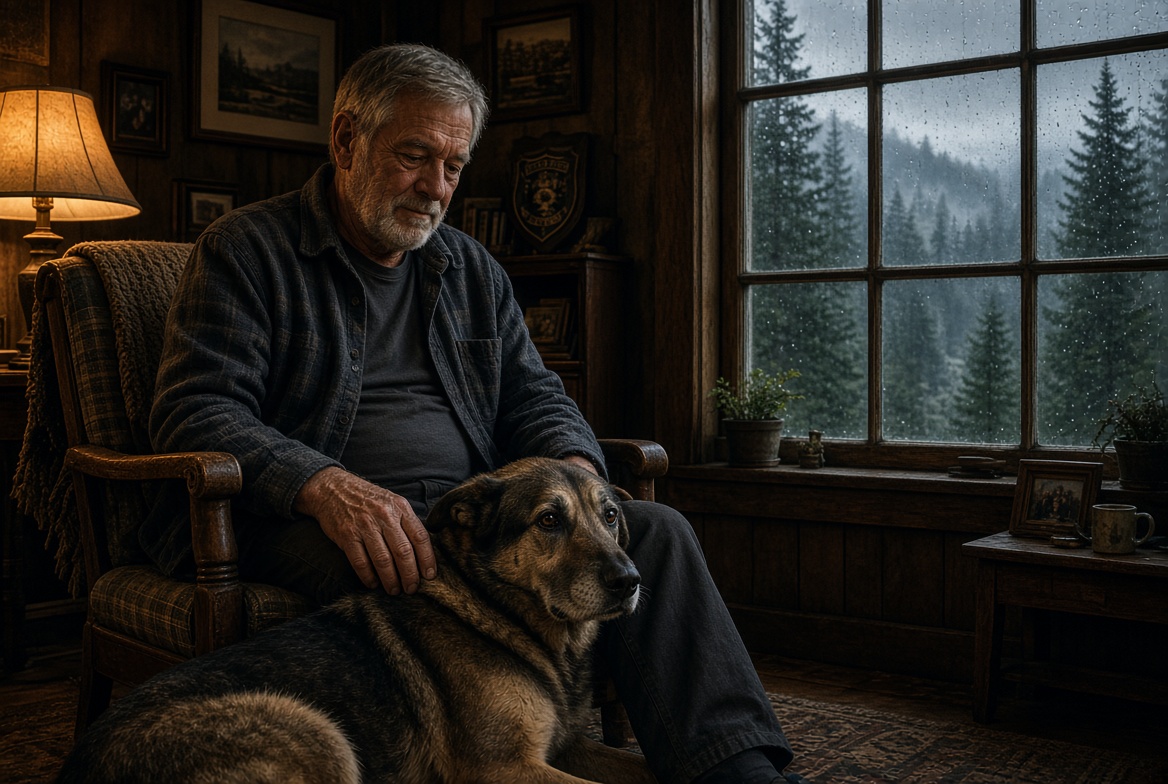
The old German Shepherd turned once on the rug and lowered himself beside Raymond’s left leg.
The same side. The same place Ranger had once been trained to wait for instructions.
Raymond rested a hand gently against the old dog’s shoulder.
No command followed.
There was nowhere Ranger needed to search, no kennel he needed to watch, no other dog depending on him to stay behind.
For the first time in years, Ranger could simply rest.
—
Days later, Nancy sent Raymond a copy of the corrected record.
At the top was the name that had been missing for three years.
Ranger.
The old status beneath it had been removed. No more uncertain location. No rescue alias. No unfinished transfer.
Only two words remained at the end of the file.
Retired home.
Ranger had spent years serving people. Then he had spent three forgotten years quietly watching over dogs who had lost their names just as he had.
And after every other kennel had emptied, after Belle was safe, after there was no one left behind for him to worry about, Ranger finally allowed himself to be the last dog to leave.
Not for another transfer. Not for another temporary place.
This time, Ranger was going home.
—
Ranger’s story reminds us of something simple but easy to forget.
Growing older does not erase the value of a life that has served, loved, and stayed loyal.
Ranger had lost his name, his home, and the future that should have been waiting for him.
Yet even after everything, he still chose to watch over the dogs beside him before thinking of himself.
Sometimes loyalty is not loud.
Sometimes it is an old dog lying beside a kennel, refusing to leave until a friend is safe.
And sometimes the greatest kindness we can offer is simply to remember those the world has stopped noticing.
—









