A Puppy Stole a Scarf — What the Deputy Found Under the Warehouse Changed Everything
Deputy Lucas Harrow was chasing a German Shepherd puppy through two inches of fresh Wyoming snow after it stole a red scarf from a local outfitter.
But the little thief wasn’t trying to escape.
Every few yards, it stopped and looked back to make sure Lucas was still following.
The chase led beyond town, across frozen ground, and toward an abandoned freight warehouse.
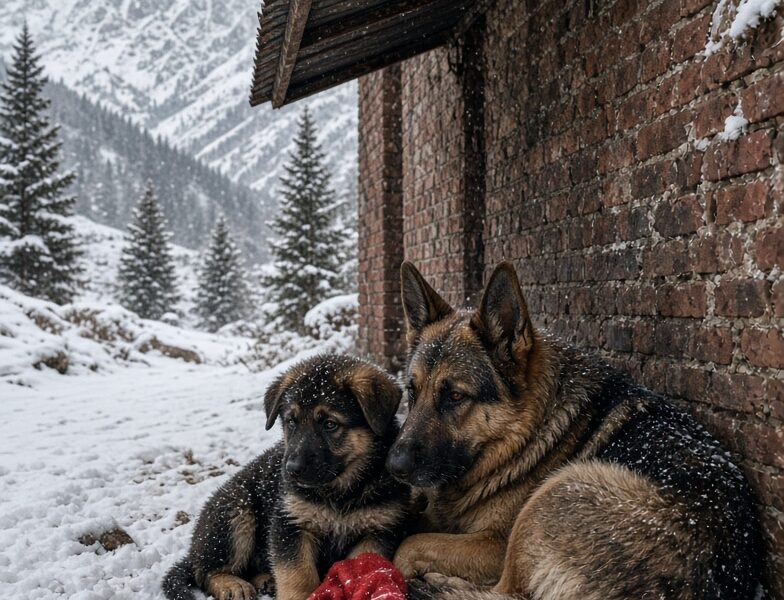
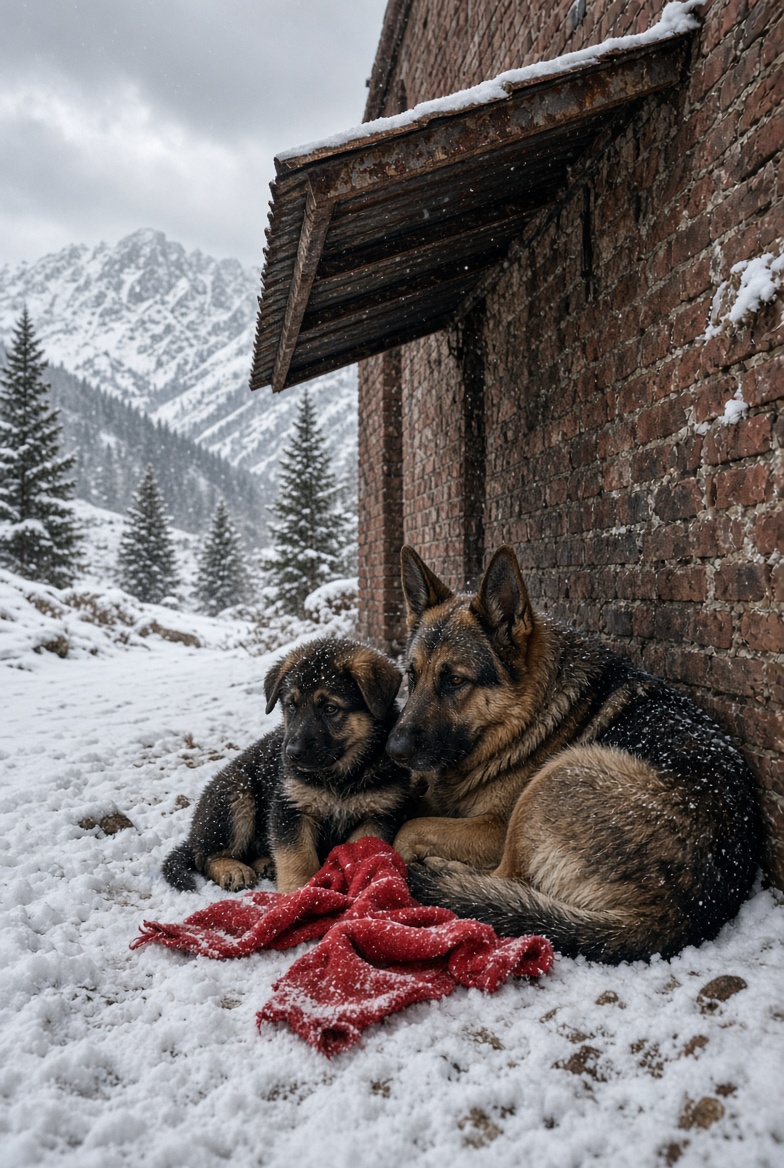
Under the old metal awning, Lucas found a painfully thin German Shepherd mother curled against the cold.
The puppy dropped the stolen scarf beside her and pressed its small body against hers.
Saving them was only the beginning.
Because soon Lucas would face a much harder question about who should care for them next.
By 7:30 that morning, Granite Pass looked as though someone had taken an eraser to half the town.
Snow softened the edges of parked trucks, covered porch steps, and turned the roofs along Main Street into long white slabs beneath a colorless Wyoming sky.
Beyond the last row of buildings, dark pines climbed the lower slopes of the mountains until they disappeared into clouds gathering over the western ridge.
More snow was coming.
Deputy Sheriff Lucas Harrow knew it without needing the weather service to tell him.
At thirty-eight, after more than a decade of patrol work in mountain country, Lucas had learned to read winter in smaller things.
The metallic smell in the air.
The way chimney smoke flattened instead of rising.
The unusual hurry of people carrying groceries from stores to their vehicles.
The forecast said the heavier storm would arrive by late afternoon.
That gave Granite Pass several hours to prepare.
Lucas drove his county patrol SUV slowly through the business district, checking intersections where packed snow had frozen overnight.
He was tall, a little over six feet, with broad shoulders that filled his dark navy patrol jacket without making him look bulky.
His dark brown hair was kept short and neat, though a few strands of gray had begun appearing near his temples.
A day’s worth of stubble sharpened an already angular jaw.
There was weariness around his hazel eyes, but not indifference.
Patrol work had taught him that most trouble did not arrive dramatically.
Often it appeared first as a car parked where it should not be, an elderly resident who had not collected the morning paper, or a set of tire tracks leading somewhere they shouldn’t.
That was why the shouting caught his attention immediately.
“Catch that dog!”
Lucas turned toward the sound.
The front door of Keat’s Outfitters had swung open so hard that the brass bell above it was still rattling.
A German Shepherd puppy burst onto the sidewalk.
For one strange second, Lucas simply stared.
The dog could not have been more than eleven weeks old.
Its black and tan coat still had the soft, slightly oversized look of puppy fur, and its paws seemed too large for the rest of its body.
One ear stood nearly upright, while the other folded forward at the tip.
Clenched between its teeth was a dark red fleece scarf.
The price tag was still attached.
Behind it came Marlene Keats.
At fifty-eight, Marlene had the compact, sturdy build of someone who had spent most of her adult life lifting cartons, stacking firewood, and refusing offers of help.
Salt-and-pepper hair had escaped from the clip at the back of her head, and a pair of tortoiseshell reading glasses bounced against her chest on their cord as she hurried onto the icy sidewalk.
She made it three steps before her boots slipped half an inch.
That was enough to convince her not to make a fourth.
“Harrow,” she called. “That little criminal just robbed me.”
Lucas pulled to the curb.
The puppy reached the corner, stopped, and looked back.
The red scarf dragged between its front legs.
“Apparently, crime is starting younger every year,” Lucas said.
Marlene gave him a look. “I’m serious.”
“So am I.”
Lucas stepped from the SUV, his boots crunching into salt and snow as he glanced toward the puppy again.
It had not disappeared.
It stood perhaps thirty yards away beside a parked pickup, breathing hard, watching them.
“What happened?”
“Back delivery door was open,” Marlene said. “Cal was bringing in boxes. Dog slipped through. Came right past the counter.”
“Hungry?”
“That’s the strange part.”
Marlene pointed through the shop window.
“We’ve got those overpriced dog biscuits right inside the door. Didn’t touch them. Snatched that scarf off the bottom display and ran.”
Lucas looked at the puppy.
“Anybody recognize it?”
“Not me.”
He started toward it.
The puppy immediately moved.
Not toward the street, thankfully, but down the sidewalk, scarf trailing from its mouth.
Lucas increased his pace without running.
Chasing frightened animals usually accomplished one thing—making frightened animals run faster.
“Easy,” he called.
The puppy stopped again.
Lucas stopped, too.
They faced one another across twenty yards of winter sidewalk.
The puppy’s chest moved quickly beneath its coat.
Snow clung to its lower legs.
Up close, or as close as Lucas could currently get, he could see that the animal was thinner than a puppy that age ought to be.
He crouched slightly and held one hand low.
“Come on, buddy.”
The puppy stared.
Then it turned and trotted away.
Lucas followed.
Twenty yards later, it stopped.
Lucas stopped.
The puppy looked back.
This time, Lucas remained still longer.
A delivery truck groaned somewhere behind him.
A shovel scraped against pavement.
Otherwise, the morning seemed to narrow around the small dog and the ridiculous red scarf hanging from its mouth.
Lucas took one step backward.
The puppy did not come toward him.
Instead, it shifted its weight as though impatient.
Lucas frowned.
He stepped forward again.
The puppy immediately turned and continued on.
That changed the feeling of the encounter.
Not dramatically.
Lucas had spent too many years in uniform to invent explanations before evidence earned them.
The dog was not necessarily asking for help.
It was not necessarily leading him anywhere.
But it was doing something more organized than simply fleeing.
It had somewhere it wanted to return to.
Lucas glanced back at Marlene.
“Stay by the store.”
“That’s a forty-two-dollar scarf.”
“I’ll put out an APB.”
“Harrow.”
He almost smiled.
Then he followed the puppy.
The route took them past the final businesses on Main Street and across a municipal parking lot, where untouched snow reached the puppy’s belly.
The little shepherd struggled through the deeper patches, occasionally stepping on the scarf and nearly tumbling over its own front paws.
Still, it refused to drop it.
Beyond the lot stood an old maintenance lane running alongside railroad tracks that had not carried freight in years.
Weed stalks poked through the snow.
A chain-link fence leaned toward the tracks under the weight of ice.
The puppy slipped through an opening beside a gate.
Lucas followed more carefully.
The temperature seemed to fall the moment the buildings were behind him.
Wind came unobstructed across the open tracks and found every gap in his jacket.
Ahead, the puppy no longer paused as often.
That told Lucas more than anything else had.
Whatever uncertainty it had felt among the shops was gone.
It knew this ground.
An abandoned freight warehouse stood farther down the maintenance lane.
Brick walls dark with age.
Loading bays boarded over.
Part of the old metal awning still extended above one side, creating a strip of ground mostly protected from fresh snow.
The puppy vanished beneath it.
Lucas slowed.
His right hand stayed nowhere near his weapon.
Instead, he reached for the small flashlight clipped to his duty belt.
“Hey, little guy.”
A faint movement came from beneath the awning.
Then the puppy appeared again, but it did not come out.
It stood sideways, looking at Lucas, the scarf still in its mouth.
Lucas took another step.
The puppy backed toward the wall.
And that was when he saw the second dog.
At first, she looked like part of the shadows gathered against the brick.
An adult German Shepherd lay curled tightly beneath the awning, her black saddle blending into the darkness behind her.
Her tan legs were drawn close beneath her body.
She raised her head when Lucas approached, but the motion seemed to cost her.
She was painfully thin.
Not injured, as far as Lucas could see.
There was no obvious wound, no blood, nothing suggesting she had been struck by a vehicle.
But her waist had hollowed behind her ribs, and the coat along her belly and sides hung flat over a body that had lost too much weight.
Fine tremors moved through her, even in the relative shelter of the wall.
The puppy hurried to her.
The red scarf fell from its mouth.
For a moment, it pawed at the fleece, stepping over it twice in the awkward, clumsy way puppies handled anything larger than themselves.
Then it caught one edge between its teeth and dragged it several inches until part of the fabric touched the adult dog’s front legs.
The mother lowered her nose and sniffed it.
The puppy circled once and pressed itself against her chest.
Lucas stood very still.
He knew better than to give the scene a meaning it had not earned.
The puppy probably did not understand insulation.
It had not walked into Keat’s Outfitters, assessed its mother’s body temperature, selected appropriate winter gear, and carried out a rescue plan.
Maybe it liked the softness.
Maybe the scarf carried a familiar kind of scent.
Maybe it was simply something the puppy had been able to grab.
But those explanations did nothing to diminish what Lucas could actually observe.
The puppy had found warmth, people, lights, and probably food in town—and it had come back here to her.
The mother watched Lucas with tired amber-brown eyes, her right ear angled slightly outward while the other stood straight.
There was no snarl, no attempt to rise and confront him, only vigilance stretched thin by exhaustion.
Lucas lowered himself slowly into a crouch several yards away.
“Okay,” he murmured. “Nobody’s taking anybody anywhere yet.”
The puppy watched him from against its mother’s body.
Lucas lifted the radio microphone from his shoulder.
“Dispatch, Harrow.”
The reply crackled through immediately.
“Go ahead.”
“I’ve got two dogs at the old freight warehouse off the east maintenance lane. Adult female German Shepherd, severely underweight and cold. Puppy, approximately ten to twelve weeks, no visible traumatic injuries.”
He looked at the mother again.
“Can you get animal control headed this way and contact Sutter Veterinary? Tell them we may need cold exposure evaluation.”
“Copy.”
Lucas released the microphone.
For the next few minutes, he did almost nothing.
That was often the hardest part of police work—understanding when action would make things worse.
He stayed low, giving the mother room to watch him.
The puppy shifted occasionally but never moved farther than a few feet from her.
Behind Lucas came the distant crunch of boots.
He looked over his shoulder.
Marlene was making her way along the maintenance lane.
“Thought I told you to stay at the store.”
“You did.”
In one gloved hand, she still held the torn half of the scarf’s cardboard tag.
Her expression suggested she had prepared several responses during the walk.
Then she saw the adult dog.
Marlene stopped.
The irritation disappeared from her face so quickly that Lucas almost felt embarrassed for having noticed it.
Her eyes moved from the mother’s narrow body to the puppy tucked against her chest, then down to the dark red fleece lying partly beneath them.
For a while, nobody spoke.
The puppy lowered its chin onto the scarf.
Marlene looked at the price tag in her hand.
Then she slowly folded it once and closed her fingers around it.
Whatever she had intended to say about the stolen merchandise, she kept it to herself.
The Wyoming wind moved across the empty tracks outside the awning.
Lucas stayed crouched in the cold, watching two German Shepherds huddled against an old brick wall, and understood that the morning had stopped being about catching anything at all.
The first thing Dr. Naomi Sutter did was ask everyone to stop crowding the dogs.
It was not dramatic advice, but Lucas noticed how quickly the room changed once she gave it.
The back examination area of Granite Pass Veterinary Clinic was warm enough to fog the lower edges of the windows.
Stainless steel cabinets lined one wall, and the air carried the clean, sharp smell of disinfectant beneath something softer.
Laundry detergent.
Dry kibble.
Old wool from the blankets stacked near the kennels.
Willow lay on two folded pads on the floor rather than on the examination table.
Scout was beside her.
Naomi had decided not to separate them unless she had to.
At forty-seven, Naomi Sutter had the calm economy of movement that came from years of treating animals that could not explain where they hurt.
She wore sage-green scrubs beneath an open white coat, her dark hair tied low at the back of her neck.
A small silver leaf clip kept one loose strand away from her face as she worked.
She did not speak to Willow in the exaggerated, sugary tone people sometimes used with frightened dogs.
She simply let Willow smell the back of her hand, waited, and began.
Lucas remained near the doorway.
He had already given dispatch the location where the dogs had been found, and animal control had been notified.
His part officially was becoming smaller.
He was comfortable with that.
Police work had taught him there were moments when the most useful thing an officer could do was recognize that someone else knew more.
Naomi listened to Willow’s heart, checked her gums, felt carefully along her ribs and abdomen, examined her paws, then stepped back.
“She’s thin,” Lucas said.
“Very starved,” Naomi looked at him before answering. “Undernourished.”
“That’s not the same conclusion.”
She ran both hands lightly along Willow’s flank again.
The dog’s ribs showed more clearly beneath the dried fur now that the snow had melted away.
Her waist narrowed sharply behind them.
To someone seeing her for ten seconds, the judgment would have been easy.
Neglected.
Abandoned.
Maybe worse.
Naomi was slower with judgment.
“Her mammary tissue tells me she’s nursed recently,” she said. “And not one puppy for a day or two. She carried a litter and fed them for a while.”
Lucas looked toward Scout.
The puppy had discovered the corner of a towel and was chewing it with solemn concentration.
“So this could be from nursing.”
“Partly. Pregnancy takes weight. Nursing takes more. Add days outside, cold weather, inconsistent food and water.”
Naomi gave a small shake of her head.
“A healthy dog can go downhill fast.”
“Any sign somebody hurt her?”
“Not that I found.”
Naomi checked Willow’s legs once more.
“No fractures. No old untreated wounds that concern me. Paw pads are worn, but that fits prolonged travel. She’s dehydrated, mildly hypothermic, exhausted.”
She looked at the shepherd’s face.
“But she’s not shutting down.”
That mattered.
Lucas had not realized how much he wanted to hear it until she said it.
Scout received his own examination next.
He protested having his temperature taken with considerably more enthusiasm than Willow had shown toward anything all morning, then attempted to climb into Naomi’s lap immediately afterward as though no offense had occurred.
“He’s in better shape,” Naomi said. “Because he’s younger, partly, and because somebody was probably giving up calories for him.”
Her glance settled on Willow.
Lucas did not need the rest explained.
A sound came from the front lobby.
The bell over the clinic door jingled once, followed by a familiar voice saying something to the receptionist.
A minute later, Marlene Keats appeared carrying a paper shopping bag.
Lucas stared at it.
“You come to collect evidence?”
“I came for my money.”
She said it firmly enough that for half a second he believed her.
Then she opened the bag.
Inside were two folded fleece blankets from Keat’s Outfitters, both plainly used.
One was gray.
The other was dark green.
Lucas looked at her.
Marlene set them on a chair.
“They’re old display stock.”
“They look brand new.”
“They’re old enough.”
“You still have tags on them.”
“Manufacturing error.”
Lucas raised an eyebrow.
Marlene ignored him.
She glanced toward Scout, who had abandoned Naomi’s shoelace and returned to Willow.
“And the red scarf?” Lucas asked.
Marlene took the damaged cardboard tag from her coat pocket, tore it in half, and dropped it into a trash bin.
“Defective merchandise.”
There was no softness in her voice.
That was probably why the gesture worked.
Naomi smiled without looking up from Scout’s chart.
“Put the blankets over there. We’ll use them once they’re dry.”
Marlene did so, then stood awkwardly for another moment, as if irritated with herself for still being in the room.
Scout noticed the pile.
He waddled over, grabbed one corner of the green fleece, and began backing away with it.
The blanket was much too large.
His paws slipped.
He backed up again.
The fabric moved perhaps three inches.
Marlene watched.
“Persistent little thief.”
This time there was no anger in it.
Scout changed his grip and pulled again.
Slowly, clumsily, he managed to drag one corner close enough that it reached the edge of Willow’s bedding.
Then he lost interest completely, stepped onto the fleece, turned around twice, and sat down against his mother’s foreleg.
Naomi crouched beside him.
“People are going to want to turn that into something mystical,” she said.
Lucas leaned against the wall.
“You don’t?”
“I think he’s eleven weeks old,” she scratched lightly beneath Scout’s chin. “And I think he’s had a bad ten days.”
The number caught Lucas.
Ten.
Estimate.
Could be less.
Could be more.
His hydration, weight loss, paw wear.
Naomi shrugged.
“Nothing exact. But they weren’t outside for one night.”
Scout got up to drink.
He took several mouthfuls from the shallow bowl, stopped, and returned to Willow.
Only after pressing his shoulder briefly against hers did he wander back to finish.
Naomi watched without romanticizing it.
“After enough instability,” she said, “proximity becomes safety.”
Lucas glanced at Willow.
“So he stays close.”
“He checks that she’s still there.”
There was something uncomfortably recognizable in that.
Not because Lucas thought like a dog, but because policing had shown him the human version often enough.
People who had lived through uncertainty developed habits long after immediate danger passed.
They checked locks twice.
Sat near exits.
Kept their phone volume high at night.
Safety became something that had to be verified, not assumed.
The clinic door opened again.
This time, the woman who entered did not carry anything sentimental.
Nora Bellamy, fifty-two, came in with a metal clipboard under one arm and a cobalt-blue slip lead looped neatly through her belt.
Her short steel-gray hair was damp from the snow.
A county animal control patch showed beneath her dark field jacket.
Nora greeted Lucas with a nod.
“What have we got?”
“Female shepherd and male puppy. No tags on either collar. Found together at the old freight warehouse.”
“Together?”
“Very.”
Nora set down the clipboard and approached Willow carefully.
Unlike Naomi, she was not there primarily to heal the dogs.
Her job lived in the awkward space between animals, people, ownership records, municipal codes, shelters, and all the things good intentions did not automatically solve.
She inspected the forest-green collar around Willow’s neck.
“No external ID.”
“Naomi hasn’t scanned yet,” Lucas said.
“I was waiting for you,” Naomi replied.
Nora took a handheld microchip reader from her case.
It beeped almost immediately over Willow’s shoulders.
For the first time that morning, everyone stopped what they were doing.
Nora ran it again.
Same result.
“Well,” she said. “Somebody registered you.”
Lucas felt the direction of the morning shift.
Not because a microchip guaranteed anything.
Chips were not GPS trackers.
Records went stale.
Owners moved.
Phone numbers changed.
But a name was more than they’d had fifteen seconds earlier.
Nora entered the number into the registry portal on the clinic computer.
The record came back under Silas Broom.
Age was not listed, but the address was a rural property less than ten miles from Granite Pass.
There was also a phone number.
Nora called it.
A recorded message answered.
The number was no longer in service.
“How current’s the registration?” Lucas asked.
“Last updated about five years ago.”
“Could be old ownership.”
“Could be.”
Nora did not fill uncertainty with theories.
She copied the information to her clipboard and asked dispatch to check the address through county records.
Then she began calling nearby shelters.
The first had nothing.
The second had nothing.
The third call took longer.
Nora gave the dog’s description.
Then Scout’s.
“Black and tan German Shepherd female, roughly five years. Male puppy, approximately eleven weeks.”
The woman on the other end asked her to wait.
Nora turned slightly away from the room.
Lucas heard keyboard tapping through the receiver.
Then Nora’s expression changed.
Not dramatically.
Her pen simply stopped moving.
“When was that filed?”
She listened.
“Name of reporting party.”
Another pause.
“Spell the last name.”
Lucas straightened.
Nora wrote it down.
“Gideon Rusk. Sixty-four years old, according to the report. Owner of a small farm south of the county line.”
The missing animal notice had been filed almost ten days earlier.
Nora asked for the complete descriptions.
The female’s name was Willow.
Green collar.
Five years old.
Black saddle.
Tan legs.
Right ear angled slightly outward.
Lucas looked at the dog lying beside Naomi.
Exact.
Then came the puppy.
Scout.
Male.
Around eleven weeks.
Rust-orange collar.
One ear not fully upright.
Marlene slowly lowered herself into the chair beside the wall.
“They have names,” she said.
Nobody answered immediately.
It was an oddly simple sentence, but until then, Willow and Scout had existed in the room mostly as conditions to be managed.
Cold dog.
Thin dog.
Puppy.
Microchip.
Hydration.
Names changed nothing medically.
They changed almost everything emotionally.
Nora continued reading.
The animals had disappeared from Gideon Rusk’s property before a major snow event.
A search had been conducted around the farm and nearby roads.
Local shelter notified.
County sheriff’s office notified.
Different county.
Different database.
Then roads closed.
Weather interrupted ground searches.
The notice had never crossed cleanly into Granite Pass.
Lucas looked at Willow again.
He thought about the warehouse, the empty maintenance lane, the puppy emerging from Marlene’s store with the red fleece in its mouth.
He had assumed nothing about who had put them there.
Other people would have.
Some already had.
A dog that thin invited an accusation.
A puppy wandering town invited another.
But someone had reported them missing.
Someone had searched.
Nora ended the call and tapped the pen against her clipboard.
“So,” she said. “We’re not looking at two dogs nobody wanted.”
Lucas folded his arms loosely.
“We’re looking at two dogs nobody could find.”
Naomi glanced toward Scout.
The puppy was asleep now.
Not deeply.
Every time Willow shifted, one of his ears moved.
Nora made another notation.
“I’ll verify Rusk before we release anything. And Broom is still on the chip, so ownership history has to be sorted out.”
Lucas nodded.
No shortcuts.
No sentimental handoff in the clinic lobby.
Names were not proof of present ownership, and a missing report did not explain how Willow and Scout had traveled from one county into another.
But the central assumption of the morning had already fallen apart.
They had not simply been discarded.
Outside, snow began brushing lightly against the clinic windows again.
Scout woke, lifted his head, and looked toward Willow.
She was still there.
He lowered his chin back onto the blanket.
For now, that seemed to be enough.
By noon, the sky over southern Granite County had lowered another shade.
Lucas Harrow drove with both hands loose on the wheel, following Nora Bellamy’s animal control truck along a two-lane county road bordered by wind-carved snowbanks.
The mountains were still visible in the distance, but their upper slopes had begun disappearing behind the next weather front.
The address from the missing animal report led them away from town, past a feed store, a closed seasonal campground, and several miles of ranch land broken by cottonwoods and wire fencing.
Gideon Rusk’s property sat at the end of a plowed gravel lane.
Lucas noticed the details before he noticed the man.
The fencing was old but patched carefully.
A stack of square hay bales had been covered with a tarp and weighted at every corner.
Two water troughs had heating cables wrapped around their bases.
The barn doors were weathered but hung straight.
Beside the main building stood a smaller enclosed structure with fresh straw visible through the open half-door.
It did not look like a place where animals had been forgotten.
A man was repairing a hinge near the barn when Nora parked.
He straightened slowly.
Gideon Rusk was sixty-four, broad through the shoulders and still large enough to suggest the stronger man he had once been.
Age had softened him around the middle and slowed the way he moved.
A short gray beard covered his jaw, and his cheeks were red from the cold above the collar of a brown canvas barn coat.
A dented stainless steel thermos sat on a fence post beside him.
His eyes went first to Nora’s county patch, then to Lucas’s uniform.
The wrench in his hand stopped turning.
“You found something?”
Nora did not make him wait.
“We found Willow and Scout.”
For a moment, Gideon remained standing.
Lucas had seen people receive difficult news in dozens of ways.
Some asked questions before reacting.
Some became loud.
Some seemed to stop hearing entirely.
Gideon simply sat down.
There was a low wooden step outside the barn.
He lowered himself onto it as though his knees had suddenly decided they were finished holding him.
“Alive? Both alive?”
Nora said, “Both alive.”
Gideon closed his eyes.
His gloved hands came together between his knees.
“Both? Both?”
He nodded once, then again.
The second nod seemed to be for himself.
Lucas watched the man’s shoulders move under the heavy coat as he took a breath and let it out carefully.
“Scout was mildly dehydrated and underweight,” Nora explained. “Willow’s condition was more serious, but the veterinarian expects her to recover.”
Gideon stared at the snow between his boots.
“How bad is she?”
“Thin, cold when she was found, exhausted.”
His jaw tightened.
“I fed that dog twice a day.”
Nora’s voice remained even.
“The vet isn’t saying otherwise.”
Gideon looked up sharply.
“I want that clear.”
“It is.”
That seemed to matter more than Lucas expected.
Not because Gideon was worried about being accused.
Because he needed someone to know that Willow had not looked like that when she disappeared.
He stood again, slower this time.
“Come inside.”
The farmhouse kitchen was warm from a wood stove installed near the back wall.
An old coffee maker hissed on the counter.
The room had the functional disorder of one person living alone.
One plate drying beside the sink.
Unopened mail stacked beneath a salt shaker.
Work gloves resting where most people would have kept fruit.
A framed photograph of a woman in her late fifties stood beside the window.
Gideon noticed Lucas looking at it.
“My wife. Ellen.”
He did not add that she had died.
He did not need to.
The photograph, the single coffee cup, and the second chair pushed permanently beneath the table said enough.
Gideon poured three cups without asking whether anyone wanted one.
Then he sat.
“Silas brought Willow here in September,” he began. “Known him about twenty-five years. We both worked county roads, different crews.”
Lucas took out a small notebook but did not immediately write.
“Why couldn’t he keep her?”
“Couldn’t keep himself up there anymore.”
Gideon pointed north with his coffee cup.
“House sits near the old maintenance route. Good place when you’re fifty. Different place when you’re seventy-one and your hip quits cooperating.”
Silas Broom had moved into senior housing in the valley.
The apartment complex allowed only small pets, but Gideon said that was almost beside the point.
Silas couldn’t walk her safely anymore.
Ice got bad last winter.
He fell twice.
Second time, Willow stood over him until the mail carrier came.
Lucas finally made a note.
“So he asked you.”
“He didn’t want a shelter.”
Gideon rubbed one thumb against a crack in the coffee mug.
“He wanted somebody he knew.”
Willow had arrived healthy.
A little unsettled, Gideon admitted, but healthy.
Several weeks later, her increasing appetite and changing shape made him suspicious.
His veterinarian confirmed she was pregnant.
“Silas had no idea,” Gideon said. “Neither did I.”
Willow delivered without complications.
There had been five puppies.
Gideon showed them photographs on his phone rather than describing them.
Willow stretched along a bed of clean straw.
Five dark, clumsy shapes pressed against her belly.
Another photograph taken weeks later showed a puppy stumbling through a patch of autumn grass.
Scout was easy to identify even then.
One ear trying to rise, the other refusing.
“Four went to people I know,” Gideon said. “Good homes. I didn’t advertise them online. Didn’t want strangers showing up with cash.”
“And Scout?”
“Smallest at first. Then I got attached.”
A reluctant smile crossed his face.
“He also chewed the laces off three pairs of my boots.”
Lucas looked down at Gideon’s current boots.
No laces.
“Learn something.”
It was the first light moment since they arrived.
It lasted only seconds.
Gideon set down his mug.
Ten days earlier, the weather service had issued a warning for heavy snow and strong winds.
Gideon had decided to move Willow and Scout from a sheltered outdoor run into an enclosed winter room attached to the barn.
He showed Lucas and Nora the route.
It was less than fifty feet.
The side gate stood between the run and the barn.
“I’d replaced the latch last spring,” Gideon said. “Thought it was fine.”
He demonstrated.
The metal latch dropped into place, but unless pushed completely down, it appeared closed while remaining barely engaged.
That morning, Gideon had gone ahead carrying a bag of bedding.
A gust struck the gate.
It opened.
Scout ran first.
Not far.
Willow followed.
Gideon expected both to circle back.
Instead, a feed truck came along the county road at almost the same time.
The noise startled Scout.
The puppy ran toward a stand of cottonwoods.
Willow went after him.
“By the time I got to the road, they were gone.”
Gideon said the words without dramatizing them.
That made them heavier.
He had searched immediately, first on foot, then in his pickup.
He called neighbors before noon.
Reported both dogs missing to the county sheriff.
Notified the shelter.
Drove the surrounding roads until after dark.
The next morning, he found tracks.
Adult shepherd prints.
And smaller ones beside them.
He followed until snow began falling again.
The second storm erased everything.
For the next week, Gideon continued driving.
He showed Lucas a folded county road map lying on the kitchen counter.
Red pen marked the roads he had checked.
Some had been crossed out twice.
Others three times.
Fuel receipts were clipped beside it.
Lucas stopped writing.
He had seen search maps prepared by deputies, volunteers, emergency teams.
This one had been made by an old rancher at his kitchen table.
There were no grids.
No official notation.
Just red lines spreading outward from one small farm.
Gideon placed one finger on the center.
“I told Silas I’d keep her safe.”
The room went quiet.
There it was.
Not the gate.
Not the money spent on fuel.
Not even the ten days of searching.
The promise.
“When he left her here,” Gideon continued, “he stood right outside that barn for twenty minutes because Willow kept looking at his truck.”
His voice lowered.
“I told him to go. Told him she was fine. Told him I’d look after her.”
He stared at the map.
“Then I lost her.”
Lucas had learned that guilt was rarely interested in proportion.
A missed latch could become a moral failure.
A wrong turn could become a lifetime sentence if somebody carried it long enough.
“You reported it,” Lucas said. “You searched. You didn’t lose her. She’s found.”
Gideon nodded, but the answer had not yet reached the part of him that needed it.
Nora shifted the conversation gently toward facts.
“Do you know why Willow might have traveled north?”
Gideon looked at her.
Then he stood.
“Actually, yeah.”
He brought the road map closer.
“Silas used to take her everywhere.”
He traced an older service road from the farm toward Granite Pass.
“When he still worked part-time for the county, Willow rode with him whenever he wasn’t running equipment. His old places are up here.”
The route did not go directly through Granite Pass, but several old maintenance roads, ranch tracks, and drainage paths connected the areas.
Lucas studied the distances.
The farm and the warehouse were separated by considerably more road mileage than straight-line distance, but not impossibly so over ten days.
Especially for an adult German Shepherd.
“She could have tried for Silas’s old house,” Lucas said.
“That’s what I’m thinking.”
“And Scout followed her.”
“He follows Willow everywhere.”
The storms could explain the rest.
A familiar direction at first.
Then snow covering scents and landmarks.
Closed roads.
Wind.
The gradual drift toward buildings, food smells, and human activity near Granite Pass.
Nothing supernatural.
Nothing precise enough to prove.
But plausible.
Lucas preferred plausible to miraculous.
Before leaving, Nora explained that Willow’s microchip was still registered to Silas, while Gideon had the recent missing report and evidence that he had been caring for her.
Ownership would need to be clarified before either dog could simply be released.
Gideon accepted that without argument.
Then he looked through the kitchen window toward the winter enclosure.
“I want them back.”
The statement came quickly.
The silence after it did not.
Outside, one section of fence leaned slightly beneath packed snow.
Near the barn, the side gate had been tied shut with an additional length of chain.
Lucas noticed several fresh boards stacked under the eaves, waiting to replace older sections before spring.
Gideon noticed Lucas noticing.
His face changed.
Not embarrassment.
Something more difficult.
He took a long breath.
“I’d been telling myself for ten days that if I found them, everything would go back the way it was.”
Neither Lucas nor Nora interrupted.
Gideon looked around the kitchen, then toward the barn beyond the window.
“Ellen used to handle half this place.”
For the first time, he said his wife’s name in a way that made her absence part of the conversation.
“Since she died, I keep cutting back. Fewer animals. Less acreage. Then something needs fixing, and I tell myself I’ll get to it tomorrow.”
He rubbed a hand over his beard.
“I’m still capable.”
Nora nodded.
“Nobody said you weren’t.”
“That’s not the same as saying I’m keeping up.”
It was a distinction Lucas suspected had taken Gideon much longer than ten days to admit.
The older man folded the road map along its worn creases.
“I want to see Willow and Scout.”
“You will,” Nora said. “But before I sign anything or take them anywhere—”
Gideon looked at Lucas.
“I need to talk to Silas.”
Lucas closed his notebook.
Outside, fine snow had started falling across the barnyard.
Gideon remained beside the kitchen window, watching it settle over the gate he had already repaired twice.
For ten days, he had believed the hardest thing would be finding the dogs.
Now that they had been found, he was beginning to understand that finding them did not automatically answer what should happen next.
Cedar Hollow Senior Apartments sat lower in the valley, where winter arrived with less violence than it did in the mountains but stayed longer in the shaded corners.
The building was three stories of pale brick wrapped around a courtyard that had been shoveled into careful paths.
Small piles of snow bordered the sidewalks.
Someone had scattered blue ice melt across the entrance, and a row of wooden benches had been moved beneath the overhang until spring.
Lucas Harrow arrived shortly after two in the afternoon.
Nora had already confirmed through county records that Silas Broom still lived there.
The microchip registration was old, but the address trail was enough to connect Willow’s previous home, Gideon’s account, and the man whose name had remained attached to her for five years.
Lucas had expected to find Silas in an apartment.
Instead, he found him in the maintenance room beside the lobby, tightening a loose screw on the handle of a snow shovel.
“Mr. Broom?”
The older man looked up.
Silas was seventy-one and still carried traces of the worker he had been.
He was not especially tall, but years of physical labor remained in the width of his hands and the solid set of his shoulders beneath a charcoal cardigan.
His white hair was combed straight back, and a short silver mustache followed the line of his upper lip.
A wooden cane rested against the wall within easy reach.
He looked at Lucas’s uniform, then at the badge.
“Depends who’s asking.”
“Deputy Lucas Harrow, Granite County Sheriff’s Office.”
Silas set the screwdriver down.
Something changed behind his pale blue eyes.
“Is this about Gideon?”
“In a way.”
Silas did not ask Lucas to continue.
He simply reached for the cane.
“Let’s go upstairs.”
His apartment was small but orderly.
A pair of boots sat on a rubber mat near the door.
A coffee mug rested beside an old weather radio on the kitchen counter.
Above the couch hung a framed photograph of a county snowplow cutting through a wall of white higher than its hood.
On another wall were photographs of mountain roads in different seasons.
Lucas recognized the old maintenance route from Gideon’s map.
Silas noticed.
“Spent thirty-two years clearing those.”
“You drove plows?”
“Plows. Graders. Whatever the county could start in January.”
He lowered himself carefully into an armchair.
The movement was controlled, but Lucas saw the stiffness in his left hip and the way Silas kept one hand on the chair until he was fully settled.
Lucas took the chair opposite him.
“I found Willow.”
For several seconds, Silas made no sound.
His hand remained closed around the curved handle of his cane.
Lucas had learned not to rush silence simply because it made a room uncomfortable.
Finally, Silas looked up.
“Alive?”
“Yes.”
The grip on the cane loosened.
“How bad?”
“She was cold and underweight, dehydrated, but the veterinarian expects her to recover.”
Silas nodded slowly, his eyes dropping to the floor.
Then he asked, “Scout still with her?”
Lucas had expected a different question.
Not “When can I see her?”
Not “When can I take her home?”
Not “Who has her instead?”
“Scout’s with her,” Lucas said. “Same room most of the time.”
Silas leaned back.
A long breath left him.
“Good.”
That single word seemed to remove more weight from him than the news about Willow herself.
Lucas studied him.
“You knew the puppy well.”
“Never met him.”
That surprised Lucas again.
“When she had the litter. He called me when he found out she was pregnant.”
“So why ask about Scout first?”
Silas looked toward the window.
“Because Gideon said he was the last one still with her. And because if Willow ran with a puppy—”
He paused.
“She would have spent every mile worrying about him before herself.”
Lucas thought of the warehouse.
Willow curled tightly against the brick.
Scout tucked against her chest.
Naomi’s assessment that the adult dog had probably spent more energy than she could afford nursing and protecting a young dog through bad weather.
Silas had never seen any of it.
Yet he had known exactly where Willow’s attention would have been.
“How long was she yours?” Lucas asked.
“Five years.”
“Working dog?”
Silas almost smiled.
“No.”
“Service dog?”
“No.”
He shook his head.
“She was a dog.”
The answer came without apology.
“That’s all.”
For some reason, Lucas liked it.
Silas pointed toward a photograph on a low shelf.
Lucas picked it up.
Willow sat beside an older pickup truck, healthier and heavier than she was now, her right ear still angled slightly outward.
Behind her stood Silas, several years younger, wearing a county road jacket and holding a thermos.
A woman with short blond-gray hair stood beside him.
“My wife, Diane,” Silas said.
Lucas replaced the photograph carefully.
“She died six years ago. Willow came along about a year later.”
He did not say Willow had saved him.
He did not say the dog had understood his grief.
Silas spoke instead about ordinary things.
Willow slept by the mudroom door.
She hated the vacuum cleaner.
She knew the sound of his pickup before it reached the driveway.
On winter mornings, she would stand beside his boots while he tied them, already certain she was going somewhere.
Most days she wasn’t.
Silas said that didn’t stop her from asking.
His mouth lifted briefly.
When Silas stopped working full-time, Willow became part of his routine.
Grocery runs.
Trips to the hardware store.
Drives along county roads to check on old co-workers during storms.
Silas had lived alone in the mountain house and liked it that way until the house began demanding more from him than he could give.
The first fall on ice had bruised his hip.
The second had put him in the emergency room.
“The doctor said I was lucky.”
Silas looked at his cane.
“I hate when doctors say that. Usually means you’re supposed to stop doing something you enjoy.”
Lucas said nothing.
“Last winter I went down by the mailbox,” Silas continued. “Couldn’t get my feet under me. Willow stood there barking at every vehicle until the mail carrier stopped.”
“How long were you down?”
“Twenty minutes. Maybe thirty.”
“And after that?”
“After that, I started lying to myself more carefully.”
Lucas looked at him.
Silas gave a dry smile.
“Told myself I’d get better boots. Told myself I’d salt farther down the drive. Told myself I could still manage a ninety-pound dog on ice because I’d always managed her before.”
There was no self-pity in the words, only hindsight.
When Cedar Hollow offered him an apartment, Silas resisted for months.
Then his hip worsened.
His knees began failing him on stairs.
A winter utility outage left his mountain road inaccessible for almost two days.
Eventually, he agreed to move.
The apartments allowed pets but only animals under thirty pounds.
Lucas expected bitterness.
Silas shrugged.
“Everybody likes blaming rules. Truth is, even if they’d made an exception, I couldn’t have given Willow what she needed.”
He tapped the cane against the carpet.
“She needs miles. A yard. Somebody steady on their feet.”
So he had called Gideon.
A man he trusted.
A man with land.
A man who understood large dogs and winter.
“He didn’t take her because I stopped loving her,” Silas said.
“I know. I need you to understand that.”
“I do.”
Silas nodded, satisfied.
Then his gaze shifted to the photograph again.
“When I took her out there, I brought her bed. Food bowl. One of my old fleece scarves.”
Lucas looked up.
“What color?”
Silas glanced at him, puzzled by the question.
“Red.”
Lucas did not immediately respond.
“Dark red?”
“Yeah.”
Something in Lucas’s face must have changed, because Silas leaned forward.
“Why?”
Lucas thought of Keat’s Outfitters.
Scout charging through the front door with a forty-two-dollar scarf hanging from his mouth.
The dark red fleece dragged through snow.
Lucas chose his words carefully.
“Scout took a scarf from a store the morning we found them.”
Silas’s eyebrows lifted.
“Stole it?”
“Marlene Keats would use that terminology.”
Despite everything, Silas laughed.
It was a small, rough sound.
“What kind?”
“Fleece.”
Lucas paused.
“Dark red.”
The laughter disappeared.
Silas looked toward the floor.
Lucas could almost see the temptation forming—the human urge to connect two details and turn coincidence into certainty.
He stopped it before either of them could.
“I’m not saying he was looking for your scarf.”
“No. He’d never met you.”
“No. And puppies carry things.”
“I know.”
Silas remained quiet.
After a moment, he said, “Still.”
Lucas nodded.
“Still.”
Sometimes facts did not need to become proof to carry meaning.
Silas rubbed his thumb slowly over the handle of his cane.
“I left that scarf because Willow slept on it at my house. Figured the smell might help while she got used to Gideon’s place.”
He swallowed once.
“Funny what you think will make leaving easier.”
Lucas understood then that the scarf was not really about Scout.
It was about a seventy-one-year-old man who had tried to leave part of home behind for a dog he could not take with him.
They sat quietly for a while.
Then Lucas brought the conversation back to the reason he had come.
“Gideon wants to see them.”
“He should.”
“He also wants to talk to you.”
Silas looked up.
“Why?”
Lucas considered how much of Gideon’s conversation belonged to Gideon.
“He told us he’s been struggling to keep up with the farm since Ellen died.”
Silas’s expression tightened.
“I knew Ellen.”
“He wants Willow and Scout back, but he’s not sure wanting them back is the same as being ready to take them back.”
Silas leaned deeper into the chair.
That took longer for him to answer.
Lucas eventually asked, “If Gideon decides he can’t keep them, what do you want?”
Silas looked at his hands.
The hands were thick-knuckled and scarred, with a pale crescent on one thumb and calluses that had outlived the machines that made them.
For more than thirty years, those hands had guided plows through roads buried beneath snow.
They had opened routes to schools, farms, stranded cars, houses where people were waiting for medicine or heat or family.
They had been useful hands.
Now one rested on a cane.
“I miss her every day,” Silas said.
His voice was quieter than before.
Lucas waited.
Silas looked toward Willow’s photograph.
“But missing a dog doesn’t mean I’m still the best place for her to live.”
The sentence settled between them without drama.
Lucas had spent much of his career returning things.
Stolen property.
Lost wallets.
Runaway animals.
People who had wandered away from nursing homes.
There was comfort in the idea that finding something meant putting it back where it had been.
But people changed.
Homes changed.
Bodies changed.
Sometimes returning something to its old place was not restoration.
Sometimes it was refusing to admit that time had moved.
“If she can’t go back to Gideon,” Silas continued, “find her somewhere she can move. Somewhere she isn’t waiting twelve hours for an old man to feel steady enough to take her outside. And Scout—”
Silas frowned slightly.
“I don’t know what’s best long-term. I’m not pretending I do.”
That answer sounded more responsible than certainty would have.
“But don’t split them up tomorrow.”
Lucas nodded.
“Naomi’s watching the puppy’s behavior. Nobody’s making a decision today.”
“Good.”
Silas leaned forward again.
“He’s been outside ten days with her. She’s been keeping track of him. He’s been keeping track of her. Give them time to learn they’re safe before somebody decides they ought to start over separately.”
There was nothing sentimental in his reasoning.
Only patience.
“I can pass that along,” Lucas said.
“That’s all I’m asking.”
Lucas stood.
Silas pushed himself upright as well, ignoring the hand Lucas nearly offered before Lucas wisely lowered it again.
At the apartment door, Silas paused.
“When can I see her?”
It was finally the question Lucas had expected at the beginning.
“Soon. Once Naomi’s comfortable with visitors and Nora has the paperwork straight.”
Silas nodded.
Then, almost as an afterthought, “Tell Gideon I don’t blame him.”
Lucas looked back.
Silas’s hand rested on the doorframe.
“He’ll blame himself anyway,” Silas said. “That’s Gideon.”
“You know him pretty well.”
“Twenty-five years.”
Silas looked toward the snowy courtyard.
“Tell him I’d rather talk before either of us decides what’s best for a dog without asking whether we’re still capable of giving it.”
Lucas stepped into the hallway.
Behind him, Silas remained in the doorway for another few seconds.
The old man had spent most of his life clearing roads so other people could get where they needed to go.
Now he was facing a different kind of road entirely.
One where loving Willow did not mean bringing her backward.
It meant helping decide where she could safely go next.
And for the first time since Lucas had found the German Shepherds beneath the warehouse awning, the question was no longer who they belonged to.
It was where they belonged now.
The paperwork took longer than the decision.
Gideon Rusk sat at the end of the examination room table with his reading glasses low on his nose, studying each page Nora Bellamy placed in front of him, as though the right sentence might somehow change what he had already decided.
Willow was resting in the recovery room beyond the glass door.
Scout was asleep beside her.
Nora had spent the previous afternoon untangling the ownership history.
Silas Broom was still listed on Willow’s microchip, but he confirmed in writing that he had transferred permanent care of her to Gideon months earlier.
Gideon provided veterinary receipts, food records, and the missing dog report filed in his name.
Once that history was documented, there was no dispute.
The choice belonged to Gideon.
That did not make it easier.
“You understand this is voluntary,” Nora said.
Gideon nodded.
“And once the rescue accepts custody, future placement decisions won’t be yours.”
Another nod.
His pen remained on the table.
Lucas stood near the window rather than beside him.
He had stopped by during patrol, mostly because Gideon had asked if he could be there.
There was nothing police-related left to decide.
This was not enforcement.
It was a man giving up responsibility before responsibility became neglect.
Gideon looked through the glass.
“Sixty-four doesn’t sound old until winter starts handing you a list.”
Nora waited.
“Two horses. Seven cattle. Fence on the west side needs replacing. Tractor starter acts up below ten degrees.”
He rubbed his thumb along the edge of the document.
“Ellen used to notice the things I forgot.”
No one tried to make the sentence easier for him.
Gideon had already begun reducing the farm after his wife’s death.
He had sold part of the acreage.
Cut the herd.
Hired someone to plow the long driveway after heavy snow.
But Willow and Scout disappearing had forced him to see something he had avoided.
The farm was not failing.
He was simply managing it with less margin for error.
One gate not latched correctly had been enough.
“I could bring them back,” Gideon said.
Lucas looked at him.
“I know.”
“I could fix the fence.”
“You probably could.”
Gideon gave him a tired look.
“You’re not helping.”
“I’m not supposed to.”
That drew the smallest smile.
Gideon picked up the pen.
“I promised Silas I’d look after Willow.”
Lucas remembered what Silas had said at Cedar Hollow.
Missing her did not mean being the best place for her.
Gideon seemed to have reached the same truth by a harder road.
He signed.
The scratch of the pen across the paper was remarkably ordinary.
No music.
No ceremony.
Just a name.
Nora collected the pages and placed them in her metal clipboard.
“I’ll make sure you get updates during the transition.”
Gideon swallowed.
“Don’t send me the sad ones.”
Nora looked at him.
“What do you mean?”
“If Scout chews somebody’s shoe, I want that picture.”
This time, Lucas smiled.
“So only evidence of criminal activity.”
“Exactly.”
By that afternoon, Tessa Vaughn had taken over the placement problem.
Tessa coordinated foster homes for a regional rescue serving several small Wyoming communities.
At forty-five, she had the kind of energy that made sitting still look temporary.
Auburn hair was pulled into a loose ponytail, and an olive canvas bag hung across her body, stuffed with paperwork, slip leads, dog treats, and at least two pens she could never find when she needed them.
She stood at the clinic counter, scrolling through messages.
“I have good news,” she said.
Naomi Sutter looked up from Willow’s weight chart.
Tessa hesitated.
“And inconvenient news.”
“That’s usually the kind you bring.”
“A family outside Riverton wants Scout.”
Lucas, who had not yet returned to patrol, leaned against the counter.
“Already?”
“Puppies don’t stay homeless long when they’re cute and mostly made of ears.”
Tessa turned her phone so they could see a photograph.
The family had a fenced yard, an adult shepherd mix, veterinary references, and previous experience raising German Shepherds.
Their application was strong.
“They sound good,” Lucas said.
“They are good.”
Naomi caught the emphasis.
“But they can’t take Willow.”
The room became quieter.
Tessa continued before anyone could turn the situation into something it was not.
“They’re not doing anything wrong. They planned for one young dog. Their resident dog probably wouldn’t tolerate another adult female. And Scout is old enough to leave his mother.”
Naomi nodded.
“He is.”
Lucas looked toward the recovery room.
Scout was awake now, standing with his front paws against the lower kennel gate.
“Would separating them hurt him?”
Naomi thought before answering.
“That question needs a better word than hurt.”
She sat down the chart.
“At eleven weeks, a puppy can absolutely transition into a new home without his mother. That’s normal. I’m not going to pretend otherwise because their story makes people emotional.”
Tessa nodded in agreement.
“But,” Naomi continued, “normal timing isn’t the only factor.”
She opened the kennel.
Scout came out quickly, nails clicking across the floor.
A metal tray dropped in the treatment room behind them.
The sound was not especially loud.
Scout froze.
His head turned toward Willow.
Within seconds, he had crossed the room and pressed himself against her front legs.
Willow did not stand.
She simply lifted her head and touched her nose briefly to the top of his neck.
Scout stayed there until the room became quiet again.
Naomi watched.
“That’s what concerns me.”
“Attachment?” Lucas asked.
“Stress behavior.”
She crouched several feet away.
“He wakes up and checks where she is. New sounds send him back to her. If she leaves the room, he watches the door.”
Tessa folded her arms.
“And Willow?”
“She tracks him, too.”
Naomi pointed toward the adult shepherd’s eyes.
Even while Scout wandered back toward the water bowl, Willow followed every movement.
“Does that mean they need to stay together forever?” Tessa asked.
“No.”
Naomi was firm.
“It means I don’t like making permanent decisions while they’re still behaving like the last ten days are happening.”
That sentence changed the conversation.
The family in Riverton was good.
Scout was adoptable.
Separating an eleven-week-old puppy from his mother was not cruel.
Every individual fact pointed toward yes.
The timing still felt wrong.
Tessa looked at her phone again.
“They can pick him up tomorrow.”
No one spoke for a moment.
A good home was waiting.
That was precisely what made the choice difficult.
Rejecting a bad option required very little courage.
Asking a good option to wait was harder.
“How much time do you want?” Tessa asked Naomi.
“Two or three weeks together somewhere quiet. Let Willow stabilize. Let Scout develop a routine that isn’t built around checking whether his mother disappeared.”
“And if they’re ready after that?”
“Then we evaluate them after that.”
Tessa sighed.
“I don’t have a foster who can take both.”
That was the practical wall.
The rescue had small-dog fosters.
One household could take Scout alone.
Another had room for Willow but no puppy-proof space.
A kennel facility had offered temporary boarding, but Naomi disliked putting recovering dogs into another high-stimulation environment unless necessary.
Lucas looked toward Nora.
Nora looked toward Tessa.
No one had a solution simply because they all agreed on the problem.
Then a voice came from the clinic lobby.
“I might.”
Marlene Keats was standing in the doorway.
Her quilted vest was unzipped over a green flannel shirt, and her reading glasses hung from their usual cord.
Tessa looked at her.
“You foster?”
“No.”
“Ever fostered?”
“No.”
“How many dogs do you own?”
“None.”
Tessa blinked.
Marlene continued.
“I’ve got two old horses, twenty-three acres, and a tack room warmer than this clinic.”
Naomi looked offended.
“Impossible.”
“Come check.”
Marlene turned to Nora.
“All of you. Check the fences, doors, water. Whatever forms you’ve got.”
Nora did not smile.
“I will.”
Marlene seemed almost disappointed that no one had tried to argue.
“I’m not adopting them.”
No one said you were,” Tessa replied.
“Good. Temporary foster means feeding schedules, vet appointments, supervised introductions, rescue access to the property.”
“I understand the word temporary.”
Lucas looked down so Marlene would not see his expression.
She pointed at him.
“Don’t.”
“I didn’t say anything.”
“You were going to.”
Nora inspected the property the following morning.
Marlene’s place sat three miles outside Granite Pass, where pasture land opened between two low ridges.
The house was modest, but the barn behind it had clearly been maintained by someone who disliked unfinished jobs.
The heated tack room had rubber flooring, a utility sink, secured feed bins, and enough space for two large crates with room between them.
Nora checked every gate twice.
One section of fencing needed reinforcement, and Marlene repaired it before lunch.
The two elderly horses were kept in a separate paddock.
Tessa required that Willow and Scout have no unsupervised access to them.
Marlene agreed.
Nora tested the latch on the dog run.
Marlene watched.
“That one staying shut?”
“It will after I replace this spring.”
“It stays shut now.”
Marlene replaced it that afternoon.
Only then did Nora sign off.
Temporary foster approved.
No shortcuts.
Willow arrived at Marlene’s farm two days later.
The change was not immediate.
For the first twenty-four hours, Willow spent most of her time sleeping.
Scout explored everything.
A broom.
A feed bucket.
A rubber mat.
One of Marlene’s gloves briefly, until she retrieved it.
By the fourth day, Naomi’s feeding plan had begun showing on Willow.
Her ribs were still visible but less sharply.
She stood longer outside and walked short loops around the fenced yard before returning to the tack room.
Scout discovered an old rubber ball near the barn.
At first, he approached it suspiciously.
Then he pounced.
The ball rolled downhill through powdery snow.
Scout chased it, overshot it, tried to turn too quickly, and disappeared shoulder-first into a drift.
Marlene laughed so loudly Willow raised her head from the porch.
Scout emerged covered in snow.
He sneezed, then attacked the ball again.
For nearly a minute, he looked like nothing had ever happened to him.
No warehouse.
No frozen maintenance road.
No ten days measuring safety by the distance between himself and Willow.
Then he stopped.
He turned.
Willow was still lying beneath the covered porch.
Scout ran back, touched his nose to her cheek, and immediately raced toward the ball again.
Marlene watched him go.
A few minutes later, he repeated the same trip.
Then again.
But each return was shorter than the last.
He was not guarding Willow.
He was checking.
Making sure.
And once he had his answer, he went back to being a puppy.
Marlene leaned against the fence while Scout stumbled after the ball through the snow.
She had thought fostering meant providing food, shelter, heat, and a place to sleep.
Standing there, she began to understand that those things were only the beginning.
What Scout needed most might be something nobody could hand him in a bowl.
He needed enough ordinary days that he could eventually stop checking whether everything he loved was still there.
For the first time in a long while, he was being given the chance to learn exactly that.
Nearly a month after Willow had been carried out of the abandoned freight warehouse, winter still held Granite Pass firmly in place.
But Willow no longer looked like the dog Lucas Harrow had first seen curled against a brick wall.
Her ribs had softened beneath a healthier coat.
The hollow behind her waist had begun filling out, and her movements no longer carried the careful economy of an animal conserving every bit of strength.
Dr. Naomi Sutter had cleared her for short periods of outdoor activity, provided Marlene kept the walks easy and watched for fatigue.
Scout required no encouragement to exercise.
He had grown noticeably in four weeks.
His legs seemed longer every few days, and the ear that had once folded forward was beginning to stand more often than not.
That Saturday morning, he was digging furiously at a patch of snow beside Marlene’s porch when her truck came up the driveway.
Lucas had arrived ten minutes earlier.
He stood beside the barn in jeans, boots, and a brown canvas work jacket, having come off duty just after sunrise.
This was no longer sheriff’s department business.
Nora had handled the custody documents.
Tessa was managing the rescue placement.
Naomi was overseeing the dogs’ health.
Lucas was simply there because he had made a phone call several days earlier.
Silas Broom wanted to see Willow, and Willow was finally ready for visitors.
Marlene parked near the house.
She climbed out first, then walked around to the passenger side.
“Don’t help me unless I ask,” Silas said from inside.
“I haven’t touched you.”
“You were thinking about it.”
“You’re exhausting.”
Lucas smiled.
Silas emerged carefully, planting his wooden cane on the packed ground before shifting his weight from the truck.
He wore the old brown chore coat Lucas remembered from photographs at Cedar Hollow, with a gray wool cap pulled low over his white hair.
In his other hand was a small paper grocery bag.
Lucas noticed it but did not ask.
Silas looked toward the porch.
Willow had already seen him.
The shepherd was standing.
Scout stopped digging and looked between his mother and the unfamiliar man.
For several seconds, nothing happened.
Silas did not call Willow’s name.
He did not slap his leg or open his arms.
Willow simply stared.
Her ears were forward except for the right one with its familiar slight outward angle.
Her body held completely still.
Then her nose lifted.
One step.
Another.
She crossed the yard at a walk that became faster only in the final few yards.
Silas remained where he was.
Marlene had placed a wooden chair beside the porch earlier, and he lowered himself onto it just before Willow reached him.
The dog stopped directly in front of his knees.
She smelled his boots first, then his coat, then his hands.
Silas held them low and open.
“Hello, Will.”
That was all.
Willow pushed her muzzle beneath his right palm.
Silas’s fingers moved automatically behind her left ear.
Lucas saw the difference immediately.
Naomi knew where Willow liked to be scratched because she had learned it during treatment.
Marlene had learned by living with her.
Silas did not search.
His hand went directly to the spot.
Willow stepped closer and rested the weight of her head across his thigh.
Silas looked down at her.
He did not cry.
At least not in the way people expected reunions to produce tears.
He just stopped moving for a while.
One hand remained behind Willow’s ear.
The other rested across her shoulder.
Scout observed from several feet away.
He had become more confident around strangers during his weeks at Marlene’s farm.
But this man was clearly different.
Willow’s behavior made him important before Scout had decided what to think of him.
Scout approached.
Stopped.
Sniffed Silas’s cane.
Backed away.
Silas glanced at him.
“That the criminal?”
Marlene folded her arms.
“Repeat offender.”
Scout tilted his head.
Silas finally smiled.
Then he remembered the paper bag beside his chair.
“I brought something.”
He reached inside.
Lucas knew what it was before Silas pulled it free.
Dark red fleece.
Older than the scarf from Keat’s Outfitters.
The fabric was faded in several places, and one edge had begun to fray.
Lucas looked at him.
“I thought that was still at Gideon’s place.”
“It was. After Willow disappeared, Gideon found the scarf pushed beneath the straw along one side of the winter enclosure. When he later went through Willow’s belongings, he returned it to me rather than sending it with the rescue paperwork.”
Silas had almost thrown it away.
Instead, he had folded it into a drawer at Cedar Hollow until today.
Willow smelled the scarf almost as soon as it appeared.
Her head lifted from Silas’s leg.
Scout moved faster.
The puppy came forward and pressed his nose deep into the fleece.
He sniffed one section, then another.
Marlene looked at Lucas.
“Here we go.”
Scout caught an edge between his teeth.
Silas laughed.
“That’s mine.”
Scout pulled.
The old man made the mistake of holding on.
For a few seconds, the two engaged in the least balanced tug-of-war Lucas had ever seen.
Silas finally released it.
Scout stumbled backward with the scarf.
Then, carrying his prize, he trotted toward the covered porch.
He stopped at Willow’s outdoor bed, dropped the fleece on top of it, pawed at one edge, turned around twice, and sat directly in the middle.
Marlene shook her head.
“Still stealing scarves.”
“Technically,” Lucas said, “that one was surrendered voluntarily.”
“Don’t encourage him.”
Even Silas laughed.
But the laughter faded as Willow walked toward the bed.
She lowered herself beside Scout.
For a moment, the old red fleece showed beneath both dogs.
Silas watched them.
His expression changed.
“I felt like I betrayed her.”
No one answered immediately.
He had not spoken loudly.
Marlene pulled another chair closer but did not sit.
Silas kept his gaze on Willow.
“When I took her to Gideon’s, I told myself all the sensible things. More land. Safer footing. Somebody I trusted.”
He rubbed both hands over the top of his cane.
“Then I went back to that apartment.”
The first night at Cedar Hollow had been quiet.
Too quiet.
Silas had woken before dawn, expecting to hear Willow shift beside the bedroom door.
For weeks, he caught himself looking toward the floor when he dropped something in the kitchen.
He continued putting his empty dinner plate too far from the edge of the table because Willow had once been tall enough to investigate it.
Habits remained after the dog did not.
“I kept thinking maybe I should have fought harder,” Silas said. “Found another apartment. Paid somebody to walk her. Made something work.”
Marlene sat beside him now.
“Would it have worked?”
Silas thought.
“Maybe. For a while.”
That was the answer that mattered.
For a while.
He looked toward Willow.
“I used to think loving her meant I was supposed to keep figuring it out forever.”
Scout rolled onto the scarf and caught one corner between his front paws.
Willow barely reacted.
Silas watched them.
“But there’s a point where asking somebody to stay with you becomes asking them to live inside your limitations.”
Lucas said nothing.
He did not want to improve the sentence.
It did not need improving.
A gust moved loose snow across the pasture.
Silas shifted in his chair.
“I don’t feel good about giving her up.”
Marlene looked at him.
“Maybe you’re not supposed to.”
He turned toward her.
Marlene shrugged.
“Doesn’t mean it was wrong.”
Silas considered that, then nodded.
They sat together without trying to make the moment cleaner than it was.
After a while, Marlene spoke again.
“I’ve been meaning to tell you something.”
Silas looked over.
“So have I,” Lucas said.
“Usually that’s a dangerous opening.”
Marlene ignored him.
She looked toward Willow and Scout.
“I don’t want to foster them anymore.”
Silas’s face tightened.
Only briefly.
Marlene saw it.
“I want to adopt them.”
The tension left his shoulders.
“Both?”
“Both.”
Scout chose that moment to roll off the bed.
Marlene pointed at him.
“Unfortunately.”
Lucas smiled.
Marlene continued before the conversation could become sentimental.
“I already talked to Tessa. She’s starting the regular adoption review. Nora will do another property check. Naomi gets final say on whether Willow’s ready.”
Silas looked surprised.
“You need another inspection?”
“Tessa says wanting a dog doesn’t make you qualified to have one.”
“Smart woman.”
“Annoying woman.”
There was relief in Silas’s face, but Marlene did not ask for his blessing.
And Silas did not behave as though it was his to give.
That was important.
Willow and Scout were now in rescue custody.
Marlene’s application would be treated like any other adoption, including references, veterinary planning, property assessment, and a trial period.
The process took another two weeks.
Nothing dramatic happened during them.
That was precisely why Tessa liked what she saw.
Willow continued gaining weight.
Scout learned that Marlene’s boots were not chew toys, though her gloves remained an unresolved ethical question.
Willow could be separated from Scout for short periods without distress.
Scout began spending longer stretches playing outside without returning every few minutes to check on his mother.
They remained close, but their closeness was beginning to look less like fear.
Naomi approved Willow medically.
Nora signed off on the property.
Tessa completed the adoption.
Marlene became the legal owner of both dogs.
Silas returned to the farm one more time shortly after the papers were finalized.
This visit was quieter.
He drank coffee on the porch while Scout slept beneath the table and Willow rested near his boots.
By late afternoon, Marlene drove him back toward Cedar Hollow.
Silas stood at the gate before getting into the truck.
Willow followed him.
She walked until the fence separated them.
Silas placed one hand through the rails and scratched behind her ear.
“Be good.”
Marlene snorted.
“Talk to the little one.”
Silas looked toward Scout.
“You’re hopeless.”
Scout wagged his tail.
Silas climbed carefully into the passenger seat.
Willow remained at the gate as the engine started.
For several seconds, she watched the truck.
Scout came running from the porch and stopped beside her.
Silas looked through the passenger window.
The truck rolled down the driveway.
Willow did not bark.
She did not run along the fence.
She watched until the vehicle reached the road.
Then Scout bumped against her shoulder.
Willow turned.
The two dogs walked back toward the porch together.
Silas kept looking through the side mirror until they disappeared behind the barn.
The last time he had driven away from Willow, he had spent months wondering whether leaving meant he had failed her.
This time felt different.
Not painless.
Different.
He knew who fed her.
He knew where she slept.
He knew which porch she lay beneath in the afternoon and which pasture she watched Scout tumble through.
Most of all, he knew she had not been left somewhere.
She had arrived somewhere.
Silas turned forward in his seat.
For once, he did not need Willow beside him to know she was home.
Winter did not leave Granite Pass all at once.
It loosened its grip by degrees.
First came the afternoons when water began dripping from barn roofs.
Then the roads stayed black instead of turning white again before sunset.
Snowbanks along Main Street shrank into gray ridges filled with gravel and pine needles.
At Marlene Keats’s farm, Willow changed with the season.
The hollows along her sides disappeared.
Her black and tan coat regained its depth and shine, and the strength returned to her hind legs until she could cross the pasture at an easy trot without Naomi worrying about how long she had been outside.
Scout seemed to grow every time Lucas saw him.
The puppy, whose paws had once looked too large for his body, gradually began growing into them.
His chest broadened.
Both ears finally stood upright, though the right one still softened slightly at the tip whenever he was tired.
One thing did not improve.
His respect for personal property.
Marlene discovered that leaving gloves on a low bench was an invitation.
Dish towels were worse.
A wool sock once traveled from the laundry room to Willow’s bed without anyone seeing Scout carry it.
After losing three shop rags and one perfectly good winter glove, Marlene placed a wicker basket beside the tack room door and filled it with things Scout was allowed to steal.
Faded towels.
Worn mittens.
An old fleece square.
And a rope toy that had somehow become less interesting the moment it was officially permitted.
“Organized crime,” Lucas called it.
Marlene pointed at Scout.
“He’s got a system.”
Scout had one of the old mittens in his mouth at the time.
He carried it across the room, dropped it beside Willow, and went looking for something else.
The behavior no longer worried Naomi.
Scout did not panic when Willow disappeared into another room.
He could spend twenty minutes racing around the yard before remembering to check where she was.
But he still checked.
That part appeared to belong to him now.
Not fear, exactly.
More like habit shaped into affection.
Silas never asked to take Willow back.
Instead, Marlene began picking him up from Cedar Hollow on certain Sundays.
At first, the arrangement was informal.
Silas would sit on the farmhouse porch drinking coffee while Willow lay across his boots and Scout investigated every pocket in his chore coat for treats.
Sometimes Gideon came too.
The first time the two older men found themselves sitting together, Lucas expected some trace of awkwardness.
There was almost none.
Gideon brought the dented thermos he carried around his farm.
Silas insulted the coffee inside it.
Gideon told him a man who drank Cedar Hollow cafeteria coffee had surrendered the right to criticize anything.
That was more or less the end of the tension.
Neither man apologized repeatedly.
Neither tried to convince the other that nothing had gone wrong.
Willow had escaped from Gideon’s farm.
Silas had been unable to keep her.
Those facts remained true.
So did another fact.
Both men had been trying in different ways to do right by the same dog.
Over time, that became enough.
When the roads dried and the weather warmed, Marlene occasionally brought Willow and Scout to Cedar Hollow instead.
The first visit happened on a mild Sunday afternoon.
Silas sat beneath the covered patio overlooking the courtyard.
Willow settled beside his chair almost immediately.
Scout did not settle anywhere.
He inspected a flowerpot, a garden hose, three chair legs, and a plastic watering can before discovering that elderly people were often excellent sources of snacks.
A man named Harold Pike, a retired telephone lineman in his late seventies, was the first resident besides Silas to approach.
Harold had lost his wife several years earlier and had developed the habit of eating lunch alone even when other tables were available.
He stood a few feet from Scout, holding half a dog biscuit someone had given him.
“This one bite?”
“Everything bites if you annoy it enough,” Silas said.
Marlene gave him a look.
“Helpful.”
Scout solved the matter by sitting in front of Harold and staring at the biscuit.
Harold laughed.
It was not a large moment.
No one watching would have called it healing.
But the following Sunday, Harold came outside before Marlene’s truck arrived.
He had bought his own bag of treats.
Another resident, June Mercer, eighty-two, eventually began joining them.
June had owned German Shepherds for most of her adult life but had stopped keeping large dogs after moving to Cedar Hollow.
She never tried to make Willow perform tricks or greet everyone.
June simply sat beside her and ran one hand slowly along the dog’s shoulder.
Sometimes they remained that way for half an hour.
On the third visit, Lucas happened to stop by while checking on Silas.
He found seven chairs in the courtyard.
The first time, there had been two.
Scout moved among them, carrying an old canvas glove someone had apparently donated to his expanding collection.
Willow lay beneath Silas’s chair.
Harold was explaining to Gideon why a twenty-year-old pickup could still be considered nearly new if the engine had only been replaced once.
Lucas stood at the edge of the courtyard for a moment.
No one had planned this.
No poster had gone up.
No program had been announced.
Two dogs had simply begun visiting one man.
Then other people began choosing not to stay inside.
That was all.
And somehow that was enough to make the courtyard feel different.
Cedar Hollow’s manager noticed, too.
She approached Tessa later that month about whether occasional animal visits could be organized properly with vaccinated dogs, appropriate handlers, facility approval, and clear rules for residents who did not want contact with animals.
Tessa agreed to help.
Willow and Scout were not declared therapy dogs.
No vest appeared on them.
No one pretended affection automatically counted as professional animal-assisted therapy.
They remained Marlene’s dogs.
But what had started accidentally gave Cedar Hollow an idea for something it could build responsibly.
By summer, Lucas saw less of them.
That was usually how good endings worked in his profession.
The people who no longer needed deputies stopped appearing in reports.
No calls from the farm.
No missing dog notices.
No emergency visits.
Occasionally, Marlene sent him a photograph.
Scout asleep upside down beneath a kitchen table.
Willow stretched across the porch, Silas sitting between them with both dogs apparently attempting to occupy the same patch of shade.
Then autumn returned.
A year passed.
On the first morning Granite Pass woke beneath fresh snow again, Lucas was back in uniform, driving the same route through the business district.
The town looked familiar in the way winters often made it look familiar.
White roofs.
Dark pines.
Tire tracks cutting through the intersection.
He slowed near Keat’s Outfitters.
Something new stood beside the entrance.
A wooden box.
Lucas parked.
Across the front, painted in Marlene’s practical block lettering, were four words.
Free warmth. Take what you need.
Inside were gloves, scarves, thick socks, hand warmers, and several small fleece blankets.
Some were new.
Others were clean, donated items.
A smaller notice explained that people could take what they needed for themselves, keep something in a winter emergency kit, or bring an item to the local shelter.
Lucas entered the store.
The bell above the door rang.
Marlene looked up from behind the register.
“Don’t touch the box.”
“I wasn’t going to.”
“Good. Because I’m pretty sure I can afford gloves.”
“That’s not why.”
Lucas looked behind the counter.
Pinned to the wooden wall beside an old sales calendar was a dark red fleece scarf.
The original one.
The price tag still hung from it.
“Forty-two dollars,” Lucas said.
“Forty-one ninety-nine.”
“You kept it.”
Marlene continued sorting receipts.
“It wouldn’t sell because a dog dragged it through snow. Minor defect.”
Lucas stepped closer.
“You could cut the tag off.”
Marlene stopped sorting.
For once, she did not hide behind a joke immediately.
She looked at the scarf.
“First time I saw that dog, all I saw was merchandise running out my door.”
Lucas waited.
Marlene folded one receipt in half.
“Figured the tag should stay.”
“So you remember the price?”
“So I remember how small the thing was that I was mad about.”
Outside the front window, movement crossed the snow.
Scout, no longer remotely puppy-sized—he had grown into a lean young German Shepherd, almost as tall as Willow now, though his movement still carried enough youthful enthusiasm to distinguish him instantly.
Marlene had brought both dogs into town that morning before opening the store.
Willow stood near the fence beside the parking area.
Scout tore across a patch of fresh snow with a battered fleece strip in his mouth.
He made a wide circle, then another.
Halfway through the third, Scout suddenly stopped.
He looked toward Willow.
She had not moved.
Scout stared for perhaps two seconds.
Then he resumed running.
Lucas watched.
A year earlier, that same behavior had meant something different.
Scout had checked because the world had recently taught him things could disappear.
Now there was no urgency in it.
Willow was simply part of the map he carried inside himself.
Something worth locating every now and then.
Marlene came around the counter.
“He’s still doing that.”
“Probably always will.”
“Naomi says it’s not a problem.”
“I didn’t say it was.”
Scout raced past the window again.
Lucas remembered the first morning.
The shouted accusation.
The absurd red scarf.
A puppy disappearing beyond Main Street.
At the time, the incident had barely seemed worthy of a report.
In fourteen years of police work, Lucas had responded to calls that sounded much more important.
Crashes.
Missing people.
Domestic disputes.
Storm evacuations.
Situations where arriving thirty seconds sooner mattered.
Yet the theft of a forty-two-dollar scarf had remained with him.
Maybe because there had never been a villain.
There had been no one to arrest.
No conspiracy hidden behind the warehouse.
No cruel owner waiting to be exposed.
Only a series of people discovering the limits of what they could do alone.
Gideon had learned that responsibility sometimes meant giving something up before good intentions became too much to manage.
Silas had learned that love did not require possession.
Marlene had learned that the first thing she saw was not necessarily the whole story.
Even Lucas had learned something.
For years, he had thought of police work largely in verbs.
Find.
Stop.
Return.
Protect.
Fix when possible.
But Willow had not needed to be returned to where she had been.
Scout had not needed someone to turn him into a hero.
Silas had not needed Lucas to solve his life.
Sometimes the useful thing was smaller.
Notice.
Slow down.
Ask one more question.
Then let the right people do their part.
Lucas looked once more at the red scarf hanging behind the counter.
The smallest theft of his career had cost less than fifty dollars.
It had also become the call he remembered most clearly from that winter.
Outside, Scout finally tired of running and went to Willow.
He dropped the fleece beside her, lowered himself into the snow, and leaned against her shoulder.
Willow remained where she was.
No one needed rescuing now.
No one was missing.
And that, Lucas thought, was probably the best ending a deputy could ask for.
Sometimes love is not proven by how tightly we hold on, but by whether we are willing to choose what is best for someone we care about, even when that choice leaves an empty place beside us.
Silas could have asked for Willow back.
Gideon could have insisted on trying again.
Instead, both men chose her well-being over their own comfort.
And because of that, Willow and Scout found not only a safe home but a way to keep the people who loved them in their lives.
Maybe there is someone or something in your own life that you love enough to put their needs before your wishes.
If this story brought someone to mind, share your thoughts in the comments.
And if you enjoy stories about loyalty, compassion, and the bond between people and dogs, we would be grateful to have you subscribe and join us again.
May you have the wisdom to know when to hold on, the courage to know when to let go, and peace in knowing that both can come from the same place.









