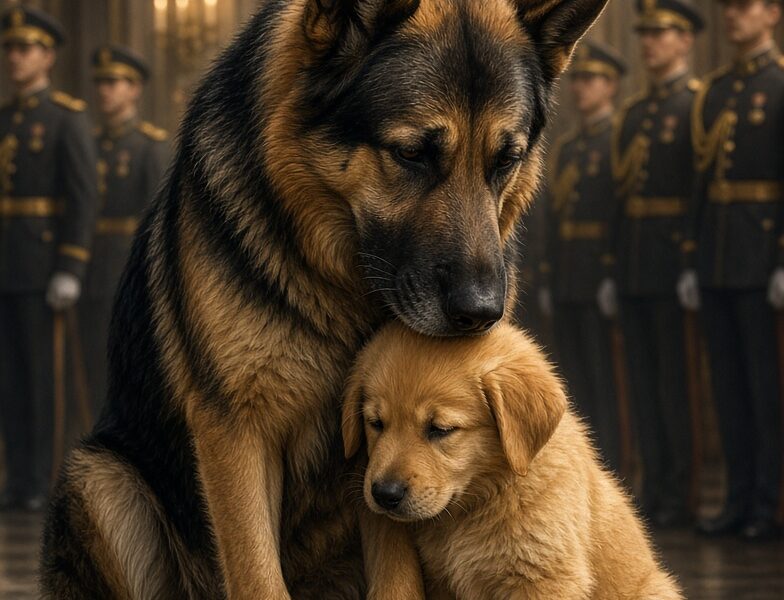
A Puppy Sat on the Old War Dog’s Paw… And 200 Soldiers Went Silent
The dog didn’t move when the puppy came through the door.
Two hundred soldiers were watching, and not one of them made a sound.
For forty minutes, the ceremony had followed the schedule printed on a single sheet of white paper: speeches, a citation, a framed photograph, and eleven years of service condensed into a few carefully chosen sentences.
Through all of it, Sergeant Major, the nine-year-old German Shepherd who had ruled Joint Base Lewis-McChord’s military working dog unit for longer than most of the soldiers in the room had worn a uniform, sat at perfect attention beside his former handler.
His ears were forward.
His amber eyes were steady.
He had sat that way in Kandahar, in Mosul, and on freezing flight lines at three in the morning when missions went wrong and the men around him were running out of options.
He had not flinched.
He had not wandered.
Even today, officially retired for six weeks, he was still doing his job.
Then Corporal Okafor opened the side door and carried in a fourteen-week-old German Shepherd puppy with golden fur, oversized paws, and absolutely no understanding of military protocol.
She stumbled across the polished floor, ignored two empty rows of chairs, and marched straight toward the oldest working dog in the room.
Sergeant Major watched her approach.
The puppy stopped beside his front left paw.
Then she sat on it.
Just sat there, as though she had reserved that particular spot weeks ago and expected everyone else to respect the arrangement.
Nobody laughed.
Nobody spoke.
Because every person in that room understood that whatever happened next would tell them something they had not come there expecting to learn.
And standing beside the old dog, with a framed citation waiting on a table behind him, Gunnery Sergeant Nathan Cole realized that the most important part of the ceremony had not been written into the program.
He also realized that a certain captain in the front row was about to discover why some things could not be measured in dollars, percentages, or carefully worded memorandums.
But before that afternoon was over, Nathan would have to decide whether he was willing to stand in front of two hundred people and repay a debt he had carried for years.
It was a debt he had never been able to put into words.
And it had everything to do with the dog whose paw now supported a sleeping puppy.
Gunnery Sergeant Nathan Cole, retired, was forty-one years old and had the kind of build that did not come from a gym.
It came from seventeen years of asking a body to perform long after that body had reasonable grounds to refuse.
He stood six feet two inches tall, with broad shoulders that had never entirely lost their military bearing.
His dark hair had turned thoroughly silver at the temples, not gradually but in the abrupt way that sometimes followed experiences a person did not discuss over dinner.
Three days of stubble shadowed his jaw.
His pale gray-green eyes had a steady, measuring quality that made people feel he was listening to something beneath their words.
Nathan was not a man who performed authority.
He simply carried it, quietly enough that other people often noticed it before he did.
He had served as a military police K9 handler in the United States Marine Corps across four deployments, including two in Helmand Province, one in Ramadi, and one in the Korengal Valley.
Some details of that final deployment remained covered by documentation he had agreed not to discuss.
Other details stayed with him for reasons that had nothing to do with paperwork.
He had returned from the Korengal with a Silver Star, a traumatic brain injury, the complete loss of vision in his left eye, and reduced peripheral vision in his right.
He could still see, but the world had changed shape.
Doorways appeared at unexpected angles.
People approaching from his left sometimes arrived without warning.
Bright lights could turn a simple afternoon into an exhausting exercise in concentration.
He had learned to compensate, as he had learned to compensate for nearly everything else.
The German Shepherd who returned with him had suffered no lasting physical injury.
Nathan had once described that fact as the clearest evidence he had ever personally witnessed that God had priorities, and that those priorities were not always the ones human beings expected.
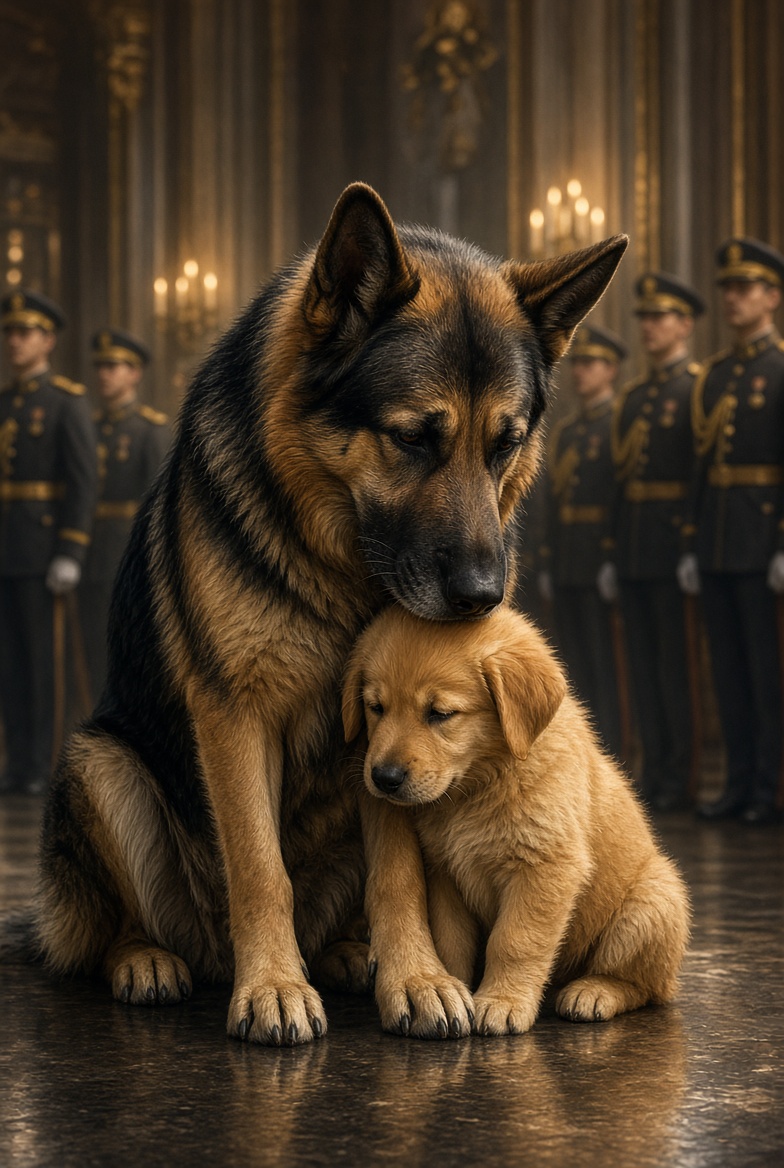
The dog’s name was Sergeant Major.
Nathan had not named him after a rank because he thought it sounded impressive.
The name had come from an incident during their first year together, when the young dog had refused to release a training sleeve until an entire group of handlers had abandoned their attempts to persuade him.
An older sergeant had finally crouched beside the dog and muttered, “You know what your problem is? You think you’re the sergeant major around here.”
The name had stuck.
The authority had come naturally.
Sergeant Major had spent eleven years serving alongside military personnel, four of them across demanding overseas deployments and six in stateside assignments.
He had located eleven improvised explosive devices during his operational career, and his handlers had credited him with preventing countless dangerous situations from developing further.
He had been recognized for his work more than once.
He had also endured long days on concrete, exhausting training exercises, cramped transport compartments, and the particular discomfort of wearing equipment designed for a working dog rather than an aging one.
His coat was nearly black along the spine, fading to deep amber around his legs and jaw.
He weighed ninety-seven pounds.
A thin scar traced the outer ridge of his right ear, left by a fragment that had grazed him in Helmand in 2016.
His left hip had grown stiff over the last year, and his mornings now began with a slow rise and a few careful steps before his body remembered what it had been built to do.
Once he was moving, however, his familiar composure returned.
He still watched doors.
He still noticed changes in the room.
And he still positioned himself between Nathan and unfamiliar movement whenever they entered a crowded place.
The military had formally retired him from active duty six weeks earlier.
Nobody had informed him that retirement was supposed to mean he could stop working.
Nathan had retired twenty-two months before the ceremony.
He lived in Lakewood, Washington, not far from Joint Base Lewis-McChord, in a modest house with a small yard, a quiet kitchen, and a living room where the afternoon sunlight fell in a narrow strip across the floor.
He did civilian consulting work for law enforcement agencies that wanted to establish or improve their K9 programs.
He understood training schedules, certification requirements, handler psychology, search patterns, and the subtle difference between a dog that was obeying a command and one that had genuinely learned to trust the person giving it.
He was good at his work.
He was also alone more often than he liked to admit.
For seventeen years, he had slept within four feet of other people.
He had shared cramped rooms, transport vehicles, temporary quarters, and the kind of uncomfortable silence that develops between people who have seen enough to understand that conversation is not always necessary.
His days had been shaped by briefings, assignments, training, and the steady presence of teammates who understood what he was doing without requiring an explanation.
After retirement, most of that disappeared.
The phone rang occasionally.
Clients asked for his opinion.
Former colleagues checked in when their schedules allowed.
But the house remained quiet, and the quiet had a peculiar weight.
Sometimes Nathan would finish a consultation, put down his phone, and realize that he had not spoken aloud to another person for six hours.
Sergeant Major would lift his head from the rug and look at him.
Nathan would look back.
“Yeah, I know,” he would say.
The dog would sigh and return to sleep.
That was usually enough to get him through the afternoon.
It was not always enough to get him through the night.
He had not expected retirement to feel like exile.
He had certainly not expected to miss the ordinary frustrations of military life: the paperwork, the early mornings, the disagreements over training plans, and the familiar voices of people who could tell from his expression when something was wrong.
He missed having a place where his presence mattered for reasons that did not need to be explained.
He missed being part of a team.
Most of all, he missed the certainty that when a difficult problem appeared, somebody would be standing beside him to help solve it.
Sergeant Major was still there.
The dog was the one constant that had survived every transfer, every deployment, every difficult return home.
But even a loyal dog could not fill every empty space in a man’s life.
And Nathan, who had spent years protecting others from dangers they could not always see, had not yet figured out how to protect himself from the loneliness of being no longer needed.
Then the invitation arrived.
It came three weeks before the ceremony, in the form of a polite email from the military working dog unit at Joint Base Lewis-McChord.
The base wanted Nathan to attend Sergeant Major’s formal retirement recognition.
There would be a citation, a framed photograph, and an official discharge document acknowledging eleven years of service.
The invitation described the event as a small unit ceremony.
Nathan read the message twice.
Then he looked down at the old German Shepherd lying beside his desk.
“Looks like they’re throwing you a party, Sergeant Major.”
The dog opened one eye.
“Don’t worry. No dancing.”
Nathan accepted the invitation that afternoon.
He did it because Sergeant Major had earned the recognition.
He did it because the old dog had given years of service without asking for anything beyond food, water, a place to sleep, and the opportunity to remain beside his handler.
And he did it because Nathan Cole was not capable of refusing something that belonged to the dog simply because he found the attention uncomfortable.
He bought a new dress shirt.
He polished the shoes he had not worn in months.
He placed the invitation beside the framed photograph on his kitchen counter, where the two of them stood together after an exercise years earlier, both muddy, both exhausted, and both looking toward the camera with the same expression of complete disinterest.
The next morning, he put the photograph away.
He did not want to think about the ceremony too much.
He had no idea that the invitation would become the first piece of evidence in a story that would eventually reach people far beyond the base.
Nor did he know that another piece of paper, hidden inside a captain’s jacket, would soon determine whether the unit that had shaped his life would be allowed to continue doing its work.
Captain Richard Harlan had never considered himself a villain.
He would have rejected the word as emotionally imprecise, professionally unhelpful, and unsupported by evidence.
At forty-four, he had built his reputation through logistics, administrative efficiency, and the ability to identify expenditures that other officers had stopped questioning.
He understood budgets.
He understood schedules.
He understood the institutional language that could turn a controversial decision into something that appeared inevitable.
Fourteen months earlier, he had been assigned to direct the military working dog program at Joint Base Lewis-McChord after the previous director retired.
He arrived with two objectives.
The first was to reduce the program’s operational budget by eighteen percent.
The second was to consolidate the training schedule and free up facility space for a vehicle maintenance expansion he had been pursuing before he received the authority to pursue it.
Both objectives looked reasonable on paper.
The base had competing needs.
Vehicles required maintenance.
Training facilities occupied valuable space.
Personnel and equipment budgets could not expand indefinitely.
Harlan believed that sentiment often prevented organizations from making necessary decisions.
In one meeting, he had described the canine program as a legacy expenditure with diminishing tactical returns.
He had smiled when he said it.
Three handlers who attended that meeting remembered the expression long after they forgot the other details.
They did not believe Harlan was incapable of understanding the program’s value.
They believed he had decided that its value was inconvenient.
Staff Sergeant Elena Reyes, the unit’s senior handler, had challenged his first training schedule reduction with documented evidence that the compressed timeline failed to meet Department of Defense requirements for military working dog handler certification.
Harlan listened to her carefully.
He asked questions.
He thanked her for her input.
Three days later, he reissued the directive unchanged, adding a single sentence stating that the revised schedule had been reviewed in consultation with appropriate oversight authorities.
Reyes had no record of such a consultation.
She requested clarification.
Harlan replied that the necessary coordination had occurred through established channels.
He did not identify those channels.
The exchange was polite.
It was also useless.
Reyes documented it and placed the correspondence in a folder.
She did the same thing when a second directive reduced training hours despite concerns about certification readiness.
She did it again when a third directive restricted access to part of the training facility during periods the unit had previously reserved for scheduled exercises.
The fourth incident involved a reporting requirement that had been changed without sufficient notice, creating a situation in which handlers appeared to have missed a deadline they had not been told had moved.
Harlan described the problem as an administrative misunderstanding.
Reyes recorded the dates, saved the messages, and requested written clarification.
She did not shout.
She did not accuse him of anything she could not prove.
She simply kept records.
Her father had been a mechanic in Ohio.
When she was young, he had taught her that a machine could fail for a hundred reasons, but a good mechanic never replaced a part just because someone important insisted it was broken.
“You find the fault,” he had told her. “You write down what you found. And you don’t let somebody talk you into pretending you saw something else.”
Reyes had applied the same principle to her work.
For fourteen months, her folder grew.
She had no grand plan.
She did not know whether the documents would ever matter.
She only knew that the directives were changing the unit’s ability to train, and that the official explanations did not always match the written record.
By the time Harlan began preparing his recommendation to reduce the active canine roster from fourteen dogs to eight, Reyes had enough documentation to make the proposed changes difficult to defend.
Harlan’s memorandum described the reduction as an efficiency measure.
It cited projected savings, revised facility requirements, and the opportunity to redirect resources toward vehicle maintenance.
It did not describe the consequences for training capacity in comparable detail.
It did not discuss the experience lost when seasoned handlers were separated from operational teams.
It did not explain how six fewer dogs would affect the unit’s ability to support simultaneous requests.
The recommendation was precise.
It was also incomplete.
Harlan had a meeting scheduled with the base commander for the following week.
He believed the numbers would carry the argument.
He believed the ceremony would be an uncomplicated event that could be concluded before lunch.
He had approved a short citation, arranged for the framed photograph, and scheduled the room for another use that afternoon.
He had not expected two hundred soldiers to attend.
He had not expected retired handlers to drive in from other states.
And he had not expected Nathan Cole.
To Harlan, the retired Marine was an invited guest, a former handler, and a man whose career had ended nearly two years earlier.
Nathan’s opinion might be respected.
It was not, Harlan assumed, a factor that would change the direction of an administrative decision.
That assumption would prove expensive.
Not financially.
Professionally.
Because Harlan had mistaken a quiet man for an uninvolved one.
And he had mistaken the absence of public protest for the absence of resistance.
On the morning of the ceremony, the base woke beneath a low Washington sky.
Rain had fallen overnight, leaving the roads dark and the air cool.
Clouds hung over the distant tree line, and the familiar smell of wet pavement drifted through the open doors of the canine facility.
Nathan arrived early.
He parked near the building, checked that Sergeant Major’s lead was properly secured, and stepped out into the damp morning.
The old dog took a moment to rise from the passenger seat.
Nathan waited without rushing him.
“Take your time, old man.”
Sergeant Major placed one paw on the ground, shifted his weight, and climbed out.
He shook himself once, sending droplets across Nathan’s trousers.
“Very professional,” Nathan murmured.
The dog looked up at him.
For a moment, Nathan’s expression softened.
“Come on. Let’s go see your fan club.”
The ceremony hall was already filling.
Nathan had expected twenty or thirty people.
Instead, he found soldiers gathering in the corridors, exchanging greetings, adjusting uniforms, and moving chairs to make room.
Some wore dress uniforms.
Others had arrived from nearby assignments in standard duty attire.
A few former handlers stood near the walls, their faces carrying the familiar mixture of pride and discomfort that came with seeing an old partner honored in public.
Nathan recognized several of them immediately.
He shook hands, exchanged brief greetings, and accepted a few quiet embraces from people he had not seen in years.
“Good to see you, Cole,” one former handler said.
“You too.”
“How’s the eye?”
“Still attached to the same head.”
The man laughed.
Nathan did not.
Then he smiled just enough to show that the joke had landed.
Across the room, Staff Sergeant Reyes was helping arrange the ceremony materials.
She was in her late thirties, with dark hair secured beneath her uniform cap and a manner that suggested she had spent years learning how to remain composed when other people became difficult.
She approached Nathan with a folder tucked under one arm.
“Sir.”
“Staff Sergeant.”
“It’s good to see you again.”
“Likewise. You look busy.”
“That’s because I am.”
Nathan glanced at the folder.
“Something I should know about?”
Reyes hesitated.
It was not a long hesitation.
But Nathan had spent seventeen years watching people make decisions in the fraction of a second before they spoke.
He noticed it.
“Not here,” she said quietly.
Nathan looked at her for another moment.
Then he nodded.
“Whenever you’re ready.”
Reyes glanced toward the front row, where Captain Harlan was checking his watch.
“I may need to speak with you after the ceremony.”
“Then I’ll be here.”
She gave him a small, grateful nod and returned to her preparations.
Nathan watched her go.
He had known enough good handlers to recognize the difference between someone who wanted to complain and someone who had been carrying a problem for too long.
Reyes belonged to the second category.
Before he could think more about it, a young corporal hurried through the side entrance with a puppy held awkwardly against his chest.
The puppy had golden fur, enormous ears, and paws that looked as though they belonged to a dog twice her size.
She squirmed in the corporal’s arms.
He adjusted his grip.
“Sorry, Sergeant Major,” he whispered to the old dog. “We’re still learning how to do this.”
The puppy responded by trying to lick his chin.
Nathan raised an eyebrow.
“Looks like she’s doing fine.”
The corporal grinned.
“Corporal Okafor, sir. I’m still in training.”
“Nathan Cole. Retired.”
“I know who you are, sir.”
“Then you have an advantage. I have no idea who you are.”
Okafor laughed nervously.
“Sorry, sir. Corporal James Okafor. This is the new pup. We haven’t finalized her designation yet.”
The puppy twisted in his arms and stared at Sergeant Major.
Her tail began to wag.
The old dog regarded her with the grave attention of a senior officer reviewing a particularly questionable proposal.
“What’s she called?” Nathan asked.
“Unofficially? Biscuit.”
“Why Biscuit?”
“She stole a biscuit from the training room yesterday and ran away with it.”
“That sounds like a solid qualification.”
“She also chewed through the corner of my notebook.”
“Promising.”
Okafor laughed again, more comfortably this time.
The puppy wriggled free enough to place her front paws against his arm.
Nathan studied her.
“How old?”
“Fourteen weeks.”
“She’s going to be a handful.”
“That’s what everybody keeps telling me.”
Nathan glanced at Sergeant Major.
The old dog had not moved.
“Don’t worry,” Nathan told the young corporal. “If she survives the first six months with that much confidence, somebody will probably make her an officer.”
Okafor laughed.
Then a voice called him from the doorway.
He turned to answer, shifting the puppy carefully onto the floor.
“Stay here, Biscuit.”
The puppy remained still for approximately one second.
Then she walked away.
Okafor turned back.
“Biscuit—”
Too late.
She crossed the linoleum floor with the unsteady determination of a creature that had never been told that a room could contain an inappropriate destination.
Nathan followed her progress.
So did Sergeant Major.
And when the puppy reached the old dog’s front left paw and settled onto it, the room seemed to draw a single breath.
Nobody laughed.
Nobody spoke.
Nathan felt the lead grow still in his hand.
For eleven years, Sergeant Major had been trained to maintain position under distraction.
He had ignored noise, movement, unfamiliar people, sudden changes in environment, and situations that would have overwhelmed less disciplined animals.
He had remained composed when the world around him became unpredictable.
But this was different.
The puppy was sitting directly on his paw.
Her small body leaned against his leg.
She looked up at him as though she expected him to explain what happened next.
Sergeant Major lowered his eyes.
He studied her face.
Then he looked toward Nathan.
For a moment, their eyes met.
Nathan had seen that expression before.
He had seen it in a vehicle far from home, when the air was filled with dust and the future had narrowed to a few immediate decisions.
He had seen it in the hospital, when he woke to find the dog lying beside his bed.
And he had seen it in the quiet mornings after retirement, when the old dog seemed to be waiting for Nathan to tell him what his next assignment would be.
Now Sergeant Major looked back at the puppy.
Slowly, carefully, he lowered his great dark head.
He pressed his nose against the top of her head and held it there.
The puppy closed her eyes.
Then she leaned more heavily against his paw and settled into sleep.
Two hundred soldiers went completely silent.
It was not the silence of people being polite.
It was the silence of people witnessing something they understood before they could explain it.
Nathan felt his throat tighten.
He looked away for a moment, pretending to examine the framed citation on the table.
He had spent years learning how to keep his face composed.
He had learned it in training, in briefings, in difficult conversations, and in places where losing control of his expression could make somebody else’s job harder.
But the sight of the old dog lowering his head over that tiny puppy reached a place in him that discipline had never managed to protect.
He remembered Sergeant Major as a young dog, all restless energy and untested confidence.
He remembered the first time the animal had fallen asleep against his boot after a long training day.
He remembered the weight of the dog across his chest in the Korengal, the steady pressure of a body refusing to leave him alone.
And now, after everything, Sergeant Major had found something smaller than himself and chosen to be gentle.
Nathan looked down.
The puppy’s tail moved once.
Then she slept.
It was the first time that morning the old dog had appeared to understand that he had nothing left to prove.
And it was the moment the ceremony stopped being about retirement.
The commanding officer stepped to the microphone.
His opening remarks were brief, respectful, and carefully prepared.
He spoke about service, reliability, training, and the contribution military working dogs made to the safety of personnel.
He mentioned Sergeant Major’s operational record and the professionalism of the handlers who had worked beside him.
He thanked Nathan Cole for attending.
Then he invited the unit’s senior personnel to present the framed citation.
Nathan accepted it with both hands.
The photograph showed Sergeant Major standing beside him several years earlier, the dog’s ears raised and his expression alert.
Nathan looked at the image longer than he intended.
“Eleven years,” the commanding officer said. “That’s a remarkable record.”
Nathan nodded.
“Yes, sir.”
“Would you like to say a few words?”
Nathan looked at the microphone.
Then he looked at the dog.
“No, sir. Thank you.”
The commanding officer accepted the answer and moved on.
Captain Harlan glanced at his watch.
The ceremony had already lasted longer than he preferred.
He stood in the front row with his arms folded, watching the proceedings with the restrained impatience of a man who considered forty minutes an excessive investment in a retirement event.
He had no personal objection to dogs.
He had owned one as a child.
He understood that military working dogs had historically served a purpose.
But he believed the modern program required restructuring, and he did not intend to let an emotional ceremony interfere with a decision he considered administratively necessary.
He had a memorandum in his jacket pocket.
It was the recommendation to reduce the active canine roster from fourteen dogs to eight.
The document had taken several weeks to prepare.
Its figures were clean.
Its language was measured.
Its conclusions were presented as the logical outcome of a resource review.
Harlan had intended to deliver it to Staff Sergeant Reyes after the ceremony, while the room remained full and the afternoon schedule was beginning to tighten.
He expected her to accept it professionally.
He expected the handlers to be disappointed.
He expected the discussion to move through the appropriate channels.
He did not expect Nathan Cole to mention the memorandum in front of two hundred people.
He certainly did not expect the room to become an audience.
Because when the commanding officer finished the formal remarks and invited the assembled personnel to remain for a brief photograph, Nathan stepped forward.
He did not move toward the camera.
He moved toward the microphone.
“Sir, may I add something?”
The commanding officer looked surprised.
“Of course, Gunnery Sergeant.”
Nathan placed the framed citation on the table.
He adjusted his stance, keeping his left side angled toward the room so that his limited peripheral vision would not leave too much unseen.
He did not consult notes.
He did not clear his throat.
He simply began.
“Sergeant Major found eleven IEDs over four deployments.”
His voice was quiet.
The room settled around it.
“Eleven devices that he located before they could create the kind of situation nobody wants to explain to a family afterward.”
He paused.
“I could give you the numbers associated with that. I could tell you what those eleven discoveries might mean in terms of lives protected, injuries avoided, and missions completed. But numbers become abstract when you say them often enough.”
He looked toward the old dog.
“What doesn’t become abstract is the face of a man who gets to go home.”
A few soldiers lowered their eyes.
Nathan continued.
“I remember people from those deployments. I remember their voices. I remember the way they complained about coffee and the way they argued about things that didn’t matter because arguing about ordinary things made the difficult things easier to carry.”
He rested one hand on the edge of the table.
“Sergeant Major helped bring some of those people home.”
The dog remained beside his leg, the sleeping puppy still resting against his paw.
Nathan’s gaze moved across the room.
“During my final deployment, there was a vehicle incident in the Korengal Valley. I lost most of the vision in my left eye that day. My right eye was damaged too, and the doctors have told me what I can expect going forward.”
He did not describe the incident in graphic detail.
He did not need to.
“The extraction took forty-seven minutes.”
Someone near the back shifted position.
Nathan’s expression remained steady.
“For forty-seven minutes, Sergeant Major stayed with me. He lay across my chest because my body wasn’t holding heat the way it should have. He stayed there while the team worked to get us out.”
He glanced down at the old dog.
“Nobody ordered him to do that.”
Nathan’s voice softened.
“He didn’t need a command.”
The silence in the room deepened.
“I came home able to see my daughter’s face. Not perfectly, not the way I did before, but enough. And I don’t take that for granted.”
He paused again.
Then he turned toward the audience.
“There is something else I need to address.”
Captain Harlan straightened.
Nathan’s eyes found him.
“I understand that there is a memorandum recommending a forty-percent reduction in this unit’s operational canine capacity.”
The words landed with a weight that no one in the room could ignore.
Several handlers looked at one another.
Reyes remained still, her folder held against her side.
Harlan uncrossed his arms.
Nathan continued.
“I have read the recommendation. I understand the budget language. I understand the facility concerns. I’ve spent enough time working with military and civilian organizations to know that resources have to be managed carefully.”
He did not raise his voice.
“That’s not the issue.”
He looked toward the handlers standing along the wall.
“The issue is what happens after a decision like that leaves a conference room.”
His fingers tightened slightly against the edge of the table.
“What happens when a request comes in and the nearest qualified team is already assigned elsewhere. What happens when training time is reduced and a handler has less opportunity to learn the difference between a dog that is tired and a dog that has found something worth paying attention to.”
He let the words settle.
“What happens when people who have spent years learning to work together are separated because the spreadsheet says the program can function with fewer teams.”
Nobody moved.
Nathan took a breath.
“I don’t pretend to know every detail of this base’s budget. I don’t have the authority to make its decisions. But I do know what these dogs are trained to do, and I know what the people standing behind me have invested in becoming capable of doing it.”
He looked toward Reyes.
“Some of them have been raising concerns for months.”
Reyes’s face tightened.
She had not expected him to mention her.
Nathan did not look away.
“They’ve documented problems. They’ve asked questions. They’ve followed the process. And they’ve kept doing their jobs while waiting for somebody to listen.”
Captain Harlan rose to his feet.
“Gunnery Sergeant, I appreciate your service, but I don’t believe this is the appropriate setting for an administrative discussion.”
Nathan turned toward him.
“I agree, Captain.”
The answer was so calm that Harlan seemed momentarily unsure how to respond.
Nathan continued.
“That’s why I’m not asking this room to make an administrative decision.”
He paused.
“I’m asking everyone here to understand what the decision actually means before somebody tells them it was just a budget adjustment.”
Harlan’s expression hardened.
“Those recommendations have not been finalized.”
“Then there’s still time to review them.”
“These matters involve information that may not be available to everyone present.”
Nathan nodded.
“That’s true.”
He took one step away from the table.
“Which is why I want to be very clear about what is already available to the people responsible for reviewing this matter.”
Harlan’s hand moved toward the front of his jacket.
Nathan noticed.
So did Reyes.
“I know who you are, Captain,” Nathan said.
His voice did not change.
“And I know what’s in your pocket.”
For a moment, Harlan appeared to consider whether he should speak.
Then Nathan continued.
“Earlier today, a formal request for review of the program director’s budget recommendations was submitted to the base commander. It was co-signed by seven former K9 handlers with a combined forty-three years of military working dog experience.”
A ripple of movement passed through the room.
“That request was submitted through the Judge Advocate General’s office after we were advised that it was the proper channel.”
Nathan allowed a moment for the information to settle.
“Two members of the House Armed Services Committee have also been contacted by a veterans advocacy organization that has expressed interest in the situation. I won’t name that organization here, because that isn’t the purpose of this ceremony.”
He looked toward Reyes again.
“Staff Sergeant Reyes has documented the directives issued by the program director’s office over the past fourteen months. Those records have been provided to the base Inspector General.”
Harlan’s face changed.
Only slightly.
But the room had become so quiet that even the smallest movement seemed significant.
Nathan delivered his final sentence with the same measured precision he had once used in operational briefings.
“I hope that information is helpful, Captain.”
Then he stepped away from the microphone.
He did not ask for applause.
He did not wait for approval.
He looked down at Sergeant Major.
The old dog was watching him.
For the first time all morning, Sergeant Major’s tail moved.
Once.
Slowly.
Then it settled against the floor.
Nathan rested his hand on the dog’s neck.
The puppy remained asleep on his paw, entirely unaware that the atmosphere in the room had changed.
Captain Harlan stood motionless.
His expression moved through three distinct stages.
First came dismissal, the reflexive response of a man who believed he could classify the interruption and return to the schedule.
Then came calculation.
He began assessing what Nathan had said, which documents might exist, which people might have received them, and which parts of the matter could still be described as an internal disagreement.
The third expression was harder to identify.
It was the look of a person who had entered a room believing he understood the terrain and had suddenly discovered that the map was incomplete.
He looked at Nathan.
He looked at Reyes.
Then he looked at the two hundred soldiers standing around him.
For the first time that morning, Harlan appeared to understand that the people in the room were not simply witnesses to a retirement ceremony.
They were witnesses to a decision that had not yet been made.
And some of them knew enough to ask difficult questions.
The first person to move was the retired master sergeant standing at the back of the room.
His name was Calvin Brooks.
He had served as Sergeant Major’s original handler before Nathan took over the partnership.
He was sixty years old, broad through the shoulders, with a weathered face and short gray hair.
He had driven four hours from Portland that morning.
He had not told anyone he was coming.
When he entered the building, he had found a place near the back wall and folded his hands in front of him, determined to remain composed throughout the ceremony.
Calvin had seen Sergeant Major as a young dog.
He remembered the animal’s early stubbornness, the way he learned patterns quickly but refused to tolerate careless handling, and the way he would press his shoulder against Calvin’s knee after difficult training sessions.
He remembered the first successful certification.
He remembered the long months when the dog seemed to have more energy than the entire unit combined.
And he remembered handing the lead to Nathan before their first deployment together.
“You take care of him,” Calvin had said.
Nathan had looked at the dog.
“I will.”
Calvin had studied him for a moment.
“That’s not quite what I meant.”
Nathan had looked back.
“What did you mean?”
Calvin had lowered his voice.
“When the work gets hard, remember that he’s not equipment. He’s your partner.”
Nathan had nodded.
“I know.”
Calvin had held his gaze.
“Knowing it and remembering it are two different things.”
That conversation had stayed with Nathan longer than either man realized.
Now Calvin stood at the back of the ceremony hall, watching the old dog rest his head over a puppy.
He watched Nathan speak without raising his voice.
He watched Harlan put the memorandum back into his pocket.
And when the captain finally turned toward the side door, Calvin exhaled slowly.
He had been holding his breath for longer than he intended.
Harlan walked toward the exit.
He did not slam the door.
He did not argue.
He simply opened it, stepped into the corridor, and allowed it to close behind him.
The sound carried through the room.
For several seconds, nobody spoke.
Then the commanding officer stepped away from the microphone and approached Nathan.
“Gunnery Sergeant.”
“Sir.”
“Are the documents you referenced available for review?”
“Yes, sir.”
“Have they been submitted through the appropriate channels?”
“Yes, sir.”
The commanding officer glanced toward Reyes.
“Staff Sergeant?”
“Yes, sir. I have copies of the correspondence, the original directives, the subsequent clarifications, and the training records affected by those directives.”
“Good.”
He looked toward the assembled personnel.
“I want to be clear that no conclusions have been reached at this point. The review process will determine what occurred and what action, if any, is appropriate.”
His tone was formal, but his expression had changed.
“This ceremony will proceed as scheduled. Sergeant Major has earned his recognition, and nothing that has been discussed here changes that.”
He turned toward the table.
“Let’s finish what we came here to do.”
The ceremony resumed.
The citation was read in full.
Nathan accepted the official discharge document.
A photographer took pictures of him standing beside Sergeant Major, with the framed photograph held against his chest.
The dog remained calm throughout.
When the photographer asked Nathan to move closer to the center of the room, Sergeant Major shifted his weight, turned slightly, and positioned himself against Nathan’s left leg.
The photographer smiled.
“He’s making sure you’re in the right spot.”
Nathan looked down.
“He’s always been better at that than I am.”
A few people laughed softly.
The tension began to ease.
But nobody forgot what had happened.
After the official remarks ended, soldiers approached Nathan in small groups.
Some shook his hand.
Others asked about the deployments he had mentioned.
A young lieutenant told him that his own father had worked with military dogs during the early years of the war in Afghanistan.
A corporal asked whether Nathan ever missed active duty.
Nathan considered the question.
“Sometimes.”
“What do you miss most?”
“The people.”
The corporal nodded.
Nathan continued.
“Not every part of the job. Not every day. But when you’re part of a good team, you know where you belong.”
He glanced at Sergeant Major.
“That’s a difficult thing to replace.”
The corporal seemed to understand.
Then he looked toward the puppy.
“Is that the new dog?”
“Looks like it.”
“She’s been asleep on his paw for almost twenty minutes.”
Nathan smiled faintly.
“Maybe she’s figured out where she belongs.”
The young corporal laughed.
But Nathan kept looking at the puppy.
Because the thought had occurred to him that perhaps the dog had not simply wandered toward Sergeant Major.
Perhaps she had recognized something in him that the people in the room had spent years learning to recognize.
Calm.
Certainty.
A willingness to remain still when the world became unpredictable.
Whatever the reason, the puppy had chosen the oldest dog in the room.
And Sergeant Major, who had spent years responding to commands, had answered her without receiving one.
When the room began to empty, Staff Sergeant Reyes approached Nathan.
She waited until the last few soldiers had moved toward the corridor.
“Sir, do you have a moment?”
“Of course.”
She glanced toward the side door.
“Somewhere private?”
Nathan nodded.
They walked into a small office adjoining the ceremony hall.
The room contained a desk, two chairs, a filing cabinet, and a window overlooking the wet pavement outside.
Reyes closed the door.
For the first time that morning, she appeared uncertain.
Nathan pulled out a chair.
“Sit down, Staff Sergeant.”
She did.
He remained standing for a moment, then leaned against the desk.
“How long have you been dealing with this?”
“Fourteen months.”
“That’s a long time.”
“Yes, sir.”
“Why didn’t you contact me earlier?”
Reyes looked at her hands.
“I wasn’t sure what you could do.”
“That’s fair.”
“And I didn’t want it to look as though I was going around the chain of command because I didn’t like a decision.”
Nathan nodded.
“That’s also fair.”
She looked up.
“I wasn’t trying to stop every budget reduction. I understand that programs have to justify their resources. We all understand that.”
“I know.”
“But the training changes were creating problems. We were being asked to produce the same certification outcomes with less time, fewer facility hours, and less flexibility in scheduling.”
She opened the folder she had carried throughout the morning.
Inside were neatly arranged copies of emails, directives, training schedules, and written requests for clarification.
“I documented the first change because I thought it might have been a mistake.”
She placed one page on the desk.
“The second time, I thought there might have been information I didn’t have.”
She placed another page beside it.
“By the third time, I realized that I needed a record of what had actually happened.”
Nathan studied the documents.
He recognized the style of official correspondence.
He also recognized the careful precision of someone who had spent months anticipating how her work might be challenged.
“You did the right thing,” he said.
Reyes let out a slow breath.
“I hope so.”
Nathan turned a page.
“Did you send copies to anyone outside the unit?”
“Only through the appropriate review channels. I asked for clarification from the director’s office, retained the responses, and then followed the guidance I received from legal personnel.”
“Good.”
He read another page.
“Who else has reviewed this?”
“The unit’s legal adviser, the base Inspector General’s office, and the former handlers who agreed to support the request.”
“How many?”
“Seven former handlers signed the review request. A few others helped organize the supporting records.”
Nathan nodded.
“That’s a substantial amount of experience.”
“Forty-three years, combined.”
“I heard.”
Reyes managed a small smile.
“Yes, sir.”
Nathan closed the folder.
“Tell me about the proposed reduction.”
Reyes pulled out the memorandum’s summary.
“The current roster is fourteen operational dogs. The recommendation is to reduce that to eight.”
“Six dogs.”
“Yes, sir. Forty-three percent of the roster, depending on how the final figures are calculated. The memorandum describes the reduction as approximately forty percent.”
“What happens to the handlers?”
“Some would be reassigned. Others might be transferred to different duties. It depends on the final plan.”
“And the facility?”
“The vehicle maintenance expansion would take over part of the space we use for training.”
Nathan looked toward the window.
“What happens to certification?”
“That depends on the schedule and how much space remains available. We have already had to rearrange some training sessions because of the previous restrictions.”
“Would the proposed plan leave enough capacity to support the same number of requests?”
Reyes did not answer immediately.
“Not without changing how the unit operates.”
Nathan looked back at her.
“Then that needs to be part of the review.”
“It is.”
“Good.”
Reyes leaned forward slightly.
“Sir, I need you to understand something.”
“Go ahead.”
“I didn’t ask you to speak today.”
“I know.”
“I didn’t want you to feel obligated because of your relationship with Sergeant Major.”
Nathan’s expression softened.
“Staff Sergeant, I didn’t speak because you asked me to.”
She looked at him.
“I spoke because I read the recommendation, and I understood what it was leaving out.”
He paused.
“I’ve spent enough years watching people reduce complicated problems to simple numbers. Sometimes the numbers are useful. Sometimes they’re necessary. But sometimes they hide the part of the problem that matters most.”
Reyes looked down at the folder.
“I kept thinking somebody would eventually look at the whole picture.”
“Somebody will.”
“How can you be sure?”
Nathan considered the question.
“I can’t be sure.”
The honesty seemed to surprise her.
“But I can tell you this. You did your part. You recorded what happened. You followed the process. You didn’t make accusations you couldn’t support.”
He rested one hand on the folder.
“That matters.”
Reyes’s eyes grew brighter, though she kept her expression composed.
“Thank you, sir.”
Nathan shook his head.
“Don’t thank me yet. The review still has to happen.”
She smiled faintly.
“I know.”
He glanced toward the door.
“Now, I believe your puppy has adopted my dog, and I’m not sure either of them has received the paperwork.”
Reyes laughed.
It was the first unguarded laugh Nathan had heard from her all morning.
“Her name is still Biscuit, unofficially.”
“That seems appropriate.”
“She has a lot to learn.”
Nathan thought about Sergeant Major.
“So do most of us.”
He picked up the framed citation and prepared to leave.
At the door, Reyes spoke again.
“Sir?”
He turned.
“That thing you said about the dog staying with you for forty-seven minutes.”
Nathan waited.
“I’ve heard the story before. Not the details, but the general outline. People talk about it when they talk about Sergeant Major.”
Nathan said nothing.
Reyes continued.
“I think some of us needed to hear it from you.”
He looked at her for a moment.
Then he nodded.
“Maybe.”
He opened the door.
“But remember something, Staff Sergeant. The point isn’t that one dog did something extraordinary. The point is that a whole team made it possible for him to do his job.”
Reyes straightened.
“Yes, sir.”
“And the team is worth protecting too.”
Nathan stepped into the corridor.
Behind him, Reyes remained seated for a moment, looking at the folder on the desk.
Fourteen months of records.
Four separate directives.
Seven former handlers.
Forty-three years of combined experience.
And one ceremony that had become something nobody had planned.
The documents had not changed.
But somebody had finally spoken about what they meant.
The official review began the following week.
The base commander requested a complete accounting of the proposed budget changes, including the effect on training capacity, certification schedules, facility use, and operational availability.
The Inspector General’s office reviewed the records provided by Reyes.
The review was not dramatic.
There were no public confrontations, no sudden announcements, and no convenient moment when every question received an immediate answer.
There were interviews.
There were document requests.
There were spreadsheets, scheduling records, and careful comparisons between what the written directives required and what the unit had actually been able to accomplish.
Reyes was interviewed twice.
The first interview focused on the sequence of directives.
The second examined the effect those directives had on the training program.
She answered every question with the same precision she had used when assembling the folder.
When she did not know an answer, she said so.
When she had a document, she provided it.
When an event had not been recorded, she did not pretend otherwise.
Nathan was contacted for a statement.
He provided one.
He described his professional experience, his understanding of the proposed changes, and the reasons he believed the operational consequences required careful review.
He did not speculate about Harlan’s motives.
He did not claim to know what had happened in meetings he had not attended.
He focused on the information he could support.
The seven former handlers submitted their own statements.
Calvin Brooks wrote three pages.
He described his years working with Sergeant Major, the development of military working dog training practices, and the importance of preserving the relationship between a handler and a dog through consistent, properly supervised training.
He ended with a sentence that Reyes would remember long after the review was completed.
“A dog can be replaced on a roster. The experience lost when a trained team is broken apart cannot be restored by changing a number in a spreadsheet.”
The review team did not treat that sentence as a technical finding.
But it helped explain why the proposed changes required more than a calculation of immediate savings.
The budget recommendation remained on hold.
Harlan continued in his position while the review proceeded.
He attended meetings.
He responded to requests for information.
He maintained that his recommendations had been based on legitimate concerns about resource allocation.
Some of those concerns were real.
The base did have competing facility requirements.
The maintenance expansion had been planned for months.
The budget required scrutiny.
But the review found that those considerations did not excuse the way the directives had been implemented.
Four separate directives had been issued outside the program director’s authority.
The supporting documentation for the revised training requirements was insufficient.
The record did not support the claim that all necessary oversight consultations had occurred as described.
And the proposed reduction had not adequately accounted for the operational effects on the canine unit.
The Inspector General’s findings were consistent with the records Reyes had submitted.
The review did not need to rely on anyone’s anger.
It relied on dates, signatures, correspondence, and the differences between what had been written and what had actually happened.
Harlan’s transfer request arrived two weeks after the ceremony.
It was approved.
He left Joint Base Lewis-McChord in March and was assigned to a logistics post in Georgia with no canine component.
The budget recommendation was formally withdrawn by the base commander following the review.
The canine program’s operational budget was restored in full.
The vehicle maintenance expansion was redesigned at a reduced scope, allowing the project to proceed without taking over the K9 facility.
The unit retained its fourteen-dog operational roster.
For the handlers, the result was significant.
But it was not the kind of victory that produced a celebration.
There was no parade.
Nobody stood at the gate to welcome them back from an administrative battle.
Training resumed.
Schedules were revised.
Equipment was checked.
Dogs continued learning their assignments.
The same work that had been threatened by the memorandum became the work that filled their days again.
Reyes returned to her responsibilities.
Okafor continued training.
And Nathan went back to Lakewood, where Sergeant Major slept beside the couch and the kitchen remained quiet.
The difference was that Nathan no longer felt quite as far removed from the world he had left behind.
He had been reminded that a team could still exist even when its members were scattered across different assignments, different homes, and different stages of life.
Sometimes a team was simply a group of people who understood what needed to be protected.
Sometimes it was a staff sergeant keeping careful records.
Sometimes it was seven former handlers signing a document.
And sometimes it was two hundred soldiers showing up to honor a dog because they remembered what he had done.
Nathan had not expected to feel counted again.
He certainly had not expected it to happen because a puppy had fallen asleep on an old dog’s paw.
But that was how the story had begun.
And in the months that followed, the puppy would provide one more reminder that the most important work often continued long after the ceremony ended.
Spring arrived slowly in western Washington.
The mornings remained cool.
Rain swept across the roads, then disappeared for an hour before returning without warning.
The trees around the base began to show fresh green growth, and the air carried the smell of wet earth and new leaves.
Sergeant Major’s hip did not improve.
Nathan had taken him to the veterinarian for regular examinations and adjusted his exercise routine to account for the stiffness.
The old dog still enjoyed his walks.
He still watched the world with the same alertness he had displayed as a young working animal.
But his pace had changed.
He no longer hurried to the door when Nathan picked up the lead.
He took his time getting up.
He preferred soft bedding to the hard floor.
And after a long morning, he would settle into a patch of sunlight and sleep deeply enough that Nathan sometimes checked to make sure he was still breathing.
The veterinarian had explained that aging was not a condition to be corrected by effort.
It was a process to be managed with care.
Nathan understood.
He had spent years working around injuries that would never completely heal.
He knew the difference between giving up and adjusting to what remained possible.
Sergeant Major seemed to understand it too.
He no longer tried to match Nathan’s pace on every walk.
He stopped when he needed to stop.
He rested when he needed to rest.
And when Nathan sat on the porch with a cup of coffee, the old dog often lowered himself beside the chair and placed his head against Nathan’s boot.
They had become quieter together.
Not because they had less to say.
Because they no longer needed to prove that they understood each other.
One afternoon, Nathan received a message from Corporal Okafor.
The puppy had been officially designated Scout.
Her name had been chosen after a discussion among the handlers, and Okafor had sent Nathan a photograph of the small German Shepherd sitting beside a training obstacle with her ears raised and her expression so serious that she looked personally offended by the existence of the obstacle.
Nathan enlarged the photograph.
Then he laughed.
Sergeant Major lifted his head.
“What do you think?”
The old dog looked at the phone.
Nathan tilted the screen toward him.
“Scout. Remember her?”
Sergeant Major sniffed once and settled again.
Nathan sent Okafor a message.
“She looks like she’s planning to file a complaint.”
The corporal replied almost immediately.
“Sir, she has already eaten two training aids, stolen my lunch, and escaped from a pen that was supposed to be puppy-proof.”
Nathan smiled.
“Sounds like leadership potential.”
Over the next several weeks, Okafor sent occasional updates.
Scout was learning to follow scent trails.
She was becoming more focused.
She still had the enthusiasm of a dog who believed every new smell represented the beginning of a major adventure, but she was learning to channel that enthusiasm into structured work.
Nathan offered advice when asked.
He did not interfere with the training program.
He understood that Okafor needed to develop his own relationship with the dog.
A handler could learn techniques from a hundred experienced people and still had to discover the individual animal standing at the end of his lead.
The partnership could not be borrowed.
It had to be built.
One evening, Okafor called.
“Sir, can I ask you something?”
“Of course.”
“It’s about Scout.”
Nathan put down the book he had been reading.
“What’s going on?”
“She seems to get distracted when we introduce a new environment. She’ll work beautifully in the familiar training area, but when we move somewhere unfamiliar, she wants to investigate everything.”
Nathan smiled.
“She’s fourteen weeks old.”
“She’s older now, sir.”
“How old?”
“Almost a year.”
“Then she’s still young.”
Okafor laughed nervously.
“I know. I just don’t want to miss something.”
Nathan leaned back in his chair.
“Let me ask you something. When she gets distracted, what do you do?”
“I give the command again.”
“And then?”
“I try to redirect her.”
“And when that doesn’t work?”
“I get frustrated.”
Nathan nodded, although Okafor could not see him.
“Good.”
There was a pause.
“Good, sir?”
“Now we know what the problem is.”
Okafor laughed.
Nathan continued.
“You’re trying to make the dog perform the way you want before you’ve finished teaching her how to handle the environment. You’re asking for the result before the skill is ready.”
“So I should slow down?”
“Slow down enough to see what she’s actually doing. Don’t confuse distraction with disobedience. Watch her. Figure out what she’s responding to. Then make the exercise simple enough that she can succeed.”
Okafor was quiet for a moment.
“That makes sense.”
“And don’t forget that you’re learning too.”
“Yes, sir.”
Nathan glanced toward the couch, where Sergeant Major was sleeping.
“One more thing.”
“Sir?”
“You’re not training a machine. You’re building a partnership. The dog needs to understand the work, but she also needs to understand you.”
Okafor took a slow breath.
“Thank you, sir.”
“You’re welcome.”
After the call ended, Nathan sat quietly for a moment.
Sergeant Major opened one eye.
Nathan looked down at him.
“Don’t worry. I didn’t tell him all your secrets.”
The dog closed his eye again.
Nathan smiled.
He had spent years teaching handlers to recognize the difference between control and trust.
It was a lesson that had become more important with time.
Because the older he grew, the more he understood that the strongest relationships were not always the ones in which one side gave commands and the other obeyed.
Sometimes strength meant knowing when to lead.
Sometimes it meant knowing when to wait.
And sometimes it meant lowering your head over a creature that had chosen your paw as a place to sleep.
Four months after the ceremony, Nathan returned to Joint Base Lewis-McChord.
Scout was scheduled to complete her final certification assessment with Okafor.
The invitation came from Reyes, who had written a brief message asking whether Nathan might like to observe the evaluation.
She mentioned that Scout had developed into a promising working dog.
She also mentioned that Okafor had been asking whether Nathan would attend.
Nathan accepted.
On the morning of the assessment, he loaded Sergeant Major into the passenger seat and drove toward the base.
The roads were wet with April rain.
Traffic moved slowly through the familiar stretches of highway, and clouds hung low over the distant hills.
Sergeant Major slept most of the way.
When they arrived, Nathan helped the old dog out of the vehicle and walked him toward the observation building.
A few handlers greeted them.
Someone brought a bowl of water.
Another person moved a chair so Nathan could sit comfortably near the back of the room.
The atmosphere felt different from the ceremony.
There were no speeches.
No framed citations.
No audience gathered to honor a completed career.
There was only the work.
Scout stood beside Okafor at the starting point of the assessment area.
She was seventeen months old now.
Her golden coat had deepened, and her frame had filled out.
She no longer stumbled over her oversized paws.
Her ears moved independently as she studied the environment.
She looked like a dog who had begun to understand that the world contained many interesting things, but not all of them required immediate investigation.
Okafor checked her equipment.
He adjusted the lead.
Then he crouched beside her.
“Ready, Scout?”
The dog looked at him.
Her tail moved once.
Okafor smiled.
“Let’s work.”
The assessment began.
Scout moved through the search pattern methodically, keeping close to the ground.
She examined the designated areas, adjusted her path when the environment changed, and responded to Okafor’s direction without losing her focus.
When she reached an unfamiliar section of the training area, she paused.
Her nose moved.
Her ears shifted.
Nathan leaned forward slightly.
He recognized the moment.
Scout was deciding what mattered.
Okafor remained still.
He did not rush her.
He did not repeat the command simply because the silence made him uncomfortable.
He gave her room to work.
Scout moved forward.
She completed the pattern and reached the final marker.
The evaluator recorded the result.
Okafor took her through the cooldown procedure, speaking softly as he checked her equipment.
Then he crouched and rested a hand against her shoulder.
“Good girl.”
Scout looked up at him.
Her tail wagged.
The evaluator approached.
“Corporal Okafor, Scout has met the required standard for certification.”
For a moment, Okafor did not seem to understand.
Then his face broke into a grin.
“Thank you, sir.”
He shook the evaluator’s hand.
Scout turned in a small circle, apparently convinced that the entire assessment had been organized to provide her with an opportunity to meet new people.
A few handlers laughed.
Nathan watched from the back of the room.
He felt a familiar warmth spread through his chest.
The young corporal had done well.
The dog had done well.
And neither of them had succeeded alone.
Okafor looked toward the observation area.
When he spotted Nathan, his expression brightened.
“Sir!”
Nathan raised a hand.
Okafor approached with Scout beside him.
“Thank you for coming.”
“Wouldn’t miss it.”
“She did better than I expected.”
Nathan looked down at the dog.
“Did she?”
Okafor laughed.
“All right. Better than I expected her to do when we started.”
“That’s more accurate.”
Scout moved toward Nathan.
She sniffed his hand, then looked at Sergeant Major.
The old dog stood quietly beside the chair, his dark coat catching the light from the windows.
Scout approached him with a confidence that seemed familiar.
She sat down.
This time, she did not sit on his paw.
She sat directly in front of him, her head raised, her tail resting on the floor.
Sergeant Major lowered his nose toward her.
Scout leaned forward and touched it with her own.
Then she sat back.
For a few seconds, the two dogs regarded each other.
Nathan felt the room grow quiet around them.
Not as silent as it had been during the ceremony.
Not as startled.
This time, the people watching knew what they were seeing.
Scout had grown into her work.
Sergeant Major had grown old enough to stop doing his.
And somewhere between those two facts lay the thing that no training schedule, budget document, or official citation could adequately describe.
The old dog had not given Scout his experience.
He had not taught her the search patterns or the procedures that had carried her through certification.
He had simply shown her, for one brief moment, what steadiness looked like.
The rest had been hers to learn.
Nathan rested his hand on Sergeant Major’s neck.
The old dog leaned slightly against him.
Okafor looked at the two animals and smiled.
“I think she remembers him.”
Nathan considered that.
“Maybe.”
Scout looked away first.
She turned toward Okafor and nudged his hand, ready for whatever came next.
Okafor laughed.
“All right, all right. I’m coming.”
He led her toward the exit.
Nathan watched them go.
The young dog walked with purpose now.
Her steps were controlled.
Her attention was focused.
And when she passed through the doorway, she did not look back.
She did not need to.
She had a handler beside her.
She had work ahead of her.
And she had become something the little puppy on the old dog’s paw could not yet have understood.
A partner.
Nathan drove home that evening with Sergeant Major sleeping in the backseat.
Rain traced thin lines down the windows.
The highway stretched ahead beneath a gray sky, and the headlights of passing cars appeared and disappeared in the wet darkness.
Nathan kept both hands on the wheel.
His right eye adjusted to the shifting lights.
His left remained a dark reminder of a day he had learned to live around but had never entirely left behind.
He was tired.
Not the deep exhaustion that had followed a long deployment, when every muscle seemed to remember the weight of equipment and every sound carried the possibility of a new problem.
This was a gentler tiredness.
The kind that followed a day spent among people who understood what a thing had cost.
He thought about Scout’s assessment.
He thought about Okafor’s expression when the evaluator announced the result.
He thought about Reyes, who had kept records for fourteen months because she believed that somebody ought to be able to reconstruct the truth if it ever became necessary.
He thought about the seven former handlers who had signed the request for review.
He thought about Calvin Brooks, who had driven four hours from Portland and stood at the back of a ceremony hall with his jaw set, determined not to cry in public.
And he thought about the two hundred soldiers who had arrived that morning expecting to honor a retired dog.
They had left with something else.
A reminder that loyalty was not a sentimental idea.
It was a practice.
It was a person showing up when the outcome was uncertain.
It was a handler keeping careful records even when nobody had promised that the records would matter.
It was a former soldier speaking calmly in a room where silence would have been easier.
It was a dog staying beside his partner for forty-seven minutes because leaving had never occurred to him as a reasonable option.
Nathan glanced at the rearview mirror.
Sergeant Major was sleeping deeply.
His great head rested against the seat.
His paws were relaxed.
His breathing was slow and even.
He looked like an animal who had finally decided the world could take care of itself for a while.
Nathan smiled.
“Good work today, old man.”
The dog did not wake.
Nathan returned his attention to the road.
He had spent twenty-two months trying to understand what retirement was supposed to mean.
He had tried to fill the empty hours with consulting work.
He had tried to keep his schedule structured.
He had tried to convince himself that a quiet house was simply another environment to which he needed to adapt.
He had succeeded in some ways.
But something had remained unresolved.
He missed being part of a team.
He missed knowing that his experience had a place in the world beyond the occasional telephone consultation.
He missed the feeling of being counted among people who understood why the work mattered.
That afternoon at the ceremony, he had felt it again.
Not as applause.
Not as recognition.
Not as the formal thanks printed on a citation.
He had felt it when the room went silent.
When two hundred people watched a retired dog lower his head over a puppy and understood that the moment was larger than the event.
When Reyes stood beside her folder and waited for the truth to be examined.
When Calvin exhaled at the back of the room.
When the commanding officer chose to review the evidence rather than dismiss the questions.
And when the old dog’s tail moved once after Nathan finished speaking.
Nathan had not been celebrated.
He had been seen.
There was a difference.
He turned onto the road leading toward Lakewood.
The rain softened.
A pale strip of evening light appeared between the clouds.
At home, he would park the truck, help Sergeant Major out of the backseat, and make sure the old dog had fresh water.
He would prepare dinner.
He would answer any messages that needed attention.
Then he would sit in the living room while Sergeant Major settled onto his bed.
The house would still be quiet.
His vision would still be limited.
The stiffness in the old dog’s hip would still be there in the morning.
Nothing about the ordinary facts of his life would have changed.
But the silence would feel different.
Because he now knew that the world he had left behind had not entirely forgotten him.
It had simply been waiting for a reason to gather again.
Sometimes that reason was a formal ceremony.
Sometimes it was a memorandum that needed to be challenged.
And sometimes it was a puppy who had no idea what a military working dog was supposed to do, who crossed a polished floor and sat on the paw of a veteran who had already given everything he had to give.
The puppy had not understood the history.
She had not known about the deployments, the citations, the long nights, or the forty-seven minutes in the Korengal.
She had not known that the old dog’s paw had carried him across four combat deployments and countless training exercises.
She had not known that a man standing beside him had spent nearly two years trying to discover where he belonged after the work ended.
She had simply seen a dog.
And she had decided to sit beside him.
Sergeant Major had answered with the only thing that mattered in that moment.
He had made room for her.
Nathan thought about that as the truck rolled through the last stretch of rain.
He had spent years learning that bravery was often described in dramatic terms.
People spoke about courage as though it always involved a defining moment, a dangerous decision, or an act so extraordinary that the world could not ignore it.
But most of the people he respected had done their best work without an audience.
They had shown up.
They had followed through.
They had protected someone who needed protection.
They had recorded the truth when it would have been easier to look away.
They had done what was right even when the outcome was uncertain.
And they had kept going.
Sergeant Major had done that for eleven years.
Reyes had done it for fourteen months.
Calvin had done it for decades.
Nathan had done it for seventeen years in uniform, then continued doing it after the uniform came off.
None of them had needed a room full of people to tell them what loyalty meant.
But sometimes a room full of people needed to be reminded.
The truck turned into Nathan’s driveway.
He parked, switched off the engine, and sat quietly for a moment.
The rain had nearly stopped.
He could hear water dripping from the edge of the roof.
Sergeant Major stirred in the backseat.
“Home,” Nathan said softly.
The old dog lifted his head.
Nathan opened the door and walked around to help him out.
Sergeant Major climbed down slowly, favoring his left hip.
Nathan waited beside him.
There was no hurry.
They crossed the yard together, one step at a time.
Inside, Nathan removed the dog’s lead and filled his water bowl.
Sergeant Major drank, then walked toward his bed near the living room window.
He lowered himself carefully, turned once, and settled onto the cushion.
Nathan watched him for a moment.
Then he took the framed retirement citation from the bag he had carried home and placed it on the shelf beside the photograph of them standing together years earlier.
The frame caught a little of the evening light.
For a moment, the two photographs seemed to belong to different lives.
In one, Sergeant Major was young, alert, and ready for the next assignment.
In the other, he was older, slower, and officially retired.
Nathan stood between them.
He looked at the old photograph.
Then he looked at the dog.
“Still the same job, isn’t it?”
Sergeant Major opened one eye.
Nathan smiled.
“Yeah. I know.”
He sat down on the couch.
Outside, the rain began again, softly tapping against the windows.
The old dog closed his eye.
Nathan leaned back and listened to the steady rhythm of his breathing.
He thought about the ceremony hall.
About the puppy asleep on Sergeant Major’s paw.
About the memorandum that had never been delivered.
About the six dogs who would have been removed from the roster if the recommendation had gone through without a proper review.
About the handlers who would have been reassigned, the training hours that would have disappeared, and the experience that could not have been restored simply by changing a number in a spreadsheet.
He thought about the people who had stood in that room and chosen not to look away.
Two hundred soldiers.
Not because they had been ordered to attend.
Not because a ceremony had been placed on their calendars.
But because they understood that some forms of service deserved to be witnessed.
And because, somewhere beneath their uniforms and responsibilities, they recognized the truth that Sergeant Major had shown them without a single word.
A life spent serving others was not made smaller by retirement.
A person who had given everything he could was not suddenly irrelevant because his assignment had ended.
And loyalty did not become less valuable when the world stopped rewarding it.
Nathan reached down and rested his hand on the dog’s neck.
Sergeant Major shifted slightly, pressing his head against Nathan’s leg.
The familiar weight steadied him.
For the first time in a long while, Nathan did not feel compelled to fill the quiet.
He did not reach for his phone.
He did not search for another consultation to schedule.
He did not try to convince himself that he should be doing something more useful.
He simply sat there.
The dog breathed beside him.
The rain moved across the roof.
And the house, which had once seemed too quiet to contain the life Nathan had left behind, felt like a place where that life could finally settle.
He had spent years believing that the end of his service would be marked by a moment when he no longer had anything left to offer.
The ceremony had shown him something different.
There would always be another person who needed a witness.
Another handler who needed someone to listen.
Another dog who needed time to learn.
Another difficult decision that required a clear account of what was true.
The work would not look the same.
It would not always involve a uniform.
But it could still matter.
Nathan looked toward the framed photograph on the shelf.
Sergeant Major’s young face stared out from the image, ears raised, eyes bright, ready for whatever came next.
Nathan remembered the promise he had made to Calvin Brooks years earlier.
You take care of him.
He had done his best to keep that promise.
He had protected the dog through difficult deployments.
He had helped him through retirement.
He had learned to recognize when the old animal needed rest, when his hip required attention, and when a walk needed to end early.
But now Nathan understood that the promise had never been only about keeping the dog safe.
It had also been about remembering what the dog had taught him.
That trust was built through repeated acts of care.
That courage did not always announce itself.
That loyalty could be quiet enough to miss if a person was too busy looking for something dramatic.
And that even after the hardest work was finished, a life could still be useful.
Sergeant Major had taught him those things long before the ceremony.
The puppy had simply reminded him.
Years later, when people who had attended that ceremony were asked what they remembered most, their answers rarely began with the memorandum.
Some remembered the framed photograph.
Some remembered Nathan’s speech.
A few remembered the look on Captain Harlan’s face when he realized that the room had become a witness to something he could no longer manage through careful wording.
But most remembered the puppy.
They remembered the tiny German Shepherd crossing the floor with her ears bouncing and her paws moving too quickly for her body.
They remembered the way she sat on the old dog’s paw as though she had discovered the safest place in the building.
And they remembered Sergeant Major lowering his head.
It had been a small movement.
A slow one.
The kind of gesture that would have been easy to overlook in a crowded room.
But two hundred people had watched it happen.
For a few seconds, there had been no rank, no budget, no administrative dispute, and no question about who had authority to approve the next directive.
There had been an old dog and a sleeping puppy.
One had spent eleven years learning how to protect people.
The other had barely begun learning how to walk through the world.
And between them was a simple truth.
The old dog had not needed to be told that the puppy was small.
He had not needed a formal assessment of her capabilities.
He had not asked whether she had earned the right to rest.
He had simply made room for her.
The handlers who watched that moment understood it because they had spent their lives working with animals whose trust could not be obtained through rank alone.
The soldiers understood it because they had seen what happened when people chose to protect one another without waiting for permission.
And Nathan understood it because he had been carried through one of the most difficult moments of his life by an animal who had never once asked what he could offer in return.
Sergeant Major had not saved Nathan because he expected a reward.
He had not stayed because he wanted a citation.
He had not lain across Nathan’s chest because somebody had promised him that his service would be remembered.
He had stayed because Nathan was his person.
That was the whole explanation.
It was also the most difficult one to replace with anything more complicated.
When the official review ended, the base returned to its ordinary routines.
Dogs trained.
Handlers learned.
Vehicles were maintained.
Reports were filed.
The world moved forward in the unremarkable way it always does after an important day.
But the lesson of that ceremony remained.
Reyes continued to insist on complete documentation.
Okafor became a more patient handler.
Scout developed into a capable working dog.
Calvin continued visiting when he could.
Nathan returned to his consulting work, but he began accepting invitations to speak with younger handlers about the transition from active service to retirement.
He did not present himself as an expert on loneliness.
He simply told them what he had learned.
“Don’t confuse the end of an assignment with the end of your value,” he would say.
Sometimes he talked about the Korengal.
Sometimes he spoke about the eleven devices Sergeant Major had located.
Sometimes he described the forty-seven minutes when the old dog had stayed beside him.
But he always returned to the same point.
“Your experience belongs to you. Your uniform doesn’t own it. Your rank doesn’t own it. And when your assignment changes, you still have something to give.”
He would pause.
Then he would add, “Just make sure you give it to somebody who needs it.”
People remembered those talks.
Some approached him afterward to ask questions.
Others simply shook his hand.
Nathan never pretended that every transition was easy.
He did not tell people that a good attitude could erase an injury or that gratitude could make a quiet house feel full.
He knew better.
He had lived through too much to offer easy answers.
But he had learned that being seen by the right people could make a difference.
He had learned that a team could survive the end of its formal assignment.
And he had learned that the most important thing a person could do was sometimes to show up before somebody else decided that the effort no longer mattered.
The ceremony had lasted less than an hour.
The memory lasted much longer.
It traveled through conversations between handlers.
It appeared in messages sent to former colleagues.
It became a story people told when a younger soldier asked why the old dogs deserved so much respect.
And every time someone repeated it, the story returned to the same image.
A puppy.
A paw.
A dark German Shepherd lowering his head.
No command.
No applause.
No need for explanation.
Just a quiet act of trust between two animals who had never read the rules about what they were supposed to be.
Perhaps that was why the moment had silenced the room.
Because everyone there had spent enough time in the world to understand how easily good things could be reduced to categories.
A person became a rank.
A dog became a line on a roster.
A training program became a budget.
A lifetime of service became a framed citation.
And a man who had given seventeen years to his country became a retired consultant working alone in a quiet house.
The categories were useful.
They helped people organize complicated responsibilities.
But they were never the whole truth.
Nathan had been more than a rank.
Sergeant Major had been more than a working dog.
Reyes had been more than a staff sergeant following instructions.
And the two hundred soldiers had been more than an audience.
They had been people who recognized something worth protecting.
The puppy had reminded them.
The old dog had confirmed it.
And Nathan had finally understood that the debt he carried was not one he needed to repay through some extraordinary act.
He could honor it by telling the truth.
By helping the next generation.
By making sure that experience did not disappear simply because the people who carried it had moved on.
And by continuing to show up.
On the evenings when the rain returned to Lakewood, Nathan sometimes sat beside Sergeant Major and remembered the ceremony.
He remembered the silence.
He remembered the framed photograph.
He remembered Harlan’s memorandum disappearing back into a jacket pocket.
But most of all, he remembered the puppy falling asleep on the old dog’s paw.
The image had become a kind of answer to a question he had not known how to ask.
What happens when a person has given everything he can and is no longer sure what comes next?
Sometimes the answer arrives as a new assignment.
Sometimes it comes through the people who remember your work.
And sometimes it arrives with golden fur, oversized paws, and a complete disregard for the importance of the room.
Nathan would smile whenever he thought about it.
Then he would look down at Sergeant Major.
The old dog would open one eye.
Nathan would rest a hand against his neck.
“Still keeping everybody in line, aren’t you?”
Sergeant Major would sigh.
And the house would settle into quiet again.
Not the empty quiet Nathan had struggled with after retirement.
A different kind.
The kind that comes when a person finally understands that being useful does not always require being needed every minute.
That being remembered does not always require applause.
And that some promises are kept simply by staying beside the ones who helped us survive.
There had been two hundred soldiers in that ceremony hall.
Two hundred people who had gathered to honor a dog whose career was finished.
They had expected a citation, a photograph, and a few words about service.
Instead, they had witnessed a reminder that loyalty was not measured by how loudly it was praised.
It was measured by what remained when the work became difficult.
By who stayed.
By who spoke.
By who kept the records.
By who made room for the next generation.
And by who understood that a life of service deserved more than a line in a budget.
Sometimes the bravest thing a soldier does has nothing to do with the battlefield.
Sometimes it happens in an ordinary ceremony room, on an ordinary Thursday, when a retired Marine stands before two hundred people and tells the truth because silence would betray everyone who had come before him.
Sometimes it happens when a staff sergeant refuses to let important records disappear.
Sometimes it happens when a young corporal learns to trust a dog instead of rushing her toward an outcome she is not ready to achieve.
And sometimes it happens when a nine-year-old German Shepherd, who has already given more than most people will ever understand, lowers his head over a sleeping puppy and shows an entire room what loyalty looks like after it has been fully lived.
There is no medal for that moment.
No budget line can capture it.
No memorandum can explain why it matters.
But two hundred soldiers saw it.
And they carried it with them.
Because those who have served faithfully are not forgotten simply because their assignments end.
They are remembered by the people who were there.
They are honored by the people who continue the work.
And sometimes, when the world becomes too focused on numbers and schedules and the things that can be counted, they are reminded of their value by a small animal who has not yet learned what she is supposed to be afraid of.
The old dog made room for her.
The room went silent.
And for one brief moment, everyone understood.
That was the story of Sergeant Major, Scout, and the man who stood between them.
It was a story about service, courage, and the kind of loyalty that does not disappear when the uniform comes off.
It was a story about doing what is right when the outcome is uncertain.
And it was a story about the quiet power of being seen by people who understand what you have given.
May we all remember the people who stood beside us when the work was difficult.
May we honor those who continue to serve without asking for recognition.
And may we never become so busy counting the cost of loyalty that we forget its value.
Because sometimes the most important thing in the room is not the person holding the microphone.
Sometimes it is the old dog standing beside him.
And sometimes it is the puppy asleep on his paw.









