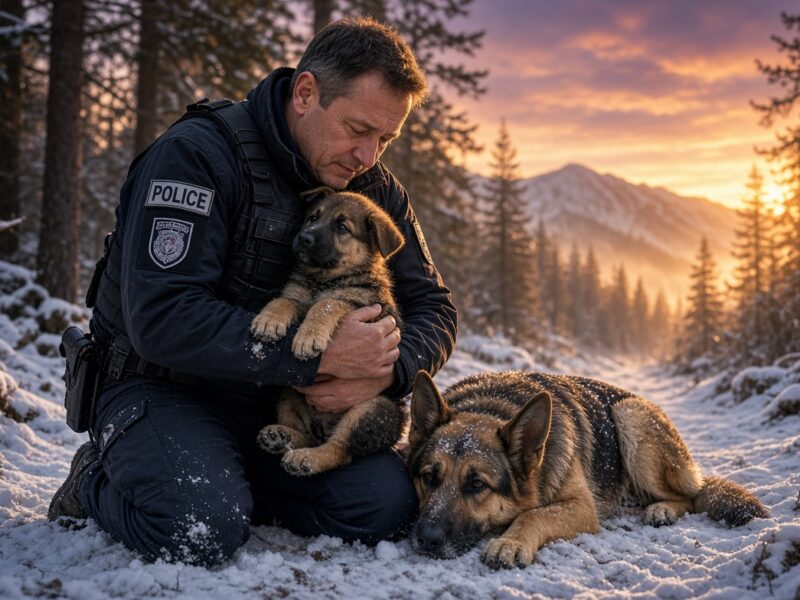
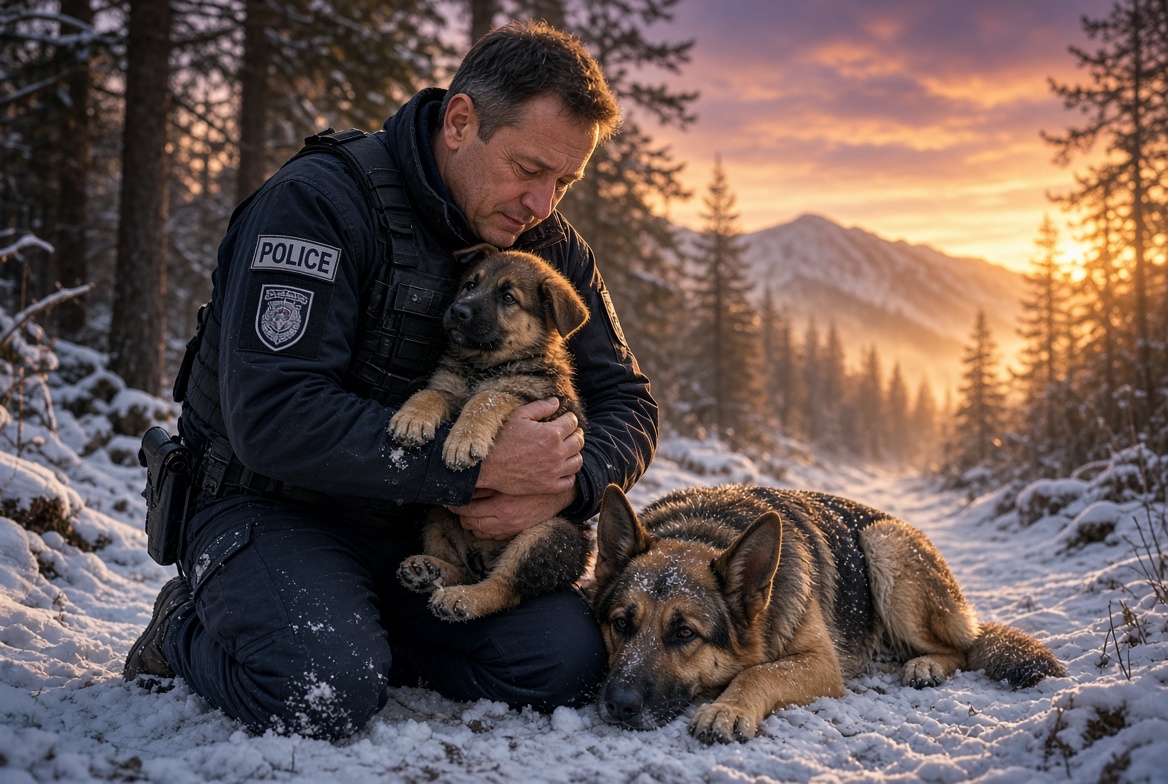
A police officer lost in a collapsing tunnel is guided out by a tiny German Shepherd puppy who refuses to abandon his mother… The rescue that changed all three of their lives forever
Officer Bram Weller had been inside the old service tunnel for twenty-three minutes when he admitted to himself that he was lost. The beam of his flashlight cut through air thick with the smell of wet stone and rusted timber, revealing walls that all looked the same.
He was forty-eight years old, a patrol officer with the Kellogg Police Department, and he had been sent to inspect reports of loose rock near the entrance. What he found instead was a maze of branching passages, faded markings, and the growing certainty that he had made a wrong turn somewhere behind him.
Then he heard it. Not water dripping. Not stone settling. A soft scraping sound, small and deliberate.
He turned. At first, there was nothing in the beam except shadow and broken timber. Then a tiny shape stepped carefully from behind a collapsed support beam. A German Shepherd puppy. No more than nine weeks old, with oversized paws and dusty fur, one ear beginning to lift while the other remained folded. The puppy stared at him with surprising alertness, thin body trembling slightly in the cold.
Bram crouched slowly. “Well,” he said quietly, “you’re not exactly who I expected to meet down here.”
The puppy did not come closer.
Bram reached into his patrol jacket and found a small packet of plain dog biscuits he had grabbed from the station that morning. He broke off a piece and held it on his open palm. The puppy stared at it, then at Bram, then back at the biscuit. “You’re allowed to be suspicious,” Bram said. “But I should warn you, this is the entire menu.”
—
The puppy approached in short, careful steps. He stretched his neck forward, took the biscuit, and retreated just beyond Bram’s reach. He chewed quickly, then stared at Bram’s empty hand.
“Oh, I see. Your guiding fee is going up already.”
For the first time since realizing he was lost, Bram almost smiled. He broke off another very small piece. The puppy accepted it but did not retreat as far. Instead, he turned and walked several steps down the passage. Then he stopped. He looked back at Bram.
Bram remained crouched. The puppy took a few more steps. Looked back again.
“You know something I don’t?”
The puppy disappeared around the corner. Bram followed.
The passage curved, widened, and joined another corridor. The puppy moved with the confidence of an animal following a route he had used before. He never went far ahead. Every few yards, he stopped and checked behind him. Bram noticed the pattern. The puppy was not wandering. He knew this way.
They moved through another turn, then beneath a section where the ceiling dipped low enough that Bram had to duck. The air began to change. Colder. Fresher. Then he saw it. A pale rectangle of daylight in the distance.
Bram stopped for half a second. “Well, I’ll be.”
The puppy continued toward the light. Within minutes, Bram could see the outside clearly. Gray sky, patches of dirty snow, the dark shape of his patrol cruiser beyond the entrance. Relief came quietly. Nothing dramatic, just the welcome certainty of knowing exactly where he was again.
The puppy reached the mouth of the tunnel and stopped. Bram stepped past him until one boot was outside on the frozen ground. Then he turned. “Come on.”
The puppy stayed where he was.
Bram gestured toward the road. “You’ve done your part. Let’s get you somewhere warm.”
No movement. The little German Shepherd stood exactly on the line where daylight met the tunnel floor. His head turned toward Bram, then toward the darkness behind him.
Bram’s expression changed. The puppy looked back again, not at Bram this time. Past him. Deeper into the tunnel.
Then the puppy turned and ran back inside.
“Hey.” Bram stepped after him. The puppy did not go far. He disappeared around the first bend, then slowed. Bram followed with the flashlight raised. “Easy. I’m not leaving you down here.”
The beam moved over stone wall, broken timber, a shallow patch of water. Then it found another shape.
Bram stopped.
Several yards deeper inside, partly sheltered beside the wall, lay an adult female German Shepherd. The mother dog was thin and exhausted. Her body trembled against the cold ground, and when she tried to lift herself at the sound of Bram approaching, her front legs barely held her. She managed only a few inches before lowering herself again.
The puppy hurried to her immediately. He pressed against her chest, then touched his nose to the side of her face. The mother raised her head just enough to look at him. Then she looked at Bram. There was no strength in her posture for warning, no energy for retreat. Only watchfulness.
Bram felt something tighten in his chest. Now he understood. The puppy had known the way out. He could have left. He simply would not leave without her.
He lowered his flashlight slightly so the beam would not shine directly into the mother’s eyes. He took one careful step forward. “It’s all right,” he said softly. “I see her.”
The puppy remained pressed against his mother. Bram looked toward the tunnel entrance behind him. Daylight was still visible around the bend. They were close. Close enough that for one brief second, the problem seemed manageable. Get the puppy outside. Come back for the mother. Call for help. Simple steps.
Bram moved another pace into the tunnel.
A deep sound rolled through the stone above him. He stopped. It was not loud at first, more like a groan traveling through the mountain. The puppy lifted his head. The mother’s ears moved weakly. Bram looked up. A thin line of dust dropped from the ceiling.
Then came a sharp crack.
The entire entrance seemed to shudder. Bram turned toward the daylight. Stone broke loose overhead. The tunnel entrance collapsed.
—
The collapse ended almost as quickly as it began. One moment there had been daylight at the tunnel mouth. The next, Bram Weller was standing several yards outside beneath a drifting cloud of gray dust while broken stone, timber, and frozen soil filled the entrance from floor to ceiling.
For half a second, he did not move. Then he ran toward it.
“Fen.”
The name came out before Bram had time to think about it. He had not officially named the puppy. He had simply needed something to call him during those few minutes in the tunnel. And Fen had been the first name that came to mind. Now it was the only word Bram could manage as he dropped beside the fallen rock and began pulling loose pieces away.
Small stones came free easily. The larger ones did not. Bram grabbed another piece with both hands. A second vibration traveled through the ground. Loose dirt spilled down the face of the collapse.
“Bram, back away.”
He recognized the voice behind him but kept working. A hand caught his shoulder. Captain Lyle Drey, fifty-six, was Bram’s commanding officer and had spent most of his career policing the mountain communities around Kellogg. He had arrived with the first response unit after Bram’s emergency transmission. Behind him, two county rescue workers were unloading helmets, ropes, lights, and stabilization equipment.
“Back away,” Lyle repeated.
“There are two dogs in there.”
“I know.”
“One of them can barely stand.”
“And if this comes down again, there will be a third life trapped under it.”
Bram looked at the wall of rock. Every instinct in him rejected the distance Lyle was asking for. Less than ten minutes earlier, Fen had stood in front of him, chewing a piece of biscuit and staring hopefully at Bram’s empty hand. The puppy had known the route through those dark passages when Bram did not. He had stopped every few yards to make sure Bram was following. He had brought Bram out. Then he had gone back for his mother.
Bram slowly released the stone in his hands.
The rescue workers moved forward only far enough to examine the collapse. One shone a light along the upper edge while the other studied the fractured ground above the entrance. Neither touched anything.
Lyle stepped beside Bram. “How far inside?”
“The mother was close. Maybe thirty yards from the entrance. The puppy was with her.”
“Condition?”
“Puppy was thin but moving well. Mother was exhausted, trembling. She tried to stand and couldn’t.”
Lyle looked toward the blocked tunnel. That was all Bram needed to say.
—
More responders arrived over the next twenty minutes. Yellow tape went up farther down the access road and equipment was carried toward the hillside. Nobody hurried blindly. That bothered Bram even though he knew it should not. Rescue work around unstable ground had its own pace. Every action had to make the next one possible.
Bram remained near the edge of the working area. He kept looking at the same section of rock. Somewhere beyond it was a nine-week-old puppy who had been close enough to daylight to escape. Fen had chosen not to.
Lyle approached again with a radio in one hand. “This tunnel have a name?”
“Nothing marked inside.”
Lyle looked toward the slope and then back toward the entrance. “One of the county guys thinks this belongs to the old East Ridge service network.”
Bram turned.
Lyle continued. “If he’s right, there may be older plans.”
“Where?”
“I’m finding out.”
Lyle walked several yards away and began making calls. Bram hated waiting, but for the moment, waiting was the only useful thing he could do. He paced once along the safe boundary, then stopped when something beside the collapse caught his attention. Cold air. Very faint.
He removed one glove and lowered his hand near a narrow gap between two rocks at knee height. Air moved across his fingers. Not much, but enough.
“Lyle.”
The captain came over immediately. Bram pointed. “There’s air flow.”
One of the rescue workers crouched beside the opening. He did not widen it. Instead, he held his hand near the gap and nodded. “That’s connected to open space somewhere inside.”
Bram lowered himself carefully. “Fen.”
Nothing.
He waited. “Fen.”
Still nothing.
The rescue worker touched Bram’s shoulder. “Don’t assume silence means anything yet.”
Bram nodded, although he had already begun assuming several things he did not want to name.
Lyle’s phone rang. He answered, listened, then stepped away from the group. The call lasted less than two minutes. When he returned, his expression had changed. “I found someone.”
—
Forty minutes later, an older pickup climbed the access road and stopped behind the emergency vehicles. Ansel Pritchard, sixty-eight, was a retired tunnel engineer who had spent much of his career inspecting and maintaining older mine and service passages throughout the Kellogg area. He climbed out carrying a long cardboard tube beneath one arm and a weathered document case in the other. He looked first at the hillside, then at the collapse.
“That entrance wasn’t supposed to still be open,” he said.
Lyle met him halfway. “Can you tell us what’s behind it?”
“Maybe.”
Ansel opened the document case on the hood of a rescue truck. Inside were photocopies, handwritten inspection notes, and several folded plans. He selected one sheet and spread it flat. Bram moved closer. The drawing was old enough that some of the markings had faded, but the network was still visible. A main tunnel, several branches, ventilation cuts, and maintenance passages extending beneath the ridge.
Ansel traced one line with his finger. “If this is the section I think it is, the main entrance isn’t your only way in.”
Bram leaned closer. Ansel pointed toward the far side of the ridge. “There was a maintenance access here. Narrow. Never meant for equipment larger than a small service cart. It hasn’t been used in years.”
“Is it still open?” Bram asked.
Ansel looked at him. “I said there was an access. I didn’t say what condition it’s in.”
Lyle studied the map. “Can you find it?”
“I can find where it should be.”
That was enough. Within minutes, part of the rescue team began preparing to move around the ridge with Ansel. The route would take them uphill through trees and old snow before dropping toward the back side of the tunnel system.
Bram reached for his jacket zipper. Lyle stopped him. “You stay here for now.”
“I know those dogs’ location better than anyone.”
“And if Ansel finds the access, you’ll be useful then. Right now, I need somebody here who knows exactly where they were relative to this entrance.”
Bram wanted to argue. He did not.
Ansel rolled the map carefully. Before leaving, he glanced toward Bram. “Puppy move well?”
“Yes.”
“Good. The mother didn’t.”
Ansel’s face tightened slightly. “Then we don’t waste daylight.”
He followed the rescue team up the slope.
—
Bram returned to the narrow air gap. He crouched again. The space seemed impossibly small. A dark line between two pieces of stone, no wider than a couple of fingers.
“Fen.”
Nothing answered.
Minutes passed. Bram tried once more, quieter this time. “Come on, little guy.”
A gust moved through the trees. Somewhere farther up the road, a truck door closed. Radios murmured behind him. Then Bram heard something. He held completely still.
Scratch.
So faint he wondered whether he had imagined it. He lowered his face closer to the opening. “Fen.”
Scratch. Scratch.
Bram’s hand flattened against the cold stone. Then from somewhere beyond the collapsed entrance came a small, tired whine. Not loud, not strong, but unmistakably alive.
Bram closed his eyes for one second. Fen was still in there.
The relief lasted only as long as the sound, because there was another question the puppy could not answer. Bram looked at the darkness behind the narrow gap and thought of the mother dog trembling on the tunnel floor, unable to stand even before the collapse. Fen was alive, but Bram still had no idea whether Dela was.
—
Ansel led the rescue team around the backside of the ridge, following landmarks that no longer looked much like the ones printed on his old plans. Snow covered the ground between the trees, and years of runoff had changed the slope in subtle ways. What had once been a narrow service trail was now little more than a shallow depression under brush and frozen soil.
Bram followed close behind. Nobody wasted breath on conversation. The sound of boots breaking through crusted snow, equipment shifting against jackets, and Ansel occasionally calling out a direction was enough.
After twenty minutes, Ansel stopped beside a low rise where several rocks formed an uneven line beneath the snow. “It should be here.”
One of the rescue workers looked around. “There’s nothing here.”
“There wasn’t supposed to be much.”
Ansel stepped forward and brushed snow from one of the larger stones. Beneath it, a rusted metal edge appeared. The team moved carefully. They cleared snow first, then loose soil and small rocks. What looked like part of the hillside slowly revealed itself as the upper edge of an old maintenance opening. The original door had long ago collapsed inward, leaving the entrance partly filled with debris.
Bram stood nearby, watching every movement. The weight at the main entrance had been difficult because he could do nothing. This was different. Now there was a direction. There was a place to go.
The rescue workers widened the opening only enough to make it passable. Anything more risked shifting the surrounding ground. One of them tested the space with a light, then disappeared halfway inside before backing out again.
“Passage is open beyond the first few feet.”
“How narrow?” Bram asked.
“Narrow enough.”
Ansel crouched beside the opening and looked at the interior. “This access joins the main tunnel farther in. At least it did on the old plans.”
Lyle, who had followed the group after securing the front site, looked at Bram. “You still know where the dogs were.”
“Near the first bend from the main entrance.”
“If the plans match reality, we should come in behind them.”
Bram nodded. That was the first hopeful thing anyone had said all afternoon.
—
The rescue team prepared quickly. Helmets went on. Lines were checked. Bram was allowed to enter because he was the only person who had seen the exact location of Fen and Dela before the collapse. Ansel stayed outside with Lyle and the remaining crew.
“You follow their instructions,” Lyle told Bram.
“I know.”
“I mean it.”
Bram looked at him. Lyle held his gaze for another second, then stepped back.
Bram lowered himself through the opening. The first section was barely high enough to crawl through. Cold stone pressed close on both sides, and damp soil stained his gloves as he moved forward behind the lead rescuer. The passage widened after several yards, allowing them to crouch, then finally stand. The air smelled of wet rock and old timber. Their lights swept across walls reinforced decades earlier with support beams darkened by age. Some remained straight, others bowed slightly under pressure.
Water dripped somewhere ahead. The sound was steady. Too steady.
One rescuer raised a hand. Everyone stopped. He examined a crack running along the lower wall. “Water’s been moving through here.”
Bram looked at the floor. The ground beneath his boots was darker than the surrounding soil.
They continued more slowly. Every few yards, one of the rescuers checked the walls and ceiling before signaling forward. Bram kept his breathing controlled, but his thoughts were already somewhere ahead. Fen had been alive when he heard the scratching. That had been nearly an hour earlier. Dela had already been struggling to lift her head before the collapse. Bram refused to calculate anything beyond that.
They reached the first junction shown on Ansel’s plan. The left passage was blocked by fallen timber. The right remained open. Bram looked at the angle.
“This way.”
The lead rescuer nodded. They moved through.
The tunnel narrowed again before curving sharply. Then Bram saw something on the floor. A small mark in the damp dust. He crouched. Paw prints. Tiny ones. Some were clear. Others had been partly washed away by water dripping from the wall.
“Fen.”
The name came out quietly. The lead rescuer looked back. Bram pointed toward the prints. “They’re his.”
The marks led around the bend. Bram followed them with his eyes, then stood. They moved again.
Farther ahead, the air became colder. A low mound of debris blocked part of the passage, but there was still enough room to pass along one side. Then Bram’s flashlight reached beyond it. He stopped so suddenly that the person behind him nearly walked into his back.
Two shapes lay against the far wall. One small, one larger.
“Fen.”
The puppy’s head lifted. Not quickly, not with the alert energy Bram had seen earlier, but it lifted. Fen was pressed tightly against Dela’s side. His small body looked even smaller in the wide beam of the flashlight. Dust clung to his fur. One front paw rested against Dela’s chest.
Dela did not move at first. Bram felt his stomach tighten. Then he saw the slow rise of her ribs. Breathing. She was breathing.
Fen lowered his nose to her neck and nudged gently. Dela’s ear moved. That tiny motion felt enormous.
Bram took one step forward. “Easy, little guy.”
Fen looked directly at him. The puppy tried to push himself upright. His legs trembled. He managed to sit for only a second before lowering himself against Dela again. Bram’s chest tightened. Fen had spent whatever energy he had left staying beside her. There was no heroic understanding behind it, no plan. He simply did not want to leave his mother.
Bram moved forward again. The lead rescuer stopped him with one arm. “Wait.”
The floor between them and the dogs looked solid at first glance, but water had seeped up through several long cracks. The soil had softened into a dark, uneven strip stretching across most of the passage. The rescuer crouched and pressed a probe into the ground. It sank farther than Bram expected.
“No. Wait here.”
Bram looked across. Dela was perhaps twelve feet away. Fen even closer. Twelve feet. He had crossed parking lots longer than that without noticing. Now it might as well have been a mile.
“Can we go around?”
“Maybe.”
The second rescuer moved along the wall, studying the edges of the weak section. He found a narrow strip of firmer ground, but part of an old support beam had fallen across it. “We’ll need to secure that side before anyone crosses.”
Bram stared at Fen. The puppy stared back for a moment. Neither moved. Bram slowly lowered himself into a crouch so he seemed less distant.
“You did good,” he said softly. “Stay with her.”
Fen’s ears shifted at the sound of his voice. He leaned into Dela again.
—
One rescuer began unpacking a short anchor line while the other tested the wall beside the weak floor. They spoke in low voices, choosing points that might hold. Bram remained where Fen could see him.
Dela lifted her head less than an inch. It was enough to show Bram how much weaker she had become. Her breathing was shallow. Her body trembled even while lying still. Bram wanted to move. Everything in him wanted to close those twelve feet. Instead, he waited.
The anchor was nearly ready when a faint vibration passed through the ground. Everyone froze. A sound came from beneath them. Deep, slow, not the sharp crack of falling stone. Something heavier.
The weakened soil in front of Bram shifted. A narrow split opened across the dark section of floor. Then another. The rescuer nearest Bram stepped backward. “Move back.”
Bram did not take his eyes off Fen. The puppy lifted his head. The ground between them dropped several inches with a dull sinking sound. Loose dirt slid into the opening. The gap widened.
Bram stood on one side. Fen and Dela remained on the other. They had finally found each other, and they still could not reach them.
—
The section of floor between Bram and the two dogs continued to settle in slow, uneven movements. Dirt slipped into the fresh cracks and the weakened strip widened until it was clear that nobody was going to cross it directly.
The rescue team backed away long enough to reassess the passage. One of the men moved his light along the right-hand wall where the ground rose slightly before narrowing around a damaged timber support. The footing there looked firmer. It was not an easy route, but it offered something the broken center section did not. A way around.
Bram watched while they checked the edge carefully. “How bad?”
“Passable if we go one at a time.”
That was enough. They secured a line along the wall and began moving across the narrow strip. Bram followed behind the lead rescuer, keeping one hand on the line and the other against the cold stone. The route forced them sideways in places. At one point, Bram had to step over an old beam while avoiding the softened ground below.
Fen watched every movement. The puppy had lifted his head again. Dela had not. Bram kept his eyes on her whenever he could. A few more careful steps brought him around the weak section. Then there was nothing between them.
Bram lowered himself slowly. Fen tried to stand. His small legs shook under him, but he managed two uncertain steps before Bram reached forward and lifted him gently. The puppy was lighter than Bram expected. Too light. Fen pressed against his chest for less than a second before twisting around to look behind him.
“Easy,” Bram said.
Fen stretched his neck toward Dela. Bram shifted his grip. “I know.”
The puppy continued looking back. He did not struggle violently. He simply refused to turn his attention away from his mother.
Bram carried him several yards to a section of firmer floor beyond the damaged ground and placed him down beside one of the rescue workers. “Keep him here.”
The man nodded. Bram turned immediately and went back. Behind him, Fen gave a small sound. Bram looked over his shoulder. The puppy was standing at the end of the safe section, staring past him toward Dela. He had not tried to follow, but he had not looked away either.
Bram returned to the mother dog and crouched beside her. Up close, Dela looked worse than she had from across the passage. Her breathing remained shallow. Her body trembled beneath a dusty coat, and when Bram placed one hand near her shoulder, she lifted her head only slightly.
“Easy, girl.”
Dela looked at him. There was fear in her eyes, but little strength behind it. Bram did not try to make her stand. That decision was immediate.
“She’s not walking out.”
The rescue worker beside him agreed. “We’ll bring the soft stretcher.”
The passage suddenly felt smaller, not because anything had changed, because Bram now understood how they had to leave. Carrying Fen was simple. Moving Dela through that narrow route was not.
—
One of the rescuers returned for the folded stretcher while Bram stayed beside her. He kept his movements slow and his voice low. Every few seconds, Dela seemed to search for something. Bram knew what. He turned his head.
“Fen.”
The puppy was still visible farther back. Bram motioned carefully. The rescuer beside Fen allowed the puppy a few steps closer but stopped him before the unstable section. Fen immediately focused on Dela. Her ears shifted. That tiny response changed something in her posture. Not strength. Recognition.
Bram rested a hand lightly along her neck. “He’s right there.”
The stretcher arrived. They opened it beside Dela and planned the lift before touching her. There was no room for sudden movements, no reason to rush the first step and lose time correcting it later. Bram supported Dela’s shoulders while another rescuer positioned the stretcher beneath her. She tried once to push with her front legs. They failed almost immediately.
Fen made another small sound from across the passage. Dela lifted her head.
“Good girl,” Bram said. “That’s enough. Let us do the rest.”
They settled her onto the stretcher. The route back required patience. At the damaged section, two rescuers took the front while Bram supported the rear. The stretcher had to remain level as they moved along the narrow wall route. One wrong angle could force them to stop in a place too tight to adjust.
Fen could not follow through that section safely. Bram crossed first with the stretcher, then returned for him. The moment he lifted the puppy again, Fen turned toward Dela. His small paws pressed against Bram’s jacket as he stretched to see around his arm.
“She’s coming.”
Bram carried him over the narrow section. When they reached firmer ground, he set Fen down. The puppy went directly to the stretcher. He touched his nose to Dela’s face. Dela opened her eyes. That was all. It was enough.
—
The team moved again. The tunnel seemed longer on the way out. The cold felt sharper, the dripping water louder. Every bend required another adjustment of the stretcher. Nobody talked unless they needed to. Bram alternated between helping carry Dela and moving Fen through places where the puppy could not safely walk. Each time Bram picked him up, Fen looked for his mother first. Each time Bram put him down, Fen returned to the stretcher.
Bram stopped trying to encourage him forward. The puppy already knew where he wanted to be.
At one narrow turn, the stretcher caught briefly against an old support. Everyone stopped. Dela’s breathing had grown quieter. Bram lowered himself beside her.
“Come on, girl.”
Fen pressed against the side of the stretcher. Dela’s ear moved. The team shifted the front corner, cleared the support, and continued.
Minutes later, Bram noticed the air changing. It was cleaner, colder in a different way. Then a pale wash of natural light appeared ahead. The maintenance opening. They were close.
The first rescuer climbed out and turned to help guide the stretcher through. Bram lifted Fen. This time, the puppy did not twist as much. He seemed exhausted now, his small body finally giving in to the long hours of cold and fear. Bram carried him toward the opening.
Daylight touched Fen first. Then Bram stepped outside. Someone took the puppy carefully and wrapped him in a blanket. Fen immediately lifted his head. He looked back at the opening.
Bram did too. The stretcher appeared moments later. Hands reached in. Dela was brought slowly through the opening and onto the snow. Fen tried to move toward her. The blanket slipped from one shoulder as he struggled forward. Bram picked him up again and carried him closer.
“You’re both out.”
For the first time since the main entrance had collapsed, Bram allowed himself to believe it. Both dogs were outside. Both were alive.
The relief barely lasted.
—
A woman in a dark winter jacket knelt beside Dela almost immediately. Dr. Sabine Norwood, fifty-two, was a local veterinarian who had been called to the site once the rescue route was confirmed. Her manner was calm and efficient as she checked Dela’s breathing, gums, temperature, and response.
Bram watched her face. At first, Sabine said nothing. Then her expression tightened. “How long has she been like this?”
“She was already weak before the collapse.”
Sabine nodded once. “We need to move now.”
Bram looked at Dela. “She’s out.”
“She is.” Sabine adjusted the blanket around the dog. “But she’s severely depleted and very cold. Getting her out of the tunnel solved one problem. It didn’t solve what the tunnel has already done to her.”
Fen was placed near the stretcher while the vehicle was prepared. The puppy lowered himself beside Dela’s head. He touched his nose to her cheek. Dela did not lift her head this time.
Bram felt the relief inside him change shape. It did not disappear. It simply became fear again.
Sabine rose and looked directly at him. “We’re not out of danger yet.”
—
By the time Bram reached Dr. Sabine Norwood’s clinic, evening had settled over Kellogg, and the temperature had fallen again. Snow melt that had softened the hills during the day was beginning to freeze along the edges of the road. Inside the clinic, the lights were bright, the floors clean, and everything felt almost unnaturally still after the tunnel.
Fen was examined first. The puppy was cold, exhausted, and mildly undernourished, but his heart rate improved once he was warmed and given fluids. He accepted a little food, then looked toward the treatment room where Dela had been taken. Bram noticed that immediately.
“So did he,” Sabine said. She had been moving between both dogs since they arrived, checking temperatures, hydration, breathing, and circulation. Fen responded quickly enough that the staff were able to settle him on a thick blanket near the treatment area.
Dela was different. Her temperature remained low. She was badly dehydrated and so depleted that even small efforts seemed to cost her more than they should. Sabine worked steadily, never rushing. But Bram could hear the difference in the way she gave instructions around Dela. Shorter. More focused.
He stayed out of the way. For the first time since entering the tunnel that morning, Bram had nothing useful to do with his hands. He could not move a rock. He could not carry a stretcher. He could not find another route. He could only wait.
Fen seemed to understand the same problem in his own way. The puppy lay beside the closed treatment room door with his head pointed toward it. At first, Bram tried moving the blanket a little farther back where the floor was warmer. Fen stood, walked back to the door, and laid down again.
Bram looked at him. “All right.”
Fen rested his chin on his paws. Bram sat in a chair nearby.
—
Nearly an hour passed before Sabine came out. “How is she?”
Sabine pulled off one pair of gloves and dropped them into a bin. “She’s responding, but slowly.”
Bram waited.
Sabine glanced toward Fen, then back at him. “There’s something else.”
Bram stood. “What?”
“Fen is underweight, but not nearly as depleted as Dela.”
Bram looked through the narrow glass panel in the treatment room door. Dela was mostly hidden from view. Sabine continued. “I can’t tell you exactly what happened before you found them. I wasn’t there.”
Bram nodded.
“But if food was scarce, it’s possible she was eating less and leaving more for him.”
The sentence settled between them. Bram looked down at Fen. The puppy was asleep now, but even sleeping, his body remained angled toward the door. Bram thought about the tunnel entrance. Fen standing at the edge of daylight, the open road behind him, his mother in the darkness. He had understood why the puppy went back. Now he understood something else. Maybe Dela had been doing the same thing for much longer, choosing the smaller body before her own.
Sabine watched Bram for a second. “It’s only a possibility.”
“I know.”
He appreciated that she did not turn it into a certainty. The truth was already strong enough without decoration.
—
The next several hours moved slowly. Fen woke twice. The first time he drank a little water and accepted another small amount of food. The second time a metal tray clattered somewhere behind the treatment room door. Fen was on his feet immediately. Bram stood at the same moment. They both stared at the door.
A technician passed through without looking concerned. Bram sat back down. Fen did not. He remained standing until the sounds inside became quiet again. Then he lowered himself to the blanket.
Bram leaned back in the chair. “You and me both.”
The puppy’s ear moved. That was the closest thing to an answer Bram received.
Later, Sabine passed quickly through the doorway carrying supplies. Fen rose again. So did Bram. This time, Sabine noticed. She looked at the two of them. Neither spoke. For the first time that night, the corner of her mouth moved slightly. Then she disappeared behind the door.
Bram sat down again. He had spent years believing waiting was passive. That night changed his mind. Waiting required discipline. It required allowing someone else to do the work while every part of you insisted on doing something yourself.
He watched the clock move past midnight. Outside, the clinic windows reflected the waiting room more clearly than the street. Bram could see himself sitting there, jacket still marked with dust from the tunnel, boots drying slowly near the chair. Fen slept in short stretches. Each time footsteps approached the door, the puppy woke. Bram began doing the same.
Just after one in the morning, Sabine came out and sat across from him. That frightened Bram more than if she had remained standing.
“How bad?”
Sabine folded her hands. “She’s still weak. Very weak.”
Bram waited for the rest.
“But her temperature is coming up. Her circulation is better. She’s responding to fluids.”
“Is she going to make it?”
Sabine looked at him carefully. “I think her chances are much better than they were when she came through that door.”
It was not the answer Bram wanted. It was the honest one. He nodded. “Can Fen see her?”
“Not yet.”
Fen lifted his head at the sound of his name. Sabine looked toward him. “He needs rest, too.”
Bram almost smiled. “Tell him that.”
“I’m a veterinarian, not a magician.”
The line was dry enough to catch Bram off guard. A quiet breath of laughter escaped him before he could stop it. Fen watched both of them, apparently unimpressed.
—
The moment passed. The night continued. At some point, Bram must have fallen asleep for several minutes because he opened his eyes to pale gray light beginning to form against the windows. Fen was still near the door. Sabine appeared again. This time, she did not hurry.
Bram stood. Fen did, too. Sabine looked first at the puppy, then at Bram.
“She’s stable.”
Bram said nothing. The word needed a second to become real.
“She’s not well,” Sabine continued. “She has a long recovery ahead. But the immediate danger has passed.”
Bram let out a breath he had not realized he was holding. Fen moved closer to the door. Sabine crouched and rested one hand near him. “She’ll need quiet, warmth, regular meals, very little stress.”
Bram nodded. “And him?”
“They should stay together if possible.”
That answer came quickly. Bram looked at Fen. The puppy was staring through the glass panel.
Sabine stood. “We can keep them here while we arrange the next step. After that, there are options.”
“What kind?”
“A temporary foster rescue placement. Eventually, a permanent home if one becomes available.”
Bram looked back toward the treatment room. Sabine studied him for a moment. “If you’re asking whether they can stay together, that would be the preference.”
“I wasn’t asking.”
“No.”
Bram looked down at Fen. The puppy had lowered himself against the bottom of the door again. Sabine waited. Bram stayed quiet.
For hours, the only question had been whether Dela would survive the night. Now that question had an answer. A new one had taken its place. Where would Fen and Dela go when they left the clinic? And why did Bram already dislike the idea of that answer belonging to someone else?
—
Bram brought Fen and Dela home three days later under an emergency foster arrangement approved through the local rescue network. Sabine had been clear that both dogs needed quiet, warmth, regular food, and as little disruption as possible. Bram’s house offered all four.
What it did not offer was experience. Until that week, the place had been orderly in the way houses often became when only one person lived in them. Bram left for work, returned at predictable hours, ate at the kitchen table, and rarely found anything where he had not left it.
Fen changed that within twenty minutes. The nine-week-old puppy inspected every chair leg, rug edge, cabinet corner, and doorway he could reach. He followed Bram from the kitchen to the living room, then back to the kitchen, apparently convinced the second trip might reveal something the first had missed.
Dela moved differently. She entered slowly and stopped just beyond the doorway. Her eyes tracked the room before her paws did. Fen wandered ahead, but Dela remained close enough to see him. Bram did not pull her forward. He set down two bowls of water, prepared the measured meals Sabine had instructed him to give, and stepped away.
Fen went to his bowl immediately. Dela waited. Only after Fen began eating did she approach hers. That first evening told Bram more than any explanation could have.
Dela ate quickly, then carried two pieces of food away from the bowl and pushed them beneath the edge of a small cabinet. Bram saw it. He said nothing. The following morning, he found another piece hidden behind a chair leg. He left that one, too.
Fen, meanwhile, adapted to the house as though he had been invited months earlier and simply arrived late. He discovered that Bram’s boots had laces. He discovered that the kitchen mat could be pulled several inches across the floor if approached with enough determination. He also discovered that following Bram into every room increased the likelihood of being noticed.
Dela remained more cautious. She slept beside the front door instead of on the thick bed Bram had placed near the heater. If Bram moved too quickly across the room, her head came up. If Fen disappeared around a corner, she stood until he returned. Every time she woke, she checked two things. The door, then Fen.
Bram began to recognize the pattern. He did not try to change it. Each morning, the bowls were full again. Each evening, the house stayed warm. Fen was always there.
—
Days passed, then a week. Bram returned from patrol one afternoon carrying a small paper bag. Fen met him before he had removed his jacket. Dela remained farther back, watching from near the living room.
“You remember these?”
Bram reached into the bag and took out the same kind of plain dog biscuit he had carried into the tunnel. Fen’s attention sharpened immediately. Bram broke off a small piece. The puppy took it. For a moment, Bram expected him to eat it where he stood. Instead, Fen turned and trotted toward Dela. He lay down beside her front legs and only then began chewing.
Bram stood in the kitchen doorway with the remaining biscuit in his hand. He did not say anything. There was nothing to add.
—
The weeks that followed changed the house gradually. Dela began gaining weight. The sharpness around her ribs softened. Her steps became steadier. She no longer hesitated before approaching the food bowl. Although for a while Bram still found small pieces hidden beneath furniture. Then one morning there were none. He checked twice. The habit had simply stopped.
Dela also moved her sleeping place. First she left the front door and began lying halfway between the entry and the living room. Several days later, she chose the rug near Fen. Bram noticed every change, but treated none of them like an achievement that required attention. He had learned something during that night at Sabine’s clinic. Not every improvement needed to be encouraged out loud. Some needed room.
Ansel came by once during the third week. He stood in the kitchen while Fen investigated his boots. “Looks like you’ve been assigned permanent supervision,” Ansel said.
“Temporary.”
Ansel looked toward Dela, then back at Fen, who had now settled on Bram’s foot. “Of course.”
Bram gave him a look. Ansel smiled and let the subject go.
He had been working with the city and county to review several older service tunnels around Kellogg. What began as a favor after the collapse had turned into regular consultation. Some entrances were being sealed, others were being marked for inspection. At sixty-eight, Ansel had thought the useful part of his career was behind him. Apparently, the mountain disagreed.
“I found three inspection records nobody’s looked at in fifteen years,” he told Bram.
“That good?”
“No. Useful? Very.”
That answer seemed to satisfy him.
—
Spring came slowly to the hills around Kellogg. Snow pulled back from the lower slopes. Water ran louder in the ditches. The afternoon light stayed longer against the windows. By then, the emergency foster paperwork had become foster to adopt. Bram did not make a ceremony of it. Neither did Fen. The puppy celebrated by dragging one of Bram’s gloves halfway across the living room.
Dela watched him do it and for the first time did not get up.
That happened on a quiet evening several weeks later. Bram was carrying a cup of coffee from the kitchen when he passed the living room and stopped. Dela was asleep. Not resting. Sleeping. Her head lay flat against the rug. Her breathing was slow and even. Fen was curled several feet away.
Bram waited. Usually, Dela would have heard him. Usually, one ear would move, her head would rise, she would check the door, then Fen. This time, she did none of those things.
Bram stood there for several seconds holding the cup. Dela slept through all of it. That was the moment he understood that recovery was not always visible in weight gained or strength returned. Sometimes it was a dog deciding without knowing she had decided that she no longer needed to keep watch.
Bram walked quietly past.
—
A week later, he signed the final adoption papers. Fen and Dela were staying. There was no grand announcement. The house simply stopped being temporary.
On a clear morning in early spring, Bram stepped onto the porch with both dogs. He reached into his jacket pocket and found one last biscuit. Fen appeared immediately. Some things never change.
Bram broke off a piece and handed it to him. Fen took it. Bram watched. The puppy did not carry it to Dela. He did not look over his shoulder first. He sat beside Bram’s boot and ate it there.
Across the yard, Dela rested near the porch steps, calm and comfortable, watching the morning without needing to monitor every movement around her.
—
Later, the three of them walked along a quiet road above Kellogg. Fen moved ahead with the confidence of a puppy who had discovered the world was larger than one dark tunnel. After several yards, he stopped. He looked back. Bram and Dela were still behind him. Fen waited until they reached him. Then he turned and continued.
The first time Bram followed that little dog, Fen had shown him the way out of darkness. In the end, he had done something more. He had led all three of them toward a place where none of them had to leave alone.
Fen and Dela’s story reminds us that being saved is not always about strength. Sometimes it begins with trust. Sometimes it means refusing to leave someone behind. And sometimes the greatest change in a life starts with something as small as a frightened puppy choosing to look back.
Bram thought he was simply helping two dogs survive a dangerous tunnel. Instead, they gave him something he had not realized was missing. A home that no longer felt empty. A reason to slow down. And two lives that had chosen to trust him.
Perhaps that is the quiet lesson in their journey. Love does not always arrive loudly. Sometimes it comes tired, cold, uncertain, and asking only one thing from us. Stay.









