A Navy SEAL’s Dog Froze on a Duffel Bag in a Crowded Diner — What the Bomb Squad Found Inside Will Leave You Breathless
Clint pressed Beckett against the tile wall beside the fire exit and snapped the cuffs shut before the second click finished echoing off the walls.
“There you go,” Clint said.
He stepped back and crossed his arms.
He looked satisfied.
“Not so tough now, are you?”
Forty feet away, a German Shepherd sat completely still.
Kodiak had not moved in seven minutes.
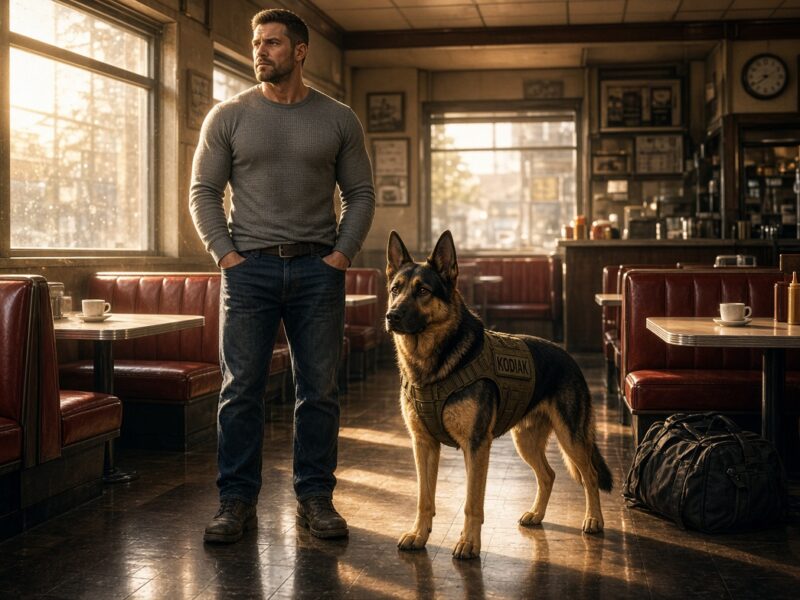
His amber eyes were locked on a black duffel bag tucked under the last booth near the emergency door.
His tail lay flat against the linoleum.
His breathing was silent and controlled.
Nobody in Ruby’s Kitchen was looking at the dog.
Nobody understood what that posture meant.
That was the problem.
Forty-five minutes earlier, Beckett had pulled his truck off Interstate 40 just past the Tennessee state line.
He had been driving since three in the morning.
His leave had started the night before.
He had a cabin rented near the Smokies.
He wanted eggs and black coffee before the mountain roads.
He parked at the far end of the lot facing the exit.
He scanned before opening his door.
Ten years with SEAL Team 4 did not switch off when you signed your leave papers.
Kodiak waited in the back seat.
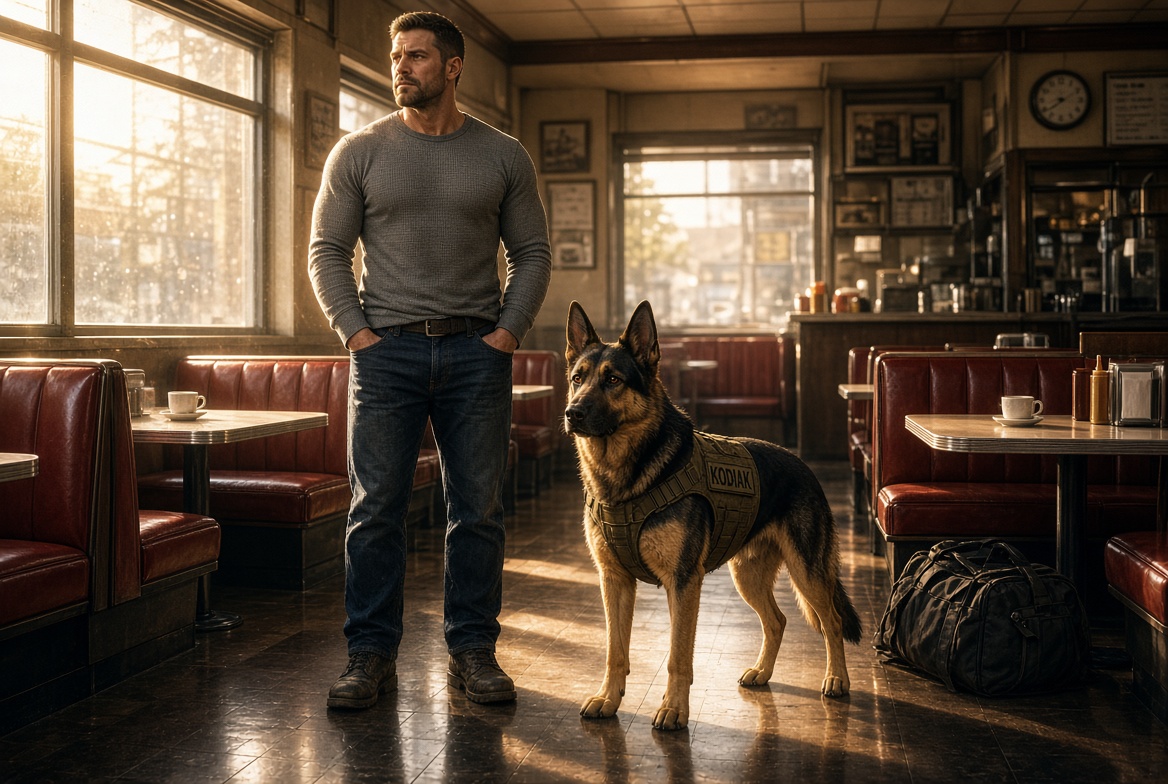
The German Shepherd wore his tan service vest over his black and tan coat.
He watched Beckett’s face.
When Beckett opened the door and gave the signal, Kodiak stepped out and fell in on his left side without a sound.
They crossed the parking lot together.
Beckett wore dark jeans, a gray thermal, and boots that had seen serious use.
Three days of beard on his jaw.
He looked like a man who lived close to the ground and was comfortable there.
Ruby’s Kitchen sat off the highway like it had always been there.
A hand-painted red sign.
A gravel lot half full of semis and pickup trucks.
Inside, it smelled like coffee and bacon grease and the particular warmth of a room that opens at five every morning and never fully cools.
Beckett held the door.
Kodiak walked through beside him.
A few heads turned.
A woman in the second booth pulled her purse closer.
A trucker near the window looked over once and went back to his phone.
A little boy in a blue jacket pointed at the dog.
His mother, Cassie, pulled his arm down gently and smiled an apology at no one in particular.
Beckett chose the table in the back left corner.
Clear sightlines to both exits.
Solid wall behind him.
Standard.
He pointed down.
Kodiak slid under the table and set his head on his front paws.
He did not look around.
He waited.
A waitress named Bonnie came over with a coffee pot and a tired, genuine smile.
She glanced at Kodiak and didn’t miss a beat.
“Black?” she asked.
“Please,” Beckett said.
“Scrambled eggs. Four toast.”
“Coming right up.”
She poured without spilling a drop.
Beckett wrapped both hands around the mug and watched the room.
The breakfast crowd moved the way breakfast crowds always move.
Slow and comfortable and completely unaware of anything outside their immediate table.
Eleven minutes passed.
Kodiak lifted his head.
The movement was small.
Most people would have missed it.
Beckett did not miss it.
He set down his fork.
Kodiak’s ears pivoted forward and locked.
His nostrils flared in fast, deliberate pulses.
His body went still in a way that was different from resting still.
Operational still.
The fur along his spine rose in a thin ridge.
Beckett said nothing.
He watched the dog.
Kodiak stood up from under the table.
He bumped the underside of the tabletop as he rose.
He stepped into the aisle and faced the far corner of the restaurant.
Not toward the kitchen.
Toward the last booth near the emergency exit.
The booth was empty.
A black duffel bag sat on the seat, pushed halfway under the table.
No tags visible.
Zipped shut.
Kodiak took one step toward it.
Beckett felt the familiar shift in his chest that came before every breach.
Not fear.
Something colder and more useful than fear.
“Hold,” he said softly.
Kodiak stopped.
His nose worked the air in rapid pulls.
He looked back at Beckett once, then back at the bag.
Beckett knew what that look meant.
He had worked with Kodiak through three operational tours.
Kodiak was certified in explosive compound detection through the Naval Special Warfare K9 program.
He had never thrown a false alert in four years of active service.
Not once.
Beckett dropped two twenties on the table.
He stood slowly.
He kept Kodiak’s leash in his right hand and moved down the aisle.
Kodiak walked ahead of him, pulling with controlled urgency, nose working the air.
They stopped five feet from the bag.
Kodiak sat, tail flat, chin slightly lowered, eyes fixed and unblinking.
Confirmed alert posture.
Beckett looked at the emergency exit.
He looked at the bag.
He looked at the number of people between that corner and the front door.
He counted eleven occupied tables.
He counted Cassie and the boy in the blue jacket.
He counted two teenage girls sharing pancakes near the window.
He counted a family of four near the center aisle.
He needed to move everyone out without causing a stampede.
He needed thirty seconds to think.
He did not have them.
People assume that because something looks ordinary, it must be safe.
The danger in that assumption is that ordinary is exactly where the extraordinary goes to hide.
“Excuse me.”
The voice came from behind him.
Sharp.
Practiced.
The voice of someone who had been waiting for exactly this kind of moment.
Beckett turned.
Clint walked down the aisle with the confident stride of a man who had something to prove.
He was mid-thirties, thick through the chest, wearing a dark polo with a small Ruby’s Kitchen Security emblem stitched on the chest pocket.
His name tag read Clint in block letters.
His hand rested on the handle of a pepper spray canister clipped to his belt.
Beckett had encountered his type before.
Not in combat.
In the vicinity of every military base he had ever been stationed near.
Men who had almost become something and had never finished that sentence.
“You cannot bring that dog up here,” Clint said.
“This is a dining area. Customers are eating.”
“He is a certified service animal,” Beckett said.
He kept his voice flat and even.
“Active working dog. He is in confirmed alert posture right now on that bag. We need to clear this corner immediately and make contact.”
“I can see what he is,” Clint said, glancing at Kodiak with visible contempt.
“He’s a large dog in a restaurant where large dogs don’t belong. I’ve already had three complaints this morning.”
“That bag under that booth,” Beckett said.
“Do you know who left it? When did it get there?”
Clint looked at the booth.
He looked back at Beckett.
“That is not your concern.”
“It is everyone’s concern right now.”
Clint pointed toward the front of the restaurant.
“Sir, I’m going to ask you once to take your animal, return to your table, or exit the building.”
Beckett did not move.
“My dog is trained by the United States Navy to detect explosive compounds. He is alerting on that specific bag right now. This is not a behavior issue. This is a confirmed threat assessment.”
Clint stared at him for a long moment.
His jaw tightened.
Then he turned and walked to the front counter.
He leaned over and said something to Wanda, who was standing behind the register.
Wanda was in her fifties, broad-shouldered, silver hair pinned back.
She ran Ruby’s Kitchen the way someone runs something they built from nothing.
With absolute authority and zero tolerance for complications.
She looked at Beckett.
She looked at Kodiak.
She walked out from behind the counter.
“Sir,” her voice was polite, but final.
“I appreciate that you have a service animal, but my staff is telling me you’re creating a disturbance, and I can’t have that in my restaurant. I need you to return to your table, or I’ll need to ask you to leave.”
“Ma’am,” Beckett said.
He looked at her directly.
“I am active-duty United States Navy. My dog is a trained explosive detection K9. He is giving me a confirmed positive alert on the bag in that last booth. I’m not asking you to take my word for it. I’m asking for two minutes to verify, and then we decide together what to do.”
Wanda looked at the bag.
She looked at Kodiak, still sitting rigid and motionless.
Something crossed her face.
Not quite belief.
Not quite dismissal, either.
“Clint,” she said, “call the sheriff.”
“Already on it,” Clint said, phone out.
Beckett didn’t argue.
He felt a small loosening in his chest.
Law enforcement could call in the right resources.
He just needed the next responder to actually listen.
He turned back to Kodiak.
The dog had not moved.
Not looked away from the bag.
Not shifted his weight.
He was a statue built from muscle and training and absolute faith in the work.
There is a kind of courage that looks like stillness.
People misread it as submission.
It is the precise opposite of that.
Deputy Price arrived in nine minutes.
He walked in with the slow roll of someone who had never seriously been wrong about anything.
He assessed the situation the way someone who had attended a seminar on situational assessment might do it.
He looked at Beckett.
He looked at Clint and Wanda by the counter.
He made his decision before he reached the back of the room.
“All right,” Price said.
He stopped in front of Beckett.
“Let’s keep this simple. You take the dog, walk out the front, and we’ll clear up any confusion in the parking lot.”
“There’s no confusion,” Beckett said.
“My dog has given a confirmed explosive detection alert on that bag. We need to evacuate this building and contact the state police bomb disposal unit right now.”
Price looked at the bag.
He looked at Kodiak.
“That bag?”
“Yes.”
“That’s where someone’s got their gym clothes.”
“Possibly. But Kodiak does not alert without compounds being present. He is not wrong.”
Price looked at Kodiak for a long moment.
The dog had not moved.
Not a muscle.
Not a breath more than necessary.
Eyes absolutely fixed on the duffel bag.
“Look,” Price said.
“I’m not calling a bomb squad because a dog sat next to someone’s luggage. What I am doing is removing a disruptive individual from private property at the owner’s request. That’s you. Let’s go.”
Beckett measured every syllable.
“Deputy, if there is a device in that bag and it triggers before we clear this room, you will carry the weight of every person in here for the rest of your life.”
Price stepped closer.
He used his size the way men like him always did.
“You’re going to want to stop telling me how to do my job.”
“Then do it,” Beckett said quietly.
The table nearest the corner went completely still.
Cassie had stopped moving.
She had her hand on Toby’s shoulder, and she was watching with wide, uncertain eyes.
Price reached for Beckett’s shoulder.
Beckett let him.
He had already run the calculation.
Resisting would end with him on the floor, Kodiak caged, and the bag unattended while chaos unfolded around it.
He chose the mission over his own comfort.
He always did.
Price turned him around and pressed him against the tile wall beside the fire exit.
The cuffs came out fast.
Left wrist.
Right wrist.
Click and click.
“Trespassing and obstruction,” Price announced to the room.
“Situation is under control.”
Phones had come out across the restaurant.
Small glowing screens catching the overhead light.
Beckett turned his head and found Kodiak in his sightline.
The dog was watching him.
The protective instinct was running hot behind those amber eyes.
Beckett could see it clearly.
Kodiak was within seconds of making the decision Price would deeply regret.
Beckett pressed two fingers tight against his thigh.
A small, precise movement, barely visible.
Kodiak saw it immediately.
He broke eye contact with Price.
He turned back toward the duffel bag.
He sat.
The fur on his back smoothed flat.
His breathing slowed.
Perfect discipline.
Absolute trust.
“What did you just do?” Price demanded.
“Told him to hold his position,” Beckett said.
“He’s still alerting. The threat hasn’t changed.”
“The only threat in this building is you.”
Price grabbed his radio.
“Dispatch, this is Price at Ruby’s Kitchen off 40. One in custody, situation stable.”
Clint stood near the counter with his arms folded and his chin up, looking satisfied in the way people do when they mistake winning a small argument for being right.
Wanda stood beside him.
She was less certain now.
Her eyes kept returning to Kodiak.
The dog had not moved.
Not when Price had grabbed Beckett.
Not when the cuffs went on.
Not when the radio crackled.
Kodiak sat in front of that bag like he had been poured from iron and left to set.
When a person ignores a warning, they are not being brave.
They are simply choosing not to look at what frightens them.
In the fourth booth from the back, on the opposite side of the restaurant, a man named Roland had stopped eating.
Roland was seventy-six years old.
He had a face like weathered limestone and hands that had done hard work across several different decades.
He wore a faded cap with VIETNAM stitched in gold thread, worn thin at the brim from years of handling.
He had served two tours with the 101st Airborne and come home with a limp and a knowledge of things that couldn’t be untaught.
He had been watching Kodiak for five minutes.
He had seen the locked front legs, the flat tail, the absolutely fixed stare on one specific point, the total absence of any ordinary dog behavior.
No panting.
No glancing around.
No reaction to the noise and movement of the room.
He had seen that posture once before.
Outside Hue.
1968.
The dog that day had been right.
Roland set his coffee cup down.
He stood up.
His knees made their usual complaint.
He ignored them.
He moved to the center of the restaurant and stopped.
“Everyone stop what you’re doing,” Roland said.
Loud.
Flat.
Completely without panic.
The room went quiet.
Price turned.
“Sir, please return to your—”
“Son.”
Roland looked at him with the particular look of a man who has seen things that reorganize a person’s understanding of importance.
“Be quiet for thirty seconds.”
Price opened his mouth, then he closed it.
Roland looked at Kodiak.
He looked at the bag.
He looked at Beckett, still handcuffed against the wall, and saw the posture, straight spine, level eyes, not a trace of fear or defeat in his expression.
He recognized a service member in three seconds flat.
“What branch?” Roland asked.
“Navy,” Beckett said.
“SEAL Team Four. That dog is certified explosive detection through the NSW K9 program. He has been in confirmed alert for over fifteen minutes.”
Roland nodded.
He turned to face the restaurant.
“Listen to me,” he said.
His voice did not rise.
It did not need to.
“I served with military working dogs in Vietnam. I know what that posture means. I know it in my bones. That dog found something in that bag. The man in the handcuffs is telling you the truth. We are going to walk out of this building right now. All of us. Slowly. No running. Leave your belongings on the table. Move toward the front door.”
Two full seconds passed.
Nobody moved.
Then Cassie grabbed Toby by the arm and stood up.
That was enough.
The room began to move.
“Walk,” Roland said, guiding people toward the front.
“Stay calm. Give that corner a wide path. Walk.”
People filed out.
The teenagers left their pancakes.
The trucker left his jacket.
The family of four left a twenty on the table for a bill they’d never see.
Bonnie walked out last from behind the counter, still holding an order pad, and didn’t seem to realize it until she was already outside.
Wanda watched her restaurant empty, and for the first time all morning looked genuinely afraid.
“Do what he says,” she said to Clint.
Her voice had changed entirely.
Clint looked at the bag.
He walked out the front door faster than anyone.
Price stood frozen near Beckett.
His radio was in his hand.
The color had left his face.
“Take the cuffs off me,” Beckett said.
No anger.
No tone at all.
Just the next necessary action.
Price reached for his key.
His hands were shaking.
He dropped it.
He picked it up.
He got the cuffs free.
Beckett rolled his wrists once and stopped thinking about them.
“Get outside and call the Tennessee State Police Bomb Disposal Unit,” Beckett said.
“Tell them you have a confirmed K9 alert on a suspected improvised device inside a commercial structure. Tell them you need the heavy response team. Do not use your radio inside this building. Go.”
Price nodded.
“Walk,” Beckett said.
“Don’t run.”
Price walked out.
Beckett turned back to Kodiak.
The dog had not moved.
“Good boy,” Beckett said.
“Stay.”
He positioned himself between the bag and the exit and waited for the professionals.
The space between a warning and a response is where catastrophe lives.
It is narrow.
It moves fast.
The ones who save lives are almost always the ones who refuse to let that space go unchallenged.
The state police arrived in twelve minutes.
Three black SUVs and the armored EOD truck came off the highway exit hard and filled the parking lot.
Uniform troopers pushed the evacuated crowd further back past the gravel, past the tree line, past the place where the land dropped toward the creek.
The bomb squad captain’s name was Tanner.
He met Beckett at the front entrance.
Compact and precise, with the kind of calm that comes from having done this in conditions that would have ended most people.
“Your dog,” Tanner said, looking past Beckett into the restaurant.
“What’s the certification?”
“Naval Special Warfare K9 program. Explosive compound detection. He’s been on a confirmed alert for twenty-four minutes. Target is the black duffel bag, last booth, left side near the fire exit. He has not broken position.”
Tanner studied Kodiak through the open door.
The dog sat exactly where he had been left, tail flat, eyes fixed, completely motionless.
“Textbook passive alert,” Tanner said.
“Yes.”
Tanner turned to his team and gave three rapid instructions.
Two technicians pulled suits from the armored truck.
A third deployed the robot.
Beckett walked Kodiak outside to the outer edge of the perimeter.
Kodiak pressed against his left leg and, for the first time in twenty-five minutes, exhaled a long, slow breath.
Beckett scratched behind his ears.
He could feel the coarse fur under his fingers.
He kept his eyes on the building.
Roland stood at the edge of the crowd.
The old veteran had gathered about a dozen people near him and was explaining quietly and without drama what was happening and why they needed to stay calm.
The crowd was listening.
Roland had that effect.
Price sat on the front bumper of his cruiser, elbows on his knees and head down.
The swagger was entirely gone.
He sat the way a man sits when he has finally understood what he almost allowed to happen.
Tanner’s voice came through the external radio speaker.
“Robot is at the target. Lifting outer material. I have eyes inside the bag.”
A pause.
Two full seconds.
“I am seeing wiring. I am seeing a device. Two pipe sections bundled together. Heavy wiring connecting them. I see a digital timer module. The display is active.”
The crowd went silent.
Even the highway seemed quieter.
“Time frame?” Tanner said.
“Eight minutes twenty seconds,” the technician reported.
Tanner did not hesitate.
“Send Brennan with the disruptor right now.”
The technician in the full bomb suit moved toward the entrance carrying the water disruptor.
From a distance, the suit made him look like someone from another world.
He moved slowly because the suit weighed nearly eighty pounds, and there was no faster way to move while wearing it.
Beckett watched the timer on Tanner’s monitor.
Seven minutes.
Six.
The air over the parking lot was absolutely still.
“Disruptor is placed,” the radio said.
“Falling back to cover.”
The suited figure reappeared in the doorway.
He rounded the corner of the building and pressed against the brick.
“Clear to fire,” Tanner said.
“Three. Two. One.”
The crack was sharp and clean.
Not an explosion.
A controlled, surgical sound.
The high-pressure water jet fired directly into the device’s firing mechanism, destroying the electrical circuit before it could complete its path.
Silence.
Then, “Target is neutralized. Mechanism is destroyed. Main charge is intact but completely inert. Building is secure.”
The breath that moved through the crowd was audible.
Tanner extended his hand to Beckett.
“Your dog saved this building.”
Beckett shook it.
“He did his job.”
“Get that animal a steak.”
“Already planned on it.”
The forensic team moved in.
The device was photographed and cataloged and placed in a containment vessel.
Investigators left to pull security footage from the highway interchange.
The device had a timer set to a specific window, which meant it had not been random.
Someone would answer for it.
Forty minutes later, the chief of the county sheriff’s office, a man named Merle, arrived in a white SUV.
He went directly to Price.
The conversation lasted four minutes.
Merle took Price’s badge.
He took his service weapon.
He told Price to wait for transport.
Price didn’t say a word.
He sat back down on the bumper of his cruiser and stared at the asphalt between his boots.
He looked like a man who had spent the morning dismantling everything he thought he understood about himself.
The crowd came back toward the parking lot.
Most of them were looking for Beckett.
Roland found him first.
The old veteran walked up with his hand out.
“You held it together,” Roland said.
“Even in the cuffs. Most men wouldn’t have.”
“Someone had to watch the bag,” Beckett said.
Roland looked down at Kodiak.
The dog looked back up at him with level, quiet eyes.
“You know,” Roland said, “I saw a dog hold that exact posture once before. Outside Hue. 1968. Cold morning. Nobody wanted to listen then, either.”
He paused.
“The dog was right. He was always right.”
Beckett nodded.
Roland ruffled Kodiak’s ears the way old veterans do it, without asking permission, with total confidence, and walked to his truck.
He left before anyone could make a speech about him.
Cassie found Beckett next.
She came through the edge of the crowd with Toby on her hip.
The boy was holding a plastic dinosaur in one hand and had apparently decided the whole morning had been a reasonably interesting adventure.
Cassie stopped a few feet away.
Her eyes were red.
“My son was sitting right next to that booth,” she said.
“He was trying to climb on the seat back. I had to pull him down twice.”
She pressed her hand over her mouth for a moment.
Then she steadied herself.
“Thank you. I don’t know what else to say. Just thank you.”
She reached a hand toward Kodiak.
The dog looked up at Beckett.
Beckett gave a small nod.
Kodiak stepped forward and pressed his nose gently into her palm.
He sat still and let her breathe.
Toby leaned down from his mother’s hip and studied the dog with enormous seriousness.
“Is he good?” the boy asked.
“He’s the best,” Beckett said.
Toby considered this and nodded, apparently satisfied, and went back to his dinosaur.
Wanda came last.
She had been standing at the back of the crowd for the better part of an hour.
She walked up with her hands folded in front of her and stopped a few feet away.
“I owe you an apology,” she said.
“You told me exactly what was happening. I didn’t listen. I looked at how you were dressed and I decided you were a problem instead of a warning.”
She glanced at Kodiak.
“I’ve been running this place for nineteen years. I thought I knew how to read people.”
She stopped.
“I was wrong.”
Beckett looked at her for a moment.
“You were trying to protect your customers, Wanda. You just had the wrong threat in mind.”
She exhaled.
“Next time I’ll listen first.”
“That’s all anyone can ask.”
She turned to go, then she stopped.
“You didn’t finish your eggs,” she said.
She looked at Kodiak.
“And neither did he.”
Twenty minutes later, Beckett sat at the same corner table, back against the wall, clear sightlines to both exits.
The eggs were fresh, and the coffee was hot, and Bonnie had brought both without being asked.
On the floor beside him, Kodiak was working through a plate that Wanda had assembled herself.
Scrambled eggs.
Three strips of thick-cut bacon arranged in a careful row on a clean ceramic plate.
And a biscuit set to the side.
The dog ate with the same focused deliberateness he applied to everything else.
Tanner stopped by on his way out the door.
He looked at the plate on the floor.
“I said steak,” he said.
“This is what was available,” Beckett said.
“He’s not particular.”
Tanner smiled and went back to his people.
Outside the windows, the parking lot was clearing.
The semis were pulling back in off the shoulder.
The highway sound returned the way it always does.
Continuous and indifferent and oddly comforting after an hour of sirens.
Beckett drank his coffee.
He thought about the cabin in the Smokies.
He thought about the mountain roads in the morning.
He thought about nothing, which after a morning like this felt like more than enough.
Kodiak finished his eggs.
He stood up.
He walked to the window and looked out at the parking lot, nose working the air quietly and methodically, the way it always did.
Then he came back.
He lay down against Beckett’s left boot.
He closed his eyes.
The mission was over.
The ones protecting us are often the ones we dismiss first.
The ones who know the truth are often the ones we silence.
And sometimes the most important thing in a room full of noise is one dog who simply refuses to look away.









