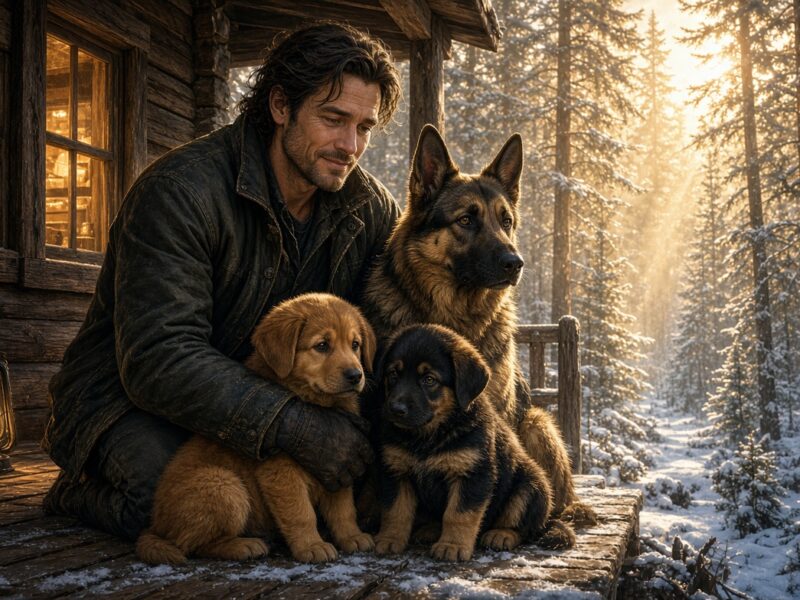
A Former SEAL Heard a Military Dog’s Alert Bark in the Frozen Forest — What He Found Guarding Two Puppies Will Leave You Speechless
The bark came at 7:42 a.m., and Mason Reed knew it wasn’t a dog asking for help.
It was a dog giving a report.
He stood beside his cabin in the frozen timber west of Bend, Oregon, a splitting maul in his gloved hands and his breath hanging white in the air. Somewhere down the slope, past the frost-stiff pines of the Deschutes National Forest, a single bark rang out. Short. Controlled.
Then a second, spaced almost perfectly.
Then a third.
The gas station thermometer on Century Drive had read nineteen degrees when he’d driven past it the day before. It felt colder now.
Mason had spent years beside military working dogs. He knew that rhythm the way other men knew their own phone number.
Alert. Mark. Hold.
“No,” he said quietly, and the word turned white and vanished.
He had come up here to stop answering that kind of call.
Two years ago, he had stopped.
This morning, the forest had other plans.
A hard gray morning had settled over the slopes, and the pines stood stiff under a skin of frost.
Low fog pressed between the trunks, turning the trail above Tumalo Creek into a narrow tunnel of silver air and old needles.
Mason breathed slowly, because slow was the only pace that hadn’t failed him yet.
He was thirty-seven. Tall and lean from years of discipline that had never quite left his bones.
Dark brown hair grown a little too long. Gray-blue eyes that missed nothing. A face that looked carved by weather, grief, and bad sleep.
Nothing about him invited conversation, which suited the forest just fine.
He brought the maul down and split a round of pine clean through.
The crack rang out, sharp and obedient.
He stacked the pieces by the porch, glanced at the sky, and told himself the day needed only ordinary work.
The world beyond the ridge could keep its noise.
He had once been part of that noise. A Navy SEAL. A man trained to walk into darkness and bring other people out of it.
Then a rescue went sideways.
A call came too late.
And a room full of clean uniforms decided his judgment had become a problem.
Mason lifted another round onto the stump.
That was when the bark came again.
He told himself what he always told himself.
The forest was wide and cruel and full of sounds that weren’t his burden. A coyote could mimic panic. A branch could snap like something worse. People got themselves into trouble and expected strangers to pay the bill.
He raised the maul.
His shoulder protested. Good pain. Simple pain. It asked for nothing but breath.
The bark came again.
This time it ended wrong.
It broke off into a low rasp that set his teeth on edge.
Mason froze.
No wind. No chickadees. No soft rush from the creek.
Just a silence so complete it felt placed there by hand.
He had known that kind of silence before. He had stood in a doorway once, too late, while a young corpsman stared through him at nothing.
“Not your problem,” Mason whispered.
The words sounded practiced.
They also sounded thin.
Some sentences you repeat for two years only to discover, on one cold morning, that you never believed a single word.
He set the maul down.
He didn’t drop it dramatically. Mason Reed had never trusted drama.
He went inside and took a compact medical kit from the shelf by the door.
He clipped a radio to his belt, even though reception up here was mostly a rumor.
He slid his old service sidearm into the locked holster under his jacket, the way some men pocket their keys.
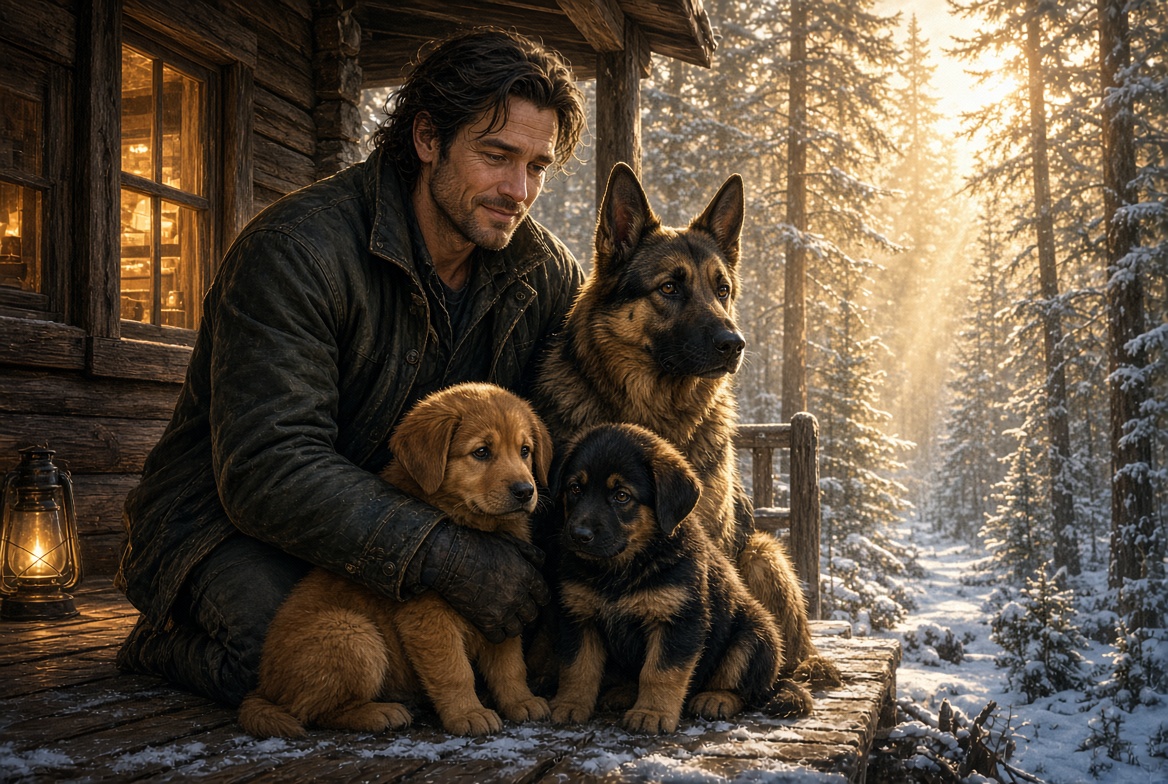
At the threshold, he paused.
The cabin behind him smelled of cold coffee, wood smoke, and cedar dust. A place built for one man who did not expect guests.
For two years, that idea had comforted him.
This morning, it felt smaller than it should have.
He stepped into the trees.
He moved quickly, but never fast enough to get careless.
The forest floor wore a crust of frost over damp soil, and every step wanted to announce him. He placed his boots where moss softened the sound. He skirted brittle sticks. He angled into the wind so his scent would trail behind him.
Old habits came back with the quiet arrogance of things that had always known where they belonged.
He hated how natural it felt.
He hated even more that it worked.
The slope rose toward a cluster of basalt and lodgepole pine.
Halfway up, he heard voices.
Men. Maybe three. Low and rough.
Not hikers lost before breakfast.
One laughed under his breath. Another said something Mason couldn’t catch.
Metal clicked once. A small, hard sound that didn’t belong in the fog.
Mason dropped into a crouch behind a fallen log slick with dew.
The barking had stopped.
In its place came a strained rumble. Low. Steady. Deliberate.
He eased forward until the trees opened into a shallow wash.
At first he saw only gray brush and the pale ribs of dead grass.
Then a shape separated itself from the fog.
A German Shepherd stood near the center of the wash.
No. Not stood.
Held.
He was big, sable-coated, with a dark mask across his face and a broad chest that rose and fell too carefully.
One ear stood upright. The other dipped a little, as if the morning had taken more from him than he wanted to admit.
His left front leg touched the ground lightly. Not useless. Guarded.
Frost clung to his whiskers. His amber-brown eyes were locked on the tree line, where the men’s voices were drifting closer.
Behind him, pressed into a pocket of fern and cedar roots, two puppies huddled together.
One shone copper-gold, even in that gray light.
The other had darker patches along its back and a small, solemn face that looked far too serious for its size.
The shepherd shifted one step, placing his body squarely between the puppies and the men.
Something inside Mason went very still.
The dog wasn’t lost.
He was guarding.
He was tired, frozen, hurting, and still guarding.
Mason raised one hand, palm open, and whispered the word that came before thought.
“Easy.”
The shepherd’s head turned. Their eyes met through the fog.
A growl rolled out of him. Measured. Not wild.
A warning with math behind it.
Mason didn’t move.
Boots scraped over rock below them.
“It came from down here,” one voice said.
“Then find the collar,” another answered. “That’s all that matters.”
Mason looked at the dog. At the puppies. At the narrow space between them and whatever was walking up that slope.
The shepherd studied him like a question neither of them had words for.
Then, barely, he shifted his shoulder aside.
Leaving room for Mason to step in.
Mason had spent two years building a life with no room in it for anyone, and a half-frozen dog had just made room for him in four inches of frozen ground.
The fog thickened, cold enough to bead on Mason’s eyelashes.
Every pine trunk shone dark as wet iron.
Beyond the cedar roots, three men moved through the timber with the confidence of people who believed the forest owed them silence.
Mason stayed low, one hand open where the shepherd could see it.
“Easy,” he said again, softer.
The dog’s eyes didn’t soften.
They sharpened.
That was almost better.
Up close, the shepherd looked like a working animal built for purpose, not charm. Wide shoulders. Paws planted with painful care.
No collar that Mason could see. Only matted fur around the neck where something had rubbed for years.
The two puppies trembled behind him, but neither one cried.
The darker pup pressed its nose into the golden one’s side, like a hand over a mouth.
“You keep them quiet,” Mason murmured. “I’ll handle the walking.”
It was a ridiculous negotiation.
The dog seemed to consider it anyway.
The voices drew closer.
Mason heard one man breathing through his mouth. Heard a pack brush a branch. Heard the faint squeal of leather nobody had bothered to oil.
They weren’t moving like weekend hunters. Too slow. Too focused.
They were searching for an object, not following a trail.
Find the collar.
Not find the dog.
Mason filed that away. The difference mattered.
It almost always did.
Mason studied the shepherd’s shoulder.
The dog didn’t have the loose panic of an animal backed into a corner. He had control in every line of his body.
But the control was costing him.
Cold had worked into his muscles. Hours of it. Maybe days. Days of choosing to stand when lying down would have made more sense.
“All right,” Mason breathed. “We move together.”
He reached slowly toward the thick fur at the side of the dog’s neck.
The shepherd tensed. Teeth showed for one clean second.
Mason stopped.
He didn’t pull back. Pulling back would say fear.
Pushing forward would say arrogance.
He held the space between them until the dog’s eyes slid past him toward the voices.
There. Alignment.
Not trust. Trust was too expensive for a morning like this.
But they had the same problem.
Mason slid two fingers into the fur and guided. Didn’t grab. Guided.
“Quiet,” he whispered.
The shepherd took one step.
The puppies tried to follow and tumbled into each other with soft, clumsy urgency.
The dog let out a low huff that sounded exactly like a command.
Both puppies froze so fast Mason blinked.
“Well,” he whispered. “You run a tighter outfit than I do.”
He steered them toward the north slope, where the wind would carry their scent away from the wash and the ground rose in broken shelves of rock.
It wasn’t the easy route.
That was why it was useful.
Twice the shepherd balked. Not from fear. Every instinct in him wanted to turn and face the threat, not leave it behind.
Mason knew that feeling well enough to dislike it in both of them.
He leaned close to the dog’s dipped ear.
“Holding your ground isn’t the only way to protect them.”
The shepherd glanced up at him.
For half a second, Mason wondered if he’d been understood. Trained dogs read tone and posture and command. Sometimes they read the part of a man he thought he’d hidden.
Below them, a man cursed.
“Tracks split here. Quit stepping on them.”
“Then quit telling me where to step.”
Mason paused beneath a leaning fir.
The golden puppy bumped into his boot, then tucked itself under the shepherd’s belly as if that had been the plan all along.
The darker pup stayed behind the dog’s back leg, watching Mason with grave suspicion.
“Fair,” Mason told her. “I’ve made better first impressions.”
The humor lasted one breath.
A twig cracked behind them.
Too close.
Mason scooped up the golden pup and tucked it inside his jacket.
The shepherd objected instantly. A flash of teeth. A low rumble.
Mason went still.
“Only carrying,” he said. “Not taking.”
The shepherd stared at him, nostrils working.
Then, grudgingly, he allowed it.
The darker pup followed on her own four stubborn legs.
They climbed until the wash disappeared below them.
Mason cut sideways along the ridge and stopped in a hollow beneath an old juniper trunk.
He eased the pup down and opened his medical kit.
The shepherd turned at once and planted himself in front of the puppies again.
Mason let him.
“You can supervise,” he said. “Since apparently I’m on probation.”
He worked with clean gauze and warm hands, checking the shoulder and wrapping it enough to support without locking it up.
The dog flinched once. A full-body tremor, mastered almost before it started.
Mason’s jaw tightened.
Not from pity. Pity had a way of insulting courage.
He kept his voice low and practical.
“You need rest. Food. Water. Probably a lecture from a vet who enjoys being right.”
The shepherd’s ear twitched.
As Mason secured the wrap, his fingers brushed something hard buried beneath the dense fur at the dog’s neck.
It was a nub of old leather, chewed through. Whatever it had held was gone.
The shepherd’s eyes moved to Mason.
Then to the ground beside Mason’s boot.
Not a warning.
An indication.
Mason followed the look and saw a small shape half buried under the needles. Dull metal against dark soil.
He brushed it clear with two fingers.
A tag.
Old. Scratched. Its chain snapped clean.
The letters were half lost under dirt, but enough remained.
K9 SEARCH AND RESCUE.
Beneath that, a name.
ATLAS.
Under the name, a federal ID number worn nearly smooth.
And along the very edge, a line of tiny numbers etched by hand. Too uneven to be factory work. Too deliberate to be decoration.
Mason closed his fingers around the tag.
The metal was warm from the dog’s body. That meant the shepherd had been carrying it until the very last stretch.
Carrying it the way soldiers carry letters.
“Atlas,” Mason said.
The dog didn’t wag. Didn’t relax. Didn’t claim the name like a pet called in from the porch.
He simply held Mason’s gaze while the men’s voices drifted farther downhill, frustrated, searching the wrong ground.
Mason looked at the puppies. Then back at Atlas.
And felt the morning rearrange itself around one ugly truth.
This dog hadn’t wandered out of the forest by accident; he had been carrying something out of it, and the men below wanted it back badly enough to hunt him for it.
By late afternoon, a dull winter light lay over the cabin, the kind that makes every window look older than it is.
The fog had thinned but never fully lifted.
Mason reached the porch with Atlas walking beside him, not in his arms.
The shepherd had made it painfully clear that being carried was an insult reserved for smaller creatures.
The fact that Atlas leaned half his weight against Mason’s leg the whole last quarter mile was, apparently, a separate matter.
The two puppies trailed behind. One copper-gold and wobbling. One dark-backed and watchful.
“Everybody inside,” Mason said.
Atlas paused at the threshold and lifted his nose.
Stale stove smoke. Cedar walls. Coffee grounds. Oilcloth. Old leather.
And whatever loneliness had soaked into the place over two winters.
Mason watched him take inventory. Exits. Corners. Heat. Risk.
A professional entering unfamiliar ground.
Mason found that comforting in a way he didn’t plan to examine.
He laid a wool blanket near the stove and pointed down.
Atlas looked at the blanket.
Then at Mason.
Then at the puppies.
The golden pup sat on its own foot and slid sideways onto the floor.
That settled it.
Atlas limped to the blanket, lowered himself with controlled reluctance, and curled his body so the puppies could press into his side.
The whole room seemed to change.
Mason fed kindling into the stove and coaxed a flame awake. Heat came slowly, orange and unsure, then stronger.
He filled a bowl with water and set it within reach.
Atlas sniffed it.
Then he waited.
He waited until both puppies had lapped at it, clumsy and splashing.
Only then did he drink.
Mason noticed.
Of course he noticed.
“You’re not their dad,” he said quietly. “You’re their security detail.”
Atlas didn’t dispute it.
Mason crouched and looked at the two small faces.
“You can’t stay ‘hey, you,'” he told them.
The golden one was already chewing the corner of the blanket.
“Copper,” Mason decided.
The dark-backed girl watched him with her serious little stare, the same color as the juniper bark where he’d first wrapped Atlas’s leg.
“And you’re Juniper.”
Juniper blinked once, like she would take the name under advisement.
After the fire settled, Mason washed his hands and opened the kit again.
“This is the part where you decide I’m useful,” he told Atlas. “Or you remove a few of my fingers.”
Atlas watched him.
“Useful it is.”
The wrap from the ridge had held. The shoulder was strained and scraped and tender, but not catastrophic.
What worried him more was the temperature. The tremor in the back legs. The way those eyes stayed too alert for a body that depleted.
Stress could do that. So could days of hard travel.
Mason had learned to respect anything that kept moving after it should have stopped.
He’d also learned respect didn’t replace care.
He switched on the old radio by the sink, raised the antenna, and tried three frequencies before the static gave way to a brisk woman’s voice.
“Pierce Veterinary. If this is about the goat on Skyliners Road, tell Earl I am not negotiating with that animal again.”
Mason closed his eyes.
“Hannah.”
A beat.
“Mason Reed. Either the world is ending, or you found something you can’t fix with duct tape.”
“German Shepherd. Working dog. Exhausted. Shoulder strain. Cold exposure. Two pups with him. I need instructions.”
Dr. Hannah Pierce dropped the joking edge immediately.
She had treated old ranch dogs, retired police K9s, and one furious barn cat that still haunted three grown men in Deschutes County.
Her voice went calm and precise.
“Fluids. Warmth. Check his gums. Small amounts of food, no big meals. Don’t overmedicate. Keep him still if you can.”
Mason looked over at Atlas, who was staring at the front door.
“That last part may be ambitious.”
“Then be more stubborn than the dog.”
“You’ve met me.”
“I’ve met dogs, Mason. They win.”
The line crackled, and for a moment Mason almost smiled.
He followed every instruction. Warm broth. Food broken into small portions. Checking the puppies while Atlas supervised each move like a skeptical inspector.
Juniper wouldn’t touch her bowl until Atlas sniffed it first.
Copper walked straight through his own water.
Mason toweled them both off and received, from Atlas, the faintest narrowing of the eyes.
Night pressed against the windows.
The cabin smelled of spruce smoke and wet fur.
Mason sat on the floor with his back to the wall, the tag resting in his palm.
He had washed it carefully under warm water. The letters stood out clearer now.
ATLAS. The federal number.
And the tiny etched numbers along the edge.
They weren’t a serial code.
They were coordinates.
Someone had scratched them in with a knife point or a nail. Patient work, done with a steady hand.
Not regulation.
Intention.
Atlas’s gaze shifted toward the door again.
Mason followed it.
Outside, the forest was black past the porch light. The road down to Bend lay empty. The ridge rose into shadow.
Nothing moved.
Yet the dog stared as if the dark had a name.
“You’re not done,” Mason said.
Atlas’s ear flicked.
The words unsettled him, because they sounded too much like something he had once feared about himself.
He’d believed leaving the teams would end the part of him that ran toward trouble.
He’d believed silence would teach him to stop hearing calls for help.
Instead, a dog had found the one language he still couldn’t ignore.
He pulled a paper map from the drawer under the table and grabbed a pencil.
He copied the coordinates twice. Checked every digit.
Then he traced them across the grid under the yellow lamp.
His finger stopped near Suttle Lake, north and west, through timber and old service roads.
More precisely, on an abandoned fire lookout above a drainage Mason knew only by reputation.
Too steep for casual hikers.
Too hidden for anyone who didn’t want to vanish.
Atlas lifted his head just enough.
“That where you came from?” Mason asked.
The shepherd held his gaze.
The radio by the sink hissed, then popped.
Hannah’s voice came back, faint and broken by distance.
“Mason… if that dog has federal tags… you need a ranger before you need a theory.”
Mason didn’t answer.
He was staring at the lookout on the map.
Someone had crossed its name out years ago and drawn a small burn symbol in red ink beside it.
CLOSED — FIRE DAMAGE.
And beside that, a date in faded handwriting.
He knew, from the old Forest Service bulletin pinned by his door, when the search-and-rescue handler out of Bend had gone missing.
He counted the months twice.
The cabin seemed to lose a few degrees.
The lookout had burned exactly six months after the handler disappeared, and Mason had never in his life believed in that kind of coincidence.
Morning came pale and windless over Bend.
A thin crust of ice shone along the gutters on Wall Street, and the sidewalks were dark with old snow.
The ranger station on the edge of town smelled of paper maps, burnt coffee, and damp wool.
Mason stood just inside the door, shoulders hunched against the heat, feeling too large for the room and too visible after months of living where nobody looked at him unless a deer counted.
Hannah had driven up at dawn to sit with Atlas and the pups. She’d shooed him out the door with a travel mug and a warning.
“If he tries to follow you, I’m sedating one of you. I haven’t decided which.”
Now Mason waited by the counter, the tag in his jacket pocket like a stone.
“Mason Reed,” a woman said from the back office.
He turned.
Norah Ellison stood beside a wall of topographic maps, one hand resting on a file box like she’d been interrupted in the middle of fighting it.
She was forty-three. Tall. Grounded. Chestnut hair tied low.
Her eyes caught the small things people hoped would stay small.
Her forest-green jacket was plain. Her badge was worn at the edges. Her voice was calm the way a locked gate is calm.
“You’re a long way from your ridge,” she said.
“Found something.”
“Most people start with hello.”
“Most people practice.”
Her mouth moved like it was considering a smile and decided to postpone it.
Mason crossed to her desk and laid the cleaned tag on a blotter stained with old coffee rings.
Norah’s expression changed so slightly that a less tired man would have missed it.
Mason didn’t.
Her fingers hovered above the tag before touching it. When she finally picked it up, her thumb went straight to the worn edge where the federal number sat.
Like she already knew it by heart.
“Where?” she asked.
“North of Tumalo Creek. He came out with two pups. German Shepherd, sable coat. Answers to Atlas.”
He paused.
“If ‘answering’ means judging me and then doing whatever he’d already planned.”
Norah closed her eyes for half a second.
Not relief. Not exactly grief.
Something that had waited too long to be named.
“Atlas,” she said.
The name sounded heavier in her mouth than it had in his cabin.
“Is he alive?”
“Yes. Stable.”
“Define stable, Mason.”
“A vet’s with him now. He’s warm. Drinking. Eating a little.”
He met her eyes.
“He wants to go back into the forest.”
Norah set the tag down carefully, as if it might break.
“Of course he does.”
That answer told Mason more than any file could have.
He leaned against the edge of the desk but didn’t sit. Sitting implied time.
He’d spent too much of his life in rooms where time turned into an excuse.
“Who was his handler?”
Norah looked at the maps. Then at the closed office door.
“Daniel Price.”
She said it like a prayer she didn’t want anyone overhearing.
She opened the file box and pulled out a folder soft at the corners, its label rewritten more than once.
Daniel Price had been a search-and-rescue handler assigned to the Deschutes region after years as a paramedic in Boise.
Thirty-nine when he disappeared.
Steady. Quiet. The kind of man who carried extra socks for strangers on bad trails.
And his partner, Atlas, had a reputation among the rangers for finding missing hikers who had already stopped calling for help.
“A year and a half ago,” Norah said, “Daniel started reporting things that didn’t fit normal poaching.”
“Like what?”
“Locked gates opened with no record. Trucks moving at two and three in the morning. Camps abandoned too clean.”
She tapped the folder.
“He believed someone was using the forest like a curtain. Moving things through it. Hiding behind jurisdiction lines.”
“And then?”
“Then he and Atlas went out on a call near Suttle Lake.”
Her voice didn’t shake. That cost her something.
“And they never came back.”
Mason watched her face.
“No search?”
Her eyes sharpened like a blade turned toward light.
“We searched.”
He nodded once.
“Fair hit.”
“Two weeks. Helicopters, volunteers, dogs from three counties. No body. No dog. No pack. Nothing anybody could take to a judge.”
She flattened her palm on the folder.
“After that, the case got passed around until every agency held a corner of it and nobody held the whole thing.”
“How long?”
Norah didn’t have to check.
“Five hundred forty-seven days.”
The number sat in the room like a fifth person.
Mason realized she hadn’t counted it once.
She’d counted it every single morning.
Five hundred forty-seven days of everyone else moving on, and the only one who never stopped working the case was a dog who couldn’t file a report.
Norah spread out the contents.
Photos. Incident summaries. Printed emails with half the lines highlighted in yellow.
And one picture of Daniel kneeling beside Atlas on a sunny trail.
The dog looked younger there. Fuller. His black mask bright against the sable coat.
Daniel had one hand resting at the side of Atlas’s neck.
Mason knew that posture. Handler and dog, each giving the other room to think.
In the corner of the photo, half out of frame, a small blur of copper fur showed near a cedar wash.
Mason tapped it.
“Was there a pup involved?”
Norah leaned in and frowned.
“No.”
“There are two now.”
“Maybe unrelated.”
“Maybe.”
Neither of them believed the word.
Mason pulled the folded paper from his pocket and laid the coordinates beside the tag.
Norah read them once. Then again.
Her jaw tightened.
She crossed to the map wall and found the grid with a pencil point.
The room seemed to shrink while she traced the lines.
Outside, a truck hissed past on wet pavement.
Inside, an old silence gathered.
“The lookout,” she said.
“I saw the burn mark.”
Norah didn’t turn around.
“It burned six months after Daniel disappeared. Officially, lightning.”
“You don’t like officially.”
“I don’t like neat answers in messy country.”
She pulled a second folder from the box. Thinner. Newer. Clearly not meant to be on top.
“After the fire, a contractor named Wade Carver got salvage rights to that drainage. Timber cleanup. Road access. Heavy equipment.”
“Legal?”
“On paper.”
She met his eyes.
“Almost too legal.”
“Did you push?”
“I pushed.”
A thin, humorless smile.
“Three weeks later, I was reassigned to permit filing. My supervisor called it a ‘rest from the field.’ Two people I’d worked with for ten years stopped returning my calls.”
“Warned off.”
“By enough people to teach me how doors close in a small town.”
She didn’t say it with self-pity. She said it the way a surveyor reads off elevation.
Mason looked back at Daniel’s photo. Then at the tag.
Atlas had crossed miles of winter timber with two puppies and a hidden coordinate scratched onto his own name.
He hadn’t come looking for kindness.
He’d come looking for completion.
Norah closed the folder and pressed both hands on top of it.
“Bring me something real, Mason. A ledger. A hard drive. A camera card. Anything that stands upright when people start pretending they can’t see.”
Mason picked up the tag and turned it over in his fingers.
“Atlas already brought the first piece.”
For the first time, Norah’s voice cracked.
“Then maybe I owe that dog more than an apology.”
The radio on her desk chirped before he could answer.
A ranger’s voice came through, thin with distance.
“Unit Three to station. Fresh tire tracks near the old Cascade Lakes spur. Same tread pattern from the Price file.”
Static chewed the line.
Then the voice came back.
“Looks recent. Real recent.”
On his way out of town, Mason stopped at the hardware store on Third Street for wire, gauze, and a bag of puppy food big enough to feed a small army.
The kid at the register glanced at the bag, then at him.
“Didn’t know you had dogs, Mr. Reed.”
“Neither did I.”
Behind him in line, a man in a canvas coat set down a box of zip ties. The patch on his shoulder read CARVER TIMBER & SALVAGE.
The man looked at the puppy food.
Then at Mason’s face.
He held the look one second too long.
Mason paid, nodded, and walked out without hurrying.
In the parking lot, he sat in his truck and watched the store door in the side mirror.
The man came out, pulled a phone from his coat, and made a call without taking his eyes off Mason’s tailgate.
Mason started the engine.
In a town of a hundred thousand people, it had taken exactly one bag of puppy food for the wrong man to start asking the right questions.
The next afternoon came in cold and bright, sunlight flashing off hard snow and making the pine shadows look almost blue.
Smoke rose steady from the cabin’s stovepipe, a thin, honest line against the winter sky.
Inside, Atlas lay near the stove on a folded wool blanket, awake even when his body begged otherwise.
Copper slept upside down with one paw in the water bowl.
Juniper sat beside Atlas like a tiny guard with far too much responsibility and not nearly enough balance.
Hannah’s red pickup sounded older than some bridges. She climbed out carrying a canvas medical bag in one hand and a covered pot in the other, her short gray-streaked hair tucked under a knit cap.
She was practical. Warm the way a good stove is warm. Never impressed by tragedy unless it interfered with treatment.
“You said German Shepherd,” she told Mason at the door. “You did not say retired general.”
Atlas lifted his head.
“See?” Hannah said. “Already judging my credentials.”
For the next hour, the cabin became a quiet clinic.
Hannah examined Atlas with careful hands, speaking to him like a colleague who’d made poor scheduling choices.
Shoulder. Gums. Temperature. Paws. Joints.
She made no dramatic faces, which Mason appreciated. Drama wasted oxygen.
Finally she sat back on her heels and looked at Mason over her glasses.
“He needs rest, warmth, small meals, and a firm refusal every time he decides he’s in charge of Oregon.”
“So no easy treatment.”
“None whatsoever.”
Atlas gave a low huff.
Hannah’s voice softened.
“He’s got a chance, Mason. A good one. If you keep him from doing anything heroic.”
Mason looked at the dog.
Atlas looked at the door.
“I’ll pass along your concerns.”
Norah’s Forest Service truck crunched to a stop by the porch before the joke could settle.
She came in carrying paper maps, a handheld radio, and a folder sealed in a plastic sleeve.
Her face had the calm of a person who’d decided sleep was optional until the truth improved.
She nodded to Hannah. Then to Atlas.
For a moment, her guard dropped.
“Hey, boy.”
Atlas’s ear twitched. Not welcome, exactly.
Recognition of rank, maybe.
Norah crouched a respectful distance away.
“Daniel would’ve hated seeing you boss civilians around.”
Mason caught the flicker of grief before she covered it.
“You knew him well.”
“Well enough to know he would’ve come back if he could.”
The words sat in the cabin like a fourth kind of weather.
They spread the maps across Mason’s kitchen table.
Norah marked the burned lookout above Suttle Lake. The burn perimeter. The salvage road Carver’s company had cut. A creek drainage Daniel had circled in his very last report.
The route was ugly. Two ridges. An old skid trail. Then a climb through deadfall where radio reception turned into a joke.
Eleven miles round trip, give or take.
Mason wanted to go alone.
Norah knew it before he opened his mouth.
“No.”
Mason looked up.
“I haven’t asked anything.”
“You were about to say something noble and irritating. Save it.”
Hannah didn’t look up from wrapping a softer support around Atlas’s shoulder.
“For the record, I side with the ranger.”
“Nobody asked you either,” Mason said.
“Yet here I am. Professionally correct.”
The cabin felt almost alive with voices, and that unsettled Mason more than the map did.
He’d built this place to hold silence.
Now silence kept losing arguments.
When Mason pulled on his jacket, Atlas tried to rise.
Not a scramble. Not panic.
Intention, gathering in bone and muscle.
Mason crossed the room fast and placed one hand on the side of the dog’s neck.
“Stay.”
Atlas stared at him.
“I mean it.”
The shepherd’s eyes went to the puppies. Then to the door. Then back to Mason.
His body trembled once with the cost of obeying.
Slowly, with deep resentment, he lowered himself back down.
Copper crawled against his belly. Juniper tucked herself beside his back leg.
Mason kept his hand there a moment longer than he needed to.
“I’ll come back,” he said.
He hadn’t made that promise to anyone in two years.
He was surprised by how much it weighed.
They left under a sky turning white at the edges. Hannah locked the door behind them and stayed with the dogs, radio on the table, medical bag open.
Mason could feel the cabin at his back even after the trees swallowed it.
For two years, walking off that porch had meant leaving nothing behind that needed him.
Now every step pulled.
Norah kept pace better than he’d expected and complained less than most men he’d trained with.
After twenty minutes she said, “Are you always this cheerful?”
“This is my town voice.”
“God help us all.”
At the first ridge, the wind picked up.
Mason found tire tracks half hidden beneath crusted snow. Wide tread. Deep cut.
Norah photographed them and held a printout from Daniel’s file beside them.
Same pattern.
Recent.
Too recent.
Mason’s radio hissed.
Hannah’s voice broke through the static.
“Mason. Norah. I’ve got an engine below the cabin. Maybe two.”
They both stopped dead on the service road.
Norah keyed her radio. “Can you see who?”
Static swallowed the answer.
Then Hannah came back, quieter.
“A man’s walking up the drive. He just asked if this is where the dog was taken.”
Mason turned back toward the ridge, and the map in his head rearranged itself in an instant.
Distance. Terrain. Time.
Too much of one. Not enough of the other.
Norah was already moving.
Behind them, somewhere through the trees, the cabin sat out of sight, and for the first time in two years Mason understood exactly what he had to lose.
They didn’t turn back.
It was the hardest decision Mason had made in two years, and Norah made it with him in four words.
“Proof first. Then home.”
“Hannah’s alone up there.”
“Hannah has a locked door, a radio, and a dog who outranks both of us.” Norah’s voice was tight. “Sheriff’s deputies are already rolling from Sisters. If those men came for the collar, the reason they want it is sitting under that lookout. We go back empty-handed, and this happens again next month to somebody else.”
Mason hated that she was right.
He was starting to notice it was a habit.
The forest above Suttle Lake was colder than the map promised. Low clouds dragged across the ridges as they cut west through the timber.
Snow clicked under their boots in a brittle crust.
A faint wind moved through the lodgepoles. Not strong enough to clear the air. Just strong enough to make every branch whisper at the wrong time.
“We get proof fast,” Norah said, breathing hard but steady. “Then we go back with more than a bad feeling.”
“Bad feelings kept me alive.”
“Proof keeps men like Wade Carver in court.”
The old skid trail rose in broken switchbacks, blocked in places by deadfall from the burn.
Charred stumps stood between new green shoots. Black and bright, side by side.
The forest doing what people always claim they’ll do and rarely manage.
Starting over.
Mason went first, clearing branches, reading the ground.
Norah followed close behind, camera ready, marking every tire gouge where heavy equipment had no legal reason to be.
Twice Mason stopped her with a raised fist.
Twice the woods offered only wind and distant water.
The third time, he heard a metallic tick somewhere downhill.
Not near enough to worry about.
Not far enough to forget.
They reached the lookout just after noon.
Little remained.
Four blackened posts. A half-collapsed stair. Rusted bolts poking up through the snow.
And a view toward Suttle Lake that would have been beautiful, if the place didn’t feel watched.
Mason walked the perimeter first.
Norah let him.
She had the restraint of someone who understood that grief can ruin evidence faster than weather.
Near the north post, Mason crouched beside a flat slab of basalt.
Scratches on its underside. Not animal marks.
Tool marks.
He brushed the snow away and slid his fingers into a seam.
“Here.”
Norah dropped beside him.
Together they shifted the slab enough to expose a hollow lined with a torn piece of tarp.
Inside lay a small waterproof pouch, stiff with cold.
Norah stared at it without touching it.
“Daniel,” she whispered.
Mason opened the pouch.
Papers folded tight. A memory card in a plastic case. Three photographs sealed back to back. A page torn from a field notebook.
Norah tugged her gloves tighter before she took them.
Her face changed with each item.
Coordinates. Dates. License plates. The names of shell companies tied to salvage permits.
Wade Carver’s name appeared twice.
Then five times.
Then eleven.
The handwriting was compact and steady.
Daniel Price had been frightened when he wrote some of these pages. Mason could see where the pressure deepened in the pencil.
But he hadn’t been confused.
Not once.
On the last sheet, Daniel had built a ledger by hand. Columns of dates. Truck plates. And a dollar figure beside each line.
The same figure, every time.
$19,500.
Norah ran her finger down the column, counting under her breath.
“Forty-one,” she said. “Forty-one night loads in eight months.”
Mason did the math before she could.
“Almost eight hundred thousand dollars.”
“Seven hundred ninety-nine thousand, five hundred.” Norah’s voice had gone flat and cold. “Paid in cash to keep gates unlocked and logbooks blank. Someone inside the permit office was signing off on every single one.”
Beneath the ledger, one line was underlined twice.
If they find this before I get it out, Atlas carries the map.
The coordinates on the tag had never been a clue; they were a plan, and Daniel had trusted a dog to finish it when no person could.
At the very bottom of the pouch lay a K9 badge. Scuffed, but whole.
ATLAS was engraved on the back, along with Daniel’s initials.
Norah turned away.
One step. That was all she allowed herself.
Mason stood watch while she breathed through it.
He knew better than to offer comfort too early. Some grief needed room to stand up before anybody tried to help it sit down.
After a minute, Norah turned back.
Her eyes were wet. Her voice had hardened into something useful.
“This is enough to reopen the case.”
“Enough to hold?”
“With the memory card? Maybe. With the ledger and a chain of custody, yes.”
Mason scanned the trees.
“Then pack it.”
A sound cracked across the slope.
Not a shot.
A branch snapping under real weight.
Mason pulled Norah behind the burned stair before she fully registered the noise.
Voices drifted up through the timber.
“He came this way,” a man said.
“Carver wants the collar,” another voice answered, impatient. “And anything that old dog dragged out. We find it before the ranger does.”
Norah’s jaw clenched at the words old dog.
Mason shook his head once.
Quiet.
Three men below. Maybe four. One closer than the rest, climbing.
They didn’t know exactly where Mason and Norah were.
But they knew enough.
Mason looked at the pouch. Then at the ridge route behind them.
“You take the evidence down the east side.”
“No.”
“Norah.”
“No. Daniel went alone. Atlas came out alone. I’m not repeating the shape of that mistake.”
Mason wanted to snap at her.
Instead he studied the burned posts, the slope, the lines of approach.
She was afraid.
She was also right again.
Annoying habit.
The radio at Norah’s shoulder burst into static.
Hannah’s voice forced its way through, thin and strained.
“Norah. Mason. If you can hear me, they’re on the porch now. One of them says his name is Wade Carver. He’s smiling like a church usher, and I hate him deeply.”
Mason’s hand tightened on his pack strap.
“Atlas knows,” Hannah went on. “I don’t know how, but he knows. He sent the puppies under the cot with one look.”
Static swallowed her.
Norah pressed the transmit button.
“Hannah, keep the door locked. Do not engage. Backup is moving.”
No answer.
Below the lookout, one of the men shouted.
“Tracks up here!”
Mason and Norah ran.
Not down the clean trail. Clean trails are where men with bad intentions point their eyes.
Mason led them down the east face through burned timber, sliding over frozen duff, catching Norah once when her boot shot out from under her.
She cursed with impressive restraint.
Branches raked Mason’s jacket. Cold air sliced his throat.
He mapped every second.
Cabin distance. Carver on the porch. Hannah inside. Atlas down but alert.
Two puppies under a cot, trusting a shepherd who’d already carried more than his share.
Halfway down the ridge, an engine started far below.
Norah heard it too.
“They’re moving.”
Mason looked through the trees toward the unseen cabin.
“Or blocking the road.”
His radio popped again.
This time Hannah came through clear enough to chill him.
“Mason. He just asked for you by name.”
The men in the forest had been hunting a dog, but the man on the porch had come for something else entirely, and he already knew who he was looking for.
Evening lowered over the ridge in thin blue layers.
The cold around the cabin took on the metallic bite that comes just before dark.
Hannah Pierce stood inside the front door, one hand on the deadbolt and the other near the radio.
She was trying to look calm for a German Shepherd who was far too smart for lies.
Atlas lay on his blanket by the stove, but his head was up. His dark mask was aimed at the porch like a compass needle.
Copper and Juniper had vanished beneath the cot after one soft sound from him.
A sound so controlled it made the hair on Hannah’s arms stand up.
“Good dogs,” she whispered.
Atlas didn’t look at her. His eyes stayed on the door.
Outside, Wade Carver knocked again.
Not hard.
That was what Hannah disliked most.
People who knew they were intruding knocked like it.
Wade knocked like the cabin had been expecting him.
“Dr. Pierce,” he called, pleasant as a morning radio host. “I know Mason Reed isn’t home. I’m only here to collect property connected to a federal file.”
Hannah’s eyes slid to the kitchen table.
Atlas’s tag lay there beside the map, exactly where Mason had left it after copying the coordinates again that morning.
She crossed the room without hurrying, picked it up, and closed her hand around it.
“Then call the federal office,” she said through the door.
“I tried. Phone lines get complicated up here.”
A pause.
“So do trespassing charges. And theft of government property. That dog belongs to an agency, Doctor. Not a hermit and a large-animal vet.”
Then a soft laugh.
“You’re awfully protective for someone who just met the animal.”
Hannah’s mouth went flat.
“I’m a veterinarian. It’s a professional hazard.”
Atlas shifted.
Not up. Not yet.
But his front paws pressed into the blanket.
Hannah crouched beside him.
“No,” she said under her breath. “You stay a patient. That’s your whole job tonight.”
He gave her a look that suggested her management style lacked vision.
Beyond the window, another man moved near the woodshed. He rattled the latch and swore softly when he found it locked.
A heavier set of footsteps crossed near the trucks.
Hannah counted them the way Mason had once told her to, years ago, when the two of them were stuck waiting out a storm on McKenzie Pass and conversation had wandered into survival.
Count feet. Count voices. Count exits.
She’d teased him for turning a weather delay into a tactical seminar.
Now she was grateful enough to be irritated about it.
Three men.
One door.
One back window that stuck in cold weather.
She slid the tag beneath the heavy rubber boot tray by the threshold, where wet boots and old mud would make sure nobody looked twice.
Then she sat down on the floor beside Atlas, put her palm flat against his chest, and waited.
“He’s coming,” she told the dog. “You know he is.”
Atlas’s ear turned toward the trees.
Somewhere out there, he’d already heard it.
In the timber above the cabin, Mason and Norah split without a word.
Norah cut wide with the evidence pouch zipped inside her jacket, radio pressed close, working to reach the deputies coming up from the main road.
She clipped a small recorder to Mason’s collar before she went.
“Get him talking,” she said. “Men like Carver love the sound of their own reasonableness.”
Mason descended through the pines, every breath measured, every step placed.
He could see Wade on the porch now.
Broad-shouldered in a dark coat. Beard streaked with gray. A posture relaxed enough to be performed.
A man used to arriving before consequences did.
Wade turned his head slightly, as if he’d heard something nobody else could.
“You can come out, Reed.”
Mason stopped behind a fir.
“Old files are chatty things,” Wade went on. “A Navy board that sealed a bad rescue. A panel of officers asking whether your judgment could be trusted in the field.”
He let it hang.
“Hard thing, being the man who has to decide. And then has to live after the deciding.”
Mason felt the words find the old scar and press down.
Inside, Atlas heard Mason’s breathing change before any human could have.
He pushed one paw forward.
Hannah laid her palm against his chest. Gentle. Firm.
“Don’t you start.”
Wade smiled at the trees.
“I don’t need trouble. I need a collar, a tag, and whatever Daniel Price tucked into that dog’s route. Hand it over, and this stays a misunderstanding.”
Norah’s voice crackled faintly in Mason’s earpiece.
“He just said Daniel’s name on record. Keep him going.”
Mason stepped out from behind the fir.
Kirk Nolan swung toward him too fast, a hand drifting to his belt.
Ben Harland flinched near the truck.
Wade didn’t move, except to widen his smile by half an inch.
“There he is.”
Mason kept his hands where everyone could see them.
“You picked a poor porch.”
“I picked the only porch with my property on it.”
“Daniel’s evidence isn’t your property.”
Wade’s eyes cooled.
“Daniel Price made accusations he couldn’t support.”
“Then why are you here?”
For the first time, Wade’s smile slipped.
A small thing.
But Norah would have it on tape.
Mason saw it and felt something steady settle under his ribs.
Not confidence.
Purpose.
A man who has nothing to hide doesn’t drive eleven miles of frozen logging road at dusk to collect a dead man’s dog tag.
Wade came down one step from the porch.
“Men like Daniel, men like you, you’ve got the same disease. You think a good intention cleans up a bad decision.”
He shook his head slowly, almost kindly.
“It doesn’t. It just leaves a mess for everybody else to clean.”
The line struck close, because it carried just enough truth to be cruel.
Mason saw the mission room again. The faces. The report.
He saw the moment he’d moved too early or too late, depending on who wrote the sentence.
His hands stayed still.
Cold ran up both arms anyway.
Then Atlas barked.
One sound. Short. Controlled.
It cut through the porch light and the trees like a hand landing on Mason’s shoulder.
Alert. Mark. Hold.
Wade glanced toward the door. So did Kirk.
That was enough.
Mason moved left, pulling their eyes away from the cabin.
Far below, a pair of headlights flickered through the trees, then went dark as Norah cut her engine near the service road.
“Backup?” Mason murmured.
“Three minutes,” Norah breathed in his ear. “Maybe less.”
Three minutes could be a lifetime.
It could also be a joke.
“Stay away from the door,” Mason said.
Wade’s voice dropped.
“Or what?”
Mason didn’t reach for anything. He didn’t need to. Not yet.
“Or this stops being polite.”
Night had settled fully now. The porch light made a small amber island in the cold.
Beyond it, the Deschutes timber stood black and close. Hidden trunks. Sloped ground. The kind of silence that could swallow a careless man whole.
Three men. One cabin.
One veterinarian inside with three dogs and a radio that had become the most important object in Oregon.
Mason didn’t need to win a fight.
He needed time.
“Daniel Price found your route,” he said.
Wade’s jaw shifted.
“Daniel Price got lost.”
“His notes didn’t.”
Kirk glanced at Wade. Too quickly.
There. Norah would like that.
Mason kept his eyes on Wade while the rest of him measured the others.
Kirk was nervous, weight too far forward. Easy to pull off balance.
Ben was heavy-footed and already wishing he’d stayed in the truck.
Wade was patient.
Patient men were harder. They waited for you to believe they were reasonable.
“You have no idea what you found,” Wade said.
“Then explain it.”
“A burned lookout. A few old permits. A dead man’s obsession.”
“Forty-one loads,” Mason said quietly. “Nineteen thousand five hundred a run. Cash, every time.”
The porch went silent.
Ben muttered, just loud enough to carry, “I told you that dog was trouble.”
Wade’s head snapped around.
“Quiet.”
One word.
It did more than a confession could have.
It confirmed a pecking order. A shared history. A fear they all understood.
Mason let the silence after it breathe.
“You came for the collar,” he said, “because the memory card wasn’t where you thought it’d be.”
Kirk swore under his breath.
Wade turned on him. “Shut up.”
In under two minutes, three grown men had told Mason Reed everything Daniel Price spent 547 days trying to prove, and not one of them had needed to say it out loud.
Mason moved again. Not forward. Left.
A quick shift behind the woodpile.
Kirk had to track him. Ben had to step away from the truck. Wade had to choose between Mason and the door.
Kirk took two steps toward him.
“I’m done talking.”
“Good,” Mason said. “You weren’t helping yourself.”
The first siren sounded far below.
Softened by the trees. Unmistakable anyway.
Ben’s head jerked toward it.
Wade’s face hardened into stone.
“Ranger’s bluffing,” Kirk said, but his voice had gone thin.
Mason shook his head.
“Norah doesn’t bluff. She documents.”
Norah’s truck lights blazed on below the slope. Two more sets of headlights swung in behind it from the main road, blue and red rolling across the snow.
Wade moved fast.
Not toward Mason.
Toward the cabin door.
Mason crossed to block him. His boots slipped once on packed snow, and his shoulder hit Wade square, hard enough to stop both men without turning it into a brawl.
Kirk lunged.
A bright beam from Norah’s flashlight caught him full in the face.
“Hands where I can see them!” Norah shouted from the tree line. “Deschutes County deputies are on scene. Everything you’ve said tonight is recorded.”
Kirk froze mid-stride.
Ben raised both hands so high he looked like he was surrendering to the moon.
Wade didn’t raise his.
Inside, Atlas pushed himself upright.
Hannah felt it happen beneath her palm.
“No. Atlas, no.”
The shepherd stood. Not gracefully. Not completely.
But enough.
He took one step toward the sliver of open door.
Copper and Juniper stayed hidden under the cot, pinned by his earlier command.
Hannah wanted to stop him.
She also knew the difference between foolish movement and a creature taking the one step his whole life had trained him to take.
She let go.
Atlas reached the threshold and stood in the warm strip of light.
Black mask lifted. Amber eyes locked on Wade.
Wade looked at him for the first time that night.
Fear crossed his face.
Not fear of teeth.
Fear of a witness.
“That dog should’ve stayed lost,” Wade said.
The words hung clean and clear in the recording.
Norah stepped into the porch light.
“Wade Carver, you’re under arrest.”
Kirk bolted for the truck.
He made it four steps before his boot hit an icy rut and he went down with a grunt that would’ve been funny if anyone had air to spare.
Ben stayed exactly where he was, hands still in the sky.
“I knew this road was cursed,” he whispered.
Hannah, despite everything, nearly laughed.
A deputy rounded the truck and cuffed Kirk where he lay. Another took Ben by the elbow, and Ben thanked him.
Wade looked at Mason one last time.
“You think this fixes what happened to you?”
Mason glanced at Atlas, who was still standing only because stubbornness had apparently become a structural material.
“No.”
“Then why?”
Mason stepped aside as Norah reached for Wade’s wrists.
“Because it stops what’s happening now.”
The cuffs closed.
The yard filled with car doors and radios and boots and voices.
Too late for Daniel Price.
Not too late for the truth he’d carried forward.
Mason turned away from Wade and went straight to the porch.
Atlas’s legs were trembling. His eyes stayed bright for one more second, meeting Mason’s, as if checking whether the perimeter was finally secure.
Mason dropped to one knee.
“Done,” he said. “You did it. Mission’s over.”
Atlas leaned into him.
All the weight of the winter and the miles and the waiting let go at once.
Mason caught him before he folded to the boards.
The shepherd’s breathing stayed steady, but his whole body went heavy with exhaustion.
Hannah was there in an instant. Sure hands. Calm voice.
“Inside. Now.”
Mason lifted him carefully.
And this time, Atlas didn’t object at all.
As he carried the dog over the threshold, Mason’s boot bumped the rubber tray by the door.
Something small and metal skittered across the floorboards and stopped against his heel.
The tag.
Hannah picked it up and pressed it into Norah’s gloved hand without a word.
Norah looked down at the scratched coordinates. Then at the dog in Mason’s arms.
“Evidence item one,” she said softly.
A strip of metal small enough to lose in a pocket had just undone eight months of cash, forty-one trucks, and every closed door in Deschutes County.
Three days later, morning came into the cabin slowly, pale gold at the window and soft across the floorboards.
The storm that blew in after the arrest had left fresh snow on every branch. The ridge looked like a quiet white chapel with no walls and no hymnal but the wind.
Mason stood by the stove in his socks, a mug of coffee cooling in his hand, watching Atlas sleep.
The shepherd had survived the long night after the arrest.
Then the longer day after that.
Then one more night, just to make his opinion of predictions perfectly clear.
That was the first truth.
The second was harder.
Atlas hadn’t stood again. Not yet.
His body had spent everything it had, and now it was demanding payment in rest.
Hannah said that wasn’t failure. She said recovery often looks like surrender to people who don’t understand it.
Mason repeated that sentence to himself several times a day.
He disliked how much he needed it.
Copper and Juniper, meanwhile, had grown bolder in the shameless way of puppies who discover that warmth is a lifestyle.
Copper now believed Mason’s bootlaces were enemy rope.
Juniper believed Copper was unqualified to lead anything and corrected him with silent shoulder bumps.
Atlas watched them through half-open eyes. Too tired to intervene. Never too tired to judge.
Hannah looked up from her notebook at the table.
“If you stare any harder, you might heal him by intimidation.”
“Is that billable?”
“Everything is billable.”
She’d slept on the narrow couch for two nights, boots tucked under the edge in case she had to move fast.
She claimed she was staying because the roads were bad.
Mason pretended to believe her.
The cabin had filled up with small mercies like that.
Norah’s truck came up the service road just before noon.
Atlas opened his eyes before the engine reached the bend.
She climbed out holding a sealed evidence case and a paper bag from a diner in town. Snow dusted her jacket. Her face was tired.
But some old weight had shifted off her shoulders.
“Carver’s talking,” she said. “Through his lawyers, so it’s less poetic. But it’s enough.”
“The other two?”
“Kirk talked first. Ben talked accidentally. And Wade discovered silence isn’t very useful once a memory card has timestamps.”
She set the case on the porch rail.
“The permit officer who signed off on all forty-one loads resigned yesterday morning. The U.S. Attorney’s office in Portland opened a federal case by afternoon. The Bend paper ran it on the front page.”
“And you?”
A small, surprised breath of a laugh.
“My supervisor called me personally. Twice. I’m back in the field Monday.”
She paused.
“Funny how fast the doors open once the lights come on.”
Then her eyes went toward the trees, and her voice changed.
“We found Daniel’s pack near Suttle Lake. The spot was marked in his notes, under a cedar wash. The search team recovered his remains close by.”
Mason let the cold settle into that silence.
He’d expected it.
Expecting didn’t soften much.
“His family’s been notified,” Norah said. “They want to meet Atlas. When he’s strong enough.”
Inside, Copper barked once at a log shifting in the stove, then hid behind Juniper, who looked offended by his entire bloodline.
Hannah opened the door.
“If that bag contains biscuits and none of them are for me, justice has not been served.”
Norah handed it over.
“Two egg sandwiches and a cinnamon roll.”
“Faith restored.”
They gathered around the kitchen table while Atlas slept.
Norah slid a page from Daniel’s notebook out of a plastic sleeve. Water stains bloomed across the paper, but the handwriting held.
The same compact lines from the lookout pouch.
She read it aloud. Her voice stayed steady until the final sentence.
“If I don’t make the road, Atlas knows home. Keep him moving home.”
Nobody spoke.
Mason looked at the dog by the stove.
Home.
Not the station. Not the handler.
Home.
Daniel had trusted Atlas not just to come back, but to carry meaning with him.
Mason had spent years believing the past ended where the loss began.
Daniel Price had written a different theory, in pencil and mud.
Norah turned the page over.
“There’s more.”
Tucked near the margin was another line. Smaller. Almost an afterthought.
Two little ones in the cedar wash. Not his. Still ours.
Mason felt his throat tighten.
“The puppies,” Norah said. “He knew about them. Probably found them while he was tracking Carver’s crew. He must have planned to bring them out once he had his proof.”
Hannah leaned back, her eyes soft.
“And Atlas finished the errand.”
The stove ticked. Snow slid off the roof in a muffled hush.
Mason looked at Copper and Juniper, both asleep now in an untidy heap against Atlas’s flank.
Not his. Still ours.
The line did something to him he couldn’t defend against.
It made the cabin feel chosen.
For two years Mason had lived like a man waiting to be told he didn’t belong anywhere, and a dead stranger’s pencil had just told him otherwise.
A week later, rain came to the lower roads while snow still held the high ridges, leaving Bend caught between seasons.
The roof dripped steadily. The yard turned from white to brown at the edges. Mud, pine needles, and paw prints that seemed to multiply whenever nobody was looking.
Atlas lay on the porch in a patch of weak sun, wrapped in a warm harness Hannah had brought from her clinic.
He’d stood twice that morning. Each time for less than a minute. Each time with the solemn dignity of a mayor opening a bridge.
Mason pretended not to be impressed.
Atlas pretended not to need the praise.
Neither fooled anyone.
That afternoon, Hannah set down her coffee mug with the particular care of someone about to say something expensive.
“There’s a federal K9 retirement facility near Salem. They’ve offered Atlas a placement. Rehab equipment, handlers who know working dogs. Good care.”
Norah watched Mason closely.
“They’ll take Copper and Juniper temporarily, too. Until they’re adopted.”
The cabin went quiet in the wrong way.
Mason nodded, because nodding cost less than speaking.
“That might be best.”
Hannah’s face gave away nothing.
“Maybe he needs more than I can give him,” Mason said.
“He needs consistency,” Hannah said. “You have a stove, a porch, stubbornness, and no social life. That’s a start.”
“Professional care matters.”
“So does being somewhere a dog stops watching the door.”
Mason looked over at Atlas.
The shepherd lay with his head up, amber eyes resting not on the forest, but on Mason.
It was a small change.
Because it was small, it felt enormous.
That evening Norah brought the transfer forms.
Mason signed them at the kitchen table while rain tapped the window. Each line of ink felt practical. Responsible. Familiar.
It was the shape of leaving, dressed up as doing the right thing.
When he pushed the papers aside, Copper crawled out from under the table and set his chin on Mason’s boot.
Juniper followed slower and sat beside him, dark eyes fixed upward.
From the blanket, Atlas lifted his tail and tapped it once against the floor.
“Don’t start,” Mason told them.
Copper sighed. A theatrical sound for something so small.
Norah stood by the door, arms crossed.
“Daniel used to say Atlas knew who was lost before the people did.”
“I’m not lost.”
Hannah snorted from the sink. Not quietly.
Mason gave her a look. She rinsed a bowl with saintly innocence.
Norah picked up the forms and tapped them straight.
“Nobody’s asking you to decide tonight. Transport comes at nine tomorrow.”
“Then tonight seems well timed for deciding.”
After they left, Mason sat alone with the dogs and the stove.
The cabin had never sounded so full. Rain. Puppies breathing. Atlas shifting in his sleep. The old clock on the shelf, still losing four minutes a week because Mason had never bothered to fix it.
For two years, he’d called walking away survival.
Sometimes it had been.
Sometimes it had only been fear wearing clean boots.
He took Daniel’s badge and Atlas’s tag from the shelf, where Norah had left them in his keeping until the hearing, and set them side by side near the stove.
The metal caught the firelight, dull gold at the edges.
Then he did something he’d avoided for longer than he cared to count.
He prayed.
No polished words came. Good. Polished words would have felt suspicious.
He bowed his head and said, “I don’t know what I’m doing.”
Atlas opened one eye.
“Not news to you,” Mason muttered.
He tried again.
He didn’t ask God to erase the old mission or make the dead less dead. He didn’t ask to feel clean.
He asked for enough courage to stay where staying was needed.
Enough humility to accept help from a ranger, a veterinarian, and a dog with command presence.
Enough patience to build things twice when love required better angles.
At 8:40 the next morning, he called the facility in Salem and canceled the transport.
Then he tore the signed forms in half and fed them to the stove.
Atlas watched the paper curl and blacken.
He put his head down on his paws and, for the first time since the ridge, slept without facing the door.
Some rescues happen in a frozen wash against impossible odds; the hardest one happened at a kitchen table, when a man finally chose not to leave.
The weeks after didn’t turn peaceful all at once.
They came unevenly. Cold mornings. Thawing afternoons. Mud that seemed personally committed to getting inside.
Mason built a ramp from the porch to the yard, because Atlas would not tolerate being lifted unless the universe was clearly ending.
He built it twice.
The first version was too steep. Hannah told him so. Atlas told him so by standing at the top and refusing to bless the project.
“Fine,” Mason said, holding a level. “The committee has spoken.”
The second ramp held.
Atlas tested it on a clear morning, Hannah on one side, Mason on the other, Norah by the steps pretending her eyes weren’t wet.
Halfway down, he stopped. The leash trembled in Mason’s hand.
“No hurry,” Mason said.
Copper waited at the bottom, vibrating with confidence he hadn’t earned. Juniper stood quieter, her small body aimed at Atlas like a compass.
The shepherd took another step.
Then another.
When all four paws touched the ground, Copper barked like he was announcing a national holiday.
Atlas gave him a look so dry that Mason nearly laughed.
Nearly became actually.
It startled everyone except Hannah.
“There it is,” she said.
“What?”
“A human sound.”
The cabin changed in small, irreversible ways. A second dog bed appeared near the stove. Then a third. A bin of kibble stood where Mason used to keep spare gear.
The town changed, too.
People Mason had nodded past for two years started stopping him at the hardware store. A retired logger left a bag of elk antler chews on his porch with a note that just said, For the dog who did our job. A Girl Scout troop from Redmond mailed Atlas a hand-drawn medal made of cardboard and gold glitter.
Mason hung it on the wall anyway.
The salvage permits on all forty-one routes were revoked. Wade Carver was held without bail. Kirk Nolan traded information for a lighter sentence. Ben Harland confessed to three extra things nobody had asked about, because guilt and poor sleep had finally joined forces.
And Daniel Price’s name went back into official sentences with the care it should have received the first time.
One rainy afternoon, Norah slid an application under his door.
Stillwater K9 Haven.
A small rehabilitation home for retired working dogs.
The name came from a margin note in Daniel’s notebook, a dream he’d scribbled for old heroes with tired paws.
Mason filled it out at the kitchen table. Adoption papers. Medical authorizations. Land-use questions. Insurance forms.
He didn’t know if it would work.
For the first time in years, not knowing didn’t make him want to leave.
Spring came to the Deschutes River Trail with clear light on the water and green returning first in the sheltered places.
Snow still held high in the Cascades. Down by the river, the air smelled of wet stone, cottonwood buds, and sun-warmed bark.
Mason stood beneath a pine near the bank, one hand resting lightly on Atlas’s harness.
No stage. No flags snapping in the wind.
Just Daniel Price’s family, Norah, Hannah, a handful of rangers, and two puppies who’d been told to behave and had accepted the instruction as a flexible concept.
Copper found a pine cone and treated it as a personal calling.
Juniper sat beside Atlas, alert and solemn, leaning into him whenever strangers passed too close.
Atlas stood longer now. Maybe never exactly like before. But he stood, sable coat brushed, black mask sharp in the morning light, left ear dipping when he tired and rising again through pure opinion.
Daniel’s mother, Carol Price, was a small woman with silver hair tucked beneath a blue scarf.
When she first saw Atlas, her face changed so deeply that Mason looked away to give her privacy.
Atlas looked at her. Then lowered his head.
Not submission.
Recognition of grief.
Carol stepped forward and laid her hand gently between his ears.
“Hello, Atlas.”
The shepherd closed his eyes.
Hannah, who’d come armed with tissues and insisted they were medical supplies, passed one over without comment.
A ranger spoke about Daniel’s years in search and rescue. The spare gloves he carried for strangers. His conviction that no life was too small to look for.
Norah spoke next. Her voice stayed steady, though her hands trembled once.
“Daniel was right,” she said. “And now the record says so.”
Then Carol turned to Mason.
“Would you say something?”
Every old instinct in him stepped back.
He could face bad weather, armed men, official rooms, and a German Shepherd with strong views on ramps.
Words in front of grieving people were harder.
Atlas leaned against his leg.
Mason looked down. “That’s cheating,” he murmured.
The dog did not apologize.
Mason stepped forward. He didn’t take the paper Norah offered. He’d only have folded it into a nervous square.
He looked at the river first, because moving water was easier than faces.
Then at Carol.
“I didn’t know Daniel,” he said. “I wish I had. But I know what he left behind.”
“He left proof when people wanted silence. He left a dog who understood duty better than most men I’ve served with. He left two small lives with a note that said, ‘Not his. Still ours.'”
He stopped and swallowed once.
“I used to think rescue meant getting there in time and bringing everyone out whole. Daniel and Atlas taught me something different. Sometimes rescue is carrying the truth as far as you can, and trusting someone else to carry it the rest of the way.”
Nobody moved. Even Copper paused with his pine cone.
Mason looked down at Atlas.
“He brought them home,” he said. “And somehow, he brought me with them.”
Carol pressed a folded photograph to her chest.
Hannah wiped her face and muttered, “Allergies,” though there wasn’t a single flower in bloom for a mile.
Afterward, Carol handed Mason Daniel’s spare leash.
“He’d want Atlas to have a home.”
“He does,” Mason said.
The answer came without hesitation.
That surprised him less than it would have a season ago.
Then Norah stepped forward and placed something small in his palm.
The tag.
Scratched coordinates and all, released from evidence the day before.
“The court’s done with it,” she said. “It belongs with him.”
That night, Mason threaded it onto a new leather collar and buckled it around Atlas’s neck.
The little line of numbers no longer pointed toward a burned lookout.
It pointed here.
By early summer, a sign stood at the end of Mason’s service road, hand-carved by a retired ranger who refused payment but accepted pie.
STILLWATER K9 HAVEN.
The first guest was an old Labrador from a county search team who snored like a chainsaw. The second was a nervous Belgian Malinois who trusted Atlas before he trusted any human.
Copper appointed himself director of stolen gloves.
Juniper became deputy of serious looks.
Hannah visited twice a week, complained about Mason’s filing system, and secretly fixed it.
Norah stopped by with case updates, coffee, and a laugh that sounded like a gate swinging open after years of rust.
The forest roads were repaired. The lookout site was marked with Daniel’s name on a small bronze plaque. Hikers started leaving little stones there. Nobody asked them to. People understand altars, even when they pretend they don’t.
One evening, Mason sat on the porch as the sun slid behind the pines.
Atlas lay beside him, head on his paws, breathing deep and even. The tag on his collar caught the last of the light.
Copper and Juniper chased each other through the grass below, safe enough to be ridiculous.
The cabin glowed warm behind him.
The road beyond the trees didn’t feel like an escape route anymore.
It felt like a way for people to arrive.
Mason rested a hand on Atlas’s neck, right over the collar, right where Daniel’s hand had rested in that old photo.
“We stayed,” he said.
Atlas opened one eye, let out a soft breath, and closed it again.
That was answer enough.
Sometimes help comes in a form we never expect.
Mason believed he was finished because one painful chapter of his life had gone wrong. Atlas looked like a worn-out working dog with nothing left to give. Copper and Juniper looked far too small to matter in a forest full of powerful men and buried wrongs.
Yet every one of them was needed. A wounded heart. A loyal dog. A ranger who refused to forget. A veterinarian who refused to leave. And two little lives that became part of the answer.
Maybe that’s the lesson for the rest of us, too.
We don’t have to be perfect before we choose kindness.
We don’t have to feel brave before we do what’s right.
Sometimes faith begins with turning back toward the sound in the trees, opening the door, making room by the fire, and saying, “This one is still ours.”









