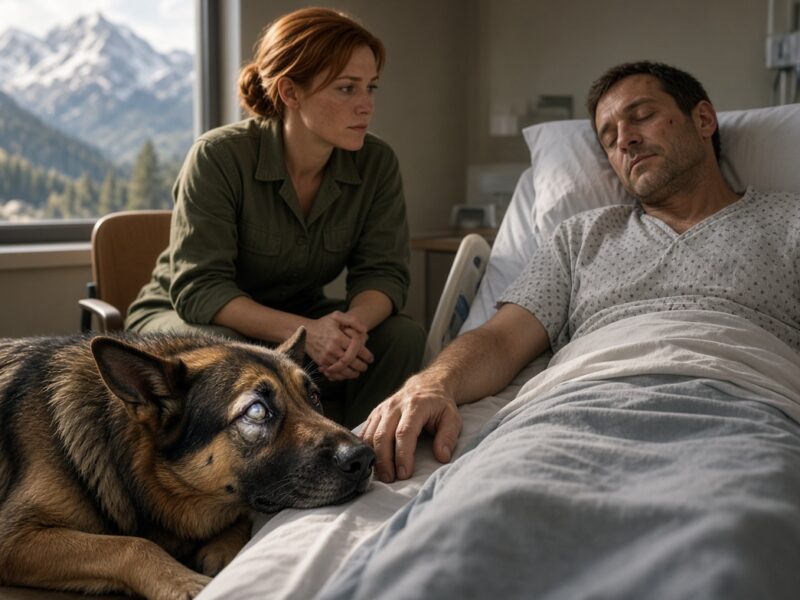
A Female Marine Found a Crashed Doctor and His Trapped K-9 Nearly 24 Hours Too Late — The Dog Refused to Leave Him
A female Marine found a wreck below a deserted Montana milepost nearly twenty-four hours too late.
A doctor lay unconscious nearby while his trapped K-9 had refused to abandon him.
Marorrow survived, but the crash took one eye, most of the hearing in one ear, and the life he once knew.
Fifteen days later, the wounded dog returned to the motorcycle and froze beside a hidden seam.
What police found beneath the seat proved the town had been hunting the wrong man.
But exposing the truth could not answer the only question Marrow still carried to his owner’s silent bedside.
The delivery van had been climbing for two hours when the navigation screen turned gray.
Rowan Hale watched the blue route line disappear beneath a blank square of Montana mountains, then glanced at the paper manifest clipped beside the wheel.
The rural clinic expected six cardiac monitors before sunset.
Turning back would cost ninety minutes, and the old county road still appeared on the printed map.
She took the western fork.
At thirty, Rowan carried the compact strength of a career Marine in the set of her shoulders and the economy of her movements.
Copper-auburn hair was secured in a low bun, and her olive drab shirt made her look more prepared for field duty than medical freight.
She had learned to distrust roads that became too quiet.
This one narrowed between yellow grass and dark pines until even the tires seemed reluctant to make noise.
A faded barrier marked a closure left by a spring slide, but one lane remained passable.
Rowan slowed.
Fifty yards beyond it, a section of wire fence leaned downhill.
Broken black plastic lay in the weeds, too clean to have weathered there.
She stopped beside Mile 117 and walked back.
A fresh scrape crossed the gravel shoulder, vanished over the edge, and continued through crushed grass below.
The air smelled of wet stone and cold metal.
She called out, heard nothing, then caught a movement near a cluster of young firs.
One upright ear appeared above the grass and disappeared again.
The slope revealed the wreck in pieces.
An adventure motorcycle rested against its protective frame, partly tangled with a reinforced canine carrier.
Beneath the luggage rack lay a sabled German Shepherd, powerful even in exhaustion, its rear leg trapped in the narrow space between metal and earth.
Its coat was dark with rain and dirt.
One eye followed Rowan; the other was swollen closed.
Several yards away, a man lay on his side in a riding jacket and helmet.
The dog tried to drag itself toward him and could not.
“Easy,” Rowan said, keeping her voice low.
“I see him.”
The shepherd did not welcome her, but it stopped fighting the weight.
Rowan checked the man first without moving his neck.
His breathing was shallow but present.
His helmet had taken damage without splitting, and there was no sign of catastrophic blood loss.
His skin was cold.
A cracked smartwatch showed its last complete activity record from the previous afternoon, nearly twenty-four hours.
The realization passed through Rowan like the shadow of a cloud.
All night the dog had been close enough to see its owner and unable to reach him.
She returned to the van for blankets, wheel blocks, a hydraulic jack, and cargo straps.
The motorcycle stood on unstable ground, so she anchored its frame to the van before touching the jack.
Wooden shipping blocks widened the base.
She lifted the machine only a few inches, watching every shift in the soil, then slid a folded cargo blanket beneath the dog and drew him clear.
He made one restrained sound and turned immediately toward the man.
Rowan covered him, left water within reach, and moved to the rider.
A sharp flash came from the grass.
For one second, she thought it was water, but the object caught the pale sun again, a curved piece of smoky blue lens beside a streak of white paint.
It lay uphill from the motorcycle slide path.
Rowan photographed it with the mile marker in frame and flagged the spot with orange survey tape.
She did not pick it up.
The road above had held another vehicle.
Her satellite unit finally connected.
Rowan gave coordinates, two patients, and the likely duration of exposure.
While waiting, she stabilized the rider’s head, insulated him from the ground, and monitored each thin breath.
A wallet identified him as Dr. Adrian Cross, thirty-nine, of Northstar Regional Medical Center.
The dog’s collar carried one word.
Marorrow.
Rowan spoke both names aloud, as if giving the empty road something it could return.
The wait lasted thirty-one minutes.
Rowan measured it by Adrian’s breaths and by the intervals at which Marorrow tried to rise.
She offered the dog water in small amounts, keeping the bowl on his seeing side, and checked the trapped leg without forcing it straight.
Whenever the wind moved through the firs, Marorrow lifted his good ear and searched for an engine.
Once he nudged the blanket covering Adrian’s shoulder, then settled against its edge.
Rowan understood the choice.
During the cold night, the dog had likely divided himself between guarding his injured body and keeping contact with the only person he trusted.
The knowledge made the silence at Mile 117 feel inhabited rather than empty.
The first sheriff’s unit arrived with paramedics, followed by a veterinary transport.
Sheriff Ellen Ward, a lean woman in her early forties with brown skin, black hair threaded with early silver, and a patient way of looking twice before speaking once, took Rowan’s photographs and secured the lens fragment.
Paramedics moved Adrian to a helicopter landing zone.
A veterinary technician examined Marorrow and promised that the injured leg had circulation.
Another vehicle arrived after the scene was taped off.
A white Northstar maintenance truck.
Its driver, Dale Voss, was a broad man near fifty with clipped blonde hair and a face made heavy by sleeplessness or habit.
He said the hospital had lost a medical sample case assigned to Adrian and had sent him to receive any recovered property.
Elena kept him outside the line.
Marorrow had endured uniforms, radios, engine noise, and unfamiliar hands without more than watchful tension.
Then he saw Dale.
His body became rigid.
A low warning rose from his chest, quiet enough that only Rowan and the veterinary technician heard it.
Dale stopped, glanced at the dog, and placed both hands where everyone could see them.
“Shock,” he said.
“Poor animal doesn’t know anyone.”
Marorrow knew something.
Rowan could not say what, and she refused to turn an injured dog’s fear into an accusation.
Still, when the helicopter lifted Adrian toward the north and the veterinary van prepared to carry Marorrow east, the shepherd kept his right eye fixed on Dale until Rowan stepped between them.
Only then did he look at her.
The doors closed on two separate vehicles, taking man and dog in different directions.
Rowan remained beside Mile 117 with the wind pulling at the survey tape and the unmistakable sense that the person who had abandoned them had not stayed away.
The helicopter disappeared before Rowan’s delivery manifest stopped trembling in her hand.
She finished the route because the mountain clinic still needed its monitors.
But by the time she reached Northstar Regional after dark, the bright corridors felt like another road she had entered without knowing where it led.
Adrian was in surgery.
A nurse could tell her nothing beyond that.
Marorrow had been transferred to a veterinary hospital across town, where the waiting room smelled of disinfectant and damp fur.
Dr. May Lynn met Rowan near midnight.
She was a small, straight-backed veterinarian in her fifties with iron-gray hair cut at her jaw and the calm voice of someone accustomed to explaining painful truths without making them crueler.
Marorrow’s spine was intact, and the trapped rear leg had suffered muscle damage rather than a major fracture.
His right ear had lost much of its hearing.
The left eye could not be saved.
“He can adapt,” May said.
“Dogs do not mourn an idea of symmetry the way people do, but he will need someone to teach him where the world moved.”
The surgery ended before dawn.
Marorrow woke disoriented, the left side of his face protected by a clean dressing.
He would not eat.
He tolerated May and the technicians but pushed himself backward whenever they tried to move him from the kennel.
When Rowan entered wearing the same olive shirt from the slope, his remaining eye settled on her.
His breathing slowed.
Northstar called while she sat on the floor outside his enclosure.
Adrian had survived surgery.
Dr. Helen Brooks, the neurologist in charge, described diffuse brain injury, a bruised lung, several broken ribs, dehydration, and hypothermia.
His brain still showed organized activity, but he had given no purposeful response.
The prognosis was grave, not final.
The words returned Rowan to a military roadside years earlier, where she had kept pressure on a friend’s shoulder and promised help was coming.
Help had come.
It had not been enough.
Since then, Rowan had preferred rescue tasks with measurable endings.
A door opened, a person transferred, a signature obtained.
Adrian’s survival had no clean edge.
It extended beyond the act of finding him.
Animal control located Marorrow’s microchip and confirmed Adrian as his owner.
The emergency contact listed in the record had died two years earlier.
May requested an emergency foster placement because Marorrow responded to Rowan and because a crowded holding facility would complicate his recovery.
The county approved forty-eight hours, renewable after review.
Rowan signed carefully.
“This is not adoption,” she told May.
“No,” May agreed.
“It is tonight.”
Marorrow came home in a padded crate with medication, a support sling, and written instructions.
Rowan’s small rental cabin had never held an animal.
She blocked the stairs, cleared furniture from his path, and placed his bed so his seeing side faced the door.
He refused food until she laid Adrian’s recovered scarf beside the bowl.
Then he ate three bites and stopped.
At dawn, he slept with his right eye turned toward her boots.
The practical work steadied Rowan.
Medication at six.
Assisted steps at eight.
Water measured rather than guessed.
Marorrow hated the sling but accepted it when she let him see each buckle before fastening it.
At the porch threshold, he froze, unable to judge the drop on his blind side.
Rowan placed her boot against the edge and tapped twice.
He tested the distance with one paw and crossed.
It was the first agreement they made that did not depend on Adrian’s scent.
Back inside, Rowan wrote the method beside May’s instructions, as though a few lines of ink could make the unfamiliar house navigable for both of them.
Elena visited that afternoon.
The preliminary explanation was fatigue and impaired driving.
A low level of sedative had been found in Adrian’s blood.
His route records showed long hours, and no second vehicle appeared on the nearest functioning road camera.
Rowan described the blue lens and white paint again, then mentioned the sealed travel mug that had been recovered with his belongings.
“If the drug was in the mug, that matters,” she said.
“If it wasn’t, it still matters.”
Elena nodded.
“The mug is sealed. The lab will handle it.”
The television murmured behind them.
A local report showed Dale Voss beside a Northstar truck, telling a camera that the hospital was cooperating fully.
His image appeared without warning.
Marorrow’s left ear turned toward the sound when he shifted his head and caught Dale with his right eye, his paws pressed hard into the bed.
He backed against Rowan’s leg.
The room went quiet around one small mechanical click from the television.
Rowan rested a hand near Marorrow without touching him.
The dog had not recoiled from paramedics, deputies, May, or the hospital courier who delivered Adrian’s scarf.
His fear had shape.
It had a face.
Elena recorded the reaction but did not call it evidence.
“Recognition can mean many things,” she said.
“I know.”
That evening, Northstar approved a supervised visit.
Marorrow traveled in his crate and entered the neurological unit with May’s clearance.
He could not see Adrian through the first door.
Yet he angled toward the room before Rowan guided him.
Inside, machines measured what Adrian could not express.
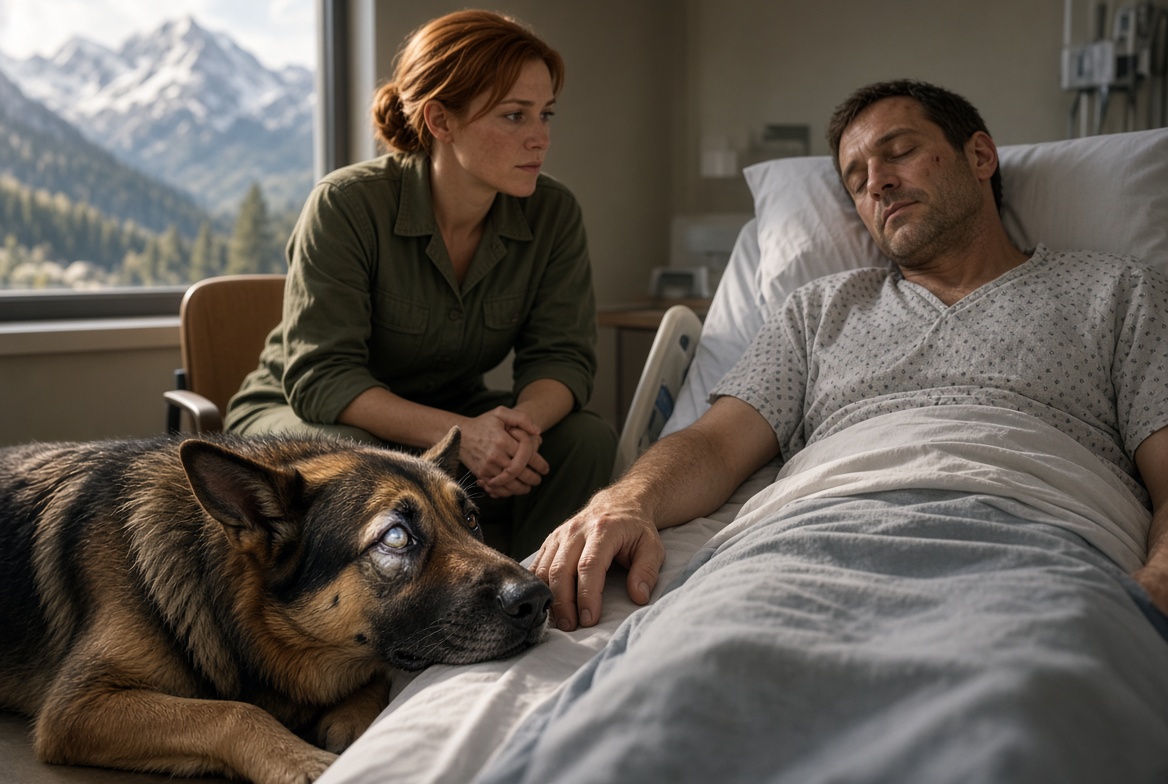
Marorrow lay beside the bed and placed his muzzle near the hand that did not move.
The visit lasted five minutes.
There was no miracle.
On the way out, Dr. Brooks told Rowan the laboratory had matched the sedative in Adrian’s blood to residue in his travel mug.
Someone could have placed it there without his knowledge.
They did not know who.
Rowan looked through the glass at Adrian, then down at Marorrow, who had turned his good eye toward her for direction.
Mile 117 was no longer the end of an exhausted driver’s mistake.
It was where someone had expected a drugged man and his dog to disappear.
The road had delivered them to separate doors, but the same hidden hand had closed both behind them.
Three days after the rescue, Elena invited Rowan to the state evidence garage for one purpose.
Keep Marorrow calm while technicians examined Adrian’s motorcycle.
The dog wore a support sling and moved in short, deliberate steps.
Rowan stayed on his left, protecting the side he could not see, and stopped at the yellow line marked for observers.
Everything beyond it belonged to the warrant and the people documenting the search.
Sergeant Isaac Cole supervised the examination.
He was a tall Black man in his late forties, clean-shaven, precise in speech, and unhurried around conclusions.
Cameras recorded every item.
The reinforced carrier had protected Marorrow from the full weight of the motorcycle, but its mounting brackets showed a hard lateral strike.
White transfer paint marked the frame.
The locator unit was gone, its cable cut cleanly after the crash.
The rear cargo case contained an empty insulated sample box.
A receipt bore the signature of Nolan Reed, a Northstar driver who had not reported for work since the night of the collision.
Nolan’s fingerprints appeared on the luggage rack and box latches.
Adrian’s phone held messages demanding that Nolan return a shipment before people were harmed.
A folded map marked an abandoned medical depot west of town.
Each discovery narrowed the story in the same direction.
Fleet records placed Nolan’s truck near the old road.
A roadside diner camera showed a man matching him seated one table from Adrian hours before the crash.
Investigators also learned that ten thousand dollars had entered Nolan’s account through a consulting company.
Local news began describing him as a fugitive before Elena had used the word suspect.
Elena explained the distinction to Rowan outside the garage.
Nolan’s prints on equipment he transported were expected.
His truck near a work route was suspicious only in context.
The money required tracing, and the diner image did not show anyone touching Adrian’s mug.
None of those cautions survived the evening broadcast, where separate facts were arranged into a single confident sentence.
Rowan had seen the same thing happen after military accidents.
Uncertainty was treated as weakness.
While a clean story sounded like competence, she reminded herself that resisting a premature conclusion did not mean declaring Nolan innocent.
It meant leaving enough room for the evidence to remain evidence.
Rowan watched Marorrow rather than the reporters outside.
He sampled the air around the motorcycle, ignored the empty box, and pulled gently toward the seat.
When the leash stopped him at the evidence line, he lowered his nose and breathed along the floor.
The reaction was focused, not fearful.
“What is he trained to find?” Cole asked.
“People, roots, personal emergency gear,” Rowan answered.
May had obtained a summary of Marorrow’s search and rescue records.
Adrian used the same canvas medical pouch in his drills.
Cole crouched without crossing into the dog’s space.
A seam along the rear seat had been resewn with thread a shade darker than the original.
Marorrow pressed his nose toward it and held still.
The fluorescent light above them flickered once, and a loose buckle tapped against the frame.
Marorrow flinched toward his deaf side, unable to place the sound, then looked to Rowan.
She gave the hand signal May had taught her.
Steady.
He returned his attention to the seam.
The damaged world had moved again, and he had found his place in it.
The warrant covered containers and removable cargo, not destructive examination of the seat.
Cole refused to cut it open.
Elena prepared an affidavit for expanded authority using the mismatched thread and the missing locator as physical grounds.
Marorrow’s behavior went in the report only as the reason officers noticed the alteration.
Analysis of the smoky blue fragment produced a second lead.
It matched a lamp assembly used on a series of commercial maintenance trucks, including Northstar’s fleet.
The hospital submitted records stating that every vehicle had returned without damage.
Then Cole compared timestamped yard photographs.
One truck had worn an older lamp on the evening before the collision and a new assembly by ten the next morning.
The maintenance entry called it routine replacement.
No damaged part had been retained.
The evidence still pointed at Nolan.
He had handled the cargo, appeared at the diner, received money, and vanished.
The truck could have been stolen or used with his help.
Elena would not clear him because a dog trusted his scent.
Rowan respected that caution even as the speed of the public verdict disturbed her.
At the hospital, Marorrow was allowed another five-minute visit.
Adrian remained motionless except for the involuntary rhythm of breathing supported by machines.
Rowan placed no hope on his hand and asked him no questions.
She simply told him that the motorcycle had been recovered and that Marorrow had eaten breakfast.
The dog rested his muzzle near Adrian’s wrist.
Dr. Brooks watched from the doorway and noted that Adrian’s heart rate changed slightly when Marorrow settled, then returned to baseline.
She refused to interpret it as awareness.
Rowan appreciated the restraint.
Hope offered too cheaply could become another kind of harm.
She guided Marorrow away when the allotted time ended, using a hand signal on his right side.
He looked back once, memorizing the distance to the bed.
Outside the room, a screen showed Grant Mercer addressing reporters.
Northstar’s director was a silver-haired man with a warm, practiced face and the slightly stooped posture of a doctor accustomed to leaning toward frightened families.
He promised transparency and urged Nolan to surrender.
He also said Adrian had been under great strain.
By evening, the judge approved the supplemental warrant.
Cole called Rowan because the seam would be open the next morning.
“The lab confirmed the thread is newer,” he said.
“Different material, different age. Someone built a compartment or repaired one.”
Rowan looked at Marorrow asleep beside Adrian’s scarf.
The motorcycle had offered investigators a neat story about Nolan Reed, but its most guarded part told another.
Whatever Adrian had hidden beneath the seat, he had expected someone to search everywhere else first.
Marorrow’s recovery did not move in a straight line.
On the second morning, he refused food until Rowan placed Adrian’s scarf beside the bowl.
On the fifth, he learned to turn his left ear toward her voice, then walked into a chair because the missing eye had erased part of the room.
He stood trembling with anger more than pain, as if the furniture had betrayed a rule he remembered.
Rowan moved the chair but did not empty the cabin of every obstacle.
May said adaptation required a world that remained real.
They developed a language of position.
Rowan approached from Marorrow’s seeing side, tapped the floor before touching him, and used broad hand signals in his right field of view.
During sling exercises, he placed the injured leg carefully and searched her face after every third step.
His trust did not arrive as affection.
It arrived as permission to continue.
May made Rowan keep a recovery log.
The pages recorded distance, appetite, balance, and the moments Marorrow startled at sounds he could not locate.
Rowan added observations that had no medical column.
He disliked the kettle’s whistle, preferred morning light, and slept facing Adrian’s scarf.
The notes prevented bad hours from erasing good days.
They also exposed Rowan’s own habit of measuring worth only through outcomes.
Marorrow could stumble at noon and still have walked farther at dawn.
Both facts were true.
Supervised hospital visits divided the days.
Adrian’s room stayed almost unchanged while Marorrow changed around it.
The dressing came off his face.
The swelling receded, leaving a closed scar where the left eye had been.
He could walk farther, rest, and walk again.
Adrian gave no purposeful response.
Rowan stopped treating the silence as an empty space she needed to fill.
She reported small facts.
Rain on the cabin roof.
Three bites becoming a full meal.
The first morning Marorrow waited at the door.
Grant Mercer visited on day twelve.
In person, Northstar’s director carried his authority quietly.
At fifty-seven, he had thick silver hair, pale blue eyes, and careful hands that rarely moved without reason.
He spoke of Adrian as a gifted physician who had once stayed through a blizzard to treat stranded families.
Northstar, he said, would cover every bill.
He also offered to move Marorrow to a rehabilitation center owned by a hospital partner.
“Rowan has county foster authorization,” May replied.
“Changing placement now would set him back.”
Grant accepted the answer graciously.
When he stepped near Marorrow, the shepherd turned his good eye toward him and sampled the air.
His body tightened, though not with the immediate fear Dale had caused.
Rowan noticed a layered odor on Grant’s shoes, hospital disinfectant over machine oil, and the faint plastic scent of insulated packing.
None of it was rare.
Together, it reminded her of the sample carrier at the evidence garage.
She stored the observation without giving it a name.
Day fifteen arrived under clear light.
May approved a brief controlled visit to the garage.
Marorrow wore a padded support harness and could work for no more than ten minutes.
Elena and Cole had already opened the seat under the expanded warrant, preserving the seam and adhesive before removing a narrow waterproof compartment.
The moment the sealed tray appeared, Marorrow leaned forward.
Inside lay a strip of canvas cut from Adrian’s familiar medical pouch, a brass key, a memory card, and folded paper.
The canvas explained the dog’s alert.
It carried the target odor from years of training, deliberately placed where Marorrow could find it if Adrian could not speak.
Cole unfolded the note beneath a camera.
Adrian’s handwriting had been verified from hospital records.
Four words stood alone.
Not Nolan.
Follow Cold Chain.
For several seconds, the garage held only the hum of ventilation.
Rowan felt the pause settle through everyone differently.
Elena saw a new investigative direction.
Cole saw an evidentiary problem to authenticate.
Marorrow saw the piece of the person he had been searching for and reached toward it with his nose.
The compartment had not been built during the chase.
Adhesive curing and wear marks showed it had existed for days.
Adrian had prepared it before meeting Nolan, anticipating that his visible cargo might be taken.
The memory card was encrypted.
The key carried a numbered tag from a specimen storage system used by rural clinics.
Financial analysts returned another result that afternoon.
The ten thousand dollars in Nolan’s account had come through Blackpine Consulting, a company with no staff and a mailing address shared by a contractor in Northstar’s distribution network.
The transfer had been initiated after Nolan’s last confirmed public sighting.
It looked less like payment than a label attached to a missing man.
Grant responded cautiously when Elena informed him that the investigation had widened.
He suggested Adrian may have been confused or pressured by Nolan.
He offered unrestricted access to hospital records subject to patient privacy and counsel.
His cooperation was polished enough to make suspicion feel impolite.
Elena accepted the offer in writing and requested preservation of fleet logs, cold storage records, internal video, and access histories.
Grant agreed before counsel could answer for him.
Rowan saw the exchange from the corridor and understood why the town trusted him.
He never pushed against authority.
He opened the door, named the rules, and made everyone feel unreasonable for wondering what might have been moved before they entered.
At the neurological unit, Marorrow completed his longest walk since the crash.
He reached Adrian’s bed without the sling, bearing his full weight, and laid his chin beside the still hand.
Nothing changed on the monitor.
Rowan felt the old instinct to leave before hope demanded too much.
Instead, she pulled a chair closer.
“Not tonight,” she said softly.
Marorrow shifted until his shoulder touched her boot.
Adrian had not awakened, but the message hidden fifteen days earlier had done what his body could not.
It had told them whom not to hunt and where to look next.
Outside the window, the last light moved over the mountains from one ridge to another, like a road visible only when the angle was right.
Grant Mercer answered Elena’s questions in a conference room overlooking Northstar’s ambulance bay.
He brought counsel but spoke before the attorney could frame his replies, offering fleet records, internal video, and access logs with the ease of a man opening doors he owned.
He described Adrian as brilliant, exhausted, and increasingly suspicious during the previous month.
Nolan Reed, he said, had exploited that strain.
Outside, a volunteer group hung banners for Northstar’s winter charity drive.
Grant’s name appeared beneath photographs of rural clinics, rescued budgets, and smiling families.
He had guided the hospital through near bankruptcy, funded free examinations, and persuaded donors to keep emergency rooms open across three counties.
Suspicion against him had to pass through years of public gratitude before it reached anyone’s mind.
The brass key from Adrian’s hidden compartment belonged to a specimen locker at Pine Hollow Clinic, closed since summer repairs.
Elena obtained a warrant.
Rowan accompanied the team only because Marorrow’s foster agreement and search history made her his handler.
The shepherd moved slowly, scar turned away from doorframes, his right eye checking Rowan’s hand whenever the building changed around him.
Locker 214 contained inspection seals peeled from approved devices, a defective infusion valve, serial number lists, and a photograph of Adrian beside Nolan among stacked cartons.
Nolan was thick-set with a dark beard graying at the chin and weary eyes that made the still image look defensive.
A jacket bearing his name hung from a hook.
Marorrow approached it without fear and lay down, the trained indication for a familiar safe scent.
Inside the pocket, technicians found gauze carrying Adrian’s blood and several strands of Marorrow’s fur.
The discovery appeared damaging until laboratory analysis showed the gauze had wrapped a wound.
The stain pattern came from pressure and contact, not an assault.
Adhesive residue matched a roadside first aid kit registered in Nolan’s truck.
A service station archive added context.
Days before the crash, its camera had recorded Adrian unsteady but walking, supported by Nolan after a disturbance beyond the frame.
Marorrow followed close, unharmed.
Nolan cleaned a minor injury on Adrian’s arm, offered the dog water, and drove them away.
The man described as Adrian’s enemy had already brought him to safety once.
The recovered image froze on the screen with a soft electronic chime.
Marorrow raised his head at Nolan’s voice, then rested it again.
Rowan watched the dog choose calm.
Records could be rearranged.
His body remembered how a person had treated him.
Cole reconstructed the earlier rescue from ordinary details.
The gauze wrapper had Nolan’s fingerprint beneath the fold, placed there before it touched blood.
A receipt showed he bought bottled water and bandages ten minutes before the service station recording.
Adrian’s minor injury had been cleaned, wrapped, and checked again.
Nothing proved Nolan was innocent of later crimes, but it destroyed the claim that the stained jacket showed violence.
Elena amended the public timeline without identifying protected evidence.
The correction received a fraction of the attention given to the accusation.
At the clinic, Marorrow also found a shallow scrape along the locker base.
Technicians recovered a broken plastic seal printed with the same lot prefix as the defective valve.
The seal had no evidentiary meaning until serial analysts compared it with Northstar’s purchase database.
It belonged to an approved device officially delivered to a mountain clinic.
Yet that clinic possessed a different unit under the same number.
One identity had been given to two machines.
The fraud was no longer a theory built around missing cargo.
It had a measurable duplicate.
Grant dismissed the footage as proof that Nolan had earned Adrian’s confidence before betraying it.
His explanation was possible, which made it useful.
He then released a statement urging Nolan to surrender and promised that Northstar would protect Adrian’s reputation regardless of what the investigation uncovered.
Digital auditors found that the fleet account used on the night of the collision belonged to a dispatcher dead for three years.
Both Dale and Grant had authority to restore archived credentials during emergencies.
The action had been routed through an administrator terminal, but a maintenance window erased the local identifier.
Elena could show access, not identity.
Then state police obtained a photograph from a highway weigh station.
A Northstar truck returned before dawn with mud coating its rear plate and a new passenger-side lamp.
Its recorded cargo weight was lower than when it departed.
The time placed it within reach of Mile 117.
The image did not reveal the driver.
Rowan later found Grant beside Adrian’s bed.
He stood with one hand on the rail, speaking quietly about old emergency room shifts.
Nothing in his manner resembled panic.
When Marorrow entered, Grant stepped back without being asked.
The dog’s nose lifted.
Disinfectant, machine oil, insulated plastic.
The same layered scent Rowan had noticed before.
Marorrow did not accuse.
He simply chose distance.
Grant saw Rowan watching.
“Trauma makes patterns where there may be none,” he said.
“Sometimes,” she answered.
Elena called before evening.
The dead dispatcher’s account had been activated from a device issued to executive operations, and the replacement lamp had been billed through an exception Grant approved.
Neither fact proved he ordered violence.
Together, they widened the road leading toward him.
Rowan asked why Grant would keep records that pointed toward his own office.
Elena said, “Powerful systems rarely depend on perfect secrecy. They depend on routine, divided responsibility, and the belief that no one will connect a billing exception to a roadside fragment. Grant could approve a repair without knowing why it was needed. Dale could use an account without telling Grant. The task is not to choose the most satisfying explanation but to eliminate the alternatives one by one.”
At home, Rowan opened Marorrow’s recovery log.
Under the day’s distance and medication, she wrote, “Nolan, safe response. Grant, avoidance.”
She drew a line beneath both.
A dog’s memory could point.
It could not convict.
Yet the town’s hero possessed the authority to awaken dead accounts, erase routes, and explain every locked door as hospital procedure.
The reconstruction changed the official case from accident to attempted murder.
Residue in Adrian’s travel mug matched the sedative in his blood.
White paint on the motorcycle matched Northstar’s maintenance fleet, while the blue lens fragment fit the lamp replaced hours after the crash.
Damage to the carrier showed a lateral impact.
The missing locator had been removed after the motorcycle stopped moving.
Sergeant Cole explained the sequence without dramatizing it.
Adrian had been impaired before he left the diner.
A truck followed him onto the old county road, forced him from the pavement, and returned after the crash.
Someone removed the medical sample case and locator but missed the compartment beneath the seat.
The evidence identified a Northstar vehicle.
It did not yet identify who drove it or who gave the order.
The diner footage supplied boundaries rather than an answer.
Adrian filled his mug at the counter, carried it to his table, and left it unattended during a telephone call.
Three people passed nearby, including a Northstar employee whose face was blocked by a delivery rack.
Nolan remained seated across the room and never approached the mug.
The timing weakened the story against him, but the obscured employee could not be identified.
Priya preserved the original recording before Northstar’s attorneys could obtain a copy.
Cole also tested the motorcycle steering and brakes.
Both functioned before impact.
Adrian had tried to avoid the truck despite the drug in his system, turning toward the slope where trees were smaller and the descent less severe.
That choice likely kept the collision survivable.
Rowan recognized the discipline in it.
Not control, but one useful decision inside a situation someone else had designed.
Dale’s credentials could alter fleet logs, and Grant had approved the truck’s maintenance exception.
Dale continued reporting to work, insisting the vehicle had been available to several employees.
Elena placed him under surveillance while analysts preserved Northstar’s network.
An early arrest based on incomplete evidence might warn everyone above him.
Rowan tried to return to ordinary deliveries.
Northstar reassigned her next route through an old timber bridge leading to a rehabilitation clinic.
Marorrow rode secured in the van under the terms of his foster care.
Near the bridge, he woke and began sampling the air through the cracked window.
A low whine came from his throat.
Rowan smelled hydraulic oil.
She stopped well short of the wooden approach.
Marorrow turned his good eye toward the left rail, then back to her.
Rowan called Elena and stayed behind the barrier.
Deputies found fresh tool marks and missing fasteners along a support guard.
The bridge itself had not been destroyed, but the loaded van could have shifted the weakened edge enough to send it down the ravine.
Wind moved a loose metal plate beneath the decking.
It struck wood once, bright, sudden, close.
Marorrow spun toward the wrong side because his damaged hearing displaced the sound.
Rowan raised a steady hand in his right field of view.
He fixed on it, and the panic left his body one breath at a time.
The danger was real.
His first interpretation did not have to be.
A trail camera captured a Northstar service truck near the bridge before dawn.
Mud covered the plate, and the person outside wore a hood.
Fibers recovered from the rail matched a common fleet jacket.
The footage could not identify Dale.
By the time Elena’s team reached his home, he was gone.
Grant called a press conference.
He announced that Dale had received threats connected to Nolan and might have been abducted.
Northstar employees stood behind him, frightened for a colleague.
The story absorbed the new facts immediately.
A missing driver.
A fugitive suspect.
Another act of intimidation.
Grant did not deny the bridge had been tampered with.
He placed the blame before investigators could name it.
Rowan’s delivery schedule had been changed less than twelve hours before departure.
The request originated from executive operations, then passed through an automated dispatch queue.
Grant’s office said a rural clinic had requested urgent supplies.
The clinic denied making the request.
Elena moved Rowan to a county guest house and assigned patrol checks.
Rowan resented the protection until she realized Marorrow slept more deeply there.
She arranged furniture to preserve his routes and continued his exercises.
Every practical act resisted the person trying to reduce lives to movable entries in a system.
Marorrow’s own progress offered no dramatic victory.
He misjudged a doorway, rested after a short walk, and refused the unfamiliar metal ramp until Rowan crossed it first.
Yet he recovered from each mistake faster.
Rowan began using a strip of pale tape along the guest house floor to mark turns visible to his right eye.
By the third evening, he followed the route from bed to water without contact.
The small achievement mattered because no one had manufactured it for an audience.
It belonged only to the dog who had learned it.
At Adrian’s bedside, Rowan told him the investigation now recognized an attempted murder.
Marorrow lay beside the bed, his recovering leg extended.
Adrian remained still.
Rowan did not ask him to wake and solve what others could solve without him.
Cole later confirmed that the bridge fasteners carried traces of the same hydraulic fluid used in Northstar’s older lifts.
It was another connection, not a signature.
Elena explained that they needed the network itself.
Records showing who controlled the false routes, altered videos, and money.
Dale could be the hand.
The hand still required a mind.
That night, Northstar’s legal office delivered thousands of pages in response to warrants.
Buried among them was a routing audit.
The change sending Rowan to the bridge had been approved from a terminal inside the executive suite during a period Grant claimed to be at a donor dinner.
Entry cameras showed him returning to the building early.
The system built to move medicine and ambulances had selected Rowan’s road.
Someone had turned schedules, credentials, and public trust into quiet weapons.
Mile 117 was no isolated act.
It was one intersection in a map Grant could redraw from his desk.
The video arrived through Northstar’s counsel on the eighteenth day after the crash.
It appeared to show Nolan inside a distribution warehouse opening sealed cartons, replacing inspection labels, accepting a thick envelope, and arguing with Adrian.
In the final sequence, Nolan thrust both hands toward him.
Adrian struck the wall.
The timestamp placed the encounter three days before Mile 117.
The images joined the money transfer, missing truck, fingerprints, and disappearance so neatly that even Elena’s caution tightened.
State police issued a warrant for Nolan.
News anchors stopped calling him a person of interest.
Grant said the footage caused him profound sorrow.
Northstar employees identified the warehouse and Nolan’s work clothes.
A supervisor remembered his anger over missing inventory, while another recalled Adrian warning that patients could be hurt.
Those truthful memories were absorbed into the edited sequence.
Rowan understood why the lie worked.
It did not invent every component.
It selected facts, removed their connections, and let viewers supply motive.
Elena ordered officers not to approach Nolan as armed or violent without independent cause, a restraint that mattered even while the warrant remained valid.
Rowan watched a forensic copy at the sheriff’s office with Marorrow resting near her chair.
A barcode scanner sounded each time a carton crossed the workstation.
Marorrow knew that tone from Adrian’s search drills.
His records described games in which medical packs were scanned before being hidden.
At one beep, the dog raised his head but looked not at Nolan.
He fixed on an orange cart at the edge of the image.
The cart appeared beside a pillar.
One frame later, it stood several feet away, though no one had moved it.
Rowan asked the examiner to pause.
She did not claim the dog had found an edit.
She pointed to the discontinuity.
Forensic analyst Priya Shah was a slim woman in her thirties with dark curls tied high and an expression that sharpened whenever someone offered certainty too quickly.
She examined compression patterns, shadows, and audio.
The scanner tone had been laid across a cut.
Forty-seven seconds were missing.
Restoration from the warehouse recorder changed the scene.
The envelope contained counterfeit inspection seals Nolan had collected.
Adrian photographed them.
Nolan’s apparent shove was a pull that moved Adrian away from a tilting carton.
Afterward, both men sealed several suspect devices inside evidence bags and signed across the tape.
Priya showed how the edit had been made from the system’s own export tool.
The user had not needed sophisticated software, only administrator access and permission to overwrite a review copy.
The audit trail pointed to a shared compliance account.
Grant’s office, distribution management, and legal staff all possessed the password.
Again, the structure protected the individual by making responsibility communal.
Marorrow’s role ended with the cart.
He could not identify an edit or understand a timestamp.
Rowan said this plainly when a deputy joked that the dog had solved the video.
Giving him magic would make the real achievement smaller.
Injured and relearning the world, he had recognized one familiar sound and looked where memory told him an object should be.
Humans did the rest.
The projector fan slowed, making the room suddenly quiet.
Marorrow placed his muzzle on Rowan’s knee.
The perfect accusation had depended on seconds no one was meant to see.
Bank investigators reached the same conclusion about Nolan’s payment.
Blackpine Consulting had initiated the transfer after his last confirmed sighting.
The account access came through an address associated with a Northstar contractor.
Someone had paid a missing man so the money could testify in his absence.
Priya decrypted part of Adrian’s memory card.
It contained serial number comparisons, photographs, and a recorded plan to contact federal investigators.
Adrian and Nolan spoke as partners.
Their concern centered on certified devices disappearing from temperature-controlled vehicles and inferior replacements reaching rural clinics.
One damaged frame showed Grant and Dale inside the warehouse with three cartons whose serial labels had been removed.
Grant’s face was partly obscured, but his distinctive hospital ring and executive access badge were visible.
Counsel argued that directors routinely toured distribution facilities.
Elena agreed the image required support.
A repeated file tag offered it.
Cold Chain Winter Relief.
Northstar’s winter charity convoy was scheduled to leave in twelve days, delivering equipment to eight remote clinics before mountain snow closed several passes.
Adrian had been working against a deadline larger than his own safety.
Grant responded by claiming Nolan manipulated Adrian into a private investigation that contaminated evidence.
He offered to postpone the convoy, then noted that vulnerable clinics depended on it.
The choice placed patient need against investigative caution exactly where public pressure favored him.
Clinic directors began calling the sheriff’s office, worried that delay would leave them without equipment before winter.
Grant appeared on evening television beside boxes labeled for charity and asked whether suspicion should deprive isolated families of care.
Elena would not seize the convoy without a factual basis tied to its cargo.
The encrypted tag provided a direction, not yet probable cause.
Time had entered the case as another form of pressure.
Rowan visited Adrian that evening.
She told him Nolan’s name had not been cleared publicly, but the video had been exposed.
Marorrow rested against the bed rail.
The monitor continued its steady answer to every question.
“You hid the right thing,” Rowan said.
“Now we have to understand it.”
Marorrow turned toward the hallway before footsteps arrived.
Elena entered carrying a preservation order for all cold chain records.
She also brought a map of a private refrigerated warehouse outside town.
Vehicle logs showed repeated after-hours deliveries there, including one by Nolan’s truck after he vanished.
The investigation had spent weeks following a story assembled from selected facts.
One missing interval had reversed its meaning.
Beyond the hospital windows, trucks moved along the highway as small pairs of light.
Somewhere among routes designed to keep medicine safe, a cold road was carrying the truth, and perhaps the man accused of stealing it.
They had very little time left.
Adrian’s condition remained unchanged when the court appointed a temporary medical guardian.
Dr. Brooks explained the process to Rowan because Marorrow’s visits would continue.
The guardian could consent to treatment while an ethics committee advised, but no administrator could simply decide Adrian’s future.
Grant’s authority over Northstar did not extend to ending care.
The clarification relieved a fear Rowan had not admitted.
Grant controlled vehicles, records, and public language.
He would not control the quiet room where Adrian waited.
Cold chain data gave Elena a different map of Northstar.
Approved devices entered refrigerated trucks under verified serial numbers.
At transfer points, temperature records developed short gaps.
The real equipment disappeared.
Inferior replacements later appeared at clinics under copied labels while authentic units moved through shell companies to private buyers.
Priya aligned temperature graphs with gate logs and found a repeated thirteen-minute interval.
Trucks entered approved facilities at the correct weight, lost their signal, then left lighter.
A second vehicle departed nearby without appearing in Northstar’s system.
The pattern occurred nine times.
Blackpine Consulting paid storage fees within hours of each gap.
No single record described theft.
Together, they showed a process designed to look like normal delay.
Elena interviewed clinic staff who had reported equipment failures.
Their accounts remained general and respectful, centered on emergency responses that did not work as expected and on families still waiting for explanations.
The investigation avoided turning private grief into spectacle.
Serial numbers, maintenance dates, and purchase orders carried the accusation more honestly than painful details could.
The private warehouse outside town received deliveries at hours when its official staff were absent.
Road cameras showed Grant’s SUV there twice.
The evidence did not make Marorrow’s response to his shoes proof, but it gave the remembered combination of disinfectant, oil, and insulation a location.
Elena obtained a search warrant.
Nolan’s jacket supplied a scent article handled under documented conditions.
Marorrow was allowed to work only outside the building with Rowan keeping him on a short line and watching his fatigue.
He ignored the loading bays and moved along the wall until he reached a vent near the ground.
There he stopped, drew air through the grill, and gave his trained indication.
Officers found no room behind that section on the current plan.
A carbon dioxide meter detected elevated air returning through the vent.
Condensation traced a vertical seam in the insulated panels.
An older construction drawing showed the interior should have extended six feet farther.
A faint knock traveled through the vent.
Marorrow’s head snapped toward his hearing side.
Everyone stopped.
The sound came again, too irregular for machinery and too weak to carry far.
Rowan felt the entire investigation narrow to one human fact.
Someone behind the wall was still trying to be found.
Elena expanded the warrant before breaching the panel.
The hidden service compartment was cold, dark, and barely furnished.
Nolan Reed lay restrained near a pipe, dehydrated and exhausted, but alive.
Medics moved him into warm air and covered him before asking questions.
Marorrow remained outside the threshold.
When Nolan saw the dog, his guarded face loosened.
Rowan kept Marorrow on the safe side of the corridor while medics worked.
The dog strained once toward Nolan, then obeyed her hand signal and settled.
His restraint impressed her more than any dramatic charge could have.
He remembered the man and wanted to close the distance, but training and trust gave him another choice.
Nolan extended two fingers from the stretcher as it passed.
Marorrow touched them with his nose.
Inside the compartment, investigators recovered water containers, disposable restraints, and a small camera used to monitor Nolan.
They documented everything without displaying images publicly.
A cable ran from the camera into the warehouse security system, proving the hidden room was not an improvised act by a stranger.
Someone with continuing access had watched the prisoner and maintained the space.
“He made it,” Nolan whispered.
At the hospital, Nolan received fluids and treatment under police protection.
He could speak only briefly.
Dale had held him, demanding the location of Adrian’s final copy.
Grant believed the memory card was incomplete.
Nolan had not known where Adrian concealed the remaining data, only that it was tied to the cold chain system.
The discovery forced Northstar’s public story to collapse.
Nolan had not fled.
He had been imprisoned inside a warehouse connected to the distribution network Grant supervised.
His fingerprints, truck records, and missing status had been arranged around his absence.
Grant claimed shock.
He said Dale must have operated a private criminal scheme and suspended him, though Dale was already missing.
Northstar’s counsel argued that the warehouse contractor concealed the compartment.
Elena preserved every communication before anyone could erase it.
Rowan took Marorrow to Adrian after the search.
The dog was tired and favored his recovering leg, so she shortened the visit.
She told Adrian they had found Nolan alive.
Marorrow placed his chin near Adrian’s hand and closed his remaining eye.
Nolan’s first recorded statement came the next morning.
Dale had kept him alive because Grant still needed the last copy of the evidence.
The statement named Grant directly, but Elena treated it as a lead requiring support.
Kidnapping could explain a desperate accusation.
Data would establish the architecture.
Priya examined the recovered warehouse server.
Its security system had notified an executive account the moment police entered.
Someone at Northstar now knew Nolan was alive.
At the same time, dispatch records changed.
The winter relief convoy moved from twelve days away to the following morning.
Rowan looked through the hospital glass at Adrian and Marorrow, one unmoving and one scarred into a new way of navigating.
The state had hunted Nolan across Montana.
He had never left the coldest link in Grant’s chain.
Now that he had been found, the chain was moving faster.
Every safe assumption had expired with the changed convoy schedule.
Before morning, Elena needed warrants, federal coordination, and proof tied to the trucks themselves.
Rowan needed to keep Marorrow rested.
Finding Nolan had opened the wall.
It had not yet stopped what was already moving behind it.
Nolan’s statement began after physicians confirmed he could speak without risking his recovery.
Elena recorded the interview, limited each session, and stopped whenever fatigue blurred his answers.
Nolan described discovering duplicate serial numbers while delivering equipment to mountain clinics.
Several devices had failed routine checks.
When supervisors dismissed his reports, he took the records to Adrian.
Adrian compared the devices with cases from Northstar’s emergency department and recognized a pattern.
Together, they documented certified equipment entering cold chain trucks, disappearing during signal gaps, and reappearing through private buyers.
Inferior replacements went to communities least able to challenge a powerful hospital.
They planned to meet federal investigators before the winter relief convoy expanded the scheme.
Grant learned of the plan.
Dale interrupted an earlier evidence transfer, which explained the gauze and service station footage.
Nolan helped Adrian and Marorrow escape.
Days later, Dale drugged Adrian’s drink, forced his motorcycle from the road, took the visible sample case, and captured Nolan.
He kept Nolan alive because Grant believed only Nolan knew where Adrian stored the final copy.
“Adrian never told me,” Nolan said.
“He said one person couldn’t surrender what he didn’t know.”
The strategy had protected the evidence but left Nolan with nothing he could trade for freedom.
Grant’s people created the transfer to his account, edited the warehouse video, and used his truck records to build a fugitive.
His absence completed their story.
Nolan identified Winter Relief as the next distribution wave.
Eight clinics would receive replacement units before snow closed the passes.
The authentic equipment had already been gathered at Northstar’s central warehouse for resale.
If investigators delayed, copied serial numbers would scatter across hundreds of miles.
Priya interrupted the interview with an alert from the private warehouse.
Its security system had notified an executive account when police entered.
Minutes later, Northstar advanced the convoy to dawn.
Grant knew Nolan was alive.
Elena asked Nolan to separate what he had witnessed from what Adrian had inferred.
Nolan had personally counted certified devices, recorded duplicate numbers, and seen Dale redirect trucks.
Adrian had traced several units to private resellers and suspected Grant because every exception required executive approval.
Nolan had heard Grant instruct Dale to recover the complete file, but he had not heard a direct order to cause the crash.
The distinction mattered.
Prosecutors could build the fraud from records and the kidnapping from the hidden room.
The attempted murder still required the truck evidence, sedative, and communications.
Nolan’s careful limits made his statement stronger.
He was not filling silence with certainty.
Priya found the convoy change inside an automated scheduling account, yet the authorization token belonged to Grant.
Eight clinics received notices saying weather demanded immediate departure.
Elena contacted each director through independent numbers and asked them to hold all incoming equipment unopened.
Federal agents obtained an emergency preservation order for the trucks, warehouse servers, and Northstar’s financial accounts.
The response grew larger than any one investigator, which was exactly what Adrian had tried to create by taking evidence beyond the hospital.
Rowan visited Nolan before leaving for command.
He asked about the first night.
She described Marorrow pinned but conscious, Adrian breathing, and the route hidden below the road.
Nolan closed his eyes.
“He chose that slope,” he said.
“There was a rock cut ahead. Adrian would have seen it.”
The detail completed Cole’s reconstruction.
Impaired and pursued, Adrian had steered toward the only place where impact might be survivable.
He had not lost control.
He had spent the last control he possessed.
At the county guest house, Rowan prepared Marorrow without pretending he was fully healed.
She checked his paw pads, packed water and medication, and promised May he would remain outside smoke.
Marorrow watched each item enter the bag.
The ritual resembled deployment, but its purpose was different.
He was not being sent toward danger.
He was being given a protected role in a team that understood his limits.
The room’s ventilation clicked off, and the sudden silence made Nolan look toward the door.
“The central warehouse,” he said.
“Dale said they’d leave nothing to audit.”
Fire alarms activated at the facility soon afterward.
Elena coordinated state police, federal agents, and the county fire chief.
A nearby school fair was still open, so patrol units began an orderly evacuation.
The warehouse stored medical oxygen cylinders.
Oxygen would not ignite, but heat could intensify the fire and raise pressure inside the cylinders.
At Northstar, trucks rolled toward the gate under charity banners.
Grant appeared before cameras and said the convoy was leaving early to protect rural patients from an approaching cold front.
The weather service showed no such emergency.
He had wrapped theft in the language of service.
Rowan waited at the county command post with Marorrow.
The dog was nearly a month beyond the crash now, stronger but still limited.
She checked his harness, water, and right-side visibility.
Elena asked Rowan to help identify loading configurations from outside the hot zone.
Her delivery experience could tell responders which trucks concealed maintenance compartments.
Nolan supplied the last operational detail.
Older refrigerated trucks contained service cavities beneath temperature controls.
Dale used them to move tools and records without logging cargo.
The information gave officers lawful grounds to examine a stopped vehicle once serial discrepancies were confirmed.
State police intercepted the lead truck.
Its devices carried numbers assigned to units already installed elsewhere.
The convoy was detained.
At the warehouse, smoke rose behind the loading roof while workers moved toward assembly points.
Rowan saw the orange glow reflected in Marorrow’s one eye and remembered the blue fragment at Mile 117.
Objects kept the colors of what people tried to hide.
Workers checked in at two assembly points, allowing the fire chief to account for everyone assigned to the shift.
One name remained absent.
Dale Voss.
A gate camera showed a service truck entering shortly before the alarm.
No image showed it leaving.
The information turned the warehouse from a suspected evidence fire into an active search for the man who knew its concealed routes.
Grant had once profited by exchanging machines in silence.
Now he was accelerating trucks and fire together, gambling that confusion would destroy the chain before investigators could name him.
Elena’s radio reported that one Northstar service vehicle had entered the warehouse minutes before the alarm.
Dale had returned to finish the work.
Emergency command divided the response.
State police secured the convoy.
Firefighters established a hot zone around the warehouse, and deputies completed the school evacuation.
Rowan remained at the cold perimeter with Marorrow, where clean air and distance protected his healing body.
She identified loading doors and vehicle types from manifests while officers searched under warrant.
Marorrow alerted to a refrigerated truck listed as empty.
His nose traced the lower panel, then stopped near the temperature controls.
Serial evidence from the convoy already linked the vehicle to the fraud, so officers opened the service cavity.
Inside were an encrypted drive, warehouse diagrams, a remote ignition controller, and a plan of the medical oxygen lines.
Dale was gone, but his odor remained.
Cole photographed the cavity before anything moved.
The controller displayed active connections to three alarm zones, although firefighters found only two sources of flame.
The third signal came from the older storage wing beside the cylinders.
Dale had designed the fire to pull responders toward visible smoke while heat accumulated elsewhere.
Fire command changed its approach, sent a team to cool the hidden wall, and shut power to automated doors.
Rowan saw how evidence and rescue depended on each other.
The search did not delay safety.
It revealed where safety was most urgently needed.
The encrypted drive carried a tamper warning.
Priya instructed officers to disconnect it from the controller without attempting access on scene.
The warehouse plan bore handwritten route marks matching corridors omitted from the current fire map.
One line ended at the west service exit.
Elena placed an arrest team there while maintaining an open route for firefighters.
No one entered the passage solely because a dog had indicated it.
Airflow plans, the abandoned truck, and Dale’s confirmed presence supplied the operational basis.
An abandoned jacket led toward the east loading bay.
Marorrow sampled it and refused the track, returning instead to air moving beneath a service door omitted from the new plan.
Rowan recognized the behavior.
The jacket was strong scent without a continuing trail.
Dale had left a decoy.
Firefighters confirmed the hidden passage connected the cold receiving area to an older section of the warehouse.
Marorrow worked only to the safe threshold.
Rowan kept herself on his blind side and used signals within his right eye.
When smoke shifted toward them, she ended his work and transferred him to a deputy behind the line.
From the corridor came the scrape of machinery, followed by a warning horn.
The sound bounced through metal walls.
Marorrow turned the wrong direction, then corrected when Rowan pointed.
Through gaps between stacked cartons, she saw Dale in a forklift driving toward the cylinder storage area.
He had set the controls and was preparing to jump clear.
Rowan had been asked to identify loading geometry, not confront anyone.
She stayed behind the divider and described the forklift’s lane over radio.
A warehouse supervisor confirmed that a second machine could block the approach from a protected cross aisle.
Fire command approved the move only after verifying the route remained clear of smoke.
The plan unfolded through short confirmations, each person responsible for one piece.
Rowan felt none of the lonely urgency that had followed her since the military crash.
Coordination did not weaken courage.
It gave courage somewhere useful to go.
The horn sounded again, flat and urgent.
Rowan radioed the position and pulled a warehouse employee behind a concrete divider.
A second forklift moved across the lane under a trained operator’s control, attempting to block the first without entering the burning section.
Fire crews cooled the cylinder wall from outside.
Dale abandoned the machine and vanished into the service passage.
The first forklift struck stacked pallets rather than the cylinder rack and stopped.
No cylinder ruptured.
The collision scattered cartons, exposing approved devices bearing the same numbers as units seized from the convoy.
At the perimeter, Marorrow stared toward the west wall.
His earlier track had ended at the hidden door, and the old diagram showed the service passage emerging there.
Rowan relayed the route.
Elena positioned officers at the western exit instead of sending anyone blindly through smoke.
Federal agents opened the recovered drive using credentials from Adrian’s card.
It contained payment schedules and coded shipping lists, but full decryption would take time.
The immediate evidence was physical.
Authentic devices in the warehouse, inferior duplicates in the trucks, and ignition equipment hidden in Dale’s vehicle.
Grant called Elena and blamed Dale.
He claimed the executive account had been compromised and demanded the convoy be released for patient safety.
Elena told him federal agents were serving a warrant at Northstar.
Grant ended the call.
The detained drivers cooperated.
Several believed they carried certified donations and were shaken when inspectors revealed mismatched labels.
Their testimony showed how compartmentalized the scheme had been.
Most employees had performed ordinary jobs around a hidden exchange.
Grant’s power came not from recruiting an entire corrupt hospital but from controlling the few points where records, cargo, and authority crossed.
Rowan reunited with Marorrow behind the command vehicle.
Ash drifted beyond the floodlights but did not reach them.
She checked his breathing and injured leg.
He had done enough.
His work had not been a charge into danger.
It had been the disciplined refusal to follow a false scent.
A west-side door opened.
Dale emerged, saw the officers waiting, and retreated toward the safer loading corridor where Rowan and Marorrow stood behind cover.
He moved along Marorrow’s blind side, believing the dog could not detect him.
Rowan had made that side her responsibility from the first week.
She saw him before he reached them and warned the arrest team.
Dale turned back toward a locked exit.
Officers closed from both directions.
He had tried to make the warehouse a final collision, but every route he chose had already been mapped by the dog he left beneath a motorcycle.
Outside, the first clean stretch of night opened above the roof, while emergency lights held every remaining exit in view.
Rowan kept distance while officers ordered Dale to stop.
He looked toward Marorrow, perhaps expecting the dog to attack and create confusion.
Marorrow remained beside Rowan, focused on her visible hand.
Dale reached the locked door and found no road beyond it.
State troopers took him into custody without further harm.
Fire crews isolated the oxygen storage, cooled the cylinders, and contained the remaining fire.
The authentic devices suffered smoke exposure but remained identifiable.
Every carton was photographed before removal.
The workers evacuated safely, and the school fair completed its move to a church gym beyond the perimeter.
The recovered drive opened the architecture of the scheme.
It listed shell companies, private buyers, copied serial numbers, and payments authorized through Grant’s office.
Messages instructed Dale to alter video, restore the dead dispatcher’s account, move Nolan, and destroy central records if the warehouse search occurred.
Grant had used careful language, but dates and responses connected each instruction to a completed act.
Priya compared the messages with server backups seized at Northstar.
Grant’s account generated one-time approval codes before each action.
Security video placed his phone in the executive suite during several authorizations, defeating the claim that credentials alone had been stolen.
Blackpine invoices matched deposits from buyers of the authentic equipment.
The money then divided among contractors, Dale, and an investment account controlled through Grant’s family trust.
Different records, created for different purposes, converged on the same person.
Cole linked the attempted murder separately.
The repaired truck carried microscopic glass remnants matching the Mile 117 fragment.
Its navigation unit retained a deleted position near the old road.
Dale’s work phone connected to the dead dispatcher’s account while Grant’s device sent a brief instruction immediately before the truck departed.
“Recover the case before federal contact.”
The message did not describe violence, but later exchanges praised completion and ordered cleanup.
Together with Nolan’s statement and the staged bridge route, the pattern was no longer an innocent chain of administrative exceptions.
At Northstar, Grant left the executive wing carrying a hard case and entered a hospital SUV at the service gate.
Elena had frozen access credentials and alerted federal agents.
They stopped him before he reached the county road.
The case contained contracts, encrypted backups, and original inspection certificates removed from rural shipments.
Grant said Dale acted alone.
Then agents showed him the authorization keys embedded in the drive.
His practiced concern disappeared, not into rage, but into calculation.
He asked for counsel and said nothing more.
Near midnight, the warehouse lights changed from emergency red to steady white.
The shift passed through the smoke like dawn arriving indoors.
Marorrow raised his head.
Rowan felt the story return to Mile 117.
One damaged light fragment had become a path through trucks, bridges, video, and cold rooms.
Nolan’s warrant remained active until prosecutors reviewed his statement and the new evidence.
By morning, the state withdrew it.
Elena told reporters that he had been abducted and framed and that prior conclusions had been incomplete.
She did not hide the investigation’s error behind passive language.
Nolan listened from his hospital room.
Public correction could not return the days when strangers had called him a murderer.
Yet he asked Elena to release one additional fact.
He and Adrian had acted because rural patients deserve the same reliable equipment as wealthy ones.
He would not let his vindication eclipse the reason they took the risk.
Elena included the statement without turning him into a flawless hero.
He had been frightened, had argued with Adrian, and had considered walking away.
He stayed when the consequences became real.
The convoy stayed impounded.
Emergency suppliers sent certified equipment to the eight clinics under independent supervision.
No community lost service because the fraudulent shipment was stopped.
Grant’s claim that scrutiny would hurt patients proved false.
Coordination protected them.
Rowan took Marorrow to May before the hospital.
His leg was tired but stable.
May praised his restraint more than his tracking and reminded Rowan that recovery did not erase permanent loss.
Marorrow would always have a blind side and uncertain sound direction.
A full life would include those facts rather than defeat them.
May also extended his activity limits.
No running on uneven ground, no prolonged search work, and rest after any sign of compensation in the rear leg.
Rowan added the instructions to the recovery log.
The page now held nearly a month of uneven progress.
She could see the change not as a triumphant climb but as accumulated adjustments, each one small enough to be overlooked, together forming a life.
At Northstar’s neurological unit, Adrian remained unchanged.
Dr. Brooks reported stable organ function and no purposeful movement.
Rowan told him Grant and Dale were in custody, Nolan was alive, and the convoy had been stopped.
She did not promise that justice would wake him.
Marorrow rested his muzzle against the bed rail.
His right eye moved from Adrian to Rowan.
For weeks, every search had ended with a person, a vent, a door, or a vehicle.
This one ended in stillness.
Nolan visited under medical supervision.
He was thinner than in the warehouse video and moved carefully, but his voice had regained strength.
He thanked Marorrow, then apologized to Adrian for not finding him sooner.
Rowan told him blame belonged to the people who caused the harm, not those who survived it.
Outside, reporters called Rowan a hero.
She corrected them with a list.
Elena, Cole, Priya, May, firefighters, clinic staff, Nolan, and Marorrow.
Courage had been distributed across many hands, including the hand on the bed that had hidden evidence before it became still.
Grant had been found.
Dale had been found.
Nolan had been found.
The authentic equipment and the route home had been found.
Marorrow settled beside Adrian’s bed as if beginning another search, one no warrant or scent trail could complete.
The only person he had never stopped waiting for had not yet returned.
Rowan pulled her chair beside him and stayed through the quiet morning watch.
Faithfully.
Federal and state charges followed the evidence rather than the headlines.
Paint and glass tied the Northstar truck to Mile 117.
Sedative residue established that Adrian had been impaired.
Original video cleared Nolan’s actions.
Cold chain data traced the substitutions, and Grant’s drive linked money and instructions to Dale.
The case no longer depended on one witness, one dog, or one recovered file.
Nolan was publicly cleared.
Northstar entered independent oversight, and certified replacement equipment reached every rural clinic.
Families affected by earlier failures received private notification, access to records, and support for the continuing investigation.
Elena released a corrected timeline distinguishing established facts from assumptions.
The honesty did not erase the harm of suspicion, but it returned Nolan’s name in the same public space where it had been taken.
Northstar’s board appointed an outside administrator and opened its purchasing records.
Clinic directors joined a regional review panel so rural facilities would no longer depend on assurances from one central office.
Priya helped design serial checks that compared receiving records with manufacturer databases.
Nolan agreed to advise the panel after his recovery.
These changes could not reverse earlier losses, but they made concealment harder and responsibility visible.
The story’s consequences moved beyond arrests into the slower work of repair.
Grant’s attorneys challenged the warrants while prosecutors preserved parallel sources for every major claim.
Dale requested counsel and offered no immediate statement.
Rowan took no satisfaction from seeing either man reduced to a headline.
Accountability mattered because of the lives treated as entries in their system, not because punishment could restore Adrian’s lost month or Marorrow’s eye and hearing.
At a community meeting, Rowan refused to stand alone beneath a banner thanking her.
She called Elena, Cole, Priya, May, firefighters, medics, clinic workers, and Nolan forward.
Marorrow sat at the edge of the group, unimpressed by applause.
When Nolan approached, the dog leaned briefly against his knee.
The room quieted.
Trust, once restored, required no speech.
Nearly a month had passed since Mile 117.
Marorrow walked without a sling, though fatigue still shortened his stride.
The left eye was gone, the right ear heard little, and a pale scar crossed his rear leg.
Rowan’s foster authorization remained temporary.
She applied for an extension rather than claiming ownership while Adrian lived.
At the cabin, she left the furniture in its adapted arrangement.
Pale tape still marked the turns visible from Marorrow’s right side.
He no longer needed every strip, but Rowan kept them because recovery did not require pretending the difficult route had never existed.
Each morning, he paused at the porch threshold, judged the step, and crossed without assistance.
Each evening, he slept between Adrian’s scarf and Rowan’s boots, holding two homes in the same small room.
The temporary medical guardian approved continued neurological care.
Dr. Brooks warned that stability did not guarantee awakening.
Rowan accepted the statement without turning it into surrender.
She had spent years believing courage ended when a rescue vehicle departed.
Marorrow had taught her that remaining beside an uncertain door could demand more.
Their final visit that week began like all the others.
Rowan guided Marorrow into Adrian’s room from his seeing side.
He crossed to the bed and positioned his left ear, the one that still heard, near Adrian’s hand.
Machines kept their even rhythm.
Autumn light entered from the right, illuminating the side of Marorrow’s face that remained open to the world.
Dr. Brooks completed a routine examination first.
She found no new purposeful response and warned Rowan that change, if it came, might be subtle and inconsistent.
Rowan thanked her.
She had stopped needing hope to arrive loudly.
Nolan waited outside because the room allowed only one visitor and the dog.
Through the glass, he gave Marorrow the same small hand signal Adrian once used for stay.
Rowan told Adrian the equipment had reached the clinics.
She said Nolan was free.
She described Marorrow walking the full cabin path without hitting a chair.
Then she stopped speaking.
Silence no longer felt like failure.
Marorrow shifted his muzzle beneath Adrian’s fingers.
One finger curled.
The monitor changed slightly.
Rowan did not call out.
She had learned the cost of forcing meaning onto the first sign.
Reflexes existed.
Hope needed verification.
Marorrow lifted his head and stared at Adrian’s face.
Adrian’s fingers moved again, slower and more deliberate.
They closed around the leather cord on Marorrow’s collar.
His eyelids tightened, as if the light beyond them had weight.
The oxygen valve hissed.
Marorrow’s remaining ear lifted.
For one suspended second, nothing else in the room moved.
Then Adrian pulled the cord the smallest distance toward his palm.
Rowan pressed the call button.
Dr. Brooks and two nurses entered, checked Adrian’s responses, and asked Rowan to step back.
She obeyed.
Marorrow stayed until a nurse gently made room, then searched for Rowan with his right eye.
She placed a hand on his back.
Nolan stood beyond the glass for a scheduled visit.
When he understood what was happening, he covered his face and wept quietly.
No one announced a recovery.
No one promised Adrian would speak, walk, or return to the life he had known.
The moment was smaller and more honest than a miracle.
Adrian’s eyelids parted a fraction.
His gaze did not focus, but his hand remained closed around Marorrow’s collar.
The dog did not bark or climb onto the bed.
He lowered his head into the hand that had finally answered.
Rowan felt the old road inside her end.
Saving someone did not mean carrying him all the way back alone.
It meant finding him, protecting the chance that remained, and staying long enough for others to hold the line.
At Mile 117, she had lifted metal from a wounded dog and kept a stranger breathing.
In the weeks after, Marorrow had led everyone through the parts of the truth that people had hidden.
Now, with one eye and one good ear, he had found the smallest path home.
The medical team gathered around Adrian.
Rowan stood beside Marorrow, neither leaving nor claiming certainty.
Between them, Adrian’s hand refused to let go.
Sometimes rescue is not a single brave moment on a lonely road.
Sometimes it is the decision to remain after the sirens fade.
When healing is slow, answers are incomplete, and no one can promise that love will be rewarded in the way we hope.
Rowan found Adrian and Marorrow because she noticed what others had passed.
Yet the deeper lesson came afterward.
She learned that strength was not carrying every burden alone.
Elena trusted evidence over appearances.
Nolan risked his name to protect patients he might never meet.
Marorrow, changed forever by injury, did not need to become the dog he had been before.
He only needed people willing to understand the dog he was now.
That is a lesson we can carry into ordinary life.
Pay attention to the quiet person, the overlooked animal, the small inconsistency, and the friend whose recovery takes longer than expected.
Offer help without demanding a perfect ending.
Protect those who cannot explain what happened to them.
Tell the truth carefully, especially when an easy story asks us to condemn someone too soon.
Perhaps miracles are not always sudden cures.
Sometimes they are a hand that moves twice, a loyal dog that refuses to leave, or the right person arriving on a forgotten road.
Sometimes grace appears through ordinary people choosing to stay, listen, and act with mercy.









