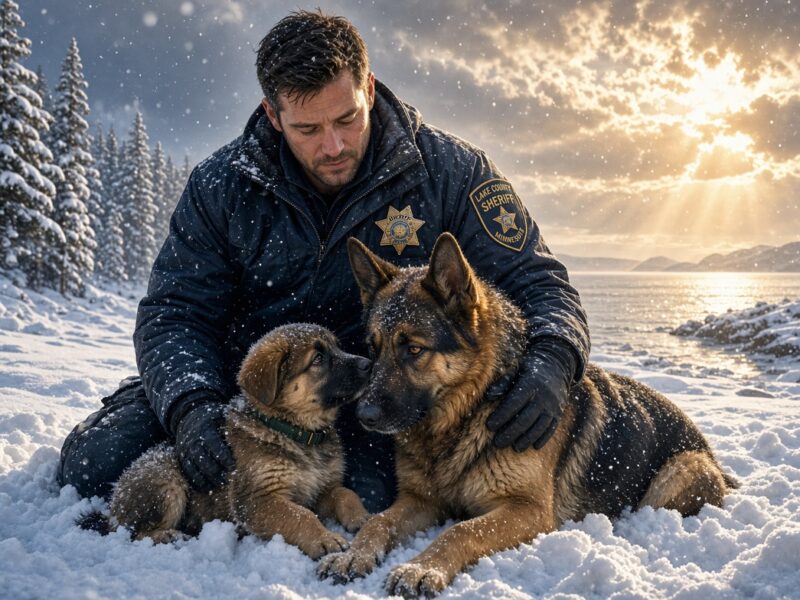
A Deputy Followed a Lost Puppy Into a Minnesota Blizzard — What He Found Changed His Life Forever
On a freezing Minnesota night, Deputy Travis Keane saw a young German Shepherd standing alone beside a highway buried in snow.
The puppy ran toward the dark timber, then came back, as if leaving someone behind was simply not an option.
What Travis found beneath the pines was not a mystery or a crime, but a bond between a mother and her pup that he could not easily forget.
He thought he was only giving Tessa and Rook a safe place for a few days.
Instead, they quietly led him back toward friendship, faith, better health, and a life he had almost stopped participating in.
And when the time came to decide where these dogs truly belonged, Travis learned that love does not always ask us to hold on.
Tell us where you’re watching from.
And if this story stays with you, please like, comment, and subscribe.
Help us reach one thousand subscribers and keep bringing you more heartfelt stories like this.
By 10:30 that night, Lake Superior had disappeared.
Not literally, of course.
It was still there beyond the dark timber and the frozen shoreline, vast enough to shape the weather of every town along its edge.
But from Highway 61, there was nothing to see beyond the reach of the patrol car’s headlights except snow.
It came sideways, fine at first, then heavy, driven hard enough across the road to erase tire tracks within minutes.
Deputy Travis Keane sat forward behind the wheel, one gloved hand resting low on the steering wheel while the other hovered near the console.
At thirty-eight, Travis had learned that winter patrols in northern Minnesota rewarded patience more than confidence.
The road could look clear one second and disappear beneath windblown snow the next.
His dark navy winter patrol jacket was zipped high against the cold, the silver badge on his chest dulled by the dashboard light.
A radio microphone clipped to his left shoulder gave a soft burst of static.
“Unit 12, copy an animal complaint off County Road 7.”
Travis reached up.
“12, go ahead.”
The dispatcher’s voice came through unevenly beneath the hiss of weather interference.
“Caller is Dean Marlo. Reports two German Shepherds missing from private property. Adult female and one approximately four-month-old male, last seen forty-five minutes ago.”
Travis glanced toward the side road passing on his right.
“Any indication they made it to the highway?”
“Negative. Caller is searching property. No dedicated response due to road conditions. Units in area advised to keep watch.”
“Copy.”
The radio went quiet again.
Travis drove another half mile before slowing for a curve where snow had begun to drift across the center line.
A few minutes later, dispatch added more information.
Dean Marlo was sixty-three, lived on a small farm several miles inland, and was temporarily caring for the dogs for a longtime friend named Everett Sloan.
Sloan, a retired fire captain, was recovering from spinal surgery in Duluth.
Dean had taken the dogs into the fenced yard before the storm worsened.
A pine limb had come down.
It tore through part of the fence.
By the time Dean saw the gap and went back inside for a heavier coat and flashlight, both dogs were gone.
Travis pictured it easily.
Not negligence.
Just bad timing.
The kind of ordinary mistake winter could turn serious faster than anyone expected.
He acknowledged the update and kept driving.
There would be no organized search tonight.
Not in this visibility.
Not with deputies already handling stranded vehicles, power outages, and reports of fallen trees.
He understood the decision.
That did not mean he liked it.
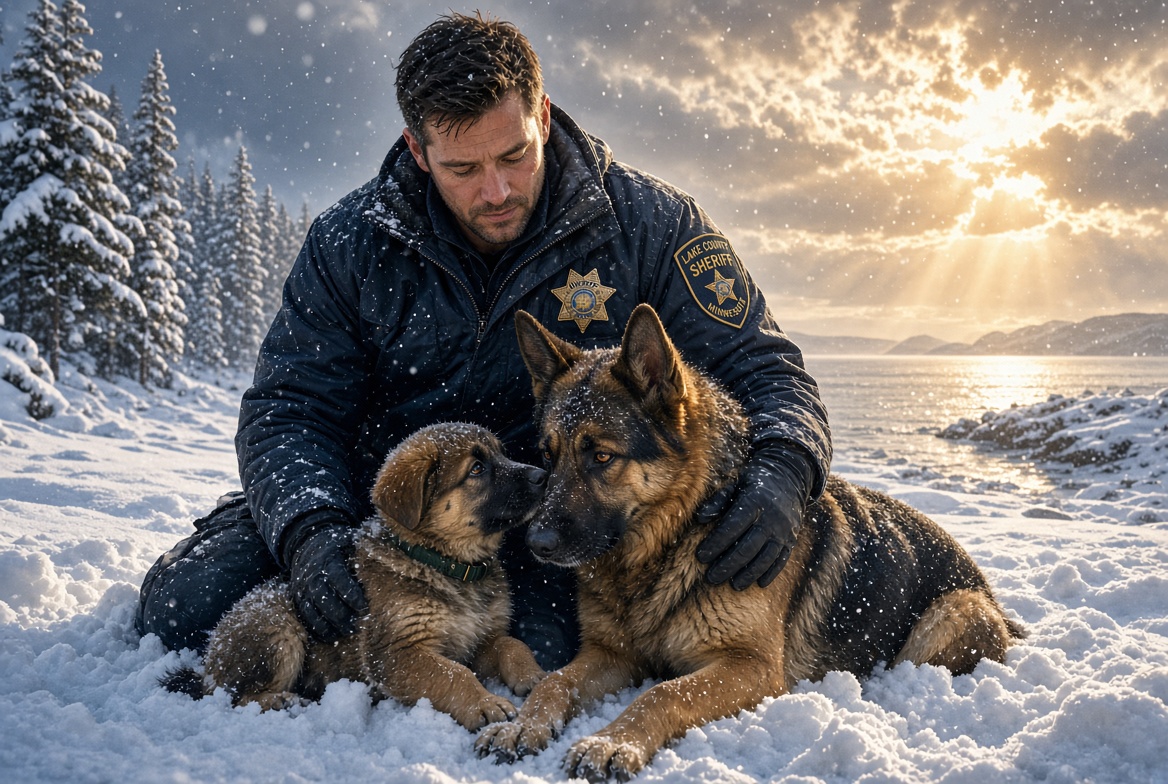
For the next hour, he watched every ditch, every mailbox, every shadow near the tree line.
Nothing.
The heater hummed steadily inside the cruiser.
His wet boots left a dark outline on the rubber floor mat.
Somewhere beneath the layers of winter clothing, the old analog watch on his left wrist pressed against his skin.
Rebecca had given it to him seven years ago.
He rarely thought about that while wearing it anymore.
That was the strange part about grief.
Objects stopped hurting before memories did.
He passed a plow truck headed toward town.
For several seconds, its amber lights filled the falling snow behind him.
Then darkness returned.
Travis checked the time.
11:47 p.m.
He should have been thinking about his route back toward Grand Marais.
Instead, he found himself wondering whether Dean Marlo was still outside looking.
Then something moved near the shoulder.
Travis’s foot came off the accelerator.
At first, he thought it was a deer.
A dark shape stood just beyond the right edge of the headlights, half obscured by blowing snow.
Then it stepped forward.
Large ears.
Narrow chest.
Long legs that looked slightly too big for the rest of its body.
A German Shepherd puppy.
Travis eased the cruiser to a crawl.
The puppy moved onto the road.
“Come on,” Travis muttered.
“Don’t do that.”
He tapped the horn once.
The dog flinched and backed toward the shoulder.
Travis expected it to disappear into the woods.
Instead, it stopped.
The animal stood there with its body angled toward the trees, one ear lifting higher than the other.
Snow had collected along its back and around the dark fur of its muzzle.
Travis brought the cruiser to a complete stop and switched on the rear emergency flashers.
He stepped outside.
The wind hit him immediately.
Cold pushed through every exposed seam in his clothing.
Snow caught in the short dark hair above his forehead and in the stubble along his jaw.
“Hey,” he called.
The puppy looked at him.
Travis took one step forward.
The dog turned and ran.
Of course.
It disappeared between the trees.
Travis stood beside the cruiser for a moment, already irritated with himself for expecting anything else.
He reached for the radio, then heard a bark not far away.
One sharp sound.
He lowered his hand.
The puppy emerged again near the tree line.
It had gone perhaps twenty yards into the woods.
Now it stood facing him.
Travis crouched slightly.
“Come here.”
The dog took three steps toward him, stopped, turned around, ran back into the trees.
Travis stared after it.
Snow blew across the beam of his flashlight in fast white streaks.
He waited.
Ten seconds.
Fifteen.
The puppy came back.
This time it did not approach the road.
It stood between two dark trunks, chest moving quickly, staring at Travis.
Then it barked again.
Something about the repetition changed the situation.
Travis had dealt with frightened dogs before.
Lost dogs tended to bolt, circle, hide, or approach cautiously when hunger overcame fear.
This one kept leaving and returning.
Not because it wanted to be caught, because it did not want him to leave.
Travis looked down the empty highway, then back toward the trees.
“Fine.”
He returned to the cruiser long enough to radio his location.
“12 to dispatch. I have a possible match on the juvenile shepherd. East side of 61, roughly two miles north of the County 7 turnoff.”
“Copy 12.”
“I’m going about a hundred yards off roadway to see if there’s another animal. Mark me out of vehicle.”
There was a pause.
“Copy. Use caution.”
Travis took the larger flashlight from the cruiser and shut the door.
The puppy was still waiting.
As soon as Travis moved toward it, the dog turned and headed deeper into the timber.
Not fast now, just fast enough to stay ahead.
Travis followed.
The snow changed beneath the trees.
Less wind reached the ground there, but the accumulation was deeper and uneven.
His boots sank nearly to the ankle in places.
He moved carefully, sweeping the flashlight across trunks, low branches, and patches of disturbed snow.
“Easy,” he said.
The puppy stopped.
Travis could see more of it now.
Black saddle, tan legs, a dark green collar around its neck.
The coloring matched dispatch’s description.
The young dog looked back once, then squeezed beneath the drooping branches of several tightly grouped pines.
Travis followed more slowly.
The branches blocked much of the wind.
Inside the small pocket beneath them, the snow was thinner.
The puppy vanished into the shadows.
Then Travis saw the second dog.
She was lying on her side beneath the lowest branches.
A full-grown German Shepherd with tan legs and a dark saddle across her back.
Her head lifted when the flashlight reached her.
Her ears came up, not aggressively, alertly.
Travis stopped where he was.
“Okay,” he said quietly.
The puppy hurried straight to her.
It pressed its body against her chest and neck, disappearing for a moment beneath her head.
The older dog did not try to stand.
That concerned him more than growling would have.
Travis lowered the beam away from her eyes.
He could see ice clinging to the fur around her paws.
One front paw shifted, then settled again.
Her breathing looked steady but tired.
Very tired.
He crouched several feet away.
“You Tessa?”
The dog watched him.
A small V-shaped notch marked the outside edge of her left ear.
Dispatch had mentioned that.
Adult female Tessa.
Juvenile male Rook.
Travis reached slowly into his jacket pocket and removed his phone, though he already knew reception in the trees would be unreliable.
The puppy, Rook, was now wedged tight against his mother.
That was when the obvious explanation finally settled into place.
Rook had not known he was stopping a police officer.
He had not understood flashing lights or uniforms or roads.
He had probably heard a vehicle, maybe seen headlights, maybe simply followed the first unfamiliar sound in a landscape that had become nothing but wind.
Then he had gone back because his mother was still here.
And when Travis did not follow, Rook had returned again.
Nothing supernatural.
Nothing heroic in the way people like to tell stories afterward.
Just a young dog unwilling to travel far enough to lose sight of the one thing he trusted.
Travis felt something tighten briefly in his chest.
He ignored it.
He keyed the radio.
“12 to dispatch.”
“Go ahead.”
“I’ve got both animals. Adult female is conscious but appears exhausted. No obvious trauma. I’m bringing them out.”
Dispatch confirmed.
Travis then called Dean Marlo directly using the number dispatch provided.
Dean answered on the first ring.
His voice sounded strained and breathless.
“This is Marlo.”
“Mr. Marlo. Deputy Keane with Cook County. I believe I found your dogs.”
The silence on the other end lasted barely a second.
“Both?”
“Both.”
Dean exhaled so hard Travis could hear it through the phone.
Travis asked him to confirm several identifying details.
Dark green nylon collar on the puppy.
Chestnut leather collar on the female.
Small notch on Tessa’s left ear.
Dean confirmed all three.
“She okay?”
“Tired. I don’t see an injury, but I want a vet to check her.”
“Do it.”
Travis ended the call and turned his attention back to the dogs.
Getting Tessa out took patience.
He did not pull her.
He let her smell the back of his glove first, then clipped a spare slip lead around her neck in addition to her collar.
When she finally stood, her legs were stiff but stable.
Rook bounced forward, then immediately returned to her side.
The three of them made their way slowly back toward the highway.
By the time Travis reached the cruiser, snow had nearly covered his earlier footprints.
He opened the rear door.
Rook climbed in first.
Tessa hesitated, then she stepped up after him.
Travis turned the heater higher before pulling onto the road.
The nearest overnight veterinary clinic was waiting for them.
For several miles, Travis said nothing.
In the rearview mirror, Tessa lay across the back seat, head low.
Rook curled against her belly, one oversized paw resting across her front leg.
Every few seconds, Tessa’s eyes opened.
Rook was still there.
Then they closed again.
Travis looked back at the road.
For reasons he could not have explained, the image followed him.
Not the storm, not the search, not even the puppy standing beneath the trees.
Just two dogs pressed close together in the back of a warm vehicle.
And suddenly, he could see his own living room.
The chair no one sat in anymore.
The second coffee mug still pushed to the back of a cabinet.
The quiet that waited for him every night when he unlocked the front door.
Travis tightened his hands slightly around the steering wheel.
Outside, snow swept across Highway 61.
Behind him, Rook slept against his mother, and for the rest of the drive, Travis did not look in the mirror again.
The veterinary clinic was dark except for the exam room at the back.
Dr. Lenora Webb had been called in after midnight, and she looked like someone who had dressed in the order her hands found things.
Gray scrub pants.
Winter boots.
A heavy cardigan over a navy shirt.
Tortoiseshell glasses that kept sliding down her nose when she bent over the table.
She was fifty-three, compact, practical, and uninterested in making an emergency feel more dramatic than it was.
That suited Travis.
Tessa stood on a rubber mat while Lenora ran her hands carefully along the dog’s ribs, hips, shoulders, and legs.
“Good girl,” she murmured, not because Tessa seemed frightened, but because the room was unfamiliar and the dog had spent enough time in the cold.
Rook sat beneath the edge of the exam table.
Every few seconds, he lifted his head to check where Tessa was.
When Lenora moved Tessa’s front paw toward the light, Rook stood.
When Tessa settled again, so did he.
Travis noticed the pattern but said nothing.
Lenora checked the pads of Tessa’s paws.
“Cold irritation,” she said.
“Some superficial cracking. No frostbite that I can see.”
“And the rest?”
“Mild dehydration. Fatigue. No obvious fractures. No abdominal tenderness. Breathing sounds good.”
She looked toward Rook.
“He’s in better shape. Young enough to make questionable decisions and apparently sturdy enough to survive them.”
For the first time that night, Travis almost smiled.
Almost.
Rook’s examination was quicker.
His temperature was normal.
His paws were cold but intact.
He had no cuts, no swelling, and no sign he had spent more than a few hours outside.
The storm had been dangerous.
It had not yet become disastrous.
That distinction mattered to Travis.
He had seen enough real disasters to dislike people turning every close call into one.
Lenora passed a scanner over Tessa’s shoulder.
A soft electronic tone sounded.
“There we go.”
She read the number from the screen and entered it into the clinic system.
A registration appeared a moment later.
“Everett Sloan,” she said.
“Grand Marais mailing address. That matches what dispatch gave me.”
Travis was about to answer when the front door opened.
A gust of snow blew into the waiting room before someone forced it shut again.
Dean Marlo appeared in the doorway.
Travis recognized him immediately from the description dispatch had provided, though nobody had mentioned how exhausted he looked.
Dean was tall but carried his shoulders slightly forward, as if years of physical work had gradually persuaded his spine to compromise.
Wet gray hair showed beneath a dark knit cap.
A short silver beard was crusted with melted snow.
His brown insulated work jacket was white across the shoulders.
In one hand, he still carried an old metal flashlight.
He had clearly not gone home to change.
“Tessa.”
The dog turned.
Dean stopped.
His face changed before the rest of him did.
Tessa took two steps in his direction, then looked back toward Rook.
Dean crouched slowly.
“Hey, girl.”
His voice broke on the second word.
Tessa approached and pressed her nose against his sleeve.
Rook followed a moment later.
Dean put one hand on each dog and closed his eyes.
Travis looked away, not because the moment embarrassed him, because some relief belonged to the person feeling it.
Dean stood again a few seconds later.
“This was my fault.”
Lenora continued entering notes into the computer.
Travis leaned back against the counter.
“The tree came down.”
“I was responsible for them. You reported them missing right away.”
“I should have stayed outside. In a storm.”
Dean rubbed a hand over his beard.
“I went in for maybe three minutes. That’s enough time for a dog to find a hole in a fence. Two dogs.”
Travis glanced at Tessa and Rook.
“They’re here.”
Dean did not seem comforted.
Travis understood why.
People who took responsibility seriously were rarely satisfied by the difference between intention and outcome.
Dean explained what had happened anyway.
He had let the dogs into the fenced run behind his farmhouse before the worst of the storm arrived.
He heard the crack of the pine limb from inside the mudroom but assumed it had fallen farther into the woods.
When he went back out, a section of fencing near the rear corner was down.
Tessa and Rook were gone.
He searched the property first, then the road, then the tree line.
Only after the wind began filling his tracks did he call the sheriff’s office.
“I should have called sooner,” he said.
“Dean,” Lenora said this time.
She had removed her glasses and was cleaning them on the edge of her shirt.
“You called before you lost another hour pretending you could see through a blizzard. That was the correct decision.”
Dean gave her a tired look.
“You always this friendly after midnight?”
“More so, usually.”
That got a faint laugh from him.
The tension in the room loosened.
Only then did the practical problem become obvious.
Dean’s fence was still damaged.
Everett was still in Duluth.
And neither situation would change before morning.
Lenora called the registration number attached to Tessa’s microchip.
It rang several times.
A man answered with a voice that was older but alert.
“Hello, Mr. Sloan. This is Dr. Lenora Webb in Grand Marais. I have Tessa and Rook here with me.”
There was no immediate response.
Lenora looked at Travis.
Then the voice came back.
“Are they hurt?”
Not “Where are they?”
Not “How did they get out?”
Not “Who found them?”
“Are they hurt?”
Lenora explained the examination in simple terms.
Tessa was tired and mildly dehydrated.
Her paws needed care and rest.
Rook appeared healthy.
Everett asked three more questions.
Was Tessa walking normally?
Had Rook eaten?
Were they together?
“Yes,” Lenora said.
“They’re together again.”
Everett went quiet.
Travis watched Tessa standing beside Dean while Rook investigated a stainless steel cabinet.
The silence over the phone lasted long enough that Lenora finally asked, “Mr. Sloan?”
“I’m here.”
His voice had softened.
“Thank you.”
That was the moment Travis realized the problem was not finished just because the dogs had been found.
Dean could not safely put them back into a damaged enclosure.
Everett had undergone spinal surgery and would remain in rehabilitation for several weeks.
The regional shelter network had already sent a storm notice that evening.
Power outages and damaged fences had produced more loose animals than available temporary kennels.
Lenora mentioned overnight boarding.
Dean shook his head.
“I can take them inside the house.”
“You have your sister’s two dogs there,” Lenora reminded him.
Dean grimaced.
Travis looked at him.
Dean explained that his sister had lost power several miles away and had brought her two elderly mixed-breed dogs to his house that afternoon.
Tessa tolerated other dogs, but Rook was energetic, unfamiliar with them, and Dean had no safe way to separate four animals overnight beyond keeping some confined in small rooms.
“It’s not impossible,” Dean said.
“Nobody answered.”
Travis knew what was happening before he spoke.
That irritated him.
He had driven into the clinic with one responsibility.
Get two lost animals somewhere safe.
That responsibility was complete.
Everything after that belonged to somebody else.
He looked at Rook.
The puppy had finally exhausted himself and was sitting with his back against Tessa’s front legs.
Travis exhaled through his nose.
“I can keep them.”
Dean turned toward him.
Lenora stopped typing.
Even Everett, still audible through the phone speaker, said nothing.
Travis immediately regretted the phrasing.
“For a couple days,” he added.
“Until the fence is fixed and you figure out something better.”
Dean stared at him.
“You sure?”
“No.”
Lenora hid a smile.
Travis continued.
“But I have a fenced yard. No other animals. I’m off tomorrow afternoon.”
Everett spoke from the phone.
“Deputy Keane.”
“Yes, sir.”
“You found them?”
“Yes.”
Another pause.
“Then I suppose they already know you.”
Travis looked at Tessa.
He doubted that.
At best, she had decided he was not dangerous.
Everett gave verbal authorization for Travis to act as temporary caregiver, which Lenora documented in the clinic record.
She told Everett she would send the routine authorization paperwork electronically when staff returned in the morning.
Nothing ceremonial happened.
No one shook hands over fate.
It was simply the least bad option.
At one in the morning, Dean drove to his farmhouse while Travis waited for Tessa to receive fluids and paw treatment.
An hour later, Dean met Travis at the small house on the edge of town.
By then, the storm had weakened.
Dean unloaded more equipment than Travis had expected.
A bag of dog food.
Two leashes.
Food bowls.
Tessa’s veterinary records.
A folded blanket.
A worn rectangular dog bed that looked as though it had traveled through several houses.
And a canvas bag filled with Rook’s toys.
Travis stared at the pile.
“You said a few days.”
Dean looked at him.
“You ever had a four-month-old shepherd?”
“No.”
“Then you need the bag.”
Inside the house, Rook forgot every hardship of the previous six hours.
He inspected the kitchen, the hallway, the legs of the dining table, a heating vent.
One boot Travis had left by the door.
Travis intercepted him before he could test the boot with his teeth.
“Absolutely not.”
Rook stared at him, then moved to the other boot.
Dean laughed for the first time that night.
Tessa entered differently.
She walked through the house slowly.
She stopped at each doorway, looked, listened, moved on.
When she reached the living room, she remained there.
Travis followed her gaze.
The room had changed very little since Rebecca died.
Not because he had deliberately preserved it.
He simply had never found a reason to change anything.
A cream-colored blanket remained folded over the arm of Rebecca’s chair.
There were books on a shelf she had arranged by subject rather than size.
A small ceramic bowl still sat near the entry table, although Travis no longer knew why she had put it there.
Dean placed Tessa’s bed near the wall.
“You want me to stay until they settle?”
“I’m good.”
Dean hesitated, then nodded.
At the front door, he turned back.
“If they give you trouble, call me.”
“They won’t.”
“You don’t know that.”
“No.”
Dean smiled faintly.
Travis looked at the bags, the bowls, two German Shepherds, and his suddenly much smaller house.
“Few days.”
Dean pulled on his gloves.
“Few days.”
After the door closed, Rook wandered another circuit through the living room before collapsing onto Tessa’s bed as though it had been his plan all along.
Tessa remained standing for several minutes.
Travis removed his winter jacket, duty belt, and boots.
He changed into a charcoal thermal shirt and returned with a glass of water.
Normally, he would have turned on the radio.
He did it every night.
Not music.
Usually talk radio at low volume.
The voices meant there was something in the room besides the refrigerator cycling on and off.
Tonight, he sat down first.
Tessa watched him from beside the wall.
A minute passed.
Then another.
She crossed the room.
Not all the way.
She stopped several feet from his chair, turned once, and lowered herself onto the floor.
Rook remained asleep on her bed.
Travis looked toward the radio.
It was still off.
He could hear the wind outside, the old heating system, Rook’s quick puppy breathing, Tessa’s slower breath nearby.
That was all.
Travis leaned back.
The cream blanket remained folded over the empty chair across from him.
For months, silence had felt like evidence.
Proof of what was missing.
Tonight, it felt different.
Not healed.
Not comfortable.
Exactly.
Just occupied.
Travis sat there for nearly an hour without touching the radio.
Tessa never moved closer.
She did not need to.
For the first time in a long while, the house was quiet without feeling empty.
And Travis, who had promised everyone it would only be a few days, did not think about how many were left.
Sunday morning came clear and painfully bright.
The storm had moved east during the night, leaving Grand Marais buried beneath clean drifts and a sky so blue it looked colder than the air actually was.
Travis stood in his kitchen with one boot on and the other in his hand.
Rook noticed the change before Tessa did.
The puppy had been chewing a rubber toy near the refrigerator.
The moment Travis pulled on his dark brown canvas jacket, Rook abandoned it and followed him toward the mudroom.
“Not happening.”
Rook sat.
Travis reached for his other boot.
Rook stood again.
Tessa remained near the doorway between the kitchen and living room, watching without moving.
Her paws had improved considerably since the night in the woods, though Travis still wiped them after each trip outside and checked the pads the way Dr. Webb had shown him.
He finished tying his boots.
Rook positioned himself directly in front of the door.
“You’re not subtle.”
The puppy tilted his head.
Travis had planned to leave them home.
It was only church.
An hour, maybe a little more.
But the thought of shutting the door with Rook pacing behind it made him hesitate in a way he disliked.
He took out his phone.
Pastor Miriam Hale answered on the fourth ring.
“St. Anselm, you know I can see your number on my screen, right?”
“Then I saved us both time.”
Travis looked at Rook.
“I’ve got a question.”
“That sounds dangerous.”
“The dogs.”
There was a pause.
“What about them?”
“Can they come?”
Another pause.
Shorter this time.
“Are they church dogs?”
“No.”
“Therapy dogs?”
“No.”
“Police dogs?”
“Definitely not.”
“Good. The last thing I need is Rook arresting Frank during coffee hour.”
Travis looked down.
“How do you know which one is Rook?”
“Dean called.”
Of course he had.
Miriam knew nearly everything that happened within twenty miles of Grand Marais.
Not because she was nosy, but because people kept telling her things.
“They can stay in the vestibule,” she said.
“Leashed, heated side, door cracked so they can see you. If either one gets restless, you take them outside.”
“Fair.”
“And use your own car.”
“I was planning to.”
“I know. I just enjoy telling law enforcement what to do.”
He ended the call before she could add anything else.
St. Anselm Community Church stood on a rise above town, a modest building of pale stone and dark timber that looked older than it was.
Snow covered the low roof and sat thick along the steps where volunteers had already cleared a narrow path.
Travis parked his pickup near the side lot.
No uniform.
No duty belt.
No badge.
Just a charcoal Henley beneath the canvas jacket, dark jeans, winter boots, and the old watch on his wrist.
He had learned after Rebecca died that civilian clothes did not necessarily make him feel less like a deputy.
People still recognized him.
They still straightened slightly when he entered a room.
Some habits belonged to the uniform.
Others belonged to the man wearing it.
Rook jumped down from the truck with more enthusiasm than balance.
Tessa followed carefully.
Inside, warm air carried the smell of coffee, old wood, and wet wool coats.
Miriam was near the front entrance speaking with an elderly couple.
At sixty-four, she had the kind of face people underestimated.
Soft features, chin-length brown and silver hair, thin tortoiseshell glasses.
Then she spoke, and the softness became less important.
She pointed toward the vestibule without interrupting her conversation.
Travis obeyed.
The side space contained a bench, a coat rack, and a radiator that clicked periodically as it warmed.
He laid Tessa’s blanket on the floor.
Rook immediately tried to investigate three scarves hanging from the coat rack.
“No.”
Rook looked offended.
Tessa lay down without argument.
The sanctuary beyond the open inner door was beginning to fill.
Travis took his usual place.
Last pew, far right side, close enough to the exit that leaving never required anyone to move for him.
Rebecca used to tease him about that.
Even when they came together, he had preferred the back.
“You spend all week watching doors,” she once told him.
“You can sit somewhere normal for an hour.”
He had replied that the back was normal.
She had rolled her eyes and gone to join the choir.
Now the choir loft seemed too large without her in it.
Travis did not look there often.
This morning he did, only for a second.
Then he sat down.
The service passed in pieces.
A hymn he remembered.
A reading he barely followed.
Miriam speaking about the ordinary obligations people owed one another in winter.
Checking heat, clearing steps, bringing groceries, noticing when a neighbor stopped answering the phone.
No grand declarations.
That was why Travis still came.
Miriam rarely turned suffering into a lesson.
She treated it more like weather.
Something real, something that changed what people needed from one another.
Halfway through the service, Travis glanced toward the vestibule.
Tessa was exactly where he had left her.
Rook was not.
He felt his shoulders tighten.
Then a dark muzzle appeared beneath the partly open door.
Rook had moved perhaps two feet forward and was lying with his chin exactly across the threshold.
Not inside.
Not outside.
He had apparently found the limit of the rule and decided to occupy it.
Travis stared at him.
Rook blinked.
A woman two rows ahead noticed and smiled.
Travis pointed silently toward the blanket.
Rook did not move.
Tessa lifted her head.
Rook looked back at her.
She lowered her head again.
Rook sighed and retreated.
Travis looked down before anyone could see the smile that came with it.
Afterward, he intended to leave quickly.
That was also part of the routine.
Arrive late enough to avoid too many conversations.
Sit in back.
Leave before the coffee was poured.
But getting two German Shepherds through a church entrance made invisibility difficult.
An older man in a green work coat stopped first.
“Which one found you?”
Travis recognized him after a moment.
Frank Dobbins, seventy, maybe a few years older.
Retired mechanic.
He had owned a repair shop off Highway 61 before selling it to his nephew.
Frank had a broad face, white hair that never seemed fully combed, and hands permanently marked by decades of engines even though he had been retired for years.
“Neither one found me,” Travis said.
“That’s not what Dean says.”
“Dean talks too much.”
“So does everybody who survives retirement.”
Frank crouched slowly in front of Tessa.
He held out the back of his hand rather than reaching for her head.
Travis noticed.
“You’ve had dogs?”
“Three shepherds over forty years.”
Tessa sniffed Frank’s fingers, then allowed him to scratch the side of her neck.
Rook tried to insert himself into the interaction.
Frank laughed.
“There he is.”
Outside, fresh snow squeaked beneath their boots.
Tessa started down the cleared walkway.
Rook followed, then stopped.
He studied the tracks she had left.
One front paw went carefully into one of Tessa’s prints.
Then another.
His hind legs did not cooperate.
Rook stepped sideways, corrected himself, and tried again.
Frank watched.
“Well, I’ll be damned.”
Rook continued down the path, awkwardly trying to place each oversized puppy paw into the marks left by his mother.
He failed more often than he succeeded.
That seemed irrelevant to him.
Frank started laughing.
Not polite laughter.
Not the soft sound people made when they thought something was cute.
A full, wheezing laugh that forced him to brace one hand against the railing.
Travis looked at Rook.
The puppy took one particularly ambitious step, missed Tessa’s track completely, and sank chest-deep into loose snow beside the path.
He emerged immediately, covered in white and looking personally betrayed by winter.
The sound escaped Travis before he could stop it.
A short laugh.
Real.
Unprepared.
Frank looked at him.
Travis stopped.
For one strange second, embarrassment hit harder than grief.
He could not remember the last time he had laughed in front of this building.
Miriam stood inside the doorway carrying two mugs.
She had heard it.
Travis knew because she looked directly at him.
She did not smile knowingly.
Did not mention Rebecca.
Did not say it was good to hear.
She simply handed Frank one mug, set the other on the exterior windowsill near Travis, and went back inside.
That made it worse somehow.
Or better.
Travis was not sure.
He stayed.
Twenty minutes became forty.
Frank told him the church pantry had received extra canned goods from a store in Duluth and needed help moving them from a utility trailer into storage.
Travis carried boxes.
Tessa remained tied near the open side door where she could watch him.
Rook tried to steal an empty cardboard carton.
An elderly woman told him no with enough authority that he immediately dropped it.
The following Sunday, Travis came back.
Then again.
No decision was made.
No promise.
The dogs simply became part of the routine.
St. Anselm had a heated vestibule.
Miriam did not mind.
People enjoyed seeing them, and Travis discovered that leaving immediately required more effort when three different people stopped to ask how Tessa’s paws were healing.
One week, he found Frank attempting to clear the front steps with a shovel that was too small for the job.
Travis took it from him.
“I had that.”
“You had half of it.”
“Same thing.”
The next week, a handrail near the fellowship hall wobbled beneath Travis’s palm.
He brought tools from his truck and tightened it.
Nobody asked him to.
Later, he helped Frank move cartons of canned soup into the pantry.
Small things.
Things Rebecca would once have volunteered him for before he could object.
That realization arrived without warning while he was carrying a box through the basement hallway.
For a moment, he could hear her voice perfectly.
“You own a truck and have shoulders. Congratulations. You’ve been assigned.”
Travis stopped.
Frank nearly walked into him.
“You all right?”
“Yeah.”
“You sure?”
Travis adjusted the box.
“Rebecca used to volunteer me for this kind of thing.”
Frank nodded once.
He did not offer condolences.
Not after more than a year.
Instead, he shifted the box in his own arms.
“She volunteered me twice after I retired.”
Travis looked at him.
“For what?”
“Christmas lights.”
“Worst three hours of my life.”
Travis smiled.
They kept walking.
By the third week, Curtis Vale noticed something was different.
Not at the sheriff’s office.
At a cafe near the harbor.
Curtis entered wearing jeans, work boots, and a dark crewneck sweater beneath his winter coat.
He was forty-five, heavier through the shoulders than Travis, with brown-red hair going silver at the temples and a short mustache that seemed to make every sarcastic remark look premeditated.
He stopped just inside the doorway.
Travis was seated at a table with Frank and two other men from St. Anselm.
A cup of coffee sat in front of him.
Rook was asleep beneath his chair.
Tessa lay calmly near Frank’s boots.
Curtis walked over.
Travis looked up.
“What?”
Curtis glanced around the table.
“Nothing.”
“That face isn’t nothing.”
“I’m just trying to identify the hostage situation.”
Frank pointed toward an empty chair.
“Sit down.”
Curtis did.
For several minutes, nobody discussed police work.
Frank complained about modern truck engines.
One of the other men argued that snow tires had become too expensive.
Curtis drank coffee.
Travis listened.
Eventually, Curtis looked beneath the table.
Rook had shifted until one paw rested across Travis’s boot.
Curtis nodded toward him.
“Looks like somebody finally figured out how to make you go home on time.”
Travis looked down at Rook.
A month earlier, he might have dismissed the remark or told Curtis to mind his business.
Instead, he took another drink of coffee.
“Temporary arrangement.”
Curtis raised one eyebrow.
Travis recognized the expression.
“Don’t.”
“I didn’t say anything.”
“You were about to.”
Curtis leaned back.
“I was going to say your coffee is getting cold.”
Frank laughed.
Travis stayed until the cup was empty.
Outside, the afternoon light had already begun fading over Lake Superior.
Tessa and Rook waited beside him while he unlocked the truck.
Behind them, voices continued inside the cafe.
Travis looked back once, then opened the rear door for the dogs.
There had been a time when Sunday meant finding the fastest route between the last pew and an empty house.
Lately, he kept finding reasons to take longer.
He was not ready to call that progress, but he had stopped calling it an accident.
Three weeks after the storm, Travis drove south toward Duluth with two German Shepherds in the back of his pickup and a feeling he refused to name.
The roads were clear that morning.
Snow still banked high along Highway 61, but the sky over Lake Superior had opened into a flat winter gray, and traffic moved normally again.
Tessa rode quietly behind him.
Rook did not.
The puppy had grown visibly in three weeks.
His legs seemed longer every morning, his paws still oversized, his ears now upright more often than not.
He moved from one side of the rear seat to the other whenever the road curved, then settled against Tessa for thirty seconds before beginning again.
“Sit down.”
Rook sat for perhaps six seconds.
Travis watched him in the mirror.
“You and I have different definitions of that word.”
Tessa looked forward between the seats.
She had recovered fully from the night in the woods.
Her paws had healed.
Her energy had returned, and the stiffness Travis had noticed during the first few days was gone.
She had also learned his house.
She knew which cabinet held food, which door led to the yard, which floorboard near the hallway made a faint click.
She knew the sound of his truck pulling into the driveway and often reached the mudroom before he opened the door.
Travis had become accustomed to all of it.
That was the problem.
The rehabilitation center had approved the visit in advance after Everett’s therapist confirmed he could meet the dogs in a private family room near the ground-floor entrance.
Travis had called twice to make sure.
He told himself that was professional caution.
He knew better.
He simply did not want anything to go wrong.
Not today.
The facility sat on the north side of Duluth, a low brick building bordered by bare trees and shoveled sidewalks.
Travis parked near the visitor entrance and clipped both dogs to their leashes before opening the rear door.
Rook jumped down first.
Tessa paused, her nose lifted.
Something changed.
Travis saw it immediately.
She did not pull, did not bark, but her whole posture sharpened.
Her ears rose.
Her head turned toward the building.
“You know where we are.”
He had no reason to believe she did.
Everett had been recovering there since before the dogs escaped.
Tessa had never visited.
Still, she moved toward the entrance with more purpose than usual.
Inside, the hall smelled faintly of disinfectant, coffee, and heated air.
A staff member led them to a small room with two windows overlooking a snow-covered courtyard.
Everett Sloan was already waiting.
Travis had heard his voice on the phone several times.
The man did not look like the voice.
At seventy-two, Everett had a broad frame that age and surgery had reduced but not erased.
His white hair was cut short, and a compact silver mustache sat above a mouth that looked permanently close to making a dry remark.
He wore a forest-green quarter-zip sweater and dark trousers.
A walker stood folded near the wall beside him.
He was seated in a sturdy rehabilitation chair, but he was sitting upright, alert, impatient.
Nothing about him suggested a man waiting for someone else to make decisions on his behalf.
His eyes moved first to Travis, then past him.
Tessa saw him.
The leash tightened in Travis’s hand.
Not hard.
Just once.
Everett’s face changed.
“Tess.”
The dog stepped forward.
Travis released several feet of leash.
Tessa crossed the room without hesitation.
She stopped directly in front of Everett, her ears forward, nose working quickly.
Then her tail moved.
Once.
Twice.
Everett bent as far as his back allowed and placed both hands around the sides of her neck.
“Well,” he said quietly.
“There you are.”
Tessa pressed her head against his chest.
Rook had lasted exactly four seconds.
He surged forward, tangled himself partly around Tessa’s rear legs, corrected course, and began circling Everett’s chair.
“Easy,” Travis said.
Rook ignored him.
Everett laughed.
“That one get any smarter?”
“No.”
“Good. I was worried you’d ruin him.”
Travis caught Rook’s leash before the puppy wrapped it around the chair leg.
“You want him?”
Everett looked up.
“That’s supposed to be a threat.”
“Could be.”
Rook rose on his hind legs, front paws lifting toward Everett’s knees.
Travis pulled him gently back.
“Four on the floor.”
“Let him.”
Travis hesitated.
Everett patted one thigh.
Rook approached more carefully this time.
Everett rubbed both hands along the puppy’s ears and shoulders.
“You got big.”
Rook immediately tried to lick his mustache.
Everett turned his head too late.
Travis laughed under his breath.
“Still want him?”
“Ask me after he turns two.”
For several minutes, Travis remained near the door.
Everett spoke to the dogs more than he spoke to him.
Not in complete sentences.
Old names.
Familiar phrases.
Tessa responded to some of them immediately.
When Everett said, “Easy, girl,” she lowered herself beside his chair.
When he tapped twice against his right leg, she shifted closer.
Small things.
Habits developed long before Travis entered the picture.
Rook eventually settled between Everett’s shoes.
Travis watched.
Something inside him fell quietly into place.
This was what belonging looked like when it had history.
Not dramatic.
Not exclusive.
Just familiar.
Everett rested one hand on Tessa’s head.
“I’ve been thinking about what happens when I get out of here.”
Travis moved to the chair across from him.
“How’s the back?”
“Annoying.”
“That medical terminology. Very advanced.”
Everett nodded toward the walker.
“They’ve got me doing laps with that thing like I’m training for the Olympics.”
“You winning?”
“I’m seventy-two. Everyone else here is seventy-eight. Of course I’m winning.”
Travis smiled.
Then Everett’s expression shifted.
“I’m not going back to the house right away.”
Travis had expected that.
Everett’s property sat farther from town, where winter roads could become difficult quickly.
Living alone there immediately after spinal surgery would not be ideal.
“I found an assisted living apartment closer to Grand Marais,” Everett continued.
“Temporary at first. Maybe longer if I like not having to shovel my own roof.”
“That sounds reasonable.”
“It allows dogs.”
The sentence was simple.
Travis felt it anyway.
Everett looked down at Tessa.
“My plan is to take them back once I’m settled and cleared to handle them safely.”
Rook rolled partly onto one hip against Everett’s shoe.
Travis nodded.
“Of course.”
Everett studied him.
Travis kept his expression neutral.
“That was always the plan.”
“I know.”
“They’re yours.”
“I know that, too.”
Nothing uncomfortable should have existed in the conversation.
Everett was their owner.
He loved them.
He was recovering.
The dogs recognized him immediately.
There was no conflict, no difficult legal question, no question at all.
And somehow that made the feeling worse.
Everett looked back at the dogs.
“You’ve taken good care of them.”
“They’re easy.”
Rook chose that moment to grab the lace of Everett’s shoe.
Travis leaned down and removed it from his mouth.
“Relatively.”
Everett chuckled.
Then his voice softened.
“I appreciate it, Travis.”
Not Deputy Keane.
Travis.
He looked up.
Everett was watching him with the expression of a man accustomed to noticing what other people avoided saying.
Travis stood.
“They’re good dogs.”
“That they are.”
The visit lasted another forty minutes.
Travis learned that Everett had spent thirty-six years with the fire service, twenty of them as a captain.
He learned Tessa had come to him after retirement, when the absence of alarms and station noise had made his own house feel unexpectedly strange.
He learned Rook was from Tessa’s only litter and that Everett had planned to keep him from the beginning.
“He was the one puppy who kept sleeping in my work boots,” Everett said.
“That explains some things.”
When it was time to leave, Tessa resisted for the first time since Travis had known her.
Not dramatically.
She simply remained beside Everett when Travis picked up the leash.
Everett scratched behind the notched edge of her left ear.
“Go on.”
Tessa looked at him, then at Travis.
Finally, she stood.
Rook required no such emotional transition because someone in the hallway rolled a meal cart past the open door, and he immediately became interested in that instead.
The drive north was quieter.
Rook slept.
Tessa watched the road.
Travis kept both hands on the wheel.
He had known from the beginning.
A few days.
That was what he had said.
Then a week had passed.
Then another.
He had never asked Everett to change the arrangement, never imagined the dogs were becoming his, at least not consciously.
But somewhere along the way, he had stopped thinking about their departure as a certainty.
Now it had a shape.
Six weeks, maybe less.
He found himself calculating how many Sundays, how many walks, how many mornings Rook would throw his body against the bedroom door because breakfast had failed to arrive on schedule.
Travis disliked himself for counting, so he stopped doing the things that made counting matter.
He stayed later at work the following Monday, then volunteered for an evening traffic detail on Wednesday.
On Sunday, he skipped St. Anselm entirely.
He told himself the roads were icy.
They were not especially icy.
The next week, Curtis asked if Travis could cover a night shift.
Travis said yes before Curtis finished explaining why.
At home, Rook still met him at the door with uncomplicated enthusiasm.
Tessa was different.
At first, she waited in the mudroom as usual.
Then, over several days, she began remaining farther back.
She still greeted him.
Still followed when he took the dogs outside.
But in the evenings, instead of settling close to his chair, she chose the rug near the hallway.
Travis noticed.
He pretended he did not.
That strategy worked with people more often than it worked with dogs.
A week later, he stopped by St. Anselm after work to replace a burned-out bulb above the rear storage entrance.
He arrived near four in the afternoon.
Miriam was inside sorting canned goods.
Travis replaced the bulb in ten minutes.
“Done,” he said.
Miriam looked at the clock.
“You want coffee?”
“No, I should go.”
She picked up her dark blue ceramic mug.
“You always should.”
Travis pulled on his jacket.
Miriam did not move.
Then, without looking directly at him, she said, “Rebecca hated when you left before the coffee got cold.”
His hands stopped on the zipper.
The room remained quiet.
Miriam continued sorting cans.
She did not explain herself.
That irritated him more than advice would have.
He looked toward the folding table where a fresh mug sat beside an empty chair.
“You set that there before I came in?”
“No.”
“You’re lying.”
“I’m clergy. We call it pastoral discretion.”
Travis almost smiled.
He took off his jacket.
The coffee was still warm.
That night, he went home before eight.
Rook met him at the door.
Tessa stood several feet behind.
Travis changed clothes, ate something, and walked into the living room.
He did not take his usual chair.
Instead, he sat on the floor.
Rook arrived immediately carrying a frayed rope toy.
Tessa stayed near the hallway.
Travis picked up one end of the rope.
Rook pulled.
Not that hard.
Rook pulled harder.
For several minutes, Travis played without thinking about six weeks.
Then he let go of the rope.
Rook stumbled backward triumphantly.
Travis rested one arm on his knee.
“Tess.”
The dog looked at him.
He did not call again.
A few seconds passed.
Then she crossed the room.
Not quickly.
She stopped beside him.
Travis reached out and rested his hand against the side of her neck.
Tessa lowered herself onto the floor.
Rook dropped the rope between them.
Travis looked at both dogs.
He still knew they would leave.
Nothing had changed about that.
Everett loved them.
They loved Everett.
That was exactly as it should be.
But Travis finally understood what he had been doing.
He was trying to leave first.
Not physically.
Just enough to make the eventual absence hurt less.
It had not worked with Rebecca.
It would not work now.
He scratched the fur beneath Tessa’s collar.
“Okay.”
Rook tilted his head.
Travis picked up the rope again.
He did not know how much time remained.
That night, for once, he decided not to measure it.
By the time Everett Sloan moved back north, the snowbanks in Grand Marais had gone gray at the edges.
Winter was still holding the town, but not with the same grip it had in January.
Water dripped from roofs in the afternoon and froze again by evening.
Highway shoulders had narrowed beneath weeks of plowed snow, and Lake Superior shifted between steel blue and white, depending on the weather.
Everett’s new apartment sat on the edge of town in a small senior living complex built around a sheltered courtyard.
It was not a nursing home, something Everett corrected whenever anyone used the wrong term.
“Apartment,” he told Dean that morning.
“I have a kitchen, a key, and nobody tells me when to go to bed.”
Dean carried a box past him.
“You’ve been telling us that for two hours because you keep forgetting.”
Travis came in behind Dean with a bag of dog food balanced against one shoulder.
Everett pointed toward the kitchen.
“Pantry?”
“I know where a pantry is.”
“I spent thirty-six years giving orders. You think retirement fixes that?”
“No,” Travis said.
“The fire department warned me.”
Everett gave him a suspicious look.
Travis kept walking.
The apartment was smaller than Everett’s old house, but it had been chosen carefully.
A ground-floor unit.
Wide doorways.
A bathroom with grab rails.
A private covered patio facing a strip of open grass and a maintained walking path that curved through spruce trees behind the building.
His physical therapy clinic was less than ten minutes away.
More important to Everett, the lease allowed dogs.
Tessa had already inspected every room twice.
Rook had inspected everything approximately twelve times.
He was nearly six months old now, taller than he seemed to understand, with long legs that frequently arrived somewhere before the rest of him.
He carried one of Everett’s gloves from the bedroom into the kitchen, reconsidered, then replaced it with a cardboard packing tube.
“Drop it,” Travis said.
Rook did for half a second.
Then he picked it up again.
Everett watched from beside the counter.
“You’ve taught him a lot.”
“I’ve taught him several things.”
“Has he learned any?”
“Not reliably.”
Everett nodded.
“Good shepherd.”
Outside, Dean was working on a small cedar dog shelter Everett had used at his old property.
One corner had loosened during transport, and Dean had refused to let anyone throw it away.
It would sit beneath the covered patio as a dry daytime resting spot, though Everett had already made it clear neither dog would be left outside unattended.
Dean drove the final screw into the roof and tested it with both hands.
“There.”
Everett stepped onto the patio using a cane rather than the walker he had needed six weeks earlier.
“You made it crooked.”
Dean stared at him.
“It was crooked when you bought it.”
“I built it.”
“That explains it.”
Travis left them arguing and went back inside.
He had been preparing for this day, or at least telling himself he had.
Tessa’s bed went near the living room window, where afternoon light crossed the floor.
Her chestnut collar stayed on her.
Rook’s toys went into a woven basket beside the bookshelf.
Two stainless steel bowls were placed on a mat near the kitchen.
Travis had packed everything carefully that morning.
Food, leashes, medication records, brushes, treats, the green rubber ball Rook preferred over every expensive toy anyone had bought him.
There was something oddly formal about returning ordinary objects.
He told himself that was why he kept checking the bags.
Nothing forgotten.
Nothing left behind.
By late afternoon, the boxes were mostly unpacked.
Dean left first, promising to return the following morning with a shelf Everett insisted he did not need.
Travis stayed long enough to walk the dogs with Everett along the paved path behind the building.
Everett managed the distance well.
Tessa naturally matched his pace.
Rook did not naturally match anybody’s pace, so Travis kept his leash and worked on stopping him from turning every patch of snow into an investigation.
When they returned, Travis stood inside the apartment with his jacket on.
There was nothing left to do.
Everett seemed to know that.
He did not make the moment larger than it needed to be.
“Thanks,” he said.
Travis nodded.
Tessa stood beside Everett.
Rook sat near Travis’s knee, distracted by something invisible beneath the kitchen table.
Travis bent and rubbed both sides of the puppy’s neck.
“Be good.”
Rook licked the cuff of his jacket.
“That’s not an agreement.”
Travis moved to Tessa.
She lifted her head.
He scratched once behind the small notch in her left ear.
“Take care of him.”
Everett frowned.
“Which one of us are you talking to?”
Travis straightened.
“Use your judgment.”
He opened the door.
Rook followed automatically.
The green leash tightened.
Everett had it in one hand.
“Rook.”
The puppy stopped at the threshold.
Travis did not turn the moment into a goodbye.
He simply stepped outside and closed the door gently behind him.
His truck was cold.
He sat behind the wheel for several seconds before starting it.
From the apartment window, he could see Everett moving slowly across the living room.
Tessa followed.
Rook appeared at the glass a moment later.
Travis put the truck in gear.
By the time he reached the highway, he had stopped looking in the mirror.
His house felt different that evening.
Not shocking.
Not unbearable.
Just returned to its previous dimensions.
There was no water bowl in the kitchen, no leash hooked beside the mudroom door, no sound of Rook dropping something upstairs that he had almost certainly been told not to carry upstairs.
Travis made dinner, ate half of it, washed the plate.
The radio sat on the counter.
He left it off.
He had spent more than a year using background voices to disguise silence.
Then he had spent several weeks learning that silence could contain breathing, paws against hardwood, tags touching a water bowl.
Now it was simply quiet again.
He did not turn the radio on to fight it.
That mattered, though he was not sure why.
Two days later, Everett called at 4:17 in the afternoon.
Travis was finishing paperwork at the sheriff’s office.
“You busy?”
“Yes.”
“Good. Come have coffee.”
Travis leaned back in his chair.
“That usually works better if you ask whether I’m busy and wait for me to say no.”
“I’m seventy-two. I’m economizing.”
“Something wrong?”
“No.”
“Tessa?”
“Okay.”
“Yes.”
“Rook?”
“Unfortunately energetic.”
Travis glanced at the unfinished report on his monitor.
“What’s this about?”
“Coffee.”
Everett hung up.
Forty minutes later, Travis knocked on the apartment door.
Everett opened it, holding the cane in one hand.
“You’re late.”
“You didn’t give me a time.”
“Then technically, you’re always late.”
Travis stepped inside.
Tessa rose from beside the living room window.
She looked at him for a second, then came across the room.
No whining.
No jumping.
No dramatic rush.
She simply pressed the side of her head against Travis’s thigh.
He rested a hand on her neck.
“Hey, Tess.”
She stayed there, then folded herself down across one of his boots.
Rook arrived at much greater speed.
He pushed his muzzle under Travis’s other hand, circled him once, then ran toward the front window when a pickup passed outside.
The truck’s engine had a low diesel note, not unlike Travis’s.
Rook stood at the glass, ears forward.
When the vehicle continued down the road, he returned.
Everett was watching from the kitchen.
Travis looked at him.
“What?”
“He’s been doing that for two days.”
Everett poured coffee into two mugs.
“Any truck that sounds like yours.”
Travis said nothing.
Everett nodded toward Tessa.
“And she found something you left.”
Beside Tessa’s bed was Travis’s dark brown canvas jacket.
He stared at it.
“I was looking for that.”
“It was in the canvas bag with her blanket.”
Travis must have packed it by mistake after laying it across the mudroom bench.
Everett set a mug on the table.
“She slept beside it the first night.”
Travis looked down at Tessa.
A familiar reaction rose immediately, something between guilt and discomfort.
Everett saw it.
“Don’t do that.”
“Do what?”
“Make it sadder than it is.”
Travis looked at him.
Everett lowered himself into a chair.
“They’re fine here.”
“I know.”
“They eat. They sleep. Tessa steals my side of the couch. Rook tried to carry a bathroom rug into the hallway this morning.”
“That sounds right.”
“They’re happy to be home.”
Travis picked up his coffee.
Everett continued.
“And they miss you.”
The words landed without accusation.
Travis looked toward the window.
Rook had returned to investigating the toy basket.
Everett rubbed his thumb along the edge of an old fire department challenge coin resting near his mug.
“I’ll tell you something I should have understood sooner.”
Travis waited.
“I spent most of my life thinking responsibility meant you handled your own.”
Everett turned the coin once.
“Your crew. Your house. Your family. Your dog.”
His eyes moved toward Tessa.
“That thinking kept people alive at fires.”
He paused.
“Doesn’t mean it works for everything else.”
Travis sat opposite him.
Everett leaned back.
“I think I got stuck on the idea that if they love being with you, somehow that took something away from what they have with me.”
“You don’t have to.”
“I’m not giving you my dogs.”
Travis almost smiled.
“I wasn’t asking.”
“I know.”
Everett took a drink.
“That’s my point.”
For a few seconds, they listened to Rook pushing his rubber ball beneath a chair and then becoming offended that the chair had trapped it.
Everett shook his head.
“Maybe a dog doesn’t need one place to belong.”
Travis looked at Tessa.
She had returned to Everett’s side now, lying with one shoulder against his shoe.
Nothing about her posture suggested confusion.
She had greeted Travis, then gone back to Everett.
Simple.
Everett noticed him watching.
“She’s not choosing.”
“No.”
“Neither am I.”
That became the beginning of an arrangement.
Neither man bothered to give it a name.
Everett remained the legal owner of both dogs.
That did not change.
But on the mornings Everett had physical therapy, Travis picked up Rook before work when his schedule allowed, or Dean transported him if Travis was on duty.
Rook spent afternoons at Travis’s fenced yard, where six-month-old legs could burn through more energy than Everett’s recovering back could safely manage.
Sometimes Tessa came, too.
Most days she stayed with Everett.
Dr. Webb updated the veterinary file with Everett’s authorization, listing Travis as a secondary emergency contact and approved caregiver.
Nothing about the arrangement was vague where responsibility mattered.
Elsewhere, they allowed it to be flexible.
On weekends, Travis often drove over and found Everett already waiting with Tessa beside him.
They walked the lakeshore path in town when weather permitted.
Everett used his cane.
Tessa matched him.
Rook moved between trying to stay beside Travis and trying to investigate every snowbank within leash range.
Occasionally Dean joined them.
Nobody called it family.
The word would have sounded too deliberate.
What they had was less organized than that.
One Saturday morning, they stopped at a bench overlooking Lake Superior.
The ice had begun breaking farther offshore, dark water showing through in long, irregular seams.
Everett sat down.
Tessa settled at his feet.
Travis remained standing with Rook, who was studying a gull with ambitions far beyond his current training.
“You know,” Everett said, “when I retired, everybody told me I’d finally have time for myself.”
“How’d that work out?”
“Terrible.”
Travis smiled.
Everett looked toward the lake.
“Turns out too much of yourself isn’t always useful.”
Travis understood.
He did not say so.
Rook eventually gave up on the gull and sat against Travis’s leg.
Tessa lifted her head toward them, then lowered it again.
There was no moment when Travis could have pointed to the arrangement and said it had become permanent.
It simply began working.
Everett had not lost his dogs.
Travis had not taken them.
Tessa had not been forced to choose between two homes.
Rook had gained more room to grow without being separated from the man and the mother he already knew.
And somewhere between physical therapy appointments, dog walks, coffee, and the exchange of leashes in parking lots, two men who had started as strangers stopped needing the dogs as an excuse to call each other.
One evening, Everett phoned Travis.
No emergency.
No dog problem.
He only wanted to know whether Travis had watched the hockey game.
They argued about it for fifteen minutes.
Afterward, Travis put the phone down and realized Rook was asleep beneath his kitchen table.
The puppy had spent the afternoon with him and would go back to Everett in the morning.
Travis looked down.
“Temporary arrangement.”
Rook opened one eye.
Travis smiled.
The words did not mean what they used to.
The first time Rook woke Travis at three in the morning, Travis blamed the water bowl.
The young German Shepherd stood beside the bed with both ears upright, breathing softly through his nose.
Travis opened one eye.
“What?”
Rook shifted his weight.
Then he put one oversized front paw on the edge of the mattress.
Travis looked at the clock.
3:08.
“You have got to be kidding me.”
He sat up, pulled on a sweatshirt, and walked downstairs.
Rook followed closely.
Travis opened the back door.
Cold March air entered the kitchen.
“Go ahead.”
Rook remained inside.
Travis pointed toward the yard.
“You woke me up.”
The dog looked outside, then back at him.
Nothing.
“No.”
Rook sat.
Travis closed the door.
“Excellent conversation.”
Five minutes later, he was back in bed.
Rook circled twice on the rug and went to sleep.
Travis forgot about it by morning.
Then it happened again.
Not the next night.
Four nights later.
This time, Rook did not put a paw on the mattress.
He stood beside Travis’s head and made a low sound somewhere between a whine and a breath.
Travis woke irritated.
He checked the clock.
3:42.
Again, the dog did not want outside.
Again, there was nothing obviously wrong.
Travis checked the water bowl.
Half full.
He walked through the house anyway, expecting to find a smoke alarm chirping or something knocked over.
Nothing.
Rook followed him through every room.
When Travis returned to bed, the dog lay down immediately.
“You’re developing terrible habits.”
Rook closed his eyes.
The pattern remained irregular enough that Travis did not take it seriously.
Some nights, Rook slept until Travis’s alarm.
Others, he woke once, shifted around the bedroom, then settled.
Travis assumed the young dog was still adapting to sleeping in different places.
Rook spent several nights each week at Travis’s house now, usually when Everett had early physical therapy or when the puppy needed more exercise than Everett’s recovering back could comfortably manage.
Tessa usually remained with Everett.
Once or twice, both dogs stayed.
Those nights reminded Travis of the first weeks after the storm, except the dynamic had changed.
Rook no longer checked where Tessa was before every decision.
He was becoming more confident, more independent, and considerably larger.
His dark back had lengthened.
His chest was beginning to fill out, while his legs still made him look slightly unfinished.
But at night, he seemed unusually interested in Travis.
One Thursday morning, Travis woke with a headache.
Not severe.
A dull pressure behind his eyes.
His mouth was dry enough that swallowing felt unpleasant.
Rook was standing beside the bed.
Travis pushed himself upright.
For several seconds, he felt as though he had come up too quickly from deep water.
He breathed in.
Then again.
The sensation passed.
Across the room, Tessa lifted her head from the rug.
She had stayed overnight because Everett had an early medical follow-up in Duluth and Dean was driving him south before sunrise.
Tessa watched Travis.
Rook remained beside the bed.
Travis rubbed both hands over his face.
“I’m awake.”
Rook did not move.
“I said I’m awake.”
That seemed to satisfy him.
He turned, walked to Tessa, and collapsed against her side.
Travis looked at the clock.
3:26.
He got up for water.
While standing in the kitchen, he tried to remember the other mornings.
Dry mouth.
Headache.
A strange heaviness behind the eyes.
Not every time, but often enough.
The thought annoyed him more than it concerned him.
At thirty-eight, Travis considered himself healthy.
He worked long shifts, carried equipment, walked in deep snow, could still outrun younger deputies when pride required it.
He was not interested in becoming someone who investigated every headache.
So he did what he normally did with physical discomfort.
He ignored it.
Three days later, Curtis Vale ruined that plan.
They were sitting in the break room at the sheriff’s office between calls.
Curtis had his dented stainless steel thermos opened beside him and was eating something from a plastic container that looked substantially healthier than anything Travis had brought.
Travis mentioned Rook only because Curtis asked why he looked tired.
“The dog keeps waking me up.”
Curtis looked over.
“To go outside?”
“No.”
“Food?”
“No.”
“Then why?”
“If I knew, he wouldn’t keep doing it.”
Curtis chewed thoughtfully.
“What does he do?”
“Stands beside the bed. Sometimes puts a paw up. Sometimes whines. Then I wake up.”
“I gathered that.”
Travis gave him a look.
Curtis pointed his fork at him.
“What’s happening before he wakes you?”
“I’m asleep, Curtis. My observational abilities are limited.”
Curtis ignored the sarcasm.
“You snore?”
Travis stopped.
“What?”
“You snore?”
“How would I know?”
Curtis stared at him.
The question hung there longer than Travis expected.
Then Curtis leaned back.
“That’s a fair point.”
Travis reached for his coffee.
“My brother had sleep apnea.”
Curtis’s voice had lost its joking tone.
Travis did not respond.
“His wife was the one who noticed,” Curtis continued.
“Said he’d snore, stop breathing for a bit, then start again like he was catching up.”
“How long is a bit?”
“I don’t know. Long enough to scare her.”
Travis looked down at his coffee.
Curtis watched him.
“You waking up with headaches?”
Travis said nothing.
“That means yes.”
“It means I’m drinking coffee.”
“Dry mouth.”
“Everybody wakes up with a dry mouth sometimes.”
Curtis lowered the fork.
“Travis.”
“What?”
“You live alone.”
The words were simple.
That was what made them land.
Curtis did not say Rebecca’s name.
He did not need to.
For more than a year, there had been no one beside Travis at night.
No one to hear whether he snored.
No one to notice whether his breathing changed.
No one to nudge him awake and complain about it the next morning.
Travis stared at the tabletop.
Curtis spoke more quietly.
“Maybe Rook’s hearing something change. Maybe he isn’t. But you’ve got symptoms. Get them checked.”
“I’m thirty-eight.”
“That’s not immunity.”
“I’m fine.”
“You’re also stubborn.”
“I’m not taking medical advice from a man eating quinoa out of a plastic bowl.”
Curtis looked down at his lunch.
“My wife made this.”
“Exactly.”
Curtis smiled briefly, then pointed the fork at him again.
“Make the appointment.”
Travis did, mostly because Curtis asked him twice more before the end of the shift.
The physician at the local clinic was far less impressed by the dog story than Curtis had been.
That reassured Travis.
She asked about headaches, daytime tiredness, snoring if anyone had ever mentioned it, weight changes, alcohol, work schedule, whether he ever woke gasping.
Travis answered as accurately as he could.
When he mentioned that Rook sometimes woke him during the night, the physician nodded but did not attach any special meaning to it.
“Dogs notice changes in sound and movement,” she said.
“That doesn’t tell us what those changes are.”
“Good.”
She looked at him.
“Good?”
“I’d prefer not to own a dog smarter than my doctor.”
She smiled, then ordered a sleep study.
Because Travis had no major complicating medical history, the first step was a home sleep apnea test.
A few nights later, he went home carrying a small monitoring device and instructions he read twice because the sensor placement was more annoying than difficult.
Rook watched from the foot of the bed while Travis attached the equipment.
“This is your fault.”
Rook yawned.
The test did not produce a dramatic moment.
No alarm.
No emergency.
Travis slept badly because he was too aware of the equipment.
When the results came back, the clinic referred him to a sleep specialist who confirmed the diagnosis.
Obstructive sleep apnea.
Treatable.
Manageable.
Not something to panic about, but not something to ignore either.
The specialist explained that the airway could repeatedly narrow or close during sleep, disrupting breathing and preventing normal rest.
The recommended treatment included positive airway pressure therapy, along with better sleep habits and follow-up.
Travis listened, asked questions, took the paperwork home.
The first night he used the machine, he hated it.
Rook hated it, too.
The dog sat several feet from the bed, staring at the mask as though Travis had voluntarily attached a vacuum cleaner to his face.
Travis pulled the mask aside.
“It’s staying.”
Rook tilted his head.
“Apparently, both of us have to adapt.”
Over the following weeks, they did.
The headaches became less frequent.
Travis began waking with more energy.
His morning coffee became something he drank because he liked it rather than because he felt incapable of functioning without it.
But the larger change surprised him.
He started paying attention.
Not obsessively.
Just enough.
He ate breakfast before work instead of calling coffee breakfast.
He stopped volunteering automatically for every unnecessary night shift.
When Curtis asked why, Travis said, “Medical orders.”
Curtis replied, “Miracles happen.”
Travis told him to shut up.
He began walking Rook farther in the mornings.
Partly because the dog needed it, and partly because Travis found that thirty minutes along the frozen lakeshore cleared his head before work.
Some mornings, Everett joined them after physical therapy.
Everett’s cane clicked against the pavement while Tessa walked at his side.
They would stop afterward at a small diner near the harbor.
Everett ordered eggs.
Travis usually ordered oatmeal and eggs.
The first time he did, Everett looked at him suspiciously.
“Who are you?”
“I eat oatmeal.”
“No healthy person says that with confidence.”
Travis smiled.
The routine became ordinary surprisingly quickly.
That was what affected him most.
Nobody had saved anybody.
Rook had not diagnosed a disease.
He had simply become familiar enough with Travis’s sleeping sounds to react when something changed.
Curtis had asked the right question.
A doctor had done the actual work.
Treatment had followed.
Simple.
Useful.
Real.
One evening, Travis stood in his kitchen preparing Rook’s food while the dog waited beside him.
His own dinner was already on the table.
Not takeout.
Not something forgotten in a patrol car cup holder.
Actual food.
Everett had called an hour earlier to confirm they were still meeting Saturday morning.
Curtis had sent him an insulting message about the Wild.
Frank had asked whether Travis could help move pantry boxes after church.
There were small obligations everywhere now.
Travis looked down at Rook.
The dog looked up expectantly.
“You know what your problem is?”
Rook’s ears lifted.
“You’ve got people convinced I’m responsible.”
The tail moved once.
Travis sat down the bowl.
Rook waited until he gave permission.
Progress.
Travis watched him eat.
For more than a year after Rebecca died, tomorrow had been something that simply arrived.
He worked because the schedule said so.
Ate because eventually hunger became inconvenient.
Slept because exhaustion won.
Then morning came.
Repeat.
He had never been actively trying to disappear.
That would have been easier to recognize.
He had simply stopped investing much in what came next.
Now there were appointments on the calendar.
Walks.
Breakfasts.
People expecting him.
A young German Shepherd who noticed when the sounds in the bedroom changed.
Travis rested one hand on the kitchen counter.
The thought was not dramatic.
It did not feel like a revelation.
It felt more like noticing daylight had begun staying a little longer each evening.
He wanted to be rested tomorrow.
He wanted to show up.
That was new enough.
For now, it was enough.
Spring arrived late in Grand Marais.
For weeks, winter seemed unwilling to admit it was finished.
Snow lingered in the shadows behind buildings, and Lake Superior remained the color of cold steel even on bright afternoons.
Then, almost without ceremony, the roads dried.
Water began running beneath the snowbanks.
The first patches of brown grass appeared along Everett Sloan’s walking path.
By May, Everett no longer talked about returning to his old house.
At first, he had described the apartment near town as temporary, a practical place to stay until his back was stronger and the roads to his property became easier.
But recovery had changed more than his mobility.
He had discovered that he liked being ten minutes from physical therapy.
He liked seeing people from his window.
He liked being able to walk to the diner on good mornings.
He even liked the fact that Dean could drop by without treating the drive like an expedition.
What Everett did not like was admitting any of this.
“I’m selling the house because the roof needs work,” he told Travis one Saturday.
They were sitting on the covered patio behind the apartment.
Travis looked at him.
“The roof was replaced six years ago.”
Everett narrowed his eyes.
“You’ve been talking to Dean.”
“Dean talks too much.”
Tessa lay beneath Everett’s chair, her head resting across one of his shoes.
Travis nodded toward her.
“She seems disappointed about the roof.”
Everett looked down.
“She’s staying out of it.”
Tessa closed her eyes.
The house went on the market two weeks later.
Everett did not make a sentimental event of it.
He kept some furniture, donated more than Travis expected, and gave Dean several boxes of tools after insisting for twenty minutes that Dean was only borrowing them.
What mattered most had already moved with him.
Tessa had adapted to the apartment as though she had been consulted during its construction.
She knew which neighbors carried treats.
She knew the maintenance man usually arrived at nine on Tuesdays.
She had learned to walk at Everett’s pace without being told.
On better days, they went farther.
On harder days, she seemed perfectly content with a slow circuit through the courtyard before settling beside him with the patience of an animal that did not measure a good day by distance.
Rook measured everything by distance.
At eight months old, he had become mostly legs, shoulders, curiosity, and momentum.
He could walk three miles and return home convinced the walk had merely been a warm-up.
Travis worked him through obedience exercises, structured walks, scent games for enrichment, and enough fetch to make Travis question who was actually training whom.
When Rook stayed with Everett, the arrangement still worked, but increasingly it required planning.
One afternoon, Travis arrived to find Everett sitting on the patio while Rook paced from one end of the small yard to the other with a tennis ball in his mouth.
Tessa was asleep.
Everett pointed at Rook.
“That dog has been waiting for you for forty minutes.”
“How does he know I’m coming?”
“He doesn’t.”
Rook dropped the tennis ball at Travis’s feet.
Everett added, “He’s been waiting for anybody with functioning knees.”
Travis picked up the ball.
“That’s flattering.”
He threw it across the grass.
Rook exploded after it.
Everett watched him go.
“He needs more than I can give him.”
Travis looked over.
There was no self-pity in Everett’s voice.
That made Travis listen more carefully.
Everett rubbed one hand over Tessa’s neck.
“I can walk her. I can handle her schedule. She’s happy with the pace.”
Rook came charging back.
Travis caught the ball before it hit his shin.
Everett continued.
“That one’s different. He’s young. He’s going to be young for a while.”
Travis threw again.
Rook vanished across the yard.
For several seconds, neither man spoke.
Then Everett said, “I want him to live with you.”
Travis turned.
Everett was looking toward the grass, not at him.
“Most of the time,” Travis asked.
“No.”
That got his full attention.
Everett finally looked over.
“I mean officially.”
Travis said nothing.
The words should not have surprised him.
Rook already spent more nights at his house than Everett’s.
Travis handled most of his exercise and training.
Dr. Webb’s office had him listed as an authorized caregiver.
Still, there was a difference between habit and ownership, between helping and being responsible for all the years ahead.
Travis looked toward Rook.
The young shepherd had become distracted by a patch of melting snow near the fence.
Then Travis asked the question that mattered first.
“What about Tessa?”
Everett’s answer came immediately.
“She stays with me.”
Tessa lifted her head at the sound of her name.
Everett scratched beneath her collar.
“This one and I have an agreement.”
Travis smiled faintly.
“You tell her about it?”
“She wrote the terms.”
Rook returned and dropped the ball between them.
Everett leaned forward.
“I’m not giving him away because I can’t handle my life.”
“I know.”
“And I’m not asking you because he likes your truck.”
“I know that, too.”
Everett studied Travis for a moment.
“I’m asking because when you look at what that dog needs for the next ten years, your life fits him better than mine does.”
Travis looked down at Rook.
The dog stared back, waiting for the ball to move.
Everett’s voice softened.
“I love him enough not to confuse keeping him with doing right by him.”
That was the part Travis had no quick answer for.
Once, he might have treated love as a promise not to let go.
Loss had made him even more suspicious of letting go voluntarily.
Everett seemed to have arrived somewhere else entirely.
Sometimes caring for something meant admitting another person could give it something you could not.
Travis rolled the tennis ball beneath his boot.
“And they still see each other.”
Everett snorted.
“Try keeping them apart.”
Travis looked at Tessa.
She had gone back to sleep.
Then at Rook.
“All right.”
Everett raised an eyebrow.
“That’s your answer?”
“What do you want? Paperwork and a speech?”
“I definitely want paperwork.”
“You’ll get paperwork and the speech.”
“No.”
Everett sighed.
“Should have given him to Dean.”
Rook barked once.
“See,” Everett said.
“Even he knows that’s a bad idea.”
They handled the change properly.
Everett signed the transfer documents.
The microchip registration was updated.
Dr. Webb’s office changed Rook’s primary owner information while keeping Everett as an emergency contact.
Travis purchased a separate insurance policy and updated the dog’s license.
Nothing about the process was cinematic.
That was part of why Travis liked it.
Rook did not understand ownership paperwork.
Tessa did not understand legal responsibility.
For them, very little changed.
Rook slept at Travis’s house every night.
Tessa remained with Everett.
Most weekends, they met anyway.
Summer brought long walks along the lake.
Autumn brought wind strong enough to bend the spruce trees near the shore.
By then, Rook had grown into a tall, athletic young shepherd, darker than Tessa across the back, and still recognizable by the two lighter tan toes on his right front paw.
He continued obedience training because Travis considered a seventy-pound dog with poor manners less a pet than a liability.
At St. Anselm, Miriam had begun watching Tessa around some of the older members of the congregation.
Tessa never pushed herself onto anyone.
She waited.
If someone reached for her, she approached.
If they did not, she was content to lie nearby.
One afternoon, Miriam mentioned a local volunteer organization that coordinated supervised therapy dog visits to senior facilities.
Everett frowned.
“You volunteering my dog?”
“No,” Miriam said.
“I’m informing you that your dog may have a better social calendar than you.”
Travis nearly choked on his coffee.
Everett did not agree immediately.
He spoke with Dr. Webb first, then with the program coordinator.
Tessa underwent a temperament assessment and additional obedience work.
Everett practiced with her around wheelchairs, walkers, dropped objects, unfamiliar rooms, and people who moved differently than she expected.
Only after she met the program’s requirements did supervised visits begin.
Her first assignment was not dramatic.
She spent twenty minutes sitting beside an eighty-one-year-old man who barely spoke and scratched behind her left ear until the visit ended.
Everett talked about it for three days.
Rook’s future remained less defined.
During one training session, Curtis watched Travis work him through a stay near the sheriff’s office parking lot.
Rook held position while a truck door slammed nearby.
“Not bad,” Curtis said.
“That sounded almost positive.”
“Don’t get used to it.”
Curtis crouched and scratched Rook’s chest.
“When he’s older, you could look into whether the department ever wants to build a community outreach or comfort dog program.”
Travis looked at him.
“Our department doesn’t have one.”
“I know.”
“So your plan begins with creating a program.”
“My plan begins with mentioning it and making you do all the work.”
Travis shook his head.
Rook remained sitting.
Curtis nodded toward him.
“He’s got the temperament potential. You interested?”
Travis thought about it, then shrugged.
“If he meets the standard someday and the department sees a use for it, maybe.”
He rubbed the side of Rook’s neck.
“If not, he’ll survive without a badge.”
Curtis smiled.
“His ego might not.”
Rook sneezed.
By the following January, almost a year had passed since the storm on Highway 61.
St. Anselm held its annual winter memorial service for members of the community who had died in recent years.
Travis had attended before.
Usually, he chose the last pew.
Usually, he left quickly.
This year, he still chose the last pew.
Some habits did not need fixing.
Rook lay in the heated vestibule beyond the partly open door, older now and capable of remaining where Travis asked him to stay.
Everett sat several rows ahead with Tessa resting beside him.
Dean was near the aisle.
Frank Dobbins had somehow managed to become responsible for handing out programs despite complaining about the job from the moment he arrived.
Miriam read the names slowly.
Parents.
Husbands.
Wives.
Friends.
Neighbors.
Then Rebecca Keane.
Travis lowered his eyes.
The pain came.
Not as sharply as it once had, but clearly.
He could still remember Rebecca standing near the choir loft with sheet music folded against her chest.
The way she sang louder than she thought she did while cooking.
The way she volunteered him for jobs he had never agreed to.
The way an ordinary Tuesday had once been enough because she was in it.
Almost a year of change had not removed any of that.
Travis was grateful it had not.
He no longer wanted healing to mean forgetting.
When the service ended, people began pulling on coats and moving toward the fellowship hall.
Travis remained seated for another minute.
Then he stood.
At the vestibule, Rook rose immediately.
Travis clipped on his leash.
Outside, fresh snow had fallen during the service.
Everett stood beneath the awning with Tessa.
Frank opened the fellowship hall door.
“Coffee’s ready,” Dean called from behind him.
“Not if Miriam made it.”
“I heard that,” Miriam shouted from inside.
“You were supposed to.”
Miriam appeared in the doorway and pointed toward the front steps.
“And somebody shoveled snow onto the wrong side of the walk again.”
Dean looked offended.
“There’s a wrong side?”
“There is when the wind puts it all back by morning.”
Frank shook his head.
“This church needs younger volunteers.”
Everyone looked at Travis.
“No,” Travis said.
Everett laughed.
Tessa started toward the fellowship hall.
Rook tugged once after her.
Travis instinctively looked toward the parking lot.
His truck sat beneath a thin coat of snow.
For years, that had been his direction.
Out the door.
Across the lot.
Home before anyone found a reason for him to stay.
Rook waited at the end of the leash.
Everett glanced back.
“You coming?”
Travis looked once more toward the truck, then toward the open door where warm light spilled onto the snow.
Frank was still complaining.
Miriam was still arguing with Dean.
Everett was waiting.
Tessa had already gone inside.
Travis adjusted Rook’s leash.
“Come on.”
They followed.
There was no miracle in it.
No single moment when Travis Keane had been rescued.
There had only been a frightened puppy beside a winter road, an older dog lying beneath pine branches, a borrowed bed in a quiet house, cold coffee, long walks, medical appointments, arguments about hockey, and people who kept expecting him to return.
Everett had learned that loving a dog did not always mean keeping every part of its life for himself.
Travis had learned something different.
He had spent a long time believing survival meant learning how to live with what was gone.
Now he understood it also meant noticing what remained behind him.
The church door closed against the cold.
Inside, somebody had saved him a chair.
This time, Travis sat down.
Sometimes healing doesn’t mean leaving someone behind.
It means carrying their memory with you while still making room for the people, the friendships, and even the faithful animals God places along your path.
Travis never stopped missing Rebecca, but little by little, he learned that loving what remains is not a betrayal of what was lost.
Maybe peace comes that way for many of us.
Not all at once, but through a warm cup of coffee, a familiar voice, a dog waiting by the door, or someone simply asking, “Are you coming?”









