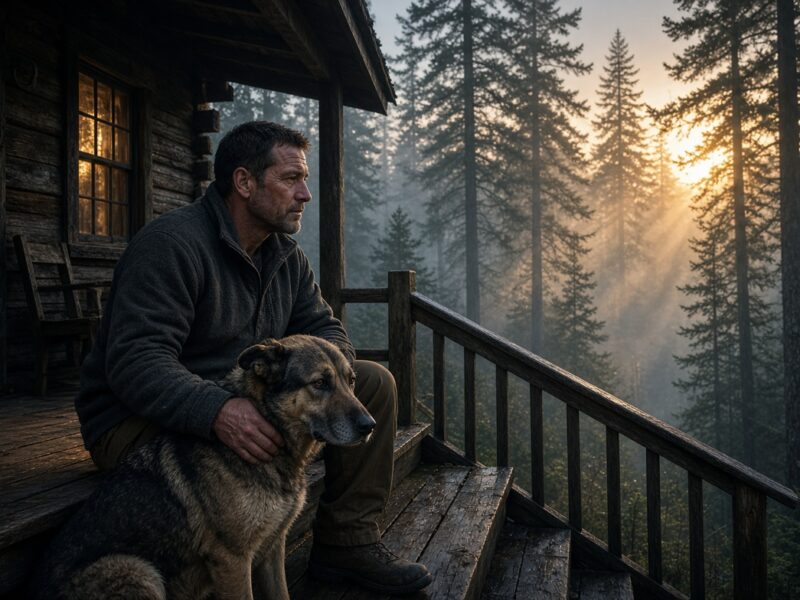
A Broken Navy SEAL Adopted a Scarred German Shepherd Doomed to Die… What the Dog Unearthed in the Woods Changed Everything
The German Shepherd was scarred, aggressive, and scheduled to be put down at dawn.
Nobody wanted a broken weapon.
But when a haunted Navy SEAL looked into the dog’s eyes, he didn’t see a monster.
He saw a mirror.
He bought the canine completely unaware the dog was about to unearth a town’s darkest secret.
—
Chief Petty Officer Nate Miller walked with a heavy limp, the permanent souvenir of a mortar shell in the Korengal Valley that had violently ended his 12-year career as a Navy SEAL.
At 34, Nate was a ghost of a man.
His days were empty, stretching out in a monotonous blur of physical therapy, painkillers, and the deafening silence of a civilian world he no longer understood.
He had retreated to a dilapidated, inherited cabin on the edge of Ironwood Ridge, an isolated logging town in Oregon where the pines grew so thick they choked out the sun.
He hadn’t come to the specialized military working dog rescue facility in Pennsylvania looking for a companion.
He had come because his former commanding officer had relentlessly pressured him to find a purpose, suggesting that adopting a retired military canine might bridge the gap between the brotherhood he lost and the solitude he now endured.
Dr. Harrison Reed, the exhausted facility director, led Nate down a concrete corridor filled with the echoing barks of dozens of retired service dogs.
But as they reached the final row, the noise abruptly stopped.
The last kennel was situated in a dimly lit corner, heavily reinforced with steel mesh.
“I’ll be honest with you, Miller,” Dr. Reed said, pausing with his hand on the chain-link gate.
“I’m only showing him to you because of your background, but I don’t recommend him. This is Havoc.”
Nate stepped closer.
In the shadows of the cage paced a massive 90-pound German Shepherd.
The dog’s coat was a faded, dull black and tan, marred by patches of missing fur and a torn left ear.
But it was the dog’s eyes that made Nate stop breathing for a second.
They were hyper-vigilant, wild, and utterly devoid of trust.
As Nate approached, Havoc didn’t bark.
Instead, he stopped pacing, lowered his head, and let out a low, guttural growl that vibrated through the concrete floor.
“I was an explosive detection and patrol asset. Two tours in Afghanistan, then transferred to a border task force,” Reed explained quietly, watching the dog’s stiff posture.
“Six months ago, his handler was killed in an ambush during a cartel raid. Havoc took a graze to the ribs and stayed over the body for 12 hours. Wouldn’t let the medics near him.”
Reed cleared his throat.
“They had to sedate him with a dart just to recover the handler. Since then, he’s unpredictable, aggressive. He’s failed three rehabilitation assessments. Protocol dictates euthanasia for a dog this traumatized. His time is up tomorrow morning.”
Nate stared at the German Shepherd.
The dog stared back, unblinking, muscles coiled like a steel spring, ready to snap.
Nate recognized that look.
He had seen it in the mirror every morning for the past two years.
It wasn’t malice.
It was the raw, bleeding edge of survival.
It was the look of a soldier who was still fighting a war that everyone else had moved on from.
“Open the gate,” Nate said softly.
Reed frowned.
“Miller, he bit a seasoned trainer last week. I can’t.”
“Open it, Doc.”
Nate’s voice carried the quiet, undeniable authority of a man used to giving orders in the dark.
Reluctantly, Reed unlatched the heavy door.
Nate didn’t step in immediately.
He slowly lowered himself to a crouch, groaning slightly as his ruined knee protested, and tossed his cane aside.
He didn’t offer his hand.
He didn’t speak in a high-pitched, comforting voice.
He just sat there on the cold concrete, exhaling a long, slow breath, making himself as small and non-threatening as possible.
Minutes ticked by in agonizing silence.
Havoc held his ground, the growl rumbling steadily in his throat.
But Nate didn’t flinch.
He just kept his eyes cast downward, projecting a calm, anchored energy.
Slowly, the growling hitched.
Then, it stopped.
The massive shepherd took one cautious step forward, then another.
Havoc lowered his massive, scarred head and pressed his wet nose against Nate’s combat boot.
He took a deep, lingering sniff, cataloging the scents of gunpowder, old blood, antiseptic, and the distinct metallic scent of chronic pain.
Finally, the dog looked up, his amber eyes locking onto Nate’s.
Nate slowly reached out his hand, palm up.
Havoc didn’t bite.
Instead, with a heavy, shuddering sigh, the massive canine rested his chin heavily onto Nate’s palm.
“I’ll take him,” Nate said quietly.
—
The first month at the Oregon cabin was a brutal test of endurance for both of them.
Havoc was heavily triggered by loud noises.
A slamming car door half a mile away would send him into a frantic patrol of the perimeter.
He suffered from night terrors, thrashing and whining in his sleep.
Nate would wake up in cold sweats from his own nightmares of the Korengal Valley, only to find the massive German Shepherd sitting rigidly by the front door, standing guard in the pitch black.
They were two broken things moving silently around each other in the gloomy, rain-soaked woods.
But slowly, a fragile bridge of trust formed.
Nate began relying on the dog’s structured routine to pull himself out of bed.
He established a strict military regimen.
0500 wake up, perimeter walk, feeding, training drills.
He communicated with Havoc using the sharp German command words the dog had been trained on.
Fass, heel.
Sitz, sit.
Bleib, stay.
In return, Havoc began to soften, just slightly.
The dog would shadow Nate’s every move, his shoulder brushing against Nate’s good leg, a silent anchor in a world that felt entirely unstable.
For the first time in two years, Nate didn’t feel entirely alone.
He had a teammate again.
But as September rolled into October, and the biting Oregon autumn brought relentless storms rolling off the Pacific, Havoc’s behavior began to shift.
The dog was no longer just patrolling the property.
He was investigating it.
And his attention was becoming dangerously fixated on one specific area.
The Ironwood Ridge property bordered thousands of acres of dense, unforgiving national forest.
It was a landscape of towering Douglas firs, impenetrable blackberry brambles, and treacherous, fog-choked ravines.
It started on a Tuesday morning during their perimeter walk.
They were about two miles from the cabin, nearing the northern property line where the woods grew incredibly thick.
Suddenly, Havoc stopped dead.
His ears pinned forward, his tail went stiff, and the fur along his spine bristled into a sharp ridge.
“What is it, Havoc?” Nate asked, tightening his grip on the heavy leather leash.
“What is it?”
The dog didn’t look at him.
His nose was pointed directly upwind, drawing in long, deep, stuttering breaths.
Suddenly, Havoc lunged forward with such explosive force that he nearly tore the leash from Nate’s heavily calloused hand.
“Hey, hey! Havoc, heel!” Nate barked, planting his boots and using his body weight to anchor the 90-pound animal.
Havoc ignored the command, a massive breach of his ingrained training.
He whined frantically, pulling against the choke collar until he was gagging, his claws tearing up the wet earth as he tried to drag Nate toward a steep, heavily wooded ravine that plunged off the edge of the property line.
Nate frowned, his tactical instincts flaring.
A bear?
A mountain lion?
But Havoc wasn’t reacting with the aggressive territorial display he usually reserved for wildlife.
His body language was purely operational.
He was tracking.
He was locked onto a scent.
Nate managed to drag the dog away that day, but the obsession only escalated.
Over the next week, Havoc spent hours sitting at the edge of the tree line, staring intensely into the woods.
He would pace the fence line, whining high in his throat, constantly testing the wind.
The dog was becoming agitated, reverting to the hyper-vigilant, restless state he had been in at the rescue shelter.
The breaking point came on a Friday night.
A massive Pacific storm front had slammed into the coast, dumping torrential rain over Ironwood Ridge.
The wind howled through the pines, rattling the windows of the old cabin.
Inside, the power had been knocked out hours ago.
Nate was sitting by the wood stove, reading a book by the beam of his SureFire tactical flashlight, trying to ignore the rhythmic, frantic pacing of the dog.
Havoc was losing his mind.
He was running from the back door to the window, scratching desperately at the heavy oak framing.
“Havoc, platz! Down!” Nate commanded sharply over the roar of the wind.
The dog dropped to his belly, but only for a second.
A massive crack of thunder shook the floorboards and Havoc sprang up, letting out a sharp, demanding bark.
He ran to the door, grabbed the brass handle in his teeth, and tried to violently wrench it open.
Nate stood up, wincing as his bad knee flared with pain.
“What is out there, buddy?” he muttered, walking to the door.
He peered through the glass, but could see nothing beyond the sheet of sideways rain and the black silhouette of the tree line.
Thinking the dog just desperately needed to relieve himself, Nate grabbed his Gore-Tex jacket and unlatched the deadbolt.
The second the door cracked open, Havoc hit it like a battering ram.
The heavy wood slammed into Nate’s shoulder, knocking him off balance.
By the time Nate recovered, the dog was gone.
“Havoc!” Nate roared into the storm.
Nothing.
Just the screaming wind and the punishing rain.
Panic, cold and sharp, flooded Nate’s chest.
The woods out there were a death trap in a storm like this.
Sinkholes, falling timber, sheer drops.
Cursing violently, Nate grabbed his high-lumen flashlight, his medical kit, and his holstered sidearm.
He didn’t bother with his cane.
Adrenaline, a ghost from his SEAL days, dumped into his system, masking the pain in his leg.
He plunged into the tree line.
The beam of his flashlight cut a stark white cone through the driving rain.
He tracked the fresh deep gouges of dog claws in the mud.
They led straight north.
Exactly where Havoc had been trying to go all week.
“Havoc!” Nate shouted again.
His voice was instantly swallowed by the roar of the trees.
He pushed through a wall of thorns that tore at his face and jacket.
Sliding down a steep muddy embankment.
He was a mile deep into the national forest now.
Far off any trail.
The terrain was brutal.
Tangled with rotting deadfall and slick rocks.
After 30 minutes of grueling tracking, Nate heard it.
A frantic wet tearing sound over the noise of the rain.
He crested a small ridge and angled his flashlight down into a deep bowl-shaped hollow.
At the base of an ancient massive cedar tree, Havoc was digging.
The dog was completely covered in mud.
Frantic, tearing at the earth with his front paws.
Mud and rocks flew through the air as Havoc dug with a desperate single-minded obsession.
Nate slid down into the hollow.
His boots sinking into the muck.
“Havoc! Back off! Hier!” The dog ignored him.
He was a foot deep.
Tearing through heavy tree roots with his teeth.
His whimpers echoing in the hollow.
Nate reached the dog and grabbed the handle of his harness.
Hauling him backward with all his upper body strength.
“I said knock it off!” Nate yelled, pinning the struggling dog against his leg.
Havoc fought him for a second.
Then suddenly froze.
He didn’t look at Nate.
He looked down into the muddy hole he had just excavated.
Then the trained canine did something that made the blood freeze in Nate’s veins.
Havoc sat down perfectly straight, staring at the hole.
He didn’t bark.
He didn’t move.
It was a passive indication alert.
The exact posture a military dog takes when they have found a buried explosive or human remains.
Nate’s breath hitched.
He stepped closer to the edge of the pit, wiping the driving rain from his eyes.
He aimed the SureFire beam directly into the churning mud.
At first it just looked like dirt and severed roots.
But then the harsh white light caught a glimmer of something unnatural.
Something that didn’t belong in the earth.
Nate dropped to his knees in the mud.
He reached down into the freezing muck, his fingers brushing against something rigid.
He cleared the mud away, his heart hammering against his ribs.
It was a piece of heavy, faded yellow fabric.
A raincoat.
Nate kept digging, his hands moving faster now.
Beneath the fabric his fingers struck something hard.
A metal box?
No.
He wiped the sludge away, revealing a small tarnished silver object attached to a rotting nylon strap.
He pulled it free.
It was a child’s backpack zipper pull shaped like a silver star.
Nate turned it over in his muddy palm.
The light illuminated three letters scratched deeply into the back of the cheap metal.
AJF.
Nate stared at the initials, his mind racing, trying to connect the dots.
Then, an icy realization washed over him.
When Nate had inherited the cabin from his uncle a year ago, he had spent hours reading old local newspaper clippings in the town library to pass the time.
One headline had dominated the front pages of the Ironwood Ridge Gazette for years.
22 years ago, a 7-year-old girl named Abigail Jane Foster had vanished while walking home from school.
The town had been torn apart.
Suspects were interrogated.
The woods were searched for months, but not a single trace of her was ever found.
Nate slowly raised his eyes from the zipper pull to the dark, muddy hole beneath the ancient cedar.
Havoc hadn’t chased a deer.
He hadn’t found an old hunter’s cache.
Guided by a scent that had somehow seeped through two decades of soil and rain, the retired, broken military dog had just found the forgotten grave of Abigail Foster.
And based on the sheer depth of the roots covering the site, she hadn’t gotten lost and died out here from exposure.
Someone had buried her.
—
Nate’s military instincts immediately overrode his initial shock.
The rain continued to violently assault the forest canopy, but Nate’s mind went eerily quiet, slipping back into the cold, calculated headspace he used during combat deployments in hostile territory.
He didn’t dig any further.
He knew the incredibly fragile nature of forensic evidence, and touching anything else could compromise a decades-old crime scene.
He placed the silver zipper pull back exactly where he found it.
He pulled a roll of bright orange paracord from his tactical medical kit and tied it securely around the trunk of the massive cedar tree, marking the exact location.
Then, grabbing Havoc’s harness, he began the grueling, treacherous hike back to the cabin.
The dog was reluctant to leave, whining softly, his amber eyes locked on the muddy pit, but a sharp, authoritative command from Nate finally broke his trance.
It took them an agonizing 45 minutes to fight their way back through the storm.
By the time they reached the porch, both man and dog were shivering, coated in thick, freezing mud.
Nate didn’t bother changing his clothes.
He grabbed his landline phone, the only reliable connection out here in the dense ridge, and dialed 911.
Two hours later, the storm had finally broken, leaving behind a heavy, suffocating fog that rolled through the pines like phantom smoke.
The flashing red and blue lights of three county cruiser vehicles illuminated the dripping trees outside Nate’s cabin.
Sheriff Wade Collins, a heavily built man in his late 50s with cold, deeply set eyes, stood in Nate’s living room, dripping water onto the floorboards.
Beside him stood his ambitious right-hand man, Deputy Brian Hayes.
“You’re telling me,” Sheriff Collins started, his tone dripping with thick skepticism, “that your crazy, washout military dog managed to sniff out a 22-year-old cold case in the middle of a torrential downpour under four feet of mud and ancient tree roots?”
“I’m telling you he found something that looks exactly like a child’s raincoat and a backpack zipper pull with the initials AJF,” Nate replied coldly, leaning heavily on his cane.
“Abigail Jane Foster. It’s a passive indication alert. Havoc is trained to find human remains. He doesn’t make mistakes.”
Deputy Hayes scoffed, crossing his arms.
“Listen, Miller. We all respect your service. But that dog of yours is a known liability. He was scheduled for the needle for a reason. There are old pioneer graves, animal bones, and illegal hunting caches all over these woods. You probably just found a poacher’s old trash dump.”
Before Nate could respond, a low menacing rumble vibrated through the room.
Havoc, who had been commanded to hold a down stay in the corner of the kitchen, was staring dead at Deputy Hayes.
The dog’s lips curled back, exposing his massive canines.
He wasn’t just growling.
He was tracking Hayes with a predatory intensity that Nate had only seen him use when sensing a direct imminent threat.
“Call off your animal, Miller, before I put him down right here,” Hayes snapped, his hand instinctively dropping to the handle of his holstered service weapon.
“Havoc, aus. Leave it,” Nate commanded softly.
The dog stopped growling but didn’t break his piercing eye contact with the deputy.
Nate’s tactical mind began turning.
Havoc hadn’t reacted this way to the paramedics, the mailman, or even Sheriff Collins.
There was something specific about Deputy Hayes that triggered the dog’s defensive drive.
Collins sighed heavily, rubbing his temples.
“Fine. We will hike out there at first light when the ground is stable. But listen to me carefully, Miller. Keep your mouth shut about this. If you go spreading rumors that you found the Foster girl, and it turns out to be a dead deer wrapped in a tarp, this town will tear you apart. Her parents are still alive. Don’t you dare give them false hope.”
The deputies left.
But Nate didn’t sleep a single wink that night.
Collins’ dismissive attitude didn’t sit right with him.
It wasn’t just skepticism.
It felt orchestrated.
It felt like containment.
As dawn broke, casting long gray shadows across the ridge, Nate made a decision.
He wasn’t going to let the local department handle this alone.
He went to his uncle’s old desk and pulled out a stack of historical county maps.
He traced the coordinates of the cedar tree.
The land wasn’t part of the national forest, after all.
It sat on a forgotten, heavily overgrown strip of private property that had once belonged to the Stanton Logging Company, owned by Robert Stanton, the current mayor of Ironwood Ridge.
22 years ago, Robert Stanton’s son, Greg Stanton, had been a wild, reckless teenager notoriously known for drunk driving and getting bailed out by the local police.
And the sheriff at the time?
Wade Collins’ older brother, who had conveniently retired exactly one month after Abigail Foster went missing.
The pieces began clicking together in Nate’s mind with sickening clarity.
Abigail wasn’t abducted by a stranger.
She was hit by a drunk driver on Ridge Road.
A powerful family panicked.
A corrupt sheriff covered it up, burying the evidence on private logging land that was permanently closed to the public the very next day.
Nate realized with a jolt of pure adrenaline that if Collins and Hayes went into those woods today, they weren’t going to secure a crime scene.
They were going to destroy it.
—
Nate didn’t wait for the local authorities.
He strapped on his tactical vest, checked the magazine of his SIG Sauer P226, and clipped Havoc into his heavy-duty combat harness.
They moved out into the dense, fog-covered woods long before the promised first-light arrival of the sheriff.
When they approached the ravine, the silence of the forest was suddenly broken by the heavy, rhythmic thud of metal striking earth.
Nate crouched low behind a thick wall of blackberry bushes, peering through the mist.
Down in the hollow, next to the giant cedar tree, stood Deputy Brian Hayes.
He wasn’t laying down crime scene tape.
He was wielding a heavy steel trenching shovel, frantically digging into the hole Havoc had opened the night before.
Next to him sat a thick, black industrial contractor bag.
He was exhuming the remains to move them.
Nate’s blood ran ice cold.
He unholstered his weapon, his thumb silently clicking off the safety.
He looked down at Havoc.
The German Shepherd was absolutely rigid, perfectly silent, waiting for the command to engage.
Nate stepped out from the tree line, raising his weapon.
“Drop the shovel, Hayes.”
His voice boomed through the hollow, echoing off the damp trees with absolute authority.
Hayes spun around, his eyes widening in panic.
But he didn’t drop the shovel.
Instead, he dropped his hand to his duty belt, drawing his firearm with surprising speed.
“You should have minded your own business, crippled boy,” Hayes yelled, raising his gun.
Nate didn’t have time to seek cover.
He relied on the one weapon he knew was faster than a bullet.
“Fass! Bite!” Nate roared.
Havoc launched himself off the muddy embankment like a 90-pound missile.
The dog covered the 30 feet between them in less than two seconds, a blur of muscle and teeth.
Hayes fired a wild shot, the bullet cracking harmlessly through the branches above Nate’s head, before Havoc impacted him squarely in the chest.
The sheer kinetic force of the canine hit lifted the deputy off his feet.
Hayes screamed as Havoc’s jaws clamped down with bone-crushing pressure onto his gun arm.
The weapon flew into the mud.
Hayes thrashed violently, punching the dog’s ribs, but Havoc had been trained to hold his grip through active combat.
The dog dragged the grown man into the mud, pinning him aggressively to the earth, snarling viciously inches from his throat.
Nate scrambled down the bank, moving as fast as his ruined knee would allow.
He kicked the deputy’s gun far into the brush and pressed the barrel of his SIG Sauer directly against Hayes’s forehead.
“Call him off! God, call him off! He’s breaking my arm!” Hayes screamed, completely terrified, the fight completely drained out of him.
“You were going to move her,” Nate said, his voice a dangerous, quiet rasp.
“Greg Stanton hit her with his truck 22 years ago. Your department covered it up. And you came out here to finish the job so the mayor’s golden boy wouldn’t go to prison.”
Hayes, trembling violently under the weight of the massive German Shepherd, began to sob.
“I— It wasn’t me. I was just a kid back then. Collins told me to do it. He said if the feds found out, we’d all go down for conspiracy. Please, man, call off the dog.”
Nate didn’t flinch.
He didn’t call the local dispatch.
Keeping his gun trained on Hayes, Nate pulled his phone out.
This time, he dialed the direct emergency line for the FBI field office in Portland, bypassing the corrupted county entirely.
Within four hours, the isolated ridge was swarming with federal agents, forensic anthropologists, and state police.
Sheriff Wade Collins and Mayor Robert Stanton were arrested before noon, dragged out of their respective offices in handcuffs as the stunned town watched.
As the sun began to set, casting a golden light over the Oregon pines, Nate sat on the tailgate of a federal command vehicle.
An FBI agent handed him a cup of black coffee, giving him a deeply respectful nod.
Down in the ravine, a specialized forensic team was delicately recovering the remains of Abigail Jane Foster, finally bringing the lost girl home to her grieving parents after two decades of agonizing silence.
Nate looked down.
Havoc was sitting dutifully at his feet, his coat still caked in dried mud, his torn ear twitching at the sounds of the radios.
The dog leaned his heavy head against Nate’s bad leg.
Nate reached down, burying his hands into the thick fur of the German Shepherd’s neck.
Dr. Reed had said this dog was broken, unpredictable, and beyond saving.
The world had looked at Nate Miller and seen the exact same thing.
A discarded weapon.
A ghost.
But as Nate looked into the dog’s calm, amber eyes, he knew the truth.
They hadn’t just saved a little girl’s legacy today.
They had saved each other.
For the first time since the Korengal Valley, Nate Miller felt a deep, profound sense of peace.
He wasn’t a ghost anymore.
He was a guardian.
And he finally had his partner back.
—
The weeks that followed brought a strange kind of quiet to Ironwood Ridge.
The national news trucks eventually packed up and left, their satellite dishes folding down like metallic flowers closing for the night.
The town, once a tight-knit community bound by shared silence and unspoken complicity, now found itself fractured along fault lines nobody had known existed.
Half the residents treated Nate like a hero.
The other half treated him like a pariah.
The Stanton family had deep roots in Ironwood Ridge.
Robert Stanton’s grandfather had founded the logging company that had built the town.
The Stanton name was on the library, the community center, the little league field.
Now it was also on a federal indictment.
Greg Stanton, the mayor’s son, had been arrested at his home in Portland, where he worked as a real estate developer.
He was 40 years old now, with a wife and two children of his own.
He had never been charged with anything more serious than a speeding ticket since that night 22 years ago.
But forensic evidence was a patient hunter.
The remains recovered from beneath the cedar tree had been positively identified as Abigail Jane Foster.
And the advanced DNA techniques that hadn’t existed in 2002 had finally caught up with the truth.
Paint chips embedded in the fabric of Abigail’s raincoat matched the make and model of the truck Greg Stanton had been driving that night.
A truck his father had reported stolen the very next morning.
The FBI had found the vehicle in a scrapyard outside Salem, sold for cash by Robert Stanton himself just three days after Abigail disappeared.
The case was airtight.
The town, however, was not.
—
Nate learned quickly that small towns have long memories and even longer grudges.
The first sign of trouble came at the grocery store.
He was standing in the cereal aisle, Havoc sitting obediently at his side in his service dog vest, when a woman in her sixties stopped dead in front of his cart.
She stared at him with eyes that burned with a quiet, simmering fury.
“You’re the one,” she said.
Her voice was flat, almost mechanical.
“You’re the one who ruined everything.”
Nate didn’t respond.
He had learned long ago that some battles weren’t worth fighting.
But Havoc sensed the tension immediately.
The dog’s ears swiveled forward, his body going rigid.
The woman noticed.
Her lip curled.
“That thing should have been put down,” she hissed.
Then she turned and walked away, her heels clicking sharply against the linoleum.
Nate exhaled slowly.
He reached down and scratched Havoc behind his torn ear.
“Easy, buddy,” he murmured.
“They don’t understand.”
But the hostility wasn’t limited to strangers in grocery stores.
A week later, Nate woke up to find the word “TRAITOR” spray-painted in red across the side of his truck.
The tires had been slashed.
The windshield was cracked.
Havoc was pacing the porch, growling low in his throat, his hackles raised.
Someone had been on the property.
Someone who knew exactly where Nate lived.
He filed a police report, but the county sheriff’s department was in shambles.
Wade Collins had been arrested, along with three of his deputies.
The interim sheriff was a young woman named Elena Vasquez, a former state trooper who had been brought in to clean house.
She took Nate’s report seriously, but she was honest with him.
“I can’t promise anything,” she said, standing on his porch, her breath fogging in the cold October air.
“Half my department is either under investigation or on administrative leave. We’re stretched thin.”
Nate nodded.
He understood.
He had spent his entire adult life in a world where resources were always scarce and threats were always real.
“I’ll handle it,” he said.
Vasquez looked at him for a long moment.
“You’re not going to do anything stupid, are you, Miller?”
Nate almost smiled.
“No, ma’am. I’m just going to keep my head down and my dog close.”
But he didn’t tell her about the phone calls.
—
The calls started three days after the graffiti incident.
Nate’s landline would ring at odd hours of the night.
2:17 a.m.
3:42 a.m.
4:58 a.m.
When he picked up, there was only silence on the other end.
Sometimes he could hear breathing.
Sometimes he could hear the faint hum of a television in the background.
Sometimes he could hear a dog barking in the distance.
Once, just once, a voice whispered four words before the line went dead.
“Go back to hell.”
Nate started keeping a log.
He wrote down the date and time of every call.
By the end of the second week, he had recorded 29 missed calls and 14 silent voicemails.
Havoc, sensing his anxiety, had become more protective than ever.
The dog refused to leave Nate’s side, even to eat.
He would stand guard by the front door for hours, his eyes fixed on the tree line, his body perfectly still.
Nate knew the signs.
Havoc was waiting for an attack.
And Nate, despite his injured knee and his haunted mind, was doing the same.
—
The breaking point came on a cold November night.
Nate was sitting on the porch, a blanket draped over his shoulders, watching the fog roll through the pines.
Havoc was lying at his feet, his head resting on his paws, his breathing slow and steady.
The cabin was warm, the wood stove crackling softly inside.
For a moment, Nate allowed himself to believe that maybe, just maybe, things were finally settling down.
Then he saw the headlights.
A single set of brights, cutting through the fog like twin blades.
The vehicle was moving slowly, too slowly, down the long gravel driveway that led to Nate’s cabin.
Havoc’s head snapped up.
A low growl rumbled in his chest.
Nate stood, his hand instinctively moving to the holster on his hip.
He had started carrying his sidearm everywhere, even on his own property.
The vehicle stopped about 50 yards from the porch.
The engine cut off.
The headlights went dark.
For a long moment, nothing happened.
Then the driver’s side door opened.
A figure stepped out, silhouetted against the gray mist.
Nate couldn’t make out a face, but he could see the outline of a heavy jacket and a baseball cap pulled low.
The figure didn’t move toward the cabin.
They just stood there, staring.
Havoc’s growl deepened.
The fur along his spine stood up like a ridge of steel.
Nate’s hand closed around the grip of his SIG Sauer.
He didn’t draw it.
Not yet.
“Can I help you?” he called out, his voice steady and calm.
The figure didn’t respond.
They just stood there, motionless, for what felt like an eternity.
Then, slowly, they raised their right hand.
Nate tensed.
But instead of a weapon, the figure held up a single object.
A piece of paper.
They held it aloft for a moment, as if showing it to Nate.
Then they dropped it on the ground, turned, and got back into the vehicle.
The engine roared to life.
The headlights blazed.
And the vehicle disappeared into the fog, its taillights fading like dying embers.
Nate waited a full five minutes before he moved.
He stepped off the porch, Havoc at his side, and walked slowly down the driveway.
The paper was lying on the wet gravel, already damp from the mist.
He picked it up and unfolded it.
There was only one sentence written on it, in neat, block letters.
“YOU DON’T KNOW THE WHOLE STORY.”
Nate stared at the note, his mind racing.
He had expected threats.
He had expected violence.
He had not expected this.
He looked down at Havoc.
The dog was staring into the fog, his body still tense, his ears swiveled forward.
He was listening for something Nate couldn’t hear.
“Come on, buddy,” Nate said quietly.
“Let’s go inside.”
But as he walked back to the cabin, he couldn’t shake the feeling that the note wasn’t a threat.
It was a warning.
And warnings, in Nate’s experience, were usually the prelude to something much worse.
—
The next morning, Nate drove into town.
He didn’t want to.
Every instinct he had, both as a former SEAL and as a man who had spent the last two years avoiding human contact, told him to stay on the ridge.
But he needed answers.
And there was only one place he could think of to find them.
The Ironwood Ridge Public Library was a small, brick building on the corner of Main Street and Elm.
It had been built in the 1950s and hadn’t been updated since.
The shelves were crammed with dusty paperbacks.
The computers were ancient.
But the local history section was surprisingly comprehensive.
Nate spent three hours combing through old newspapers, yearbooks, and county records.
He was looking for anything that might explain the note.
Anything that might tell him what he was missing.
And then he found it.
A single photograph, buried in the back of a 1999 yearbook from Ironwood Ridge High School.
The photo showed a group of teenagers standing in front of a bonfire.
They were laughing, their faces lit by the flickering flames.
In the center of the group, his arm slung around a pretty blonde girl, was a young Greg Stanton.
But it wasn’t Greg who caught Nate’s attention.
It was the boy standing next to him.
A tall, lanky kid with dark hair and a crooked smile.
A kid who looked vaguely familiar.
Nate squinted at the caption.
“Senior bonfire, Class of 1999. Left to right: Greg Stanton, Brian Hayes, Sarah Mitchell, and Tommy Foster.”
Nate’s blood ran cold.
Tommy Foster.
Abigail Foster’s older brother.
—
Nate sat back in his chair, his heart pounding.
He pulled out his phone and typed a quick search.
Tommy Foster, Ironwood Ridge.
The results were sparse.
A few social media profiles, all set to private.
An obituary for a Margaret Foster, dated 2015.
And a single news article from the Oregonian, dated three years ago.
“Thomas Foster, 38, of Ironwood Ridge, was arrested last week on charges of public intoxication and disorderly conduct. Police say Foster, the brother of missing child Abigail Foster, was involved in an altercation at a local bar. He was released on $500 bail.”
Nate stared at the screen.
Tommy Foster had been at that bonfire.
He had been friends with Greg Stanton and Brian Hayes.
And his sister had disappeared just a few years later.
The pieces didn’t fit together.
They didn’t make sense.
Unless Tommy Foster had known something all along.
Unless he had been carrying a secret for 22 years.
Nate closed his laptop and stood up.
Havoc, who had been sleeping under the table, raised his head.
“We need to find him,” Nate said.
Havoc’s ears perked up.
“Come on, buddy. We’ve got work to do.”
—
Thomas Foster lived in a trailer park on the outskirts of Ironwood Ridge.
His home was a rusted, single-wide with a sagging roof and a broken screen door.
Nate parked his truck on the gravel road and stepped out, Havoc walking stiffly at his side.
The trailer was dark.
The windows were covered with tattered curtains.
But there was a light on in the back, a faint glow that flickered like a candle.
Nate knocked on the door.
No answer.
He knocked again.
“Tommy? My name is Nate Miller. I need to talk to you about your sister.”
Silence.
Then, a hoarse voice from inside.
“Go away.”
“I’m not going anywhere,” Nate said.
“I know what happened to Abigail. I found her.”
The door creaked open.
A man stood in the doorway, gaunt and unshaven, his eyes red-rimmed and hollow.
He looked at Nate with a mixture of fear and desperation.
“You found her?” he whispered.
Nate nodded.
“Her remains. They were buried on the old Stanton logging property. The FBI has already made arrests.”
Tommy Foster stared at him for a long moment.
Then his face crumpled.
He sank to his knees, his hands covering his face, and began to sob.
Nate didn’t move.
He just stood there, Havoc at his side, and waited.
When Tommy finally spoke, his voice was barely a whisper.
“I knew,” he said.
“I knew all along.”
—
Nate sat across from Tommy in the cramped, cluttered living room of the trailer.
The air smelled of stale cigarettes and old regret.
Havoc lay at Nate’s feet, his eyes fixed on Tommy, watchful but calm.
Tommy held a mug of black coffee in his trembling hands.
He hadn’t taken a sip.
He just stared into the dark liquid, as if it held the answers to questions he had been too afraid to ask.
“I was 16,” Tommy said.
“The night Abigail disappeared, I was supposed to walk her home from school. But I was with Greg and Brian. We were drinking. I forgot.”
He swallowed hard.
“When I realized what time it was, I ran to the school. But she was already gone.”
Nate didn’t interrupt.
He just listened.
“The next day, Greg showed up at my house. He was a mess. Crying. Shaking. He told me he hit something on the road the night before. Something small. He thought it was a deer. But when he got out to check…”
Tommy’s voice cracked.
“It was Abigail. She was still alive. She was bleeding. She was calling for me.”
Nate’s jaw tightened.
“Greg panicked. He called his father. Robert Stanton showed up with Wade Collins. They told Greg to go home. They said they would handle it.”
“And they did,” Nate said quietly.
Tommy nodded.
“They buried her out there. On the logging property. Wade Collins told me if I ever said anything, they would kill me. They would kill my parents. They would burn our house down.”
He looked up at Nate, his eyes filled with tears.
“I was 16 years old. I was a coward. I let them take her. I let them bury her. And I’ve been living with that every single day for 22 years.”
Nate was silent for a long moment.
He thought about the Korengal Valley.
He thought about the men he had lost.
He thought about the things he had seen and done and carried with him every single day since.
He understood Tommy Foster in a way that most people never could.
“You’re not a coward,” Nate said finally.
“You were a kid. They were the monsters.”
Tommy shook his head.
“I should have said something. I should have fought back.”
“You can’t change the past,” Nate said.
“But you can change what happens next.”
Tommy looked at him.
“What do you mean?”
“Robert Stanton and Wade Collins are in federal custody. Greg Stanton is awaiting trial. The FBI has enough evidence to put them all away for the rest of their lives. But they need witnesses. They need people who are willing to testify.”
Tommy’s face went pale.
“I can’t. They’ll kill me.”
“They’re already in jail,” Nate said.
“They can’t hurt you anymore.”
“You don’t know that. They have friends. They have money. They have power.”
Nate leaned forward.
“And you have the truth. That’s the only weapon that matters.”
Tommy stared at him for a long moment.
Then he looked down at Havoc.
The German Shepherd was watching him with those calm, amber eyes.
“He’s the one who found her, isn’t he?” Tommy whispered.
Nate nodded.
“Havoc was a military working dog. He was trained to find human remains. He led me right to her.”
Tommy reached out a trembling hand.
Havoc didn’t growl.
He didn’t flinch.
He just sat there, perfectly still, as Tommy’s fingers brushed against his fur.
“She loved dogs,” Tommy said, his voice breaking.
“Abigail. She loved dogs. She always wanted one. But our mom was allergic.”
He pulled his hand back and wiped his eyes.
“Okay,” he said.
“I’ll testify. I’ll tell them everything.”
Nate nodded.
“Good. I’ll make some calls.”
—
The trial of Robert Stanton, Wade Collins, and Greg Stanton was held in federal court in Portland.
It lasted six weeks.
The prosecution called 47 witnesses.
They presented 1,200 pieces of evidence.
They showed the jury photographs of the cedar tree, the muddy pit, the silver zipper pull with the initials AJF.
Tommy Foster testified for three hours.
He told the jury everything.
About the bonfire.
About Greg’s confession.
About the burial.
About the threats.
About the 22 years of silence.
When he stepped down from the witness stand, he was crying.
But he was also smiling.
For the first time in his life, he was free.
The jury deliberated for two days.
They found all three men guilty on all counts.
Robert Stanton was sentenced to 25 years in federal prison for obstruction of justice and accessory to manslaughter.
Wade Collins received 20 years for official misconduct and conspiracy.
Greg Stanton was convicted of vehicular manslaughter and tampering with evidence.
He was sentenced to 15 years.
The town of Ironwood Ridge was never the same.
But then again, it had never really been the same since that night 22 years ago.
—
Nate and Havoc returned to the cabin on the ridge.
The pines were still thick.
The fog still rolled through the valleys like phantom smoke.
But something had changed.
The silence that had once felt suffocating now felt peaceful.
The solitude that had once felt like a punishment now felt like a choice.
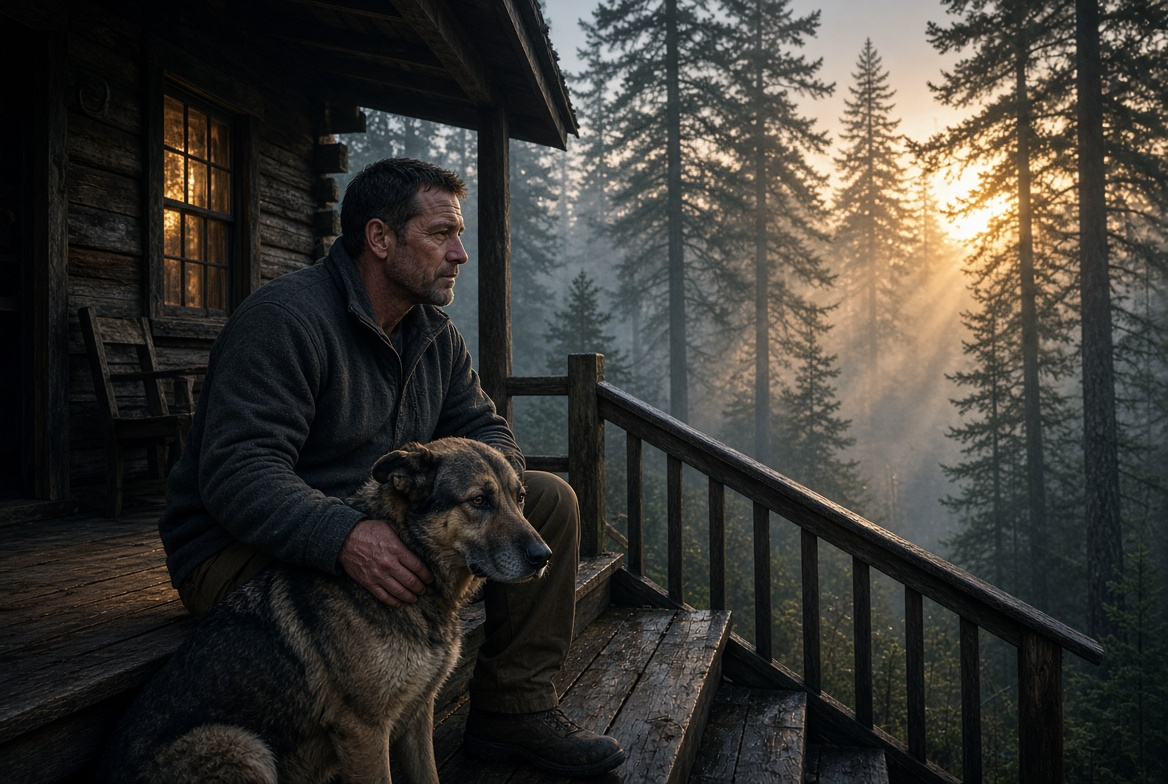
Nate sat on the porch, a cup of coffee in his hand, watching the sun set over the mountains.
Havoc lay at his feet, his head resting on his paws, his eyes half-closed.
The dog was older now.
His muzzle was gray.
His joints were stiff.
But his eyes were still sharp.
Still watchful.
Still loyal.
Nate reached down and scratched him behind his torn ear.
“You did good, buddy,” he said quietly.
“You did real good.”
Havoc let out a soft sigh and closed his eyes.
Nate leaned back in his chair and looked up at the sky.
The stars were coming out, one by one, like tiny pinpricks of light in the vast, dark canvas of the universe.
He thought about Abigail Foster.
He thought about the life she never got to live.
He thought about the parents who had waited 22 years for answers.
He thought about Tommy Foster, who had finally found the courage to speak the truth.
And he thought about himself.
A broken man.
A haunted warrior.
A ghost.
But not anymore.
He had found a purpose.
He had found a partner.
He had found a reason to keep going.
The world had looked at Nate Miller and seen a discarded weapon.
The world had looked at Havoc and seen a monster.
But they had been wrong.
They had both been wrong.
Because sometimes, the most broken things are the ones that shine the brightest.
Sometimes, the most wounded souls are the ones that heal the deepest.
Sometimes, the most forgotten graves are the ones that need to be found.
Nate took a long sip of his coffee and smiled.
For the first time in a long time, he felt like he was exactly where he was supposed to be.
—
Six months later, Nate received a letter in the mail.
It was handwritten, on pale blue stationery.
The return address was a small town in Vermont.
He opened it carefully, his hands steady.
Dear Mr. Miller,
My name is Eleanor Foster.
I am Abigail’s mother.
I wanted to thank you for what you did.
For finding my daughter.
For bringing her home.
For giving us closure after all these years.
I know it wasn’t easy.
I know you faced danger and hostility and doubt.
But you didn’t give up.
You didn’t let them win.
You gave my little girl a voice when she couldn’t speak for herself.
And for that, I will be forever grateful.
I also wanted to tell you about something.
Something that might mean something to you.
Abigail loved German Shepherds.
She used to beg me for one every single day.
She would cut out pictures from magazines and tape them to her bedroom wall.
She would draw them in her notebooks.
She would pretend she had one, and she would walk around the house with a leash made of yarn.
She never got her dog.
But I like to think that maybe, in some way, she helped you find yours.
I like to think that maybe she was looking out for you.
I don’t know if you believe in that kind of thing.
But I do.
Because I have to.
Because it’s the only thing that makes sense.
Thank you, Mr. Miller.
Thank you for everything.
With all my love and gratitude,
Eleanor Foster
Nate read the letter three times.
Then he folded it carefully and placed it on the mantel above the wood stove.
Havoc, who had been sleeping by the fire, raised his head and looked at him.
“What do you think, buddy?” Nate asked.
“Do you think she’s right?”
Havoc just stared at him with those calm, amber eyes.
Then he let out a soft woof and laid his head back down.
Nate smiled.
He walked to the door and stepped outside.
The pines were thick.
The fog was rolling in.
The stars were coming out.
And for the first time in his life, Nate Miller felt like he was home.
—
**THE END**









