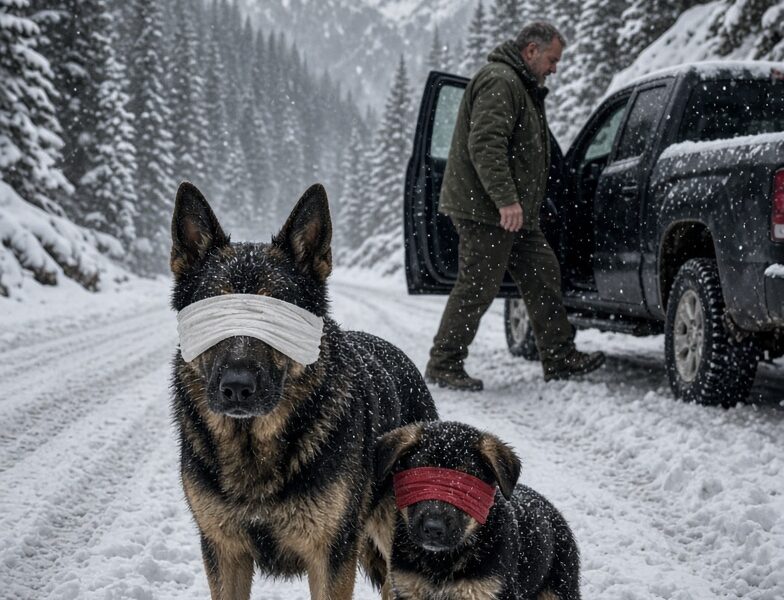
A Blindfolded Retired Military Dog Stood Guard in a Blizzard… Protecting a Puppy He Couldn’t Even See
The old German Shepherd stood in the middle of a snow-covered road outside Durango, Colorado, with a white bandage covering his eyes. Behind him, a tiny puppy wearing a red bandage stumbled through the storm, unable to see the danger surrounding them. When Staff Sergeant Ethan Walker stepped out of his pickup, the older dog immediately positioned himself between the approaching Marine and the helpless puppy.
He couldn’t see Ethan. He couldn’t know whether the stranger meant to help or hurt them. Yet he stood firm, his body shielding the little dog behind him.
Ethan had spent years around military working dogs. He recognized that posture immediately. It wasn’t panic. It was duty.
What he didn’t know was that the old Shepherd had already been abandoned by two families, had spent more than a year struggling to understand retirement, and had finally found something worth following into a blizzard.
Ethan thought he was bringing two lost dogs home for one night.
He had no idea that one of them would eventually lead him into a mountain storm, help save a missing veteran, and teach him something about loyalty that no military assignment ever had.
Before we begin, tell us where you’re watching from. Please like, share, and subscribe as we work toward 1,000 subscribers.
Late December had turned the roads west of Durango into narrow white ribbons beneath the San Juan Mountains. Snow drifted across the pavement, pine-covered slopes faded behind a pale gray sky, and the morning seemed to grow quieter with every mile Staff Sergeant Ethan Walker drove toward home.
At thirty-nine, Ethan stood six feet two inches tall, with broad shoulders, close-cropped brown hair, and a faint scar crossing the edge of his left eyebrow. His blue-gray eyes possessed the habit of checking mirrors, intersections, tree lines, and exits almost automatically.
He wasn’t unfriendly. Years in the United States Marine Corps had simply taught him to pay attention to things other people overlooked.
He was on leave before transferring to a training assignment, although anyone watching him that morning might have wondered whether he understood what leave was supposed to mean.
His old dark green pickup carried three toolboxes, a winter emergency kit, two extra blankets, tire chains, and enough supplies to suggest he expected something to go wrong.
Ethan usually did.
He had left Durango shortly after sunrise and was less than twenty minutes from the small cedar-sided house his parents had once owned near the lower slopes of the San Juans when the snowfall intensified.
Visibility narrowed.
Ethan reduced his speed.
Then something appeared in the center of the road.
At first, it looked like a dark shape moving through the blowing snow. Ethan leaned toward the windshield, trying to make sense of it.
The shape moved again.
He hit the brakes.
A large German Shepherd stood several yards ahead of the truck. The dog was mature, perhaps nine years old, with a broad chest, a heavy black-and-tan coat, and the thick winter fur of an animal built to endure difficult weather.
Gray had begun spreading around his muzzle. His movements carried the stiffness of a dog whose strongest years were behind him.
But that wasn’t what made Ethan open the truck door immediately.
A wide white protective bandage covered the Shepherd’s eyes.
“Easy, partner,” Ethan murmured as he stepped into the snow.
Then he saw the second dog.
Several feet behind the older Shepherd stood a puppy no more than five months old. He had oversized paws, ears that hadn’t quite decided whether to stand straight, and a soft black-and-tan coat that made him look rounder than he would eventually become.
A red protective bandage covered the puppy’s eyes.
The little dog took two uncertain steps forward and bumped gently against the older Shepherd’s hip.
The older dog adjusted his position without hesitation.
Ethan stopped.
The Shepherd had placed himself directly between Ethan and the puppy. He couldn’t see the Marine approaching, yet his head had turned precisely toward the sound of Ethan’s boots pressing through the snow.
His ears were forward.
His body was steady.
There was no frantic pulling, no wild movement, and no attempt to flee.
Ethan knew that posture. He had seen military working dogs hold it beside their handlers overseas and during training exercises back home.
This wasn’t simply a frightened dog standing in a road.
This was a working dog protecting something behind him.
Ethan slowly lowered himself into a crouch.
“All right, partner. Nobody’s coming through you.”
The Shepherd’s ears shifted.
Ethan noticed the reaction immediately. He tried another phrase in the calm, measured tone he remembered from military kennels.
“Easy, soldier.”
The change was subtle, but unmistakable. The dog’s shoulders lowered slightly, although he didn’t abandon his position.
The puppy pressed against his side.
Ethan held out one gloved hand without moving closer.
After several seconds, the older Shepherd took one careful step, then another. He stopped just beyond Ethan’s reach and lifted his nose, studying the unfamiliar man through scent and sound instead of sight.
That was when Ethan noticed the collar.
It was worn brown leather, older than anything he expected to see on an ordinary household pet. Beneath the thick fur hung a scratched metal identification tag.
Ethan waited until the dog allowed him close enough to turn it.
Four words had been stamped into the front.
RANGER — MWD — RETIRED.
Ethan looked at the Shepherd again.
“Ranger.”
The dog’s head turned toward him immediately.
The puppy bumped Ranger’s shoulder for the second time. Ranger shifted sideways, gently guiding him away from the center of the road.
Something tightened in Ethan’s chest.
Even unable to see, the old dog was keeping track of the puppy’s position.
The younger Shepherd wore a blue nylon collar. A small plastic tag beneath it carried a name and the number for Pine Creek Veterinary Center.
Scout.
Ethan pulled out his phone and called the clinic.
The call was answered on the second ring.
“Pine Creek Veterinary Center. This is Claire.”
“My name is Ethan Walker. I’m on County Road 214, west of Durango. I think I’ve found two dogs connected to your clinic.”
There was a pause.
“What dogs?”
“An adult German Shepherd. His tag identifies him as Ranger, a retired military working dog. There’s also a puppy named Scout.”
For a moment, the woman on the other end seemed unable to respond.
“Oh, thank God.”
Dr. Claire Bennett was forty-two, tall and slender, with dark auburn hair usually twisted into a practical knot and green eyes that rarely missed a change in an animal’s posture.
She had spent nearly fifteen years working with injured, elderly, and difficult-to-place dogs. Her staff described her as patient, almost to a fault, although years of watching frightened animals get misunderstood had made her fiercely protective of those who needed time rather than pressure.
She quickly explained what had happened.
Ranger and Scout had been staying in a sheltered recovery yard behind Pine Creek. Both had undergone eye treatment that required temporary protective coverings while their eyes healed.
Neither dog had been expected to remain without useful vision permanently.
Before dawn, a heavy pine branch had fallen across part of the outer fence. The branch damaged a section of the enclosure, leaving an opening large enough for both dogs to escape.
When employees discovered the damage that morning, Ranger and Scout were gone.
“We’ve had people searching for almost three hours,” Claire explained. “We assumed Ranger slipped out first.”
Ethan looked toward the two dogs.
Scout had wandered half a step away. Ranger immediately moved with him.
“I don’t think he did.”
Claire became quiet.
Ethan described what he was seeing. Ranger kept Scout against his left side. Whenever the puppy turned toward the road, Ranger redirected him with his shoulder. Whenever Scout stopped, Ranger stopped.
It looked less like two lost dogs traveling together and more like one dog guiding the other.
“Please wait there,” Claire said. “I need to check something.”
Ethan stood beside Ranger while snow collected across the shoulders of his field jacket.
A minute later, Claire returned.
“I checked the security camera. Scout found the broken fence first.”
Ethan looked down at the puppy.
“He went out at 6:17 this morning,” Claire continued. “Ranger stayed inside.”
Ethan said nothing.
“Then Scout disappeared beyond the fence. Ranger got up, followed his scent to the opening, and went after him.”
The meaning settled quietly between them.
Ranger hadn’t escaped.
He had followed.
Claire then told Ethan something else.
Ranger had been retired for more than a year. Twice, families had attempted to adopt him. Both placements had failed.
Not because Ranger was aggressive.
He simply never seemed able to stop working.
He slept near doors. He monitored windows. He positioned himself between unfamiliar visitors and whoever he considered his responsibility.
Even in retirement, Ranger seemed convinced that somewhere, somehow, somebody still needed him.
Ethan looked at the old Shepherd standing in the snow.
Scout bumped against him again.
Ranger leaned gently back.
For reasons Ethan couldn’t explain, the scene felt uncomfortably familiar.
Even on leave, he had spent that morning checking equipment nobody had asked him to check. Ranger had left a safe enclosure because a puppy had wandered into a storm.
Neither of them seemed particularly talented at believing they were allowed to have nothing to protect.
The wind strengthened across the road.
“Ethan,” Claire said, her voice growing serious, “another storm band is moving in from the west. County crews may close that road within the hour.”
Ethan looked toward the mountains.
The ridge line had disappeared entirely.
He opened the rear door of his pickup and spread one of his emergency blankets across the seat.
Scout heard the movement and turned toward it.
Ranger immediately turned with him.
Ethan watched the old military dog guide the puppy through the falling snow.
Whatever had brought Ranger onto that road, one thing was now clear.
The old K-9 hadn’t gone looking for freedom.
He had gone looking for Scout.
By the time Ethan turned away from County Road 214, the mountains west of Durango had nearly vanished behind the storm.
Snow moved across the road in long white sheets, filling the tire tracks almost as quickly as vehicles made them.
Ranger sat upright behind the passenger seat, his white protective bandage still covering his eyes, while Scout had somehow worked himself into the narrow space against the older Shepherd’s stomach.
The puppy’s red bandage made him look even smaller beneath Ranger’s heavy winter coat.
Ethan had intended to drive directly to Pine Creek Veterinary Center.
That plan lasted less than ten minutes.
Claire called again before he reached the junction. County crews had closed the northern approach to the clinic after two vehicles became stuck near a steep curve, and the western road was expected to close shortly afterward.
Pine Creek still had staff inside, but getting Ethan safely through the storm was no longer worth the risk.
“Keep them with you tonight,” Claire advised. “We’ll arrange transport as soon as the roads are safe.”
Ethan glanced into the rearview mirror.
Scout was asleep.
Ranger wasn’t.
Even without sight, the retired canine sat with his head angled toward the window, listening to every change in the truck’s movement.
“One night,” Ethan said.
“One night sounds better,” Claire replied.
She warned him that Scout was curious about absolutely everything, while Ranger preferred routine, space, and clearly defined boundaries.
“That sounds manageable.”
“Scout chewed through the drawstring on my scrub pants yesterday.”
Ethan glanced in the mirror again. The puppy was sleeping with the peaceful expression of an animal incapable of wrongdoing.
“Less manageable.”
Twenty minutes later, Ethan reached the cedar-sided house near the base of the San Juans.
The place had belonged to his parents before they moved south several years earlier, and Ethan had kept it largely unchanged. Dark wood floors, a stone fireplace, heavy furniture, framed photographs, and very little decoration that didn’t serve some practical purpose.
It was a comfortable house.
It was also a quiet one.
Ethan had never considered that a problem.
Ranger stepped from the truck first. Ethan guided him carefully through the snow, but the old Shepherd didn’t need much encouragement. He paused, lifted his nose, listened, and moved toward the porch with deliberate steps.
Scout followed by tracking Ranger’s movement.
The puppy bumped against Ranger’s hind leg once, corrected himself, and continued as if nothing unusual had happened.
Inside, Ethan removed their wet outer coverings and gave both dogs time to adjust.
Scout immediately began exploring.
He couldn’t see, but that seemed to strike him as an inconvenience rather than a limitation. He followed Ethan’s footsteps into the kitchen, turned toward the smell of firewood near the living room, discovered the edge of a chair with his nose, backed away, and tried again from another direction.
Ranger explored very differently.
He checked the front entrance first, then the kitchen door, then the short hall leading toward the bedrooms. At the garage door, he stopped for several seconds and listened.
Ethan leaned against the wall and watched.
Ranger continued toward the windows, tracing their lower edges with his nose before returning to the hallway.
Finally, he settled at the intersection between the living room and kitchen, a place from which he could monitor both the front entrance and the route toward the rear of the house.
Claire had told Ethan what Ranger did in previous homes.
Now Ethan understood.
Ranger hadn’t chosen a comfortable place.
He had chosen a useful one.
Scout eventually found him.
The puppy approached, carrying something in his mouth.
Ethan narrowed his eyes.
“My sock?”
Scout stopped.
The gray work sock hung from one side of his mouth. Ethan had left it beside a pair of boots near the laundry room less than five minutes earlier.
Scout carried it directly to Ranger and dropped it against the older dog’s front paw.
Ranger lowered his head, sniffed the sock, and slowly pushed it away with his nose.
Scout found it again.
He returned it.
Ranger pushed it away a second time.
Ethan watched the exchange repeat until Scout apparently concluded they were playing.
Dinner established another routine.
Ethan placed the bowls several feet apart and made certain Scout could locate his by scent.
Ranger ate slowly.
Scout finished first and immediately started toward the older dog’s bowl.
Ranger lifted his head.
Scout stopped.
Nothing else happened.
No growling. No sudden movement.
Ranger simply remained still.
Scout backed away and sat.
Ethan raised an eyebrow.
He had known the puppy for less than a day and was already beginning to suspect that Ranger could accomplish more with one silent correction than Ethan could with an entire afternoon of commands.
Later, Ethan opened the back door to let them outside briefly.
Ranger stopped at the threshold.
Scout didn’t.
The puppy stepped forward until Ranger quietly shifted sideways and blocked him.
Scout waited.
Only when Ethan stepped onto the porch did Ranger move forward. Scout followed beside his shoulder.
The lesson repeated when they came back inside.
By the third attempt, Scout stopped at the threshold before Ranger had to block him.
“Show-off,” Ethan muttered.
Ranger ignored him.
That evening, Ethan drove carefully into town before the roads worsened and returned with two dog beds, extra food, and several inexpensive toys.
The storm had turned his temporary guests into a logistical problem, and logistical problems were something Ethan understood.
He placed one thick bed near the fireplace and another several feet away.
Scout investigated both.
Then he walked directly past his own bed and climbed onto Ranger’s.
Ranger remained beside the hallway.
Ethan picked Scout up, moved him to the second bed, and pointed downward.
“That one is yours.”
Scout stayed there for perhaps forty seconds.
Then he got up, found Ranger again, and lay across the older dog’s front paws.
Ranger’s entire body stiffened.
Ethan waited for him to move.
He didn’t.
Scout stretched once, sighed, and went to sleep.
For several minutes, Ranger remained upright, one ear angled toward the front of the house.
Then his head slowly lowered.
Ethan turned off the living room lamp.
At five the next morning, he woke without an alarm.
Years of military schedules had made sleeping late nearly impossible. He checked the weather, then the county road conditions, then the truck, then the generator, then the battery charger in the garage.
By 5:45, he had reorganized a tool shelf that hadn’t needed reorganizing.
His phone rang just after six.
Walter Hayes appeared on the screen.
Walter was sixty-seven, a retired Marine gunnery sergeant with a thick gray mustache, a broad chest softened slightly by age, and a permanent squint earned from decades of working outdoors.
He had served with Ethan’s father and had known Ethan since he was a teenager.
Walter possessed the irritating talent of recognizing when Ethan was avoiding a subject before Ethan recognized it himself.
“I hear you stole two dogs,” Walter said.
“I found two dogs.”
“Same thing if they’re eating your food.”
Ethan opened the garage door and checked the snowfall for no particular reason.
“They’re staying until the road’s clear.”
“You’re on leave, Walker. You know leave means you’re allowed to have nothing to fix.”
Ethan didn’t answer.
Walter chuckled.
“That silence sounds exactly like your father.”
“My father slept until eight after retirement.”
“Took him about three years to learn.”
Ethan looked through the doorway toward the living room.
Ranger was standing near the front window.
Scout was beside him.
The puppy sat for a moment, then apparently became tired of waiting and lowered himself onto the floor.
Ranger continued listening toward the street.
Scout shifted closer until his shoulder touched Ranger’s front leg.
A minute passed.
Ranger remained standing.
Then he slowly folded himself onto the rug beside Scout.
Ethan stopped listening to Walter for several seconds.
“What are you doing?” Walter asked.
“Nothing.”
“Good. Practice that.”
Over the following two days, the storm kept the mountain roads unreliable enough that Claire recommended leaving the dogs where they were.
The temporary arrangement began developing routines of its own.
Ranger became Scout’s guide.
He slowed before the two steps leading from the kitchen into the mudroom. He stopped at doorways and waited for the puppy to locate him. When Scout drifted toward furniture, Ranger sometimes touched him gently with his shoulder and redirected him.
Scout accepted these corrections without complaint.
He also continued bringing Ranger offerings.
A tennis ball.
One of Ethan’s gloves.
The same gray sock.
A rubber toy Ethan had purchased mostly because it appeared difficult to destroy.
Ranger ignored most of them.
Occasionally, however, he pushed something back toward Scout with his nose.
The first time Ranger nudged the tennis ball across the rug, Scout chased the sound, overshot it completely, then circled back with such enthusiasm that Ethan laughed before realizing he had done so.
The bigger change was quieter.
Every time Ranger remained too long beside a door or window, Scout eventually found him.
Sometimes the puppy sat.
Usually, he simply lay down.
At first, Ranger continued standing above him. Later, he began lowering himself sooner.
On the third evening, Scout managed to lead Ranger all the way from the hallway to the rug beside the fireplace by repeatedly carrying a glove there and returning.
Ranger finally followed.
He lay down near the warmth.
Scout immediately curled against him.
Ethan watched from the kitchen.
Ranger’s head remained raised. One ear stood upright.
Scout shifted in his sleep and placed one oversized paw directly across that ear.
The ear flattened beneath it.
Ranger opened his mouth in what looked almost like a tired sigh.
Then his head lowered.
Within minutes, both dogs were asleep.
Claire called that night with encouraging news from their records and previous examinations.
If healing continued normally, the protective bandages should only be temporary. Neither dog was expected to remain without useful vision.
Ethan should have felt relieved because it meant the arrangement would soon become simpler.
Instead, after ending the call, he remained in the living room doorway.
Two expensive beds sat almost untouched nearby.
Ranger and Scout were still crowded together on the rug.
Ethan had told Claire the arrangement would last only until the storm passed.
Outside, snow continued falling beyond the windows.
Inside, Ranger slept while Scout’s paw rested across his ear.
For the first time since bringing them home, the old canine wasn’t positioned where he could guard a single door.
And Ethan noticed that he had stopped checking them, too.
Eight days after Ethan found Ranger and Scout on the snow-covered road west of Durango, the storm finally released its hold on the San Juan foothills.
Snow still covered the fields and rooftops, but the sky had cleared into a hard winter blue. Sunlight reflected from the white ground with enough brightness to make Ethan squint as he pulled into the parking lot of Pine Creek Veterinary Center.
Scout rode in the back seat beside Ranger, unusually restless.
During the previous week, the puppy had learned to navigate Ethan’s house almost entirely through scent, sound, and the movements of the older dog beside him.
Ranger had slowed at steps, blocked unsafe turns, waited at doors, and quietly redirected Scout whenever the puppy’s confidence carried him somewhere his vision couldn’t.
What had begun as protection on a mountain road had become routine.
Dr. Claire Bennett met them in an examination room and checked Scout first.
She moved with the same deliberate patience Ethan had noticed over the phone, speaking to the puppy before touching him and allowing him to smell each instrument.
After several minutes, she smiled.
“He’s ready.”
Ethan stood near Ranger while Claire carefully removed Scout’s protective covering.
Scout blinked.
For a few seconds, he did nothing.
The room seemed to arrive around him all at once: pale cabinets, stainless-steel equipment, Ethan standing near the wall, Claire kneeling in front of him, and winter sunlight coming through the narrow window.
Scout’s ears lifted.
His tail began moving.
Ethan expected him to rush toward the nearest interesting object.
Instead, Scout turned his head.
He searched the room.
Then he saw Ranger.
The puppy crossed the floor so quickly that Claire barely had time to move aside.
He stopped directly in front of the old Shepherd, whose own white protective bandage still covered his eyes, and pushed his nose against Ranger’s muzzle.
Ranger remained still.
Scout backed away, then circled him once, then again.
Ranger turned his head, following the puppy by sound.
Ethan smiled.
“He’s showing off.”
“He just discovered the world has colors,” Claire said. “I’d probably show off, too.”
Ranger would need several more days before his own covering could come off. Claire wanted his recovery to remain gradual, especially because age made her more cautious with him.
She also noticed something else while examining him.
“He’s put on a little weight.”
Ethan looked down.
“Is that bad?”
“It’s good. He was leaner than I liked when he arrived.”
Claire ran one hand gently along Ranger’s shoulders.
“And his resting heart rate is better.”
Ethan said nothing.
Claire glanced toward him.
“He’s sleeping more, isn’t he?”
“Sometimes.”
“That means yes.”
Ethan ignored the satisfaction in her voice.
The change became clearer once they returned home.
For the first week, Ranger had been Scout’s guide.
Now Scout seemed determined to return every lesson.
In the backyard, the puppy ran ahead through the snow, then stopped and looked back.
Ranger followed Ethan’s voice and the familiar boundaries he had already memorized, but Scout never went far.
He would move ten feet, turn, and wait.
If Ranger slowed near the porch steps, Scout came back and stood beside him.
The first time it happened, Ethan assumed it was coincidence.
By the fifth time, he stopped pretending.
At the kitchen doorway, Scout waited.
Near the mudroom steps, Scout waited.
When Ethan called them in from the yard, Scout reached the door first, then turned and watched Ranger approach before going inside.
The puppy, who had once needed Ranger to show him every boundary, now seemed unwilling to cross one without making sure the older dog was there.
Three days later, Claire removed Ranger’s covering.
The old Shepherd opened his eyes slowly.
His vision wasn’t perfect immediately, but Claire was pleased with his response. She asked Ethan to keep things calm for the rest of the day and avoid overstimulation.
Ranger made that easy.
He didn’t rush around the room.
He looked first at Ethan, then Claire, then toward the door.
Finally, he found Scout.
The puppy was sitting several feet away with the tennis ball between his paws.
Scout picked it up, carried it toward Ranger, and dropped it.
Ranger stared at the ball.
Scout lowered his front legs.
Nothing happened.
Then Ranger leaned forward and nudged the ball with his nose.
It rolled across the floor.
Scout launched after it. His paws slipped slightly on the smooth surface before he recovered and returned triumphantly with the ball.
Ranger watched him.
Scout dropped it again.
This time, Ranger pushed it farther.
Ethan remained quiet.
The exchange lasted less than two minutes, but it was the first time he had seen Ranger participate in something that served no purpose at all.
No guarding.
No guiding.
No checking.
Just a ball rolling across a room because a puppy wanted it to.
A few days later, Ethan brought both dogs to Second Ridge Veteran Center, where Walter had been asking to meet them since the storm.
The center sat on several open acres outside Durango, built from an old ranch property with a long wooden porch, a community room, a workshop, and several small cabins used for temporary housing.
Veterans came there for meals, woodworking, counseling, or simply somewhere to spend an afternoon without being expected to explain themselves.
Walter met Ethan near the workshop.
The retired Marine did exactly what Ranger seemed to prefer.
Nothing.
He didn’t crouch.
He didn’t call the dog.
He didn’t reach for him.
Walter simply stood with his hands in his coat pockets and said, “So that’s the old sergeant.”
Ranger looked at him for several seconds, then walked over and sat nearby.
Walter nodded.
“Good taste.”
Scout was less selective.
He had already discovered someone else.
Noah Parker was sixteen, tall and thin in the unfinished way of a teenager who had grown several inches too quickly. Straight dark-blond hair fell across his forehead, and his gray sweatshirt was usually marked with sawdust from the workshop.
He spoke quietly and rarely joined the larger groups at Second Ridge.
His father had taken a long-term construction job out of state the previous year, and Noah had gradually begun spending afternoons at the center instead of going directly home to an empty house.
Walter had given him small repair jobs, discovering that the boy was far more comfortable working beside people than talking to them.
Noah stood near a workbench when Scout noticed him.
The puppy immediately started forward.
Ranger stepped across his path.
Not sharply. Not threateningly.
He simply stopped several yards from Noah and sat.
Scout looked at Ranger, then at Noah.
After a moment, Scout sat too.
Noah stared at the two dogs.
“Did you train them to do that?”
“No,” Ethan said.
Noah slowly crouched.
He didn’t move closer immediately.
Ranger watched.
Scout’s tail struck the floor.
Finally, Noah held out one hand.
Scout walked to him.
Ranger allowed it.
Walter looked at Ethan but said nothing.
Later, Ethan learned that Noah had dog biscuits in his sweatshirt pocket because one of the center’s volunteers occasionally brought an old Labrador to visit.
Scout discovered them within minutes.
From that moment, Noah’s value increased considerably in the puppy’s estimation.
Ranger remained more cautious, though he seemed comfortable around the boy because Noah never forced interaction.
If Ranger moved away, Noah let him.
If Ranger sat nearby, Noah continued whatever he was doing.
That afternoon, Noah noticed the stiffness in Ranger’s rear legs when the Shepherd stepped onto the workshop porch.
“He doesn’t like that step,” Noah said.
“He can manage it,” Ethan replied.
“I know.”
Noah studied the height difference between the snow-covered ground and the porch.
Then he pulled a tape measure from the workbench.
Ethan watched him.
“What are you doing?”
“Making it easier.”
The boy found two pieces of leftover lumber and began measuring a shallow ramp.
Ethan eventually took the other end of the board.
Neither said much.
Noah marked.
Ethan cut.
Noah sanded the rough edges.
Ranger lay several feet away while Scout attempted to steal the measuring tape.
By late afternoon, the ramp was finished.
Ranger approached it, sniffed once, and walked up without hesitation.
Noah tried not to smile.
He failed.
It was the first time Walter had seen the boy voluntarily spend almost an entire afternoon beside someone else in months.
The visit became the beginning of something neither Ethan nor Noah named.
Before leaving, Ethan found Walter on the porch with Ranger sitting beside his chair.
Walter still hadn’t touched him.
Ranger seemed perfectly satisfied with the arrangement.
The following week, Ethan returned to Pine Creek for another routine check.
Claire was pleased with both dogs.
Ranger was stronger, sleeping better, eating normally, and adapting more comfortably to daily life.
That was when Megan Foster entered the room.
Megan was thirty-one, medium height, with curly chestnut hair cut just above her shoulders and an expressive face that made it difficult for her to hide what she was thinking.
She coordinated placements for a regional working-dog rescue and had developed a careful, practical manner after seeing too many adoptions fail because families chose dogs based on appearance rather than temperament.
She greeted Scout first, then looked at Ranger.
“He looks better.”
“He is,” Claire said.
Megan checked several notes on the folder in her hand.
“That means we can probably start looking for the right permanent family again.”
The words landed strangely.
Permanent family.
Ethan looked toward Ranger.
The Shepherd was sitting beside Scout.
Scout leaned against him without invitation.
Something in Ethan tightened before he could explain why.
Megan noticed.
“You okay?”
“Fine.”
“You made a face.”
“I didn’t make a face.”
Claire suddenly became very interested in her computer.
Megan smiled slightly.
“You know, fostering doesn’t mean you have to decide anything today.”
“There’s nothing to decide.”
Ethan reached for Ranger’s leash.
“I’m keeping them until everything’s settled.”
Megan looked at Claire.
Claire said nothing.
Ethan headed for the door with both dogs.
Scout trotted ahead.
Ranger followed beside him.
Outside, winter sunlight covered the parking lot.
Ethan had spent nearly two weeks telling everyone the arrangement was temporary.
For the first time, the word no longer sounded reassuring.
It sounded like a deadline.
By the middle of January, Second Ridge Veteran Center had become part of Ranger and Scout’s routine.
Three or four afternoons each week, Ethan’s pickup would turn through the wooden entrance gate, and before he had even shut off the engine, Scout would begin shifting excitedly across the back seat.
Ranger reacted more quietly, lifting his head and watching the familiar ranch buildings through the window.
But Ethan had learned that the old Shepherd’s calm didn’t mean indifference.
Ranger now knew exactly where they were going.
Scout had developed his own method for announcing each trip.
Whenever Ethan reached for the jacket he normally wore to Second Ridge, the young Shepherd disappeared into the mudroom and returned carrying both leashes.
Sometimes he brought the correct ones.
Sometimes he dragged one leash and a work glove.
Once, he proudly delivered a dog leash and the extension cord from Ethan’s shop vacuum.
Ranger usually watched these attempts with the tired patience of a much older brother.
At the center, Scout moved through the common room like sunlight with paws.
He greeted volunteers, investigated coat pockets, and leaned against anyone willing to scratch behind his ears.
Ranger entered differently.
During his first visits, he had paused at every doorway, checked the hallway leading toward the kitchen, and positioned himself where he could see most of the room.
Now, he sometimes walked past two doors without examining either one.
More surprisingly, he had begun choosing people.
Ranger rarely approached the loudest groups.
Instead, he seemed drawn to the men and women sitting at the edges of the room.
He would stop several feet away, wait, and then settle nearby if they didn’t object.
Nobody had trained him to do it.
Nobody gave him a command.
He simply stayed.
Walter often spent entire afternoons beside Ranger without touching him.
The retired Marine would read a newspaper, drink coffee, or stare through the windows toward the mountains while Ranger rested near his chair.
Walter understood almost immediately that the old dog didn’t need constant affection to know he was welcome.
Scout was learning that lesson, too.
One afternoon, a veteran near the fireplace turned slightly away when Scout approached.
Months earlier, the puppy would have interpreted almost any human presence as an invitation.
This time, Scout slowed.
He glanced toward Ranger, who was lying several yards away with his head on his paws.
Scout sat.
The veteran eventually lowered one hand.
Only then did Scout move closer.
Ethan noticed.
So did Noah Parker.
Noah had begun spending more time with the dogs whenever Ethan brought them.
The sixteen-year-old still spoke less than most people his age, but the uncomfortable silence around him had softened.
He brushed Ranger’s heavy coat on the workshop porch, walked Scout around the open field behind the center, and helped Megan assemble information boards for retired working dogs waiting for homes.
The wooden ramp Noah had started the previous week was finally finished.
He had widened the surface, added short side rails, and covered the top with an old rubber mat so Ranger’s paws wouldn’t slip.
Noah positioned it against the workshop porch and stepped back.
Ranger approached.
He sniffed the lower edge, placed one paw on it, then walked steadily to the top.
Noah smiled before he could hide it.
Ethan folded his arms.
“Looks like he approves.”
“He didn’t say anything.”
“He’s not much of a talker.”
Walter, standing in the doorway with a coffee mug, looked at Noah.
“Neither are you. We kept you anyway.”
Noah rolled his eyes.
It was the most comfortable Ethan had seen him look in weeks.
The visits affected Ethan, too, although he was slower to recognize it.
He started imagining ways Ranger might be useful at Second Ridge.
The old Shepherd was calm around quiet veterans. He seemed to understand nervous dogs. He had already influenced Scout.
Maybe Ranger could become a therapy dog.
Maybe he could help introduce retired working dogs to new families.
Maybe he could become part of some formal program.
Ethan mentioned the idea while he and Walter sat on the porch one afternoon.
Walter listened without interrupting.
When Ethan finished, the older man looked toward Ranger.
The Shepherd was stretched in a patch of winter sunlight while Scout slept with his chin across Ranger’s ribs.
“Why does he need another job?” Walter asked.
Ethan frowned.
“He likes having something to do.”
“Maybe he spent most of his life working. I know what military means, Walker.”
Ethan ignored that.
Walter continued.
“You keep trying to replace his old assignment with a nicer one.”
“There’s nothing wrong with giving him purpose.”
Walter studied him for a moment.
“Nothing. Unless you’re teaching him he has to earn the right to stay.”
Ethan looked toward Ranger.
Walter’s voice became quieter.
“That dog spent years being useful. Maybe the thing he needs most is to learn he still matters when he isn’t useful to anybody.”
The sentence bothered Ethan because it reached farther than Ranger.
His own transfer to a training position had been on his mind for months.
He told himself he was ready for a slower chapter of military life.
Yet every quiet morning left him reorganizing equipment, checking vehicles, or finding something that needed to be repaired.
One day, the uniform would come off permanently.
One day, nobody would call him Staff Sergeant Walker.
Ethan had never seriously considered what would remain afterward.
Two mornings later, he woke to sunlight already reaching across his bedroom wall.
The clock read 7:18.
Ethan sat up immediately.
He hadn’t slept past six without being sick in years.
He walked quickly into the living room and stopped.
Scout was stretched across the couch.
Ranger lay on the rug below him.
Somewhere during the night, Ethan had fallen asleep in the armchair with a book on his chest.
Walter called shortly after breakfast.
When Ethan admitted what had happened, there was a long silence.
Then Walter said, “Seven eighteen.”
“Don’t start.”
“I’m proud of you, Walker.”
“Another ten years and you might discover weekends.”
Ethan ended the call.
That afternoon, Megan arrived at Ethan’s house with a folder.
She had found a potential family for Ranger.
David and Rachel Monroe lived outside Pagosa Springs on several fenced acres.
David was fifty-four, broad-shouldered and soft-spoken, with close-cropped gray hair and the careful movements of a man accustomed to large dogs. He had previously worked with search-and-rescue dogs as a volunteer.
Rachel was fifty-one, tall and athletic, with shoulder-length blond hair and an easy, observant manner.
She worked from home as an accountant and had grown up around German Shepherds.
Their children were adults.
They owned no other pets, and their property was quiet.
On paper, Megan explained, they were nearly ideal.
Ethan agreed to the meeting.
He told himself that was what responsible fostering meant.
The Monroes arrived the following Saturday.
David didn’t approach Ranger immediately.
Rachel allowed the Shepherd to smell her hand before touching him lightly along the shoulder.
They asked sensible questions about his routines, his stiffness in cold weather, his reactions to unfamiliar sounds, and how much space he preferred.
Ranger behaved perfectly.
He was neither anxious nor defensive.
He accepted a treat from David and sat near Rachel while she spoke with Megan.
Nothing about the meeting went wrong.
That somehow made it harder.
Scout spent most of the conversation near Ethan’s boots.
Eventually, the puppy crossed the room and lay beside Ranger.
Ranger looked down at him.
Then, while David was explaining the fenced area behind their house, Ranger stood.
Ethan watched him walk across the room.
For a moment, he thought the Shepherd was approaching the Monroes again.
Instead, Ranger passed them.
He reached Scout, lowered himself onto the rug, and settled against the younger dog.
Scout immediately rolled onto his side and rested his head against Ranger’s shoulder.
Ranger closed his eyes.
The room became quiet.
Rachel looked at the two dogs for several seconds.
Then she smiled, not disappointed, just certain.
“I think he already picked his home.”
Ethan looked at her.
Rachel glanced toward Scout, then back at Ethan.
“We could probably give him a very good life,” she said, “but I don’t think we’d be giving him his life.”
David nodded.
Megan closed the folder.
Nobody tried to convince them otherwise.
After the Monroes left, Ethan found Ranger’s adoption form beneath several papers Megan had left on the kitchen table.
He read the first page, then the second.
At the bottom waited the section for a permanent adopter.
Ethan found a pen.
Ranger was asleep beside Scout.
Ethan stared at the signature line for several seconds.
Then he put the pen down.
He carried the form to the small desk in the hallway, opened the top drawer, and placed it inside.
He didn’t sign it.
He didn’t throw it away, either.
The next morning, Ethan reached for his Second Ridge jacket.
Scout disappeared into the mudroom.
A moment later, he returned carrying both leashes.
This time, he had chosen the correct ones.
Ranger rose from the rug.
Ethan opened the door.
Neither dog hurried through it.
Scout waited beside Ranger.
Ranger looked up at Ethan, and for the first time, Ethan wondered whether the decision everyone seemed to be waiting for had already been made.
By late January, winter had settled hard over the San Juan Mountains.
The storm that reached Durango that evening had been building since noon, covering the open fields around Second Ridge Veteran Center and turning the pines beyond the workshop into fading gray shapes.
By sunset, wind pushed snow across the property faster than the maintenance crew could clear it, and everyone inside had been advised to remain there until conditions improved.
Noah Parker was helping Walter secure the workshop when the weather worsened.
Over the past several weeks, the sixteen-year-old had become almost a permanent afternoon presence at Second Ridge.
He still preferred tools to conversations and rarely volunteered personal details, but he no longer disappeared whenever a room became crowded.
Working beside Ethan, caring for Ranger, and walking Scout had given him a place where silence didn’t feel like isolation.
Walter had noticed the change without commenting on it.
That was his way with people he cared about.
Shortly after seven, one of the center’s staff members realized Walter was no longer in the common room.
At first, nobody was alarmed.
Walter often moved between the kitchen, workshop, porch, and storage rooms without telling anyone where he was going.
Then Noah checked the workshop.
Empty.
Walter’s winter coat was gone from its hook.
His dark wooden cane was missing.
His phone remained on the small table beside his coffee mug.
The room changed immediately.
Noah stood beside the table, staring at the phone.
“He wouldn’t leave that.”
The staff searched the buildings twice.
Walter was nowhere inside.
Over the previous months, Walter had occasionally repeated a question or forgotten where he had placed something. He joked about it whenever anyone noticed, but Noah had seen the moments when the older man became quietly frustrated with himself.
Someone remembered Walter mentioning that he wanted to check an old maintenance shed beyond the rear trail because a section of its roof had been damaged earlier in the winter.
Nobody knew whether he had actually gone there.
By the time Ethan received Noah’s call, county emergency crews were already on their way.
Ethan arrived with Ranger and Scout shortly afterward, driving only as far as officials had cleared the access road.
Ranger stepped from the truck and immediately sensed the tension around the center.
Scout, normally eager to greet everyone, stayed close to Ethan’s leg.
A county search supervisor named Lena Brooks coordinated the response.
Lena was forty-five, short and solidly built, with dark hair tucked beneath a knitted cap and the measured voice of someone who had spent years keeping other people calm during bad weather.
She had worked mountain searches throughout La Plata County and didn’t waste time pretending conditions were better than they were.
Visibility was falling, and fresh snow was quickly softening tracks around the buildings.
Noah approached Ethan before Lena finished organizing the first search teams.
“I’m coming.”
“No.”
“I know those trails.”
“So do the rescue crews.”
Noah’s jaw tightened.
“He stayed here for me when my dad left for work. I’m not going home while he’s out there.”
Ethan looked at him.
The boy was frightened, but he was no longer trying to hide it behind silence.
“You stay inside,” Ethan said. “You help them with maps, keys, whatever they need. That matters, too.”
Noah looked as if he wanted to argue.
Then he nodded.
It was the first time Ethan understood that Second Ridge had stopped being somewhere Noah simply spent afternoons.
It had become family.
Inside Walter’s small office, Ranger moved slowly around the room.
Ethan hadn’t asked him to do anything.
In fact, he had spent the drive telling himself that he wouldn’t.
Ranger had finally begun learning that he didn’t need another mission. Ethan didn’t want to undo that lesson simply because the old dog possessed skills everyone else suddenly needed.
Scout wandered near Walter’s chair.
Then he found a single brown leather glove beneath the desk.
The puppy picked it up and carried it toward Ranger.
He dropped it between the older Shepherd’s paws.
Ranger lowered his head.
He smelled the glove.
Then he looked toward the doorway.
Ethan remained still.
Ranger smelled it again.
This time, the old Shepherd walked toward Ethan and stopped directly in front of him.
The choice felt different from everything Ranger had done before.
Nobody had commanded him.
Nobody had placed a harness on him.
Walter was simply missing.
And Ranger knew his scent.
“All right,” Ethan said quietly. “We do this together.”
Lena agreed to let Ranger work alongside a small team while Scout remained under Ethan’s control.
The younger dog had no search training, but separating him from Ranger immediately made him restless. Ethan knew from experience that Scout sometimes reached the old Shepherd when people couldn’t.
They started behind the workshop.
Ranger worked slowly, his nose close to the snow before lifting his head to test the wind.
Age showed in his pace, but not in his concentration.
He passed the first trail leading toward the main road and chose a narrower path between the pines.
Twenty minutes later, the team found the first useful sign: a shallow impression near a fence line.
Farther ahead, part of a familiar walking-stick mark remained beneath fresh snow.
Ranger continued.
The trail curved toward the old maintenance area, where several unused storage structures stood beyond a grove of trees.
Then a heavy engine sounded through the storm.
A county snowplow was clearing another access route in the distance.
The sound carried strangely through the valley, growing louder as it echoed between the slopes.
Ranger stopped.
Ethan felt the leash become still.
The Shepherd’s body tightened, his ears pulled backward.
For several seconds, he didn’t seem interested in Walter’s trail at all.
Ethan recognized the change.
He had seen versions of it before, first in the garage, then during other sudden mechanical sounds.
Ranger was physically standing in Colorado, but something inside him had moved elsewhere.
“Ranger?”
No response.
Ethan didn’t pull him forward.
The snowplow sounded again.
Scout moved before Ethan did.
The young Shepherd stepped through the snow until he reached Ranger’s shoulder.
He touched his nose gently against the older dog’s neck.
Ranger remained rigid.
Scout stayed there.
Then he pressed closer, side against side.
Ranger turned his head.
Scout looked back at him.
No command.
No correction.
Just the familiar dog who had slept across his paws, waited at steps, brought him tennis balls, and refused to let him stand alone beside doors.
Ranger’s breathing gradually slowed.
He looked at Scout, then at Ethan.
Finally, his nose returned to the trail.
“Good,” Ethan whispered.
They moved on.
Less than fifteen minutes later, Ranger changed direction sharply near a line of snow-covered brush.
He pulled toward an old maintenance shed set below the treeline.
The door was partly closed.
Ethan called Walter’s name.
A weak but unmistakable answer came from inside.
They found Walter sitting against the interior wall, wrapped in his coat with his cane beside him.
He was cold, exhausted, and embarrassed, but awake and able to speak.
He had apparently become disoriented after walking toward the maintenance area and had chosen the shed for shelter when the storm worsened.
When Walter saw Ranger, his tired expression softened.
“Of course they sent you.”
Ranger walked directly to him.
Walter rested one hand against the Shepherd’s neck.
“You never did learn how to retire.”
The rescue team helped Walter back toward the waiting vehicle.
Ethan stayed behind for several seconds with the dogs.
Ranger watched the team leave.
Months earlier, Ethan suspected he would have continued checking the shed, the surrounding trees, the trail, anything that might still require attention.
Instead, Ranger looked at Scout.
Scout lay down in the snow.
Ranger stood for another moment.
Then he lowered himself beside him.
The mission was finished.
And Ranger allowed it to be finished.
Walter was taken to a nearby clinic for observation.
Several hours later, Ethan, Noah, Ranger, and Scout were allowed into his room.
Walter looked tired, but considerably warmer.
His first question wasn’t about the storm.
“Did Ranger get dinner?”
Ethan stared at him.
“You disappear in a blizzard, and that’s your first question?”
Walter looked toward Ranger.
“He worked. He ate good.”
Noah sat in a chair near the wall, relief finally replacing the tension he had carried all evening.
Later, while they waited for discharge instructions, Ethan found him asleep in the waiting room with Scout curled beside his boots.
Ranger rested nearby.
Ethan reached beneath Ranger’s harness and touched the old military identification tag.
He had always thought the tag represented what Ranger had been.
That night, it felt different.
Ranger didn’t need metal around his neck to prove he had served.
He didn’t need another search to prove he still mattered.
At home, Ethan removed the tag from the harness and placed it inside a small wooden memory box with Ranger’s old veterinary papers and the first photograph Claire had sent him.
Not to erase the past.
To let the past belong where it belonged.
Then Ethan opened the hallway drawer.
The adoption forms were still there.
He carried them to the kitchen table.
Ranger lay on the rug beside Scout.
For weeks, Ethan had avoided the signature line because signing felt like making a decision he wasn’t ready to admit had already been made.
That night, he stopped pretending.
He signed Ranger’s form, then Scout’s.
Two names.
One address.
One home.
Ethan set down the pen.
Scout was asleep against Ranger’s side.
Ranger raised his head briefly, looked at Ethan, and lowered it again.
There was nothing left to decide.
Spring came slowly to Durango.
By late March, snow still covered the highest ridges of the San Juan Mountains, but the lower fields had begun turning green again.
Meltwater ran along the edges of the roads.
Sunlight stayed over the valley longer each afternoon, and the porch outside Ethan Walker’s cedar-sided house had finally become warm enough for two dogs to stretch beneath it without immediately searching for shelter from the cold.
Ranger had changed, not completely.
An unfamiliar vehicle slowing near the driveway could still lift his head from the rug. The metallic crash of a dropped tool in Ethan’s garage sometimes brought his ears forward and tightened his shoulders for a few seconds.
Years of training hadn’t disappeared simply because Ranger had finally found a home.
The difference was what happened afterward.
Months earlier, Ranger would have risen automatically.
He would have checked the window, then the door, then the hallway.
Now he sometimes raised his head, listened, and made a choice.
More often than not, the old German Shepherd decided the sound could survive without his supervision.
Then he went back to sleep.
Scout had grown almost beyond recognition from the five-month-old puppy Ethan had found wandering behind Ranger in the snow.
His legs were longer, his chest broader, and his black-and-tan coat had begun taking on the heavier shape of an adult German Shepherd.
His ears now stood properly, although one occasionally tilted sideways when he was tired.
His personality had changed much less.
Scout still believed most objects had been placed on Earth for his investigation.
He still carried Ethan’s gloves through the house whenever one was left within reach.
And despite having his own oversized dog bed near the fireplace, he continued squeezing himself onto Ranger’s.
Ranger had stopped resisting.
Sometimes Scout would climb onto the bed, circle twice, and collapse half across the older Shepherd.
Ranger would open one eye, then move several inches.
That was as close as he ever came to complaining.
The adoption papers Ethan had signed after Walter’s rescue had changed nothing about their daily lives and everything about how Ethan thought about them.
There was no longer a date when Ranger and Scout might leave.
No more temporary arrangement.
No more telling Claire or Megan that he was only keeping them until something was settled.
Two stainless-steel bowls now sat permanently beside the kitchen door.
Ranger’s and Scout’s.
Home had become a fact rather than a question.
At Second Ridge Veteran Center, Noah Parker continued volunteering several afternoons each week.
The quiet sixteen-year-old, who once disappeared into the workshop whenever a room became too crowded, had begun taking on responsibilities without being asked.
He still preferred working with his hands, but he no longer avoided people simply because conversation might follow.
Noah helped Walter repair benches, walked Scout around the property, brushed Ranger’s heavy coat, and began reading everything Claire gave him about canine behavior and rehabilitation.
One afternoon, Ethan found him sitting on the workshop steps with a veterinary rehabilitation textbook open beside him.
“You planning something?” Ethan asked.
Noah shrugged.
“Maybe.”
“That usually means yes.”
The teenager looked toward Ranger, who was resting beneath a maple tree.
“I was thinking about animal behavior or veterinary rehabilitation after school.”
Ethan nodded.
“You’d be good at it.”
Noah glanced at him, almost suspicious of the compliment.
“You don’t know that.”
“I know you built a ramp for a dog without anybody asking you to.”
That seemed to satisfy him.
The larger idea began almost accidentally.
Megan Foster had been receiving more calls about retired working dogs whose families were struggling to understand them.
Some were former military dogs.
Others had worked with police departments or detection teams.
A few were older dogs whose routines made ordinary adoption difficult.
Claire saw the same pattern medically.
Walter saw another side of it at Second Ridge.
Too often, people assumed retirement meant a working dog should immediately behave like an ordinary pet.
Ranger had taught them otherwise.
One afternoon, the four adults sat around a scratched wooden table at Second Ridge while Noah worked nearby.
Megan spread several folders across the surface.
“We keep treating these dogs like they failed placement,” she said. “Sometimes the placement failed them.”
Walter nodded.
“A family hears ‘retired working dog’ and imagines a perfectly trained pet.”
“And then they’re surprised when he sleeps beside the door,” Ethan added.
Walter looked toward Ranger.
The old Shepherd was asleep several feet away.
“Then stop trying to make the dogs fit the families. Find families who understand the dogs.”
That became the beginning of the Second Watch K9 Program.
It was small.
There was no expensive facility and no polished advertising campaign.
Second Ridge offered space for introductions and temporary visits. Claire handled medical assessments and recovery plans. Megan screened potential families carefully. Walter recruited veterans who understood routines, patience, and the complicated feeling of leaving structured service behind.
Ethan handled transportation, repairs, and most of the work nobody else had given a title.
Noah volunteered wherever he could.
Their guiding principle was simple.
A working dog didn’t need to forget its past in order to deserve a future.
Ranger became the first dog associated with the program.
Although Ethan refused every suggestion that they call him a mascot, Ranger didn’t perform demonstrations or wear a special vest.
Nobody asked him to impress visitors.
He simply came with Ethan.
Scout usually came, too.
That turned out to be enough.
The first few introductions taught everyone something.
Ranger rarely approached nervous dogs immediately.
He gave them distance.
He might lie nearby or sit with Ethan and wait until the other dog made the first move.
Scout had once been incapable of that kind of patience.
Now he was learning.
The clearest proof arrived on a warm April afternoon.
Megan brought in another retired German Shepherd named Cooper.
Cooper was eleven, slightly smaller than Ranger, with a dark sable coat, a gray muzzle, and an old stiffness through his hips that made him move carefully.
He had spent years in detection work before retirement and had recently struggled through another unsuccessful placement.
He wasn’t aggressive.
He simply became uncomfortable when unfamiliar people or dogs crowded him too quickly.
When Cooper entered the fenced yard at Second Ridge, he immediately moved toward the far corner.
Megan gave him space.
So did Ethan.
Scout didn’t, at least not initially.
The young Shepherd took several excited steps forward.
Then he stopped.
Ethan hadn’t called him.
Ranger hadn’t moved.
Scout simply looked back.
Ranger was lying beneath the maple tree with his head between his paws.
He watched Scout quietly.
For several seconds, nothing happened.
Then Scout turned toward Cooper again.
Instead of approaching, he lowered himself onto the grass several yards away.
No barking.
No pulling.
No attempt to force an introduction.
He waited.
Cooper remained near the fence.
Scout stayed where he was.
A minute passed, then another.
Finally, Cooper lifted his head.
He took one careful step toward Scout, then stopped.
Scout didn’t move.
From the porch, Noah smiled.
Ethan looked toward Ranger.
The old Shepherd had closed his eyes.
Something had been passed forward without a command.
Ranger had once taught Scout to stop at doors, wait at curbs, respect distance, and understand that protection didn’t always require action.
Now Scout was using those lessons for someone else.
That afternoon, Ethan drove home with both dogs in the back seat.
Scout reached the front door first.
Ranger followed at his slower pace.
Inside, the two stainless-steel bowls waited beside the kitchen entrance.
Scout drank from his, then immediately checked Ranger’s, as though months of evidence hadn’t convinced him the second bowl contained exactly the same water.
Later, both dogs moved toward the living room.
Scout ignored his enormous new bed.
He climbed directly onto Ranger.
Ranger looked at him.
Scout settled anyway.
After a moment, Ranger shifted to one side and placed one front leg loosely across Scout’s shoulders.
Ethan went outside and sat on the porch.
The evening sun was dropping behind the San Juans when his phone vibrated.
The email was from his command.
His requested transfer had been approved.
Ethan would move into a training assignment close enough to Colorado that he could keep the house, continue helping at Second Ridge, and remain with Ranger and Scout.
Months earlier, the news might have frightened him.
Training meant change.
Change meant moving farther from the identity he had spent most of his adulthood building.
Now Ethan read the email twice, then put the phone down.
In the yard, Noah and Walter were finishing a wooden sign they had been working on for several days.
Walter held one side while Noah tightened the final screws.
Across the front, burned carefully into the wood, were the words:
SECOND WATCH K9 PROGRAM.
Below them:
EVERY WORKING DOG DESERVES A HOME AFTER THE MISSION.
Ethan looked through the open door.
Ranger was asleep.
Scout was pressed against him.
Months earlier, Ethan had found them walking through falling snow with their eyes covered.
Ranger had been guiding a puppy who couldn’t see where he was going.
Now both dogs could see perfectly well.
But that was no longer the most important part.
Scout no longer needed Ranger to show him every step.
Ranger no longer needed a mission to tell him where he belonged.
And Ethan was beginning to understand that a life could change without becoming empty.
The sun lowered across the porch.
A truck passed somewhere along the road.
Ranger’s ear moved once.
He didn’t get up.
Scout remained beneath his leg.
Two bowls waited by the door.
Two dogs slept beside the fireplace.
And for the first time in years, Ranger let someone else keep watch.
Perhaps that’s what stays with us most about Ranger’s story.
It isn’t the snow or the bandage covering his eyes.
It’s knowing that when Scout wandered through that broken fence, Ranger followed him into the storm.
Even unable to see, he refused to let the puppy face the road alone.
Ranger had spent his life believing love meant duty.
Guarding doors.
Following trails.
Protecting others.
But Scout taught him something different.
Love could also mean resting by the fire, sharing a bed, chasing a tennis ball, and finally trusting that he was safe enough to close his eyes.
Maybe that was what God wanted Ethan to understand, too.
Ranger was learning how to live without a mission, while Ethan was quietly learning the same lesson.
Because one Marine stopped on a snowy road, Scout found a family.
Ranger finally found peace.
Noah discovered a future working with animals.
Walter came home safely.
And Second Watch was created so other retired canines would never have to prove their worth just to deserve a home.
Tonight, may God bless you, protect your family, bring peace to the parts of your heart that are still standing guard, and remind you that your worth is greater than what you can do for others.
If Ranger and Scout’s story touched your heart, write AMEN in the comments.
And if you believe in loyalty, faith, healing, and second chances, subscribe and stay with us.
Because Ranger wasn’t the last retired K9 whose past followed him home.
A former Marine would soon find an aging German Shepherd alone beside an abandoned ranger station during a freezing mountain storm.
The dog carried an old service tag, refused to leave the porch, and kept returning to one snow-covered trail as though someone were still out there waiting for him.
When the Marine finally followed, he discovered that the old canine wasn’t trying to return to his former job at all.
He was trying to finish one promise he had never been able to let go.
And sometimes, the most important mission of a dog’s life begins after everyone else believes the mission is over.
Tighten the middle for faster pacingStrengthen the delayed homecoming payoff









