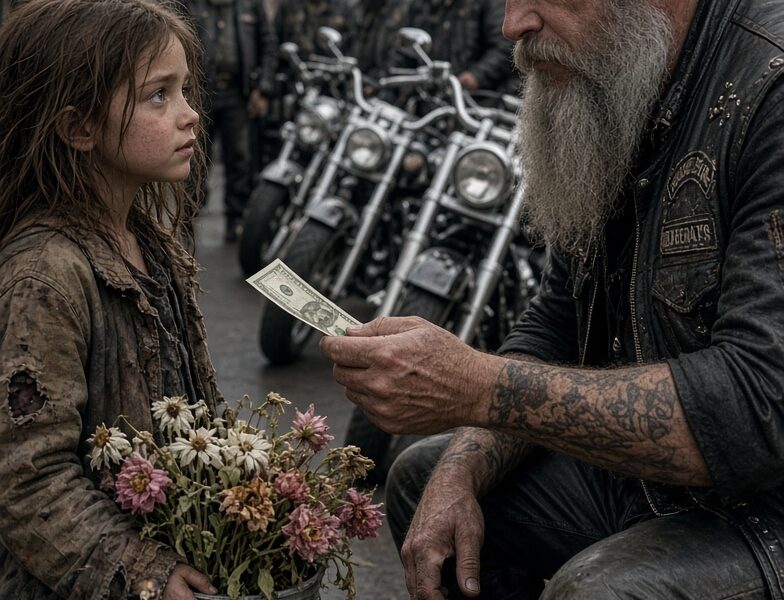
A 7-Year-Old Girl Sold Wilted Flowers for Her Dying Mother… Then 80 Hells Angels Stopped and Did the Unthinkable
The morning sun barely broke through the gray clouds hanging over Flagstaff when Ivy Caldwell stepped out of the run-down apartment on Butler Avenue.
Her small hands clutched a plastic bucket filled with wilted daisies and roses she’d salvaged from the dumpster behind Fletcher’s Flower Shop.
At seven years old, she looked even smaller than she was, her frame thin from months of skipped meals, her brown hair tangled and unwashed.
But her green eyes held something that poverty couldn’t erase.
Determination.
She walked the three blocks to the intersection of Route 66 and Milton Road, where morning traffic crawled through town.
The April air still carried winter’s bite, and Ivy’s threadbare jacket did little against the cold.
She’d been working this corner for two weeks now, ever since her mother’s medication ran out and the pharmacy refused to extend any more credit.
Patricia Caldwell lay in their apartment, her body ravaged by stage 4 pancreatic cancer.
The diagnosis had come eight months ago, right after Ivy’s father walked out.
He’d taken everything—the car, their savings, even Patricia’s jewelry.
Left behind nothing but unpaid bills and a sick woman with a child to raise alone.
The state insurance had covered the initial treatments, but now they wanted prior authorizations, referrals, documentation that Patricia was too weak to obtain.
The pain medication alone cost two hundred forty dollars a week.
Patricia needed it to breathe without screaming.
Ivy had watched her mother deteriorate, watched her skin turn yellow, watched her lose fifty pounds, watched her curl into herself every night, whimpering.
That’s when Ivy started selling flowers.
“Flowers! Fresh flowers, only two dollars!”
Her small voice barely carried over the traffic noise.
She held up a daisy, its petals brown at the edges.
Most drivers looked straight ahead, avoiding eye contact.
Some sneered.
A woman in a Mercedes actually rolled down her window just to tell Ivy she was ruining the neighborhood aesthetic before speeding off.
By noon, Ivy had sold four flowers.
Eight dollars.
She needed thirty more for today’s medication dose.
She didn’t notice the motorcycles at first.
The rumble of engines was constant in Flagstaff, especially on Route 66.
But these engines were different.
Deeper.
More powerful.
A formation of bikes rolled down Milton Road, chrome gleaming even under the cloudy sky.
Hells Angels patches were visible on every leather vest.
Death heads.
MC rockers.
Arizona bottom rockers.
Eighty bikes in total, moving like a single organism.
The formation stopped at the red light directly in front of Ivy.
She froze, her bucket of flowers trembling in her grip.
Every adult in her life had taught her the same lesson.
Stay away from bikers.
They were dangerous criminals, drug dealers, violent men who hurt people for fun.
The lead bike’s rider turned his head.
Frank Garrison, though Ivy didn’t know his name yet.
Fifty-two years old, president of the Flagstaff chapter.
His face was weathered leather, his beard gray and long, his arms covered in tattoos that told stories of violence and loss.
He looked at Ivy, then at her bucket of dying flowers, then at her shoes—two sizes too small, held together with duct tape.
Frank raised his fist.
The entire formation killed their engines simultaneously.
Ivy’s heart hammered.
She took a step back, ready to run.
Frank swung his leg over his bike and walked toward her.
He was massive—six foot four, two hundred fifty pounds of muscle and scar tissue.
His boots were steel-toed, his hands like sledgehammers.
Every pedestrian on the corner scattered.
Ivy couldn’t move.
Couldn’t breathe.
Frank stopped three feet away and crouched down, bringing himself to her eye level.
His voice when he spoke wasn’t what she expected.
“What’s your name, kid?”
“Ivy.”
“Ivy. That’s pretty.”
He gestured to her bucket.
“You selling these flowers?”
She nodded, unable to speak.
“How much?”
“Two dollars.”
Frank pulled out his wallet—leather, worn.
He extracted a twenty-dollar bill and held it out.
“I’ll take all of them.”
Ivy stared at the money.
Twenty dollars.
That was more than she’d made all week.
“Go on,” Frank said gently. “Take it.”
Her small hand reached out, trembling, and took the bill.
She thrust the entire bucket toward him.
Frank took one daisy, leaving the rest.
“You keep those. Sell them again.”
“But you paid for all of them.”
“Consider it an investment.”
Frank stood up, still holding the single wilted daisy.
He turned to the eighty men behind him, all watching the exchange.
“Boys.”
What happened next would become legend in Flagstaff, though the telling would vary wildly depending on who told it.
Eighty Hells Angels—men who had collectively served over three hundred years in prison, who had been in more fights than they could count, whose society had written off as thugs and criminals.
These men walked forward one by one to a seven-year-old girl with a bucket of dying flowers.
Each one bought a flower.
Five dollars.
Ten.
Twenty.
One man, a giant called Victor Brennan with a scar across his throat, gave her fifty and told her to keep the change.
Another, Ray Hutchkins, pressed two twenties into her hand and said, “For your mama.”
By the time the last biker bought his flower, Ivy was holding over eight hundred dollars in crumpled bills.
She looked down at the money, then up at Frank, tears streaming down her face.
“Why?” she whispered.
Frank crouched again.
“Because you’re out here trying, kid. That means something.”
He paused.
“What’s the money for?”
“My mom. She’s sick. She needs medicine.”
“Where’s your daddy?”
“Gone.”
Something dark passed through Frank’s eyes.
“What kind of sick?”
“Cancer. The bad kind.”
Frank was quiet for a long moment.
Then he pulled out a card—business card, ironically.
Something the club used for their legitimate ventures.
“You need anything else, you call that number. Understand?”
Ivy nodded, clutching the money and the card.
Frank stood, gestured to his men.
Eighty engines roared to life simultaneously.
The formation pulled away, leaving Ivy standing alone on the corner with more money than she’d ever held in her life.
She ran.
Ran all three blocks back to Butler Avenue, up the stairs, through the door.
Patricia was on the couch, barely conscious, her face gray with pain.
“Mama!”
Ivy dumped the money on the coffee table.
“Mama, look! I can get your medicine!”
Patricia’s eyes opened.
She saw the money.
Saw her daughter’s tears.
And something broke inside her.
“Baby, where did you get this?”
“I sold flowers, Mama. I sold so many flowers.”
Patricia pulled Ivy into her arms, too weak to ask more questions, too relieved to care.
For the first time in weeks, she would sleep without screaming.
But neither of them knew that the eighty men on motorcycles were already making phone calls, asking questions, piecing together a story that would change everything.
—
The pharmacy on Switzer Canyon Drive had been owned by the Hoffman family for thirty years.
Gerald Hoffman stood behind the counter, a thin man with wire-rimmed glasses and a permanent expression of disapproval.
He watched Ivy count out bills with increasing suspicion.
“That’s two hundred forty dollars,” Ivy said, pushing the money forward. “For my mom’s medicine. Patricia Caldwell.”
Gerald didn’t touch the money.
“Where’d you get this?”
“I sold flowers.”
“You expect me to believe a child sold enough flowers to make two hundred forty dollars?”
“I did. I sold them.”
Gerald crossed his arms.
“This money is stolen. I’m not selling you anything until you tell me where you really got it.”
Ivy’s eyes widened.
“It’s not stolen. I worked for it.”
“A likely story. Get out of my pharmacy before I call the police.”
“But my mom needs—”
“Out. Now.”
Ivy grabbed the money and ran out, tears blurring her vision.
She sat on the curb outside, sobbing into her hands.
She’d done everything right.
She’d earned the money.
But it didn’t matter.
Adults never believed her.
Never helped her.
The rumble of motorcycles made her look up.
Frank Garrison pulled his bike to the curb, followed by five others.
Ray Hutchkins, Victor Brennan, and three prospects—younger members earning their patches.
Frank killed his engine and approached Ivy, his expression darkening when he saw her tears.
“What happened?”
“He won’t sell it to me,” Ivy choked out. “He said I stole the money, but I didn’t. You gave it to me. All of you did.”
Frank’s jaw tightened.
He looked at the pharmacy, then back at Ivy.
“Wait here.”
He walked into Hoffman’s Pharmacy with Ray and Victor flanking him.
The bell above the door chimed cheerfully, incongruous with the tension that immediately filled the space.
Gerald Hoffman’s face went pale.
Three Hells Angels had just entered his pharmacy, and every customer instinct in him screamed danger.
He reached for the phone.
“I wouldn’t,” Frank said calmly, approaching the counter. “We’re just here to pick up a prescription. Patricia Caldwell.”
“I already told that girl—”
“That girl has a name. Ivy. And she has two hundred forty dollars in cash that she earned. Legal money. So fill the prescription.”
“I don’t have to serve anyone I don’t want to serve,” Gerald said, trying to sound authoritative. “This is private property.”
Frank leaned forward, his massive frame looming over the counter.
His voice dropped to something quiet and far more dangerous than shouting.
“Let me tell you what I see, Gerald. I see a man who looks at a seven-year-old kid with money and assumes crime. I see a man who’s so worried about his own prejudices that he’d rather let a woman die in pain than admit he might be wrong. Now, you’re going to fill that prescription, or I’m going to stand right here—completely legally—until you do. And my brothers outside? They’ll wait, too. All eighty of them. Right in your parking lot. How’s that going to be for business?”
Gerald’s hand shook on the phone.
“You’re threatening me.”
“I’m stating facts. Fill the prescription.”
A long silence stretched between them.
Finally, Gerald’s fingers moved to his computer keyboard.
“Fine. But only because I don’t want trouble.”
“Smart man.”
Ten minutes later, Frank walked out with a white paper bag and handed it to Ivy.
“This is a week’s worth. Your mama takes one every six hours. Understand?”
Ivy nodded, clutching the bag like it was made of gold.
“Now,” Frank crouched down again. “I need you to be straight with me. How bad is it at home?”
“What do you mean?”
“Food. Heat. Running water.”
Ivy looked down.
“We have water and heat when we can pay for it. Food is sometimes.”
Frank exchanged looks with Ray and Victor.
The three men had seen enough poverty in their lifetimes to recognize its signs.
Ivy’s clothes were filthy, her hair unwashed for weeks, her body malnourished.
This wasn’t just about medicine.
“Where do you live?” Frank asked.
“Butler Avenue. Building twelve. Apartment three.”
“Okay, here’s what’s going to happen. You go home, give your mama her medicine. Ray here is going to follow you. Make sure you get there safe. Then we’re going to have a church meeting.”
“A church meeting?” Ivy asked, confused.
“That’s what we call it when the club needs to make decisions. And we got a decision to make about you and your mama.”
Ivy wanted to ask what kind of decision, but something in Frank’s expression told her not to.
She just nodded and started walking home, Ray Hutchkins following at a respectful distance on his bike.
Frank watched her go, then turned to Victor.
“Call everyone. Full church. One hour. And somebody find out where that piece of trash father went.”
—
The Hells Angels clubhouse sat on the outskirts of Flagstaff, a converted warehouse with reinforced doors and no windows on the ground floor.
Inside, it looked like any other club—pool tables, a bar, motorcycle parts scattered on workbenches, walls covered in photographs and patches from chapters across the country.
But it was the upstairs room—the chapel—where real business happened.
Eighty men crowded into the space, sitting on folding chairs and benches.
Frank stood at the head of the room, Ray and Victor on either side.
The club’s sergeant-at-arms banged his gavel, calling the meeting to order.
“Most of you met a little girl today,” Frank began. “Seven years old, selling flowers to buy her dying mother’s medicine. Her father abandoned them. The state won’t help them fast enough. And that pharmacist treated her like a criminal just for having cash in her hand.”
He paused, letting that sink in.
“Now I know what people think about us. We know what we are. We’ve done time. We’ve fought wars. We’ve lived hard. Society looks at us and sees monsters.”
Murmurs of agreement rippled through the room.
“But that little girl didn’t see monsters today. She saw men who gave a damn when nobody else would. And I’m standing here to ask this club—what are we going to do about it?”
A hand raised.
Connor Blake, one of the younger members, barely thirty.
“We help her. That’s what we do.”
“How?” Frank asked. “We can throw money at it, sure. But money runs out. The mother’s got stage four cancer. Even with treatment, she’s got maybe six months. What happens to Ivy when Patricia dies?”
The room went quiet.
These were men who understood harsh realities.
Ray spoke up.
“The father needs to be found. He’s got legal responsibility.”
“Already on it,” Victor said. “Got a brother in Phoenix who knows a guy. We’ll have a location by tomorrow.”
“And if he won’t come back?” someone asked.
“Then we make him,” Victor said flatly.
Frank held up a hand.
“Easy. We do this right. Legal. The last thing Ivy needs is her mother’s would-be protectors getting arrested.”
He looked around the room.
“Here’s my proposal. We set up a fund. Every chapter in Arizona contributes. We cover Patricia’s medical bills, their rent, food, utilities—everything until she passes. We also make sure Ivy’s got what she needs. Clothes, school supplies, whatever. And after?”
“After we find family,” Connor said. “Grandparents, aunts, uncles. Someone.”
“If there’s nobody, we work with social services to find her a good placement. But we stay involved. We make sure she’s safe.”
Another hand—Aaron Walsh, a veteran who’d been with the club for twenty years.
“Why? Why this kid?”
Frank smiled grimly.
“Because everybody else walked past her. Because society would rather clutch their pearls about scary bikers than help a dying woman and her daughter. Because we can. That enough reason for you?”
Aaron nodded slowly.
“Yeah. That’s enough.”
“All in favor?” Frank asked.
Eighty hands went up.
Not a single dissent.
“Then it’s decided. Ray, you’re point on logistics. Victor, you handle the father situation. Connor, you coordinate with the other chapters for fund contributions. And someone needs to make contact with Patricia. Let her know what’s happening. Volunteers.”
Several hands raised.
Frank picked two older members—men with grown daughters of their own who would understand how to approach a dying mother without frightening her.
The meeting adjourned.
As men filed out, Ray pulled Frank aside.
“You know this is going to bring attention,” Ray said quietly. “The kind we usually avoid.”
“I know.”
“Media’s going to eat it up. Hells Angels helping a little girl. They’ll make us out to be either heroes or manipulators using a kid for good PR.”
“Let them,” Frank said. “I’m not doing this for PR. I’m doing it because it’s right.”
“Since when do we care about right?”
Frank looked at his oldest friend, his vice president, the man he’d bled beside in more fights than either could count.
“Since always, Ray. We just never advertised it.”
—
Patricia Caldwell had fallen asleep for the first time in three days, the pain medication finally working through her system.
She woke to knocking on her apartment door.
Gentle, respectful knocking—not the pounding of bill collectors or angry landlords.
Ivy opened the door carefully, keeping the chain lock engaged.
Two men stood in the hallway, both in leather vests with Hells Angels patches, but they held their hands visible and non-threatening, and one was holding a stuffed animal.
“Mrs. Caldwell,” the older one said. “My name’s Aaron Walsh. This is Connor Blake. We’re friends of your daughter’s. May we come in?”
Patricia struggled to sit up.
Every instinct screamed danger, but Ivy was smiling at these men, and Ivy didn’t smile at strangers.
“Yes. Come in.”
Aaron and Connor entered the small apartment and immediately assessed the situation with experienced eyes.
The place was clean—Patricia had clearly tried to maintain standards—but desperately poor.
Furniture from thrift stores, cracks in the walls, a space heater that looked like a fire hazard, a shrine of pill bottles on the coffee table next to medical bills stacked six inches high.
Connor handed the stuffed animal—a teddy bear—to Ivy.
She took it with wonder, hugging it immediately.
Aaron sat in the chair across from Patricia, keeping distance.
“Mrs. Caldwell, earlier today about eighty of us met your daughter at a traffic light. She was selling flowers to buy your medicine.”
Patricia’s eyes filled with tears.
“She’s not supposed to be doing that. She’s supposed to be in school, being a child, not—”
Her voice broke.
“You’re right,” Aaron said gently. “She shouldn’t have to. And that’s why we’re here. Our club wants to help.”
“I don’t understand.”
Connor spoke up.
“We took a vote. We’re going to cover your medical expenses, your rent, your utilities, and food. Everything you need for as long as you need it.”
Patricia stared at them.
“Why would you do that? You don’t know us.”
“Because Ivy shouldn’t be on street corners selling flowers,” Aaron said. “Because you’re sick and you need help. Because everyone else walked past and we’re not everyone else.”
“But you’re—” Patricia stopped herself, but the implication hung in the air.
“Hells Angels?” Aaron finished. “Yeah, we know what people think. That’s okay. We’re not asking you to trust us completely. We’re asking you to let us help your daughter.”
Patricia looked at Ivy, who was clutching the teddy bear and smiling wider than she had in months.
She looked at the two men, trying to find the threat she’d been taught to see, but all she saw was sincerity.
“What do you want in return?” she asked carefully.
“Nothing,” Connor said. “Except maybe to change your mind about us.”
“I don’t—I don’t know what to say.”
“Say yes,” Aaron said. “Let us help. Please.”
Patricia wept.
Great heaving sobs that shook her frail body.
Ivy rushed to her side and Patricia held her daughter close.
Through her tears, she managed to whisper, “Yes. Yes. Thank you.”
Aaron and Connor exchanged glances.
This was going to work.
Over the next hour, they gathered information.
Medical needs. Dietary restrictions. Ivy’s school situation—she’d been missing weeks of classes.
Connor took notes on his phone while Aaron asked questions with the patience of a father.
Before they left, Aaron handed Patricia a phone number.
“That’s Frank Garrison, our president. You need anything—day or night—you call. Someone will answer.”
After they left, Patricia held Ivy close, both of them sitting in stunned silence.
“Mama,” Ivy said quietly. “Are they good guys?”
Patricia thought about the question.
Thought about the men who’d walked into her apartment with respect and compassion.
Thought about the club that voted unanimously to help strangers.
Thought about how the world had taught her to fear these men while the respectable people had turned away.
“Yeah, baby,” she said finally. “I think maybe they are.”
—
Gerald Hoffman closed his pharmacy at six p.m. as he had every weekday for thirty years.
He walked to his car in the parking lot, keys in hand, already thinking about dinner.
He didn’t notice the motorcycles until engines roared to life around him.
Eighty bikes forming a circle in the parking lot.
Frank Garrison sat directly in front of Hoffman’s car, blocking his exit.
Gerald’s hands shook.
“What do you want?”
Frank didn’t get off his bike.
He just looked at the pharmacist with an expression that could have been carved from stone.
“I want you to remember something. That little girl you treated like a criminal today? She’s under our protection now. Her mother, too. So you’re going to fill every prescription they bring you. No questions asked. No attitude. You’re going to treat them with the respect you’d give any customer. Understood?”
“You can’t intimidate me,” Gerald said, though his voice betrayed him.
“I’m not intimidating you. I’m educating you. See, people like you, Gerald—you look at people like us and see criminals. You look at people like Ivy and see problems. But we see something you don’t. We see people who need help. And we’re done asking for permission to give it.”
Frank started his engine.
The circle of bikes opened, creating a path for Gerald’s car.
“Drive safe, Gerald,” Frank said. “And remember what I said.”
As Gerald drove away, hands white-knuckled on the steering wheel, Frank watched him go.
Ray pulled up beside him.
“Think he got the message?”
“Oh, he got it,” Frank said. “Question is whether he’ll follow it.”
“And if he doesn’t?”
Frank smiled, but there was no humor in it.
“Then we’ll have another conversation.”
—
Word spread through Flagstaff faster than wildfire.
The story changed with each telling, growing more dramatic, more unbelievable.
Some versions had the Hells Angels threatening the pharmacist.
Others had them giving Ivy thousands of dollars.
One particularly creative version involved Frank Garrison carrying Patricia Caldwell to the hospital himself.
The truth, as it often did, fell somewhere in between.
But the core remained the same.
A seven-year-old girl had touched the hearts of eighty men society had written off, and those men had responded with unexpected compassion.
The local news picked up the story three days later.
A young reporter named Amy Choi had heard the rumors and started investigating.
She showed up at the clubhouse with a camera crew requesting an interview.
Frank agreed on one condition—no filming Ivy or Patricia.
Their privacy was non-negotiable.
The interview took place in the clubhouse’s main room.
Frank sat on his bike, Ray and Victor standing behind him.
Amy held a microphone, her cameraman recording.
“Mr. Garrison, people are calling what you did for Ivy Caldwell extraordinary. How do you respond?”
“I respond by saying it shouldn’t be extraordinary,” Frank said bluntly. “A kid was in trouble. We helped. That should be normal.”
“But you’re Hells Angels. You have to admit your organization has a certain reputation.”
“We do. And I won’t lie about our history. We’re not angels, despite the name. We’ve lived hard, fought hard, and some of us have paid for it with prison time. But that doesn’t mean we don’t care. Doesn’t mean we can’t see when someone needs help.”
“Some people are skeptical. They think this is a publicity stunt.”
Frank’s expression hardened.
“Let them think what they want. I’m not interested in changing minds. I’m interested in making sure a little girl doesn’t have to sell flowers on street corners while her mother dies in pain. If people want to doubt our motives, that’s their problem, not ours.”
“What made you decide to help?”
Frank was quiet for a moment.
“You ever look at someone and see yourself? See your own kid or your sister or someone you love? That’s what I saw when I looked at Ivy. Not a story. Not a charity case. Just a kid trying her best in a situation no kid should be in. And I thought—if we don’t help her, who will?”
The interview aired that night.
The response was immediate and divided.
Half the comments praised the club’s actions, calling them heroes.
The other half insisted it was a manipulation, a calculated move to improve their public image.
Frank didn’t watch the news.
He was too busy organizing the next week’s schedule.
Food deliveries for Patricia and Ivy.
A visit from Dr. George Quinn, a physician who’d agreed to provide in-home care.
Coordination with Ivy’s school to get her back in classes without stigma or questions.
But there was one more piece of business to handle—one that Frank had been putting off because he knew it would get ugly.
Victor walked into the clubhouse office holding a piece of paper.
“Found him.”
Frank looked up from his desk.
“The father?”
“Yeah. Name’s Robert Caldwell. Living in Phoenix, working construction, has a girlfriend, one-bedroom apartment. No sign he sent a single dollar to his daughter or ex-wife.”
“Let’s pay him a visit.”
“When?”
“Now.”
—
Robert Caldwell was sitting in his apartment watching television when the knock came.
He opened the door without checking the peephole, expecting his girlfriend back from work.
Instead, he found himself face to face with Frank Garrison and five other Hells Angels.
“Robert Caldwell?” Frank asked.
Robert tried to close the door.
Frank’s boot stopped it.
“We need to talk,” Frank said, stepping inside.
The other men followed, crowding the small apartment.
“Who the hell are you people?” Robert demanded, backing up.
“We’re friends of your daughter. Ivy. Remember her?”
Robert’s face went pale.
“What about her?”
“She’s been selling flowers on street corners to buy medicine for her dying ex-wife. Your ex-wife. Patricia. Who you left with nothing when you walked out.”
“That’s none of your business.”
Frank moved faster than a man his size should have been able to.
He grabbed Robert by the shirt and lifted him against the wall.
“You made it my business when you abandoned a seven-year-old girl and her sick mother. Now here’s what’s going to happen. You’re going to give me your banking information. You’re going to set up an automatic transfer of three hundred dollars a month to Patricia’s account. Child support, Robert. That thing you’re legally required to pay but haven’t.”
“I don’t have three hundred a month.”
“Then get a second job. Sell your TV. I don’t care. You have a daughter who’s suffering because you’re a coward. That ends today.”
“And if I refuse?”
Frank leaned in close.
“Then we come back. And next time we won’t be this friendly.”
Robert looked at the five other men in his apartment, all watching with expressions that promised violence if necessary.
He swallowed hard.
“Okay. Okay. I’ll do it.”
“Smart choice.”
Frank released him.
“Victor here is going to wait while you make that bank transfer. You try anything cute, things get complicated.”
Twenty minutes later, Victor confirmed the automatic payment was set up.
Frank and his men left, leaving Robert trembling in his apartment, his girlfriend’s questions about what happened going unanswered.
On the drive back to Flagstaff, Ray spoke up.
“He’s going to try to stop that payment.”
“I know,” Frank said. “That’s why Victor’s brother in Phoenix is going to check in on him weekly. And if the payments stop, we’ll have another conversation.”
“You really think we can keep this up? Monitoring this guy, covering expenses for Patricia and Ivy?”
“For as long as it takes,” Frank said firmly. “We made a commitment. We don’t walk away from commitments.”
—
Spring turned to summer in Flagstaff.
Patricia’s condition deteriorated despite the best medical care the club could provide.
Dr. Quinn visited three times a week, managing her pain and adjusting medications.
Patricia knew she was dying, but the knowledge came with strange peace.
Her daughter was fed, clothed, safe.
The medical bills were paid.
She could die without leaving Ivy destitute.
Ivy flourished.
The club had become her extended family.
Connor taught her how to play guitar.
Aaron showed her pictures of his own daughters, now grown with children of their own.
Victor—the scarred sergeant-at-arms who’d intimidated criminals and rival clubs—spent afternoons reading to her from books he bought specifically for that purpose.
And Frank?
Frank became the father Robert had never been.
He attended parent-teacher conferences at Ivy’s school, intimidating the administrators but charming her teachers.
He fixed their apartment’s broken heater, repaired the leaking sink, replaced the fire hazard space heater with a safe unit.
He sat with Patricia on her bad days when the pain was so intense she couldn’t stand visitors, and he listened to her fears about leaving her daughter alone.
“She won’t be alone,” Frank promised one afternoon in July, sitting beside Patricia’s bed. “We’ll make sure of that.”
“You can’t adopt her,” Patricia said weakly. “The state won’t allow it.”
“No. But we can make sure whoever does is worthy of her. We’ll be watching. Always.”
Patricia reached out a skeletal hand.
Frank took it gently.
“Why?” she whispered. “Why did you do all this?”
Frank thought about his answer carefully.
“Because I have a daughter too. Had. She died twenty years ago. Car accident. Drunk driver hit her and her mother. I was inside doing a seven-year bid. Couldn’t even attend the funeral. By the time I got out, there was nothing left but a grave to visit.”
He paused, his voice rough.
“I couldn’t save my girl. But I could save yours.”
Patricia wept, and Frank sat with her until she fell asleep.
—
The end came in August.
Patricia passed peacefully in her sleep.
The pain finally gone.
Ivy was staying at Aaron’s house that night—the club had arranged rotating sleepovers to give Patricia rest.
Aaron received the call from Dr. Quinn at three a.m. and immediately woke Ivy gently, sitting her down to explain.
“Your mama loved you very much,” Aaron said, holding the crying girl. “She fought so hard to stay with you. But sometimes, even when we fight our hardest, the battle’s just too much.”
Ivy sobbed into his chest.
“I want my mama.”
“I know, sweetheart. I know.”
The funeral was two days later.
The club arranged everything.
Casket. Burial plot. Flowers that weren’t wilted or salvaged, but fresh and beautiful.
Eighty Hells Angels attended, standing in formation around the graveside.
They wore their colors proudly, despite knowing how it would look, despite the stares from other mourners.
Karen Foster, the neighbor who’d occasionally checked on Patricia and Ivy, approached Frank after the service.
She’d been crying, clutching a tissue.
“I need to apologize to you,” she said.
Frank looked at her, surprised.
“For what?”
“For assuming the worst about you and your club. When I saw you coming and going from Patricia’s apartment, I thought—well, I thought terrible things. I even called the police once, reporting suspicious activity.”
“What changed your mind?”
Karen gestured to the grave, to Ivy being held by Connor as she cried.
“Everything. You did more for that woman and her child than anyone else did. More than I did, and I live next door. I’m ashamed of myself.”
“Don’t be,” Frank said. “You’re not the first person to judge us, and you won’t be the last. But maybe you’ll think twice before assuming next time.”
Karen nodded.
“I will. I promise.”
—
The custody battle for Ivy lasted three months.
Patricia had no living relatives willing to take her.
Robert wanted nothing to do with her despite his legal obligations.
The state wanted to place her in foster care, but the club fought it.
They hired lawyers.
They provided character witnesses.
They presented financial statements showing they could support her education, health care, everything she needed.
And they presented something else.
Testimony from Ivy herself.
The judge—a stern woman named Margaret Alvarez—met with Ivy privately in her chambers.
No lawyers. No bikers. Just the two of them.
“Ivy,” Judge Alvarez said gently. “I need to ask you some questions. You can be completely honest with me. Do you feel safe with the Hells Angels?”
“Yes.”
“Has anyone in the club ever hurt you or scared you?”
“No. They’re nice to me.”
“Your father wants custody. Would you like to live with him?”
Ivy’s expression turned cold—a look far too adult for a seven-year-old.
“He left us. He didn’t care if Mama died or if I starved. I don’t want to live with him.”
“What about foster care? A nice family who could adopt you.”
“I want to stay with Frank and the others. They’re my family now.”
Judge Alvarez studied the small girl in front of her.
She’d read the case files, seen the evidence, listened to testimony.
She knew the law. Knew what she should decide.
But she also knew something the law sometimes forgot.
That family wasn’t always blood.
“Okay, Ivy. Thank you for being honest.”
The hearing reconvened the next day.
Judge Alvarez looked out at the courtroom—at Robert Caldwell and his lawyer, at the state representative, at Frank Garrison and his club members filling the benches.
“I’ve made my decision,” she said. “Custody of Ivy Caldwell will be awarded to her biological father, Robert Caldwell.”
A collective gasp went through the room.
Frank’s jaw tightened.
Ivy began to cry.
“However,” Judge Alvarez continued, “given Mr. Caldwell’s history of abandonment and failure to provide support, custody is contingent on several conditions. First, Mr. Caldwell must demonstrate stable housing and employment for six months before Ivy is placed with him. Second, he must complete parenting classes and counseling. Third, during this six-month period, Ivy will be placed in foster care with a family approved by both the state and—” she looked directly at Frank “—the Hells Angels Motorcycle Club, specifically Mr. Frank Garrison, who will act as a guardian ad litem to ensure Ivy’s well-being. Mr. Garrison will have visitation rights and the authority to report any concerns about Mr. Caldwell’s fitness as a parent.”
Robert jumped to his feet.
“You can’t be serious!”
“I’m absolutely serious, Mr. Caldwell. You abandoned your daughter. You forfeited your right to immediate custody. If you want her back, you’ll prove you deserve her. This court is adjourned.”
Outside the courthouse, Frank explained the decision to Ivy as simply as he could.
“It means you’re going to live with a nice family for a while. But I get to visit you, make sure you’re okay. And if your father doesn’t get his act together, we’ll be back in court.”
“What if I don’t want to live with him, even if he does everything right?” Ivy asked.
“Then when you’re old enough, you can decide for yourself.”
Ivy hugged Frank tightly.
“I love you.”
Frank—this massive, scarred man who’d been in countless fights and shown mercy to no enemy—felt his eyes burn with tears.
“I love you too, kid.”
—
The foster family was named the Weatherbees.
Paul and Hannah. In their forties. No children of their own, but years of fostering experience.
Frank vetted them personally before agreeing to the placement.
They lived in a comfortable house on the north side of Flagstaff, had stable jobs, and—most importantly—they understood the unusual circumstances.
“The Hells Angels will be part of her life,” Frank told them flatly. “We’ll respect your household, but we won’t disappear.”
“We wouldn’t want you to,” Hannah said. “Ivy needs consistency. People she trusts. You’re those people.”
The arrangement worked surprisingly well.
Ivy adjusted to living with the Weatherbees, but Frank visited twice a week without fail.
The club organized events—a birthday party at the clubhouse when Ivy turned eight, a Christmas celebration with more presents than any child needed, a summer camping trip that involved forty bikers teaching one girl how to fish and start a campfire.
Robert Caldwell did try, to his credit.
He completed parenting classes, got a better job, moved to a two-bedroom apartment.
But six months in, when it was time for supervised visitation, Ivy refused to see him.
“I don’t want to,” she told the social worker. “He’s not my dad. Frank is.”
The social worker tried to explain that Robert was her biological father, that he’d worked hard to change, but Ivy was unmoved.
“He left when Mama needed him. Frank stayed.”
Robert gave up after three more failed attempts at reconciliation.
He signed away his parental rights, and custody transferred permanently to the Weatherbees with the understanding that the Hells Angels remained involved.
—
Ivy Caldwell grew up surrounded by leather and chrome, by men society feared, but who had shown her nothing but love.
She graduated high school with honors, attended community college, and became a social worker specializing in child welfare.
Her office displayed two photographs—one of her mother, Patricia, and one of Frank Garrison on his motorcycle.
Frank retired from club presidency at sixty-five but remained active in the Flagstaff chapter.
He attended Ivy’s college graduation, her wedding at twenty-six to a good man who understood her unusual family, and held her first child when she became a mother herself.
The child—a boy—was named Franklin.
On Franklin’s first birthday, the Hells Angels threw a party at the clubhouse.
Eighty men, many now gray-haired and slowed by age, celebrated with cake and presents.
Ivy stood in the center of it all, holding her son, watching these men who’d saved her life without knowing they were doing it.
Frank approached, walking with a cane now but still imposing.
“He’s beautiful, kid.”
“He is,” Ivy agreed. “And he’s going to know the truth about his grandfather.”
“What truth is that?”
“That you’re not monsters. That you’re men who saw someone in need and helped when everyone else looked away. That you’re the reason I’m standing here today—alive and whole and happy.”
Frank smiled—that rare expression that transformed his weathered face.
“You give us too much credit.”
“I don’t give you enough.”
Ivy kissed his cheek.
“Thank you for everything. For my mother’s peace. For my childhood. For teaching me that family is who shows up, not who shares your blood.”
Around them, the party continued.
Music played. Children laughed.
And eighty men whose society had written off as criminals celebrated life with the girl they’d once rescued from a traffic corner.
—
The story of the little girl who sold flowers and the Hells Angels who found her had become local legend in Flagstaff.
Some versions were embellished. Some were skeptical.
But all agreed on one thing.
Something extraordinary had happened on that corner sixteen years ago.
But Frank knew the truth.
It wasn’t extraordinary.
It was just what men do when they see someone who needs help and decide to give a damn.
The tragedy was that it was rare enough to be called extraordinary at all.
—
Years later, a reporter would ask Frank about that day—about why he stopped for Ivy when thousands of others hadn’t.
His answer would be printed in magazines, shared online, and quoted in discussions about prejudice and judgment.
“People see the leather, the patches, the motorcycles,” Frank said. “They see the arrest records, the scars, the reputation, and they think they know who we are. But they don’t see the guy who holds his brother when his kid dies. They don’t see the man who works three jobs to pay child support. They don’t see the grandfather teaching his grandson to ride a bike. They only see what they’re afraid of. And fear makes you blind.”
“So what should people see?” the reporter asked.
Frank smiled.
“They should see what Ivy saw. Not monsters or angels. Just people. Complicated, flawed people who are capable of both good and bad. That’s all any of us are.”
The interview ended, and Frank rode home on his motorcycle, the Arizona sun setting behind him.
He thought about Patricia—about her gratitude and her fear, about how she changed her mind once she looked past the leather.
He thought about Ivy—thriving and happy, raising a child who would grow up knowing that prejudice is taught, not inherent.
And he thought about the eighty men who’d stood with him that day, who’d opened their wallets and their hearts for a seven-year-old stranger.
Society called them outlaws, criminals, dangers to be avoided.
But a little girl with a bucket of flowers knew better.
And in the end, that was the only judgment that mattered.









