
A 6-Year-Old Climbed Onto the Forbidden Sofa — And the Most Feared Man in New York Let Her Stay
Six years, 2,190 nights, and in all that time, one man had never once been touched by another human being on his left side.
The golden sofa in the great salon of the Moretti mansion could seat four, and everyone in New York who mattered knew that, and everyone in New York who mattered knew something else.
The cushion beside Dante Moretti was not a seat.
It was a line.
Cross it, and you did not get a second warning.
A city councilman had crossed it once, drunk, laughing, a hand on the armrest, and he still lived in New York, he simply never again stood in a room where Dante was sitting.
So when a six-year-old girl in a cream lace dress walked through the crowd, passed six armed men, and climbed onto that cushion as if it were a playground swing, the most dangerous room in the city did something it had not done in six years.
It went completely silent.
There was one place in the Moretti mansion that no one entered unless invited, and it was not the study on the second floor where men twice Dante’s age had walked in confident and walked out quiet.
It was not the wine cellar behind the steel door, and it was not the east wing where the ledgers were kept.
It was a golden sofa in the great salon, cream silk, gilded arms, burgundy cushions worn soft at one end for six years.
Dante Moretti had sat at that end alone.
At every dinner, every meeting, every private gathering, the space beside him stayed empty.
Senators stood rather than take it, rival capos negotiated from across the room with their drinks untouched, and even tonight at the Moretti Foundation gala, when the salon was so crowded that women in diamonds leaned against the marble columns, a clear circle of floor surrounded that sofa like a chalk outline.
People said he considered the seat sacred.
People said he would break the hand of anyone who touched it.
People said many things in New York because the truth was heavier.
Six years earlier, on the night his wife was due to give birth, Isabella Moretti had been taken from him.
He had promised to protect her, and someone inside his own circle had made sure he could not.
He kept the cushion empty because it was the only part of his family he still knew how to guard.
Dante sat at his usual end, one arm stretched along the gilded backrest, one ankle over his knee.
At thirty-six, he was the kind of man rooms rearranged themselves around, and his pale blue three-piece suit was immaculate, his burgundy tie perfectly knotted.
The ink along his knuckles and wrists was the only thing he had never bothered to hide, his dark curls were still damp from the rain outside, and his eyes missed nothing.
Guests laughed too loudly near him, no one disagreed with him, and no one stayed long.
Victor Hayes, his head of security, stood by the east doors with the stillness of a man who counted exits for a living.
Marcus Reed worked the crowd’s edge, scanning hands rather than faces.
And at Dante’s shoulder, as always, stood Adrian Cole, adviser, strategist, friend since boyhood, murmuring about a shipping contract as though nothing in the room could ever go wrong.
“The Calabrians want an answer by Monday,” Adrian said.
“They can wait.”
Dante’s eyes had drifted to the empty cushion again, because they did that, they always did.
And for a fraction of a second, the great salon disappeared, and he saw Isabella curled into that corner with her feet tucked under her and her hand on her belly, laughing at something he had said.
Then he blinked, and it was only silk.
Across the mansion, Vivien Bennett had been on her feet since noon.
She was a private event coordinator, twenty-nine years old, and she hated mistakes.
Tonight there had been three: a late florist, a missing cake stand, and a babysitter who canceled an hour before doors opened.
So her daughter had come to work with her, parked in a corner with a coloring book and one rule.
Stay where I can see you.
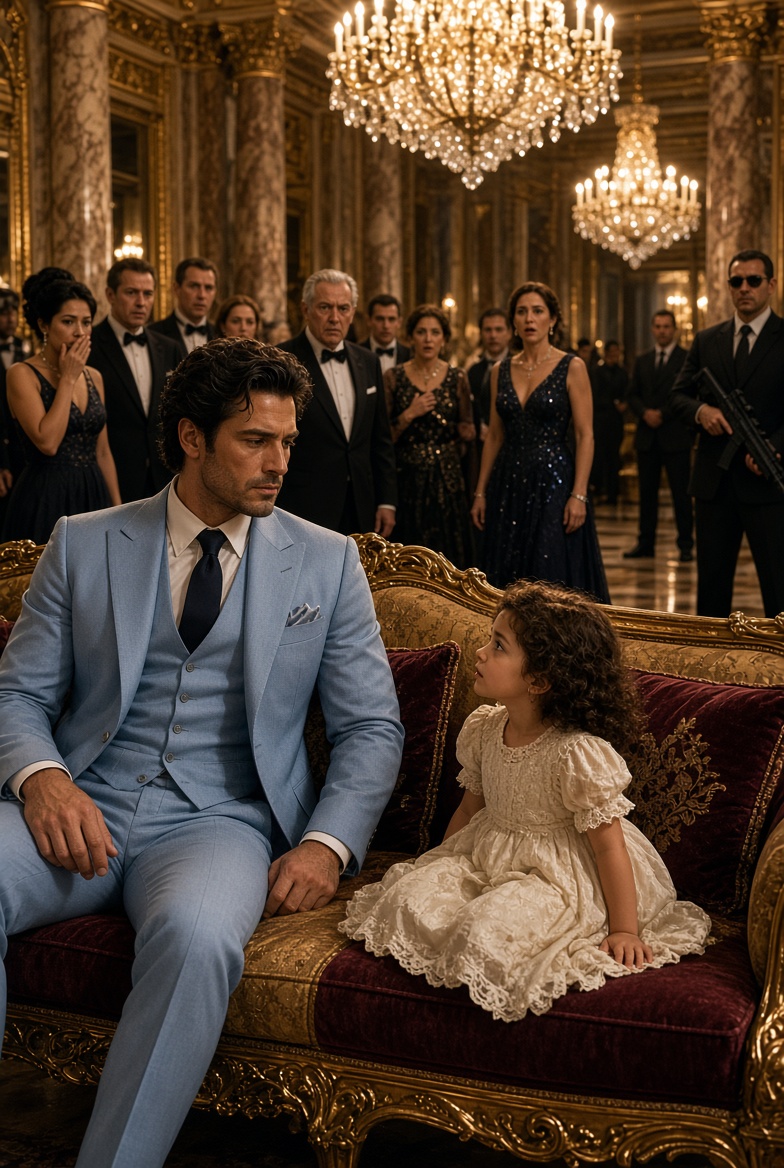
Isla Bennett was six, with brown curls pinned half up under an ivory bow that was already sliding loose, one white sock fallen to her ankle, and the unnerving habit of noticing everything.
She stayed in the corner for forty minutes.
That was a record.
Then she tugged her mother’s sleeve as Vivien passed with a clipboard.
“Mommy, there’s a seat.”
Vivien followed her pointing finger and her stomach dropped.
“No, there are four seats. They are not ours.”
“Is somebody coming?”
“No.”
Isla frowned.
“Then why can’t we sit?”
“Because that is Dante Moretti,” Vivien whispered. “Because people have lost everything for irritating him.”
“Stay close,” she said, and hurried toward the kitchen.
For almost ten minutes, Isla obeyed.
Then a waiter’s tray hit the marble by the entrance, crystal exploded across the floor, every head turned, and every guard moved toward the noise.
Vivien turned too, already apologizing to someone, and she took her eyes off her daughter for perhaps three seconds.
Three seconds was enough.
Isla slipped between two men in tuxedos, crossed the polished floor, and stopped in front of the golden sofa.
Marcus saw her first and started forward, Victor was already moving with his hand drifting toward his jacket, and neither reached her in time.
She climbed up, smoothed her skirt, and sat two feet from the most feared man in New York.
A glass paused halfway to someone’s lips, and the quiet spread outward in rings like a crack through ice.
Near the bar, Adrian Cole’s smile held for one second too long, then faded.
Dante turned his head slowly.
A small girl in a lace dress looked up at him with open, fearless curiosity.
“Good evening,” she said.
Victor’s fingers closed around the grip of his weapon, and Dante raised one hand without looking at him.
Victor stopped.
“You are in my seat,” Dante said, in the quiet voice that men in three boroughs had learned to fear.
Isla looked down at the cushion.
“Yes.”
It was not an apology.
She glanced at the empty space between them.
“There’s plenty of room.”
Somewhere behind them, a cough might have been a strangled laugh.
“Where is your mother?”
Isla pointed, and Vivien was already pushing through the crowd, pale, apologizing before she reached them.
“Mr. Moretti, I am so sorry. She doesn’t understand. Isla, come here now.”
Isla slid halfway off the cushion, then stopped, and she looked at the gold, at the guards, at the hundred frozen faces.
Then she looked back at him.
“Why me?” she asked. “Nobody else is sitting here. Why does everyone act like sitting beside you is forbidden?”
The salon stopped breathing.
“Isla,” Vivien whispered.
“Because they know better,” Dante said.
Isla considered this seriously.
“Mommy says sad people shouldn’t always have to sit alone.”
Vivien closed her eyes, because for one terrible second she thought her daughter had finally found the sentence that would get them both thrown out of the city.
Dante did not move.
He looked at the child, and then at the cushion, and for a moment he saw Isabella again, not the woman in the hospital memory he had replayed ten thousand times, but the one who had laughed on that sofa and believed he could still become a better man.
The remark unsettled him more than any threat ever had.
“Let her stay,” he said.
Victor stared. “Boss, the gala has been interrupted enough.”
Vivien stood rigid beside the sofa, desperate to snatch her daughter away, and Isla swung her feet, studied Dante’s suit, and tilted her head.
“You wear blue.”
“I wear what I choose.”
Isla hesitated, then leaned closer and lowered her voice to a whisper she believed was private.
And in the dead silence of the great salon, it carried to every corner of the room.
“My mommy said the man in the blue suit killed your wife.”
No one breathed.
“Are you going to kill him, too?”
For one heartbeat, every guest in that room looked at Dante in his pale blue suit and wondered whether a six-year-old had just accused the boss of murder.
But Dante was not thinking about himself.
He was thinking about a sealed evidence file, and he was thinking about the blue suit Isabella had been wearing the night she died, the one detail that had never reached a newspaper, a witness, a police statement, or a single member of his own organization.
Only a handful of people alive knew it.
None of them should have been a woman who arranged flowers for a living.
He looked at Vivien.
The color had drained from her face, and she was staring at Isla the way someone stares at a child who has just stepped off a ledge, because she knew exactly what her daughter had repeated and exactly who had never been meant to hear it.
Across the salon, Adrian Cole laughed lightly.
“Children repeat the strangest things.”
It came a moment too fast, and Dante noticed.
“Victor,” Dante said without raising his voice. “Seal the doors. No one leaves.”
A murmur broke across the room, and Victor was already speaking into his earpiece.
“Marcus, Mrs. Bennett and the girl, go to my study now.”
“Mr. Moretti.” Vivien’s voice shook, but she did not lower her eyes. “She is six years old. She hasn’t done anything wrong.”
“I am not interested in punishing a child.” He rose from the sofa for the first time that night. “I want to know how a woman I have never met knows what my wife wore the night she died.”
He glanced back at the cushion.
It looked smaller than it had for six years, an ordinary square of silk with a small, warm dent where a child had been sitting.
A stranger had crossed the line, and she was not afraid.
He turned to Vivien, and the question came out low and cold and dangerous.
“Who told your daughter about my wife’s final night?”
Vivien held his gaze, and her hands were trembling, but her voice was not.
“Your wife did.”
The study sat at the end of the second-floor corridor behind a door that weighed more than most men, and locked cabinets lined one wall.
A Caravaggio hung over the fireplace, and at the far end a black walnut desk held the phones, the ledgers, and the quiet machinery of a criminal empire.
No one had been questioned in that room without bleeding in at least a decade.
Tonight, the only person trembling was the woman in the plain black dress, and she was not bleeding.
Victor took the door, Marcus took the corridor, and Isla, who had walked in as if it were a library, climbed into a leather armchair, accepted a pencil and a sheet of the boss’s personal stationery from Marcus without a flicker of fear, and began to draw a horse.
Dante did not sit.
He stood at the window with his back to the room.
“You said my wife told your daughter. Isabella has been dead for six years.”
“I know.” Vivien kept her hands folded so he would not see them shake. “I was her nurse.”
Dante turned.
“I worked the emergency department at St. Brennan’s,” she said. “I was the one who cut off her coat the night Isabella Moretti was brought in.”
“She was dead on arrival.” His voice was flat. “I read the report. Paramedics pronounced her at the scene.”
“That is what the report says.” Vivien lifted her chin. “It is not what happened.”
Silence pressed on the room, and even Isla’s pencil paused.
“She came in at 11:40,” Vivien said. “She was alive. She was bleeding. She was terrified. And she had a grip on my wrist like iron. She kept saying one word.”
“What word?”
“Dante.”
He did not move, and something in his jaw did.
“She asked me to call you, over and over, as if it were a prayer. I was reaching for the desk phone when two administrators arrived with a man I had never seen. They moved her to the restricted wing, the one used for diplomats and donors, and told the staff the case was sealed. No calls, no notes, no questions.”
“Who was the man?”
“I never saw his face. He stood in the shadow at the end of the corridor.” Her voice dropped. “But I saw his suit. Pale blue. He wasn’t dressed for a hospital. Everyone around him moved when he moved, as if he had every right to be there.”
The words hit the room like a dropped glass.
“Hours later, the chart said she died before she ever reached us. I filed a complaint. I was ignored. Two days later, an envelope was in my locker. Inside was one sentence. Stop asking.”
Dante crossed the room in four strides and stopped in front of her.
“How much?”
Vivien blinked. “What?”
“How much do you want for this story? Money? Protection? Every woman who ever learned my name has come with an angle.”
She stood, and her knees nearly gave way, and she did it anyway.
“For six years I have been protecting that child,” she said, her voice barely above a whisper. “I changed hospitals. I changed apartments. I have never once said your name out loud. If I wanted money, Mr. Moretti, I would have come to you years ago.”
He stared at her.
It was the stubborn tilt of her chin that undid him, because Isabella had looked at him exactly like that the night he told her she would not be walking to the market without guards.
Victor spoke from the door.
“Boss, before you trust either of them, we verify.”
“Agreed.”
The door opened behind Victor, and Adrian Cole walked in without knocking, as he had for twenty years, his face creased with concern.
“The guests are secured. Dante, let me help. I have contacts at the state medical board, quiet ones. Give me forty-eight hours and I will have every record St. Brennan’s ever produced on this desk.”
It was a generous offer.
“Do it,” Dante said.
Then, without looking away from Adrian, “Victor, you run your own inquiry separately. Tell no one.”
Victor nodded once, and Adrian’s smile did not change.
It never did.
Victor returned at one in the morning carrying a sealed folder from Dante’s private archive, a vault that did not appear on any floor plan.
He laid three pages on the walnut desk.
Isabella’s detail was supposed to be six men, and at 9:52 p.m., forty minutes before she was taken, an authorization moved four of them to the north gate.
“Who signed it?”
“A senior code. Real, current, and not a forgery.” Victor’s expression was grim. “Someone with access to our own system signed those men away.”
He slid a second page forward, a payment ledger from St. Brennan’s.
Six unexplained transfers paid to four employees, all of whom had touched Isabella’s case.
No name, no killer, but the official story had a hole in it big enough to bury a man.
“She was telling the truth,” Dante said softly.
“About the cover-up,” Victor said. “Not yet about everything else.”
By two in the morning, Isla had abandoned the horse and wandered into the sitting room that joined the study, led by the sound of nothing and the glow of a single lamp.
Dante found her standing before a silver frame on the mantel.
A woman laughed in the photograph, dark hair loose, one hand resting on a rounded belly.
“Is that your wife?”
“Yes.”
“She’s pretty.” Isla studied the picture with the same attention she had given the sofa. “Where is she?”
“She died a long time ago.”
Isla was quiet.
Then, “Do you still miss her?”
Dante did not answer.
Isla did not seem to need one.
“Mommy looks at old pictures when she thinks I’m asleep,” she said. “She doesn’t cry. She just looks.”
He stood very still.
He had believed that his grief made him unique, that no one else could carry a loss like his and still be walking around.
But a nurse in a plain black dress had been carrying one in plain sight for six years, without a mansion, without an army, and without turning her home into a fortress.
Vivien’s phone buzzed at 2:47 a.m., and she read it standing in the study doorway, and the blood drained out of her face.
Dante took the phone from her hand.
Unknown number, one line of text.
You were told to stop talking.
Below it was a photograph, a small girl in a school uniform, ivory bow in her curls, walking through the gate of her school.
It had been taken from across the street three days ago.
Vivien made a sound Dante had heard only once before, from a woman at a graveside.
“Marcus,” he said, “two men on the Bennett apartment, two on the school. Nobody leaves their sight.”
He looked at Vivien.
“You and Isla stay here tonight.”
“I can’t.”
“This is not a request.” His voice was quieter than she had expected. “Someone knows you were in this house tonight, and they knew it in less than seven hours.”
The conspiracy was not buried in old paper.
It was awake and watching.
Victor reappeared in the doorway, his face pale in the lamplight, and he held an empty folder.
“Boss, I went back to the archive for the hospital’s original report, the one our lawyers copied six years ago.”
Dante already knew.
“It’s gone,” Victor said. “Someone knew we would come looking.”
The Moretti mansion had gone quiet in the way a battlefield does before the second wave.
Dante did not sleep.
He sent Victor and Marcus out through the service gate in an unmarked sedan with instructions that were short and cold.
“St. Brennan’s. The people who left, the people who stayed, and the people who died. Find them all.”
By noon, they had the first names of the eleven employees who had touched Isabella’s case.
Seven had resigned within a year, two had moved out of state, and one had taken an early pension and a lake house she could not possibly have afforded.
And the hospital administrator who signed the restricted wing order had been found at the bottom of his own stairwell four years earlier.
His death was ruled an accident.
“Accidents,” Marcus muttered. “I do love this case.”
The last name on the list was a former records clerk, Dolores Finch, retired and living above a laundromat in Queens.
She agreed to speak only after Victor promised no one would learn where she had been.
“I have been waiting six years for someone to ask,” she said, gripping a cold cup of tea. “Mrs. Moretti’s file was finished, signed, stamped, closed. Then an hour later, someone reopened it and changed the time of arrival.”
“Who?”
“I never saw. But the same shift, I processed a second registration. A new patient. A very small one.”
Her eyes went somewhere far away.
“The file was sealed before I could finish it. When I went back the next day, it wasn’t in the system. It was as if the child had never been born.”
Marcus and Victor exchanged a look.
A little girl, and an empty sofa.
That evening, the great salon was empty again, stripped of its guests, its roses, and its string quartet.
Dante sat at his end of the golden sofa, alone with a glass of whiskey he had not touched.
A small voice spoke from the doorway.
“Mommy says I have to say sorry for climbing on your sofa.”
Isla stood there in borrowed pajamas two sizes too big, a stuffed rabbit under one arm and Marcus’s jacket draped over her shoulders like a cape.
“Are you sorry?” Dante asked.
She thought about it honestly.
“No.”
Something twitched at the corner of his mouth and was gone before she could see it.
She climbed up beside him, uninvited, and tucked her feet under her.
Not a single guard moved, and Victor, standing at the far wall, had learned that lesson in a single night.
“Why doesn’t anybody sit here?” she asked.
“Because this seat belonged to someone.” He looked at the cushion between them. “My wife. And the child we were waiting for.”
“The baby?”
“The baby.”
Isla was quiet for a while.
“If somebody else sat here, would you forget her?”
He had never been asked, not by Adrian, not by Victor, not by anyone brave enough to try.
“I don’t know,” he said, and it was the most honest thing he had said in six years.
Isla nodded slowly, as if he had confirmed something obvious.
“Mommy says remembering somebody and making room for somebody else are not the same thing.”
She leaned her head against his arm, and for the first time in six years, someone sat beside Dante Moretti and he did not stop breathing.
She wasn’t trying to replace anyone.
She was only keeping him company.
After Isla was asleep in the guest wing, Dante found Vivien in the corridor standing at a window she was not looking through.
“You left something out,” he said.
She did not deny it.
“You told me you left St. Brennan’s after the complaint. You didn’t tell me why a nurse who filed a complaint did not simply go to the police.”
Vivien closed her eyes.
“Because I was afraid for myself.” She drew a breath. “And because I had taken something with me when I left.”
“What?”
“A baby.”
The corridor seemed to lose its air.
“That night, a newborn was registered in the same wing. Before the paperwork was finished, someone had already started changing it. I saw them do it, Dante. They were erasing the child while she was still warm.”
Her voice cracked.
“I took her out through the laundry exit before they could finish.”
He stared at her.
“Whose child?”
“I can’t tell you yet.” Her eyes opened, wet but steady. “She’s safe. That’s all I can say tonight. If I say more, I don’t know who hears it.”
Dante understood then that the mystery was bigger than a murder, and he understood that she was not lying.
She was terrified of telling the truth.
Adrian arrived at the study the next morning with a thin folder and a face arranged into sorrow.
“I have something,” he said. “It isn’t pleasant.”
He set one page on the desk, a birth certificate, Isla Bennett.
Beneath the printed text, in a faint line, was a notation. Amended.
“It was changed weeks after her birth. The original registration is missing. The hospital can’t explain it.”
Adrian kept his tone gentle.
“Dante, a woman who alters her child’s records and vanishes from a hospital doesn’t have a clean past. She may be running from something. I think you should move them out of the house until we know who they are.”
“The girl is six years old, and she knew about the blue suit. I am not treating a child as a suspect.”
Adrian bowed his head. “Of course. I only want to protect you.”
Alone, Dante looked at the certificate for a long time, not at the name, at the date.
He did not let himself finish the thought, but the thought did not leave.
Victor came in that afternoon looking like a man who had spent the day underground.
“The diversion on Isabella’s detail,” he said. “The authorization wasn’t forged. It was entered with valid internal credentials from inside the network at 9:52 p.m., meaning someone knew her schedule, knew where the men were, and had the clearance to move them.”
He opened a notebook.
“I count five people who had access to all three that night.”
He read the names: Dante’s lawyer, a security chief who had since died, a driver, Victor himself, and Adrian Cole.
The room felt colder.
“It’s circumstantial,” Victor added quickly. “All five had the access. It proves nothing.”
“It proves someone arranged it,” Dante said. “It was not a failure. It was a design.”
Victor said nothing, which was answer enough.
At nightfall, Marcus knocked on the door of the study without waiting.
“Black SUV, no plates, parked on the service road for forty minutes. It left when it saw my men turn.”
He set a small object on the desk.
They found the device twenty minutes later, a camera no bigger than a coin, tucked beneath a gutter and aimed squarely at the windows of the guest wing, the wing where a six-year-old girl was sleeping.
Dante stood very still.
Then he picked up the device, crushed it in his fist, and spoke to Marcus without turning.
“Move them to the safe room. Tonight.”
The investigation had not uncovered a secret.
It had woken something alive, and it was watching the house.
Victor stood beside him, quiet for a long moment, looking at the broken pieces in Dante’s palm.
“Whoever ordered the attack knew Isabella’s schedule,” he said. “Our security codes. Exactly where you would be standing that night. Who had that kind of access?”
Victor met his eyes.
“Someone you trusted.”
The protected wing of the Moretti mansion had no windows, three steel doors, and a keypad that only five people in the world could open.
Dante walked Isla and Vivien through it himself, because he did not trust the walk to anyone else.
“No one approaches the girl without my authorization,” he told the guards lining the corridor. “Not a cook, not a doctor, not my own mother if she were alive.”
Victor stood at the security console with his eyes moving across forty camera feeds, and Marcus paced the east hall, coordinating the guards by radio in a voice low and even.
“All clear,” Victor said.
At 1:14 a.m., nothing on the perimeter.
For one brief moment, the house felt safe.
Then four cameras went dark at once.
Victor’s head snapped up.
“West gate. Garden. South terrace. Kitchen.”
An alarm tore through the mansion, and a second later gunfire cracked outside, flat and fast.
Marcus was already running.
“They’re at the west entrance.”
But Victor was staring at the screens with a growing chill, because the attackers were not charging the house.
They were slipping through it, moving along the exact gaps in the guard rotation, avoiding every post where men were concentrated.
They knew the map.
Dante’s every instinct screamed at him to go to the west entrance.
He had spent twenty years answering violence with violence, his hand was on his weapon, and his men were dying in the garden.
Every part of him wanted to meet the people who had dared to come into his house.
Then, over the radio static and the alarm, he heard a sound he knew he would never forget.
A child crying.
He did not decide.
He simply turned, and the war left his body.
He ran down the corridor and slammed through the steel door.
Vivien was on the floor behind an overturned table, curled around her daughter, her back to the door, her arms locked like a cage.
Two guards were already pulling them toward the evacuation route.
Dante dropped to his knees and lifted Isla out of her mother’s arms.
She clung to his neck, her small body shaking, her bunny crushed between them.
“I’ve got you,” he said into her hair. “I promise no one is going to hurt you.”
He had said those words once before.
He had said them to Isabella six years ago and had been wrong.
The terror that rose in him now was the same one he had felt that night, helpless, cold, a hand closing around his lungs.
But this time he was holding the person who needed him.
This time he was not going to let go.
Victor’s voice cut through the radio like a blade.
“They came in through the service tunnel under the kitchen. That route isn’t on any public plan. Marcus, seal it now.”
Marcus pulled four men and hit the tunnel from the garden side.
At the third checkpoint, he stopped.
A post was empty.
A guard named Collins, a man who had stood that position for three years and who had clearance for the wing where Isla slept, was gone.
His radio sat on the floor, still on.
“Collins is missing,” Marcus said. “He left his post. He had access to the guest wing.”
“Find him,” Victor said.
The fight lasted eleven minutes.
When it was over, the attackers retreated the way they had come, vanishing into the dark as though they had been told exactly when to stop.
Two of Dante’s men were wounded, and one attacker lay bleeding in the garden, a rifle still near his hand.
Marcus dragged him inside.
The man on the kitchen floor was perhaps thirty, his jacket soaked dark, his breath coming in short wet pulls.
Dante knelt beside him, having left Isla with Vivien and two guards, and the look on his face made Marcus step back.
“Who sent you?”
The man almost laughed. “You think I know his name?”
“Who sent you?”
“Intermediary.” Blood bubbled at his lips. “Somebody from your circle, boss. Somebody close.”
His eyes drifted toward the ceiling, toward where the child was hidden.
“The job wasn’t to scare you. It was the girl. Take out the girl.”
Dante’s hand tightened on the man’s collar.
“Why?”
The man’s gaze unfocused, and his voice dropped to a whisper.
“They said it was just like the last time. The garden stays quiet.”
He never spoke again.
Victor had gone absolutely still behind them.
“Boss,” he said, “I have seen that phrase before.”
“Where?”
“In an archived security communication. Six years old. It was the signal to stand down.” His voice was hollow. “It was sent forty minutes before Isabella was taken.”
The sun was rising when Vivien found Dante on the terrace, surrounded by broken glass and the smell of smoke.
“I have to tell you why I ran,” she said, holding herself together with both arms.
“That night in the restricted wing, I saw a document on a clipboard, a transfer order for the baby. At the bottom, in the notes, were those exact words. The garden stays quiet.”
Her voice shook.
“I didn’t know what it meant, but I understood what it was. They weren’t delivering her. They were disposing of her.”
Dante did not move.
“I had perhaps ten minutes. I took her out through the laundry. I went home, packed everything I owned, and I raised her under my own name because it was the only name no one would search for.”
“You expect me to believe,” Dante said slowly, “that you saved a child without knowing who she was.”
Vivien looked at him.
“I expect you to believe that there was a baby and someone wanted her dead, and I was the only person in that building willing to carry her out. Saving her was the only decision I could make while there was still time.”
The words sat between them in the gray light.
Dante turned away so she would not see his face.
By midmorning, the mansion security team had been through every room, and Victor found it in the captured attacker’s jacket, folded inside a waterproof sleeve.
The edges were burned.
“Boss, you need to see this.”
It was a photograph, damaged, taken from above and slightly out of focus.
A hospital corridor, dim and institutional, a door marked Restricted.
Outside the door, a man stood with his back to the camera, his face turned away.
He wore a pale blue suit.
Dante held the print under the lamp, and his own breath had become very loud in his ears.
The face was hidden, but the man’s hand rested on the door frame, and on that hand, catching the corridor light, was a ring.
Heavy platinum, a signet set with a dark stone cut in a pattern Dante had seen ten thousand times across a card table, at weddings, at funerals, across a thousand silent dinners.
He knew that ring.
He had watched it lift a glass at his own wedding.
“Adrian,” he whispered.
Victor said nothing.
“Adrian was there.”
His eyes dropped to the edge of the print, where a corner of the hospital’s paperwork was visible on a clipboard in the background.
He pulled the folder from Victor’s hand and flipped to the recovered record.
Beneath Isabella’s name, in a smaller line, a second entry had been typed.
Female infant. Delivered 11:52 p.m., eight minutes before the time the hospital had claimed she died.
Victor worked through the afternoon with the doors locked and the blinds drawn, laying the pieces across the walnut desk like a man assembling a bomb he was afraid to finish.
The hospital’s surviving paperwork, the security logs from the night, the amended registration Adrian had delivered with such gentle concern.
When he finally spoke, his voice was rough.
“Isabella was alive at 11:52 p.m. She delivered a child, a girl. The infant was entered under a temporary registration, and that entry was altered less than two hours later.”
He tapped a second page.
“This is a transfer form. It authorizes the removal of a newborn from the maternity wing by a licensed nurse.”
Dante did not ask whose name was on the form.
He already knew.
Vivien Bennett.
She came to the study without being summoned, as though she had been waiting years for the sound of his footsteps.
The transfer form lay on the desk between them.
Vivien looked at it, then at him.
“You told me you didn’t know whose baby she was,” Dante said quietly. “You lied.”
“Yes.”
The single word cracked something in the room.
“Isabella gave birth before she died,” Vivien said. “The baby lived. And while the doctors were still working on Isabella, I saw the paperwork change in front of me. Someone was erasing the child from every record in that building. I understood what that meant. The people who killed her would not let the baby leave alive.”
“So you took her.”
“I took her. I changed the records. I raised her under my own surname.” Her hands were shaking. “I did not do it for money, Dante. I did not do it for myself. I did it because the only way to keep her alive was to make her disappear.”
He stood very still, and she watched the rage in him fight a war with something worse.
It would have been easier if she were a thief, because a thief he could punish.
But she had done exactly what he would have wanted done, and it meant that someone had stolen six years of his daughter’s life while he sat at the end of a golden sofa and guarded an empty seat.
“Say it,” he whispered.
Vivien’s eyes filled.
In the next room, through the half-open door, a pencil was scratching softly on paper, and a small voice hummed an off-key tune.
“Isabella begged me to save her,” Vivien said. “She told me one thing before they took her away. The man in the blue suit did this. Then she told me the baby’s name.”
Her voice broke.
“Isla is Isabella’s daughter. She is yours.”
The study seemed to tilt.
Dante turned his head toward the adjoining room, and through the gap in the door he saw a small girl at a low table with her curls falling over her face, drawing a horse that looked more like a large dog, entirely unaware that the adults on the other side of the wall were rewriting the shape of her life.
For six years, he had believed he buried his wife and his unborn child in the same grave.
He had been burying the wrong thing.
His daughter had been alive.
She had been losing teeth and learning to read and falling asleep with a stuffed rabbit under her arm somewhere just beyond the walls of his mansion.
He sat down in the nearest chair because his legs would no longer hold him.
He did not go to her right away.
He sat with his hands over his face until the shaking stopped, then he stood, crossed the room, and lowered himself to one knee beside the little table as carefully as a man approaching something that could break.
“Isla.”
She looked up. “You’re quiet today.”
“Do you remember anything about the night you were born?”
She tilted her head. “Mommy tells me stories. I don’t remember the hospital. Why?”
“I wondered.” His voice caught, and he tried again. “Would you like to know more about the lady in the photograph? The one on my mantel?”
Isla slid off her chair and followed him to the silver frame.
She studied Isabella’s laughing face, her dark hair, her hand resting on a rounded belly.
“Yes,” she said softly. “I would.”
“Her name was Isabella. She was my wife.” He swallowed. “And I think—I believe—you may be my daughter.”
Isla was very quiet.
She looked at the photograph, then at him, then at her own hands.
“Do you think so, or do you know so?”
That was Isabella.
That was exactly Isabella.
“I think so,” he said. “And we will find out together. I promise.”
Later, when Isla had been taken to wash her hands and eat something that wasn’t pastry, Dante found Vivien alone in the corridor.
“Why didn’t you come to me?”
She didn’t flinch.
“Because of who you are.”
He waited.
“I believed you loved her. I believe that. But your world killed her, Dante. Your men, your organization. I had no way of knowing whether the people who controlled it would let a newborn girl live.”
She wiped her eyes.
“You were the last place on earth I could have taken her.”
The accusation landed in the silence like a stone in a well.
Six months ago he would have answered with a threat, and six weeks ago he would have answered with a command.
Now he only saw the truth of it, whole and merciless.
His power had never protected his family.
It had been the thing that made them need protecting, and the thing that made a frightened nurse believe the safest place in the world for his child was far from him.
He did not defend himself.
“What do you need to feel safe?” he asked.
Vivien stared at him.
It was the first time in six years anyone had asked her.
That evening the great salon was empty again, and Dante sat at his end of the golden sofa.
The cushion beside him was empty, as it had been for six years, but he was not guarding it tonight.
He was waiting.
Isla came in wearing the oversized pajamas with her rabbit tucked under her arm, and she stopped at the edge of the rug, hesitating as though she had suddenly remembered that it was not hers.
Dante turned toward her.
“I can’t get back the years we lost,” he said, and his voice was low and steady. “I wish I could. But I would like the chance to know you, if you will let me.”
Isla looked at him for a long moment.
“Am I allowed to sit there again?”
Something in his chest gave way.
“You never needed to earn permission.”
She climbed up beside him, pulled her knees to her chest, and leaned against his arm.
He did not move, and he barely breathed, because he was afraid that if he did, the moment might vanish like everything else he had ever loved.
Then the door opened, and Victor stood there with his face the color of ash and a thin folder in his hand.
“Boss,” he said quietly. “The final security report.”
Dante did not look at Isla, because he did not want her to see what was in his eyes.
“The ring in the hospital photograph has been identified,” Victor said, “and the authorization used to divert Isabella’s guards—”
He stopped, and he seemed to need a moment.
“It traces directly to Adrian Cole.”
Dante did not sleep that night.
He sat in the study with Victor and Marcus while the evidence went onto the walnut desk, one cold page at a time.
The security schedules from the night Isabella died, accessed from Adrian’s own terminal.
Six calls to St. Brennan’s administrator in the week before.
A series of transfers routed through three shell companies, landing in the accounts of the four hospital employees who had altered Isabella’s file.
A quiet consolidation of the Moretti shipping routes in the eighteen months after her death.
Every one of them signed by the man who had stepped in to hold things together.
At dawn, Marcus came in from the garage with a bruised, gray-faced man between two guards.
Collins, the missing guard, had been caught at a bus station with a one-way ticket and eleven thousand dollars.
He started talking before anyone asked him a question.
The man in the kitchen had been hired by an intermediary, and the intermediary answered to one person.
Victor set the last page on the pile.
“That’s all of it,” he said. “The murder and the attack are the same hand.”
Dante looked at the stack for a long time.
“Bring him to me,” he said.
Adrian arrived at nine in a charcoal suit and the same warm smile he had worn at Dante’s wedding.
“You sounded serious,” he said, taking the chair opposite the desk. “Is it the Calabrians?”
“It isn’t the Calabrians.”
Dante pushed the folder across the desk.
Adrian read the first page, and his face did not change.
He read the second, then set the folder down, and when he looked up there was only gentle concern in his eyes.
“Dante, this is a fabrication.”
“Is it?”
“The nurse is clever. She has found a grieving man and given him exactly what he wanted to hear. Think about what you’re doing. You are throwing away twenty years of friendship because of a story told by a stranger.”
Dante laid the damaged photograph on top of the folder.
Adrian looked at it.
He looked at the pale blue suit in the corridor, and the ring on the door frame.
Then, slowly, he looked down at his own right hand.
Something in his face cracked, only a hairline at first.
“You were always going to make this choice,” he said very quietly.
“What choice?”
“You were weak with her.”
The warmth had gone out of his voice, and what was underneath it was colder than anything Dante had expected.
“You would have given up the Calabrian routes for a dinner at home. You wanted a nursery in a house with twelve armed guards. I held this family together while you were busy falling in love.”
“Say it,” Dante said. “Say what you did.”
Adrian leaned back in the chair, the mask gone now, and he did not seem to miss it.
“I moved her guards,” he said. “9:52. A single authorization. It was supposed to be a warning, a scare, and then a quiet removal of the one thing standing between you and the work you were born to do.”
His mouth twisted.
“I did not think it would be so efficient.”
Dante did not move.
“The hospital was supposed to close the file quietly, and then the nurse took the baby, and I understood that I had a larger problem.”
“A problem?”
“A child with your blood?” Adrian said almost gently. “A legitimate heir. In twenty years she would have been the one sitting where I intended to sit. So I concealed her. I changed her papers so that no one would ever find her, and I waited. And when you started looking for her, I sent men to the house to finish what I should have finished at the beginning.”
He smiled sadly.
“I thought your grief would make you easy to manage. It did, for six years. It was the little girl who ruined everything.”
The room went white at the edges.
Dante remembered the hospital call at two in the morning.
He remembered Isabella’s empty side of the bed, her last voicemail still saved on a phone he never used.
He remembered every dinner in six years at which he had sat at the end of a gilded sofa beside nothing at all, while his oldest friend poured him wine and agreed that some wounds simply never heal.
He was on his feet before he knew it, his hand was on the weapon beneath his jacket, and the gun came out and leveled at Adrian’s head.
The room held its breath, and Adrian smiled.
“Go on,” he said softly. “Do it. Put me down in your own study. The boss of the Moretti family, executing his oldest friend over a nurse’s story. Everyone who owes me a favor will know what you are. They will bury the evidence in a day and you in a week.”
His eyes glittered.
“Show them who you really are, Dante.”
Dante’s finger tightened, and then, absurdly, he saw Isla.
Not the girl on the sofa, the girl in the corridor, pale with fear in the dark, clutching a stuffed rabbit with both arms while gunmen moved through the house.
If he pulled the trigger, he would be a man who had killed in front of his daughter’s eyes, in the house where she slept for the second time in her life.
His hand lowered.
“No,” he said.
Adrian’s smile faltered.
“You don’t get to decide what kind of man I am,” Dante said. “Not anymore.”
He turned his head.
“Victor.”
“Boss.”
“Secure him. Every page, every record, every transfer, it all goes to the authorities. Every piece of it.”
It took Victor and Marcus four hours to dismantle everything Adrian had spent twenty years building.
The evidence went into three separate vaults, with copies sent to two federal officers who had waited a decade for a Moretti to hand them anything.
Adrian was escorted out through the service entrance in handcuffs, his charcoal suit rumpled, his face finally empty of every expression he had practiced.
By noon, the men who had owed Adrian favors had discovered their phones no longer worked, their accounts had been frozen, and their access to the Moretti organization had quietly ended.
The conspiracy that had controlled this story for six years did not collapse with a bang.
It simply stopped.
But Dante did not feel victory.
He stood alone at the study window and made himself look at what he had spent his life building.
An empire so ruthless that his best friend had believed the only way to survive in it was to kill his wife.
A house so full of weapons that a nurse had believed the safest place for his child was anywhere but here.
Betrayal had not grown in his empire by accident.
He had planted the soil.
He picked up the phone and began to dial, one call at a time.
Lawyers, accountants, men who ran the legitimate half of the business.
His daughter would not inherit a war.
He found them in the great salon, Isla on the golden sofa with her legs folded under her and Vivien beside her with a hand resting on her back.
He stopped at the edge of the rug.
“Isla.”
She looked up. “Did you find the bad man?”
“I did.” His voice was not entirely steady. “He won’t hurt anyone anymore.”
He crossed the room and knelt in front of her so they were eye to eye.
“The test came back this morning,” he said. “Everything your mother told me is true. I am your father.”
Isla did not say anything, and her small face was very serious.
“You don’t have to decide today what that means,” Dante said. “You don’t have to call me anything. You can take as long as you want.”
She looked at him for a long moment, the same look she had given him at the gala, steady, unafraid, and far too old for her face.
Then she asked in a very small voice, “Will you still let me sit next to you?”
“Yes,” he said. “Always.”
Isla reached out and took his hand.
Her fingers were small and warm and trusting, and in that moment Dante understood something Adrian had never understood in twenty years of scheming.
Defeating the traitor had been the easy part.
The harder task was earning the trust of a child who had every reason to wonder whether he would stay.
Six weeks passed, and the Moretti mansion was still beautiful.
The marble still gleamed, the chandeliers still threw gold across the ceilings, and the garden still smelled of white roses.
But something in the air had changed, the way a house changes after a long fever finally breaks.
The armed men no longer lined every corridor, and the steel doors stayed open during the day.
Dante had spent weeks reviewing every part of his organization that had put his family in danger, and one by one he had closed them.
Victor still kept the house secure, but he had learned to do it quietly, and Isla’s life was no longer a map of checkpoints.
Marcus, who had once been a stranger in a black suit, was now the man who knew exactly which cabinet held the cereal she liked, and who pretended not to notice when she hid her vegetables in his pockets.
Dante began to move his schedule around a six-year-old.
Meetings ended by five, phone calls were taken in the garden within sight of the swing, and the great salon, once a place where men waited in silence for permission to breathe, now had a half-finished jigsaw puzzle on the coffee table.
The golden sofa was no longer a monument that everyone had to avoid.
He discovered that fatherhood was made of small things that could not be solved with money.
The first lesson came on a Tuesday evening when Isla appeared in the study doorway holding a worksheet and a pencil with a chewed end.
“I have a project,” she announced. “It’s about volcanoes. It’s due Friday.”
Dante handled it the way he had handled every problem in his adult life.
He picked up the phone.
By seven, a courier had delivered fourteen books on volcanology, a professional-grade model kit, and a framed poster of Vesuvius.
By eight, a retired geologist from Colombia was waiting on a video call.
Isla looked at the small mountain of supplies, and her shoulders dropped.
“I didn’t want you to buy the answers,” she said quietly. “I wanted you to help me.”
The words went into him like a blade.
He looked at the books and the model and the poster, a tower of expensive evidence that he still did not know how to be a father.
Then he put down the phone.
“I’m sorry,” he said. “I don’t know how to do this yet.”
“You don’t have to know,” Isla said. “You just have to sit.”
He sat.
They built the volcano out of newspaper and flour paste, and it collapsed twice, and the red paint went on the carpet, and Dante laughed, a real laugh, loud and rusty, and it startled a guard in the hallway so much that he stopped midstep.
When the volcano finally erupted, a small fizzing trickle of baking soda, Isla clapped as if the mountain itself had spoken.
In the weeks that followed, he learned the shape of her days.
Breakfast without bodyguards, bedtime stories where he was told to do the voices, and the way she narrowed her eyes at broccoli.
He learned to let her be a child instead of a person he had to guard from the whole world.
Vivien watched all of it from the doorway, and she did not know what to do with what she saw.
She could see he was changing, but six years of fear did not dissolve in six weeks.
Every time Dante laughed, a small cold voice in her chest asked how long it would last.
She found him on the terrace one evening and told him so.
“I don’t know if I can trust you,” she said. “I want to. I just—I don’t know how yet.”
Dante did not argue, and he did not ask her to forgive him for a life she had spent running from his world.
“Then I won’t ask you to,” he said.
He handed her a thin folder.
“These are yours to decide. Where Isla goes to school, who looks after her, what kind of security she has, or whether she has any at all. Where she lives, if you want her somewhere I am not.”
Vivien stared at the pages.
“You saved her life,” he said. “I have no right to erase the bond you built. I would never ask her to choose between us.”
It was the first time in six years that anyone had asked what she wanted.
She looked at the man in front of her.
He was not a saint and he never would be, but he was trying, and he was trying where she could see it.
“I’m not ready to trust everything,” she said. “I know.”
“But I think,” she said slowly, “you might become a safe father.”
It was enough for now.
On a gray Sunday morning, Dante drove alone to the private memorial he had built for Isabella, a small stone garden behind a locked gate where white roses grew along the wall.
He stood in front of her name for a long time.
“I found her,” he said at last. “Our daughter.”
His voice cracked on the last word.
“She’s stubborn. She asks too many questions. She asked me if I thought or knew. You would have loved her.”
The wind moved through the roses.
“I’m sorry,” he said. “I’m sorry for every year I didn’t know. I kept your seat empty because it was the only thing I could still protect.”
He pressed his palm against the cold stone.
“I thought if I let someone sit there, I would lose you.”
He stood in the quiet, and he understood finally what a six-year-old had tried to tell him on the first night.
Remembering someone and making room for someone else were not the same thing.
He had not been honoring Isabella with the empty seat.
He had been hiding behind it.
Loving Isla did not take anything from the love he had for his wife.
It gave that love somewhere to go.
The family gathering was small.
There was no gala, no string quartet, no senators, just Victor, Marcus, a few old friends of the house, a cake with too much frosting, and the soft evening light through the tall windows of the great salon.
Dante sat on the golden sofa at his usual end.
Across the room, the guards stood near the walls, tense and watchful, because old habits die slowly.
Their eyes drifted to the empty cushion beside him, and several of them straightened, ready to enforce a rule that no longer existed.
Then Isla ran in.
She wore a yellow dress, her curls were coming loose, and she did not slow down for anyone.
She climbed onto the cushion beside him as she had that first night, smoothed her skirt, and settled in.
No one moved to stop her.
Victor was looking at the ceiling with great concentration, and Marcus was pretending to examine a vase.
“Why is everybody staring?” she asked.
Dante smiled faintly. “They’re still learning.”
Isla considered this seriously, then leaned against his arm.
“Is this seat mine now?”
“It isn’t only yours,” he said. “It belongs to anyone who is welcome in our family.”
Vivien crossed the room.
She hesitated at the edge of the rug as if she were not sure whether she was allowed, and then she sat down on Isla’s other side.
For the first time in six years, the golden sofa held a family instead of a grieving man and an empty space.
Dante took Isla’s hand.
“I am going to keep trying,” he said, “every day, to deserve this.”
Isla did not ask him to be perfect.
She only looked up at him, and her voice was small and serious.
“Will you be here next time? I want to sit beside you.”
“I will,” he said.
It was not a promise made to a hospital bed or a grave.
It was a promise made in the light of an ordinary evening, to a child who was holding his hand, and this time he intended to keep it.
Outside the tall windows, the sun went down over New York.
Inside, on the golden sofa, a little girl sat beside the most feared man in the city, exactly as she had on the first night.
But everything about it had changed.
The empty cushion had once meant grief, fear, and the family Dante believed he had lost.
Now it meant belonging, forgiveness, and the chance of a different future.
For six years, Dante Moretti had guarded the empty seat as though it were the last piece of his broken world.
He had never understood that it was not waiting for the dead to return.
It was waiting for his daughter to come home.
The cushion was the thing, and the thing was the cushion, and the cushion was an empty square of burgundy silk that had held a ghost for six years and finally held a child.
The cushion was the thing.
The cushion is always the thing.









