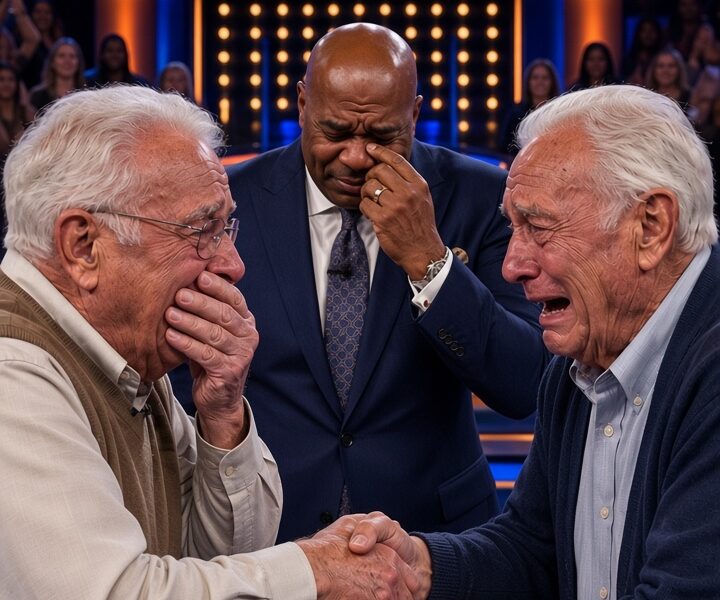
84-Year-Old Brothers Separated at Birth Meet for the FIRST Time — Steve Harvey BREAKS DOWN
Close your eyes for a second. Now picture believing for 84 straight years that you were born alone. You are an only child, a single thread, with no twin, no brother, and nothing but a mother who died before you could ever know her voice.
Now picture finding out at 84 that the whole time, a man who looked almost exactly like you had been living less than 400 miles away, believing the very same lie about you. That was Bernard Whitlo’s entire life, right up until a Tuesday afternoon on a game show stage in Lach, Texas.
Steve Harvey has hosted this stage for a long time. By the show’s own telling, he has broken down exactly twice in 15 years, and this was the second time. The first, years earlier, involved a mother and a son separated by a war.
This time, the story had been quietly building for 84 years before anyone in that building even knew it was happening.
Family Feud tapes in blocks, five or six games a day, with contestants cycling in and out in matching shirts. Everybody rehearses handshakes in the hallway beforehand. The whole operation runs on rhythm, and on paper, the Whitlo family’s episode looked like any other.
Bernard, 84, was playing alongside his granddaughter, Naomi, and two of his great-nephews. All four wore matching sage green shirts that Naomi had picked out weeks earlier. They looked like a family out for a pleasant afternoon, and that is exactly what Bernard believed he was attending.
What nobody watching from home would have guessed was that Naomi had been planning this exact taping for four months. She had been coordinating quietly with producers on details she had not shared with a single other member of her family, including her grandfather. She told Bernard only that the family had been selected for a taping and that it would mean a lot to her if he came along.
He agreed without hesitation, the way he agreed to most things Naomi asked of him. She was, by his own frequent admission, his favorite grandchild, though he tried not to say that part around the others.
Steve greeted the family warmly at the top of the show, the way he greets every family. He had no idea yet that this particular introduction was about to become one of the most consequential of his career.
“Tell me about yourself, Mr. Whitlo,” Steve said, shaking Bernard’s hand.
“Not much to tell,” Bernard said, smiling easily. “Eighty-four years old, one daughter, four grandkids, and I still change my own oil. That’s about the whole story.”
Bernard believed it completely. He had no reason yet to believe otherwise. By his own measure, he had lived a good, ordinary life.
He had spent 41 years as a high school shop teacher. He had been married to a woman named Doy, who passed away six years earlier. He lived in a house where he had built most of the cabinets himself.
If a person had asked him whether anything was missing from that life, he would have said no, honestly, and meant it. That is the strange thing about a missing piece. You cannot feel its absence if you have never been told it existed.
Across the stage, the Delgato family waited for their turn. They were three siblings and a cousin who had entered through the regular casting line. They had no idea they were about to become a small footnote in the most talked-about taping the show would have all year.
To understand what was about to happen, you have to go back to the spring of 1942. Bernard Whitlo was born that April in a small hospital outside Mon, Georgia, one of a set of twin boys. Their mother, Eleanor, died two days after the delivery, from complications that nobody in that era had good answers for.
Bernard’s father, Thomas, became a widower overnight, with two infant sons and no family nearby able to help. In the fog of that grief, he made an impossible decision. A well-meaning nurse and a church placement worker helped arrange it, without ever fully explaining to him what it would mean decades later.
Thomas was a farmhand with no living relatives closer than three states away. His wife was in the ground before he had even had time to formally name both boys. He was grieving, exhausted, and alone in a system with very little patience for any of those things.
The hospital records, once they were finally pulled, showed a man who had signed papers he likely never fully understood. He was handed a sentence that sounded final and was told it was kind.
Thomas kept the older twin, the one born nine minutes first. He was told the second boy had not survived the week.
That was the story Bernard grew up with. He had a stillborn brother he never met, and a grave he was told existed somewhere he had never visited. He also had a quiet sadness his father carried but rarely spoke of.
Thomas remarried when Bernard was six, to a kind woman named Ruth, who raised him as her own. Thomas never had another biological child. In the 60 years he lived after that spring in 1942, he never once stopped keeping a small photograph on his nightstand.
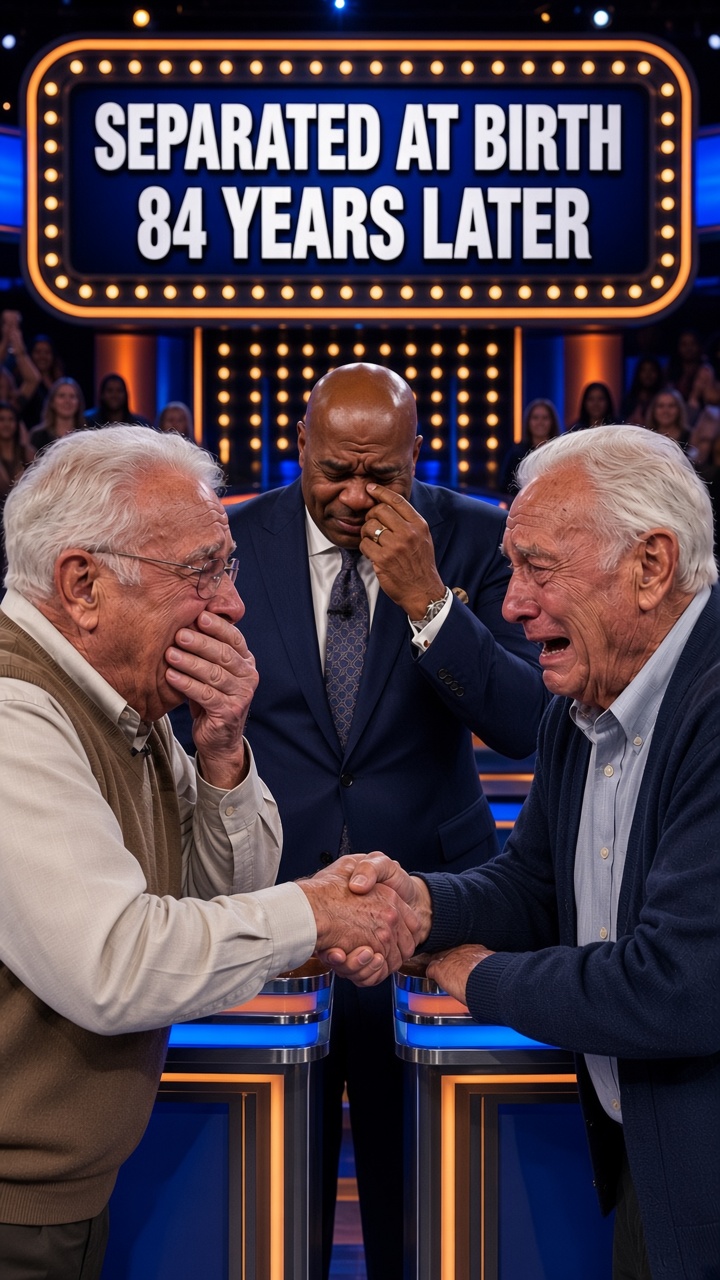
What Thomas was never told, and what nobody in that hospital ever corrected, was that the second twin had in fact survived. He had simply been placed for adoption through the same church that helped arrange the burial story. It was a common enough practice in that era for families who could not manage two infants and no mother.
That second boy grew up 400 miles away as Clifford Doss. He was raised by a loving family who adopted him at six weeks old, and who never fully knew the details of where he had come from either. The Doss family had been told simply that the birth mother had died and that the father could not care for the child alone.
It was true, as far as it went. It was also missing an entire other half of the story.
Both boys grew up as only children in every sense that mattered to them. Neither one ever stopped wondering quietly what a brother might have been like. It is the kind of question a person learns to carry without ever saying it out loud.
Clifford, for his part, spent much of his adult life volunteering with a big brother program in Amarillo. His own granddaughter would later find the fact almost impossible to hear without crying once she understood why he might have been drawn to it in the first place.
He mentored 11 boys over three decades. He always told people it just felt like something he was supposed to do, and he was never quite able to explain why.
Bernard, meanwhile, kept one half of a photograph his whole life. It was a torn, faded picture of a young pregnant woman standing in front of a farmhouse, cut cleanly down the middle decades before he was old enough to ask why.
His father told him it was the only photo that existed of his mother, and that it had been damaged in a move. Bernard never questioned it, not once in 84 years. That changed when his granddaughter Naomi asked to borrow it for a family history project six months ago.
Round one went the way rounds usually go. Bernard answered a question about kitchen appliances, got it right, and did a small fist pump that made the audience laugh. To anyone watching, he was simply a cheerful old man having a good time.
Naomi’s hands, though, had not stopped shaking since they walked out. She kept glancing toward the wings, toward a door that led backstage, toward a hallway that only she knew held anything unusual behind it.
Her grandfather noticed none of it. He was too busy enjoying himself.
The road to that door began six months earlier. Curious about her family’s history for a school project, Naomi sent a DNA sample to a genealogy service. She did it mostly for fun, expecting nothing more interesting than a percentage breakdown of which countries her ancestors came from.
What she got back instead was a message flagged urgent: a close family match, a possible sibling relationship. It was attached to a name she had never heard in her life.
The name was Clifford Doss, age 84, of Amarillo, Texas. She nearly deleted the message, assuming it was some kind of scam, until she noticed the estimated relationship percentage. It was not a cousin. It was not an uncle. The math only worked one way.
She sat with that message for three full days before telling anyone. She was terrified of what it might mean, and equally terrified of what it might mean to say nothing at all.
That was not the part of the afternoon that would end up mattering most. Not yet.
Over the following months, Naomi built a careful, quiet bridge between two families who had no idea the other existed. She found Clifford’s own granddaughter through the DNA service’s messaging system. She approached her cautiously, terrified of destabilizing two elderly men’s entire understanding of their own lives with a single wrong move.
The two granddaughters talked for weeks before either family knew anything. They compared notes, birth dates, and hospital records requested from Georgia archives. The church placement paperwork, read closely for the first time in 84 years, told a very different story from the one both families had always believed.
They tracked down the original hospital ledger page through a records request that took 11 weeks and two dead ends before it finally came through. It listed two live births, not one, on the same April morning in 1942. It was a detail that neither family’s official story had ever included.
Naomi photographed the ledger page the moment it arrived. She stared at it for nearly an hour before she could bring herself to call anyone, the wait of 84 years sitting quietly on a single scanned document.
Then came the detail that settled it. Both grandfathers had kept half of the same photograph. Neither man had ever wondered why his half ended abruptly at a torn edge, right where a second child would have been standing beside their mother.
When Naomi finally worked up the courage to test the theory, she asked Clifford’s granddaughter to photograph her grandfather’s half of an old torn picture. She was gentle about it and careful not to explain why. It showed a pregnant woman standing in front of a farmhouse.
The two photographs, laid side by side on a laptop screen at midnight, fit together seamlessly. It was the same farmhouse, the same woman, and the same smile, with one hand resting on a stomach that was carrying both of them at once.
Naomi cried alone in her kitchen for 20 minutes before she could bring herself to call her mother.









