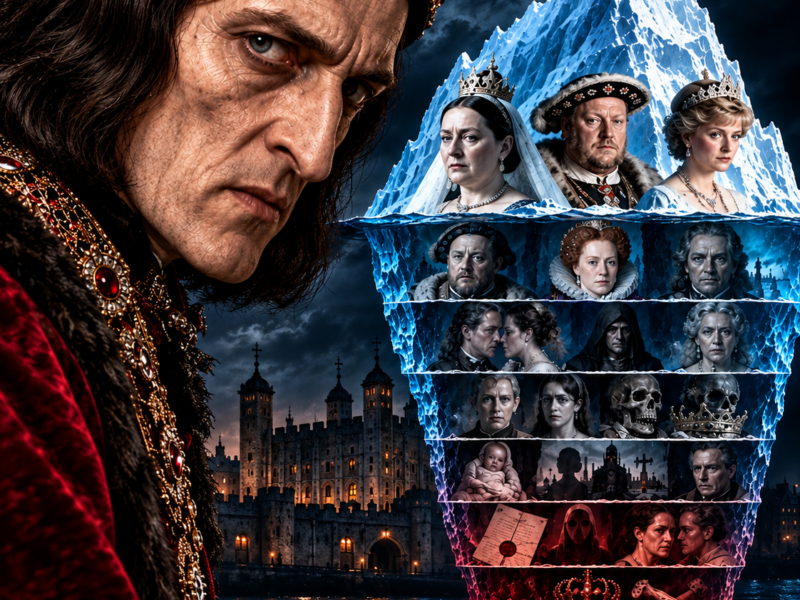
7 Levels of Dark Truth, From a King Poisoned by His Doctors to a King Who Drank the Dead
A king’s severed head hits the scaffold, and the crowd does something no history book wants to describe.
They surge forward and soak their handkerchiefs in his blood.
Some of them will drink it.
They believe a dead king’s blood can cure disease and hold back death.
The body on the boards is Charles I of England, and the year is 1649. His own subjects are consuming him like medicine.
But this is not the strangest thing the crown ever did with a body.
It is only the most public.
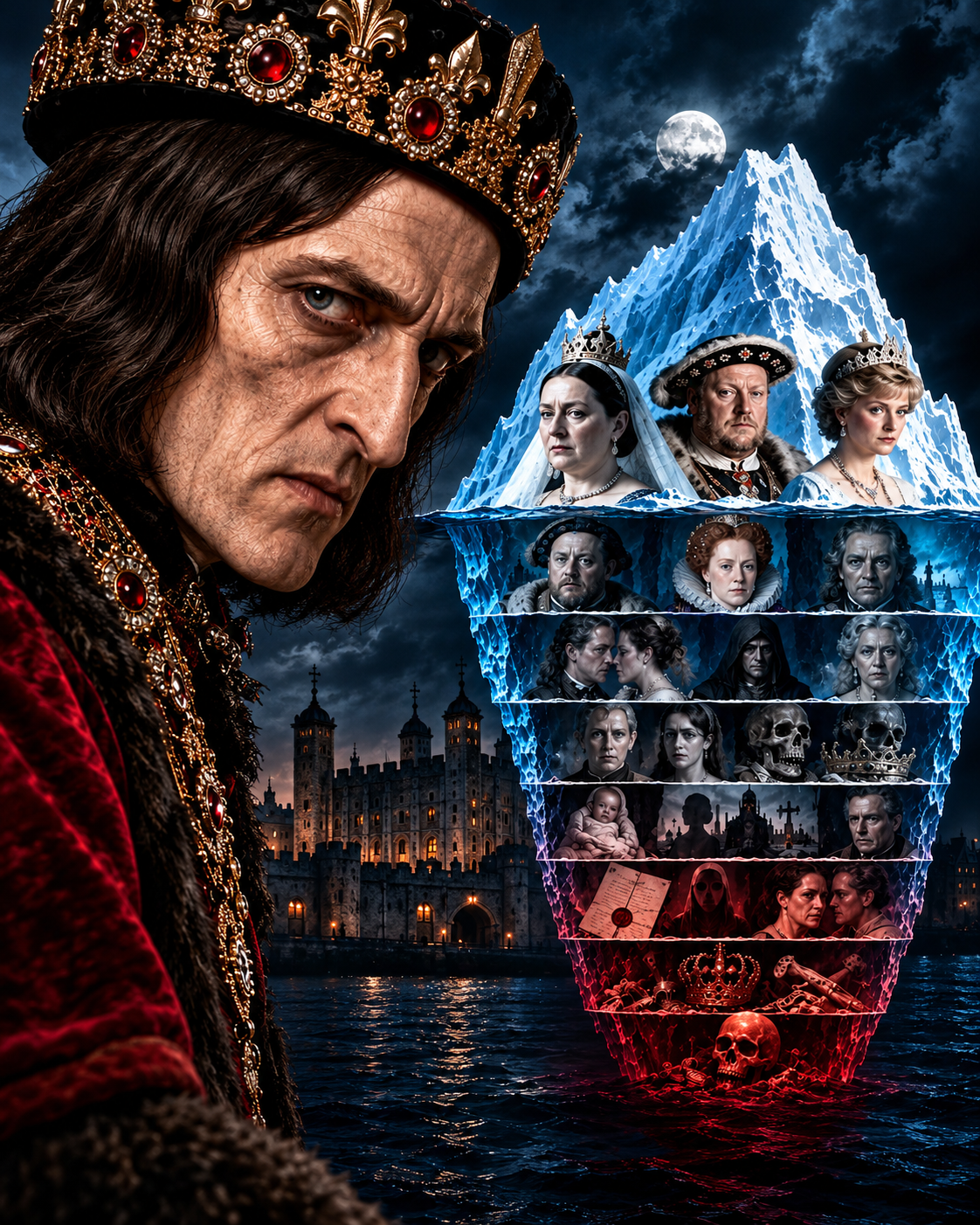
There are seven levels to this iceberg, and each one is worse than the last.
Level one sits just under the surface, and you already half know it.
Windsor, 1788. The King of England is tied into a specially built restraint chair, a device he bitterly calls his throne.
He talks. He talks for hours without stopping, until his voice cracks and foam runs from his mouth.
And the second he catches his breath, he starts again.
His skin is blistered on purpose by his own doctors. He is bled, gagged, and dosed with poison until, by one account, he is praying for death.
This is George III, the king who lost America.
The man in charge of curing him is Francis Willis, a seventy-year-old clergyman who runs a madhouse in the countryside.
For two hundred years, everyone agreed on the diagnosis. A rare blood disease called porphyria.
The proof was in the chamber pot, because the king’s urine was reported to run blue.
Except that story just fell apart.
When historians went back to his actual medical records, they found something the porphyria theory left out.
George was being given a medicine made from gentian, a plant that turns urine blue.
His most famous symptom may have been nothing more than a side effect of what they were pouring down his throat.
In 2017, a study of his own letters concluded that the porphyria diagnosis was thoroughly discredited, and that what the king actually suffered looked far more like acute mania.
And a lock of his hair, tested in 2005, was loaded with arsenic. Three hundred times a normal level.
Arsenic that was almost certainly in his medicine, too.
So the very surface of the iceberg is already a lie.
The king was not cursed by his blood. He was, very possibly, being slowly poisoned by the men paid to save him.
But a poisoned king is a private tragedy.
One level down, the poison is in the bloodline itself, and it is being handed from mother to son across every royal house in Europe.
Level two. The illness they only ever whispered about.
The royal disease.
It starts with one boy who would not stop bleeding.
Leopold, Duke of Albany, was the youngest son of Queen Victoria. He was so fragile that the smallest knock left him black with bruises, and the smallest cut would not close.
In 1884, at the age of thirty, he slipped on a staircase at a villa in the south of France. He struck his knee and his head, and by morning he was dead from a bleed inside his skull.
Leopold had hemophilia. His blood could not clot.
And the source of it was his mother.
Victoria carried the flaw. And then she did what royals do.
She married her children into thrones across the continent.
Her daughters carried the defect in silence and passed it to grandsons and great-grandsons in Germany, in Spain, and in Russia.
In Russia, her great-grandson Alexei, heir to the entire empire, bled so badly that his desperate mother handed the fate of the dynasty to a Siberian mystic named Grigori Rasputin.
At least nine of Victoria’s male descendants inherited the disease.
Boys who bruised like soft fruit, who could bleed to death from a nosebleed or a pulled tooth.
They were kept out of photographs. Kept out of view. Treated as a family shame to be managed rather than a disease to be named.
The blood of Europe’s royalty was quite literally defective, and they knew.
And they kept marrying each other anyway.
That is the pattern taking shape.
Hide the body that does not fit.
But the next body they hid was not a flaw in the blood. It was a child.
Level three. The prince who was kept out of the frame.
In 1905, Queen Mary gave birth to her sixth and final child, a boy named John.
By every account, he was a happy, funny little boy.
But around the age of four, the seizures began. Epilepsy, in an age that treated epilepsy as something close to a curse.
As the fits grew more violent and more frequent, the boy was moved.
Away from his brothers and sister, out to a quiet house called Wood Farm on the edge of the Sandringham estate, with a nurse to care for him.
The seizures had become so severe that, in his governess’s own words, they dared not let him be with the other children because it upset them too much.
And so the youngest son of the King of England grew up largely apart. Not paraded, not photographed, not mentioned.
He died during a seizure in January 1919, at just thirteen years old.
Most of the country learned that he had existed, and that he had epilepsy, in the same newspaper article, in the same breath.
His own mother wrote in her diary that his death came as a great relief for the poor little boy’s restless soul.
His father called it the greatest mercy possible.
This one is darker in its silence than in any single cruelty.
He was loved. He had a garden, and playmates brought in from the village.
But the machine around him made a choice that tells you everything.
A royal child who did not fit the picture was quietly edited out of it, alive and then dead.
And the public was told only once it no longer mattered.
Editing a living prince out of the family photo is one thing.
On level four, they edited two living women out of existence entirely.
On paper. In writing. While they were still breathing.
Level four. The cousins who were declared dead while they were still alive.
In a cemetery in Surrey, there was for years a grave marked with nothing but a small plastic tag and a serial number.
The kind you would use to label a sample in a hospital.
Under it lay a woman named Nerissa Bowes-Lyon.
And she was not some distant relation. She was the first cousin of Queen Elizabeth II.
Nerissa and her younger sister Katherine were both born with severe intellectual disabilities.
In 1941, they were placed in an asylum, the Royal Earlswood Hospital. And there they stayed.
Then, in 1963, the most respected register of the British aristocracy, Burke’s Peerage, printed something extraordinary.
It listed both sisters as dead.
Nerissa, it said, had died in 1940. Katherine in 1961.
Neither of them had died.
Nerissa lived another twenty-three years. Katherine would live until 2014.
They had been entered into the official record of the nation’s nobility as corpses while their hearts were still beating.
When a journalist finally uncovered it in 1987, the story broke as a royal scandal. A cover-up to bury a disabled bloodline.
But the truth is quieter. And in a way, it is worse.
There was no grand palace conspiracy about pure blood.
The disability came from the sisters’ mother’s side of the family, not the royal line, and it posed no threat to the throne at all.
On the very same day the Bowes-Lyon sisters were committed, three of their cousins, disabled in the same way, were committed to the same institution.
Five women from one family, quietly filed away.
The false death dates were most likely their own mother’s doing.
Not murder. Not conspiracy.
Just a family and a country that found it easier to write disabled women down as dead than to admit they were alive.
The next three levels are where it stops being neglect and turns deliberate.
What comes next was done with a needle and a clock.
Level five. The king who was killed to make the morning paper.
It is just before eleven at night on January 20, 1936.
The King of England is dying, but he is dying too slowly.
So his personal physician, Bertrand Dawson, takes out a syringe.
He fills it with three-quarters of a grain of morphine, then a full grain of cocaine.
He finds the swollen vein in the dying king’s neck, and he pushes it in.
George V is dead within the hour.
We know this in exact detail for one reason.
The doctor wrote it down.
In his own private notes, revealed to the public only in 1986, half a century later, he calmly explained that he had decided to determine the end.
And he explained why he chose that precise moment.
He wanted the death announced in the right newspaper.
A death late at night would break first in the cheap evening papers. A death closer to midnight would land, with dignity, in the morning edition of The Times.
So the physician timed the injection, and he telephoned London to have the front page held.
The next morning, the headline spoke of a peaceful ending at midnight.
It was not peaceful, and it was not natural.
The King of England was killed on deadline, so that the story of his death would look respectable over breakfast.
The doctor even noted that the nurse in the room was so disturbed by what he was doing that he gave the fatal injection himself.
The crown had killed a body to protect an image.
But at least it knew where that body was.
On level six, we reach two bodies the crown has been sitting on for more than three hundred years, and refuses, to this day, to let anyone identify.
Level six. The bones in the Abbey that no one is allowed to test.
Two boys are lodged inside the Tower of London.
Edward is twelve years old. His little brother Richard is nine.
Edward is the uncrowned king of England.
Their uncle takes the throne instead, and the boys are never seen alive again.
For nearly two hundred years, they were only a rumor.
Then, in 1674, workmen tearing out a staircase in the Tower found a wooden box buried about ten feet down.
Inside were the skeletons of two children.
The reigning king ordered the bones sealed in a marble urn inside Westminster Abbey.
They sit there today, a few steps from the very spot where the living royal family is crowned, married, and mourned.
That urn has been opened exactly once, in 1933.
The examiners said the bones belonged to two children of roughly the right ages.
But they had no way to prove who the children were, or how they died, or even, for certain, that they were boys.
Here is the part that should stop you.
We could actually know.
A modern DNA test could compare those bones to known royal remains and potentially end a five-hundred-year-old murder mystery overnight.
Historians have asked, repeatedly.
The answer has always been no.
The monarchy, backed by the church, has refused for decades to allow the urn to be opened and tested.
Even after the bones of Richard III, the very man history accuses of the murder, were dug out from under a car park and identified in 2012, the crown still would not allow those children to be examined.
Whatever is inside that urn, they would rather leave it a mystery than let a laboratory speak.
Which brings us to the bottom.
The last level. The one thing they never taught you in school, because it turns your entire idea of royalty inside out.
At the very bottom of this iceberg, the crown is not hiding a body or killing one.
It is eating one.
Level seven. The bottom. The kings who ate people.
Go back to that scaffold for a moment, and the crowd soaking up Charles I’s blood as if it were medicine.
You assumed that was superstition. Peasant nonsense.
It was not.
It was royal practice.
The son of that executed king, Charles II, did not just believe a human body could heal you. He manufactured the cure himself.
In his own private laboratory inside the palace, the King of England distilled a tonic from crushed human skulls.
He reportedly paid a small fortune for the recipe. Then he brewed it, bottled it, and drank it.
It became so tied to him that it had a name.
The King’s Drops.
Powdered human skull dissolved in alcohol, taken by the King of England as a daily remedy.
And when he suffered a violent seizure in 1685 and lay dying, the very first thing he reached for was that bottle.
His last act on earth was to swallow another human being, ground to dust, in the hope it would keep him alive.
It did not.
He was dead within the week.
Now put the whole iceberg back together and look at what it actually is.
At the surface, a king poisoned by his own doctors.
Then a bloodline they knew was rotten. A child erased. Two women written down as dead. A king killed for a headline. Two children the crown will not let anyone identify.
And at the very bottom, a king who drank the dead.
It was never a list of seven random secrets.
It is one single pattern, running for more than three hundred years.
The power of the crown has always rested on one thing: total control of the human body.
Whose blood is sacred? Whose body gets hidden? Whose death gets timed? Whose bones stay sealed, and whose corpse ends up in the king’s own cup?
At the top of this iceberg, the crowd consumed a king.
At the bottom, a king consumed the crowd.
The whole thing was always about who gets to own a body.









