5 Shocking American Slave Stories They Didn’t Teach You in School
Behind the dates and battles in American history are lives that were hidden, exploited or nearly forgotten. Some were buried on purpose. Others simply fell through the cracks of a story told by the people in power.
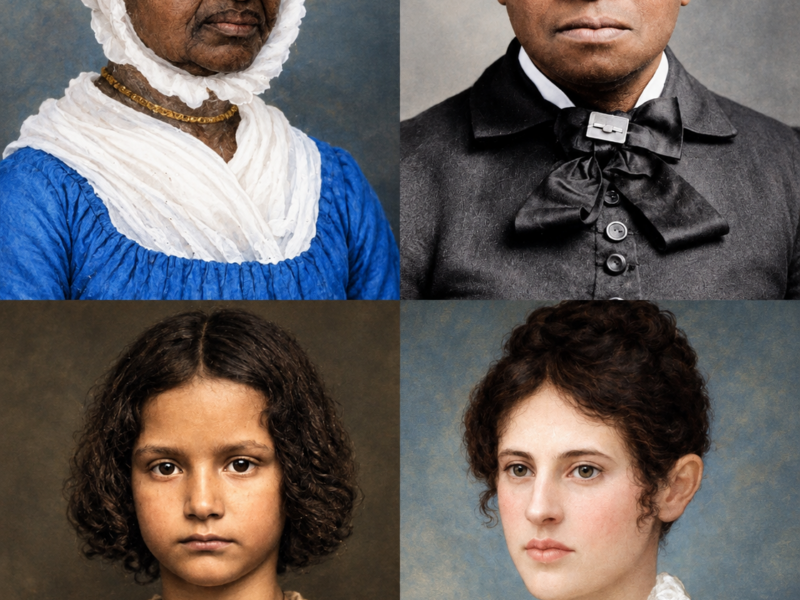
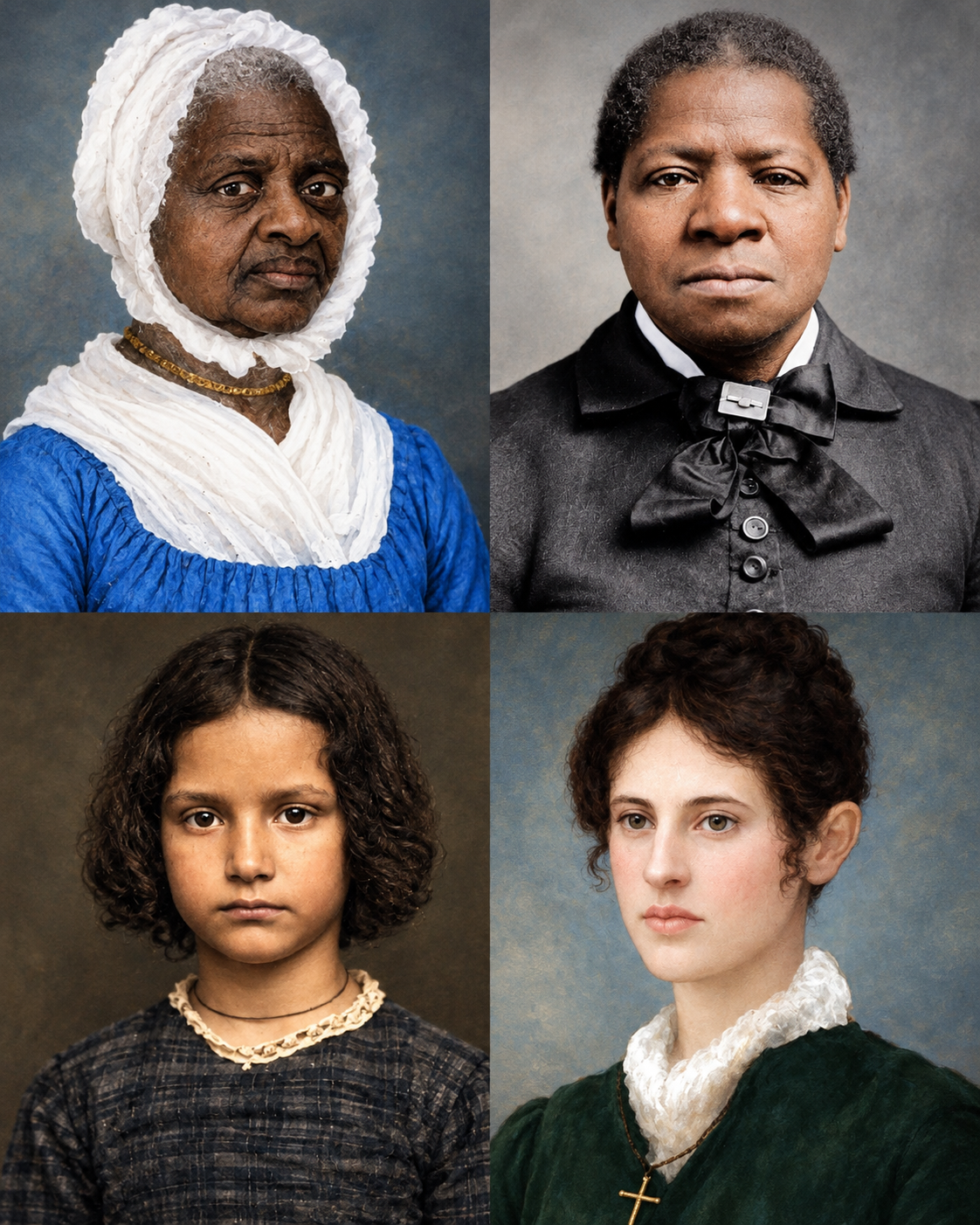
Five enslaved women, from colonial New England to the eve of the Civil War, left marks that history tried to erase. One sued for her freedom without being able to read a word. One ran a plantation while legally owned by the man who lived in it. One was turned into a sideshow. One became one of the richest women in California. And one became the face of a national outrage.
Their stories reveal a dark reality of survival and exploitation, and also of courage that refused to stay quiet.
Elizabeth Freeman was born into slavery in colonial New York and was never meant to leave a mark on history. She was poor, illiterate and enslaved, ignored by men who demanded liberty for themselves while refusing it to her.
Yet she did the unthinkable. She sued her so-called master for her freedom. How could a woman who could neither read nor write win such a case? And how did her fight shake the foundations of a new nation?
Elizabeth Freeman, later known as Mumbet, was born in the mid-1740s, possibly in the spring of 1744. Her exact birthplace is uncertain, though some suggest New York State, where she grew up on the farm of Pieter Hogeboom at Claverack, in what is now Columbia County. Hogeboom came from a Dutch family that had settled the area in the mid-seventeenth century, when New York was still the Dutch colony of New Amsterdam.
In her early years she was known as Bet, almost certainly short for Elizabeth. The Hogeboom household held many enslaved people, among them her sister Lizzy. As was common in the eighteenth century, the identities of her parents are unknown, and it isn’t clear whether they stayed on the same estate.
Bet never learned to read or write, and her early life is shrouded in silence because she left no written accounts. What we know comes from later, after she forced her way into public view through a bold and unprecedented legal battle.
In the early 1750s, Hogeboom’s daughter Hannah married Colonel John Ashley, a prominent figure in Sheffield, Massachusetts. Bet was sent to live with Hannah as a household slave, possibly at only seven or eight years old.
We can still see the world she lived in for nearly three decades, because Colonel Ashley’s house, built in 1735, still stands today as a museum. It was a large country house by mid-eighteenth-century standards. Bet’s days there were spent keeping the house clean, washing clothes and doing the arduous manual work that took up far more time before washing machines and vacuum cleaners.
In the Ashley household, Bet established herself as a woman who was not intimidated by her enslavers. Later accounts describe Hannah Ashley as harsh. One famous story says she grabbed a heated shovel to strike Bet’s sister Lizzy, and Bet stepped in and took the blow.
The wound left a sizable scar. Rather than hide it, Bet displayed it openly from then on, a way of telling visitors that Mrs. Ashley was cruel to the people she enslaved.
During these years Bet also became a mother. The identity of her child’s father remains uncertain, but tradition holds that he left to serve in the American Revolutionary War and never returned. While men marched to fight for liberty, Bet stayed in bondage, raising a child in a world that denied her even the most basic claim to freedom.
She lived through an era of enormous change. At the Ashley house she would have heard constant talk of the long war with the French that raged across North America from 1754 to 1763, which ended with Britain taking control of New France. She would also have heard John Ashley and his guests complain about the rising taxes imposed by the British Crown on Massachusetts and the other colonies.
In January 1773, when she was probably nearing 30, she would have seen a large group of Massachusetts landholders gather at the Ashley house to draft what became known as the Sheffield Declaration. It protested growing British tyranny and declared that people in a state of nature are “equal, free, and independent of each other,” with a right to enjoy their lives, liberty and property. Thomas Jefferson would paraphrase those ideas three years later in the Declaration of Independence.
It appears that a young lawyer named Theodore Sedgwick drafted most of the declaration during the meeting. He would soon feature in Bet’s story.
If Bet heard anything of the Sheffield Declaration, she couldn’t have missed the irony. Men who claimed that all people were entitled to liberty wrote those soaring phrases while keeping her in bondage under the same roof. The language of freedom echoed through the halls, but it didn’t include her. Not yet.
The declaration was a major event in the run-up to the Revolutionary War. The Boston Tea Party followed in December 1773, and by the spring of 1775 the colonies were at war. The Second Continental Congress issued Jefferson’s Declaration of Independence in the summer of 1776. A bitter war followed, won by 1781, with Britain acknowledging American independence in 1783.
As part of building a new state, Massachusetts drew up its own constitution in 1780. It included a passage echoing both the Sheffield Declaration and the Declaration of Independence, stating that “all men are born free and equal” and have certain natural and unalienable rights.
Bet was about to turn those lofty words into a weapon.
In 1781, aware of the wording of the Massachusetts Constitution, Bet sought her freedom on the idea that the constitution effectively forbade slavery in the state. According to a later account, she told Theodore Sedgwick, “I’m not a dumb critter. Won’t the law give me my freedom?” She said she had heard the constitution read the day before.
Sedgwick’s legacy in the abolitionist movement is mixed, but he believed slavery was incompatible with the principles of the new constitution, and he agreed to take the case. He filed the paperwork on behalf of Bet and another enslaved man in the Ashley household, Brom. Brom was reportedly added to strengthen the case, since women had limited legal rights at the time.
Brom and Bett v. Ashley opened at the county court in Great Barrington in August 1781. Sedgwick’s co-counsel was Tapping Reeve, the founder of the Litchfield Law School in Connecticut, one of the earliest law schools in America. Together they were considered two of the most formidable lawyers in Massachusetts.
They argued that the wording of the new constitution made slavery illegal in the state and that Brom and Bett had to be freed. Ashley responded that the pair were not slaves but household servants with nowhere else to go, an argument common in cases of this kind.
The court ruled for Brom and Bett. It ordered Ashley to release them and pay compensation for their years of unpaid labor. Bet had done the unthinkable: she had won.
In that moment she became the first African American woman to win her freedom under the Massachusetts Constitution, turning its promise of equality into a living fact.
After they won, Brom and Bet were offered paid work at the Ashley house. That was common for freed people in the late eighteenth and early nineteenth centuries, and many simply swapped being slaves for being low-paid servants. Bet turned the offer down. She went to work for Theodore Sedgwick instead.
She spent over 25 years in the Sedgwick household, becoming a close member of the family and nanny to Theodore and his wife Pamela’s children. The name “Mumbet” stuck at this time, while she took the surname Freeman after her court victory and became known forever as Elizabeth Freeman.
The Sedgwick children’s use of “Mumbet” shows how integral she became to the family. Our most detailed accounts of her life come from Catharine Sedgwick, one of Theodore’s daughters and later a well-known author. In 1853, when she was an old woman herself, Catharine wrote Slavery in New England, published in Bentley’s Miscellany. It portrayed slavery in Massachusetts and other northern states in a mild light, but it remains a valuable source on Bet’s life and how she won her freedom.
While Bet was beginning her new life, Massachusetts law was being reshaped by her actions. Her case was one of several early-1780s lawsuits arguing that slavery had become illegal under the 1780 constitution. The others were three cases collectively known as the Quock Walker cases, all involving the same enslaved man.
It became clear, even to those who hoped to preserve slavery in Massachusetts, that the institution was living on borrowed time. In 1783, two years after Elizabeth’s victory, the Massachusetts Supreme Judicial Court declared slavery incompatible with the state constitution. When the first federal census was taken in 1790, not a single enslaved person was listed in Massachusetts.
Massachusetts thus became one of the first parts of the United States to become a free state, following the Vermont Republic, which abolished slavery at its founding in 1777, and Pennsylvania, which began abolishing it in 1780. Some northern states, such as New York, would not end slavery until well into the nineteenth century.
Elizabeth Freeman had helped tip the balance of history.
During her years with the Sedgwicks she also worked as a local healer, nurse and midwife. In the early nineteenth century she saved enough to buy her own house. The Sedgwick children were grown, and she retired to a home on Cherry Hill in Stockbridge, where her daughter lived nearby with her own children. Elizabeth spent her later years close to her grandchildren and even great-grandchildren.
She died in Stockbridge in December 1829, at around 85. Because her birth date isn’t known, her exact age can’t be given, but she had spent more of her life free than enslaved.
Reflecting on what liberty meant to her, she once said that if a single minute of freedom had been offered while she was a slave, even on the condition that she die at its end, she would have taken it. She said she would do it “just to stand one minute on God’s earth a free woman.”
She was laid to rest in the Sedgwick family plot in Stockbridge, the only non-Sedgwick buried there. Her gravestone inscription says she was born a slave and remained one for nearly 30 years, and that she could neither read nor write, yet “in her own sphere, she had no superior or equal.” It ends with the words “Good mother, farewell.”
Around 1812, Susan Ridley Sedgwick, one of Theodore’s daughters-in-law, painted a delicate watercolor-on-ivory miniature of Bet when she was about 70. It’s preserved by the Massachusetts Historical Society and widely regarded as her only known portrait.
In the two centuries since her death, her story has become central to the history of abolition in the United States. In August 2022, the Sheffield Historical Society unveiled a statue in her honor. She is often described as the Rosa Parks of her time, and her courage did more than win her own liberty. It helped ignite a movement.
The second story is one of the most unusual and uncomfortable in American history, a relationship that was controversial, deeply complex and never freely chosen.
Julia Chinn was born into slavery and spent her childhood laboring like any other enslaved child. Her life changed when she was sent to the plantation of Richard Mentor Johnson, a rising politician and future vice president of the United States.
Johnson took Julia as his concubine. She helped manage his household and raised their children. Yet he never granted her freedom. Why did he keep her enslaved? And why was she almost erased from history?
Who Julia Chinn was, especially in her earliest years, is hard to establish. Records for people born into slavery in the late eighteenth century were poorly kept. We know she was born in the 1790s, but even her leading biographer can only narrow it to somewhere between 1790 and 1797. Some sources say 1790. Others say she was about 15 or 16 in 1812, which puts her birth around 1796 or 1797.
There is little detail about her background either. Her mother was an enslaved woman named Henrietta. Her father is believed to have been a free white man, whose surname she took, since a prominent settler family named Chinn lived in that part of Kentucky.
It’s easier to identify her enslavers. She was born on the plantation of Robert Johnson and his wife Jemima in the Bluegrass region of Kentucky, then on the western frontier of the United States. The Johnsons were among the first European American settlers there in the 1770s. Robert worked as a surveyor and land assessor, helping map the colonization of Kentucky.
They had many children, but it was their fifth son, Richard Mentor Johnson, born there in 1780, who would be crucial to this story. At the time, many white Americans saw slavery not as a moral crisis but as an ordinary, even necessary institution woven into the expansion of the frontier.
Kentucky had been settled by people moving west from Virginia from the 1760s on, and it became the fifteenth state in 1792. Slave ownership was fully legal there, and the fight over whether new states should allow slavery hadn’t yet become the fierce political battle it would be from the 1810s.
Despite being a slaveholding agricultural state, Kentucky quickly became home to the largest free Black population of any state. Formerly enslaved people from places like Virginia were often the first to move west to buy a small farm or live away from where they had been enslaved. There was also still a large Native American population in the region. The result was a state where the social rules among white settlers, Black people and Native peoples differed from those elsewhere, and that racial mixing would shape Julia’s life.
Julia was born to an enslaved woman, but she was far from being of purely West African descent. The details of her ancestry are disputed. Most studies describe her as an octoroon, meaning only one-eighth African and seven-eighths European, though that was extremely rare in the pre-Civil War United States and probably wasn’t true of Julia. She was said to be lighter-skinned than many other enslaved people, but she was most likely a quadroon at most, with at least one quarter African ancestry. We can’t be sure what she looked like, since cameras didn’t exist before she died and nineteenth-century drawings of her may not be accurate.
Whatever her ancestry, she was treated like any other enslaved child. Her mother, Henrietta, received far too little food for the grueling labor expected of her and her children. They survived by growing small amounts of beans, cabbage and potatoes in the slave garden, and like many enslaved people they were chronically short of protein and undernourished.
As she entered her teens, her life would take a turn that tied her fate to the powerful Johnson family.
Her life didn’t get easier. She was separated from her mother and sister and sent to the household of Richard Mentor Johnson, the Johnsons’ youngest son. He was around 30 and already an ambitious rising figure in Kentucky politics. He had set up his own household at Blue Spring Farm, a substantial estate, and he was unmarried. He never married in the traditional sense.
Later accounts say that at about 16 he had proposed to a young woman, but his mother strongly disapproved and pressured him to end it. Some stories claim he vowed never again to let his mother or anyone else dictate his personal life. Whether or not he made that vow, it shaped the unconventional arrangement that followed.
When Julia was sent there, she quickly became his concubine. It’s hard to use a phrase like “entered a relationship,” because this clearly wasn’t consensual for Julia at first, although the nature of their bond grew more complicated over time. Her exact age is also unclear. If she was born around 1796 or 1797, she was only about 14 when she was sent to live with Richard. If she was born around 1790, she was already entering her twenties.
What is known is that she gave birth to a daughter, Imogene, in 1812, and a second daughter, Adaline, soon afterward. There is little doubt Richard was their father. He referred to Julia as his wife, according to some evidence, and he introduced the girls to visitors as his daughters. They carried the Johnson surname, and he eventually arranged for them to receive land.
Most historians describe the couple as eventually in a kind of unofficial common-law marriage outside the legal system. Yet Julia remained a slave.
Richard Mentor Johnson is best known today as vice president under Martin Van Buren from 1837 to 1841, but his political career spanned 46 years. He was first elected to the Kentucky House of Representatives in 1804, and three years later he went to Washington as a member of the U.S. House. He held that seat until 1819, when he was elected a U.S. senator from Kentucky. He returned to the House for eight years from 1829 before becoming vice president.
Julia would not live to see him become vice president, but his career shaped her life. Because he never married a white woman or started a conventional family by the standards of the day, and because he was in Washington about six months of each year, she effectively ran Blue Spring Farm, a plantation worked by many enslaved people.
She dealt with the contractors who bought their produce and bought supplies for the household and farm. She organized and ran social functions, many of them held when Richard returned from Washington to meet local politicians and businesspeople. She was said to play the piano very well and to help create the refined atmosphere those gatherings needed. When Johnson left again each year, he even left her in charge of the cash he had withdrawn beforehand, an unusual level of trust for an enslaved woman at that time.
One striking part of her management was the Choctaw Academy, a boarding school built on the farm for Native American boys, which operated for around a decade. In some ways it extended her work educating her own daughters. She employed a local minister, Thomas Henderson, to teach Imogene and Adaline, and he later taught at the school too.
The building is still partly standing. At Blue Spring Farm, the shell of the structure sits in a field, with bushes and trees pushing through the walls and the roof largely collapsed after more than a century of neglect. For anyone in that part of Kentucky, it’s still a living piece of Julia’s story.
All of this suggests near-equality by the 1820s, but the reality was more complex. The local community tolerated the unusual union between their congressman and his “wife” but criticized it behind closed doors. The relationship was shaped throughout by the laws and racial boundaries of the time.
In 1815, after his father’s death, Johnson gained full legal ownership of Julia. He didn’t free her. She stayed legally enslaved even as he openly acknowledged their daughters and raised them as his own.
Historians offer different explanations. Some suggest he avoided freeing her because emancipation might have loosened the ties that bound her to him. Others point out that interracial marriage was banned in Kentucky, so freeing her wouldn’t have allowed them to marry anyway.
Julia did have influence in the household. She arranged for her brother Daniel and his family to be brought to Blue Spring Farm, where they lived in somewhat better circumstances for several years. In 1821 they were sold, likely because Johnson faced mounting financial pressure while sustaining his political career.
There is also evidence that Julia sometimes struggled to maintain discipline on the plantation because she was enslaved. Johnson’s letters show he told his white employees to obey her. Historians note, though, that some enslaved field hands ignored her orders, and neighboring men wouldn’t step in when she asked them to help punish them.
In the summer of 1833, cholera swept across the American Midwest. Known as the “blue death,” it came in vast waves across Europe and the Americas between the 1810s and the 1890s, killing millions, and the 1830s were its deadliest decade in the United States. An outbreak hit the Choctaw Academy, and many students fell ill.
For weeks Julia nursed the children back to health. Then she caught the disease herself and died. We can’t be sure of her age. She was either in her late thirties or early forties. Her burial place is unknown.
After her death, Richard reportedly grieved deeply. In the years that followed he began a relationship with another enslaved woman on the plantation. When she later left him for another man, Johnson had her seized and sold at auction. He then began a similar relationship with her sister, who was also enslaved.
Julia’s story was forgotten for many decades, and in some ways it was covered up. During the presidential election of 1836, Johnson’s private life drew fierce negative publicity. Broadsides attacked him over his relationship with Julia and their two daughters. One 1836 cartoon shows Johnson with both daughters, one holding a portrait of Julia, with the skin tones of Julia and the girls deliberately darkened to heighten racial stigma and ridicule him in public.
Despite the controversy, Johnson was elected vice president on Martin Van Buren’s ticket. By 1850 he was still active in politics, but his physical and mental health were in decline. He died of a stroke on November 19 of that year, aged 70, and was buried in Frankfort Cemetery.
His daughters with Julia had been given substantial farms and had married white men. They received nothing under his will. After his death, two of his surviving brothers, John and Henry Johnson, appear to have destroyed Richard’s papers and records.
There were probably two motives. They wanted to erase the memory of his controversial relationship and his daughters, and although he wasn’t enormously wealthy, his estate was large enough that the brothers wanted it for themselves rather than see it pass to Imogene, who was still alive in 1850. They found a judge willing to help. The court declared that he left no widow, child, father or mother living, and a falsified record entered the books.
With the papers destroyed and the estate passed to his brothers’ families, Julia’s story was largely silenced. Then, in the late twentieth century, passing mentions in publications of the vice president and his enslaved wife aroused enough interest that researchers began digging. Several studies have since appeared, including a full-length biography by Amrita Chakrabarti Myers.
Much of Blue Spring Farm has disappeared, but local preservationists have worked to stabilize the surviving stone building of the Choctaw Academy, ensuring that at least part of the place where Julia lived and worked will endure. Once largely erased from history, her memory is slowly being recovered.
The third story belongs to a woman who was turned into an attraction, and to the showman who profited from her even after she died.
Joice Heth was an enslaved African American woman who apparently lived to 161. In 1835 she was being exhibited, and audiences came from far and wide to see her, not only for her great age but because she had supposedly been George Washington’s childhood nurse. Her tales of “little Georgie” cemented the claim. Behind her kind, chatty personality, though, was a man exploiting her, even after she was dead.
In the autumn and early winter of 1835, Joice Heth was the talk of New England and New York. She was the centerpiece of an exhibit touring Massachusetts, Connecticut and other states, run by Phineas Taylor Barnum, a man in his mid-twenties then largely unknown but soon to be revered as P. T. Barnum, the “greatest showman on earth.”
The 1835 show was a modest affair next to the theaters and circuses he would run later. He had only one exhibit: an old woman named Joice Heth. That might not sound exciting, but Heth was said to be astonishingly old. She claimed to have been the wet nurse of George Washington, the hero of the Revolutionary War and first president of the United States.
Visitors that autumn and winter, or those who had seen her debut at Niblo’s Garden in New York a few weeks earlier, were fascinated by her stories about little Georgie and how she raised him in Virginia a century before. Washington was born in the spring of 1732, 103 years before Barnum began exhibiting Heth. Wet nurses were usually between 20 and 40, so if Barnum’s claims were true, Heth would have to be over 120.
Barnum pushed it further, saying she was born in 1674 and was 161. That was a bit bizarre, since it would have made her a woman in her late fifties when nursing Washington. Perhaps he thought the bigger number would draw a bigger crowd. It certainly made many people doubt him.
Heth was billed as the most astonishing and interesting curiosity in the world, a woman who had been enslaved by Washington’s father, Augustine, and cared for the future founding father through the 1730s and into the 1740s. For a time Barnum made a lot of money and garnered a lot of press. It didn’t last.
Heth died in New York City on February 19, 1836, after just a few months in the spotlight.
Her death led to an event that paradoxically proved Barnum had been lying about her background, while also boosting his career. With the old woman lying dead, Barnum decided to cash in on her notoriety. He hired a doctor, David L. Rogers, to perform an autopsy to verify that she was well over a century old.
Rogers didn’t confirm Barnum’s outlandish claims. He said she was in her late seventies or early eighties, not a centenarian. The autopsy and the publicity could have ruined Barnum, but he understood there’s no such thing as bad publicity. He had already drummed up interest by charging some 1,500 people half a dollar each to attend, a significant sum then.
Even afterward, he kept the public guessing, spreading stories that Rogers had actually autopsied a different person and that Heth was alive and well and touring Europe. The penny newspapers couldn’t get enough, and it helped launch his career. The sad reality was that Joice Heth was dead.
Her autopsy suggested she was most likely born in the 1750s, when Washington was entering adulthood. So if she wasn’t who Barnum said she was, who was she?
Very little is known about the real Joice Heth, but enough evidence survives to piece together a few details. She was apparently born in the 1750s. Her birthplace is unknown, though the claim made at the time that she came from Madagascar can almost certainly be dismissed. It’s more likely that she came from an enslaved family in a southern state such as Virginia, the Carolinas or Georgia.
There is no record tying her to Washington’s Mount Vernon estate. The first major records of her appear when she was quite elderly and enslaved in Kentucky. Early in 1835, Barnum got a tip about her from a Kentucky showman named R. W. Lindsay. He went to see her and found a very old woman who was totally blind, with thick gray hair, a small frame, fingernails like talons and a wrinkled face.
What stood out most was that Heth, who was almost certainly suffering from advanced senility and memory loss, was extremely talkative and loved to entertain guests with tales of looking after her dear little Georgie. Who “Georgie” really was remains open to debate.
Barnum arranged to rent her, since buying a slave in the free northern states was illegal by the mid-1830s. He also drew up a fake bill of sale supposedly from the eighteenth century, linking her to the Washington family. Then he set off for New York to exhibit what he called “George Washington’s nursing mammy.”
When the events of 1835 are set against who Heth really was, Barnum’s behavior looks especially callous. He was taking a vulnerable, elderly enslaved woman and presenting her as an attraction for profit, and he overworked her badly.
At the height of her popularity, he exhibited this blind woman of around 80 six days a week for over 12 hours a day. People could shake her hand, take her pulse and touch her, within reason, much as though she were an animal. It went on for seven or eight months, and he pocketed all the profits, believed to be over $1,500, about $50,000 today.
He was also bending the slave-ownership rules by “renting” her from her Kentucky owner and taking her to the free states of the North. For all practical purposes he had bought her and was illegally traveling around New York and New England with an enslaved person.
There were rumors of further abuse. One story holds that Barnum got Heth drunk and had her remaining teeth pulled to make her look like a more authentic 161-year-old. It’s unclear whether that’s true, and it’s possible she had no teeth when he met her. But the fact that such a story could circulate says something about how he treated an elderly woman who couldn’t care for herself. Many also blame him for her death, arguing that the grueling schedule left her weak and sent her to an early grave.
Barnum’s defenders have long stressed that he believed she was genuine at the time and that the idea wasn’t his own. Critics say that doesn’t explain the schedule, the fake papers or the autopsy spectacle.
Whatever the verdict on his conduct, the episode launched his career. Shortly after the autopsy he set up Barnum’s Grand Scientific and Musical Theater. It had mixed success because of the Panic of 1837, a financial crash that led to economic stagnation in the late 1830s. When money returned in the early 1840s, crowds flocked to his next venture, Scudder’s American Museum, where he exhibited people deemed to have physical abnormalities, including dwarfs, albinos and people with gigantism.
It was the start of a long career in which the man who became known as the greatest showman on earth and co-founded the Barnum & Bailey Circus made his fortune largely by exploiting unfortunate people like Joice Heth, with whom it all began.
Barnum’s reputation is still polished today, notably by the 2017 film The Greatest Showman, which overlooked the unsavory parts of his life and career.
Heth was buried after the autopsy in Barnum’s hometown of Bethel, Connecticut. He claimed it was done respectfully, though that sits oddly with everything that came before. In later years Barnum became a staunch abolitionist, and his exploitation of Heth became a major embarrassment.
In his 1869 memoir he wrote that the least deserving of all his efforts in the show business was the one that introduced him to it. He said the scheme was not of his own devising and that he honestly believed it genuine when he took it over. He played down the tour and avoided details of the autopsy, calling it a dark subject shrouded in mystery.
Today her memory is being reclaimed from the role of mere oddity used to build a career. Harriet A. Washington’s book Medical Apartheid highlights how medical experimentation on African Americans persisted in the nineteenth century even as slavery was ending, and Benjamin Reiss’s work on race in nineteenth-century entertainment shows how Heth was victimized by a man too often celebrated as the greatest showman of his age.
The fourth story runs in the opposite direction, from slavery to one of the biggest fortunes in California.
Biddy Mason was born into slavery and became one of the richest Black women in the American West. Her life captures both the end of slavery and the westward expansion of the United States.
She is believed to have been born on August 15, 1818, in Hancock County, Georgia, though the details can’t be confirmed. She was named Bridget at birth but became known as Biddy in her youth and kept the name for life. Georgia was a slave state and would remain one for nearly 50 more years.
In her youth she was separated from her parents and sold to a Georgia plantation owner, Robert Smithson. Her early adult years were arduous, but she picked up skills that would serve her later. On the Smithson plantation she learned animal husbandry and agriculture. Other enslaved people taught her the folk medicine passed down from Africa through generations, and she learned midwifery.
In 1836, Biddy was either given as a wedding present or sold to Robert and Rebecca Smith, a young couple with a plantation in Mississippi. She spent the next ten years there and had three daughters: Ellen in 1838, Ann in 1844 and Harriet in 1847. It has been speculated that Robert Smith fathered the girls, but there is no definitive evidence.
In 1847, Mormon missionaries arrived in Mississippi to convert locals to the Church of Jesus Christ of Latter-day Saints. Joseph Smith had founded the church in western New York in the 1820s after claiming a series of divine revelations, and the church grew steadily and began moving west in search of an American Zion. It had outposts by the 1840s in Illinois, Ohio and Missouri, but its rising strength also drew opposition, and in 1844 Smith was killed in a riot in Illinois. His followers stayed committed, and Mormon groups kept heading south and west looking for converts.
One such group reached the Smith plantation in 1847. Not long afterward, Robert Smith converted and decided to move to Utah, where the church’s leaders had gone to build a new frontier community. He took his family and the people he enslaved, including Biddy and her three daughters.
Brigham Young, Joseph Smith’s successor, had led his people to the Salt Lake Valley, where they were establishing Salt Lake City. The Smiths’ convoy crossed Colorado in 1848 and arrived in Utah. Biddy’s medical skills were useful along the way, and she was an integral member of the convoy. They settled at Cottonwood, not far from Salt Lake City.
The LDS church was not an abolitionist denomination. Brigham Young held clear hostility toward African Americans, and slavery was allowed in Salt Lake City and nearby settlements. Yet in 1851 Young made a decision that seemed to open a path to freedom for Biddy.
In 1848 the United States had acquired a vast territory stretching from Texas to the Pacific in the peace settlement of the Mexican-American War, including Alta California, which quickly became a U.S. state. That same year gold was discovered, and the Gold Rush of 1849 sent tens of thousands of prospectors west. The state developed extremely quickly, and Young wanted the church to have a presence there.
In 1851 he sent a mission southwest to San Bernardino. California had been admitted to the Union in 1850 as a free state, so enslaved people couldn’t be owned there, and anyone who brought slaves from Utah to California would effectively be granting them freedom. When Robert Smith decided to join the mission with his family and the people he enslaved, it seemed Biddy would soon be free.
Smith had other ideas. He did not free them on arrival, and many enslaved individuals like Biddy didn’t know they were entitled to freedom once in the state. In the early 1850s, California authorities were also generally reluctant to prosecute slaveholders who brought people in and didn’t free them. Biddy and her daughters remained enslaved for several more years.
In 1855, Biddy’s daughter Ellen began seeing a free Black man named Charles Owens. From him Biddy learned that California law had banned slavery and that she had a legal right to challenge her and her daughters’ status. Owens helped her file a petition in the Los Angeles County court.
Biddy wasn’t allowed to speak on her own behalf. But Smith failed to appear, and the court granted Biddy and her three daughters their freedom under California law. The case was adjourned in January 1856, when Biddy was about 38.
She took the surname Mason, the middle name of a Mormon in San Bernardino she had worked for and evidently respected. After winning freedom, she and her daughters went to live with the Owens family who had helped her, and Ellen soon married Charles Owens.
Biddy found work as a nurse and put her medical skills to use. She prospered, especially as smallpox swept California in the late 1850s and early 1860s, and her midwifery was constantly in demand. She lived frugally and saved.
By 1866 she had enough to buy a house of her own on Spring Street in Los Angeles for $250. That was cheap, since Spring Street was on the edge of the city at the time, but as the city grew it became central. She became one of the first Black women to own property in California, and soon she owned more.
The same frugality carried into the 1870s. She used her savings to buy cheap real estate on the city’s edges and sold it a few years later at a handsome profit as values climbed. By the early 1880s she had enough wealth to build commercial buildings that she rented out as offices.
By the late 1880s, Biddy Mason, born a slave in Georgia 70 years earlier, had built a fortune estimated at about $300,000, roughly $10 million today.
Her activities reached beyond business. In 1872 she and her son-in-law Charles Owens co-founded the Los Angeles branch of the First African Methodist Episcopal Church, the city’s first African American church. The planning meetings were held in her home on Spring Street, and she donated the land on which the church was built.
She is also remembered for her philanthropy. She is credited with a significant role in founding the city’s first elementary school for African American children, and she gave generously to local charities. She often visited jail inmates to see what legal aid could be arranged. When severe floods struck Los Angeles in the 1880s and thousands were left destitute, she opened accounts in her name at several grocery stores and paid for flood victims’ shopping for weeks.
In her later years she effectively turned her home into a mix of orphanage and care home for the destitute. People came every day for relief. When her health declined and she could no longer meet them at the gate, her grandson brought them in to see her. Within the city’s Black community, she became known as “Grandma Mason.”
She died on January 15, 1891, in Los Angeles, in her early seventies. Despite her standing in the community, she was buried in an unmarked grave at Evergreen Cemetery in the Boyle Heights district. It took nearly a century for her contribution to be recognized. A large tombstone was erected over her grave in 1988, the California Afro-American Museum held an exhibit on her life the next year, and November 16, 1989, was declared Biddy Mason Day. Biddy Mason Memorial Park in Los Angeles is named in her honor.
The fifth story begins with a photograph.
Early in 1855, a picture of a seemingly white seven-year-old girl became a sensation across America. Her name was Mary Mildred Williams, and she had just been freed from slavery in Virginia. The man behind the image was Senator Charles Sumner, who hoped to ignite national outrage and advance the abolitionist cause. But who was this girl, and how did she end up enslaved in the American South?
The girl in the photograph Sumner circulated in the mid-1850s was born Mary Mildred Botts and would later be better known as Mary Mildred Williams. Her story is a peculiar one that highlights the strange nature of race relations and the politics of slavery on the cusp of the Civil War.
She was born into slavery in Virginia in 1847. Her father was believed to be Seth Botts, an enslaved man with a complicated family line. It isn’t known for certain who his own father was, but it seems likely to have been a member of the Botts family who enslaved him. Many Botts family members were prominent politicians in nineteenth-century Virginia. John Botts, for example, sat in the U.S. House of Representatives from 1847 to 1849. There is debate, though, over whether Seth Botts was actually Mary’s biological father.
Her mother, Elizabeth Nelson, was the daughter of her enslaver, Thomas Nelson, and was born in Virginia in 1822. She grew up enslaved by her own father. In her early twenties she met Seth, and they married. Their first child, a boy named Oscar, was born in 1845. Mary followed two years later, and a second daughter, Adelaide, was born in 1849.
Something about the girls was unusual, something that would later captivate the nation. Their parents were both enslaved, but Mary and Adelaide looked entirely white. Whispers swirled, rumors spread and questions arose. Were these truly Seth’s children, or was there a hidden story behind their pale skin and another paternity?
It’s easy to imagine Seth growing suspicious early on, given their light skin. In the pre-Civil War South it was tragically common for slave owners to abuse enslaved women, often fathering children who bore little resemblance to their legal fathers. Enslaved women could also be loaned to other households, and their ownership could change. That’s what happened to Elizabeth in 1846, the year before Mary was born.
Elizabeth’s father, Thomas Nelson, died late in 1845, and she, her mother and her sisters passed into the ownership of her father’s brother-in-law, J. C. Weeden. He began taking possession of his late in-laws’ slaves in early 1846. Mary and Adelaide were born during this period, so light-skinned they could easily pass for white. Given the timing and their looks, many assumed Weeden was their father. But the truth may have been even more complicated.
Seth may genuinely have been unsure whether he was the father, which is understandable. He continued to see Elizabeth occasionally after she left the Nelson farm, and the timing of those visits could line up with both pregnancies. In the blurred dynamics of slavery, such uncertainty was not uncommon.
Elizabeth herself was very light-skinned. By the racial classifications of the time, she would likely have been called a quadroon or octoroon, terms from the pseudoscientific racial calculus of the era. Her father was white, her mother was mixed-race, and her ancestry included a large share of white colonial lineage. Seth, too, was of mixed race, the illegitimate son of a free white man.
Against that background, it’s easier to see why Mary and Adelaide appeared almost entirely white, and why Seth couldn’t be certain he was their father. It shows how tangled slavery and racial identity could become in the American South, the result of generations of unchecked exploitation and extreme power imbalance between enslavers and the enslaved.
Mary would never have come to public attention without the racially and politically charged atmosphere of her time. Slavery had been practiced in what became the United States since 1619. By the time of the Declaration of Independence in 1776 there were several hundred thousand enslaved people in the emerging country. Even then there was growing debate about its morality, and some New England states began restricting or banning it as early as the 1780s. In southern states like Virginia, the Carolinas and Georgia, however, the economy depended on crops like tobacco and cotton picked by enslaved labor, and opposition to abolition was strong.
For many years before Mary’s birth, most northern states had abolished slavery yet agreed to live in harmony with the South, where it remained entrenched. That uneasy balance let each region follow its own path. But westward expansion and the admission of new states in the 1840s and 1850s reignited fierce conflict over whether slavery would be allowed in the new lands.
In 1854 the Republican Party emerged, declaring opposition to slavery a core mission. One of its founding members was Massachusetts Senator Charles Sumner, a relentless advocate for freedom. Soon after, Mary Mildred Williams was thrust into the national spotlight.
Mary spent only seven years in slavery, but those years left deep scars. The position that she, her siblings and her mother held in the Weeden household was precarious and tense. Weeden wanted to sell many of the people he had inherited from Nelson, but the courts blocked him over a complicated dispute about legal ownership of Elizabeth and her children, which involved her complex family line. They remained in legal limbo at Weeden’s plantation for years.
In 1850, determined to take his own destiny in hand, Seth Botts undertook a daring and dangerous journey. With help from Henry Williams, a freed man and trusted ally, he forged freedom papers. He fled Virginia along the Underground Railroad, the secret network that helped countless enslaved people reach the North.
He reached Boston and threw himself into relentless work with one goal: to buy the freedom of his wife and children. With help from abolitionist allies, he raised enough by early 1855 to secure their release. The family took the surname Williams, the name on the forged papers that had enabled his escape. Little Mary Mildred was no longer enslaved in Virginia. She was Mary Mildred Williams, a free girl in Boston.
That’s where Charles Sumner came in. By the time Mary, her mother and her siblings gained their freedom in early 1855, Seth had already built ties to the abolitionist movement. One of them was Sumner, who had just helped found the Republican Party. He had heard about Mary and Adelaide’s family history and that, to anyone who saw them, they looked white.
Recognizing the power of images, he arranged for a daguerreotype of Mary to be taken, probably choosing her because she was the elder sister. The image was published in the Boston papers and the New York Daily Times, with editorials that stunned readers. How could a girl who looked so unmistakably white have been enslaved?
The photograph became what abolitionists called undeniable proof of the moral rot at the heart of slavery, exposing the South’s twisted racial logic. The reaction was electric. The articles caused a national sensation, and Mary’s image spread like wildfire, making her America’s first true poster child barely a decade after the invention of photography.
Sumner took her on a speaking tour across the North. In speech after speech he argued that slavery had dehumanized millions and had also blurred the boundaries of race, largely through generations of sexual exploitation. Mary became a living indictment of the South.
Some critics at the time accused abolitionists of exploiting a child’s appearance to shock audiences, while supporters argued the cause justified the spectacle. Either way, the effect was powerful.
Mary was so young that she probably didn’t grasp the significance of her story. After the tour, the controversy faded, and she returned to Boston, where she lived with her siblings, now finally free to live as a family.
Her time as a poster girl had major consequences, however. On May 22, 1856, Sumner was attacked on the floor of the U.S. Senate by Preston Brooks, a pro-slavery congressman from the South. Brooks nearly beat him to death. Sumner was left with a severe spinal injury and recovered only after experimental surgery in Europe in 1858. The brutal attack is widely seen as a pivotal moment in the collapse of relations between North and South, a violent symbol of the divide that would lead to the Civil War in 1861.
The war ended four years later with the ratification of the Thirteenth Amendment, abolishing slavery in the United States, after Abraham Lincoln’s Emancipation Proclamation. The formal end of slavery began the long and painful dismantling of the system that had shaped Mary’s complex and tragic ancestry.
But her story doesn’t end there. After rising to national fame in the mid-1850s, she faded quietly from public view. She lived a long life, though a slightly unorthodox one for the era. She stayed in Boston after the Civil War, and she and her family were joined by a growing number of former slaves who migrated from the South to northern industrial cities in the late nineteenth century. The Williams home sheltered some of them, including Josephine and Joseph Jackson, a freed couple from Louisiana, and Henry Clay, a 19-year-old former slave from North Carolina. It became a refuge where newcomers could get on their feet.
In time the family drifted apart. Mary and her mother moved to a house in Hyde Park, a predominantly white neighborhood of Boston. In 1882 Mary got a respectable job as a clerk at the registry of deeds, with an annual salary of $780, about $25,000 today. She moved to an apartment on Tremont Street in 1888 to be closer to work and stayed in the job until she retired in the early years of the twentieth century.
Mary never married and had no children, and she outlived her other family members by many years. By the dawn of the twentieth century she was the only one still alive. In an interesting detail about racial identity in post-Civil War America, she chose to identify as white in her adult life and is recorded that way in official documents such as census records.
The 1900 federal census also lists her as living with a woman named Mary Maynard, then 45, in Boston’s Beacon Hill district, which was known for a relaxed attitude toward gay and lesbian relationships that weren’t openly expressed. Maynard was probably her partner, which would help explain why she never married or had children, though the census alone can’t confirm it.
Mary Mildred Williams died in Boston in 1921, in her mid-seventies. It was a quiet, unremarked end to a life that had once held the gaze of an entire nation, a former child icon of abolition slipping into obscurity as history moved on without her.
Five women, five very different lives, and one common thread. Each was shaped by a system built to erase her, and each left behind a record that history tried to bury and could not fully destroy.









