18 Shocking Facts That Destroy Everything Hollywood Told You About the West’s Most Legendary Outlaw
You think you know Billy the Kid.
You’ve seen the movies.
You’ve heard the legends.
The young outlaw with the boyish face who killed 21 men, one for every year of his life, before he was gunned down by Pat Garrett in the dark.
It’s a story Hollywood has sold for over a century.
There’s just one problem.
Almost none of it is true.
The real Billy the Kid is far stranger than any myth.
His name wasn’t even William Bonney.
The 21 kills?
Historians count nine men at most, maybe fewer.
What we’ve been told is myth piled on top of myth, layer after layer of fiction built on a foundation of half-truths and drunken journalism.
But the actual story, the one buried in arrest records and court documents and witness statements, is more fascinating than anything Tinseltown ever dreamed up.
This is the Billy the Kid you’ve never met.
The one who spoke better Spanish than English.
The one who was the life of every party.
The one who was betrayed by a governor who traded his freedom for a best-selling novel.
The one who died barefoot in the dark, asking “Who is it?” in Spanish, never seeing the face of the man who killed him.
Buckle up.
Because everything you thought you knew about the most famous outlaw of the Old West is about to fall apart.
No one knows Billy the Kid’s real name.
Stop and really think about that for a moment.
The most famous outlaw in American history, the subject of countless books and movies and songs, and to this day, nobody can say with absolute certainty what his name actually was.
Three different names appear in official documents from the same period.
William H. Bonney.
William McCarty.
Henry Antrim.
Arrest records, court documents, witness statements, all use these three names as if they belonged to different people.
But they were all the same man.
The most widely accepted explanation is that he was born William Henry McCarty around 1859.
He started using Antrim after his mother married a man named William Antrim.
And sometime around 1877, he adopted the name William Bonney, probably to bury a criminal record he had left behind in Arizona.
Historians still debate it to this day.
No one has ever settled the question.
The most legendary figure in the American West didn’t even leave behind a birth certificate to confirm who he really was.
Think about that.
A man whose name is known around the world, and we still don’t know what his mother called him.
Billy the Kid died at 21, but his most famous photo makes him look 15.
It was the early hours of July 14th, 1881.
Pat Garrett was waiting in the dark inside a room in Fort Sumner, New Mexico.
Billy the Kid walked in without knowing he was there.
Garrett fired.
Billy was 21 years old.
Here’s the detail that fools everyone.
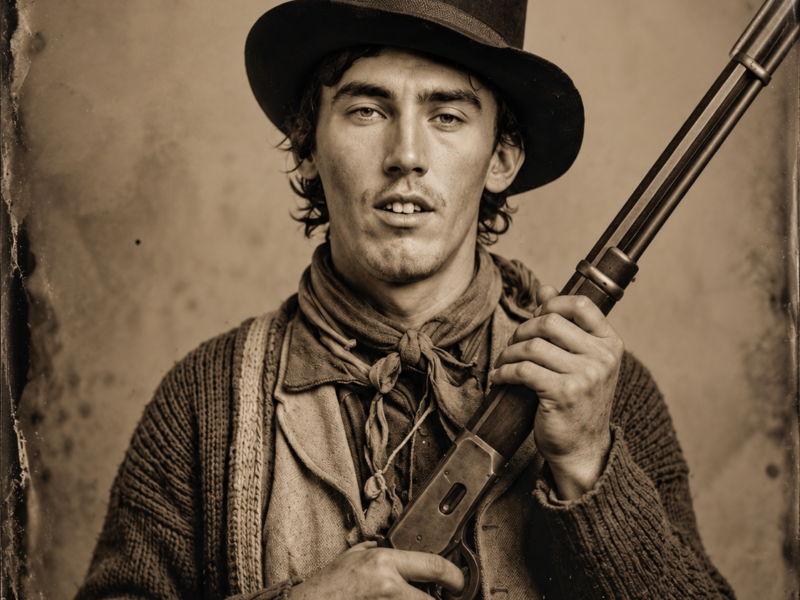
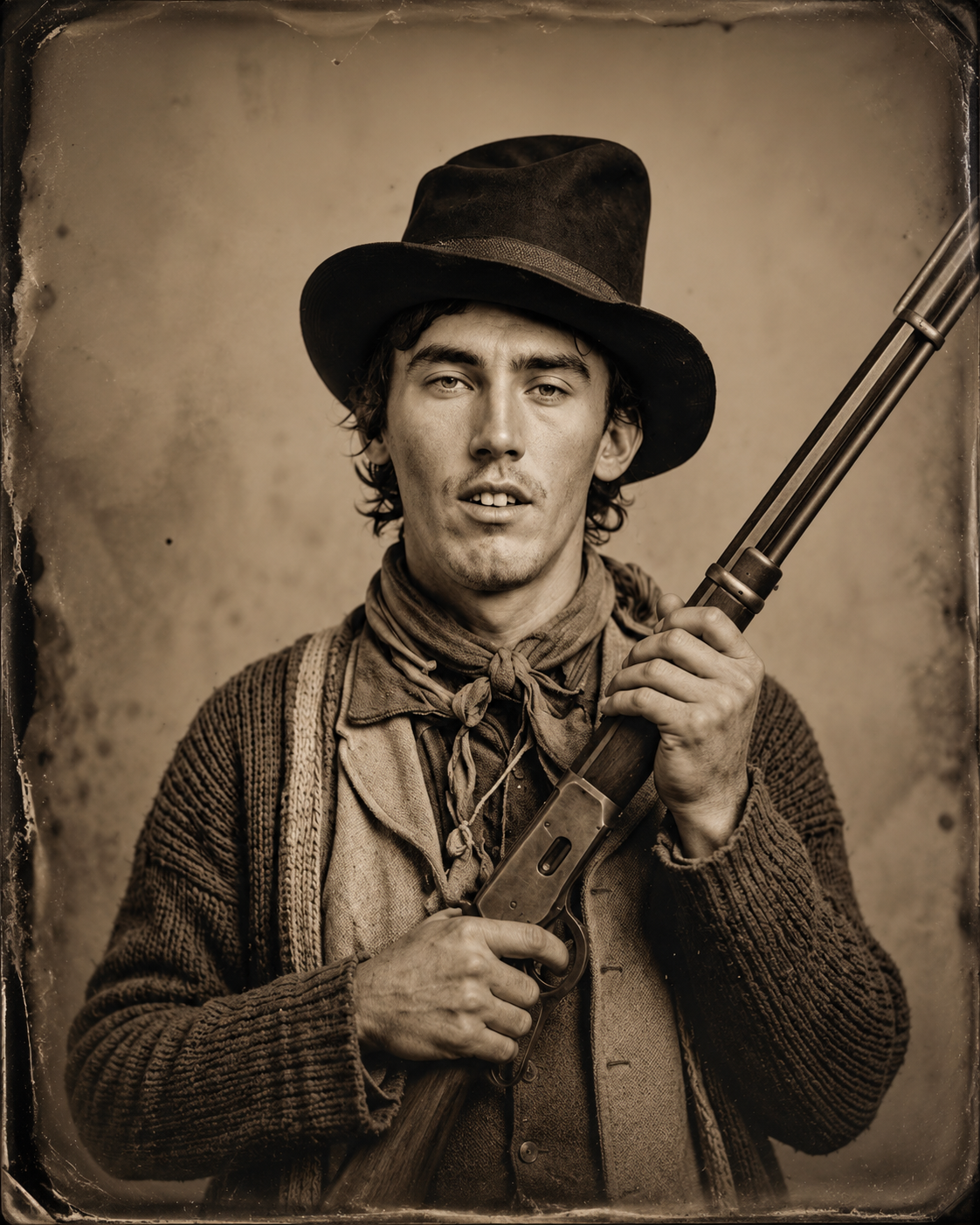
The only authentic photo of him, an old tintype from around 1880, shows a young man with a boyish face.
He looks like a kid who should be in school, not a wanted outlaw with a price on his head.
But that kind of photo came out reversed, like a mirror image.
For decades, people looked at the gun on the wrong side and swore he was left-handed.
He wasn’t.
He was always right-handed.
That same little metal plate, about the size of a playing card, was sold years later for more than $2 million.
And the man in that photo was no child.
He already had years of a bloody land war behind him, the Lincoln County War.
He had killed, escaped, and become a legend before turning 22.
His face was misleading.
What he had already done was not.
He paid $2 for an old box of photos and may have found Billy the Kid.
In 2010, a man named Randy Guijarro walked into a junk shop in Fresno, California, and bought a box of old photos for $2.
Just the kind of thing someone buys because they feel like digging around.
In one of the photos, a group of people was playing croquet in a yard.
Nothing special at first glance.
Then came the suspicion.
One of the faces looked like Billy the Kid.
The most wanted outlaw in the Old West, captured in a casual game of croquet.
If it’s real, it’s an image no one had ever seen before.
In 2015, a company valued the photo at $5 million.
Most historians are still skeptical and say no one has proven anything.
And it doesn’t stop there.
The only photo of him that no one disputes, an old tintype, had already gone up for auction in 2011 and sold for $2 million.
A man who died more than a century ago is still worth a fortune.
Billy the Kid spoke Spanish better than English, and that’s what kept him alive for years.
There’s a side of Billy the Kid that movies almost never show.
He spoke fluent Spanish.
He learned it as a boy while traveling through Arizona and New Mexico.
He got so good at it that in conversation, he was more comfortable speaking Spanish than his own English.
That changed everything.
Fort Sumner, New Mexico, in 1881 was a Hispanic community.
They didn’t see Billy as an outsider.
They saw him as one of their own.
He went to mass.
He showed up at parties.
He had girlfriends in the area.
He was treated like family inside those homes.
Now think about Pat Garrett’s problem.
The sheriff was the Anglo outsider.
Billy was protected by an entire neighborhood that kept quiet and covered his tracks.
It wasn’t fear.
It was loyalty.
That’s why Garrett had such a hard time finding a man who was, the whole time, hiding in plain sight.
Billy the Kid was a good dancer and went to Fort Sumner dances with a price on his head.
Forget for a second that image of an outlaw hiding in a cave, eating cold beans in the dark.
Billy the Kid lived very differently from that.
Even with a reward out for his capture, he showed up at community dances, the famous fandangos, like any other neighbor.
And he wasn’t the kind of guy who stood off in a corner.
The people of Fort Sumner remembered him as a good dancer, a smooth talker, the guy who brought the room to life.
Everyone there knew the face of the most wanted young man in the territory.
No one turned him in.
Pat Garrett knew that routine very well.
The sheriff knew Billy’s habits and used those dances to keep an eye on him.
In other words, the lonely fugitive from the legend was in reality the most social person in town.
But before he became a myth, how many men did Billy actually kill?
The real number has nothing to do with what Hollywood told us.
Billy the Kid killed four men, not 21.
The rest was made up by a drunken journalist.
You’ve heard the story.
Billy the Kid supposedly killed 21 men, one for every year of his life.
Sounds a little too perfect, right?
That’s because it is.
That number first appeared in an 1882 book credited to Pat Garrett.
But it was actually written by a journalist named Ash Upson, a man who liked to drink and barely knew Billy.
When historians went looking through the real records, death certificates, witness statements, and territorial documents, the count came out very differently.
Only four deaths can be tied to Billy with solid evidence.
Frank Cahill in 1877.
Joe Grant in 1880.
And guards Bob Olinger and J.W. Bell, killed during his jail escape in 1881.
The others blamed on him happened during shootouts in the Lincoln County War, where no one could say which bullet came from which gun.
The number 21 spread around the world for one simple reason.
It sold a lot more newspapers than the number four.
Billy the Kid wasn’t born an outlaw.
He was hired as a gunman in a business war.
We grew up thinking Billy the Kid was bad from the start, a natural-born criminal.
The real story looks more like a business dispute than a Hollywood Western.
In New Mexico in 1878, two groups were fighting over the region’s big money.
Cattle sales, supplies, and most of all, army contracts.
On one side were Lawrence Murphy and James Dolan, who held the monopoly and had the support of the local government.
On the other were two newcomers, John Tunstall and Alexander McSween, who were trying to break through that grip.
So where does Billy fit in?
He was hired by Tunstall’s side as a gunman.
It was a job.
A paycheck.
Not a calling to be a criminal.
But in February of that year, Tunstall is killed.
That’s when it became personal.
Billy swore revenge and stayed in the war even after his boss was dead.
Almost everything he was later tried for started there, in that fight over money.
Billy the Kid’s first killing was self-defense against a bully who had him pinned to the ground.
A lot of people think Billy the Kid killed out of cruelty.
His first case tells a different story.
It happened in August 1877 at a military post called Camp Grant in Arizona.
Billy was only 17 years old.
A skinny kid.
At that saloon, there was a man named Frank Cahill, nicknamed Windy, a big blacksmith who was always picking on the boy.
That day, the taunting turned into a real fight.
Cahill was much bigger.
He knocked Billy to the ground and got on top of him with his knee pressed against his chest.
Trapped, Billy reached for a revolver and fired.
Cahill died the next day.
The jury at the time ruled it a criminal and unjustifiable killing.
But no one was able to prove that Billy had started the fight.
Before they could arrest him, the young man got on a horse and disappeared.
The first time Billy killed someone, he was underneath a man who wanted to finish him off.
Billy the Kid escaped the gallows by killing both guards and even stopped to chat before disappearing.
April 28th, 1881.
Billy the Kid was being held in Lincoln, New Mexico, waiting to be hanged.
Pat Garrett had gone away to collect taxes and left the young man in the custody of two guards, J.W. Bell and Bob Ollinger.
Billy asked to use the outhouse out back.
On the way back, as he climbed the stairs, he appeared with a revolver in his hand.
Many people believe an accomplice had hidden the gun for him.
Bell tried to react, and Billy killed him right there.
Ollinger was across the street when he heard the shot and came running.
Billy waited for him at the upstairs window and brought him down with Ollinger’s own shotgun.
And here comes the part no one can believe.
Instead of taking off in a hurry, Billy spent nearly an hour out on the balcony, pounding at the shackles on his feet to break free and chatting with the people watching from the street.
Only then did he get on a horse and ride away.
Calm as could be.
Billy the Kid’s hands were too small, and that may be why no handcuffs could hold him.
There’s one detail about Billy the Kid that almost no one talks about, but it could explain a lot.
Several people from that time, including Pat Garrett himself, said the young man had surprisingly small hands for a grown man.
Garrett brought it up specifically when complaining about how hard it was to keep Billy securely restrained.
Think about the problem.
Handcuffs back then were made to fit the hands of an average man.
On Billy’s slender hands, they were loose.
And that’s where the debate historians still bring up today comes in.
There are reports that at least once before his famous escape, he simply slipped out of the handcuffs.
In other words, that reputation for being impossible to hold may have had nothing to do with magic, luck, or supernatural reflexes.
Maybe it was simply a matter of how the man was born.
Pure anatomy and nothing more.
Billy the Kid was the only one convicted for a shootout involving several gunmen.
Here’s an injustice that really makes you think.
In 1881, Billy the Kid went on trial for just one crime, the killing of Sheriff William Brady, who had been shot three years earlier in April 1878 during the Lincoln County War.
But there’s one detail that changes everything.
Brady didn’t fall in a duel.
He was caught in an ambush with several men firing at the same time from behind a wall.
There was no way to know which gun fired the bullet that killed him.
Even so, out of everyone who was there that day, only one man was convicted.
Billy.
The others never even stood trial.
And the court was not exactly impartial.
The judge and prosecutor had ties to the Murphy-Dolan side.
The very people Billy had fought against in that war.
The trial lasted about two days.
The jury took less than an hour to decide.
In the end, Billy became the only man convicted for everything that happened during that entire conflict.
For decades, people thought Billy the Kid was left-handed.
The photo fooled everyone.
Here’s something interesting.
In that famous photo of Billy the Kid, the only authentic one taken in Fort Sumner around 1880, he appears holding a Winchester rifle in his left hand with a Colt revolver on the left side of his body.
The obvious conclusion, right?
The guy was left-handed, and that’s how he went down in history.
It even became the title of a movie, The Left-Handed Gun, starring Paul Newman.
But there was a problem.
That kind of old photograph, a tintype, came out reversed, just like looking at yourself in a mirror.
In other words, what appeared on the left was actually on the right.
The definitive proof came from the gun itself.
The loading gate on the Winchester appears on the wrong side in the photo.
Something that could only happen if the image had been mirrored.
And everyone who knew Billy always said the same thing.
He was right-handed.
The so-called left-handed Billy never existed.
It was just a trick of 19th-century photography.
The governor promised Billy the Kid a pardon in a secret meeting and broke his word.
Not many people know this.
On March 17th, 1879, Billy the Kid secretly met with none other than New Mexico Governor Lew Wallace at a lawyer’s house in Lincoln.
The deal was put in writing.
Billy would testify about the killings from the Lincoln County War, share what he knew, and in return receive immunity and a pardon for the charges against him.
And Billy held up his end exactly as promised.
He testified.
He allowed himself to be arrested as part of the plan, just as they had agreed.
And he waited.
The pardon never came.
The governor simply did not keep his word.
And guess what Wallace was doing while leaving the young man hanging?
Finishing a book.
Not just any book.
It was Ben-Hur.
The one that became the famous movie with the chariot race.
The best-selling American novel of the 19th century.
Billy was traded for a best-seller.
Billy the Kid wrote letters begging for the promised pardon.
The governor never answered.
Between 1879 and 1881, Billy the Kid put pen to paper and wrote directly to Governor Lew Wallace more than once.
These letters are not legend.
They are still preserved today in the New Mexico State Archives.
And anyone who reads them is surprised.
There was nothing about an outlaw scribbling threats.
Billy wrote politely, with clear reasoning, reminding Wallace point by point of the agreement they had made in 1879.
He was asking only for what was fair.
I kept my end of the deal.
Now keep yours.
That was exactly what he asked in plain words.
On the other side, silence.
Wallace never answered a single one.
And while the young man waited for a word that never came, the governor’s life only got better.
His book, Ben-Hur, published in 1880, had become a huge success.
And soon afterward, Wallace was rewarded with a diplomatic post overseas.
One was rising.
The other was heading straight for the gallows.
The governor who betrayed Billy the Kid wrote the biggest literary success of the 19th century, Ben-Hur.
To understand the full irony, you need to know who Lew Wallace was.
He wasn’t just any politician.
The man had been a general in the Civil War.
He was also a lawyer and a writer.
He was sent to New Mexico in 1878 with one clear mission, to put an end to the bloodshed of the Lincoln County War.
He served as governor from 1878 to 1881.
And here’s the coincidence.
That was exactly when Billy the Kid was hunted down, captured, tried, and sentenced to death.
While all of that was happening, on the other side of the desk, Wallace was finishing a novel.
That novel was Ben-Hur, published in November 1880.
It got off to a slow start, but over the years, it became the best-selling American book of the 19th century.
And decades later, the famous movie starring Charlton Heston.
Think about that.
The same man who left Billy hanging out to dry entered history as one of the country’s great authors.
Billy the Kid could have escaped to Mexico and saved himself.
But a woman kept him in Fort Sumner.
After that incredible escape in April 1881, Billy the Kid still had about 10 weeks left to live.
And here’s the question that still haunts historians today.
Why didn’t he disappear for good?
The way was open.
All he had to do was cross the border into Mexico, beyond the reach of American law.
Garrett himself later said Billy had thought about it.
It made perfect sense.
But instead of getting away, the young man went straight back to Fort Sumner, the most dangerous place he could possibly be.
The most widely accepted reason is the most human one of all.
A woman.
Billy had grown close to Paulita Maxwell, a young woman from an important local family.
And it was there, at the Maxwell home, on the night of July 14th, that he walked into the dark room where Garrett was waiting.
The most wanted man in New Mexico was caught for one simple reason.
He couldn’t stay away.
Billy the Kid died barefoot and unarmed.
He went to get meat from the kitchen and was shot twice.
The night Billy the Kid died was nothing like a movie duel.
It was in the early hours of July 14th, 1881, at Pete Maxwell’s house in Fort Sumner.
Billy woke up hungry.
He got up, didn’t even put his shoes on properly, and went to the kitchen to get a piece of meat.
He had a knife in his hand, but it was for cutting food, not for fighting.
On the way, he saw some men standing on the porch whom he didn’t recognize.
They were Pat Garrett and his deputies.
Suspecting nothing, Billy went into Pete Maxwell’s room just to ask who the strangers were.
The room was dark.
Garrett was already inside, sitting on the edge of the bed.
Billy couldn’t see who it was and asked in Spanish, “¿Quién es?”
Who is it?
Garrett didn’t answer with words.
He answered with two gunshots.
Billy fell right there, barefoot, with a kitchen knife in his hand, without ever seeing the face of the man who killed him.
Billy the Kid’s grave was lost in floods.
His headstone was stolen, and the legend only grew.
For years after his death, Billy the Kid was buried in Fort Sumner, New Mexico.
But even in death, he couldn’t rest in peace.
Floods swept through the area and shifted the ground.
His grave was lost.
His headstone was stolen.
The exact location of his final resting place became a mystery.
It was as if the earth itself was trying to erase the man who had become a legend.
But the legend refused to die.
Books were written.
Movies were made.
Songs were sung.
Every few years, someone claimed to have found a new photo of Billy the Kid.
Every few years, someone claimed he had actually survived and lived to old age under a different name.
The myths kept multiplying, even as the facts remained stubbornly complicated.
The real Billy the Kid was a young man with small hands and a boyish face.
He spoke Spanish better than English.
He was a good dancer.
He was loyal to his friends and deadly to his enemies.
He was betrayed by a governor who became famous writing a book while Billy waited for a pardon that never came.
He was caught because he couldn’t stay away from a woman.
He died barefoot in the dark, asking who was there.
That’s the real Billy the Kid.
Not the myth.
Not the legend.
Just a man.
A complicated, contradictory, very human man.
And maybe that’s what makes him so fascinating.
Not the 21 kills that never happened.
Not the left-handed gunfighter who never existed.
But the real person underneath all those layers of myth.
The one who is still, after all these years, a mystery.
The one whose name we still don’t know for sure.
The one who was more comfortable speaking Spanish than English.
The one who danced at fandangos with a price on his head.
The one who wrote polite letters to a governor who ignored him.
The one who died in the dark, barefoot, with a kitchen knife in his hand.
That’s the real Billy the Kid.
And now you know him.
Or at least, you know as much as anyone can know about the most famous outlaw of the Old West.
The man who was never really William Bonney.
The man who never killed 21 men.
The man who was so much more interesting than the myth Hollywood sold us.
The man who, even in death, remains a mystery.
And maybe that’s the way it should be.
Because some stories are too strange for fiction.
And some men are too complicated for legends.
Billy the Kid was both.
And he still is.









