18 Shocking Facts About Frank Hamer, the Texas Ranger Who Killed Bonnie and Clyde and Was Erased From History
Hollywood gave you the love story.
The beautiful young outlaws, doomed and romantic, racing across the American heartland in a stolen Ford V8.
Bonnie and Clyde.
Rebels with a cause.
Icons of freedom and passion and youthful defiance.
That’s the version you know.
That’s the version that sold millions of tickets and made Warren Beatty and Faye Dunaway into legends.
But here’s what Hollywood never told you.
The man who actually brought them down was a real-life superhero, a lawman so tough that bullets seemed to bounce off him, a hunter so methodical that he treated every shootout like a chess match.
His name was Frank Hamer.
And almost nobody knows who he was.
Frank Hamer was a Texas Ranger.
He survived more than 50 gunfights.
He was shot 17 times over the course of his career.
He was pronounced dead four separate times.
And he still died of old age, in his own bed, at 71 years old.
Think about that for a moment.
The man who hunted Bonnie and Clyde, who ended the most famous crime spree in American history, lived long enough to watch Hollywood turn the killers into heroes and turn him into a forgotten footnote.
These are the facts they left out.
These are the stories Hollywood chose to bury.
This is the real Frank Hamer.
Frank Hamer was shot 17 times and pronounced dead four times, and still died of old age in bed.
Between 1905 and 1934, Texas Rangers records document more than 50 shootouts with his name on them.
Do the math.
Most lawmen from that era didn’t survive even five.
Historians call it statistically impossible.
But luck had nothing to do with the story.
Hamer treated every confrontation like a chess match before he ever drew his gun.
He had already chosen the ground.
He had studied the position of the sun.
He had mapped out his opponent’s escape routes.
He never went into a shootout without a prepared advantage.
If the conditions weren’t his, he simply waited.
It was that cold patience that in 1934 made Texas the obvious choice.
When no one could stop Bonnie and Clyde, they called Hamer.
And the rest, as they say, became history.
August 1917, Navasota, Texas.
A group of smugglers set up an ambush for Frank Hamer on a deserted road.
They fired several shots.
They saw his body lying there, bleeding, not moving.
They left certain the job was done.
Fatal mistake.
Hamer survived.
And here is the part that separates this man from anyone else.
He did not gather a posse.
He did not go out shooting for revenge.
He spent two months recovering in silence, gathering names and information.
Then he returned to Navasota alone.
One by one, he tracked down every man involved in the ambush and arrested them without firing a single shot more than necessary.
No spectacle.
No headlines.
Just methodical, cold, relentless work.
Texas criminals learned the lesson the worst way possible.
Leaving Hamer for dead was the fastest way to meet him again.
Frank Hamer had a training habit that puzzled his fellow officers.
He spent hours shooting with his left hand.
Even though he was right-handed.
It was not showing off.
It was survival math.
Hamer understood a truth most lawmen only learn too late.
In a real shootout, the dominant hand is the most likely target.
A man who can only shoot with one hand becomes a dead man the second that hand gets hit.
And the theory was tested in practice.
In at least two documented confrontations, Hamer was shot in the right hand.
What happened next caught his attackers by surprise.
Instead of falling back or surrendering, he switched the revolver to his left hand and kept firing while looking for a new position.
His opponents were counting on a man taken out of the fight.
What they found was a shooter changing hands like changing tools.
It was not natural talent.
It was method.
Hamer did not train for the good day.
He trained for the worst day of his life.
In February 1934, a car pulled up at Frank Hamer’s ranch in Austin.
The man who stepped out was Lee Simmons, head of the Texas prison system.
And he had not come for a social visit.
Hamer had been retired for two years.
He was 50 years old.
He had no desire to come back.
But Texas had a problem no one could solve.
Bonnie and Clyde had already killed police officers, broken into a prison, and made fools of the authorities for two years.
Simmons got straight to the point.
He did not offer Hamer a statement with the Rangers.
He offered him a special commission created for one target only.
Hamer listened in silence and accepted on one non-negotiable condition.
He would work alone.
No boss breathing down his neck.
No politician giving opinions.
His way and on his schedule.
Simmons shook his hand and agreed on the spot.
He knew what he was buying.
Not a police officer.
But a hunter.
In that handshake, without anyone knowing it, the fate of America’s most wanted couple was sealed.
From February 10th to May 23rd, 1934, 102 days.
That was how long Frank Hamer spent on the road, sleeping in his car, barely eating, and following Bonnie and Clyde’s trail through four states.
Texas, Louisiana, Arkansas, and Oklahoma.
But here’s the detail few people know.
Hamer almost never tried to catch up to them.
He studied the couple like a scientist.
He wrote down the routes they chose, the times they moved, the kinds of places where they slept, even how they decided where to get gas.
While every other police force was chasing the wrong car, Hamer was putting the puzzle together.
And he found the pattern no one else had seen.
No matter how far they ran, they always came back to northern Louisiana to visit the family of one gang member.
A criminal can change cars and states, but he does not change habits.
That was behavioral analysis decades before the FBI turned the idea into a science.
He was not chasing Bonnie and Clyde.
He was waiting for them.
The ambush that stopped Bonnie and Clyde was not luck.
It was engineering.
Hamer and five officers arrived in Gibsland, Louisiana, six days before the confrontation.
While the whole country was looking for the couple, they were studying a road.
They walked that stretch yard by yard until they chose the exact spot, a curve on Highway 154, where the driver coming in could see almost nothing ahead.
It was the perfect place for someone waiting and a deadly trap for anyone passing through.
In the early morning of May 23rd, 1934, the six men took their positions in the brush before sunrise and lay in the vegetation for hours without smoking, without talking, enduring the heat and mosquitoes in absolute silence.
Around 9:15 a.m., the growl of a Ford V8 came up the road.
It was the car.
When it passed in front of the firing line, all six opened fire at the same time.
In seconds, more than 190 bullets tore through the vehicle.
The 102-day manhunt ended in less than half a minute.
Here is the detail from the ambush that still sparks debate more than 90 years later.
When the 130 bullets hit the Ford V8, Bonnie Parker was eating a sandwich.
The later investigation confirmed it.
She did not have a gun in her hands at the exact moment of death.
There was no warning, no order to surrender, no chance.
And Frank Hamer never apologized for it.
When questioned over the years, he held the same position until the end.
Bonnie was not a hostage or a bystander.
She was an active participant in a gang that had killed nine police officers.
And any attempt at a clean arrest had already cost men their lives.
To Hamer, the element of surprise was not cowardice.
It was the only way to end it without burying anyone else on his side.
The public was divided then and remains divided today.
A pragmatic hero to some, a cold executioner to others.
The controversy followed Hamer to the grave.
And he never lost a night of sleep over it.
Want to know how much Texas paid the man who stopped Bonnie and Clyde?
$180.
$180 for a month of work that included a 102-day manhunt in the most famous ambush in American history.
Do the math.
It was less than Hamer made as a regular ranger before he retired.
For years, he knocked on the state’s door asking for fair compensation for the special job.
And for years, Texas refused systematically, like it was just pushing paperwork aside.
Meanwhile, on the other side of the country, Hollywood was making fortunes telling the story of Bonnie and Clyde on the big screen.
And worse, on screen, the murderous couple became a romantic legend.
And Hamer appeared as a villain or a background figure when he appeared at all.
The man who did the real work, risking his skin on the side of a Louisiana road, received less than an office salary.
America turned the outlaws into stars and sent the bill for being forgotten to the man who stopped them.
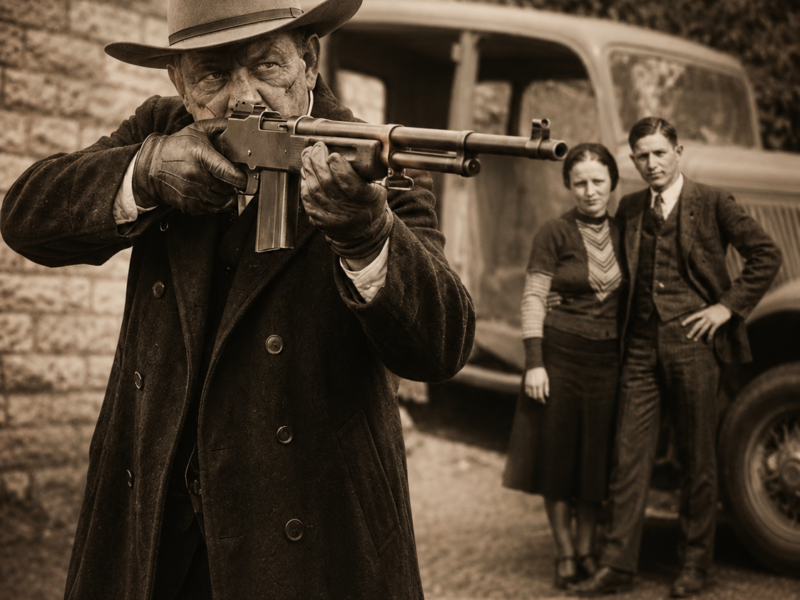
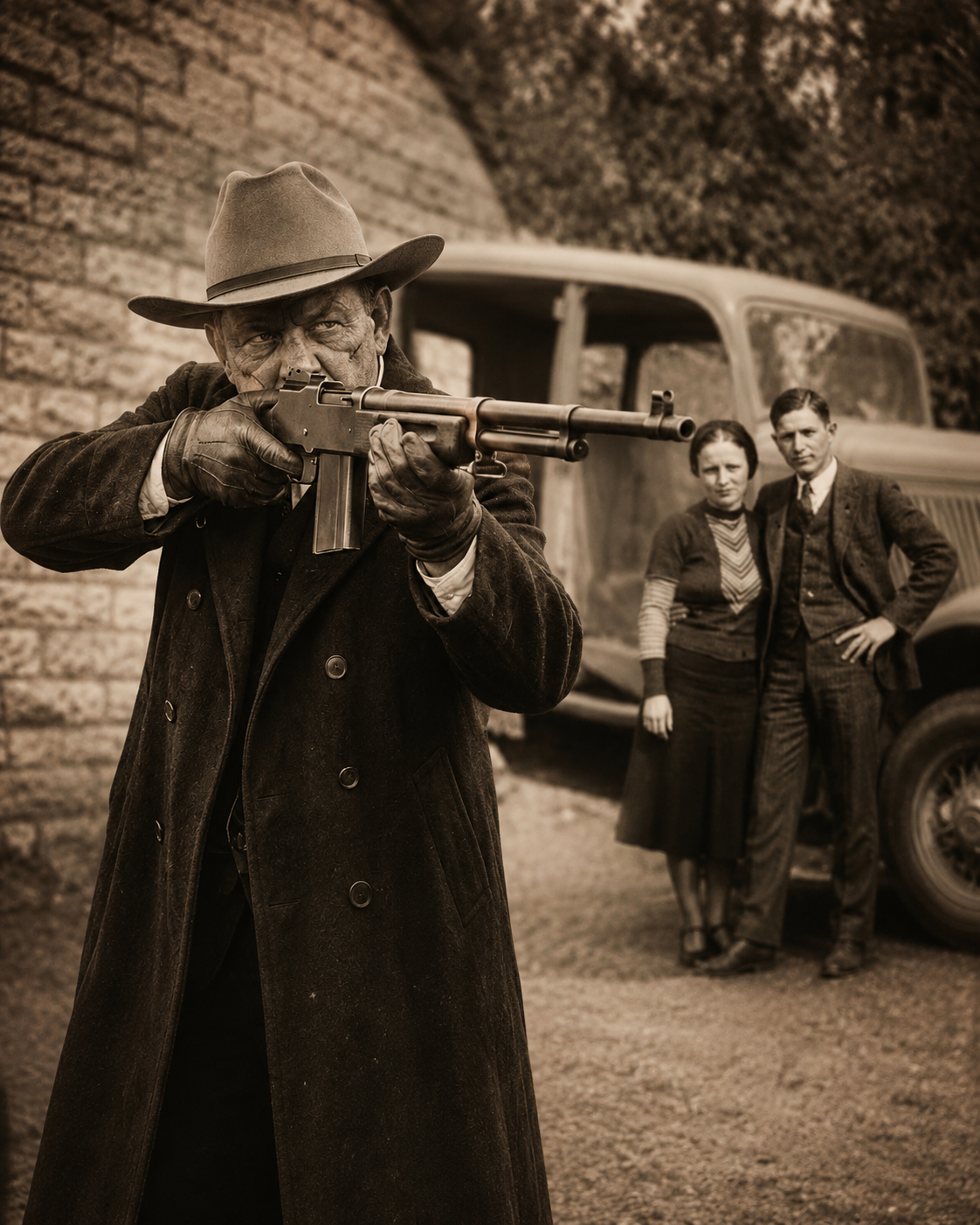
In 1967, Hollywood released Bonnie and Clyde starring Warren Beatty and Faye Dunaway, and committed a dishonesty the Hamer family refused to swallow.
In the film, the character based on Frank Hamer is captured by the couple, photographed hugging them like a trophy, and humiliated in front of the cameras.
That scene never happened.
It was pure fiction, invented from scratch.
In real life, Hamer never crossed paths with the two before the ambush.
But the damage was done.
Millions of Americans walked out of theaters believing the hunter was a vengeful clown.
Hamer had already died in 1955 and could not defend himself.
The one who fought back was his widow, Gladys, who sued the producers for defamation.
The studio, knowing it had no way to defend the lie in court, chose not to risk it.
The case ended in an out-of-court settlement with a payment to the family.
Hollywood invented a humiliation for the real hero for one simple reason.
The truth sold fewer tickets.
Here is what makes Frank Hamer different from every legendary gunfighter of the Old West.
He never told his own story.
While Wyatt Earp spent the last years of his life sitting down with journalists and screenwriters polishing his own legend brick by brick, Hamer did the opposite.
He refused every interview until the day he died.
He did not write memoirs.
He did not authorize a biography.
He did not pose for hero photos.
The little we know about his methods came from colleagues and official records, never from his own mouth.
His wife, Gladys, explained why.
To Hamer, talking about his own shootouts was vulgar, the kind of talk small men liked.
A man who really did it does not need to talk about it.
But that code of silence came at a bitter price.
When Hollywood invented the false version, there was no word from him to refute it.
The man who won more than 50 shootouts lost the one battle he refused to fight.
The battle for his own story.
This is the chapter of Frank Hamer’s life that almost no one knows.
And it may be the bravest one of all.
In 1908, Hamer was the marshal in Navasota, Texas, a town where lynchings happened in broad daylight and no one answered for them.
That year, a crowd of dozens of armed men gathered to lynch a black man.
Hamer did not call for backup.
There was no backup.
He walked alone into the middle of the mob and put his own body between the crowd and the victim.
Dozens on one side, one man on the other, and the crowd backed down.
Think about what that meant in 1908 in deep Texas.
Standing up to outlaws earned you a medal.
But standing up to your own white community for a black man made you enemies for the rest of your life.
And Hamer collected plenty of them there.
He did it anyway more than once in his career.
For a Texas lawman of that era, it was an almost unheard of position.
Hamer did not protect the law only when it was comfortable.
He protected it when it came at a cost.
Not everything in Frank Hamer’s story fits the portrait of a hero.
And this is the part he preferred to keep in the shadows.
In the 1920s, between stints with the Rangers, Hamer wore another hat.
Private investigator working for Texas oil companies.
The state was caught up in the black gold rush.
And wherever serious money flowed, sabotage, equipment theft, and violent disputes followed.
Hamer was hired to solve those problems, and he solved them.
The pay was much better than a Ranger’s salary.
But there was one uncomfortable detail.
In those contracts, he was often on the side of corporations against workers in conflict.
The man who had faced down crowds to protect an innocent person was now being paid to protect company interests.
It is no coincidence that this is the least documented phase of his life, and the scarce records suggest it was not an accident.
The legend paints Hamer in black and white.
The 1920s show a man in shades of gray.
Frank Hamer’s Ranger record had two stains the legend usually hides.
In 1917 and again in 1922, he was suspended from the force for the same reason, excessive force.
In both cases, the pattern repeated itself.
Suspects arrested by Hamer arrived at jail with injuries that did not match a peaceful arrest, broken bones, and marks that no report could properly explain.
Internal investigations were opened, dragged on, and ended the way they often did back then with no definitive conclusion, no witness willing to talk, and no punishment.
Hamer was reinstated both times and went on with his career as if nothing had happened.
But the record remained, and it tells an uncomfortable truth.
For Hamer, the line between necessary force and excessive force was not fixed.
He was the one who decided where it fell case by case.
The same cold method that stopped Bonnie and Clyde had a side that hero books prefer to skip.
On the morning of the Gibsland ambush, Frank Hamer was not carrying a police weapon.
He was holding a Browning Automatic Rifle, the famous BAR, a piece of portable artillery created for the trenches of World War I.
Automatic fire.
.30-06 caliber ammunition capable of cutting through a car’s body like paper.
It was not the choice of a man who wanted to make an arrest.
It was the choice of a man who understood the enemy.
And here is Hamer’s cold logic.
Clyde Barrow robbed military arsenals and carried BAR rifles inside the Ford V8.
The same wartime firepower.
Police officers who faced the gang with service revolvers died trying.
Hamer going into that fight with an inferior weapon was not courage.
It was announced suicide.
His rule held throughout his entire career.
Never give the enemy the advantage in firepower.
Match it or surpass it.
When the 130 bullets hit the car on that Louisiana road, most of them came from weapons of war.
Hamer did not go to arrest two thieves.
He went to fight a battle and he won it before the first shot.
How many men did Frank Hamer kill?
The question has echoed across decades and the answer depends on who is telling it.
Biographer H. Gordon Frost, who dug through records and testimonies, arrived at an astonishing number.
53 dead and another 23 wounded over the course of Hamer’s career.
Other researchers pumped the brakes, arguing that some of those deaths do not have solid documentation and that the real count may be lower.
And the one man who could have ended the debate did what he always did.
Stayed silent.
Hamer never confirmed or denied a single number, staying loyal to his code of never talking about his own shootouts.
But here is what no serious historian disputes.
Official records show that Hamer was involved in deadly confrontations with a frequency unmatched among American lawmen of the 20th century.
Wyatt Earp.
Bat Masterson.
Any famous name.
None comes close to Hamer’s documented list.
The exact number died with him.
The scale stayed in the archives.
Inside the Texas Rangers, Frank Hamer carried a curious reputation.
He was the man everyone wanted in the field and no one could command.
His superiors lived with a constant dilemma.
His results were unbeatable.
But his independence kept every boss up at night.
Hamer acted first and reported later when he reported at all.
If he judged an action necessary, he carried it out without asking any authority for permission.
He decided on his own when to use force and how much force to use.
And he had another habit that irritated the chain of command.
He refused missions right to his bosses’ faces, whether because he considered them beneath his level or because they smelled of political or ethical dirt.
In today’s language, Hamer was what people call a cowboy.
The kind of man who solves what no one else can solve, but in his own way and by his own rules.
In Ranger culture, the label was both praise and accusation at the same time.
His bosses never knew whether Hamer worked for Texas or whether Texas depended on him.
Here is an irony few people stopped to think about.
Clyde Barrow died at 25 on a Louisiana road on May 23rd, 1934.
Frank Hamer, the man who stopped him, lived another 21 years.
And they may have been the strangest years of his life.
The deadliest hunter in Texas hung up his guns and disappeared into anonymity by choice.
He refused every interview that came knocking.
And he watched in silence as America pulled off a reversal that must have hurt.
The two killers he hunted became romantic icons on the radio, in magazines, and in the movies.
While he, the lawman, was reduced to a supporting character or painted as the villain of the story.
He never answered back.
Never defended himself publicly.
On July 10th, 1955, Hamer died of a heart attack in Austin, Texas at age 71 in his own bed.
A fate dozens of men had tried to deny him with bullets.
He outlived every rival.
He just did not outlive the version they told about him.
What happened in the minutes after the Gibsland ambush is a chapter official history prefers not to detail.
No sooner had the echo of the gunfire faded on the road than officers and curious civilians swarmed the bullet-riddled Ford V8.
Before any scene control.
Before any inventory.
Before any official photographs.
And the looting began.
Weapons, clothes, and personal items belonging to America’s most wanted couple disappeared from pocket to pocket like hunting souvenirs.
The most glaring case, one of Clyde Barrow’s pistols, visible in photos taken of the car shortly after the ambush, simply does not appear in the evidence.
The man who brought down Bonnie and Clyde should have been remembered as one of the greatest lawmen in American history.
Instead, he was forgotten.
His story was buried under layers of Hollywood fiction.
His reputation was dragged through the mud by filmmakers who never bothered to check the facts.
His family had to sue to defend his name.
And even then, the truth never caught up with the myth.
Frank Hamer was a man who was shot 17 times and kept fighting.
A man who faced down lynch mobs alone.
A man who tracked two of the most dangerous criminals in America for 102 days and ended their reign of terror in less than 30 seconds.
A man who asked for nothing more than fair pay and a quiet retirement.
And a man who was denied both.
He died in his own bed, an old man, while the world celebrated the killers he had stopped.
That is the real story.
That is the story Hollywood didn’t want to tell.
Because the truth is messy.
The truth is complicated.
The truth doesn’t fit neatly into a two-hour movie with a romantic soundtrack and beautiful young stars.
But the truth matters.
Frank Hamer mattered.
And now, finally, you know his name.
He was not a villain.
He was not a background character.
He was not a vengeful clown.
He was a Texas Ranger.
The best there ever was.
And he deserves to be remembered.
Not as the man who killed Bonnie and Clyde.
But as the man who survived 17 bullets, 50 shootouts, and four death sentences, and still died peacefully in his sleep.
That is the legacy Hollywood tried to erase.
That is the legacy we just restored.
Frank Hamer.
Hunter.
Lawman.
Legend.
And now, finally, remembered.









