10 Royal Families That Married Themselves Into Ruin, and the Shocking Fate of the Worst One
Walk through the old royal portrait galleries of Europe, and you start to notice something.
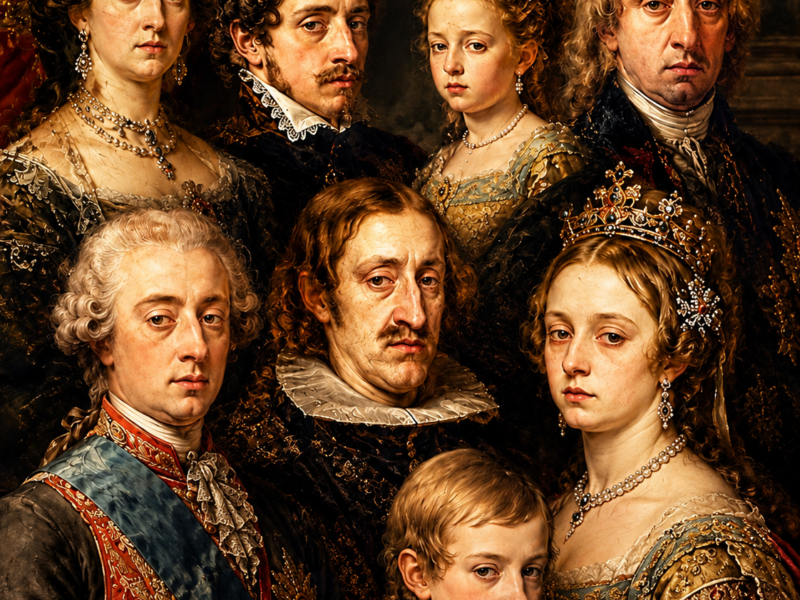
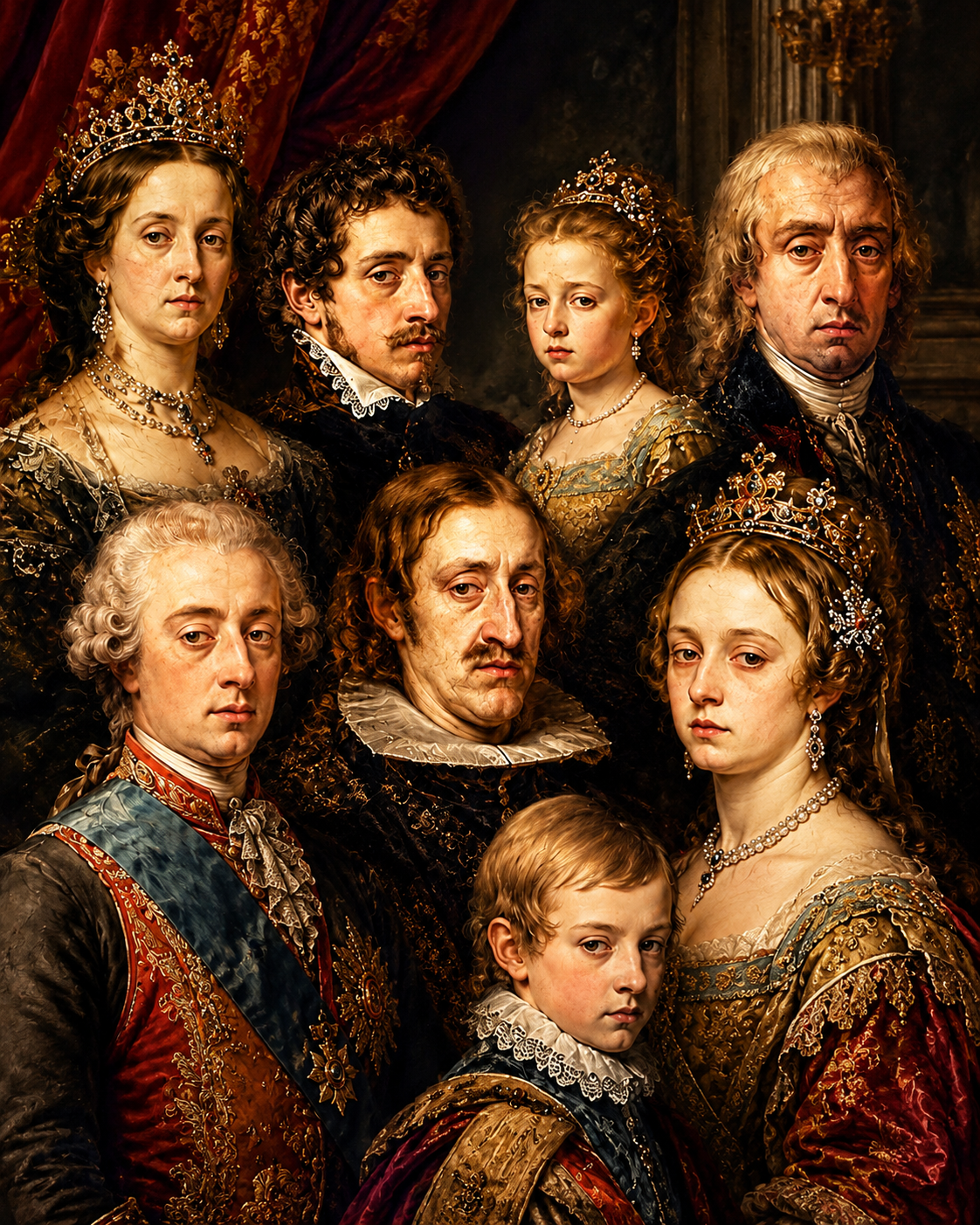
The same heavy, jutting jaw. The same drooping lip. The same slightly wrong face, repeating from painting to painting, generation after generation, like a photocopy of a photocopy of a photocopy.
That jaw was not noble breeding.
It was a warning.
A genetic alarm bell, ringing across two hundred years of oil paint, and the families staring back at you were far too proud to hear it.
This is the story of the royal houses that married themselves into ruin, and we are counting down the ten who did it worst.
So how does an entire continent of royalty end up with jaws that do not close, minds that break, and children who do not survive?
It comes down to one cold piece of logic.
To a medieval or Renaissance dynasty, a foreign spouse was a threat. Someone who might drag the crown into a rival’s orbit.
But a cousin, an aunt, a niece? That kept the territory, the titles, and the treasure locked safely in the house.
Multiply that across ten, twelve, fifteen generations, and the family tree stops branching outward. It starts folding back on itself until it barely looks like a tree at all.
We are counting down the ten royal houses that folded it the tightest.
And I promise you, the deeper we go, the stranger it gets.
Coming in at number ten, the House of Hanover.
This was the German dynasty that sat on the British throne for nearly two hundred years.
The Hanoverians drew from a shallow pool of Protestant German princely families, marrying cousins and second cousins over and over to keep the succession both pure and Protestant.
The most famous casualty of that closed gene pool was King George III, the king who lost the American colonies.
George suffered severe, recurring episodes of what his own doctors could only describe as madness.
He raved for hours. He talked until he was hoarse. His physicians restrained him in a straitjacket.
For decades, historians attributed his illness to porphyria, a hereditary metabolic disorder passed down through intermarried royal lines.
Modern scholars debate that theory, and some argue it was a psychiatric illness instead.
But whatever the cause, it ran in the blood of a family that kept marrying its own.
And compared to who is coming next, the Hanoverians were only playing at this game.
At number nine, the House of Hohenzollern, the iron dynasty that built Prussia and then forged the German Empire.
The Hohenzollerns sat at the center of Europe’s royal web, tied by blood and marriage to Britain, Russia, and half the German states, constantly trading cousins back and forth to cement alliances.
Their most infamous son was Kaiser Wilhelm II, the man whose reckless ambition helped drag the world into the First World War.
Now, an honest note here, because it matters.
Wilhelm’s famously withered left arm came from a traumatic breech birth, not from inbreeding, so do not let anyone tell you otherwise.
But the larger point stands.
He was born into a family so intermarried that he was, at the same time, the grandson of Britain’s Queen Victoria and a cousin to the Russian Tsar he would later go to war against.
Remember that name, Victoria.
She is about to become the single most important thread in this entire story.
And it starts unraveling right now.
Number eight takes us east, to the House of Romanov.
They ruled Russia for three centuries, and their reign ended in a hail of gunfire in a basement in Yekaterinburg.
For generations, the Romanovs imported their brides almost exclusively from the intermarried German royal houses.
Eventually the imperial family was less a Russian dynasty than a branch of the same tangled European bloodline as everyone else on this list.
And that is exactly how catastrophe walked through the front door.
When Tsar Nicholas II married Alix of Hesse, a granddaughter of Queen Victoria, he unknowingly married a carrier of one of the deadliest genetic curses in royal history.
Their only son, the heir to all of Russia, a boy named Alexei, was born with hemophilia.
It is a disorder in which the blood cannot properly clot, and a single bruise can become a death sentence.
His mother’s desperate search for a cure pulled a mysterious faith healer named Rasputin into the heart of the empire.
That scandal helped crack the dynasty wide open.
But to understand where Alexei’s disease actually came from, you have to follow the blood back to its source.
Which is exactly where we are going.
At number seven, one of the oldest and strangest royal families in Europe, the House of Wittelsbach, who ruled Bavaria for more than seven hundred years.
The Wittelsbachs married within an incredibly tight circle of German and Habsburg relatives for centuries.
The family became notorious for a recurring streak of mental instability.
Their most legendary member was King Ludwig II, the Swan King, the dreamer who bankrupted himself building storybook castles into the sides of mountains.
Ludwig grew increasingly withdrawn and eccentric, until his own government declared him insane and deposed him.
Days later, he was found dead in the shallow water of Lake Starnberg, under circumstances that have never been fully explained.
And here is the detail most people miss.
His younger brother Otto, who inherited the crown, had already been declared insane too.
Two brothers, two broken minds, one throne, all from a family that had spent centuries marrying its cousins.
Historians rightly caution that we cannot blame all of that on inbreeding alone.
But the pattern is impossible to ignore.
And the next family turned that pattern into a national tragedy.
Number six brings us to the Iberian Peninsula and the House of Braganza.
This was the dynasty that ruled Portugal and, for a time, an empire stretching all the way to Brazil.
The Braganzas fell into a centuries-long habit of intermarrying with their neighbors, the Spanish royal families.
Cousins wed cousins across the border again and again, until the two peninsular dynasties were hopelessly entangled.
That tangle produced Queen Maria I, remembered by history with a brutal nickname: Maria the Mad.
Maria married her own uncle.
After a series of personal tragedies, including the deaths of her husband and her eldest son, she descended into religious melancholia and delusions so severe that she could no longer rule.
Witnesses described her screaming through the corridors of the palace.
Eventually the crown had to be handed to her son as regent, while she lived out her days lost inside her own mind.
But if you think uncle and niece is as close as European royalty was willing to go, you have no idea.
We are only getting started.
Number five is the House of Bourbon of Spain, and the Bourbons took that entanglement and industrialized it.
When they inherited the Spanish crown, they inherited its habits too.
They spent the next two centuries marrying into the very same overlapping web of French, Italian, and Austrian relatives, cousin to cousin, generation after generation.
And then came the moment when the hemophilia curse from the Romanov story came home to roost.
When King Alfonso XIII married Victoria Eugenie, yet another granddaughter of Queen Victoria, he brought hemophilia straight into the Spanish royal nursery.
Two of his sons were born with the disease.
His heir bled to death after a minor car accident.
This was not ancient history, and it was not some distant German court.
This was the twentieth century, with cars on the road and telephones on the wall, and a family still paying the price for who its grandmothers had been.
And speaking of grandmothers, it is finally time to meet her.
At number four sits the woman whose name has haunted this entire countdown.
Queen Victoria, and the sprawling house of Saxe-Coburg she helped create.
Here is what makes her extraordinary.
Victoria married her own first cousin, Prince Albert. The two of them shared the same grandfather.
But that is not even half of it.
Between them, they had nine children, and they married those children strategically into nearly every royal house on the continent.
Germany. Russia. Spain. Greece. Romania.
Within two generations, Victoria’s descendants sat on thrones from London to St. Petersburg, which is exactly why she is remembered as the grandmother of Europe.
But she passed down more than crowns.
Victoria was a carrier of the hemophilia gene, and by seeding her family into every court on the map, she seeded the disease along with it.
Into Russia. Into Spain. Into Germany.
The most powerful marriage strategy in modern history was also one of the most catastrophic genetic experiments ever run on a single family.
And yet, believe it or not, she is not even close to number one.
Because to find the true champions of marrying your own blood, we have to leave Europe’s borders entirely.
Coming in at number three, and stretching the definition of European back to its Greek roots, the Ptolemaic dynasty.
When Alexander the Great died, one of his Macedonian generals, Ptolemy, seized Egypt and founded a Greek dynasty that would rule it for nearly three hundred years.
To cement their claim in the eyes of their Egyptian subjects, the Ptolemies adopted the ancient pharaonic tradition in its most extreme possible form.
Brother married sister.
Not cousins. Not uncles and nieces. Full siblings, generation after generation after generation.
The most famous Ptolemy of them all was Cleopatra VII, and even she was the product of generations of sibling unions.
She herself married two of her own younger brothers in turn.
By the time the dynasty collapsed, the family tree had folded so completely that it was less a tree than a straight line.
The Ptolemies were the blueprint, the proof of just how far a dynasty would go to keep the blood pure.
And two families spent the centuries that followed trying to catch up.
They shared the same name, and they are our top two.
At number two, the House of Habsburg of Austria, the family that turned marriage into a weapon of conquest.
The Habsburgs had a famous motto: Let others wage war, but you, happy Austria, marry.
And they meant it.
Instead of conquering territory with armies, they acquired it with wedding rings, absorbing kingdoms and crowns through carefully arranged unions.
Then, crucially, they married their own relatives to make sure none of it ever slipped away.
Over the centuries, the Austrian branch married cousin to cousin, uncle to niece, again and again.
A distinctive physical feature became almost a family signature: the Habsburg jaw.
A heavy, protruding lower jaw and lip that grew more pronounced with each intermarried generation.
Modern geneticists have studied portraits of fifteen Habsburgs and found that the more inbred the individual, the more severe the jaw.
It was a deformity you could literally watch worsening across the paintings on the wall.
But the Austrian Habsburgs, for all their intermarriage, kept just enough fresh blood to survive.
Their Spanish cousins did not.
And that brings us, at last, to number one.
The undisputed tragic champions of royal inbreeding: the Spanish Habsburgs.
When the Habsburg empire split into an Austrian and a Spanish branch, the Spanish kings became obsessed with keeping their crown within the family.
They married each other relentlessly. Uncle to niece. First cousin to first cousin.
Generation after generation, they tightened the knot, until the royal family was drinking from a genetic pool so shallow it had almost run dry.
The final product of all of it was a king named Charles II.
Geneticists have calculated Charles’s inbreeding coefficient, and the number is staggering.
His genome was as inbred as if his own parents had been full brother and sister, even though on paper they were merely uncle and niece.
He was physically disabled, chronically ill, unable to chew his own food, and almost certainly infertile.
He did not learn to speak until he was four, or to walk until he was eight.
He was nicknamed the Bewitched, because his own court could think of no earthly explanation for how broken he was.
And when Charles died in the year 1700 with no child to inherit, the mighty Spanish Habsburg dynasty simply ceased to exist.
It was snuffed out not by war, and not by revolution, but by two hundred years of a family refusing to marry anyone but itself.
The empire they had spent centuries guarding through those marriages was carved apart in the war that followed.
They had held on so tightly that they strangled their own bloodline.
And that is the final, brutal lesson of every family on this list.
From George III pacing his palace at night, all the way to a king who could not chew his own food, every one of these families believed they were protecting something precious.
The crown. The territory. The pure and unbroken line.
And every single time, the thing they did to protect the bloodline was the exact thing that poisoned it.
Power, it turns out, is a terrible reason to choose who you love.









